stopthemaangamizi.com

Stop the harm as the first step to repairing the damage!

Menu

Skip to content
  • Home
  • CONTACTS
  • GLOBAL MAJORITY VS
  • I AM WITNESS
  • MAANGAMIZI DESECRATORS & DENIERS
  • MAANGAMIZI EDUCATIONAL TRUST (M.E.T)
  • SMWeCGEC PETITION
  • TAKE ACTION
  • PAN-AFRIKAN REPARATIONS REBELLION GROUNDINGS

Tag Archives: International Social Movment for Afrikan Reparations

‘STOP THE MAANGAMIZI!’ POSTCARD ADVOCACY CASE STUDY

Posted on March 8, 2018 by STOP THE MAANGAMIZI


Greetings Supporters of the ‘Stop the Maangamizi: We Charge Genocide/Ecocide!’ Campaign (SMWeCGEC)

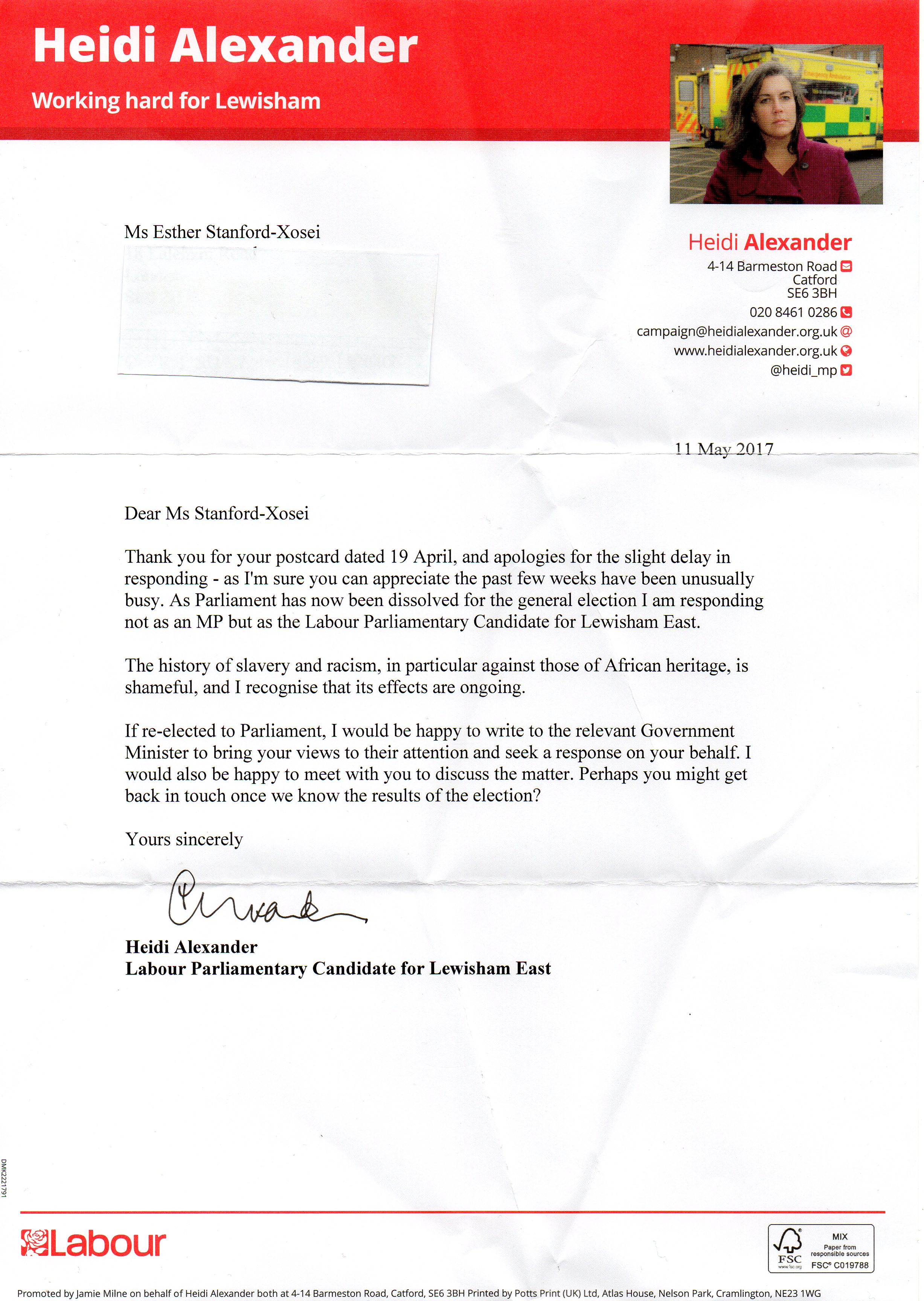
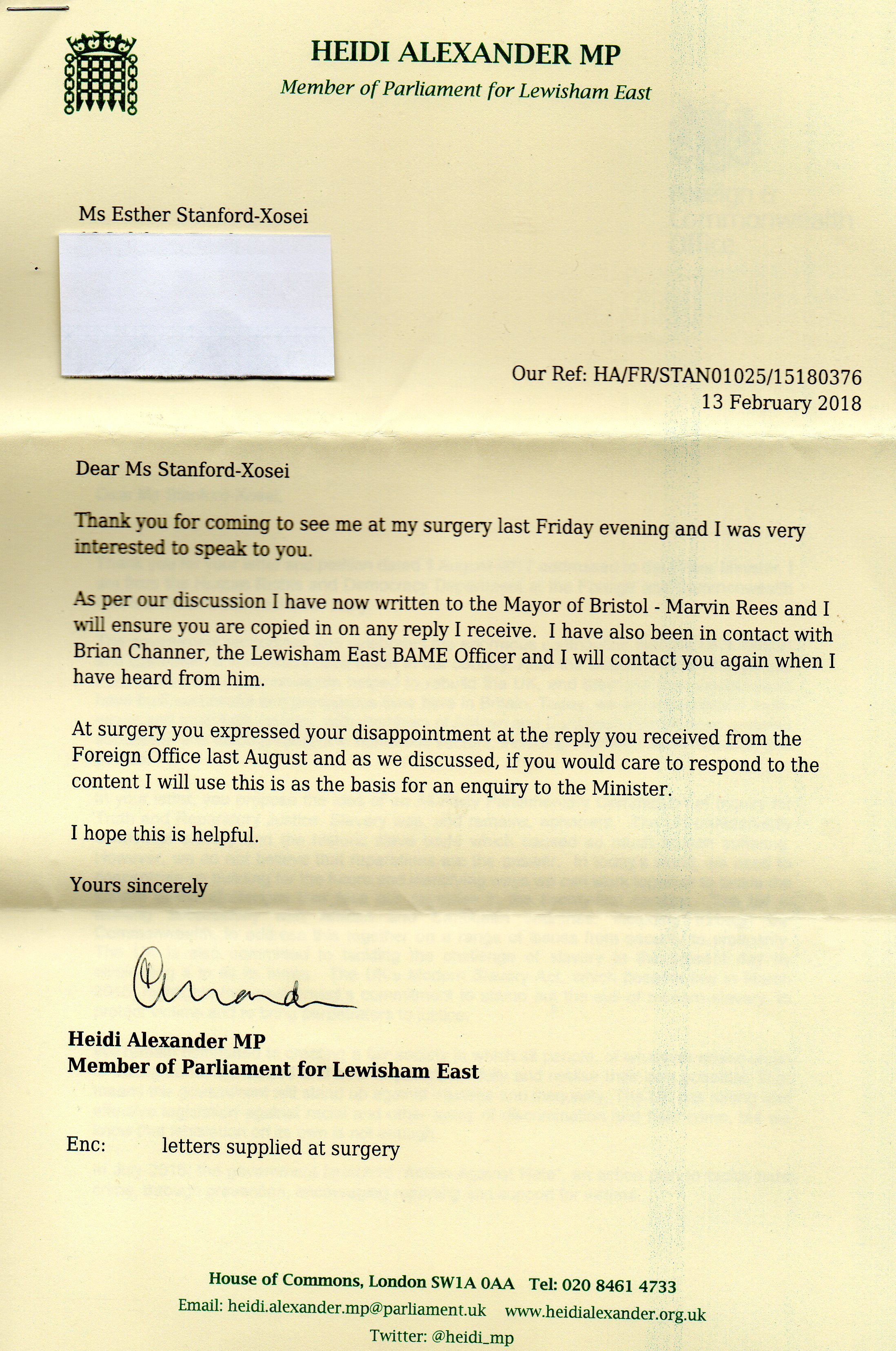
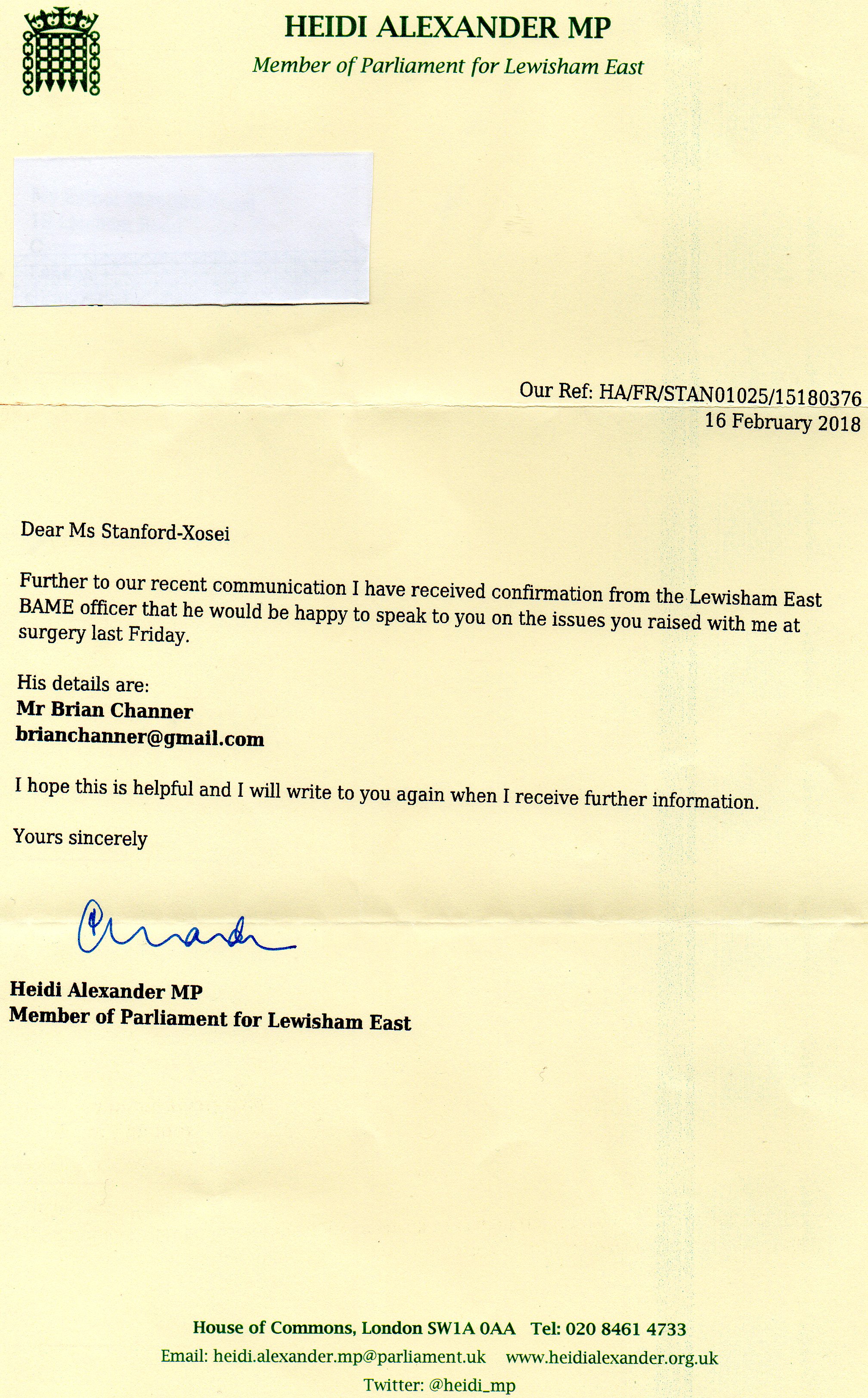
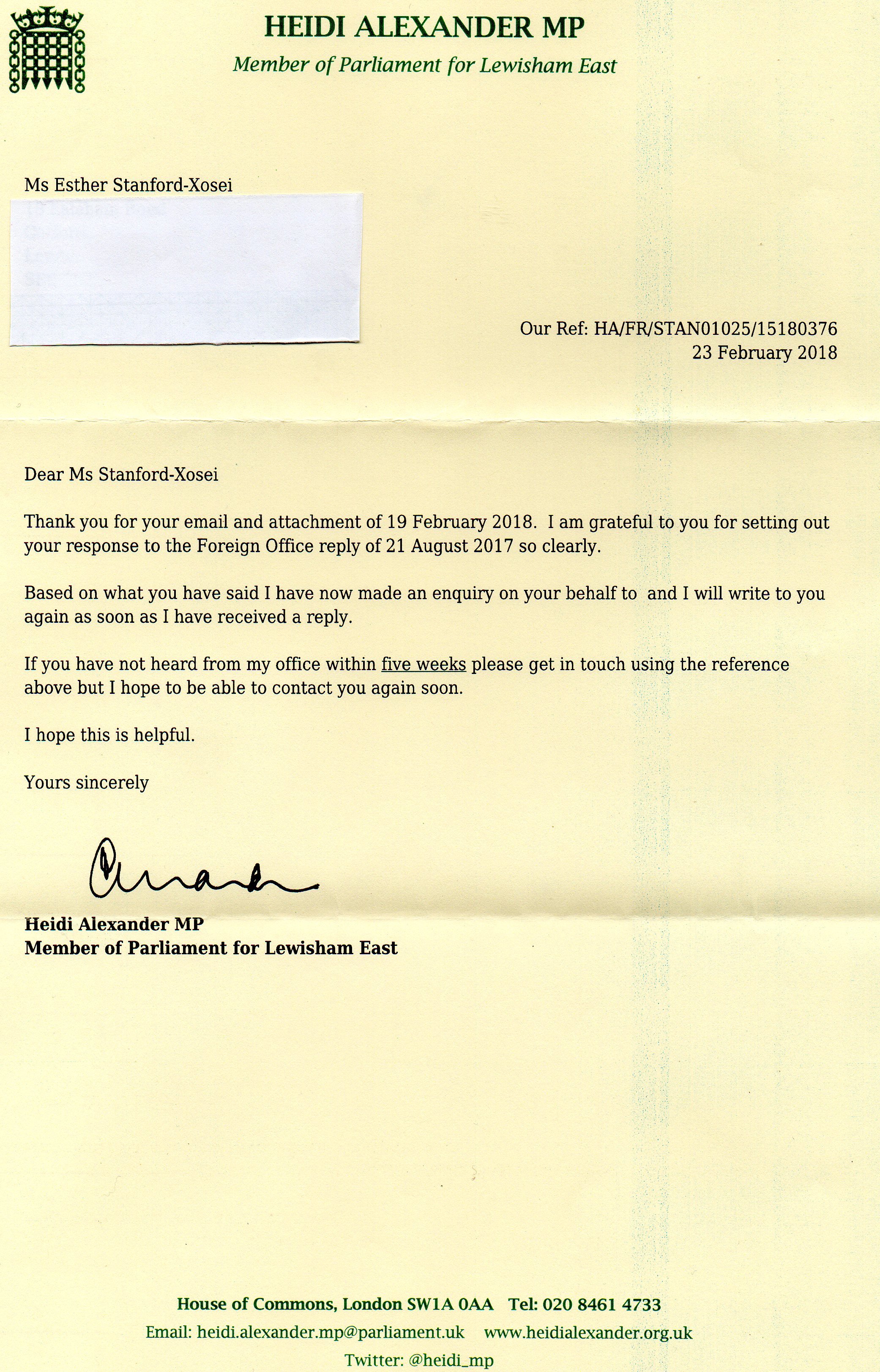
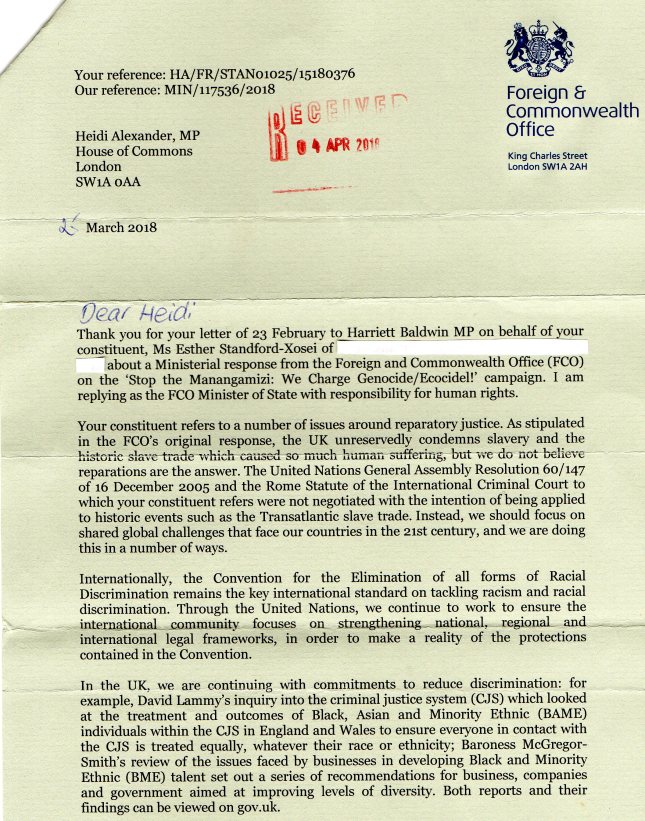
This is a report-back of a meeting and series of correspondence between ‘Stop the Maangamizi: We Charge Genocide/Ecocide!’ Campaign (SMWeCGEC) Advocate Esther Stanford-Xosei and Heidi Alexander, Member of Parliament for Lewisham East.


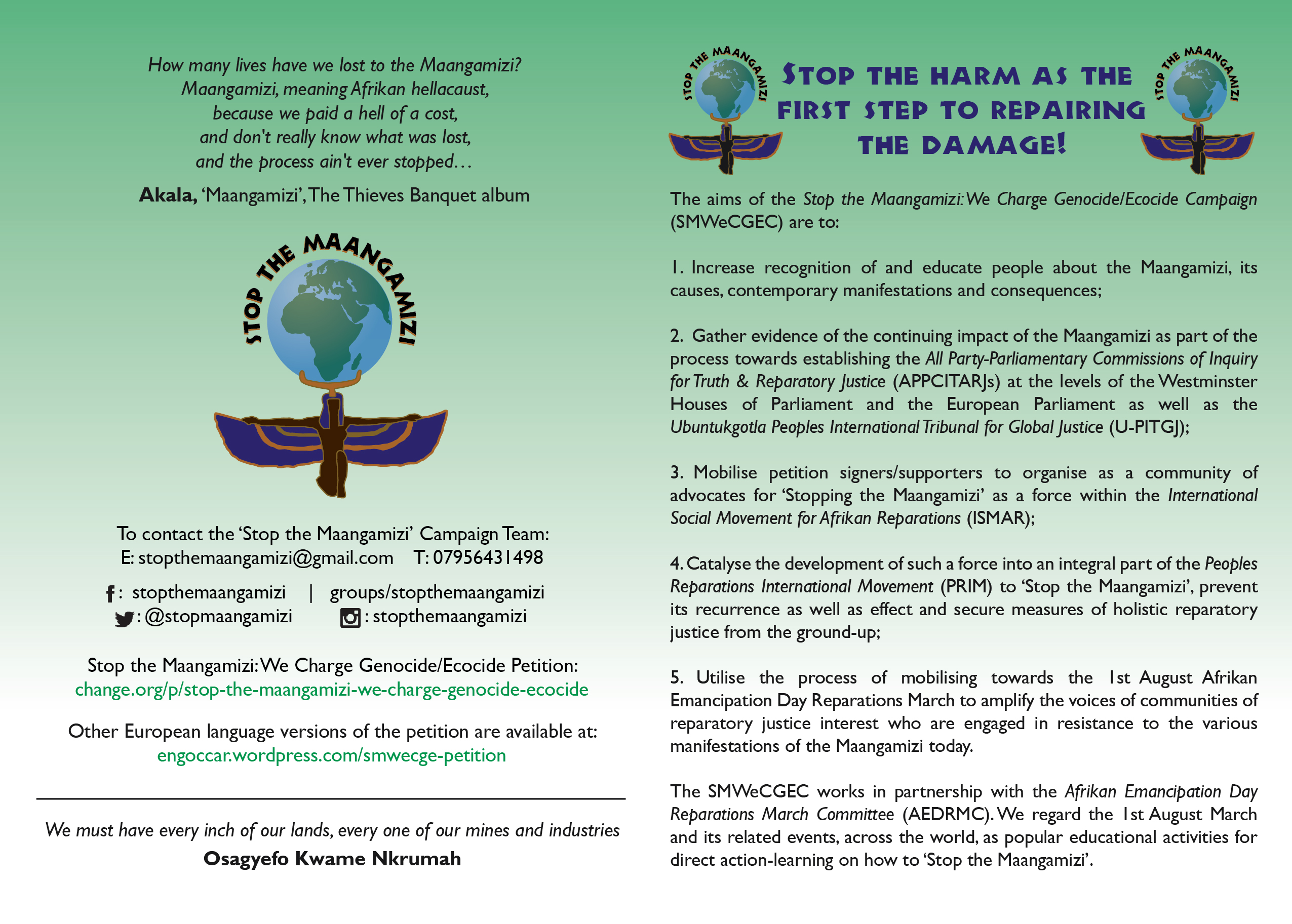
SM POSTCARD - Postcode fix-page-001


Follow-up letter to Heidi Alexander dated 20th January 2018 requesting her to take action on the ‘Stop the Maangamizi!’ Postcard

ESTHER STANFORD-XOSEI LETTER TO HEIDI ALEXANDER ON TAKING ACTION ON THE SMWeCGEC POSTCARD


On Friday 9th February 2018, Esther Stanford-Xosei went to see her MP Heidi Alexander regarding the demands in the ‘Stop the Maangamizi!’ Postcard campaign

Upon visiting Heidi at my local surgery, she was asked to explain the purpose of my visit and what I wanted which gave me some opportunity to explain the holistic meaning of reparations and why it is relevant to the local community development and campaigning efforts of Afrikan heritage community groups organising in the borough of Lewisham and working on Maangamizi legacy issues.  She explained that the simple notion of ‘pay us’ is not what holistic reparations are about (and tend to close off discussions) and rather the starting point in addressing reparations is to take action on instituting the APPCITARJ.

It was acknowledged that the most focus of elected officials would be looking at reparations policy-making in addressing to meeting community development needs in all areas of people activity where our people are working to address the impact of the Maangamizi by way of community self-repairs. Therefore, prioritisation should be given to hearing our perspectives on these issues and hearing from us about the impact of the Maangamizi locally, nationally and internationally and also finding out from Afrikan heritage communities what efforts we are taking to redress it ourselves, irrespective of government responsibility or action to do the same. This made sense to her in light of a similar approach which was initiated with former Home Office Minister for Race & Communities Fiona McTaggert, MP in 2004 by the Rendezvous of Victory (ROV) which Esther Stanford-Xosei and Kofi Mawuli Klu, leading members of the SMWeCGEC, were founder-members of, (see flier below ‘Commemorations 2004-7: Time to Resolve the Big Question of Reparations’ where a programme was launched acknowledging reparations from the approach I have highlighted above).


This approach is also in alignment with the approach we are encouraging in the SMWeCGEC and support organisations in relation to Afrikan heritage community self-repairs (Maatubuntujamaa /Afrikan Heritage Community for National Self-Determination – AHC-NSD building as a model of a community repairing itself, see ). It was agreed that this is seen as a more viable approach to addressing reparations which is most likely to get support from elected officials who will be concerned with redress via local and central government policy-making and is most likely to secure short-medium term reparations goals in terms of what is referred to as administrative reparations processes. Heidi Alexander acknowledged that no issue facing people of Afrikan heritage today whether it is Anti-Black racism and/or Afriphobia, school exclusions, gun and knife crime, gangs, racial profiling, homelessness, health challenges, unemployment etc. could be tackled without acknowledging the impact of the Maangamizi on Afrikan heritage communities. Esther Stanford-Xosei that it is Afrikan heritage community self-repairs initiatives which need to be better resourced and supported as at the community level, we as Afrikans also have the responsibility to be and become the change we wish to see.


Indeed, part of the repair is about Afrikan heritage communities developing our own community capacity and power-base as well as our own community rebuilding plan, which the SMWeCGEC recognise as ‘Pempamsie’ Afrikan Heritage Community Self-Repairs planning (Pempamsie is the Adinkra symbol for sewing together in readiness -preparatory actions for reparatory justice. building our future out of our principled operational unity despite our diversity). This planning is something that was championed in the Black Quest for Justice Campaign (BQJC) plan which was developed in 2003 as a result of the BQJC legal challenge to the UK government on Pan-Afrikan Reparations for Global Justice and also contributed to the development of the SMWeCGEC.

Afrikan Community Self-Repairs are the self-determined efforts that need to be made in building our own power, in such a way, that Afrikan heritage communities are able to identify and enhance ongoing work towards stopping the contemporary manifestations of the Maangamizi, which are putting the individuals, families and other social groups that make up our communities into a state of disrepair; as well as reasoning and consciously carrying out the alternative solutions for glocally rebuilding our power base as communities, in such a way that that they are eventually transformed, in accordance with the principles and programmatic demands of Pan-Afrikan Reparations for Global Justice.

Esther Stanford-Xosei was therefore able to put into the context the importance and practicalities of the All-Party Parliamentary Commission of Inquiry for Truth & Reparatory Justice (APPCITARJ) and the need for local data and hearings to assess the situation of people of Afrikan heritage locally. With the emphasis being on – recognise our people’s agency and self-determining community development initiatives which should be receiving greater support and resourcing. This includes initiatives in relation to implementation of the UN International Decade for People of African Descent (IDPAD).


The main points raised with Heidi Alexander were:

· Hear what Afrikan people are trying to do for themselves (Afrikan Heritage Community self-repairs) within and beyond the borough of Lewisham;

· The intergenerational work being done to address the Maangamizi on the part of Afrikan heritage communities which will be as aspect of the proposed hearings of the APPCITARJ and provide an opportunity to hear about work being done to address the Maangamizi which should be recognised, better supported and resourced. It is not about saying to officials come and do something about our situation which reinforces our people’s powerlessness and denies their agency whilst the state and local government has responsibilities to support our self-determined efforts as we know best what is working and what is not working for our people.

· Addressing the impact of the Maangamizi requires embarking on international conversations and actions galvanised by the IDPAD as even our communities own solutions are global and many activists involved in the SMWeCGEC work glocally. It follows that the UK government cannot adequately support Afrikan heritage communities locally or even regionally without recognising Afrikan people’s international legal personality as Afrikans who are connected to other people of Afrikan heritage within and beyond the UK which is part of our own re-empowerment process.


The three asks of Heidi Alexander were:

1. Heidi to support APPCITARJ Glocal Roundtables which are local hearings which hear Afrikan heritage community roundtables on the Maangamizi, efforts to address it and the IDPAD. It was suggested that in Lewisham we can use the model of the Peoples Commission of Inquiry on Saving Lewisham Hospital as a template.

2. Heidi to write to the related appropriate Minister in support of the main goals of the ‘Stop the Maangamizi!’ Petition.

3. Heidi to host or support, with other MPs, a meeting in Parliament on ‘The Academic Legitimacy for the Afrikan Reparations Case in British State Policy Making & Political Lobbying’ in association with the International Network of Scholars & Activists for Afrikan Reparations (INOSAAR), where the SMWeCGEC in association with the Afrikan Emancipation Day Reparations March Committee which facilitates the organisation of the annual 1st August Afrikan Emancipation Day Reparations March  and are engaged in UK reparations social movement-building actions which are contributing to knowledge-production through action-learning on reparations can be profiled. This is something which we are also encouraging other INOSAAR activists to do.


Outcome

Heidi Alexander wanted to know what was unsatisfactory about the response from the Foreign & Commonwealth Office (FCO) to the ‘Stop the Maangamizi!’ Petition and its accompanying letter presented to the office of the UK Prime Minister Theresa May on 1st August 2017.  She asked Esther Stanford-Xosei to email her to guide her follow-up enquiry to the relevant minister. Heidi Alexander stated that that she believed the issues Esther raised are very important for the Afrikan Heritage Community in Lewisham (46% so-called Black and other racialised and minoritized groups population of which about 32% is Afrikan heritage and local schools having 76% youth from Black and other racialised and minoritized groups !!!).

Regarding glocal APPCITARJ hearings and addressing the concerns locally, Heidi wanted to know what work is being done in other boroughs that Lewisham could learn from and she specifically asked which other MPs have expressed a willingness to support the ‘Stop the Maangamizi!’ postcard campaign objectives. She said that Esther should provide info about what is happening in other boroughs which was good practice that Lewisham could perhaps also pilot.

In relation to the meeting in Parliament, Heidi said that it was unlikely that she could host such a meeting as most of her parliamentary work is focused on Brexit and reforms of the NHS (which was an indication about how to also further present/frame aspects of the SMWeCGEC to gain local interest from MPs such as herself).

Heidi also stated that the local Labour Party ‘BAME representative’ is someone she wanted to connect me with as he would be very interested in the issues Esther raised.

Going forward, we in the SMWeCGEC cannot stress enough the importance of more of us making similar approaches to other MPs and elected officials.


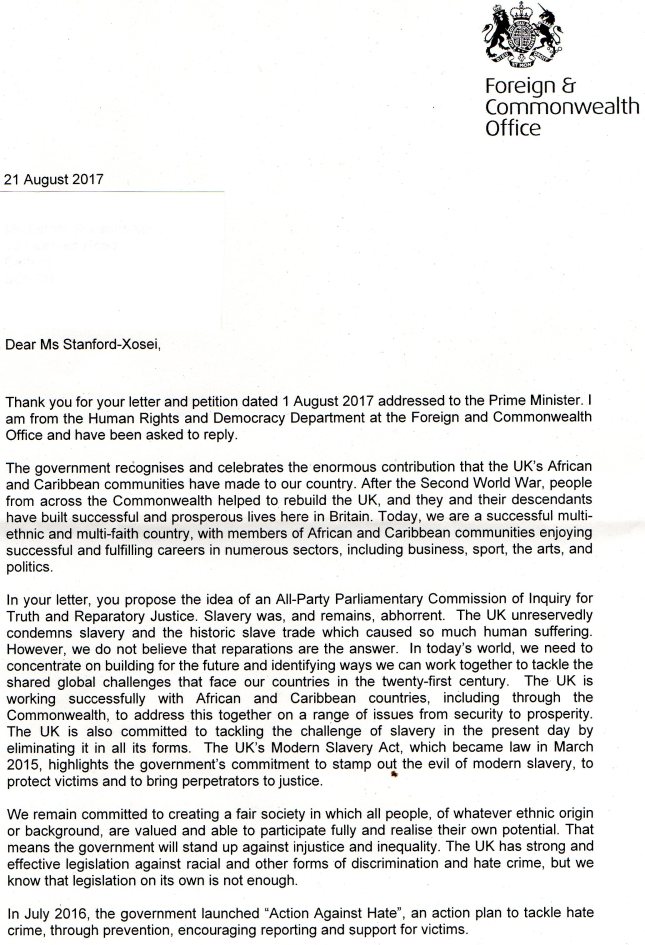
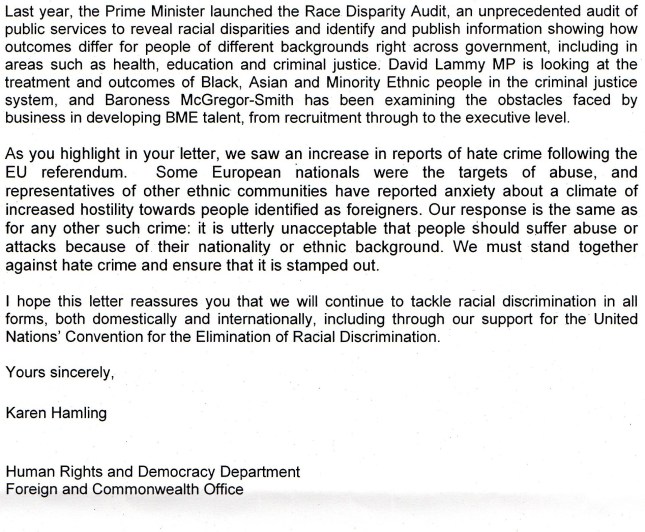
ESTHER STANFORD-XOSEI LETTER TO HEIDI ALEXANDER REGARDING THE FCO RESPONSE setting out what is wrong with the response received from the Foreign & Commonwealth Office to the 2017 ‘Stop the Maangamizi!’ Petition & its accompanying letter.


LORD AHMAD 1

LORD AHMAD 2

LORD AHMAD 3


This link includes the response sent to Heidi Alexander MP further to receiving the above response from Lord Ahmad.

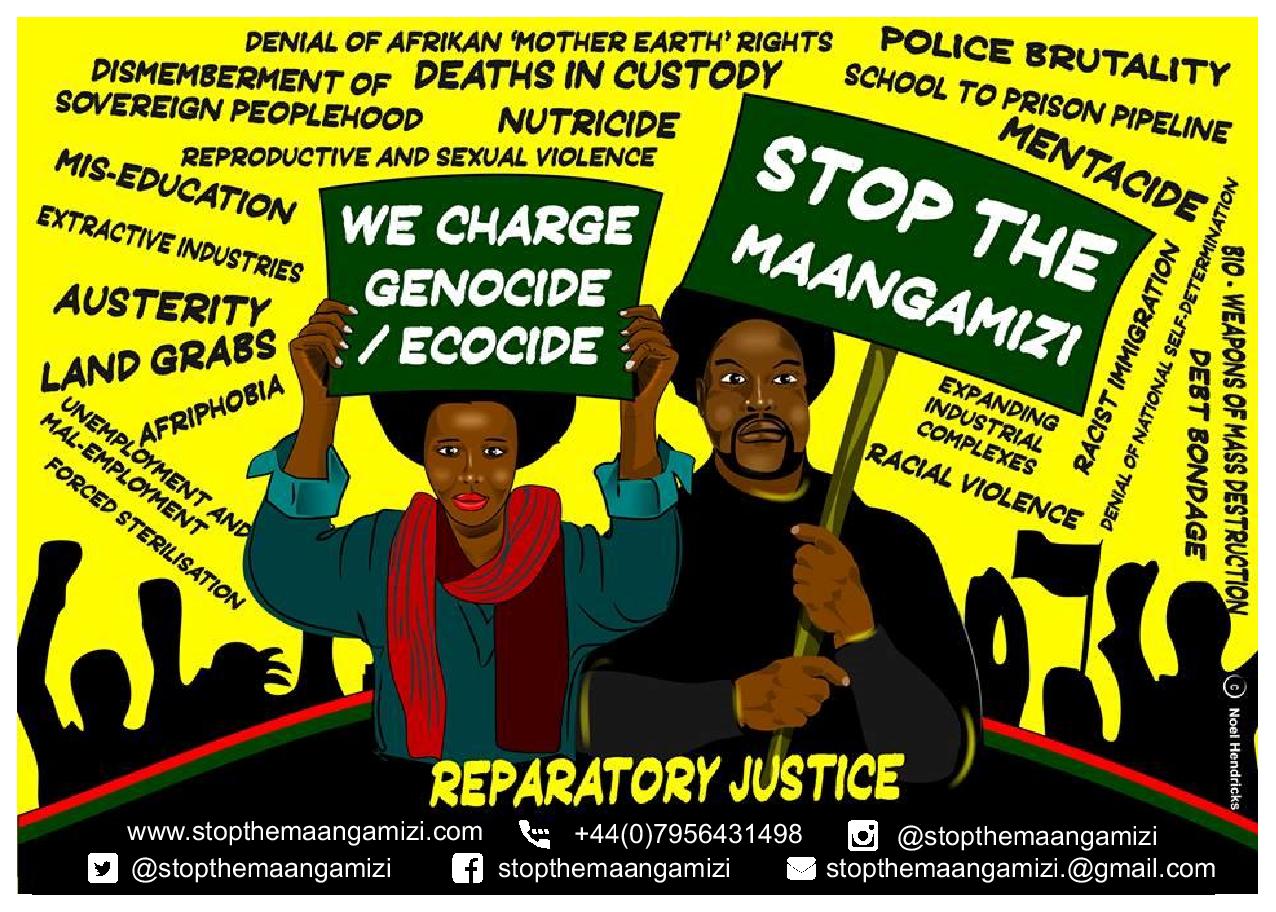
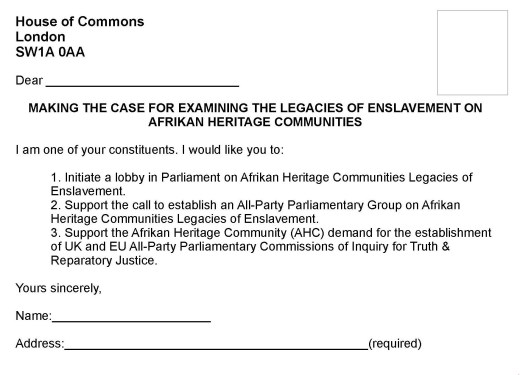
See here for the ‘Stop the Maangamizi!’ Postcard and template letter.

Check out this guidance on lobbying MPs and other elected officials.


In Service

Stop the Maangamizi: We Charge Genocide/Ecocide! Campaign International Steering Committee Spearhead Team (ISC-SMWeCGEC) 


Posted in AFRIKAN RESISTANCE, ALL PARTY PARLIAMENTARY COMMISSION OF INQUIRY (APPCITARJ), INTERNATIONAL SOCIAL MOVEMENT FOR AFRIKAN REPARATIONS, ISMAR, MAANGAMIZI RESISTANCE, MAANGAMIZI RESISTORS, REPARATIONS, Reparatory Justice, SMWeCGEC, STOP THE MAANGAMIZI CAMPAIGN, STOP THE MAANGAMIZI PETITION, Uncategorized | Tagged Afrikan Heritage, Afrikan Liberation, Afrikan lobby, APPCITARJ, British Colonialism, British Government, Commission of Inquiry, Ecocide, Genocide, Grassroots Leadership, Grassroots lobbying, Hellacaust, International Social Movment for Afrikan Reparations, ISMAR-Building, Maangamizi, Movement-Building, People Power, REPARATIONS, Reparatory Justice, Self-Repairs, Social Movement, Stop the Maangamizi | Leave a comment

HOW YOU CAN TAKE ACTION TO ADDRESS THE MAANGAMIZI

Posted on March 4, 2018 by STOP THE MAANGAMIZI


take action


Greetings Supporter/s of the ‘Stop the Maangamizi: We Charge Genocide/Ecocide! Campaign (SMWeCGEC)

Now that you have signed the ‘Stop the Maangamizi!’ Petition, do you want to take action to get redress for the Maangamizi (Afrikan ‘Hellacaust’ of chattel, colonial and neo-colonial forms of enslavement) as it affects you, your family and community?

Here is an example of how you can do so; please see the ‘Stop the Maangamizi!’ Postcard template below, which we urge you to send to your MP.  You can find out details about your MP here.

We also attach a template letter which has been revised to include reference to the issue of ‘compensation to enslavers tax fraud’ which is the subject of a separate but connected ‘Refund Our Taxes To Compensate Enslavers!’ petition. You can print off and sign the following letter here: SMWeCGEC Template Letter to MP- Elected Official. The letter is also drafted in such a way that you can send to any publicly elected official, not just MPs.


The postcard and letter are tools aimed at enabling you to better lobby and engage with establishment decision-makers about including Maangamizi impact issues as they affect you, your family and community in the constituency representational work and local, national and international policy-making they prioritise.

Please keep us updated in the SMWeCGEC about any progress you make as we are beginning to map which MPs are responding positively to the campaign aims, our contacts can be found here.  This is very important because the experience we have so far is that MPs want to know who else is being lobbied and taking action on the campaign demands contained in the postcard and/or letter. It is essential for us to have this data and info about which individuals and groups are making what approaches to which publicly elected officials and in which geographical areas across the UK.

Check out this guidance on lobbying MPs and other elected officials.

You can also read this ‘Stop the Maangamizi!’ Postcard advocacy case-study.

See here for other ways that you can take action.

We look forward to hearing from you about any progress you make or any barriers you may encounter! We are developing a page to identify Maangamizi desecrators and deniers so are interested to know if you encounter any public officials that can be characterised as such.


In Service

‘Stop the Maangamizi: We Charge Genocide/Ecocide! Campaign (SMWeCGEC) Spearhead Team


Posted in AFRIKAN HELLACAUST, AFRIKAN RESISTANCE, ALL PARTY PARLIAMENTARY COMMISSION OF INQUIRY (APPCITARJ), INTERNATIONAL SOCIAL MOVEMENT FOR AFRIKAN REPARATIONS, ISMAR, MAANGAMIZI RESISTANCE, MAANGAMIZI RESISTORS, REPARATIONS, Reparatory Justice, SMWeCGEC, STOP THE MAANGAMIZI CAMPAIGN, STOP THE MAANGAMIZI PETITION, THE 2017 AFRIKAN EMANCIPATION DAY REPARATIONS MARCH, THE 2018 AFRIKAN EMANCIPATION DAY REPARATIONS MARCH, UBUNTUKGOTLA/PITGJ | Tagged Afrikan Heritage, Afrikan Liberation, APPCITARJ, British Colonialism, British Government, Commission of Inquiry, Ecocide, Genocide, Grassroots Leadership, Hellacaust, International Social Movment for Afrikan Reparations, ISMAR, Maangamizi, Movement-Building, People Power, Reparations March, Reparatory Justice, Social Movement, Stop the Maangamizi, STOP THE MAANGAMIZI PETITION, Tax Fraud, U-PITGJ, We Charge Genocide/Ecocide! | Leave a comment

‘LIBYA SLAVE AUCTIONS’: UPDATING OUR ‘STOP THE MAANGAMIZI!’ RESPONSE

Posted on December 4, 2017 by STOP THE MAANGAMIZI

CLARKE NKRUMAH


“To be a slave was to be a human being under conditions in which that humanity was denied.
They were not slaves. They were [Afrikan] people.
Their condition was slavery.
They looked upon themselves and their servitude with the eyes and minds of human beings, conscious of all that went on around them”.
Julius Lester


“Most human behaviour is controlled by images. Image is a factor in how people look at themselves and what they use to reflect themselves. The control of images is a major factor in world power”
John Henrik Clarke


LIBYA COLLAGE


“Powerful people cannot afford to educate the people that they oppress, because once you are truly educated, you will not ask for power. You will take it.”
John Henrik Clarke


They say silence speaks louder than words; in what has been perceived to be our silence, we have also been speaking volumes. It is not that we have not been responding, it is simply that some are looking for us to respond in typical sorts of ways. We in the ‘Stop the Maangamizi: We Charge Genocide/Ecocide!’ Campaign (SMWeCGEC) do not pander to obscurantism, more so with misguiding populist decorations. Our priority focus is on educating, organising and mobilising people to ‘Stop the Maangamizi!’ through their own reparatory justice action-learning in order to build their own power to effect holistic reparatory justice. This is why we concur with Dr John Henrik Clarke as quoted above. What is happening in and around Libya is more than enslaved Afrikans being sold on auction blocks. Rather, this is one of the symptoms of an increasingly decadent, rotten and stinking neocolonialism as being perpetuated in Afrika by the Global Apartheid racist forces of Euro-Amerikkkan imperialism which is making our own homeland terribly more impossible to live in. If our own countries have not become hell on earth why wouldn’t Afrikans want to stay in Afrika?

Some people are making lots of noise and taking sporadically reactive actions about Afrikans being sold on auction blocks in Libya. It is not lost upon us that some of these noises and actions are being orchestrated and paid for from dodgy sources inimical to the best interests of Afrika. As justified in their spontaneity as some of such actions may appear, they raise lots more questions than answers. After these sorts of protests that we are seeing being organised in response largely to the imperialist corporate mouthpiece CNN reporting and dissemination of ‘controlling images’ of Afrikans being sold on auction-blocs, what do most of the participants who attend such protests, (including those who simply do so simply because they are paid bogus NGO bureaucrats and poverty-pimps, whose job it is to orchestrate and profit from such wild-goose chases), do as follow-up actions of every-day resistance to effect change in eradicating the root causes of such horrors? How long shall we continue to run helter-skelter in spontaneous protests actions, without taking effectively organised actions to prevent the killing of our freedom-fighting prophets and the violent destruction of the movements of resistance they have been trying to build? It would seem that there are some in our Afrikan Heritage Communities that seek to limit our activism to aimless protests, outside of the context of movement-building, with no clear goals or agreement on who should be the targets of our actions, the change we are seeking to bring about and no plan to build principled organizational unity or the capacity to facilitate such potentially change-making endeavours.

Why are those concerned not crying out and protesting louder about the mess being made of our Afrikan homeland by Euro-Amerikkkan imperialism through its neocolonial Afrikan and Arab elitist puppets; the stinking mess with all the brutalities of white-supremacy racist barbarism that is driving ordinary Afrikans away from their homes? Please be more critically aware, discerning and vigilant. Take the kind of well-planned ‘Stop the Maangamizi’ for Reparatory Justice! action/s that will prevent Afrikans from fleeing our own homeland in the first place and vacating it for more foreign setter-colonialists to move in, racially cleanse and occupy for nefarious geopolitical ends. It is high time that our people once again focused on the kinds of systematic actions that will effect systemic change and not simply respond in knee-jerk fashion to the various symptoms of the same system in such a way that these symptoms become the main focus of our protest actions.

A more useful starting point would be to target Euro-Amerikkkan imperialism and its agencies, institutions and quislings, including their Black puppets of neocolonialism, that are masterminding such horrific crimes of the Maangamizi; particularly with a view to shutting down the Maangamizi Crime Scenes that you can find anywhere near you or close to communities you can be engaged constructively with. For people in Afrika ‘Stop the Maangamizi!’ is not just a slogan, it is a life and death matter, hence why we initiated the SMWeCGEC with specific aims and objectives towards stopping the Maangamzi which manifests itself in the current system of neocolonialism with symptoms including variations of ‘modern-day slavery’, such as is becoming more highlighted currently in Libya. In our justified outrage about this form of modern-day enslavement of Afrikans, we must be mindful of who is pushing and profiting from this particular narrative and proliferation of ‘slave-auction controlling images’ and whose agenda is our people’s very predictable-spontaneous reactions to such narratives serving? It is indeed the same forces today as was the case yesteryear. After all, those that are most pushing the ‘modern day-slavery’ agenda and ‘it is Afrikans that are at it again‘ agenda are those actually responsible for creating, fuelling and perpetuating those conditions which continue to make it possible, including violently killing those freedom-fighters of ours who organise and build movements so stop such manifestations of the Maangamizi.

How comes this was not occurring under a Colonel Gaddafi led-Libya? Modern-day enslavement of Afrikans in Libya, in this aggravated form, is happening because NATO forces deliberately have chosen to make it happen in order to lend credence to their governments propaganda about us forgetting our intergenerational reparatory justice demands and rather begging them to clean up the Euro-Amerikkkan ‘mess’ they have created in Libya; and save us from horrors they contrive all the time in different ways and means. After all, isn’t Libya and its current neocolonial puppet-government a territory that is absolutely controlled in military and all other forms by the same forces of Euro-Amerikkkan imperialism and their creation of reactionary counterinsurgency terrorist forces like Al-Qaeda and Islamic State?

We must not allow ourselves to fall into the Hegelian Dialectic i.e. Roman Emperor Diocletian’s age-old problem-reaction-solution method for securing geopolitical interests. This highlighting of the modern-enslavement of Afrikans in Libya, divorced from the context and continuum of the Maangamizi, is an attempt by the Euro-Amerikkkan imperialist Establishment to assert its geopolitical interests in Afrika and to shift and misdirect the masses attention away from the task of every-day resistance movement building for Pan-Afrikan Power through effecting Pan-Afrikan Reparations for Global Justice by our own People’s Power.

Directing our protests at forces which right now have no interests in stopping the trafficking, incarceration and enslavement of Afrikans in Libya is the classic way we give up our own change-making power by thinking that ‘WE THE AFRIKAN PEOPLE’ do not have the power to set our own agenda and organise to achieve it. Our time, and difficult to harness resources, are better utilised in self-determinedly organising according to our own Pan-Afrikan Liberation agenda to put a full-stop to the Maangamizi in the process of effecting holistic reparatory justice by our own people’s power; a global force those of us in the Diaspora have the responsibility first and foremost, to develop through building Afrikan Heritage Communities for National Self-Determination (AHC’s NSDs/Maatubuntujamaas) to organically generate the MAATUBUNTUMANDLA Pan-Afrikan Government of Peoples Power Abroad which in our contemporary times will be the most effective way to uphold, defend and promote the best collective geo-political interests of Afrikan people throughout the World.

What is happening now in Libya and the disgraceful inability of governments and other state officials throughout the Continent and Diaspora of Afrika to do anything effective in addressing the situation makes it more imperative for Afrikans, outside of the Continent of Afrika, to prioritise the building of such MAATUBUNTUMANDLA as a step towards achieving MAATUBUNTUMAN (Pan-Afrikan Union of Communities at Home & Abroad); so that we are able to not only ‘substantively’ represent’ ourselves in positive action to make our Afrikan Lives actually matter in deed; but also amplify the voices of our Communities of Resistance on the Continent and support them in freedom-fighting actions that will enable them to stop such crimes of the Maangamizi upon their own initiatives. This is how best we in our time can fulfil our ‘mission’ and not betray it, as others have and are still doing, so as to win and guarantee our collective security and thereby provide a brighter future for us and our progeny on Planet Earth.

‘Stop the Maangamizi: We Charge Genocide/Ecocide!’ Campaign International Steering Committee (ISC-SMWeCGEC)

04/12/17 revised from original statement of Kofi Mawuli Klu on 28/11/17

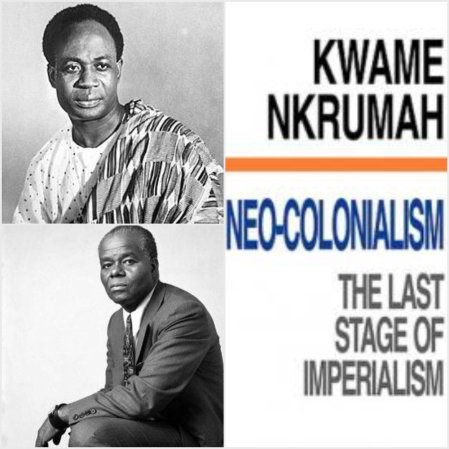
“The neo-colonialism of today represents imperialism in its final and perhaps its most dangerous stage. In the past it was possible to convert a country upon which a neo-colonial regime had been imposed — Egypt in the nineteenth century is an example — into a colonial territory. Today this process is no longer feasible. Old-fashioned colonialism is by no means entirely abolished. It still constitutes an African problem, but it is everywhere on the retreat. Once a territory has become nominally independent it is no longer possible, as it was in the last century, to reverse the process. Existing colonies may linger on, but no new colonies will be created. In place of colonialism as the main instrument of imperialism we have today neo-colonialism. The essence of neo-colonialism is that the State which is subject to it is, in theory, independent and has all the outward trappings of international sovereignty. In reality its economic system and thus its political policy is directed from outside.”
Osagyefo Dr Kwame Nkrumah, ‘Neocolonialism: The Last Stage of Imperialism’


“Those who do not learn from history are condemned to repeat it”
George Santayana


STM LOGO - RGB-blk-02

Posted in AFRIKAN HELLACAUST, AFRIKAN RESISTANCE, ALL PARTY PARLIAMENTARY COMMISSION OF INQUIRY (APPCITARJ), INTERNATIONAL SOCIAL MOVEMENT FOR AFRIKAN REPARATIONS, ISMAR, MAANGAMIZI RESISTANCE, MAANGAMIZI RESISTORS, PREFIGURATIVE POLITICS, PRIM, REPARATIONS, Reparatory Justice, SMWeCGEC, STOP THE MAANGAMIZI CAMPAIGN, STOP THE MAANGAMIZI PETITION, UBUNTUKGOTLA/PITGJ, Uncategorized | Tagged Afrikan Liberation, Afrikan Sovereignty, APPCITARJ, British Colonialism, British Government, French Colonialism, French Imperialism, Genocide, Grassroots Leadership, Holocaust, International Social Movment for Afrikan Reparations, ISMAR, Maangamizi, Marching, Modern Day Slavery, Movement-Building, Pan-Afrikan Revolution, Pan-Afrikanism, People Power, Problem-Reaction-Solution, REPARATIONS, Reparatory Justice, Self-Repairs, Social Movement, Stop the Maangamizi, U-PITGJ | Leave a comment

REPARATIONS INTERNATIONAL DIALOGUE HIGHLIGHTS ‘STOP THE MAANGAMIZI!’

Posted on November 23, 2017 by STOP THE MAANGAMIZI

AN ISMAR UK DIALOGUE IN LONDON WITH CARICOM – NATIONAL COUNCIL ON REPARATION IN JAMAICA (JNCR): AN INITIAL REPORT-BACK

DIALOGUE DATE : 14 NOVEMBER 2017


*ISMAR stands for International Social Movement for Afrikan Reparations


Including:

1. Professor Verene Shepherd: Scholar-Activist Co-Chair of the Jamaica National Council on Reparation (JNCR), Director of the UWI – Centre for Reparation Research, Independent Expert at the UN Committee on the Elimination of Racial Discrimination.

2. Bert Samuels: Pan-Afrikanist Attorney-at-Law, Head of JNCR Legal Working Group.

3. Lord Anthony Gifford QC: Attorney-At-Law, Member of Queen’s Commission, Member of JNCR, Citizen of Jamaica since 1990’s, involved with reparations since days of mentor Bernie Grant, MP.

“Dialogue is a form of struggle. It is not a chit chat. Create a dialogue that focuses not just on the vulnerability of all groups, but on those larger issues of justice, democracy and the crisis within our own communities then try to hammer out some everyday problems that relate to the everyday lives of those groups”

Professor Cornel West


Purpose of the Meeting

The meeting started with introductions and a reminder of the purpose of the deliberations:

1: The status of the reparatory justice movement in the UK and Jamaica (update on both sides);

2: What strategies have worked and why? What strategies have not worked and why?;

3. The way forward.

It was reiterated that this meeting is a dialogue and, notwithstanding the limits of time, participants should adhere to and help reinforce the principles of dialogue. Communication agreements were highlighted: it was emphasized that people should speak from their own reality, speak in their name, from their own point of view and also realise that we are here to share as well as listen to others; and that in doing, so we do not all have to agree with each other.


From the JNCR

Professor Shepherd made some preliminary comments. She recognised that there were some misgivings and acknowledged that some of the participants had previously sent in their issues of concern in advance of the meeting. She stated that they would not be able address all the points and issues that had been sent in advance from some parties in the dialogue but emphasized that this is not the only trip the delegation will make. She informed the gathering that she is head of the JNCR Diaspora and International Engagement Working Group. There is another JNCR working group which is the Internal Reparations and Internal Engagement Working Group for Postcolonial Wrongs committed by post-colonial regimes like Coral Gardens. So, the JNCR is working externally and internally.

Professor Shepherd acknowledged that there were lots of questions about the CARICOM Reparations Commission (CRC). The Chair of the CRC, she explained that Professor Sir Hilary Beckles, wanted to join on this trip and was not able to but has committed to a separate trip here next year on behalf of the CRC. She reiterated that this engagement is part of the JNCR terms of reference point 6, which is “to engage the international community in Afrika, the Americas and Europe in discussion on reparations and build a global coalition of reparations activists”. It was pointed out that the experience in the UK can guide in what they are doing in Jamaica. After all, many in the United Kingdom are part of Jamaica and have been calling for closer collaboration. She acknowledged that reparations conversations in Jamaica and other parts of the Caribbean cannot continue to exclude us in UK.

Professor Shepherd explained that the JNCR was first established in 2009, but this version of the JNCR is the 3rd version of it. She explained that the JNCR is preparing a report on its activities of the last few years, in order to advise on the way forward, including what forms reparations should take. It is currently consulting on this with a view to better comprehending what reparations would be like internally and externally.

First reason being the need to ally itself with civil society, including Rastafari organisations, as governments should not stand aside from the movement. Secondly, was their own conviction that the Maangamizi (Afrikan holocaust/hellacaust) is a Crime against humanity and that Western European nations have failed to repair damage done by the Afrikan holocaust.

Professor Shepherd commented on the recent visit to Jamaica by Lord Tariq Ahmad, the current UK Government Minister responsible for the Caribbean, Commonwealth and the United Nations Affairs. During his visit, Lord Ahmad insensitively stated that it was better for Jamaica to look ahead and maximise its potential rather than to peer into history at a time when everyone was peering into history at Remembrance Day. She pointed out that similar comments were made by Lord Ahmad’s predecessor, Mark Simmonds, as well as former UK Prime Ministers, David Cameron and Tony Blair. She mentioned the letter of Barbados PM Fruendel Stuart, QC. to Lord Tariq Ahmad proposing a meeting to discuss the evidential basis of Caribbean Reparations Initiative to which there was a response that the British Government “does not believe that reparations are the answer”.

Professor Shepherd referenced the reparations context from a state perspective, within which the movement is growing and why the Jamaican government felt it should establish the JNCR. It was highlighted that Gordon K. Lewis reminded us in ‘The Growth of the Modern West Indies’ that Britain “sought withdrawal from the Caribbean area without providing the sort of economic aid to which, on any showing, the colonies were entitled.” In addition, Sir Ellis Clarke, who was the Trinidadian Government’s United Nations representative to a sub-committee of the Committee on Colonialism in 1964, had made this point in his statement: “An administering power… is not entitled to extract for centuries all that can be got out of a colony and when that has been done to relieve itself of its obligations…. Justice requires that reparation be made to the country that has suffered the ravages of colonialism before that country is expected to face up to the problems and difficulties that will inevitably beset it upon independence.”

Professor Shepherd spoke about challenges that the JNCR has had in implementing its workplan in relation to receiving submissions, undertaking public consultations, conducting hearings and receiving testimonies to guide a national response on reparations and consulting various constituencies. Nevertheless, they have tried to reach people by conducting a media blitz, utilising the ‘Running African’ show of Ka’bu Ma’at Kheru on IRIE FM and big public events where reparations are promoted and discussed such as:

• Establishment of a memorial for the ‘Zong Massacre’ in Black River to commemorate the lives of the 133 enslaved Afrikans who were thrown overboard by the crew of the ‘slave ship’ Zong in 1781 for insurance purposes);

• Play on the ‘Trial of Governor Eyre’ written by Bert Samuels, directed by Michael Holgate; the play addresses what would happen if Edward John Eyre, governor of Jamaica during the Morant Bay Rebellion of 1865, was tried for murder, including the deaths of National Heroes Paul Bogle and George William Gordon;

•  It was acknowledged that the Jamaican Government must follow through on obligations to pay compensation to Coral Gardens victims and deal with responsibilities to family members where victims have died;

• Committing to youth engagement as youth are not significantly engaged;

• Highlighted the regional ‘run for reparations’ baton relay, which is going around the country, to end on 27th December in St. James, where war of 1831-2 started. So, the focus is on the youth using media and events;

• Professor Shepherd informed the gathering that she had helped to revise history on the syllabus in schools; over much objection, reparations is now on the syllabus; having to take applied history perspectives i.e. using history to address a modern concern.

She concluded her comments by sharing other challenges that they are working with in the JNCR including:

• 49% in a 2011 poll by the Jamaica Gleaner suggested most Jamaicans believe the country would be better off today if it had remained a British colony;

•”Reparations are another begging bowl”;

• “Governments cannot be trusted and only a grassroots movement will succeed”;

• People don’t trust academics, elite Rastas and lawyers and worse CARICOM;

• People do not agree on forms of reparations and only individual reparations with a personal benefit will appeal to them;

• People are not too happy how £350 million distributed in the region, not part of reparations.

Professor Shepherd closed her comments by asking “So how do we overcome the challenges, how do we go forward, what has worked for you and what lessons can be learned?”


Lord Anthony Gifford QC

Lord Gifford commenced by stating that he sees the delegation and their colleagues in the JNCR as being “independent thinkers” with connections and skills who have been asked to advise the Jamaican government. In this regard, firstly, it must be continually emphasized that reparations is a legally sound just cause for crimes against humanity, and reparations have never been addressed. This case was made in Abuja in 1993 and in Durban at the 2001 World Conference Against Racism (WCAR). He highlighted that there has been at least a verbal acceptance by CARICOM governments that this case is made out. He pointed out that lots of strides have thus far been made in the Caribbean by mobilising people in support of reparations.

Secondly, it is important to work out what reparations mean and if possible agree upon what forms reparations will take. He explained that this point of unity among pro-reparations forces has not as yet been arrived at. Hence why it is important to consult people and friends in other countries as well as consult with the wider Diaspora.

One of most important things on which to give honest and correct advice to the JA government is the necessity to consult the people. Gifford explained that we cannot just have a scheme that just looks good on paper; adding: “you can’t even just have a scheme that is good on paper because government can be destabilised by all kinds of forces, and there are many working against reparations in a vicious way. He pointed out that it is no coincidence that Lord Ahmad was visiting the Caribbean at the same time while their JNCR delegation is in the UK; and also surmised that part of Chief Abiola’s downfall in Nigeria was because he spoke out on reparations on behalf of Afrika and her Diaspora.

Lord Gifford concluded by highlighting that it seems that in the UK we are in a potentially life changing situation, with a possibility of a Corbyn led- government; stating that he was, interested to know how the gathering, in attendance, thought a change in UK government will assist the cause of reparatory justice.


Attorney Bert Samuels

Bert Samuels raised the case of Somerset v Stewart highlighting contradictions within the British legal system, (as well as between Britain and Jamaica), concerning the whole idea of slavery being a crime against humanity. He sees internal reparations as very important, and is proud to be lead adviser to the Coral Gardens group, helping to win $10 million Jamaica Dollars for the Rastafari community. He believes we must “tidy our own houses” before we can approach others to say they should help tidy ours. He also spoke of what happened at the 1865 Morant Bay Rebellion, where 400+ persons were killed by militia and that historical-legal research was being done to include various dimensions to the Jamaican reparations case.

Samuels concluded by highlighting the role of legal actions in ‘demystifying the law’ and also creating avenues for public education and mass mobilisation which are part of the power-building to institute alternative legal and extra-legal measures.


To demystify law is to make people lose their awe before the law as it being something ‘sacrosanct’ by simplifying and summarizing legal principles, concepts and decisions/judgements for those not critically schooled or untrained in the disciplines of law ultimately leading to a democratisation of law-making and legal practice.


UK ISMAR Report Back

It was stressed that we need to recognise the fact that the International Social Movement for Afrikan Reparations (ISMAR) is the way it is here in the UK because of the radical ground-up anti-imperialist approach, led from the grassroots, by non-state actors that we have inherited in terms of the global legacies of the Pan-Afrikan Congresses, the Garveyite Movement, the Black Power and Rastafari Movements as they have developed in the UK. We endeavour to maintain fidelity to such legacies that have been shaped by the roles of Afrikans from both the continent and diaspora of Afrika such as Attobah Kwodjo Enu (aka Ottobah Cuguano), Olaudah Equiano, Henry Sylvester-Williams, Marcus Garvey, W.E.B. DuBois, John Archer, Paul Robeson, C.L.R. James, Osagyefo Kwame Nkrumah, Peter Abrahams, George Padmore, Amy Ashwood Garvey, Ras Makonnen and Jomo Kenyatta in advancing together from Britain the Pan-Afrikan Movement to enhance the global harmonisation within the Pan-Afrikan Congresses of the reparatory justice demands that Afrikan people have been making for centuries from their own homeland and extending throughout the World.

It was further emphasized that it is with their precious blood, sweat and tears from exertions not only of brawn but also of brain power, wherever our Afrikan people were compelled to endure the dispossessions, degradations and dehumanization of various forms of enslavement, that they have bequeathed to us a most treasurable arsenal of intellectual and organisational weapons that we continue to utilise in updating our ISMAR-building and its strategy and tactics here in the UK, with input from all those contingents of the ISMAR and its interconnected Peoples’ Reparations International Movement (PRIM) throughout the World, particularly Afrikan Communities of Reparations Interest and their allies, with which we keep networking. Therefore, most of the leading Afrikan Heritage Community activists who identify with the ISMAR and are conscious of its history and true legacies see ourselves as custodians of a Reparations Movement which is informed by a global and glocal, rather than country national, or even regional perspectives. Most of such leading activists see reparations as inextricably connected to global Afrikan Liberation, recognising that it is through such total liberation in Pan-Afrikan revolutionary perspective that we can glocally effect truly meaningful reparatory justice by our own Black People’s Power.

However, it was also recognised that there was a need for this history to be more accessible and widely known by ordinary members of the public who are largely miseducated about this history due to state schooling; more so since ordinary members of the public are recipients of a state-miseducation system which continues to perpetuate the disconnection of generations of Afrikan Heritage Communities from their history and the neglected social history that Afrikan people have made in the UK, particularly since the so-called World War I and II. In addition to the failure of the education system to equip Afrikan people to see the connections between their current reality, in relation to deaths in custody, school exclusions and colonialism and neocolonialism, i.e. the failure to see the domestic colonised/neocolonised status of people of Afrikan heritage in the UK. In this regard, it was recommended and strongly advocated that we cannot approach Afrikan reparatory justice from the perspective of sentimentality but that there was a need for serious scholarly work to be done which was put in service of building a people-centred mass movement for reparatory justice.

At the same time there was also a need for scholars/intellectuals whether they are establishment scholars or grassroots scholars to become or stay community engaged and accountable. In this regard, the International Network of Scholars and Activists for Afrikan Reparations (INOSAAR) was highlighted as an approach to non-extractivist research and scholarship which is accountable to the ISMAR. Just as is being done by some constituencies of the PRIM in various countries of Abya Yala (the so-called Americas), including Bolivia, Ecuador, Brazil, the USA and Canada, the INOSAAR is supporting the ISMAR-promoted development of endeavours towards building a more egalitarian, equitable and pluriversal Global Academy Commons by giving recognition to scholars not only in Establishment Academia but also those of Grassroots Academia, including those engaged in scholarship utilising Afrikan Indigenous Knowledge Systems that indigenous communities of Afrika are revitalising on the continent as well as other systems of knowledge production developed by Afrikan Heritage Communities of the Diaspora.

It was further recommended that the JNCR as well as the UWI-based Centre for Reparations Research (CRR) should link into the work and replicate some of the approaches of the INOSAAR.

ISMAR activists in the meeting articulated their defence of advocating for activists in the UK to work from the non-negotiable standpoint of critical support for some reparations state actors, while maintaining that it is non-state actors of civil society that remain the foremost driving force of the ISMAR. Hence taking the uncompromising standpoint that it is the grassroots of Afrikan Civil Society that leads the ISMAR, with its own independent programme of action arising from its anti-establishment strategy and tactics of total Pan-Afrikan liberation as the process through which we can best take, effect and secure holistic reparatory justice, by our own people’s power, in pursuit of this strategy and tactics.

• It was pointed out that the 1993 Abuja first Pan-Afrikan conference on Reparations for chattel enslavement, colonialism and neocolonialism was appealing to many of us who identify as being part of the ISMAR in the UK, because of its interconnection of the past with present systemic injustices of the Maangamizi, unlike the CARICOM position which emphasizes reparations for the past of chattel enslavement and native genocide only. Accordingly, very good note must be taken of the popularisation of the 1993 Abuja Declaration, and its related documents such as the very enlightening paper of Professor Chinweizu, by the likes of the late Bernie Grant MP in his parliamentary and extra-parliamentary work. Noteworthily, Bernie Grant drew together both state and non-state actors within and beyond the UK, to buttress the African Reparations Movement (ARM) with the active involvement and support of some of the participants in the 14th November 2017 Dialogue in London. The remarks about this made in the meeting by Lord Anthony Gifford are therefore of very important significance. These legacies from before and beyond the Abuja Declaration are what have left deep imprints upon the landscape of reparations movement-building in the UK, which most of us committed to advancing the ISMAR to its definitive victory continue to energetically promote.

It was explained that, notwithstanding this fact, there are some in the movement here in Britain that still do not appear to be taking reparations for neo-colonialism seriously and it was pointed out that some of the pro-reparations forces were reluctant to countenance any critical appraisal of the CARICOM Reparatory Justice Initiative including its 10-Point Plan for this reason. Some groups and individuals appear therefore to be taking neocolonialism off their reparations agenda. It follows that some of the standpoints of uncritical support for the CARICOM position on Reparations were devoid of objectively critical people-centred appraisal of CARICOM because they do not see reparations for neocolonialism and the role of CARICOM states in the still ongoing perpetuation of neocolonialism. Therefore, it was reasoned that such elements do not want to interrogate neocolonialism because of what others see as ‘complicity’ in aiding and abetting it in the desire to be what is perceived to be ‘economically successful’ within the Global Apartheid status quo of the ongoing Maangamizi against Afrikan and all other oppressed “Wretched of the Earth“.

“The neo-colonialism of today represents imperialism in its final and perhaps its most dangerous stage. In the past it was possible to convert a country upon which a neo-colonial regime had been imposed — Egypt in the nineteenth century is an example — into a colonial territory. Today this process is no longer feasible. Old-fashioned colonialism is by no means entirely abolished. It still constitutes an African problem, but it is everywhere on the retreat. Once a territory has become nominally independent it is no longer possible, as it was in the last century, to reverse the process. Existing colonies may linger on, but no new colonies will be created. In place of colonialism as the main instrument of imperialism we have today neo-colonialism. The essence of neo-colonialism is that the State which is subject to it is, in theory, independent and has all the outward trappings of international sovereignty. In reality its economic system and thus its political policy is directed from outside.”

Osagyefo Dr Kwame Nkrumah, ‘Neocolonialism: The Last Stage of Imperialism’


• Disapproval of ‘Caribbean citizenship by investment programmes’ was expressed. The creation of such Citizenship by Investment (CBI) programmes have mainly driven by the Caribbean governments desire to find new ways to raise revenue and are currently operating in St Kitts and Nevis, Grenada, Dominica, Antigua and Barbuda, and St Lucia. In particular, concern was raised by what is currently happening in Barbuda where politicians and investors are taking advantage of the island’s devastation after Hurricanes Irma and Maria to grab land from people displaced by the recent series of hurricanes. It is feared that the government will overturn Barbuda’s communal land system by introducing land privatisation. Prime Minister Gaston Browne recently proposed changing the law to privatise the land by selling it for a dollar a plot to leaseholders. But, local people, activist groups and even some politicians are saying that it is really commercial leaseholders of large plots such as those for hotels, who will benefit from the move. This is even more worrying given that no land has been bought or sold on Barbuda since the abolition of slavery more than 180 years ago, so in this era it was stated that Antigua & Barbuda were going back to the days of English ‘slave trader’ and plantation developer Christopher Codrington! It was asserted that this and other failures to interrogate the operation of neocolonialism leaves doubts about where heads of government are finding the ‘collective consciousness’ through which to authentically champion true reparatory justice on behalf of their Afrikan Caribbean citizenries.

• Concerns were raised about the impact of neocolonialism on Afrikan Heritage Communities in Europe which has the purpose of seeking to assimilate and co-opt Afrikan and other Black peoples into the system of white supremacy within and outside the imperialist metropolis. It was pointed out that this is occurring through the whitening of Black spaces through the spatial racism and Afriphobia of gentrification such as is occurring in Brixton. Initiatives such as those of Brixtonics@Brixton, which are seeking to counter the erasure of Brixton’s association with the legacies of CLR James, Olive Morris and their associated militant traditions of Revolutionary Pan-Afrikanism and Black Power resistance, were highlighted, including the work now happening to bring together Black traders and their allies who are seeking to develop a glocal economic base. It was pointed out that the success building of such a glocal economic base in the Diaspora to impact effectively on reparatory justice transformations on the continent of Afrika will require the development of a global Pan-Afrikan Government in waiting hosted by the Afrikan Diaspora. It is this kind of governance body that some refer to as the MAATUBUNTUMANDLA – Pan-Afrikan Government of People’s Power Abroad.

• Challenging questions were asked about the outcomes of existing CARICOM legal and diplomatic strategies and a discussion ensued about conventional legal strategies and their effectiveness in securing reparatory justice gains to our people. It was highlighted that a key feature of the ISMAR in the UK is that there is not a prioritization of conventional Eurocentric legal strategies, hence the strong critique of Leigh Day & Co which came from many activists in the UK. There was a recognition that the settlement in Mutua & Others V FCO (Mau Mau case) was a not a precedent that could or should be replicated in the global Afrikan reparations case. In this regard, there was a discussion about Lord Gifford’s legal opinion on the Leigh Day advice and some of the ‘legal insurmountables’ that his advice indicated. There was an exploration of the limitations as well some benefits of the uses of conventional legal strategies in terms of public conscientisation and mobilisation. The approach of ‘Law as Resistance’ was highlighted, from the standpoint of which grassroots legal and extra-legal initiatives in Britain, such as the 2003 Black Quest for Justice Campaign case for the Queen Elizabeth II to answer was advocated. From this precedent was identified the need to enhance the international popularisation of ‘Law as Resistance’ and also to support the proposal for partnership with the INOSAAR in training younger legal practitioners and activists to utilise community-engaging forms of lawyering as well as alternative mechanisms to the International Court of Justice such as the Ubuntukgotla-Peoples’ International Tribunal for Global Justice (U-PITGJ), as advocated by the ‘Stop the Maangamizi: We Charge Genocide/Ecocide!’ Campaign (SMWeCGEC).

• The question of London-centrism was raised and the need for outreach to and participation of activists, communities and other stakeholders outside of London. It was agreed that greater attention should be paid to broadening engagement within the ISMAR by doing outreach, community education and mobilisation etc. It was also highlighted that due recognition of the reparations movement-building work that is being spearheaded from London, which is also informed by activists from outside London; and also to recognise the rich intellectual sophistication and greater audacity of perspectives and praxis emanating from activists who have taken advantage of the global positioning of London and its Black demographics in order to shape London-based and glocally rippling Pan-Afrikan liberatory activism, rooted in militant intellectual and organisational traditions cultivated from the Global Apartheid anti-racism of anti-imperialist dimensions. It was pointed out that such historically conscious advancements were possible because of the presence and central role in contemporary ISMAR-building of London-based and London influencing activists with specially privileged elevation from gains of ‘Struggle’ made by those from previous generations that provide considerably advantageous ramparts more than is currently possible to have in other places within Britain and even throughout Europe.

It was agreed that there should be regular report-back sessions which included the various regions where people were organising for reparations and jointly collaborating and publicising each other’s initiatives and programmes for reparations. It was highlighted that there needed to be greater information sharing and planning among and between reparations organisations and stakeholder groups in the UK especially when it came to matters such as initiatives being taken at the United Nations, the African Union, and especially in relation to meetings regarding the United Nations International Decade for People of African Descent (IDPAD) and the Committee for the Convention of the Elimination of Racial Discrimination (CERD). GACuk highlighted some of the work they have been doing in relation to the CERD.

• There was a reiteration of the importance of voluntary Repatriation, which some of us prefer to call Rematriation, given the fact that conceptually, we refer to Afrika as our Motherland rather than Fatherland. Rematriation/Repatriation should be central to all we do, in addition to recognition of the need to include renewal of Afrikan material cultural as well as integration and restoration of independent Afrikan community and nationhood. This must be pursued being sensitive to and cognisant of the perspectives of formations like the Global Afrikan Family Reunion International Council: the developing network of Chiefs, other traditional leaders and activists in Ghana/West Afrika who are demanding, in accord with the legitimate reparatory justice interests of indigenous Afrikan Communities on the continent of Afrika, particularly those arising from their still ongoing freedom-fighting against neocolonialism and its related vestiges of colonialism and the devastating impact of chattel enslavement, as manifestations of the continuing Maangamizi; such as land rights and the divisive borders of the 1884-1885 Berlin Conference, among all other concerns of their inalienable human, peoples‘ and Mother Earth rights.

• The question of the inadequacy of existing internal reparations initiatives, including compensation for the Tivoli Gardens Massacre was reiterated. In addition, concerns were expressed about the role of lawyers in what was stated to be the “cover up” process of the ensuing 2016 West Kingston Commission of Enquiry was expressed as a cause of concern.

• There needed to be greater recognition of the importance and role of sites of community organising and activity where masses of our people are engaged to focus on in seeking to advance the cause and build the movement for reparations. Such sites of organising including, trade unions, faith groupings, youth and student groupings as well as women-focused and other sites of social justice activism.

• A point was made about the representativeness of the meeting and other groups that ought to have been represented in the deliberations. Explanations offered highlighted the request of Professor Verene Shepherd and others who had asked for the meeting to be convened to restrict this initial meeting to a selected group of about 10-12 activists capable of engaging in mutually respectful discussions on the agenda proposed by the National Council on Reparations in Jamaica (JNRC) initially; in accordance with which request the Convenor diligently acted as best as she could with the necessary serious consideration in the careful choice of the participants in this meeting. Attendees to the dialogue with reparesentatives of the JNCR were identified on the basis of those who were considered, with appropriate consultations, as not only representative of our Afrikan Heritage Communities and groups of reparations interest in and around London, in addition to having an organisational/ track-record on reparations organising as groups and associated individuals; but also who are most capable at this initial stage of engaging meaningfully with due respect for the required best practice and rules of meaningful dialogue.

This was added to by emphasizing the wider terrain of representation and the need for Afrikan Heritage Community representation outside of narrow activist circles which were not representative of wider Afrikan, Afrikan Caribbean and other Afrikan Diaspora communities, including Afrikan and Caribbean country Diaspora representative groups and organisations who are doing work relevant to reparatory justice. It was emphasised that we all had to do more to broaden our outreach work to much wider embrace our Afrikan Heritage Communities (AHCs) in their rich diversity from all over the World that make up the Diaspora and our mother-continent of Afrika. In doing so, we must always remember that it was on our mother-continent of Afrika that the ISMAR began; when the first captured Afrikans immediately started raising their Reparatory Justice demands, with insistence upon recovering their inalienable freedom and other human, peoples’ and Mother Earth rights according to their own values and worldviewpoints. They did so in full cognisance of their Cognitive Justice right to their own self-determination of whom they regarded themselves and their own communities and systems of being, knowledge and societal organisation and progress to be; with what they regarded as their own civilizational systems of morality, law and Justice, for which reason they, there and then, started their freedomfighting against the Maangamizi crimes of denial of their humanity, enslavement and colonisation in various forms.

• It was advocated that there needed to be a ‘truth’ process among various representatives and groupings of the ISMAR in the UK; because, in spite of our lofty declarations and the grandstanding of some amongst us, there were not only commendable strengths but also some despicable weaknesses among us, including negative tendencies such as unscrupulous pandering to Establishment power no matter how unjust it is, sycophancy, sectarian competitiveness, male-chauvinistic and other egoistic posturings that are at variance with the ethics of the very reparatory justice we claim to be standing up for and demanding of others to honour! It was also pointed out that recognition should be given to initiators of initiatives like what has now developed to become the Afrikan Emancipation Day Reparations March which takes place annually on the 1st August, now has specific aims and objectives and is organised in such a way as to promote and strengthen ISMAR-building. Equally it was stressed that is necessary and truthful to recognise when there are developments and improvements on such initiatives especially when they are abandoned by initiating groups. It was pointed out that history was relevant here, as often the consequences of actions taken historically often have unforeseen consequences which must also be acknowledged and reflected upon when surveying and assessing the current state of the ISMAR in the UK. It was emphasized that in all our endeavours, we must listen to the wishes of our communities to guide our organising actions and that there should be transparency and accountability to the constituencies we represent.


Way forward

• We as the Civil Society grassroots from diverse Afrikan Heritage Communities of Reparations interest in the UK, shall work with all non-state actors in and beyond Britain on our terms; as such, we shall also work in critical engagement with those state actors that are prepared to engage in honest dialogue with us. We will proactively engage such state actors, with whom, we will identify in such dialogue; and maintain our right to be critical of those positions taken and/or advocated which we find detrimental to the interests of the majority of Afrikan people all over the World and therefore not conducive to the kind of victory for holistic reparatory justice that we are pursuing.

• We ask those who represent or are accountable to CARICOM states (e.g. national commissions and councils for Reparations) to make it clear that, as state actors or organising as state-appointed and accountable actors, they do not control or speak for civil society in and beyond their respective countries. It should be recognised that Afrikan Heritage Community civil society, via their own autonomous organisations, is freely pursuing and should be encouraged and where possible facilitated to carry out its own programmes, strategies and tactics in doing what it has to do independently locally, nationally and internationally, with due respect for human, peoples’ and Mother Earth rights. Further that they, as state actors, should seek to increase overstanding for, and in certain circumstances, even critical support for, what the non-state actors of civil society can do, mindful of the strengths and weaknesses on both sides, and with particular attention in all honesty to the realities of neocolonialism and therefore the limitations it imposes upon all those located within the state machinery, even with the best of their intentions to advance the goals of reparatory justice.

• We will recognise points of convergences and differences between state and non-state actors. Accordingly, we will be mindful of each other’s strengths, weaknesses and resources, as state and non-state actors as well as within and between various groups of non-state actors.

• Our independence is non-negotiable as non-state actors of the ISMAR, located at the grassroots of Afrikan Heritage Civil Society in the UK, and therefore, in thinking globally and acting locally in fidelity to the legacies bequeathed to us by some of the very best of the sons and daughters of Mother Afrika, committed in firm principledness to working glocally for holistic Reparatory Justice from the fundamental global Pan-Afrikan liberatory perspective of our “Wretched of the Earth”.

• There is a need to recognise the importance of such dialogue that we entered into and institutionalise such dialogue between state and non-state actors, as for example with the establishment of the kind of forum mentioned below.

• It is important to promote diligent reparations study and application of knowledge through praxis by way of action-learning conducive to cognitive justice for Afrikan people at home and abroad as integral to true reparatory justice.

• It is necessary to pay greater attention to how we harmonise strategy and tactics; and therefore, recognize that such a process of harmonisation should be in the form of knowing what state actors can do most effectively and equally what non-state actors can do most effectively. For example, non-state actors are best able to build people’s power from the ground upwards through initiatives like the SMWeCGEC in association with mass mobilisation and community unifying processes like the street column of the ISMAR which is being strengthened through organisation and mobilisations towards the annual Afrikan Emancipation Day Reparation March as spearheaded by the Afrikan Emancipation Day Reparations March Committee (AEDRMC). It was therefore important to recognise, support and implement the SMWeCGEC campaigning operations such as advocating and defending human, peoples’ and Mother Earth rights to the point of working towards shutting down Maangamizi crime scenes on the continent and Diaspora of Afrika. It was proposed that this should be done also being cognisant that state actors will feel unable to openly advocate such operations.

• It was advocated that this issue of shutting down Maangamizi crime scenes is key in relation to stopping the ongoing pillage of Afrikan resources and despoliation of lands and destabilisation of Afrikan communities as can be seen to be the manifestations of the ongoing Genocide/Ecocide of the present-day phase of escalating neocolonial enslavement against Afrikan people throughout the World. This point was further elaborated on in the ‘Britain’s New Colonialism’ report by War on Want. If we can stop the Maangamizi, resources can be used for Afrikan people’s self-empowerment, self-emancipation and self-development in Afrika and throughout the Diaspora all over the World. The importance of abandoning dehumanising enslaver-mentality terminology like ‘slave’ and ‘slave trade’ was emphasized. It was proposed that there should be a greater usage of terminology such as Maangamizi and the awareness-raising popularisation of its contemporary manifestations as well as the imperative to stop this phase of the Maangamizi in order to effect genuine reparatory justice, hence the clarion call to ‘Stop the Maangamizi!’

• It was further asserted that unless we have an ‘or else’ dimension to our advocacy and relations when dealing with European powers, they will not respond seriously to our respective campaigning demands; there is ample global historical evidence that the forces of white supremacy never seriously respond to merely gentlemanly and diplomatic approaches because there is no threat factor in that and powerless groups do not subject themselves to less powerful groups. This would also impact on our ability to capture the imaginations of and attract the youth, who often see our people as powerless in relation to other peoples who are able to flex their power on the international stage. ‘Separation’ was advocated in terms of carrying this reparatory justice struggle to its logical conclusion, which entailed separating our Black/Afrikan selves from the stranglehold of white supremacy racism instead of appealing to the absent morality of the European Establishment and pursuing a course of reparations which is palatable to and on the terms of our historical and contemporary oppressors. The self-repair process of reclaiming, recreating and reinforcing our Afrikan Personality and ‘Black selves’, was key to realising the intergenerational goals of the re-establishment of the sovereignty of Afrikan people; given that the question of Afrikan reparatory justice, even for people of Afrikan origin in the Caribbean, is premised upon a global Afrikan solution to the Afrikan National Question at home and abroad.

• Common areas of possible joint work between state and non-state actors identified include education, mass Mobilisation and international community diplomacy. In this regard, it was proposed that a joint Memorandum of Understanding should be developed to include joint working protocols in furtherance of principled operational unity, including adherence to principles of reparaBerlntions ethics.

• Whilst our approach to International Community Diplomacy as non-state actors is “Grassroots People-to-Peoples’ Internationalist Solidarity and Ground-up Diplomacy Action Learning” through the ISMAR as a vital column of (PRIM); that of state and state-aligned actors is working through governmental organisations and other state institutions at local, national and international levels. A relevant action point in this connection is targeting, with our soft as well as hard power, the forthcoming Commonwealth Heads of Government Meeting (CHOGM) to be held in London and Windsor in April 2018.

• A Forum of State and Non-State Actors for Reparatory Justice (FOSANSARJ) will be established as a UK-wide formation, with local branches as deemed necessary, to keep the dialogue going towards concrete aims and objectives flowing from the above matters as well as other relevant issues to be determined in a ‘summit of solutions’. In light of the concerns about what diplomatic missions of the CARICOM member countries, in London, are failing to do with regard to desirable public engagement with its Reparatory Justice Framework, it is envisaged that such a forum (the FOSANSARJ) shall include duly mandated representatives of high commissions and other embassy officials from member-countries of the CARICOM, the African Union (AU) and other such bodies in the UK representing countries with significant Afrikan Heritage Communities.

• Practical steps can be taken to counter anti-reparations propaganda by reading Caribbean/UK/European newspapers to get a sense of the extent of such anti-reparations propaganda and that activists and other stakeholders should also counter such negative propaganda by writing rebuttals and giving alternative perspectives by way of a corrective to counter media disinformation. One such example that was highlighted was Professor Shepherd’s response to statements made by the UK Minister of state with responsibility for the Caribbean, the Commonwealth and the United Nations, Lord Tariq Ahmad, on his recent trip to the Caribbean, where he denounced the call for reparations.

• In guiding our reparations activism as activists, scholar-activists, civil society groups/organisations and members of communities of reparatory justice interest, we must be mindful of the need to ‘ground’ with the masses as advocated by the late Dr Walter Rodney who explained the relevance of the term “grounding” to the Black Power Movement and his manner of activism in Jamaica. This included the need for the Black/Afrikan intellectual to “attach himself/herself to the activity of the masses”, by facilitating public and open critical dialogue at the level of the society and engaging in free, popular education sessions beyond Establishment Academia with workers, the dispossessed and ostracized groups, where the classroom takes on any form as a site for organising cells of popular resistance in his ‘Groundings with my Brothers’: “I was prepared to go anywhere that any group of Black people were prepared to sit down to talk and listen.  Because, that is Black Power, that is one of the elements, a sitting down together to reason, to ‘ground’ as the Brothers say…We have to ground together [Groundings, pg.78]” As well as adhere to the admonition best articulated by Amilcar Cabral that: “we should always bear in mind that the people are not fighting for ideas [about reparatory justice], for the things in anyone’s head. They are fighting to win material benefits, to live better and in peace, to see their lives go forward, to guarantee the future of their children.” In this regard, what should unite us is our focus and prioritisation of efforts to create a better world; and, in doing so, to be conscious of the varying and various strengths that we have; strengths to which we should work, whilst at the same time struggling together, individually, collectively and organisationally, against our own weaknesses.

“We must begin by asking ourselves: What weaknesses on our side made the holocaust possible? Weaknesses of organization? Weakness of solidarity? Weaknesses of identity? Weaknesses of mentality? Weaknesses of behaviour? If we do not correct such weaknesses, even if we got billions of billions of dollars in reparations money, even if we got back all our expropriated land, we would fritter it all away yet again, and recycle it all back into alien hands. We must therefore find out what deficiencies in our sense of identity what quirks in our mentality, what faults in our feelings solidarity made it possible for some of us to sell some of us into bondage; still make it possible for us to succumb to the divide and conquer tactics of our exploiters; make it possible for all too many of us to be afflicted with Negro necrophobia- our counterpart of the self-hating disease of the anti-Semitic Semite. Twenty years ago, when I was writing The West and the Rest of Us , I gave it a subtitle: ‘White Predators, Black Slavers and the African Elite.’ That was to serve notice that we cannot overlook our complicity, as Black Slavers and as the African Elite, in what happened, and is still happening to us. We must, therefore, change ourselves in order to end our criminal complicity in perpetuating our lamentable condition.”

‘Reparations and A New Global Order: A Comparative Overview’ by Professor Chinweizu 


Sis Esther Stanford-Xosei
Convenor of the Dialogue

23 November 2017


Meeting Venue: May Day Rooms @Fleet Street


Attendees

1. Abu Akil, Global Afrikan Congress, uk (GACuk)

2. Judy Richards, GACuk

3. Sorena Francis, GACuk

4. Jendayi Serwah, Afrikan Emancipation Day Reparations March Committee (AEDRMC)

5. Dulani Masibuwa Dumisai, (AEDRMC)

6. Chief Gege, Stop the Maangamizi’: We Charge Genocide/Ecocide Campaign (SMWeCGEC)

7. Kwame Adofo Sampong, Pan-Afrikan Fora International Support Coordinating Council (PAFISCC)

8. Leo Muhammad, Nation of Islam, London Study Group (NOI)

9. Althea Gordon Davidson, Pan-Afrikan Community Educational Service (PACES)

10. Daniel Solomon, Brixtonics@Brixton

11. Simeon Stanford, Global Afrikan People’s Parliament (GAPP)

12. Ras Shango Baku (Contributed in absentia), Nyabinghi National Council (NNC), IDPAD UK

13. Sugar Dredd, Rastafari Movement UK (RMUK)

14. Prophet Kweme Abubaka, Ethiopian Afrika Black International Congress (EABIC)

15. Cecil Gutzmore, Pan-Afrikan Society Community Forum, (PASCF)

16. Professor Gus John, Gus John Associates, Member of the African Union Technical Union Technical Committee of Experts on the 6th Region

17. Esther Stanford-Xosei, Pan-Afrikan Reparations Coalition in Europe (PARCOE)

18. Kofi Mawuli Klu, (PARCOE)

19. Rosemarie Davidson-Gotobed, Founding-Member of Sam Sharpe Project, Jamaica Baptist Union, Founder and Direct of Sam Sharpe Lectures


This slideshow requires JavaScript.


Posted in EVENTS/TRAINING, INTERNATIONAL SOCIAL MOVEMENT FOR AFRIKAN REPARATIONS, ISMAR, PRIM, REPARATIONS, STOP THE MAANGAMIZI CAMPAIGN, UBUNTUKGOTLA/PITGJ, Uncategorized | Tagged 1st August, Afrikan Heritage, Afrikan Liberation, Afrikan National Question, Afrikan Sovereignty, Afriphobia, Berlin Conference, Black Radical Imagination, British Colonialism, British Government, Caribbean Citizenship by Investment, CARICOM, CARICOM Ten-Point Plan, CHOGM, Cognitive Justice, Critical Dialogue, DPAD, Ecocide, Emancipation Day, Genocide, Global Apartheid, Grassroots Leadership, Groundings, IDPAD, International Social Movment for Afrikan Reparations, ISMAR, ISMAR-Building, Land Grab, Maangamizi, MAATUBUNTUMANDLA, Marching, Movement-Building, Neocolonialism, Pan-Afrikan Revolution, Pan-Afrikanism, People Power, Peoples Tribunal, PRIM, Rematriation, REPARATIONS, Reparations debate, Reparations March, Reparatory Justice, Repatriation, Self-Repairs, Social Movement, Stop the Maangamizi, U-PITGJ, UK Reparations Activism, We Charge Genocide/Ecocide! | Leave a comment

RESPONSE FROM THE FOREIGN & COMMONWEALTH OFFICE TO THE 2017 SMWeCGEC PETITION

Posted on August 23, 2017 by STOP THE MAANGAMIZI


Greetings Signatories of the ‘Stop the Maangamizi!’ Petition and Supporters of the ‘Stop the Maangamizi!: We Charge Genocide/Ecocide Campaign (SMWeCGEC).

Please see the attached response from the Foreign & Commonwealth Office (FCO) of Her Majesty, Queen Elizabeth II’s Government dated 21st August 2017 and received today 23rd August 2017. No doubt the British Government would have been aware that today is the 226th anniversary of the insurrection of Afrikans in the north of the then French colony of Santo Domingo (present-day Haiti) which occurred during the night of August 22–23, 1791. However, to be true to the historical record, the Haitian Revolution (1791-1804) actually commenced on 14th August 1791 with a Vodun ceeremony in Bwa Kayiman, in the northern part of present-day Haiti. The Haitian Revolution was one of the most important events in modern history. It was the first successful anti-slavery revolution. Not only did enslaved Afrikans in Haiti liberate themselves, they also inflicted crushing defeats on three empires – the Spanish, French, and British. There were numerous fatalities among the colonialists, each suffered catastrophic losses trying, and failing, to take back the island from its heroic defenders. 161 sugarcane refineries and 1,200 coffee plantations got torched, with damage estimated at 600 million pounds. In recognition of the fact that it was Afrikans that liberated themselves in Haiti, the 23rd August is also commemorated as the United Nations ‘International Day for the Remembrance of the Slave Trade and its Abolition’.

You can then read our initial thoughts on this response below the letter from the FCO.

Please note the address of Esther Stanford-Xosei has been concealed which explains the gap between the date and opening line of the letter.


img014img015A


Our initial thoughts in reaction to this sort of Maangamizi denial response are:

Firstly, further insult has been added to injury in that contrary to the Prime Minister Theresa May’s initial response to the ‘Stop the Maangamizi!’ Petition and its accompanying letter  dated 8th August 2017 stated that she had requested her correspondence officer to arrange for a Minister in the FCO to respond to us directly;  instead we have received a response from Karen Hamling, Human Rights & Democracy Department. Karen Hamling’s position within the department is not clearly identified in the correspondence. For your information, a list of FCO ministers can be found here:

So, is Theresa May confirming her notoriety popularised in song as a “Liar Liar” or has the Foreign & Commonwealth Office chosen to disobey her requests seeing her as a weak leader on her way out?

Secondly, the response from Karen Hamling on behalf of the FCO shows how the Government in its response to us is seeking to counter our assertions by highlighting those from our communities who are collaborating with the genocide and ecocide crimes of white power and priding themselves on being successful within this genocidal imperialist white supremacy racist capitalist system, without highlighting anything being fundamentally wrong with it. This emboldens the FCO to display this type of dismissive attitude to the cries of the majority of our Afrikan people across the world about the continuing genocide and ecocide of the Maangamizi that they are suffering. In addition, such a response starkly reveals that if our case for reparatory justice is to be taken seriously by the British state and its white power accomplices in Europe, then we have to re-examine the situation of the minority who are made to look successful from among us. Arguably, their so-called success in this genocidal imperialist, white supremacy racist capitalist system is largely possible due to the ‘selling out’ of our people through the actions, inactions and omissions of those deemed to be successful i.e. those collaborators in perpetration of the Maangamizi crimes of genocide and ecocide against Afrikans and Mother Earth.

Yes, we often hear praise-singing alongside finger-pointing to some in our Afrikan Heritage Communities who are deemed to be successful, the question is:

at what genocidal price for the majority of our people does the so-called success of a tiny minority come?

This type of untruthful and insulting response from FCO comes out of such notions of success that some ignorantly or opportunistically tout and pride themselves on in our Afrikan Heritage Communities.

It is mind-boggling that in spite of reports by British NGOs such as the ‘Honest Accounts 2017 – How the world profits from Africa’s wealth’ and ‘The New Colonialism: Britain’s scramble for Africa’s energy and mineral resources’, the British Government is still in denial that it is aiding and abetting British corporate criminals in the perpetration of the Maangamizi crimes of ecocide and genocide against Afrika and people of Afrikan heritage all over the world today.

Increasingly it is becoming clearer that the British Government will only begin to listen to our Afrikan Reparatory Justice demands, including the demands of the SMWeCGEC when the advocacy, encouragement and support by our Afrikan Heritage Communities in Europe is given to the efforts of our Afrikan Communities of Resistance in Afrika, the Caribbean, other parts of Abya Yala, (the so-called Americas), as well as in Europe to shutting down extractive industries and other foreign corporate crime scenes of the Maangamizi. This is something we stated in the letter to the Prime Minister accompanying the 2017 hand-in of the ‘Stop the Maangamizi!’ Petition. It follows that the plunder of our community resources is still continuing to enrich white power in Britain and European domains of global apartheid across the world. We therefore need to seriously revisit some of the strategies and tactics with which our revered Ancestors fought successful liberation struggles; gaining some concessions that resulted in the official discontinuation of the British Empire, even from inside the brains and belly of the beast of the said Empire!

In fact, it is by pursuing strategies and tactics in Britain that advocated for, encouraged and supported actions of Afrikan people to make the British and other European Empires in Afrika, the Caribbean, Abya Yala as well as Asia ungovernable, which compelled changes in the British Empire, resulting in the proclamations of independence of our current nations states in Afrika and the Caribbean. A similar outcome and impact can be brought about again in our lifetime with the shutting down of Maangamizi crimes scenes in Afrika, the Caribbean, other parts of Abya Yala and Europe.

For those that still say they are not for petitioning or Marching, which actually cost us very little risk or harm in Britain today, what else is it you are prepared to do which you feel will bring about a more favourable response from the British state to our Afrikan Reparatory Justice demands?

The honestly critical discussion and reasoning that should flow from these perspectives of ours in the SMWeCGEC is something that we urge is carried out in Afrikan Heritage Communities not only in the UK, but throughout Europe, Afrika, Abya Yala and other parts of the world. We further urge that this is also done against the background of the historical legacies and the contemporary manifestations of the still ongoing Maangamizi as outlined in the ‘Stop the Maangamizi!’ Petition.

So we in the SMWeCGEC invite you to share your own thoughts on the contents of this response from the FCO. Please email your thoughts and suggestions to: stopthemaangamizi@gmail.com by Friday 22nd September 2017.

We aim to utilise your ideas to inform a more detailed response to the FCO on our part as the SMWeCGEC.


In Service & Struggle


International Steering Committee ‘Stop the Maangamizi: We Charge Genocide/Ecocide!’ Campaign

(ISC-SMWeCGEC)


bell hooks

“[We] have had only a slave’s idea of freedom, and to the slave the master’s way of life represents the ideal free lifestyle...”

bell hooks, ‘Ain’t I a Woman’


Kwame_nkrumah


“It is my deep conviction that all peoples wish to be free, and that the desire for freedom is rooted in the soul of every one of us. A people long subjected to foreign domination, however, does not always find it easy to translate that wish into action. Under arbitrary rule, people are apt to become lethargic; their senses are dulled. Fear becomes the dominant force in their lives; fear of breaking the law, fear of the punitive measures which might result from an unsuccessful attempt to break loose from their shackles. Those who lead the struggle for freedom must break through this apathy and fear. They must give active expression to the universal longing to be free. They must strengthen the peoples’ faith in themselves, and encourage them to take part in the freedom struggle. Above all, they must declare their aims openly and unmistakably, and organize the people towards the achievement of their goal of self-government.”

Osagyefo Kwame Nkrumah, ‘Africa Must Unite’


queen_moore_mother

“Those who seek temporary security rather than basic liberty deserve neither!”

Queen Mother Audley Moore

Posted in AFRIKAN HELLACAUST, ALL PARTY PARLIAMENTARY COMMISSION OF INQUIRY (APPCITARJ), INTERNATIONAL SOCIAL MOVEMENT FOR AFRIKAN REPARATIONS, ISMAR, REPARATIONS, Reparatory Justice, STOP THE MAANGAMIZI CAMPAIGN, STOP THE MAANGAMIZI PETITION, THE 2017 AFRIKAN EMANCIPATION DAY REPARATIONS MARCH | Tagged 1st August, Afrikan Heritage, APPCITARJ, British Colonialism, British Government, Commission of Inquiry, Ecocide, Emancipation Day, Hellacaust, International Social Movment for Afrikan Reparations, ISMAR, Maangamizi, People Power, Reparations March, Reparatory Justice, Stop the Maangamizi | 4 Comments

AFTER THE 2017 REPARATIONS MARCH: WHAT NEXT?

Posted on August 5, 2017 by STOP THE MAANGAMIZI


no 9


The Afrikan Emancipation Day Reparations March, as the street column of the International Social Movement for Afrikan Reparations (ISMAR) is a vehicle for mass mobilisation and education as part of our self-repair and people’s power-building process. It is also a conduit as part of an on-going parliamentary and extra-parliamentary strategy, hence the delivery of the ‘Stop the Maangamizi: We Charge Genocide/Ecocide‘ Campaign (SMWeCGEC) Petition charging the British State with the crimes of Genocide and Ecocide and demanding an end to their role in the continuing Maangamizi. The Afrikan Emancipation Day Reparations March Committee (AEDRMC), in association with the SMWeCGEC, will continue the year long process of march planning, mobilisation and organisation alongside its ‘Education is Part of the Preparation for Reparations‘ programmes in preparedness for the establishment of All-Party Parliamentary (People’s) Commissions of Inquiry for Truth and Reparatory Justice (APPCITARJs), also contained within the SMWeCGEC Petition.

You are encouraged to continue to mobilising and self-organising. The March is NOT the entire Reparations Movement so YOU need to develop complimentary reparatory justice strategies in your own groups, organisations and networks. If you would like to get more information about and/or be more involved in the ISMAR, please read on…

Given that the AEDRMC as facilitators of the annual 1st August Afrikan Emancipation Day Reparations March organising process in partnership with the SMWeCGEC are in pursuit of comprehensive holistic land-based reparations. This means our reparations as Afrikans in the Diaspora is umbilically connected to the liberation of our Motherland Afrika, restoration of her sovereignty and the self-determination of Afrikan people worldwide including the establishment of forms of non-territorial forms of autonomy in the Diaspora. We are working for the achievement of the kind of reparations that we can ALL be truly proud of. This is necessary to ensure that all of our people, (not just a few) get ‘satisfaction’ out of the results (that also includes our predecessors, our contemporaries and our posterity, i.e. those yet to be born).


quote-revolution-is-based-on-land-land-is-the-basis-of-all-independence-land-is-the-basis-malcolm-x-124-97-55


For these reasons, our means of achieving and securing this kind of reparations is by revolution starting with enhancing and developing our independent people’s power, from the ground-up, so as to ‘effect’ this kind of reparations by our own power. There is no shortcut to the freedom true reparations shall deliver to us. We want the majority of our people in the Diaspora and on the Continent of Afrika involved, as this will ensure that we collectively and cooperatively harness our people’s power to effect and secure reparatory justice in our own self-determined best interests. This is why the following are are all steps in the revolutionary achievement of true holistic reparatory justice:

  • 1st August Afrikan Emancipation Day Reparations March;

vintage-calligraphic-elements-1nyoWZ-clipart

  • Implementation of the aims & objectives of the March and the SMWeCGEC, its sister campaign, which continue to be relevant and worked on all year-round;


SM AIMS MARCH


  • AEDRMC ‘Education is Part of the Preparation for Reparations‘ mobilisation programmes including local and regional March Outreach Teams;
  • Establishment of the APPCITARJs at the levels of the UK and European Parliaments;vintage-calligraphic-elements-1nyoWZ-clipart
  • Establishment of the Ubuntukgotla (U-PITGJ);vintage-calligraphic-elements-1nyoWZ-clipart
  • Development of a nuclei of Afrikan communities of reparatory justice interest into MAATUBUNTUJAMAAs which are communities of reparatory justice interest into interconnected Afrikan Heritage Communities for National Self-Determination (AHC-NSD’s) all over the Diaspora. Such MAATUBUNTUJAMAAs are meant to be glocal Afrikan family regenerations of AHC-NSDs purposely meant for development of the Diasporan interconnections into the future MAATUBUNTUMAN;

    vintage-calligraphic-elements-1nyoWZ-clipart

  • MAATUBUNTUMAN: Pan-Afrikan Union of Communities throughout the Continent and Diaspora of Afrika expressing Maatubuntu dignity integrated into a holistic global superpowerful polity of Maat which practices Ubuntu in relation to her people, all of humanity and the cosmos. 
  • The AHC-NSDs are focused on the holistic regeneration of Afrikan communities; mindful of the fact that, at present, such Afrikan communities exist within and beyond the UK as a multiplicity of different and even conflicting nation-state, ethnic, racial, class, gender, age and other socio-cultural configurations brought from all over the world;vintage-calligraphic-elements-1nyoWZ-clipart
  • AHC-NSDs seeks to strengthen links with similar communities of resistance in contested and liberated zones (as explained by Osagyefo Kwame Nkrumah) on the Continent of Afrika. Doing this is also in line with the imperatives for us as Afrikan people coming out of the BREXIT crisis in Europe, necessitating a Pan-Afrikan reparatory justice response by way of a PAFREXIT.


PAFREXIT KOFI 2


By PAFREXIT we mean, the Pan-Afrikan exit out of the global system of Euro-Amerikkkan imperialism! The more people in Europe find it difficult to endure the systemic malaise of their own European Union, as much as increasing numbers of people in North Abya Yala, (the so-called USA), are crying about the ‘American dream’ becoming more of an ‘American nightmare’, the more it becomes untenable for Afrikan people to work for their salvation as an integral part of the Euro-American Empire. So, PAFREXIT becomes necessary for Afrikan people getting out of the Babylon of Euro-America and stepping towards our MAATUBUNTUMAN: Pan-Afrikan Union of Communities throughout the Continent and Diaspora of Afrika expressing Maatubuntu dignity integrated into a holistic global superpowerful polity of Maat which practices Ubuntu in relation to her people, all of humanity and the cosmos.

Whilst everyone is free to choose their own path, those who want and are committed to achieving this holistic and transformative kind of reparatory justice for our people (and not just for us as individuals and parochial groups committed to the status quo), in the quickest possible time, are called upon to work their hardest in educating, organising and mobilising around these tasks of everyday resistance and transformative people’s power-building. This can be initiated as part of the various local and regional March Outreach Teams and Task Action Groups operating under the auspices of the AEDRMC and in support of the March in addition to the SMWeCGEC as an integral part of the ISMAR.

The Afrikan Emancipation Day Reparations March is not just a March, it is organised to advance reparations social movement-building of various constituencies within the Afrikan Heritage Communities. Priority is given to mobilising our own individual and collective ‘power to’ effect and secure reparatory justice through community organising, reparations social movement-building and institution-building.


strategies

Social movement-building is the long-term, coordinated effort of individuals and organised groups of people to intentionally spark and sustain a (reparations) social movement.It entails: “the creation of movement infrastructures required for sustained organising and mobilisation, including social relationships, organisational networks and capacity, affective solidarity, as well as movement-related identities, frames, strategies, skills, and leadership.” There is a difference between organisation/institution-building and social movement-building, see here for an explanation.

See here for what has been achieved thus far after 4 years of marching.


The ISMAR is not a spectator movement that we watch others build, sacrifice for, and be repressed whilst we sit back and wait for the benefits. It demands active participation by all those who have a stake in the outcome, not only to walk its talk, but also to become, be and live the self-repairs change we desire. There are many things that you can do to get more involved and strengthen the ISMAR, through mobilising and organising as part of the various constituencies within the Afrikan Emancipation Day Reparations community of interest. The following are some suggestions:

  1. Adopt the reparations ethics standpoint of recognising and learning to discern and distinguish between the various contributions that others have and are making to reparations-social movement-building, from many different ideological persuasions, and organising traditions. In the same way that we may critique the actions of others, we too must be prepared to have our own reparations actions, (be they individual, organisational/institutional or inter-movement), subjected to scrutiny in the best interests of improving the focus and effectiveness of our move-ment-building endeavours. This struggle for reparatory justice is an intergenerational one. We stand on the soldiers of many greats from among us past and present who have individually and collectively played their role in the line of March.vintage-calligraphic-elements-1nyoWZ-clipartflaws 2
    vintage-calligraphic-elements-1nyoWZ-clipart

    These are some of the various representatives of the ISMAR past and present that have and are making a contribution to reparations social movement-building

    PARCOE OLDPARCOE NEW


vintage-calligraphic-elements-1nyoWZ-clipart

Ossie Davis‘ words below are relevant to us all in seeing ourselves as part of the continuity of our intergenerational long March to the true freedom that Reparatory Justice will give all of us.

“We gotta fight!, the March to freedom, and the March to equality was in process when I was born, I just got on board. I suspect when they let me off and put me in one of those quiet places forever, the March will still be going on, and I will be able to tell history that, at least, when I was alive, there was a place for me in the line of March. You should be happy to say as much. That’s the reward for being alive, to be part of the struggle.”


ossie dais

Ossie Davis, Activist, Actor, Author


vintage-calligraphic-elements-1nyoWZ-clipart


  1. Defend the integrity of the March which is a people’s reparations march. Many from within and outside our Afrikan Heritage Communities and even from within some Afrikan Reparations Communities of Reparations Interest and their allied organisations, networks and structures have made various attempts to liquidate the March, to counter it and deny its role in ISMAR-Building. Others have sought, in various ways and means, to diminish the significance of its contribution to raising the visibility and profile of the UK contingent of the ISMAR, which those ordinary members of the Afrikan public who contribute to organising and providing community service in support of the March, have been labouring to achieve.


mAANGAMIZI MARIMAANGAMIZI -mine-shootings-reaction-horizontal-large-gallery

Protesters at Marikana in Azania (South Afrika)


3. Amplify the voices and defend the actions of those members and groups within specific Afrikan Heritage Communities and our various and diverse communities of reparatory justice interest who are engaged in civil disobedience and taking forms of direct action to shut down ‘Maangamizi Crime Scenes’ in Afrika and other locations in the Afrikan Diaspora. It is also important to support Afrikan liberation movements in Afrika and wherever they are found in the Diaspora, including those with operation in the UK.

4. Engage in acts of everyday resistance to the Maangamizi as it is affecting you or other Afrikan Heritage Community members. The specific manifestations that are highlighted in the SMWeCGEC Petition include:

  • The dismemberment of Afrikan People’s sovereign peoplehood, in familyhood with our kith and kin in other Afrikan heritage communities throughout the continent and Diaspora of Afrika;
  • enduring legacy of epistemic, physical, structural and racial violence, including reproductive and sexual violence against women and children and the totality of all that we see as Maangamizi violence;
  • denial of Black and Afrikan ‘Mother Earth’ (Nana Asase Yaa), human and peoples’ rights to national self-determination as an oppressed People;
  • expanding health/medical, prison, psychiatric, economic, development, academic and military industrial complexes, which are making political prisoners of increasing numbers of Afrikan people in their diverse ways of engaging in resistance to the Maangamizi;
  • brutality by police and security agents including deaths in custody;
  • unemployment and mal-employment;
  • mentacide of Afrikan heritage youth and adults through the state mis-education system;
  • racist immigration patrols and policies;
  • extractive industries, abuse of our natural resources, free trade agreements and privatisation schemes, including private finance initiatives (PFI’s), public-private partnerships (PPP’s), and Economic Partnership Agreements (EPA’s) of the European Union (EU) being forced on Afrikan, Caribbean & Pacific countries;
  • proliferation of HIV/Aids, ebola and other bioweapons of mass destruction
  • denial of genomic, food and seed sovereignty by enforcing GMO products resulting in nutricide;
  • crimes against humanity inherent in the wars of aggression and proxy wars committed against Afrikan and other Majority World Peoples.


Everyday resistance in Azania

southafricanstudentprotests

https://www.theguardian.com/world/2016/aug/29/south-africa-pretoria-high-school-for-girls-afros

5. Keep in touch with the AEDRMC and listen out for announcements about the Public Evaluation Meeting on Sunday 3rd September 2017 (venue to be confirmed), when we would like to here from you your feed-forward (reflections on and community evaluation of) the Afrikan Emancipation Day Reparations March. We would also like to hear more about the work you are doing towards effecting and securing reparatory justice, remember it is not either or, but both and much more!


Contribute to March bloc-building

6. Between the annual 1st August Afrikan Emancipation Day Reparations Marches, contribute to building and sustaining the organisation of the following blocs:

Mwakalenkonso – Revered Ancestors
Pamoja – Community
Ujamaa – Global Afrikan Family
Fiankra – Repatriation
Imani – Interfaith
Sankofasuafo – Students
Ujima – Trade Unionists
Kuumba – Artists
Ubuntu – Non-Afrikan Allies.

These blocs will continue to operate, mobilise and organise throughout the year as part of reparations social movement-building, at the core of which is the intergenerational Afrikan Liberation Movement. If this bloc-building work is sustained between the Marches, the annual Reparations March then becomes the culmination point of our year round reparations campaigning and other forms of activism, in addition to being a vehicle for publicly showcasing the strength of our organising, networks and capacity-building to advance the ISMAR.

As part of the bloc-building, please remember that the costs of emancipating ourselves from the modern-day Maangamizi are not free. Social-movement building needs resourcing, and the ISMAR is a movement that is self-funded. Fundraising to build and sustain this street colum of the ISMAR must also go on all year round. See below for how you can support the work towards facilitating the March and its related campaigning aspects by donating to the ASR fund (Afrikan Self-Repairs) of the AEDRMC: https://www.gofundme.com/ukmarch


SM March Committee Bank Details


Mwakalenkonso (Revered Ancestors) Bloc

MARCH ANCESTORS BLOC

Participate in the Mwakalenkonso (Revered Ancestors) Bloc by coming to the March appropriately dressed as or otherwise symbolically representing a heroic ancestor from your own family line or a community Ancestor who has in some way been involved in resistance to the Maangamizi or advocating some form of reparatory justice. We must always remember that our people’s claims and right to reparations are based on the principle of intergenerational justice and therefore have transgenerational, transnational and intercultural dimensions. By appearing on the March visually representing or otherwise imaging revered Ancestors, one will be doing so in remembrance, honour and recognition of the interconnectedness of our Ancestor’s foundational struggles to resist the Maangamizi with our own.

This will not detract from the serious nature of the protest that we will be undertaking, however does introduce a more creative element to protest actions that are typical of marches and other forms of street action. Claims to reparations have to move beyond merely calling on the name of our Ancestors as justification for the genesis of our entitlements to redress today to truly recognising the personhood, worldviews and visions of reparatory justice of the Afrikans that were enslaved in various parts of the world. In addition, we have a duty to past generations and future generations to ensure that our reparatory justice objectives, programmes and actions bring about the holistic and transformatory redress; empowerment, repair and restoration of our people’s sovereignty. Being visually reminded of our Ancestors activism and struggles to emancipate us compels us to uphold the reparations ethics and standards of the past generations of our clan, family, or community freedom-fighters.


Imani – Interfaith Bloc

ED POPSAR 6

          Bishop Joe Aldred @ 2016 Reparations March 

You can organise a church service for ‘Reparations Sunday’ on the second Sunday, or the Sunday closest to 12th October, the European Union (EU) Day for Reparations Related to Colonisation. If you are part of another faith community then you can organise a similar activity on your preferred day of worship closest to 12th October. This action is particularly relevant for people who are interested in building the Imani-Interfaith Bloc of the March.

Those from faith communities who attend churches, mosques, temples and other religious/spiritual organisations are also encouraged to come on the March with placards displaying messages relevant to their liberation theology work, in their respective places of worship and fellowship, which are relevant to reparatory justice.


Kuumba -Artists Bloc

You can add your creative talent to producing art forms which popularise and promote the messages of the ISMAR.

An example is this track by Akala entitled Maangamizi


For further info about the blocs and how you can get involved contact the AEDRMC           Tel: 07922035446/ 07597592889
Email: getinvolved@reparationsmarch.org                    FB page: ReparationsMarchUK


7. Continue to do as much as possible to educate yourself and your families about reparations, the history of the Movement, the diversity of the Movement, the goals, tactics and strategies of the Movement, even the internal contradictions of the Movement. One of the best ways apart from increasing your theoretical knowledge base is to engage in praxis (a cycle of theory, action and reflection that helps us analyze our efforts in order to improve our ideas) and action-learning (learning through doing). Theory without action and testing out that which we have theoretically learned produces armchair critics and/or revolutionaries. However, action without reflection produces ineffective or counter-productive activism. That’s why we advocate praxis. To assist in this process, we encourage you to look at some of the suggestions made under the ‘Take Action’ tab on the SMWeCGEC website.

This is a short article about the importance of learning within the ISMAR: https://reparationsscholaractivist.wordpress.com/2015/05/13/learning-and-education-for-a-post-african-reparations-world/.


ne-csp-why-it-works


8. If you are part of an organisation, or work add a specific reparations objective to your organisation’s aims and work on its practical realisation.

9. Engage in discussions with the support the SMWeCGEC Team on how best to support the SMWeCGEC in the realisation of its campaign goals which will take year-round activism. See if there are any of these actions that you are willing to take.

10. Continue to sign, discuss and disseminate the SMWeCGEC Petition which calls for the establishment of a UK All-Party Parliamentary Commission of Inquiry for Truth and Reparatory Justice (APPCITARJ). This petition is being used as a political tool and tactic to accompany reparations conscientisation, mobilisation and organisation.


commission of inquiry 3


Begin preparing yourself for the All-Party Parliamentary Commission of Inquiry for Truth & Reparatory Justice

11. Prepare yourself for the APPCITARJs by beginning to do family and community research on how we and our immediate families each have suffered, continue to suffer and have also challenged the various crimes of the Maangamizi. In this regard, see the aims of the SMWeCGEC:

Afrikans in the UK and Europe organising towards establishing commissions of inquiry for truth and reparatory justice and local, national and international people’s tribunals to hold the governments of Britain, and other European countries to account. If you are able to gather such evidence you can assist us  to arrive at a comprehensive assessment and a full picture of what our journeys and experiences of the Maangamizi have been across the Diaspora, as well as on the Continent of Afrika. Each person and representative of families and their communities have to become our own advocates and experts on your own situation and then we can bring all these experiences together as part of us becoming ‘reparations enforcers’ who are building the power and capacity to hold to account all those who are continuing to profit from the ill-gotten gains of the Maangamizi and are also complicit in its perpetuation today.

See the video below from the documentary ‘Freedom Summer’ for some AAPCITARJ lessons from our Shero Fannie Lou Hamer.

https://www.facebook.com/AmericanExperience/videos/10154189386704122

Hamer’s testimony had such a huge impact upon the government and public in and outside the USA, and was so powerful, that President Lyndon B. Johnson called an impromptu press conference to get her off the air. This is a recording of the full testimony and also a transcript of that testimony. Her testimony provides an example of what we envisage could be the impact similar ISMAR-coordinated grassroots testimonies by our Afrikan Survivors, Resistors and Challengers of the Maangamizi, from all over the World to the APPCITARJs in the UK Parliament of Westminster and the European Parliament. We surmise that the ‘holding to account’ referred to above can best be done in a collective way by supporting the establishment of the Ubuntukgotla, court of peoples humanity interconnectedness, otherwise known as the Peoples International Tribunal for Global Justice (U-PITGJ), which we encourage you to support the development of. This can be done through hosting sittings of the tribunal, locally, nationally and internationally. If you would like to know more about the APPCITARJ/U-PITGJ contact PARCOE on info@parcoe.com or 07751143043.

As part of the rationale for this approach, it is important to have a better sense of the historical antecedents of the SMWeCGEC in the UK, see these historic recordings from 2003 of Esther Stanford-Xosei speaking about the 2003 Black Quest for Justice Campaign (BQJC) legal & extra-legal strategy for reparations; the need for a UK commission of inquiry to address the legacies of the Maangamizi (Afrikan hellacaust of chattel, colonial and neocolonial enslavement); and the commencement of the UK version of the ‘We Charge Genocide petition and campaign’ under the auspices of then then Black United Front-Parliament (BUF-P). The second set of videos where Stanford-Xosei is interviewed, precedes in order and time the first video where Stanford-Xosei is speaking to camera.


Set up a Maatzoedzaduara

12. Set up a MAATZOEZADUARAs (i.e. Maat action-learning circles or ‘Maat Training Practice Rings’) which is a reparatory justice circle of Maat practitioners who learn to be the self-repairs change at the levels of their person, home, family, neighbourhood, workplace, school, places of leisure and worship, etc. These Maat Training Practice Rings encompass a number of families and lineages, across geographical boundaries and generations. For example, a home or family based Maat Training Practice Ring will entail getting a selected number of people in your family interested in unravelling family histories and using this knowledge to recognise and gather evidence of the harm that has been done to you as a family. the Practice Rings will also explore how such harms have been passed down throughout the generations, resulting in increasing levels of disrepair. We are looking for case studies of some of these family stories documenting family member’s lived experiences of the Maangamizi and resistance to it. This unravelling of these stories is part of the process of repairing the harm and continuing damage being done within our own families.maat-balance

                                                             ©www.zengarner.com


13. Creatively utilise SMWeCGEC Petition Soulsquestathons (SMWeCGE-PS), which is literally a collection of souls, for spark-rippling MAATZOEZADUARAs. The aim is to link chains of MAATZOEZADUARAs together encompassing a number of families, across geographical boundaries and generations, all over the place, as Grassroots Afrikan Reparatory Justice Action Learning Praxis Exercising Rings (GARJALPERs) of the U-PITGJ. This means that they will share their stories and practice not only testifying with these stories but also putting their cases through trial rehearsals. The key point about the Soulsquestathons is that the various participants connect to, compare and contrast their self-repairs reparatory justice work as families within these MAATZOEZADUARAs. Basically, these are intergenerational connections, not only of family members of the present, but also the past. It therefore becomes necessary for us to keep records about and bring the lives and work of our revered Ancestors into our everyday lives of the present.

It is important to see ourselves as belonging to an intergenerational continuum of Survivors, Resistors and Challengers of the Maangamizi that unless it (the Maangamizi) is stopped, will stretch indefinitely into the future. We are reminded that our society today is not merely an association of contemporaries, it extends forward and backwards in time and encompasses our family members and people of the past who sought to provide us with a just inheritance, as well as those entities who unjustly conspired to deny them their rights to pass on the fruits of their labour and sacrifices, thereby denying future generations their rightful inheritance. As Afrikan liberation leader Amilcar Cabral reminded us, “As Afrikans we firmly believe that the dead continue to walk beside us. We are a society of both the living and the dead.” Our society also consists of people of the future who will inherit what we have achieved, good and bad as well as what we have failed to redress and repair. In our justice-seeking endeavours we remain duty-bound to our revered Ancestors on whose behalf we act today, as the temporary caretakers of lineages and prosperity.


The work we can do within our own families, the SMWeCGE-PS sparkrippling and proliferation of MAATZOEZADUARAs, are the first strides of ‘Global Afrikan Reparations How Steps of Positive Action’ (GARHSOPA), which can be taken by Afrikans and all people of Afrikan heritage everywhere. This speaks to positive action steps as part of a process or methodology for moving beyond making a demand for holistic reparations to seeking to enforce such demands. This is done by us building the power and collective capacity to effect and secure reparatory justice, starting with personal and interpersonal change collectivized until it contributes to social change. Positive action therefore refers to the adoption of all legitimate democratic means by which we can cripple the pro-White supremacy forces of European imperialism and similar powers, from within and outside our communities, obstructing the free exercise of our right to effect and secure reparatory justice, by any means necessary, for ourselves.

The methods of positive action include:

(1) legitimate political agitation;
vintage-calligraphic-elements-1nyoWZ-clipart
(2) media and educational campaigns; and

vintage-calligraphic-elements-1nyoWZ-clipart

(3) the democratic exercise of our rights to protest, to organise agitational rehearsals of our people’s reparatory justice case through the MAATZOEZADUARAs as part of the process of establishing the U-PITGJ and pressurising the establishment at UK and European levels, resorting to various actions of non-cooperation and civil disobedience, such as the application of strikes, boycotts, occupations, declarations of expropriation of the expropriated etc. based on the principle of non-violence and organising constitutionally towards participatory democratic ‘upstandings’.

There must be clearer overstanding of the signing of the SMWeCGE Petition in a “Soulsquestathon” as meaningful only when a signatory proceeds not only to promote the diligent comprehensive study of its contents to encourage participatory mass education, but also the use of the contents for the glocal practical training and rehearsal of court proceedings in his/her home, workplace, spaces of worship, leisure sites, etc., of our Global Afrikan Family Case for Holistic Reparatory Justice, as it ought to be heard by the future U-PITGJ.

Likewise, the MAATZOEZADUARAs should also be utilised to very well prepare, by way of rehearsals and other training and educational practices, e.g. ‘SoulTruth Barings’, (where we bear our soul truthfully), and other kinds of presentations to parliamentary commissions of inquiry at local, national and international levels by Afrikan Heritage Community groups and individuals, as well as interested others from diverse communities, who desire the truthful public telling of their own germane personal, family and community stories relating to the Maangamizi. The creative popular democratic utilisation of the SMWeCGE-PS, in propelling the mass educational wide-spreading of the MAATZOEZADUARAs, ought therefore to be the kickstarting point for conscientisational agitation in stepping forward towards various self-empowering measures of self-determination to effect and secure holistic reparatory justice, by our own sovereign Afrikan people’s power throughout the continent and Diaspora of Afrika.


ANCESTORS EGBE

©Egbe Egun-Ancestral Society


The MAATZOEZADUARAs are extremely important in ensuring that we proceed in our pursuit of reparations mindful of the fact that the claims and case of Afrikan reparations are based on the principle of intergenerational justice and therefore have transgenerational, transnational and intercultural dimensions. The point about any struggle including the struggle for reparations is that it comes with its own heritage, knowledge foundations and social justice traditions. So those of us in this generation who seek to be integrated into the ISMAR should not pretend as though we are coming with new ideas which have not been forged at the heart of our Afrikan and Diaspora communities of resistance seeking to reclaim our true sovereignty, wealth, livelihoods and custodianship of and the ‘right to belong’ to our Motherland and benefit from the resources generated from such land.

As the descendants and heirs of Afrikans, some of whom were martyrs, that were enslaved in previous phases of the Maangamizi, we are mindful of our ancestral responsibility to ensure that when we speak in their names we do not allow our enslaver’s visions of justice to prevail in advocating what are considered to be adequate reparatory justice. The discourse on reparations therefore has to move beyond merely calling on the name of our ancestors as justification for the genesis of our entitlements to redress today, to truly recognising the personhood, worldviews and visions of justice of our Afrikan predecessors that were kidnapped, trafficked and enslaved in Abya Yala (the so-called Americas, including the Caribbean).

We have to remember that they were sentient and rational human beings who lived under conditions in which that humanity as well as their Afrikan personalities, legal and political heritages were denied. It is no longer tenable to assume that the practice of law was alien to Afrikan peoples prior to chattel enslavement and colonisation and they operated on the basis of cultural, legal and political logics of their own. To give primacy to their enslaved status and legal and justice frameworks of their enslavers and their descendants continues their deracination, invisibilisation and dehumanisation.

According to Jurisconsult, Kofi Mawuli Klu, the use of law is one of the most important instruments of our Afrikan struggle for reparations. For Klu, the need to locate our claim to restitution for the damages caused by gross violations of Afrikan sovereignty raise for us the essential questions of whose framework, whose law and whose justice? Such an approach of social justice/community/movement lawyering includes recognising how Afrikans have and continue to exercise legal agency, define law, assert alternative conceptualisations of law and legality in addition to how resistance to unjust laws contributes to the everyday legal meaning-making and justice restoring practices that we engage in. Albeit that there are different legal models as to how to use law to create the desired reparations outcomes that we seek to achieve, the idea that reparations will ultimately be something that will be ‘won’ in a European court of law by ‘hot shot’ lawyers needs to be re-evaluated in the face of what reparations social movement history reveals.


vintage-calligraphic-elements-1nyoWZ-clipart

“Progressive social movements do not simply produce statistics
and narratives of oppression; rather, the best ones do what great
poetry always does: transport us to another place, compel us to relive horrors and, more importantly, enable us to imagine a new
society. We must remember that the conditions and the very existence of social movements enable participants to imagine something different, to realize that things need not always be this way.”

Robin D.G. Kelley, Freedoms Dreams: The Black Radical Imagination, 2002, p.23

vintage-calligraphic-elements-1nyoWZ-clipart

In the view of the SMWeCGEC, and its related organisational pillars, justice for Afrikan people, our ancestors and the required legal transformation to ensure it can only really happen with the political education and mobilisation of large numbers of people to challenge the systemic and structural legacies of Afrikan enslavement, colonialism and neo-colonialism. Such collective action must ultimately disrupt the Eurocentric norm of lawyers being seen as saviours or gatekeepers and seek to exceed the limits of existing law by forcing progressive change through direct action. This requires utilising legal advocacy to build and mobilise the power and leadership of grassroots communities. It does not come from the top-from legal, political or academic elites assuming that it is their ‘brain power’ that will result in a negotiated settlement or simply receiving pay-outs through legislation or courts. In fact, there are multiple tactics that social justice lawyers genuinely working to advance the cause of reparations can engage in to support the goals of the ISMAR.

Accordingly, we take the view that by charting and combining an Afrikan self-determined path of ‘legal’ recourse and struggle for reparations and community organising, it is possible to effect and secure reparations holistically defined as part of a broader social change strategy generally referred to as ‘social justice’ ‘community lawyering’ or ‘movement lawyering’. Community lawyering encourages lawyers to critically and creatively examine non-traditional forms of advocacy such as community organising and other grassroots actions as a way of addressing the unmet legal and non-legal needs of clients and stakeholders of strategic litigation. This entails engaging lawyers and other law and justice practitioners who are willing to de-emphasise litigation as the primary tool for advancing reparations goals and outcomes at the systemic, group and systemic level.

The role of a “community lawyer” also includes working in partnership with community ‘clients’ and utilising multiple forms of advocacy, including community organising, litigation, media events, community education workshops and public demonstrations to address their individual, group as well as systemic outcomes. Movement lawyering is a type of community lawyering whereby lawyers work in partnership with social movement organisations trying to bring about reparatory justice social change. Such lawyers work with organisations within a Movement to build their ‘agency‘, rights awareness and take back their power in the process of building a sustainable reparations movement.

It follows that in building our family cases as part of our Global Afrikan Case for Reparatory Justice, we have a responsibility to future generations to ensure that the decisions we make today do not negatively impact the interests or well being of the unborn and each generation to come. All of these factors should be prime considerations in establishing MAATZOEZADUARAs.

If you would like support or further guidance on setting up a MAATZOEZADUARA or initiate any other action, you think appropriate at your own individual or group effort towards reparatory justice positive action, then you can seek assistance from the OSORJALs (Open Surgeries of Reparatory Justice Action Learning) of PARCOE https://www.facebook.com/parcoeinfo, email info@parcoe.com or call: 07751143043.


ANCESTORS CABRAL (2)


Help us gather evidence of the Maangamizi

14. Help us gather evidence of and document the Maangamizi (hellacaust of chattel, colonial, and neocolonial forms of enslavement) as well as resistance to it, as it is genocidally and ecocidally impacting on our various Afrikan heritage communities today. In this regard, please share such knowledge and experiences with the SMWeCGE Campaign. Gathering such data is essential because we are building a dossier of Maangamizi crimes and resistance them in the modern era. We aim to produce a version of the original 1951 We Charge Genocide Petition edited by Afrikan American communist lawyer William L. Patterson which documents the various manifestations of genocide against Afrikan Americans in the 1940s and 1950s. This document will provide undeniable evidence of the Global Afrikan Family Case for Holistic Reparatory Justice citing the various contemporary manifestations of genocide and the ecocide that we and our lands and environment are being subjected too.


WE CHARGE GENOCIDE


Lobby MPs and other elected public officials

15. Do what you can to implement relevant aspects of the ‘SMWeCGE Guidance For Proposals on Parliamentary Actions‘ including the Stop the Maangamizi Postcard Campaign which targets MPs for action towards establishing the APPCITARJ.

16. Vote in accordance with pro-reparations choices of candidates for elected public offices, lobby elected public officials to support reparations and the establishment of the UK APPCITARJ as contained in the SMWeCGEC Petition. For support in taking this kind of action visit https://globalafrikanpeoplesparliament.org/policy-positions/.


Prepare yourself for participating in the 2018 March

17. Begin speaking with family members, friends or colleagues about getting involved with the March & SMWeCGEC organising processes. You can start thinking and preparing for getting a group of you to attend the 2018 1st August Emancipation Day Reparations March from Windrush Square (Brixton, London) to the Houses of Parliament. Simultaneous marches take place in Afrika, the Caribbean and so-called North America.

Here are a few examples of how you can prepare yourself, families, friends, groups, organisations and communities for effectively participating in the March: prepare yourself to come with placards which visually portray and promote:

  • images of Afrikan heroes, sheroes, Maangamizi Resistors and Martyrs that have made a contribution to Afrikan people’s struggles for freedom from the Maangamizi, both in the past and in the present;
    vintage-calligraphic-elements-1nyoWZ-clipart
  • slogans and quotations which speak to the various campaigns and struggles Afrikan people worldwide have been waging for reparatory justice, both in the past and in the present;


Protesters_outside_Wolverhampton_Civic_Centre

  • the reparatory justice programmes and initiatives you, your family, organisation or campaigning group are involved in. Of particular reparatory justice interest is work that is being planned and done with reference to Afrikan Community Self-Repairs needs and aspirations such as work in education, health, employment, parenting and social care, (particularly for children, the elderly and the differently-abled), sports, recreation, social enterprise and cooperative economic development.


Afrikan Community Self-Repairs are the self-determined efforts that need to be made in building our own power, in such a way, that Afrikan heritage communities are able to identify and enhance ongoing work towards stopping the contemporary manifestations of the Maangamizi, which are putting the individuals, families and other social groups that make up our communities into a state of disrepair; as well as reasoning and consciously carrying out the alternative solutions for glocally rebuilding our power base as communities, in such a way that that they are eventually transformed, in accordance with the principles and programmatic demands of Pan-Afrikan Reparations for Global Justice.

So, for example:

  • You may be running a care home for children, differently-abled or elderly people, if so, you could bring along a placard that not only profiles your bespoke service, but also demands appropriate resources for the Afrikan culturally competent care of those you are serving;

vintage-calligraphic-elements-1nyoWZ-clipart

  • Students are encouraged to come on the March with placards addressing the Afriphobic and anti-Black racism they suffer in their institutions and the activities they are carrying out to resist their unjust situation and effect institutional change.


For further info about the March and how you can get involved contact the AEDRMC         Tel: 07922035446/ 07597592889
Email: getinvolved@reparationsmarch.org                    FB page: ReparationsMarchUK

18. Organise local, regional and international Reparations March Outreach Teams between the Afrikan Emancipation Day Reparations Marches to continue the street education and mobilisation work for reparatory justice for more info about how to go about this and ‘Education is Preparation for Reparations’ teach-ins and workshops please contact: education@reparationsmarch.org or call 07922035446/ 07597592889 .


HEREO JS OJF
CALUM 23 (2)
ED POPSAR 6
ED POPSAR 8
ED POPSAR 5
ED POPSAR 9
ED POPSAR 7
ED POPSAR 13
ED DULANI ABO 111
ED POPSAR 10
ED CLARE SHEPHERD 77
no 14
ED CLARE SHEPHERD JJ


19. Start rehearsing arguments in support of reparatory justice for the People’s Open Parliamentary Session on Afrikan Reparations (POPSAR), which was first introduced as a feature for the 2016 March. The POPSAR is a mass concientisational forum for public debate and discourse on Afrikan Reparations as a matter of critical social importance. The purpose of the POPSAR is to engage audiences in action-learning on participatory democratic parliamentary debate on critical issues such as Afrikan Reparatory Justice. Each year a different reparations related motion will be debated and people are encouraged to engage in practical rehearsals in preparation for the annual POPSAR on 1st August which takes place as part of the programme for the Afrikan Emancipation Day Reparations March.


Get involved with the grassroots acadaemia column of the ISMAR

20. Join the ARTCoP which promotes the development of grassroots scholar activists on reparations and harnesses the co-production of activist and other forms of knowledge between advocates, activists and academics on reparations. To contact ARTCoP email: artcop.edu@gmail.com.

21. Among the opportunities that the ARTCoP can open for interested participants in its activities, is training to become a volunteer researcher or advocate for the APPCITARJ and/or the U-PITGJ. This will be particularly beneficial to participants of the Sankofasuafo – Students Bloc of the Afrikan Emancipation Day Reparations March who would like to keep themselves engaged with grassroots scholar-activist work and activities relevant to their normal academic studies in between the annual 1st August Afrikan Emancipation Day Reparations Marches.

22. For more info about the reparations activist research, (PhD in history at the University of Chichester), that is being undertaken on the history of the ISMAR in the UK and other matter relevant to reparations learning, advocacy and scholarship please visit: https://reparationsscholaractivist.wordpress.com/about/.


Help to internationalise the cause of reparatory justice!

23. Contribute to the development of the Europe-wide NGO Consultative Council For Afrikan Reparations, (ENGOCCAR)  and its work programmes including signing its various European language versions of the SMWeCGEC Petition in Europe addressed to the European Parliament. For further info contact engoccar@gmail.com or UK representative organisation, PARCOE or email info@parcoe.com.

24. For those from other communities (non-Afrikan) who wish to show solidarity with the cause of Afrikan reparations, you can

  • Help build the Allies Bloc and its programmes for the year, to find out more email Fe Haslam or Althea Gordon-Davidson on gjfgong@yahoo.comvintage-calligraphic-elements-1nyoWZ-clipart
  • Get involved with the relevant programmes and activities of the Global Justice Forum, (GJF), you can email: gjfgong@yahoo.com and the Intercommunity Forum for Lifelong Learning carat.cafa @gmail.com.

vintage-calligraphic-elements-1nyoWZ-clipart

  • Mobilise and self-organise your own reparations struggles as part of the Peoples Reparations International Movement (PRIM), i.e. the reparations movement that consists of all other people’s reparations causes and find common cause with those of us in the ISMAR. This can be done by bringing along your allied progressive forces into exploring the building of neighbourhood renewal Communities of anti-racist resistance that share joint combativeness against Afriphobia and all other forms of racial discrimination as well as commonalities of Reparatory Justice interests strongly enough to forge mutually self-repairing bonds of decolonizational restitution under the banner of the PRIM.

vintage-calligraphic-elements-1nyoWZ-clipart

“If you have come here to help me, you are wasting your time. But if you have come because your liberation is bound up with mine, then let us work together.”
-Lilla Watson-


SM GHILLAR
SM FIJI (2)

First Nation 

Brother from Australia, Ghillar Michael Anderson, Convenor of the Sovereign Union of Aboriginal Nations and Peoples in Australia and Head of State of the Euahlayi Peoples Republic

Sister from Fiji, Oni Kirwin, Fiji Native Government in Exile

vintage-calligraphic-elements-1nyoWZ-clipart

If you are from other Black Majority World communities, that do not necessarily define as Afrikan but would like to work in solidarity with the March as non-Afrikan allies, please connect with PECOBEAL by emailing pecobeal.ac.net@gmail.com


vintage-calligraphic-elements-1nyoWZ-clipart

“It will be gross self-delusive wishful thinking to believe that those wielding the reins of White racist supremacy are going to pay and serious heed to the Afrikan demand for Reparations unless their hold on the machinery of global power is effectively challenged by the well-organised, upsurgent and self-empowering masses of Afrikan people and their allied progressive forces throughout the world.”

Kofi Mawuli Klu ‘Charting an Afrikan Self-Determined Path of Legal Struggle for Reparations’, a draft paper for presentation to the 11th December 1993 Birmingham Working Conference of the African Reparations Movement, UK, 1993.

vintage-calligraphic-elements-1nyoWZ-clipart

In Livicated Service

Esther Stanford-Xosei

Coordinator-General of the International Steering Committee of the Stop the Maangamizi: We Charge Genocide/Ecocide Campaign (SMWeCGEC)
Esther Stanford-Xosei is also the Official Spokesperson for the Afrikan Emancipation Day Reparations March Committee (AEDRMC)


SM BANNER HEADWARP

©#TobyLaurentBelson

Produced in 2016 as part of the Kuumba- Artists Bloc of the Afrikan Emancipation Day Reparations March

Posted in AEDRMC, ALL PARTY PARLIAMENTARY COMMISSION OF INQUIRY (APPCITARJ), STOP THE MAANGAMIZI PETITION, THE 2016 1ST AUGUST AFRIKAN EMANCIPATION DAY REPARATIONS MARCH, UBUNTUKGOTLA/PITGJ | Tagged Afrikan Heritage Community for National Self-Determination, Afrikan Liberation, AHC-NSD, APPCITARJ, BREXIT, Commission of Inquiry, International Social Movment for Afrikan Reparations, Land based reparations, MAATUBUNTUMAN, MAATUBUNTUMANDLA, PAFREXIT, Pan-Afrikan Revolution, People Power, Peoples Tribunal, REPARATIONS, Reparatory Justice, Stop the Maangamizi, U-PITGJ | Leave a comment

STOP THE MAANGAMIZI CAMPAIGN INFLUENCES AFRIKAN-DUTCH REPARATIONS INITIATIVE

Posted on February 9, 2017 by STOP THE MAANGAMIZI

Greetings Supporter of the ‘Stop the Maangamizi: We Charge Genocide/Ecocide’ Petition and its wider campaign (SMWeCGEC)

We thought you would like to know that the SMWeCGEC is influencing other Afrikan Heritage Community-led reparations initiatives across Europe taking place under the auspices of the Europe Wide-NGO Consultative Council for Afrikan Reparations (ENGOCCAR).


engoccar


See the following link for information about the ‘Civilians Reparations Initiative‘:

file:///C:/Users/User/Documents/ENGOCCAR%20ReparationLetterJanuary%202017.pdf

The initiative calls for a Dutch parliamentary debate about reparations in the relation to the Dutch Transatlantic Traffic in Enslaved Afrikans, slavery, apartheid, piracy and colonialism in addition to the full extent of the MAANGAMIZI. It also calls for the establishment of a Parliamentary  Commission of Inquiry for Truth & Reparatory Justice in the Netherlands.

Click on the link for more info about ENGOCCAR.

That is all for now!

Stop the Maangamizi: We Charge Genocide/Ecocide Campaign Team
(SMWeCGEC Team)


The ‘Stop the Maangamizi: We Charge Genocide/Ecocide‘ Campaign (SMWeCGEC) is one of the campaigning tools of the International Social Movement for Afrikan Reparations (ISMAR) for mobilising our people’s power to exert upon the British Houses of Parliament and other European Parliaments towards establishing the All-Party Commission For Truth & Reparatory Justice, and other actions necessary to advance the process of dialogue from the ground-upwards, with the British State, other European states and society on Reparatory Justice.

Posted in STOP THE MAANGAMIZI CAMPAIGN | Tagged APPCITARJ, Commission of Inquiry, ENGOCCAR, International Social Movment for Afrikan Reparations, Maangamizi, Stop the Maangamizi | Leave a comment

AFTER THE REPARATIONS MARCH: WHAT NEXT?

Posted on August 6, 2016 by STOP THE MAANGAMIZI


ED 124


The Afrikan Emancipation Day Reparations March, as the street column of the International Social Movement for Afrikan Reparations (ISMAR) is a vehicle for mass mobilisation and education as part of our self-repair and people’s power-building process. It is also a conduit as part of an on-going parliamentary and extra-parliamentary strategy, hence the delivery of the ‘Stop the Maangamizi: We Charge Genocide/Ecocide‘ (SMWeCGE) Petition charging the British State with the crimes of Genocide and Ecocide and demanding an end to their role in the continuing Maangamizi. The Afrikan Emancipation Day Reparations March Committee (AEDRMC), in association with the SMWeCGE Campaign, will continue the year long process of march planning, mobilisation and organisation alongside its ‘Education is Part of the Preparation for Reparations‘ programmes in preparedness for the establishment of All-Party Parliamentary (People’s) Commissions of Inquiry for Truth and Reparatory Justice (APPCITARJs), also contained within the SMWeCGE Petition.

You are encouraged to continue to mobilising and self-organising. The March is NOT the entire Reparations Movement so YOU need to develop complimentary reparatory justice strategies in your own groups, organisations and networks. If you would like to get more information about and/or be more involved in the ISMAR, please read on…

Given that the AEDRMC as facilitators of the annual 1st August Afrikan Emancipation Day Reparations March organising process want and are in pursuit of comprehensive holistic land-based reparations. This means our reparations as Afrikans in the Diaspora is umbilically connected to the liberation of our Motherland Afrika, restoration of her sovereignty and the self-determination of Afrikan people worldwide including the establishment of forms of non-territorial forms of autonomy in the Diaspora. We are working for the achievement of the kind of reparations that we can ALL be truly proud of. This is necessary to ensure that all of our people, (not just a few) get ‘satisfaction’ out of the results (that also includes our predecessors, our contemporaries and our posterity, i.e. those yet to be born).


quote-revolution-is-based-on-land-land-is-the-basis-of-all-independence-land-is-the-basis-malcolm-x-124-97-55


For these reasons, our means of achieving and securing this kind of reparations is by revolution starting with enhancing and developing our independent people’s power, from the ground-up, so as to ‘effect’ this kind of reparations by our own power. There is no shortcut to the freedom true reparations shall deliver to us. We want the majority of our people in the Diaspora and on the Continent of Afrika involved, as this will ensure that we collectively and cooperatively harness our people’s power to effect and secure reparatory justice in our own self-determined best interests. This is why the following are are all steps in the revolutionary achievement of true holistic reparatory justice:

  • 1st August Afrikan Emancipation Day Reparations March;
  • Implementation of the aims & objectives of the March and its sister Campaign ‘Stop the Maangamizi‘, which continue to be relevant all year-round;


SM MARCH AIMS 2017


  • AEDRMC ‘Education is Part of the Preparation for Reparations‘ Mobilisation Programmes including Grassroots Reparations Education and Outreach Teams (GREOTs);
  • SMWCGE  and the campaign around it, including the APPCITARJs at the levels of the UK and European Parliaments;
  • Ubuntukgotla Peoples International Tribunal For Global Justice (U-PITGJ);
  • Development of a nuclei of Afrikan communities of reparatory justice interest into interconnected Afrikan Heritage Communities for National Self-Determination (AHC-NSD’s) all over the Diaspora. The AHC-NSD is focused on the holistic regeneration of Afrikan communities; mindful of the fact that, at present, such Afrikan communities exist within and beyond the UK as a multiplicity of different and even conflicting nation-state, ethnic, racial, class, gender, age and other socio-cultural configurations brought from all over the world. The AHC-NSD seeks to strengthen links with similar communities of resistance in contested and liberated zones (as explained by Osagyefo Kwame Nkrumah) on the Continent of Afrika. Doing this is also in line with the imperatives for us as Afrikan people coming out of the BREXIT crisis in Europe, necessitating a Pan-Afrikan reparatory justice response by way of a PAFREXIT.


PAFREXIT KOFI 2


By PAFREXIT we mean, the Pan-Afrikan exit out of the global system of Euro-Amerikkkan imperialism! The more people in Europe find it difficult to endure the systemic malaise of their own European Union, as much as increasing numbers of people in North Abya Yala, (the so-called USA), are crying about the ‘American dream’ becoming more of an ‘American nightmare’, the more it becomes untenable for Afrikan people to work for their salvation as an integral part of the Euro-American Empire.So, PAFREXIT becomes necessary for Afrikan people getting out of the Babylon of Euro-America and stepping towards our Maatubuntuman: Pan-Afrikan Union of Communities throughout the Continent and Diaspora of Afrika expressing Maatubuntu dignity integrated into a holistic global superpowerful polity of Maat which practices Ubuntu in relation to her people, all of humanity and the cosmos.

Whilst everyone is free to choose their own path, those who want and are committed to achieving this holistic and transformative kind of reparatory justicefor our people (and not just for us as individuals and parochial groups committed to the status quo), in the quickest possible time, are called upon to work their hardest in educating, organising and mobilising around these tasks of everyday resistance and transformative people’s power-building. This can be initiated as part of the various Street Outreach Teams and Task Action Groups operating under the auspices of the AEDRMC and in support of the Afrikan Emancipation Day Reparations March in addition to the SMWeCGE Campaign as an integral part of the ISMAR.

The Afrikan Emancipation Day Reparations March is not just a March, it is organised to help advance reparations social movement-building of various constituencies within the Afrikan Heritage Communities. Priority is given to mobilising our own individual and collective ‘power to’ effect and secure reparatoty justice through community organising, reparations social movement-building and institution-building. Social movement-building is the long-term, coordinated effort of individuals and organised groups of people to intentionally spark and sustain a (reparations) social movement.It entails: “the creation of movement infrastructures required for sustained organising and mobilisation, including social relationships, organisational networks and capacity, affective solidarity, as well as movement-related identities, frames, strategies, skills, and leadership.”

See what has been achieved thus far: https://stopthemaangamizi.com/2016/07/13/approaching-3rd-year-of-marching-what-has-been-achieved/

The International Social Movement for Afrikan Reparations is not a spectator movement that we watch others build, sacrifice for, and be repressed whilst we sit back and wait for the benefits. It demands active participation by all those who have a stake in the outcome, not only to walk its talk, but also to become, be and live the self-repairs change we desire. There are many things that you can do to get more involved and strengthen the ISMAR, through mobilising and organising as part of the various constituencies within  the Afrikan Emancipation Day Reparations community of interest. The following are some suggestions:

1.Keep in touch with the AEDRMC and listen out for announcements about the Public Meeting in September 2016 (date to be confirmed), when we would like to here from you your feed-forward (reflections on and community evaluation of) the Afrikan Emancipation Day Reparations March. We would also like to hear more about the work you are doing towards effecting and securing reparatory justice, remember it is not either or, but both and much more!

2. Continue to do as much as possible to educate yourself and your families about reparations, the history of the Movement, the diversity of the Movement, the goals, tactics and strategies of the Movement, even the internal contradictions of the Movement. One of the best ways apart from increasing your theoretical knowledge base is to engage in praxis (a cycle of theory, action and reflection that helps us analyze our efforts in order to improve our ideas) and action-learning (learning through doing). Theory without action and testing out that which we have theoretically learned produces armchair critics and/or revolutionaries. However, action without reflection produces ineffective or counter-productive activism. That’s why we advocate praxis. To assist in this process, we encourage you to look at some of the suggestions made under the ‘Take Action’ tab on the ‘Stop the Maangamizi’ (SMWeCGE) website.

This is a short article about the importance of learning within the ISMAR: https://reparationsscholaractivist.wordpress.com/2015/05/13/learning-and-education-for-a-post-african-reparations-world/.

3. Continue to sign, discuss and disseminate the SMWeCGE Petition which calls for the establishment of a UK All-Party Parliamentary Commission of Inquiry for Truth and Reparatory Justice (APPCITARJ). This petition is being used as a political tool and tactic to accompany reparations conscientisation, mobilisation and organisation.


commission of inquiry 3


4. Between the annual 1st August Afrikan Emancipation Day Reparations Marches, contribute to building and sustaining the organisation of the following blocs:

  • Mwakale/nkonso – Revered Ancestors
  • Pamoja – Community
  • Ujamaa – Global Afrikan Family
  • Fiankra – Repatriation
  • Imani – Interfaith
  • Sankofasuafo – Students
  • Ujima – Trade Unionists
  • Kuumba – Artists
  • Ubuntu – Non-Afrikan Allies.

These blocs will continue to operate, mobilise and organise throughout the year as part of reparations social movement-building, at the core of which is the intergenerational Afrikan Liberation Movement. If this bloc-building work is sustained between the Marches, the annual Afrikan Emancipation Day Reparations March then becomes the culmination point of our year round reparations campaigning and other forms of activism, in addition to being a vehicle for publicly showcasing the strength of our organising, networks and capacity-building to advance the ISMAR.

As part of the bloc-building, please remember that the costs of emancipating ourselves from the modern-day Maangamizi are not free. Social-movement building needs resourcing, and this is a movement that is self-funded. Fundraising to build and sustain this aspect of the ISMAR must also go on all year round. See below for how you can support the work towards facilitating the March and its related campaigning aspects by donating to the ASR fund (Afrikan Self-Repairs) of the Afrikan Emancipation Day Reparations March Committee (AEDRMC): https://www.gofundme.com/ukmarch


SM March Committee Bank Details


For further info about the blocs and how you can get involved contact the AEDRMC             Tel: 07922035446/ 07597592889
Email: getinvolved@reparationsmarch.org                    FB page: TheMarch August

5. Prepare yourself for the APPCITARJs by beginning to do family and community research on how we and our immediate families each have suffered, continue to suffer and have also challenged the various crimes of the Maangamizi. In this regard, see the aims of the SMWeCGE Campaign: https://stopthemaangamizi.com/

Afrikans in the UK and Europe organising towards establishing commissions of inquiry for truth and reparatory justice and local, national and international people’s tribunals to hold the governments of Britain, and other European countries to account. If you are able to gather such evidence you can assist us  to arrive at a comprehensive assessment and a full picture of what our journeys and experiences of the Maangamizi have been across the Diaspora, as well as on the Continent of Afrika. Each person and representative of families and their communities have to become our own advocates and experts on your own situation and then we can bring all these experiences together as part of us becoming ‘reparations enforcers’ who are building the power and capacity to hold to account all those who are continuing to profit from the ill-gotten gains of the Maangamizi and are also complicit in its perpetuation today.

See the video below from the documentary ‘Freedom Summer’ for some AAPCITARJ lessons from our Shero Fannie Lou Hamer.


Hamer’s testimony had such a huge impact upon the government and public in and outside the USA, and was so powerful, that President Lyndon B. Johnson called an impromptu press conference to get her off the air. This is a recording of the full testimony and also a transcript of that testimony. Her testimony provides an example of what we envisage could be the impact similar ISMAR-coordinated grassroots testimonies by our Afrikan Survivors, Resistors and Challengers of the Maangamizi, from all over the World to the APPCITARJs in the UK Parliament of Westminster and the European Parliament. We surmise that the ‘holding to account’ referred to above can best be done in a collective way by supporting the establishment of the Ubuntukgotla, court of peoples humanity interconnectedness, otherwise known as the Peoples International Tribunal for Global Justice (U-PITGJ), which we encourage you to support the development of. This can be done through hosting sittings of the tribunal, locally, nationally and internationally. If you would like to know more about the APPCITARJ/U-PITGJ contact PARCOE on info@parcoe.com or 07751143043.

As part of the rationale for this approach, it is important to have a better sense of the historical antecedents of the SMWeCGE Campaign in the UK, see this video for some further insight:


6. Set up a MAATZOEZADUARAs (i.e. Maat action-learning circles or ‘Maat Training Practice Rings’) which is a reparatory justice circle of Maat practitioners who learn to be the self-repairs change at the levels of their person, home, family, neighbourhood, workplace, school, places of leisure and worship, etc. These Maat Training Practice Rings encompass a number of families and lineages, across geographical boundaries and generations. For example, a home or family based Maat Training Practice Ring will entail getting a selected number of people in your family interested in unravelling family histories and using this knowledge to recognise and gather evidence of the harm that has been done to you as a family. the Practice Rings will also explore how such harms have been passed down throughout the generations, resulting in increasing levels of disrepair. We are looking for case studies of some of these family stories documenting family member’s lived experiences of the Maangamizi and resistance to it. This unraveling of these stories is part of the process of repairing the harm and continuing damage being done within our own families.maat-balance

                                                                 ©www.zengarner.com

7. Creatively utilise SMWeCGE Petition Soulsquestathons (SMWeCGE-PS), which is literally a collection of souls, for sparkrippling MAATZOEZADUARAs. The aim is to link chains of MAATZOEZADUARAs together encompassing a number of families, across geographical boundaries and generations, all over the place, as Grassroots Afrikan Reparatory Justice Action Learning Praxis Exercising Rings (GARJALPERs) of the U-PITGJ. This means that they will share their stories and practice not only testifying with these stories but also putting their cases through trial rehearsals. The key point about the Soulsquestathons is that the various participants connect to, compare and contrast their self-repairs reparatory justice work as families within these MAATZOEZADUARAs. Basically, these are intergenerational connections, not only of family members of the present, but also the past. It therefore becomes necessary for us to keep records about and bring the lives and work of our revered Ancestors into our everyday lives of the present.

It is important to see ourselves as belonging to an intergenerational continuum of Survivors, Resistors and Challengers of the Maangamizi that unless it (the Maangamizi) is stopped, will stretch indefinitely into the future. We are reminded that our society today is not merely an association of contemporaries, it extends forward and backwards in time and encompasses our family members and people of the past who sought to provide us with a just inheritance, as well as those entities who unjustly conspired to deny them their rights to pass on the fruits of their labour and sacrifices, thereby denying future generations their rightful inheritance. As Afrikan liberation leader Amilcar Cabral reminded us, “As Afrikans we firmly believe that the dead continue to walk beside us. We are a society of both the living and the dead.” Our society also consists of people of the future who will inherit what we have achieved, good and bad as well as what we have failed to redress and repair. In our justice-seeking endeavours we remain duty-bound to our revered Ancestors on whose behalf we act today, as the temporary caretakers of lineages and prosperity.


The work we can do within our own families, the SMWeCGE-PS sparkrippling and proliferation of MAATZOEZADUARAs, are the first strides of ‘Global Afrikan Reparations How Steps of Positive Action’ (GARHSOPA), which can be taken by Afrikans and all people of Afrikan heritage everywhere. This speaks to positive action steps as part of a process or methodology for moving beyond making a demand for holistic reparations to seeking to enforce such demands. This is done by us building the power and collective capacity to effect and secure reparatory justice, starting with personal and interpersonal change collectivized until it contributes to social change. Positive action therefore refers to the adoption of all legitimate democratic means by which we can cripple the pro-White supremacy forces of European imperialism and similar powers, from within and outside our communities, obstructing the free exercise of our right to effect and secure reparatory justice, by any means necessary, for ourselves.

The methods of positive action include:
(1) legitimate political agitation;
(2) media and educational campaigns; and (3) the democratic exercise of our rights to protest, to organise agitational rehearsals of our people’s reparatory justice case through the MAATZOEZADUARAs as part of the process of establishing the U-PITGJ and pressurising the establishment at UK and European levels, resorting to various actions of non-cooperation and civil disobedience, such as the application of strikes, boycotts, occupations, declarations of expropriation of the expropriated etc. based on the principle of non-violence and organising constitutionally towards participatory democratic ‘upstandings’.


There must be clearer overstanding of the signing of the SMWeCGE Petition in a “Soulsquestathon” as meaningful only when a signatory proceeds not only to promote the diligent comprehensive study of its contents to encourage participatory mass education, but also the use of the contents for the glocal practical training and rehearsal of court proceedings in his/her home, workplace, spaces of worship, leisure sites, etc., of our Global Afrikan Family Case for Holistic Reparatory Justice, as it ought to be heard by the future U-PITGJ.

Likewise, the MAATZOEZADUARAs should also be utilised to very well prepare, by way of rehearsals and other training and educational practices, e.g. ‘SoulTruth Barings’, (where we bear our soul truthfully), and other kinds of presentations to parliamentary commissions of inquiry at local, national and international levels by Afrikan Heritage Community groups and individuals, as well as interested others from diverse communities, who desire the truthful public telling of their own germane personal, family and community stories relating to the Maangamizi. The creative popular democratic utilisation of the SMWeCGE-PS, in propelling the mass educational wide-spreading of the MAATZOEZADUARAs, ought therefore to be the kickstarting point for conscientisational agitation in stepping forward towards various self-empowering measures of self-determination to effect and secure holistic reparatory justice, by our own sovereign Afrikan people’s power throughout the continent and Diaspora of Afrika.


ANCESTORS EGBE

©Egbe Egun-Ancestral Society


The MAATZOEZADUARAs are extremely important in ensuring that we proceed in our pursuit of reparations mindful of the fact that the claims and case of Afrikan reparations are based on the principle of intergenerational justice and therefore have transgenerational, transnational and intercultural dimensions. The point about any struggle including the struggle for reparations is that it comes with its own heritage, knowledge foundations and social justice traditions. So those of us in this generation who seek to be integrated into the ISMAR should not pretend as though we are coming with new ideas which have not been forged at the heart of our Afrikan and Diaspora communities of resistance seeking to reclaim our true sovereignty, wealth, livelihoods and custodianship of and the ‘right to belong’ to our Motherland and benefit from the resources generated from such land. As the descendants and heirs of Afrikans, some of whom were martyrs, that were enslaved in previous phases of the Maangamizi, we are mindful of our ancestral responsibility to ensure that when we speak in their names we do not allow our enslaver’s visions of justice to prevail in advocating what are considered to be adequate reparatory justice. The discourse on reparations therefore has to move beyond merely calling on the name of our ancestors as justification for the genesis of our entitlements to redress today, to truly recognising the personhood, worldviews and visions of justice of our Afrikan predecessors that were kidnapped, trafficked and enslaved in Abya Yala (the so-called Americas, including the Caribbean).


ED DULANI 11


We have to remember that they were sentient and rational human beings who lived under conditions in which that humanity as well as their Afrikan personalities, legal and political heritages were denied. It is no longer tenable to assume that the practice of law was alien to Afrikan peoples prior to chattel enslavement and colonisation and they operated on the basis of cultural, legal and political logics of their own. To give primacy to their enslaved status and legal and justice frameworks of their enslavers and their descendants continues their deracination, invisibilisation and dehumanisation.

According to Jurisconsult, Kofi Mawuli Klu, the use of law is one of the most important instruments of our Afrikan struggle for reparations. For Klu, the need to locate our claim to restitution for the damages caused by gross violations of Afrikan sovereignty raise for us the essential questions of whose framework, whose law and whose justice? Such an approach of social justice/community/movement lawyering includes recognising how Afrikans have and continue to exercise legal agency, define law, assert alternative conceptualisations of law and legality in addition to how resistance to unjust laws contributes to the everyday legal meaning-making and justice restoring practices that we engage in. Albeit that there are different legal models as to how to use law to create the desired reparations outcomes that we seek to achieve, the idea that reparations will ultimately be something that will be ‘won’ in a European court of law by ‘hot shot’ lawyers needs to be re-evaluated in the face of what reparations social movement history reveals.


vintage-calligraphic-elements-1nyoWZ-clipart

“Progressive social movements do not simply produce statistics
and narratives of oppression; rather, the best ones do what great
poetry always does: transport us to another place, compel us to relive horrors and, more importantly, enable us to imagine a new
society. We must remember that the conditions and the very existence of social movements enable participants to imagine something different, to realize that things need not always be this way.”

Robin D.G. Kelley, Freedoms Dreams: The Black Radical Imagination, 2002, p.23


In our view, justice for Afrikan people, our ancestors and the required legal transformation to ensure it can only really happen with the political education and mobilisation of large numbers of people to challenge the systemic and structural legacies of Afrikan enslavement, colonialism and neo-colonialism. Such collective action must ultimately disrupt the Eurocentric norm of lawyers being seen as saviours or gatekeepers and seek to exceed the limits of existing law by forcing progressive change through direct action. This requires utilising legal advocacy to build and mobilise the power and leadership of grassroots communities. It does not come from the top-from legal, political or academic elites assuming that it is their ‘brain power’ that will result in a negotiated settlement or simply receiving pay-outs through legislation or courts. In fact, there are multiple tactics that social justice lawyers genuinely working to advance the cause of reparations can engage in to support the goals of the ISMAR.

Accordingly, we take the view that by charting and combining an Afrikan self-determined path of ‘legal’ recourse and struggle for reparations and community organising, it is possible to effect and secure reparations holistically defined as part of a broader social change strategy generally referred to as ‘social justice’ ‘community lawyering’ or ‘movement lawyering’. Community lawyering encourages lawyers to critically and creatively examine non-traditional forms of advocacy such as community organising and other grassroots actions as a way of addressing the unmet legal and non-legal needs of clients and stakeholders of strategic litigation. This entails engaging lawyers and other law and justice practioners who are willing to de-emphasise litigation as the primary tool for advancing reparations goals and outcomes at the systemic, group and systemic level. The role of a “community lawyer” also includes working in partnership with community ‘clients’ and utilising multiple forms of advocacy, including community organising, litigation, media events, community education workshops and public demonstrations to address their individual, group as well as systemic outcomes. Movement lawyering is a type of community lawyering whereby lawyers work in partnership with social movement organisations trying to bring about reparatory justice social change. Such lawyers work with organisations within a Movement to build their ‘agency‘, rights awareness and take back their power in the process of building a sustainable reparations movement.

It follows that in building our family cases as part of our Global Afrikan Case for Reparatory Justice, we have a responsibility to future generations to ensure that the decisions we make today do not negatively impact the interests or well being of the unborn and each generation to come. All of these factors should be prime considerations in establishing MAATZOEZADUARAs.

If you would like support or further guidance on setting up a MAATZOEZADUARA or initiate any other action, you think appropriate at your own individual or group effort towards reparatory justice positive action, then you can seek assistance from the OSORJALs (Open Surgeries of Reparatory Justice Action Learning) of PARCOE https://www.facebook.com/parcoeinfo, email info@parcoe.com or call: 07751143043.


ANCESTORS CABRAL (2)


8. Help us gather evidence of and document the Maangamizi (hellacaust of chattel, colonial, and neocolonial forms of enslavement) as well as resistance to it, as it is genocidally and ecocidally impacting on our various Afrikan heritage communities today. In this regard, please share such knowledge and experiences with the SMWeCGE Campaign. Gathering such data is essential because we are building a dossier of Maangamizi crimes and resistance them in the modern era. We aim to produce a version of the original 1951 We Charge Genocide Petition edited by Afrikan American communist lawyer William L. Patterson which documents the various manifestations of genocide against Afrikan Americans in the 1940s and 1950s. This document will provide undeniable evidence of the Global Afrikan Family Case for Holistic Reparatory Justice citing the various contemporary manifestations of genocide and the ecocide that we and our lands and environment are being subjected too.


WE CHARGE GENOCIDE


9. Organise a group of family members, friends or colleagues to attend the 2017 1st August Emancipation Day Reparations March from Windrush Square (Brixton, London) to the Houses of Parliament. Simultaneous marches take place in Afrika, the Caribbean and so-called North America. For more info about the march or if you would like to organise a solidarity march/action in other parts of the world please contact Tel: 07922035446/ 07597592889,  Email: info@reparationsmarch.org, FB page: TheMarch August.


This slideshow requires JavaScript.
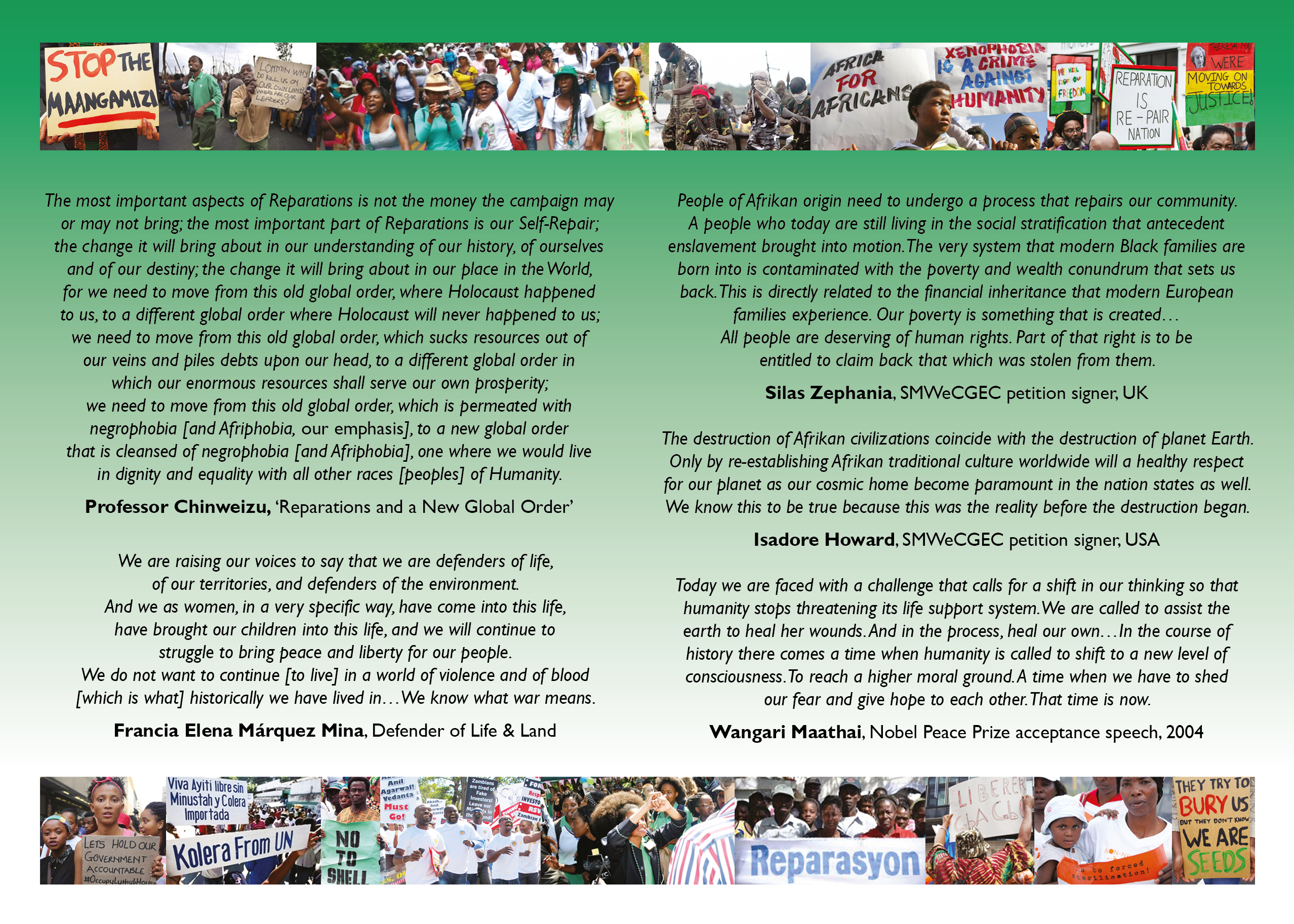
See here for more pictures from the 2016 Afrikan Emancipation Day Reparations March.

vintage-calligraphic-elements-1nyoWZ-clipart

10. Organise local, regional and international Grassroots Reparations Education and Outreach Teams (GREOTs) between the Afrikan Emancipation Day Reparations Marches to continue the street education and mobilisation work for reparatory justice for more info about how to go about this and the GREOT inductions and ‘Education is Preparation for Reparations’ teach-ins and workshops please contact: education@reparationsmarch.org or call 07922035446/ 07597592889 .

11.Start rehearsing arguments in support of reparatory justice for the People’s Open Parliamentary Session on Afrikan Reparations (POPSAR), which was introduced as a feature of the 2016 March. The POPSAR is a mass concientisational forum for public debate and discourse on Afrikan Reparations as a matter of critical social importance. The purpose of the POPSAR is to engage audiences in action-learning on participatory democratic parliamentary debate on critical issues such as Afrikan Reparatory Justice. Each year a different reparations related motion will be debated and people are encouraged to engage in practical rehearsals in preparation for the annual POPSAR on 1st August which takes place as part of the programme for the Afrikan Emanipation Day Reparations March.

12. Do what you can to implement relevant aspects of the ‘SMWeCGE Guidance For Proposals on Parliamentary Actions‘ including the Stop the Maangamizi Postcard Campaign which targets MPs for action towards establishing the APPCITARJ.


sm postcard


13. Agree to host an ‘Education is Preparations for Reparations’ workshop organised by the AEDRMC. Other advanced courses available are the ‘Introduction to the Social Movement for Afrikan Reparations’ course, the ‘Stop the Maangamizi Advocates Course’ or the ‘Reparations Advocacy Training for Allies’ courses delivered by PARCOE, in association with the SMWeCGE Campaign, Momentum Black ConneXions and the Afrikan Reparations Transnational Commuity of Practice (ARTCoP) See this early promo video here as well as this interview with Akala which references the aforementioned training course. For more info about the AEDRMC ‘Education is Peparation for Reparations’ workshops contact the AEDRMC. For more info about the other courses contact: info@parcoe.com.

14. Vote in accordance with pro-reparations choices of candidates for elected public offices, lobby elected public officials to support reparations and the establishment of the UK APPCITARJ as contained in the SMWeCGE Petition. For support in taking this kind of action visit https://globalafrikanpeoplesparliament.org/policy-positions/.

15. Join the ARTCoP which promotes the development of grassroots scholar activists on reparations and harnesses the co-production of activist and other forms of knowledge between advocates, activists and academics on reparations. To contact ARTCoP email: artcop.edu@gmail.com.

16. Among the opportunities that the ARTCoP can open for interested participants in its activities, is training to become a volunteer researcher or advocate for the APPCITARJ and/or the U-PITGJ. This will be particularly beneficial to participants of the Sankofasuafo – Students Bloc of the Afrikan Emancipation Day Reparations March who would like to keep themselves engaged with grassroots scholar-activist work and activities relevant to their normal academic studies in between the annual 1st August Afrikan Emancipation Day Reparations Marches.

17.Contribute to the development of the Europe-wide NGO Consultative Council For Afrikan Reparations, (ENGOCCAR)  and its work programmes including signing its various European language versions of the SMWeCGE in Europe addressed to the European Parliament . For further info contact engoccar@gmail.com or UK representative organisation, PARCOE https://www.facebook.com/parcoeinfo or email info@parcoe.com.

Please also read the ENGOCCAR statement in response to the recently published ‘Public Statement by Civil Society Organisations in Europe and the United States Representing People of African Descent on Britain’s Historical Involvement in the Transatlantic Traffic of Enslaved Africans and Its Far Reaching Impacts’.

18. Organise a church service for ‘Reparations Sunday’ on the second Sunday, or the Sunday closest to 12th October, the European Union (EU) Day for Reparations Related to Colonisation. If you are part of another faith community then you can organise a similar activity on your preferred day of worship closest to 12th October. This action is particularly relevant for people who are interested in building the Imani-Interfath Bloc of the Afrikan Emancipation Day Reparations March.

19. For more info about the reparations activist research, (PhD in history at the University of Chichester), that is being undertaken on the history of the ISMAR in the UK and other matter relevant to reparations learning, advocacy and scholarship please visit: https://reparationsscholaractivist.wordpress.com/about/.

20.For those from other communities (non-Afrikan) who wish to show solidarity with the cause of Afrikan reparations, you can get involved with the relevant programmes and activities of the Global Justice Forum, (GJF).

If you are interested in mobilising as part of the Peoples Reparations International Movement (PRIM), i.e. the reparations movement that consists of all other people’s reparations causes. It is also recommended that you get involved with the Intercommunity Forum.

SM GHILLAR

 First Nation Brother from Australia, Ghillar Michael Anderson, Convenor of the Sovereign Union of Aboriginal Nations and Peoples in Australia and Head of State of the Euahlayi Peoples Republic

If you are from other Black Majority World communities, that do not necessarily define as Afrikan but would like to work in solidarity with the March as non-Afrikan allies, please connect with Momentum Black ConneXions (MBC).

If you would like to get more involved with the Afrikan Emancipation Day Reparations March please contact
Tel: 07922035446/ 07597592889
Email: getinvolved@reparationsmarch.org Twitter: @uk_march.

Or for further info visit:www.stopthemaangamizi.com


In Livicated Service

Esther Stanford-Xosei

Coordinator-General of the International Steering Committee of the Stop the Maangamizi: We Charge Genocide/Ecocide (SMWeCGE) Campaign

Esther Stanford-Xosei is also the Official Spokesperson for the Afrikan Emancipation Day Reparations March Committee (AEDRMC)


https://www.youtube.com/watch?v=VfB7Zj6RacI

vintage-calligraphic-elements-1nyoWZ-clipart

“It will be gross self-delusive wishful thinking to believe that those wielding the reins of White racist supremacy are going to pay and serious heed to the Afrikan demand for Reparations unless their hold on the machinery of global power is effectively challenged by the well-organised, upsurgent and self-empowering masses of Afrikan people and their allied progressive forces throughout the world.”

Kofi Mawuli Klu ‘Charting an Afrikan Self-Determined Path of Legal Struggle for Reparations’, a draft paper for presentation to the 11th December 1993 Birmingham Working Conference of the African Reparations Movement, UK, 1993.

Posted in AEDRMC, ALL PARTY PARLIAMENTARY COMMISSION OF INQUIRY (APPCITARJ), STOP THE MAANGAMIZI PETITION, THE 2016 1ST AUGUST AFRIKAN EMANCIPATION DAY REPARATIONS MARCH, UBUNTUKGOTLA/PITGJ | Tagged Afrikan Liberation, APPCITARJ, Commission of Inquiry, International Social Movment for Afrikan Reparations, Land based reparations, Pan-Afrikan Revolution, People Power, Peoples Tribunal, REPARATIONS, Reparatory Justice, Stop the Maangamizi, U-PITGJ | Leave a comment

ABOUT THE ALL-PARTY PARLIAMENTARY COMMISSION OF INQUIRY FOR TRUTH & REPARATORY JUSTICE (APPCITARJ)

Posted on October 12, 2015 by STOP THE MAANGAMIZI

commission of inquiry 3

This article was updated on 07/08/17, 27/06/18 and 17/10/20 from when it was originally published in 2015

vintage-calligraphic-elements-1nyoWZ-clipart

“The damage sustained by the Afrikan peoples is not a thing of the past, but is painfully manifested in the damaged lives of contemporary Afrikans from Harlem to Harare’ in the damaged economies of the Black World from Guinea to Guyana from Somalia to Suriname.”

Abuja Proclamation of the First Conference on Reparations for Enslavement, Colonisation & Neocolonisation, 1993

vintage-calligraphic-elements-1nyoWZ-clipart

No exact template or model exists for the All-Party Parliamentary Commission of Inquiry for Truth & Reparatory Justice (APPCITARJ) in that it will have to be shaped in a way that meets the needs and aspirations of Afrikan Heritage Communities that have been enslaved, colonised or otherwise oppressed by the British Empire and/or the current British State. However, our vision is that the APPCITARJ will consist of British and European Parliamentary Commissions established with representation from the political parties in these parliaments and thy will hear our submissions as Afrikan Heritage Communities who have been impacted by the Maangamizi (Afrikan hellacaust of chattel, colonial and neocolonial enslavement). This is an example of the revolutionary use of reform in that we are tactically seeking to use establishment institutions and some of their processes to achieve some of our revolutionary objectives for reparatory justice social change and transformation.

For us in the ‘Stop the Maangamizi: We Charge Genocide/Ecocide!’ Campaign (SMWeCGEC), this is not about taking our individual and collective cases to parliamentarians for those parliamentarians, on their own, to decide on the merits of our individual/family/people’s case and to make final judgements about what the outcomes should be. In our view, this adjudication function can best be achieved by the establishment of the Ubuntukgotla-Peoples International Tribunal for Global Justice(U-PITGJ) in which representatives of our people and other peoples who have experienced European colonialism, enslavement and genocide become the judges using law from our various people’s legal traditions. Rather, the establishment of the APPCITARJs, at the levels of the Westminster Houses of Parliament and the European Parliament, are a tactic to facilitate widespread evidence gathering which reveal facts about the magnitude of the Maangamizi and for the public dissemination of that evidence as part of the battle to win hearts of minds and influence public opinion to support our people’s cause.

It is therefore important for the proposed APPCITARJ to seek an appropriately weighted balance between an individualized approach that places victims and perpetrators at the centre of the process and recognising as well as redressing the impact of the Maangamizi on whole collectivities. However, this requires a focus on tackling the systemic aspects of the Maangamizi and examining the role of institutions, structures of legitimisation and governance in its continuance. In this regard, we are keen to ensure that the systemic aspects of the Maangamizi are no longer hidden from scrutiny or public accountability.

vintage-calligraphic-elements-1nyoWZ-clipart

“We call upon the British state to honour the need and right of the descendants of the enslaved to speak in a public forum, provide testimony and evidence of how the legacies of enslavement are resulting in continued human and peoples’ rights violations, impaired quality of life and the ensuing destruction of the essential foundations of life for Afrikan people today.”

SMWeCGEC Petition

vintage-calligraphic-elements-1nyoWZ-clipart

Dissemination of such evidence in the arena of the British public will compel the majority of the British public to agree with us that there is an overwhelming case for their criminal ruling classes to answer. In effect, we want our people to have a ‘hearing’ and to speak to the public, (court of public opinion) through the British Parliament. This entails exposing the evidence to the glare of the public and utilising various forms of media who will be reporting on the proceedings to influence public support for our cause of Afrikan Reparatory Justice. According to the 2005 UN Basic Principles and Guidelines on the Right to A Remedy and Reparation for Victims of Gross Violations of International Human Rights Law and Serious Violations of International Humanitarian Law, an essential aspect of reparations include, among other measures: investigation of the facts, official acknowledgement and apology, receipt of answers; an opportunity for victims to speak in a public forum about their experiences and to have active involvement in the reparative process. We are therefore seeking to ensure that our people’s testimonies will bring to light all the gory details that the British public has not been allowed to hear; has been denied true education about; and that we too have not been allowed to narrate on platforms with official legitimisation.

YOUTH PLARDS

This parliamentary and extra-parliamentary process will create the opportunity for a diverse collectivity of Afrikan voices, from all over the world, to speak to the Maangamizi crimes of the British Empire, the British State and its ruling classes, by providing public testimony about our family and people’s case, as we see it. Once these testimonies of ordinary people, as well as the various research and other forms of documentation of the Maangamizi that exists, are being heard over and over again, clarity will dawn on the British public.

Ultimately, we are seeking to ensure that our combined evidence, voiced, recorded and reported from the UK and European Parliaments, paints the horrific truth of the culprits crimes. This is an opportunity we have never been given. Once the British public have heard the whole truth, it will be easier for us to win them over to our side; to publicise who the main culprits are ; and elucidate the harm that their deception over the years has done not only to Afrikan Heritage Communities, but also to the British people as a whole. This spark-rippling process will in itself compel the majority of those conscientious members of the British people to join us all in movement-building to stop the harm and repair the damage being done to themselves, and to others, in their name. So what will be a just retribution in terms of holding such perpetrators to account? One form of retribution is to strip the criminals of their ill-gotten wealth and status (“Expropriate the Expropriators!) and reclaim our wealth for Reparatory Justice Redistribution.

This slideshow requires JavaScript.

A large part of our people’s case for compensation is that this is unjustly obtained intergenerational wealth includes the wealth that which we as Afrikan Heritage Communities, are historically owed and have been denied, in addition to what is being stolen from and owed to our contemporary generations. We therefore advocate that we must have out of that redistributed wealth, all that we need to repair our own selves i.e. Afrikan Community Self-Repairs*. Although, we concede that the majority of British people deserve some of that wealth from their ruling classes in terms of wealth that has also been stolen from them over the years. Practically, this is how we see that external compensation in the form of the just redistribution of our people’s wealth will be secured.

*Afrikan Community Self-Repairs are the self-determined efforts that need to be made in building our own power, in such a way, that Afrikan heritage communities are able to identify and enhance ongoing work towards stopping the contemporary manifestations of the Maangamizi, which are putting the individuals, families and other social groups that make up our communities into a state of disrepair; as well as reasoning and consciously carrying out the alternative solutions for glocally rebuilding our power base as communities, in such a way that that they are eventually transformed, in accordance with the principles and programmatic demands of Pan-Afrikan Reparations for Global Justice.

vintage-calligraphic-elements-1nyoWZ-clipart

“The inheritance of rich people’s wealth by their children should stop. The expropriators should have their wealth expropriated and redistributed“

Arundhati Roy

vintage-calligraphic-elements-1nyoWZ-clipart

So for us, the strategic purpose of the APPCITARJ is to divorce the masses of the British public from aligning with their ruling classes in order that they can once again be on the right side of history (as were their abolitionists);  in collaborating with us to strip their ruling classes of their ill-gotten wealth and other gains and collaborate with us to secure its redistribution.

One of the greatest challenges for transformative reparatory justice change processes and mechanisms is  addressing not only the histories of acts of Maangamizi dispossession and violence, but also those of structural violence, where power relations are manifest through the systematic and collective violation/s of economic, social and cultural rights. In many contexts, racialised and otherwise marginalised populations, particularly those of Afrikan heritage, are often systematically excluded from community development initiatives as well as often being denied full participation and substantive Afrikan Heritage Community representation in social, economic and political life.  So the way other commissions of inquiry or truth commissions have interacted with ‘victims’ of these harm causing violations; such as receiving testimony, writing histories of victimization in such a way that assists such groups to recover their agency, and recommending reparative approaches – can be replicated with Afrikan Heritage Communities as a collective victim.

The 2014 Instance de la Vérité et Dignité (IVD, Commission for Truth and Dignity) in Tunisia pointed the way, by seeking to address the broad range of demands that the Tunisian Revolution made, including not just for truth, but also threats to dignity including issues such as the lack of graduate jobs and the often extreme geographical inequalities that came to the fore in Tunisia under the Ben Ali regime. To address the issue of the collective and structural violence of social exclusion; and for the first time in the history of truth commissions; the IVD defined and implemented the concept of a collective victim as including: “any person who suffered harm following a violation…, be they individuals, or groups of individuals” (Organic law on Transitional Justice).

To maximize the impact of collective reparations for Afrikan Heritage Communities requires that such reparations not only address harms, but also the structures and institutions underpinning such harms, and ensure that the such reparations transform the circumstances of unjustly impoverished and marginalised victims. Such transformation occuring in such a way as to address contemporary injustice in its multiple dimensions, (i.e. historical, ethnic, social, political, cultural, religious, sexual, epistemic and ecological). Such injustice being underpinned by ‘cognitive injustice’ which is the failure to recognise the plurality of different knowledges by which Afrikan Heritage Communities give meaning to their existence. It is only by pursuing global cognitive justice that holistic and transformative reparatory justice can become a reality. Hence why in our approach to developing the APPCITARJ, we are cognizant of the need to also adopt approaches, processes, mechanisms and initiatives that incorporate the legal cosmovisions (Indigenous worldviews), ideas and claims of Afrikan people. This in itself, requires a more complete set of tools for building alternatives to the present system of legalized injustice.

vintage-calligraphic-elements-1nyoWZ-clipart

“Always remember that the people do not fight for ideas, for the things that exist only in the heads of individuals. The people fight and accept the necessary sacrifices. But they do it in order to gain material advantages, to live in peace and to improve their lives, to experience progress, and to be able to guarantee a future for their children. National liberation, the struggle against colonialism, working for peace and progress, independence – all of these will be empty words without significance for the people unless they are translated into real improvements in the conditions of life.”

          Amilcar Cabral, Guinea-Bissau: A Study of Political Mobilisation, 1974, p.91

vintage-calligraphic-elements-1nyoWZ-clipart

Among the challenges facing reparations for Maangamizi resistors and survivors, is to differentiate between reparations and the requirement that a state deliver basic public services. Reparatory justice measures will not be secured from others outside of a comprehensive and holistic Afrikan Heritage Community Pempamsie (sewing together) Community Self-Repairs Plan and related policies, which must accompany and shape it. This is why we in the SMWeCGEC, in partnership with the Afrikan Emancipation Day Reparations March Committee (AEDRMC), its allied organisations and other formations, are mobilizing and supporting others to self-organise year-round building on the 2017-2018 Afrikan Emancipation Day Reparations March theme of ‘Promoting the reparatory justice change that we are organising to bring about’ with the 2018-2019 theme: ‘Nothing About Us Without Us: Actualizing the Reparatory Justice Change We Envisage‘!

The beginnings of  such a Pempamsie Plan were documented in the 2003 Black Quest for Justice Campaign (BQJC) legal & extra-legal Strategy for Pan-Afrikan Reparations for Gobal Justice; and were included in its legal action supported by the Pan-Afrikan Reparations Coalition in Europe (PARCOE), the Black United Front (BUF), the then newly formed Global Afrikan Congress (GAC) and the International Front for Afrikan Reparations (IFAR).

This slideshow requires JavaScript.

Characteristics of Commissions of Inquiry with Truth Commission Functions:

In her thesis, ‘Truth Commissions and Public Enquiries: Investigating Historical Injustices in established Democracies’ Kim Stanton asserts that the truth commission is really a specialised form of public inquiry that has developed over the last three decades as a response to historical injustices.

vintage-calligraphic-elements-1nyoWZ-clipart

“In recent decades, the truth commission has become a mechanism used by states to
address historical injustices. However, truth commissions are rarely used in established
democracies, where the commission of inquiry model is favoured. I argue that established
democracies may be more amenable to addressing historical injustices that continue to
divide their populations if they see the truth commission mechanism not as a unique
mechanism particular to the transitional justice setting, but as a specialised form of a
familiar mechanism, the commission of inquiry. In this framework, truth commissions are
distinguished from other commissions of inquiry by their symbolic acknowledgement of
historical injustices, and their explicit “social function” to educate the public about those
injustices in order to prevent their recurrence.”

Abstract, Kim Pamela Stanton (2010), pii

vintage-calligraphic-elements-1nyoWZ-clipart

To get a sense of what we are envisioning for the APPCITARJ, it is best to understand what a truth commission is.

• Truth commissions are generally understood to be “bodies set up to investigate a past history of violations of human rights in a particular country -which can include violations by the military or other government forces or armed opposition forces.”[1] Priscilla B. Hayner, in ‘Unspeakable Truths’ delineates four main characteristics of truth commissions:

1. First, they focus on the past and its impact. The events may have occurred in the recent past, but a truth commission is not an ongoing body akin to a human rights commission.


2. Second, truth commissions investigate a pattern of abuse over a set period of time rather than a specific event. In its mandate, the truth commission is given the parameters of its investigation both in terms of the time period covered as well as the type of human rights violations to be explored.

3. Third, a truth commission is a temporary body, usually operating over a period of six months to two years and completing its work by submitting a report. These parameters are established at the time of the commission’s formation, but often an extension can be obtained to wrap things up.

4. Fourth, truth commissions are officially sanctioned, authorised, or empowered by the state. This, in principle, allows the commission to have greater access to information, greater security, and increased assurance that its findings will be taken under serious consideration. Official sanction from the government is crucial because it represents an acknowledgment of past wrongs and a commitment to address the issues. Furthermore, governments may be more likely to enact recommended reforms if they have established the commission.

PUBLIC HEARING

Goals of truth commissions include:

• Making recommendations for redress suffered by victims and survivors
• Recording and educating about the past
• Identifying perpetrators
• Formulating policy proposals and recommendations on rehabilitation and the healing of Maangamizi resistors, survivors, their families and the community at large
• Providing the victims/survivors with different forms of support to ensure that the commission of inquiry/truth commission process restores the victims’ dignity
• Preventing repetition of aspects of the Maangamizi
• Forming the basis for a new pluriversal democratic order
• Promoting reconciliation
• Creating a collective memory.

You can see  a list of previous truth commissions here.

Characteristics of commissions of inquiry with truth commission functions:

  • They are non-judicial mechanisms but can complement judicial mechanisms;
  • They are commissions of inquiry whose primary function is investigation of human and people and Mother Earth rights violations and violations of humanitarian law, unlike courts or tribunals which deal with adjudication;
  • They focus on severe acts of violence or repression;
  • They are victim-centred bodies focused on victims ideas, views, needs, experiences and preferences as primary focus as opposed to elite witnesses or perpetrators;
  • They formulate recommendations to guarantee the non-repetition of past crimes and reform state institutions involved in the commission of human, peoples and Mother Earth rights violations.

Truth Commission Activities

  • Investigations/ documentation of violations/ research
  • Statement taking
  • Interview/ public hearings
  • Victim Support
  • Events and programmes to promote intra and inter community cohesion, reconciliation and conciliation
  • Public awareness.

Advantages of the APPCITARJ:

  • It can delegitimize Maangamizi denial;
  • It can rebut misrepresentations of the old order through investigations, public hearings and detailed reports;
  • It can spur significant national debates;
  • It can help governments to take corrective/reparatory actions and develop reparatory policies;
  • It can provide a measure of accountability for the legacies of past and present atrocities and violations/abuses of human, peoples and Mother Earth rights through its findings.

There are many factors that will determine the composition and mandate of the APPCITARJ including how much we are able to bring pressure to bear on relevant decision-makers and institutions. There has already been some thinking, analysis, research and consultation on what the purpose of the APPCITARJ should be, although this is an evolving process.

PLACRDS CO2

The APPCITARJ will seek to:

  1. acknowledge the fundamental injustice, cruelty, brutality, and inhumanity of the imposition of the Maangamizi, i.e. Afrikan chattel, colonial and neocolonial enslavement within and beyond the British Empire;
  2. examine subsequent de jure and de facto racial and economic discrimination against Afrikans and people of Afrikan descent;
  3. examine the impact of these forces on living Afrikans and Afrikan descendant communities, as well as other peoples;
  4. make recommendations to Parliament and similar bodies at local, national and international levels, including the European Parliament, and;
  5. Determine appropriate methods of dissemination of findings to the public within and beyond Britain for consultation about proposals for supporting Afrikan Heritage Community Self-Repairs and designing other forms of redress and repairs.

2020-groundings-2-1

On the importance of speaking our grassroots power of truth to establishment power

baldwin 2

vintage-calligraphic-elements-1nyoWZ-clipart

“The victim who is able to articulate the situation of the victim has ceased to be a victim… he or she has become a threat.”

James Baldwin, ‘The Devil Finds Work’, 1976

vintage-calligraphic-elements-1nyoWZ-clipart

In providing testimony, the so-called victim/survivor becomes an agent, and his/her narrative is especially threatening because it dares to expose violations and violence when others declare that such oppressions do not exist.

The APPCITARJ will not substitute a judicial process and is not designed to let perpetrators off the hook. Hence the need for the APPCITARJ to evolve in conjunction with the U-PITGJ. The organising processes towards establishment of the APPCITARJ, including the mobilisational role of the SMWeCGEC, will also galvanise grassroots work towards establishing glocal sittings of the U-PITGJ, as part of a series of actions which will put a full stop, by way of holistic and transformative reparations, to all acts of Genocide/Ecocide against Afrikan people.

Sign reparationsmarch-0679

Begin preparing yourself for the APPCITARJ & U-PITGJ


You can prepare yourself for the APPCITARJ by beginning to do family and community research on how we and our immediate families each have suffered, continue to suffer and have also challenged the various crimes of the Maangamizi. In this regard, see the aims of the SMWeCGEC.

Afrikans in the UK and Europe organising towards establishing commissions of inquiry for truth and reparatory justice and local, national and international people’s tribunals to hold the governments of Britain, and other European countries to account. If you are able to gather such evidence you can assist us  to arrive at a comprehensive assessment and a full picture of what our journeys and experiences of the Maangamizi have been across the Diaspora, as well as on the continent of Afrika.

Each person and representative of families and their communities have to become our own advocates and experts on your own situation and then we can bring all these experiences together as part of us becoming ‘reparations enforcers’ who are building the power and capacity to hold to account all those who are continuing to profit from the ill-gotten gains of the Maangamizi and are also complicit in its perpetuation today.

See the video below from the documentary ‘Freedom Summer’ for some APPCITARJ lessons from our Shero Fannie Lou Hamer.

https://www.facebook.com/AmericanExperience/videos/10154189386704122

Hamer’s testimony had such a huge impact upon the government and public in and outside the USA, and was so powerful, that President Lyndon B. Johnson called an impromptu press conference to get her off the air. This is a recording of the full testimony and also a transcript of that testimony. Her testimony provides an example of what we envisage could be the impact similar ISMAR-coordinated grassroots testimonies by our Afrikan Survivors, Resistors and Challengers of the Maangamizi, from all over the World to the APPCITARJs in the UK Parliament of Westminster and the European Parliament. We surmise that the ‘holding to account’ referred to above can best be done in a collective way by supporting the establishment of the Ubuntukgotla, court of peoples humanity interconnectedness, otherwise known as the Peoples International Tribunal for Global Justice (U-PITGJ), which we encourage you to support the development of. This can be done through hosting sittings of the tribunal, locally, nationally and internationally.

As part of the rationale for this approach, it is important to have a better sense of the historical antecedents of the SMWeCGEC in the UK, see these historic recordings from 2003 of Esther Stanford-Xosei, former legal advisor to the BQJC speaking about the BQJC legal & extra-legal strategy for reparations; the need for a UK commission of inquiry to address the legacies of the Maangamizi; and the commencement of the UK version of the ‘We Charge Genocide Petition and campaign’ under the auspices of then then Black United Front-Parliament (BUF-P). The second set of videos where Stanford-Xosei is interviewed, precedes in order and time the first video where she speaks to camera.


Set up a family or community group Maatzoedzaduara

You can set up a MAATZOEDZADUARA (i.e. Maat action-learning circles or ‘Maat Training Practice Rings’) which is a reparatory justice circle of Maat practitioners who learn to be the self-repairs change at the levels of their person, home, family, neighbourhood, workplace, school, places of leisure and worship, etc. These Maat Training Practice Rings encompass a number of families and lineages, across geographical boundaries and generations. For example, a home or family based Maat Training Practice Ring will entail getting a selected number of people in your family interested in unravelling family histories and using this knowledge to recognise and gather evidence of the harm that has been done to you as a family.

The Practice Rings will also explore how such harms have been passed down throughout the generations, resulting in increasing levels of disrepair. We are looking for case studies of some of these family stories documenting family member’s lived experiences of the Maangamizi and resistance to it. This unravelling of these stories is part of the process of repairing the harm and continuing damage being done and passed down intergenerationally within our own families.


maat-balance                 

©www.zengarner.com

You can also creatively utilise SMWeCGEC Petition Soulsquestathons (SMWeCGEC-PS), which are literally a collection of souls, for spark-rippling MAATZOEZADUARAs. The aim is to link chains of MAATZOEZADUARAs together encompassing a number of families, across geographical boundaries and generations, all over the place, as Grassroots Afrikan Reparatory Justice Action Learning Praxis Exercising Rings (GARJALPERs) of the U-PITGJ. This means that they will share their stories and practice not only testifying with these stories but also putting their cases through trial rehearsals. The key point about the Soulsquestathons is that the various participants connect to, compare and contrast their self-repairs reparatory justice work as families within these MAATZOEZADUARAs. Basically, these are intergenerational connections, not only of family members of the present, but also the past. It therefore becomes necessary for us to keep records about and bring the lives and work of our revered Ancestors into our everyday lives of the present.

If you would like to know more about how to get involved with the APPCITARJ/U-PITGJ or you would like support with setting up a Maatzoedzaduara please contact PARCOE on info@parcoe.com or 07751143043.

PLACRDS COI 23

Share your story!

One of the roles of the APPCITARJ will be to gather statements from Maangamizi resistors, survivors and anyone else who feels they have been impacted by the Maangamizi and its legacies.

It is our intention to coordinate the collection of individual statements by written, electronic or other appropriate means such as audio-visual recordings with regard to providing a safe, supportive and sensitive environment for individual/collective/group statement taking/truth sharing.

If you would like to begin with compiling your story as a case study or indeed to make a statement about the impact of the Maangamizi, you are invited to contact us to discuss how best this can be done.

You can also lobby your local MP and other public elected officials to support the establishment of the APPCITARJ by utilising this SMWeCGEC postcard campaign tool.

It is important that you let us know how you get on with your local MP or other publicly elected officials so that we can keep a record of progress or where there is a need for more focused lobbying. Here are the contact details for the SMWeCGEC. Please also see this guidance on Guidance on Proposals for Parliamentary Actions.

stop-the-maangamizi-appcitarj

What next?


In partnership with the Afrikan Emancipation Day Afrikan Reparations March Committee and other reparatory justice organising processes, we in the SMWeCGEC will continue to consult and canvass our communities, networks and constituencies of the ISMAR on the following four themes:

1. How best people can be involved and participate in the APPCITARJ?
2. Aims, hopes and fears for the APPCITARJ?
3. Mandate, terms of reference, powers and structure of the APPCITARJ?
4. What are the other ways to deal with the legacies of the Maangamizi and enforce accountability?

The SMWeCGEC will continue to develop alliance-building work; such as has occurred with the Green Party who at their 2020 autumn conference which concluded on the 11th October 2020, passed a motion on ‘Atonement and Reparative Justice for the Transatlantic Traffic in Enslaved Africans‘. The SMWeCGEC worked with members of the Green Party in developing this motion.

Volunteer researchers required to contribute to a people’s history-making process of securing reparatory justice!

Law students

If you are a law or politics student or have other relevant skills and experience and you are interested in using your knowledge and skills to support Afrikan people’s struggle for holistic redress and secure Afrikan Reparatory Justice, you can become a volunteer researcher. We are looking for volunteer researchers who would like to join the SMWeCGEC research team in preparations for establishing the APPCITARJ and the U-PITGJ. If you would like to get involved, please contact: Afrikan Reparations Transnational Community of Practice (ARTCoP) on artcop.edu@gmail.com or PARCOE on info@parcoe.com or 07751143043.

Support from movement lawyers is welcome!

If you are a social justice advocate, legal practitioner or cause lawyer and would like to offer pro-bono advice or support to this community-led initiative; are willing to build equitable relationships with people and organisations challenging historical and contemporary injustice; and are prepared to respect the approach of social justice/community lawyering,*please also get in touch as above.

*Community lawyering has many variants: collaborative lawyering, community, lay lawyering, cause lawyering, social justice lawyering, political lawyering, critical lawyering, rebellious lawyering, movement-lawyering etc. The common thread among them is that the clients, not the lawyers, play a central role in resolving the issues that have an impact on their opportunities to succeed. It is: lawyering that is community-located, community-collaborative, community-directed and based on the collaboration of lawyers, clients and communities in which they live; and transforming law and lawyering to address the inequalities experienced by subordinated and underserved groups. The legal system in the UK and other Westernised countries is very individualistic. It tends to atomise and depoliticise disputes, which work against a community organising model. Furthermore, the facilitation of individual rights has not benefited the long-term needs of communities, especially impoverished communities, especially where such impoverishment is as a result of intergenerational injustice. The Sargent Shriver National Centre on Poverty Law (USA) defines “community lawyering” as a “process through which advocates contribute their legal knowledge and skills to support initiatives that are identified by the community and enhance the community’s power.”

Similar to the different schools of thought in community organising, community lawyering has many different strains. However, what sets lawyers who adopt community lawyering apart from each other boils down to their answers to the following three questions: Who do you work with? What do you do for them? And how do you work together? Similar to community organising, the answers to these questions vary depending on the political orientation of the lawyer and the theory of social change they ascribe to. By combining legal recourse and community organising, it is possible to utilise “community lawyering” as a social change strategy.” This approach engages lawyers who are prepared to de-emphasise litigation as the primary tool for advancing social justice. Instead, community lawyering encourages such lawyers, in collaboration with communities, their groups, activists and organisers, to critically and creatively examine non-traditional forms of advocacy such as facilitative leadership, institution-building, community organising, collective action and other grassroots actions including strategic litigation, media events, community education workshops and public demonstrations. This is done as a way of addressing the legal and non-legal problems of their clients. Community lawyering can also be described as a more participatory process that fosters collaboration between lawyers and their community (group) clients, rather than fostering—if not perpetuating—the dependency that most clients have on their lawyers to solve their legal problems in a conventional lawyer-client relationship. 

The role of a “community lawyer” entails working in partnership with one’s community clients and utilises multiple forms of advocacy, to address their individual as well as systemic problems. Community lawyering practitioners recognise that their clients are partners—not just in name—but in leadership, control and decision-making. Through collaboration, lawyers can support Afrikan Heritage Community groups in building their own resources and community capacities to advance their own interests in effecting and securing reparatory justice in a self-determined and self-directed manner.

Another critical component of community lawyering is creating race-conscious cultural competence—a set of beliefs, values, and skills built into a structure that enables one to negotiate cross-cultural situations in a manner that does not force one to assimilate to the other. The goal of race-conscious community lawyering is to support lasting structural and systemic changes that will bring about holistic reparatory justice for racialised groups.

Movement-lawyering is a specific form of community lawyering but the lawyers work in collaboration with grassroots movements. This lawyering recognises that community members and organisers have expertise that should be valued. In fact, movement lawyers should also be engaged in a process of political study and growth collectively with movement-organisers that are aligned with particular community struggles. Here are some tips for lawyers that are aligned with movements and are particularly relevant to how lawyers can best support communities, their activists and organisers who are engaged in reparatory justice struggles as part of the ISMAR.

COI CHRISTOPHER ICHA

Notes
[1] Priscilla B. Hayner, Unspeakable Truths. New York: Routledge, 2001, p. 14.

Posted in AEDRMC, AFRIKAN HELLACAUST, ALL PARTY PARLIAMENTARY COMMISSION OF INQUIRY (APPCITARJ), INTERNATIONAL SOCIAL MOVEMENT FOR AFRIKAN REPARATIONS, ISMAR, PALM, PREFIGURATIVE POLITICS, REPARATIONS, Reparatory Justice, STOP THE MAANGAMIZI CAMPAIGN, STOP THE MAANGAMIZI PETITION, UBUNTUKGOTLA/PITGJ | Tagged Allies, APPCITARJ, British Colonialism, British Government, Cognitive Justice, Commission of Inquiry, Green Party, Green Party Conference, Greens of Colour, International Social Movment for Afrikan Reparations, ISMAR, Maangamizi, People Power, Peoples Tribunal, REPARATIONS, Reparatory Justice, Self-Repairs, SMWeCGE Petition, Social Movement, Stop the Maangamizi, We Charge Genocide/Ecocide! | Leave a comment

Post navigation

Newer posts →

Recent Posts

  • SMWeCGEC MP Letter Template Guidance
  • MET brokers partnerships in Belize to advance reparations education & campaigning initiatives
  • Statement Issued by the Afrikan Emancipation Day Reparations March Committee & The Stop The Maangamizi: We Charge Genocide/Ecocide Campaign regarding Co-Organising the 1st Mosiah 2024
  • Theme for the PARRG 2023
  • SMWeCGEC & AEDRMC Key Achievements in ISMAR & PRIM-building

Recent Comments

Kitchen Kara's avatarKitchen Kara on METRO NEWSPAPER ADVERT 21, 25…
Enita Barrett's avatarEnita Barrett on MET brokers partnerships in Be…
Adé Olaiya, M.A.'s avatarAdé Olaiya, M.A. on Ourstory continues to be made:…
Morgan Moss, JR's avatarMorgan Moss, JR on Ourstory continues to be made:…
Morgan Moss, JR's avatarMorgan Moss, JR on Response to 2nd written questi…

Archives

  • March 2025
  • August 2024
  • June 2024
  • July 2023
  • June 2022
  • February 2022
  • December 2021
  • November 2021
  • October 2021
  • September 2021
  • June 2021
  • May 2021
  • March 2021
  • February 2021
  • January 2021
  • December 2020
  • November 2020
  • October 2020
  • September 2020
  • August 2020
  • July 2020
  • June 2020
  • December 2019
  • November 2019
  • August 2019
  • June 2019
  • May 2019
  • March 2019
  • February 2019
  • January 2019
  • December 2018
  • November 2018
  • October 2018
  • August 2018
  • July 2018
  • April 2018
  • March 2018
  • February 2018
  • December 2017
  • November 2017
  • October 2017
  • September 2017
  • August 2017
  • July 2017
  • June 2017
  • May 2017
  • March 2017
  • February 2017
  • December 2016
  • November 2016
  • September 2016
  • August 2016
  • July 2016
  • May 2016
  • April 2016
  • March 2016
  • January 2016
  • October 2015

Categories

  • 2019 AFRIKAN EMANCIPATION DAY REPARATIONS MARCH
  • AEDRMC
  • AFRIKAN HELLACAUST
  • AFRIKAN RESISTANCE
  • ALL PARTY PARLIAMENTARY COMMISSION OF INQUIRY (APPCITARJ)
  • APPGAR
  • Ecocide
  • EVENTS/TRAINING
  • Extinction Rebellion
  • I AM WITNESS
  • INTERNATIONAL SOCIAL MOVEMENT FOR AFRIKAN REPARATIONS
  • ISMAR
  • Jerry Amokwandoh
  • MAANGAMIZI RESISTANCE
  • MAANGAMIZI RESISTERS
  • MAANGAMIZI RESISTORS
  • PALM
  • Pan-Afrikan Liberation Movement
  • PARRG 2022
  • PARRG 2023
  • POPSAR
  • PREFIGURATIVE POLITICS
  • PRIM
  • REPARATIONS
  • Reparations Rebellion
  • REPARATIONS REBELLION 2020
  • REPARATIONS REBELLION GROUNDINGS
  • Reparatory Justice
  • SMWeCGEC
  • SMWeCGEC CAMPAIGNING TOOLS
  • STOP ECOCIDE
  • STOP THE MAANGAMIZI CAMPAIGN
  • STOP THE MAANGAMIZI PETITION
  • THE 2016 1ST AUGUST AFRIKAN EMANCIPATION DAY REPARATIONS MARCH
  • THE 2017 AFRIKAN EMANCIPATION DAY REPARATIONS MARCH
  • THE 2018 AFRIKAN EMANCIPATION DAY REPARATIONS MARCH
  • UBUNTUKGOTLA/PITGJ
  • Uncategorized
  • YOUNG PEOPLE/ GLOBAL MAJORITY V UK GOV

Meta

  • Create account
  • Log in
  • Entries feed
  • Comments feed
  • WordPress.com
Blog at WordPress.com.
  • Subscribe Subscribed
    • stopthemaangamizi.com
    • Join 49 other subscribers
    • Already have a WordPress.com account? Log in now.
    • stopthemaangamizi.com
    • Subscribe Subscribed
    • Sign up
    • Log in
    • Report this content
    • View site in Reader
    • Manage subscriptions
    • Collapse this bar
 

Loading Comments...