2018 PROMOTIONAL FLYER
2018 PROMOTIONAL VIDEOS
Call to action video:
Rationale for why we march video
Link to jingles for radio
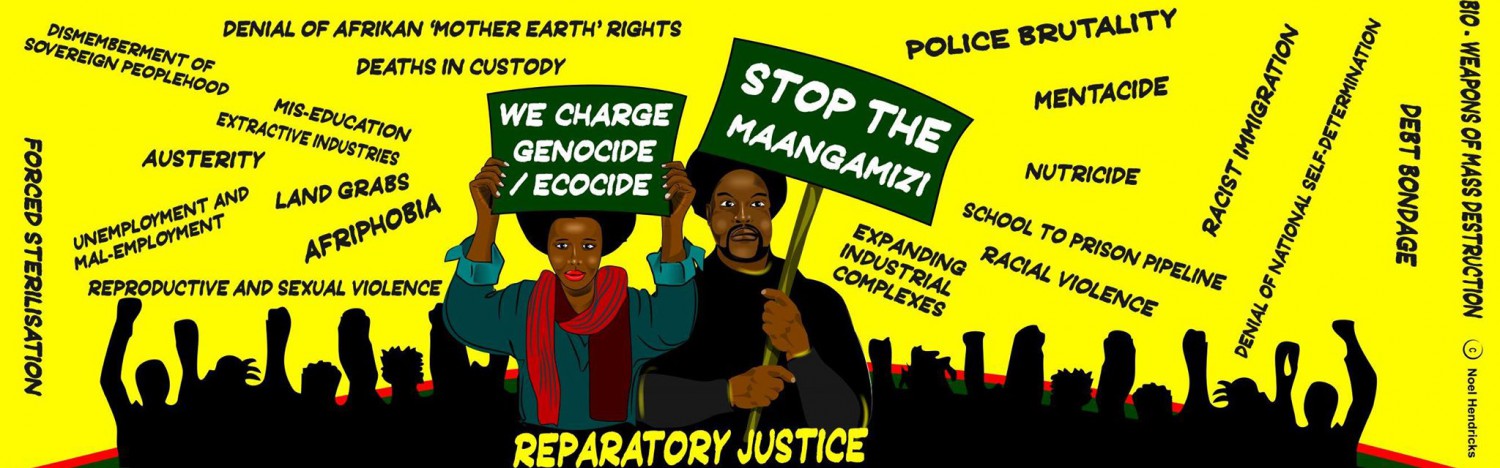
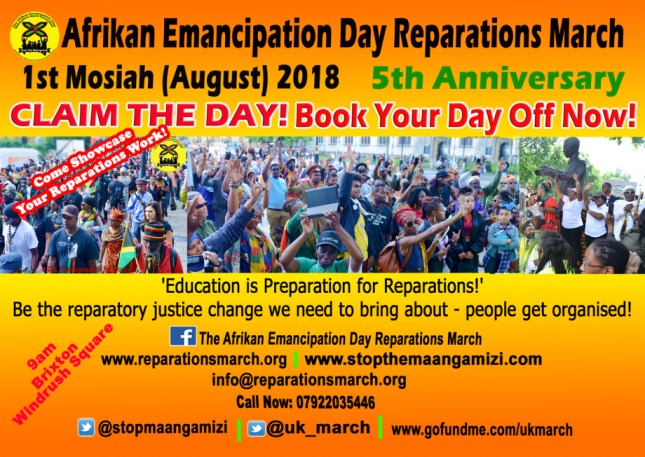
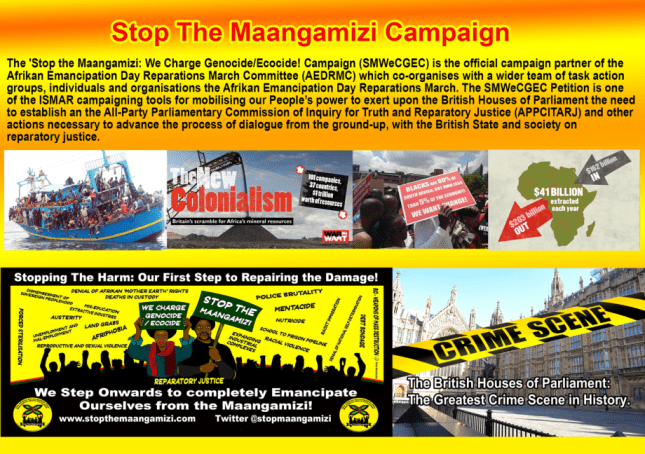
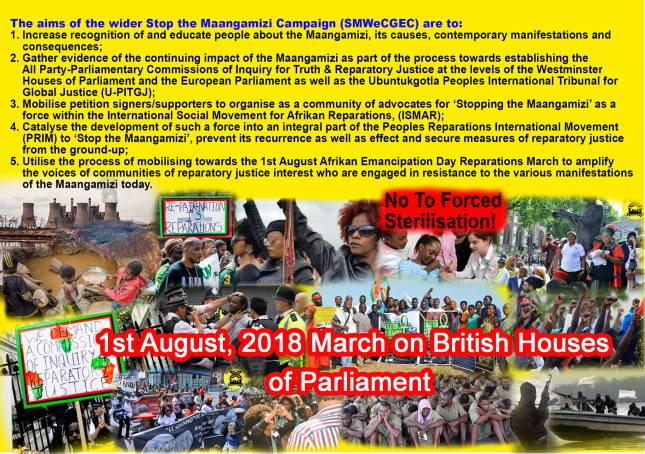
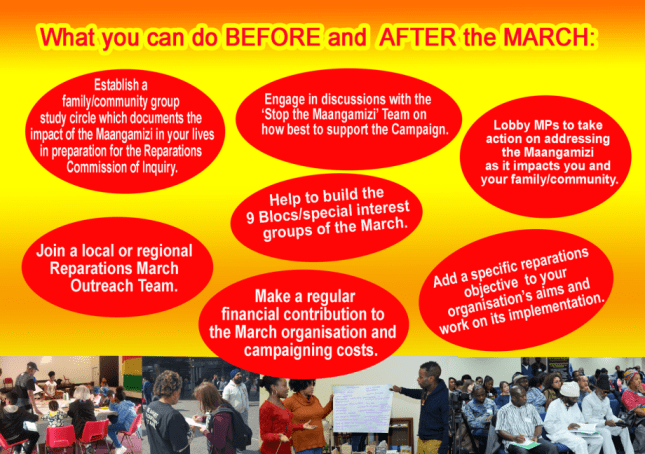
2018 PROMOTIONAL FLYER
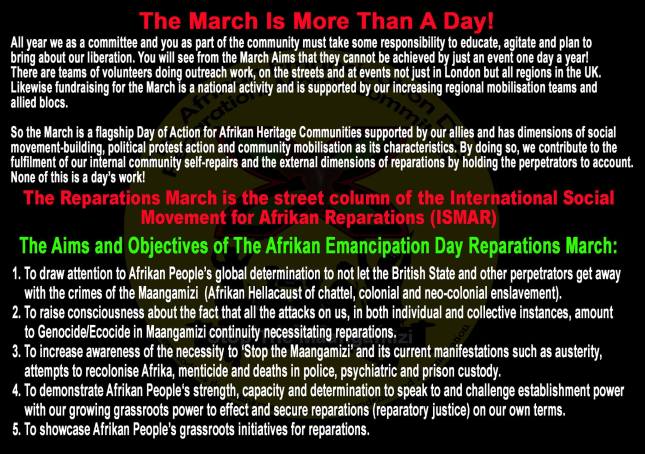
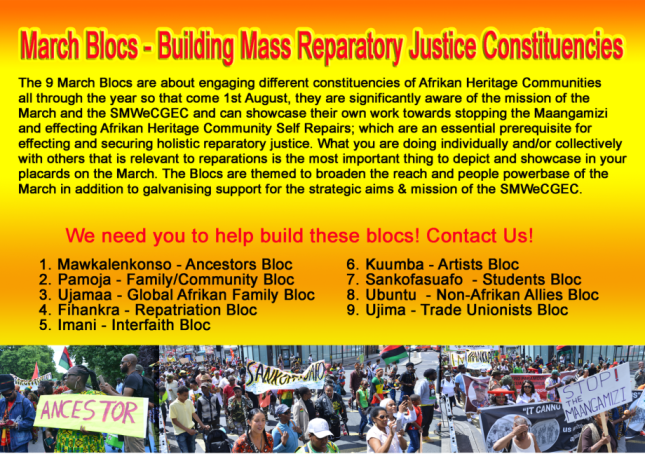
2018 PROMOTIONAL VIDEOS
Call to action video:
Rationale for why we march video
Link to jingles for radio

Greetings Supporters of the ‘Stop the Maangamizi: We Charge Genocide/Ecocide! Campaign (SMWeCGEC)
Following the 13th April 2018 news report on the front page of the Times Newspaper: ‘PM should apologise to ex-colonies says Labour’, it would appear as if the Labour Party is now taking steps towards listening to Afrikan voices for reparatory justice. It is only now since the passing of the late Bernie Grant MP that Labour is thinking of hearing Afrikan voices like his on our intergenerational struggle for reparatory justice.
Within 24 hours of the 11 April 2018 letter from Esther Stanford-Xosei being sent to Heidi Alexander MP and also made available to the office of the Rt Hon Jeremy Corbyn MP, leader of the Labour Party, the Shadow Foreign Secretary, Emily Thornberry, advocates in the House Magazine that Prime Minister Theresa May should use the forthcoming Commonwealth Heads of Government Meeting to apologise for the UK’s historic wrongs. Emily Thornberry also states that, if Labour form the next government in Britain, they will ensure that promoting and engaging with the Commonwealth is one of their top foreign policy priorities. In Esther Stanford-Xosei’s letter to Heidi Alexander she states:
“The fact that BREXIT is making it necessary for the UK Government to seek to strengthen its Commonwealth links in the aftermath of the BREXIT vote raises questions pertinent to Afrikan Reparatory Justice. Among such questions, for example, is the one about what type of relationship is Britain seeking to strengthen with Afrikan and Caribbean countries of the Commonwealth when the existing relationship is not only a product of the crimes of the past, but also fortifies present wrongs of the Maangamizi? So much is this the reality, that in the opinion of the constituencies of the ISMAR to which I belong, this relationship can only be transformed to ensure justice for all, by measures of reparations that will enable Afrikans and people of Afrikan heritage to equitably participate in re-ordering the war-begotten, unequal and unfair system of international relations that continues to be imposed, with manly Euro-American imperial might, upon the globe today.”
It would appear that Emily Thornberry is in her article also providing an answer to the above question that has been posed, in various arenas, by SMWeCGEC and some other formations of the International Social Movement for Afrikan Reparations (ISMAR) when she states:
“…we see our Commonwealth cousins [not] just as potential trading partners, but [because] we see them as full and equal partners in all of the challenges faced by the world and by each of our nations, from climate change and terrorism to the fight for gender equality.”
We in the SMWeCGEC are of the view that the above comment on behalf of the Labour Party demonstrates that they can be influenced to advance steps towards better listening to the case being made for holistic reparations by authentic Afrikan Heritage Community voices in and beyond the UK who are involved in building the ISMAR. However, this realisation should, under no circumstances. make campaigners for Afrikan reparations lower our guard about critically engaging with the Labour Party and the wider Labour Movement on what repairs ought to mean, so as to enable us make gains of true reparatory justice.
That is why we should be mindful and seek to ensure that the Labour Party is not made, by ‘BAME’ gate-keeping apparatchiks and other sections still clinging to its old ways of misusing the bureaucratic party machinery, to distort the legitimate measures of redress that oppressed communities influence it to address by revising them, sometimes even to the point of outright deformation; so that at the stages of policy-formulation and implementation, they become mere white-washing tokenistic gimmicks which tinker Afriphobically with vital concerns of particularly Afrikan Heritage Communities; thereby robbing us of the agency that is vitally necessary for us to do for ourselves the true reparatory justice we are seeking.
So let us keep knocking at the door of publicly elected officials as those seeking such offices will come knocking on our doors in the coming weeks soliciting our votes. We must ensure that we use our votes wisely to make candidates we may be inclined to vote for support our Afrikan Heritage Communities strategic interests and concerns; top-most on the agenda should be their support for Afrikan Reparatory Justice and their concrete action on the ‘Stop the Maangamizi!’ Postcard demands.
In Service
‘Stop the Maangamizi: We Charge Genocide/Ecocide!’ Campaign International Steering Committee Spearhead Team (ISC-SMWeCGEC)
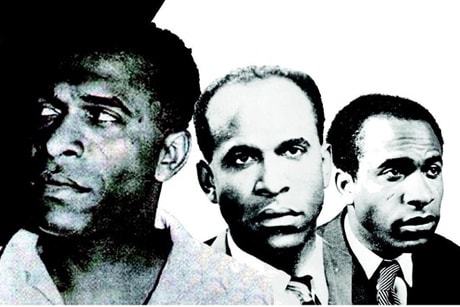
“The future will have no pity for those men and women who possess the exceptional privilege to speak the words of truth, instead have taken refuge in an attitude of cold complicity and mute indifference.“
Revised quote from Frantz Fanon, ‘Toward the African Revolution: Political Essays’, 1994
Greetings Supporters of the ‘Stop the Maangamizi: We Charge Genocide/Ecocide!’ Campaign (SMWeCGEC)
The letter below is the latest in the ongoing correspondence between Esther Stanford-Xosei and MP, Heidi Alexander, on issues to do with the SMWeCGEC and the campaign’s work for reparatory justice:
ESTHER STANFORD-XOSEI LETTER TO HEIDI ALEXANDER MP RE RESPONSE FROM FCO MINISTER LORD AHMAD
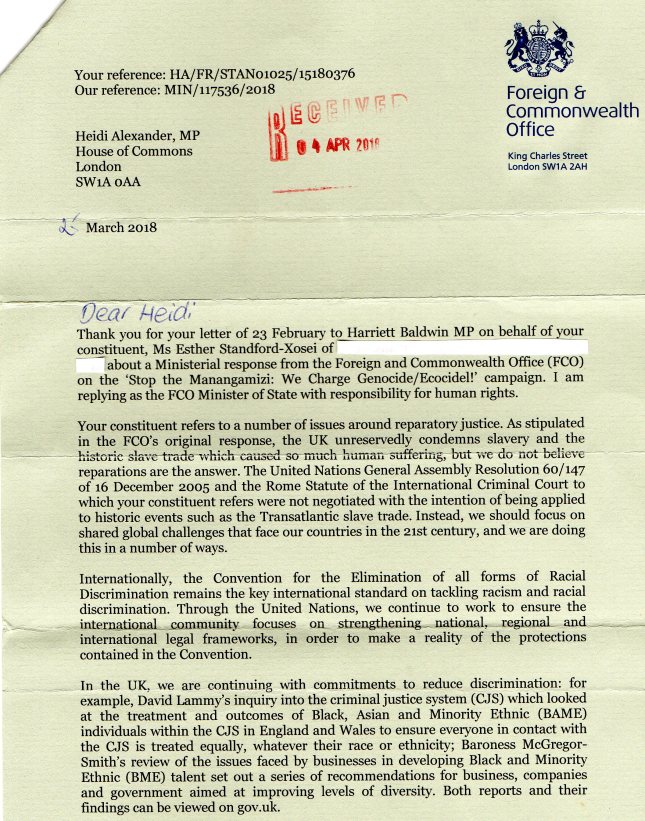
The letter from Esther Stanford-Xosei deals with the response from Foreign & Commonwealth Minister of State for the Commonwealth and the UN, Lord Ahmad to the 2017 ‘Stop the Maangamizi!’ Petition and its accompanying correspondence.
The exchanges so far show that as much as sections of the Labour Movement are becoming more interested in communications with certain constituencies of the International Social Movement for Afrikan Reparations (ISMAR), there is a greater need to ensure that the Labour Party is challenged to develop a correct way of dealing with the issues raised in the correspondence and our Afrikan Heritage Communities in consonance with the ethics of reparatory justice. This must also be done in such a way that recognises Afrikan people’s human and people’s right to Substantive Afrikan Heritage Community Representation.
What this means is that Labour Party is being challenged by SMWeCGEC and other Afrikan Reparations campaigners to engage in ‘institutional self-repairs’ in the ways it deals with Afrikan Heritage Communities and our autonomous community organisations as well as the issues that concern us. Only by doing so, will it become a worthy stakeholder with locus standi in Afrikan Heritage Community reparatory justice engagements.
In livicated Service!
Stop the Maangamizi: We Charge Genocide/Ecocide! Campaign International Steering Committee Spearhead Team (ISC-SMWeCGEC)
Greetings Supporters of the ‘Stop the Maangamizi: We Charge Genocide/Ecocide!’ Campaign (SMWeCGEC)
Last October we notified you about the launching of the International Network of Scholars & Activists for Afrikan Reparations (INOSAAR) in association with PARCOE, the Pan-Afrikan Reparations Coalition in Europe. We in the International Steering Committee Spearhead Team of the ‘Stop the Maangamizi: We Charge Genocide/Ecocide!’ Campaign (ISC-SMWeCGEC) recognise this initiative for making a significant and unprecedented contribution to developing the intellectual arsenals necessary for tackling Afriphobia and other manifestations of the genocide/ecocide; particularly its mentacide within and beyond educational institutions. We are also pleased that the SWWeCGEC is recognised in the INOSAAR Principles of Participation.
Since the launch event, the INOSAAR has had a conference in Birmingham and looks forward to two follow-up events in Senegal and a conference in Benin. One of the follow-up actions arising from the recent INOSAAR Birmingham Conference was for INOSAAR members and constituencies to support us in getting their MPs to support a meeting in the House of Parliament to discuss ‘The Academic Legitimacy of the Afrikan Case for Reparations and its Implications for British State Policy-Making’.
See this link for the template letter which you can amend accordingly and send to your own MPs if you are based in the UK. The text is also reproduced below.
Please let INOSAAR know of any progress you make with your MPs by emailing Dr Nicola Frith & Professor Joyce Hope Scott at inosaar.ed.ac.uk.
Dear [MP NAME]
I am writing as local constituent regarding a matter of concern to me as a person of Afrikan heritage/a concerned member of the public [DELETE AS APPROPRIATE].
I was horrified to recently discover that up until 2015, tax-payers in Britain, including myself as a descendant or relative of enslaved Afrikans [DELETE IF NOT APPLICABLE], were paying off a debt that was accrued as a result of the compensation awarded to British enslavers as legislated with the Slavery Abolition Act 1833 (see, for example, the article in the Bristol Post from 13 February 2018).
The opinion of experts working in the field, like Bristol-based historian David Olusoga, has strengthened my own conviction about the injustice glaringly showed in this matter (see, for example, the article published in The Guardian on 12 February 2018).
Such is the public outrage, that a petition has been started about this misuse of taxes. This increasing public interest is stimulating not only public debate, but also academic research and discourses relevant to policy-making regarding these and other pertinent issues of domestic and foreign policies.
The 17 March 2018 conference in Birmingham of the International Network of Scholars and Activists for Afrikan Reparations (INOSAAR) is an example of such activity, which is drawing together both scholars, activists and policy-campaigners to exchange perspectives on their thinking and actions about how best to address these kinds of injustices.
One recent political response has been the plan unveiled by the Labour Party for firms with links to the so-called Atlantic ‘slave trade’ to contribute to the setting up of a Slavery Educational Trust (see, for example, the article in The Standard on 23 March 2018).
In response to these developments, I am requesting your support to host a meeting in the Houses of Parliament to discuss ‘The Academic Legitimacy of the Afrikan Case for Reparations and its Implications for British State Policy-Making’.This proposed meeting in Parliament is important because, as hinted at in the ‘Refund Our Taxes’ petition, the refund of tax monies can assist the Afrikan Heritage Community to effect its own innovative ‘Pempamsie’-planning approaches to reparatory justice. In other words, Afrikan Heritage Communities will be able to design their own bespoke reparatory justice programme that will satisfy their own self-determined interests and purposes. Examples of such approaches include educational and other community self-repairs, which form a vital part of the reparative process and go far beyond paycheques to individuals and governments.
I look forward to hearing from you on this urgent matter in due course.
Yours Sincerely
[YOUR NAME & SIGNATURE]
Stop the Maangamizi: We Charge Genocide/Ecocide! Campaign International Steering Committee Spearhead Team (ISC-SMWeCGEC)
Greetings Supporter/s of the ‘Stop the Maangamizi: We Charge Genocide/Ecocide!’ Campaign (SMWeCGEC)
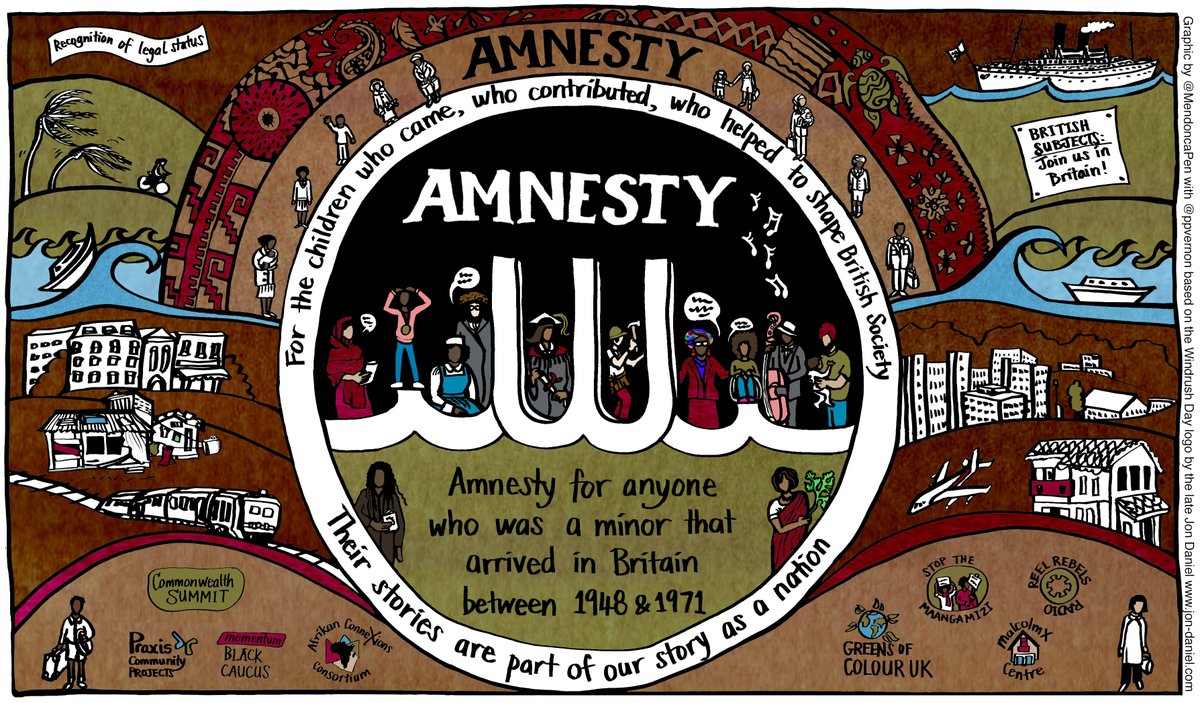
We wanted to let you know that the SMWeCGEC is once again joining forces with other campaigns and campaigners to increase awareness and develop campaigning and organising strategies which include ‘Stop the Maangamizi!’ and reparatory justice dimensions to addressing the violations of Afrikan heritage communities human, peoples and Mother Earth rights.
One such campaign is that around amnesty for Afrikan Caribbean people who are being threatened with deportation. In this regard a petition has been started in Bristol by Green Party Cllr Cleo Lake and is supported by the Afrikan Connexions Consortium, Malcolm X Centre, Momentum Black Caucus, Greens of Colour UK and forms an element of the SMWeCGEC.
It is the view of the SMWeCGEC that “Preventing these deportations, implementing the immigration amnesty and allowing these people to stay and rightly benefit from the contributions made by themselves and their enslaved and colonised Ancestors to the building of Britain, is a necessary step toward Reparatory Justice!”
As of today, 14, 351 have signed the petition so far, please also read, sign and share the petition too:
https://www.change.org/p/home-office-we-demand-an-immigration-amnesty-for-commonwealth-citizens
This is a news report from the Bristol Post about the Campaign:
In Service
Stop the Maangamizi: We Charge Genocide/Ecocide! Campaign (SMWeCGEC) Spearhead Team
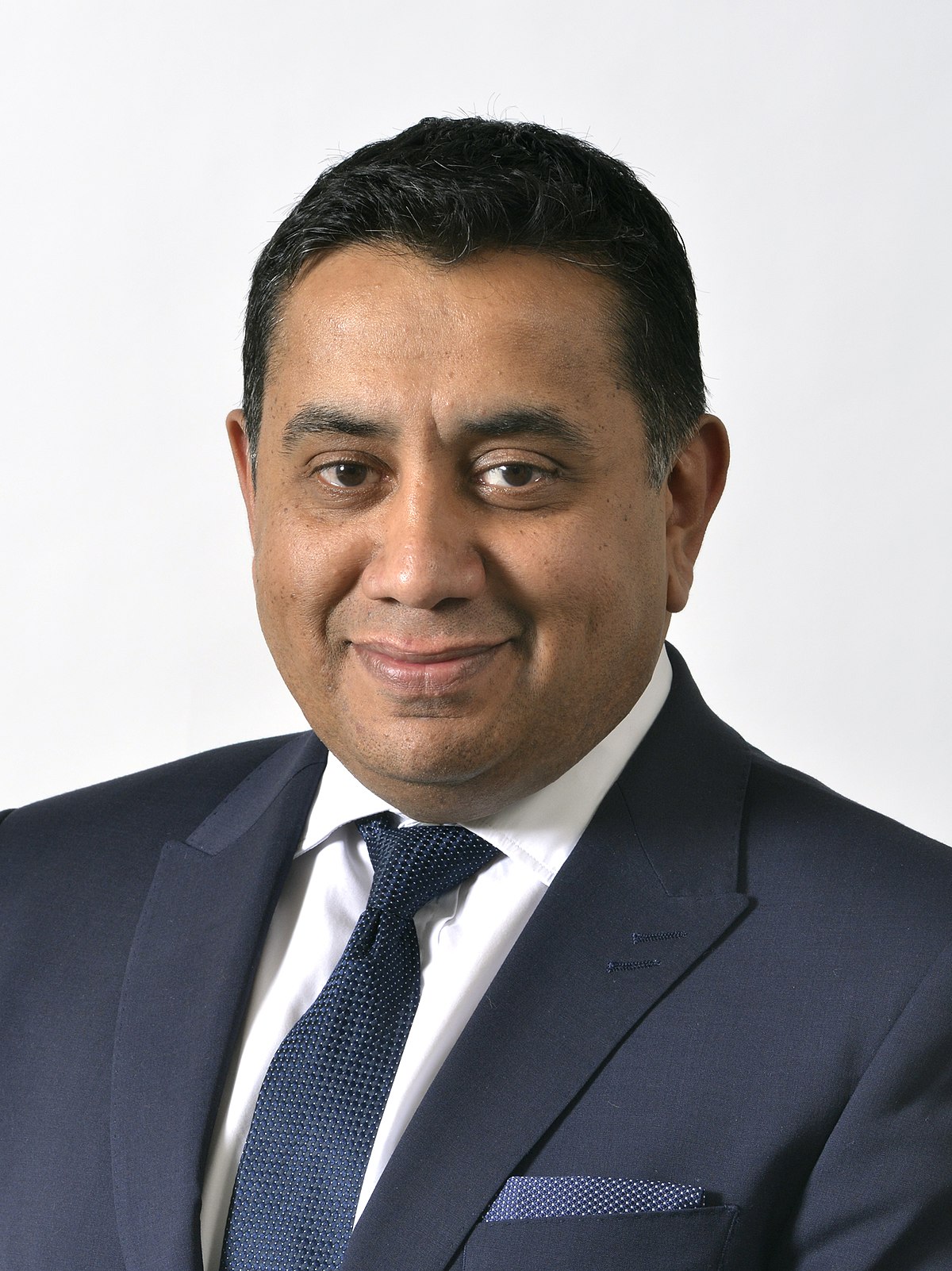
Tariq Ahmad, Baron Ahmad of Wimbledon
Greetings Supporter/s of the ‘Stop the Maangamizi: We Charge Genocide/Ecocide!’ Campaign (SMWeCGEC)
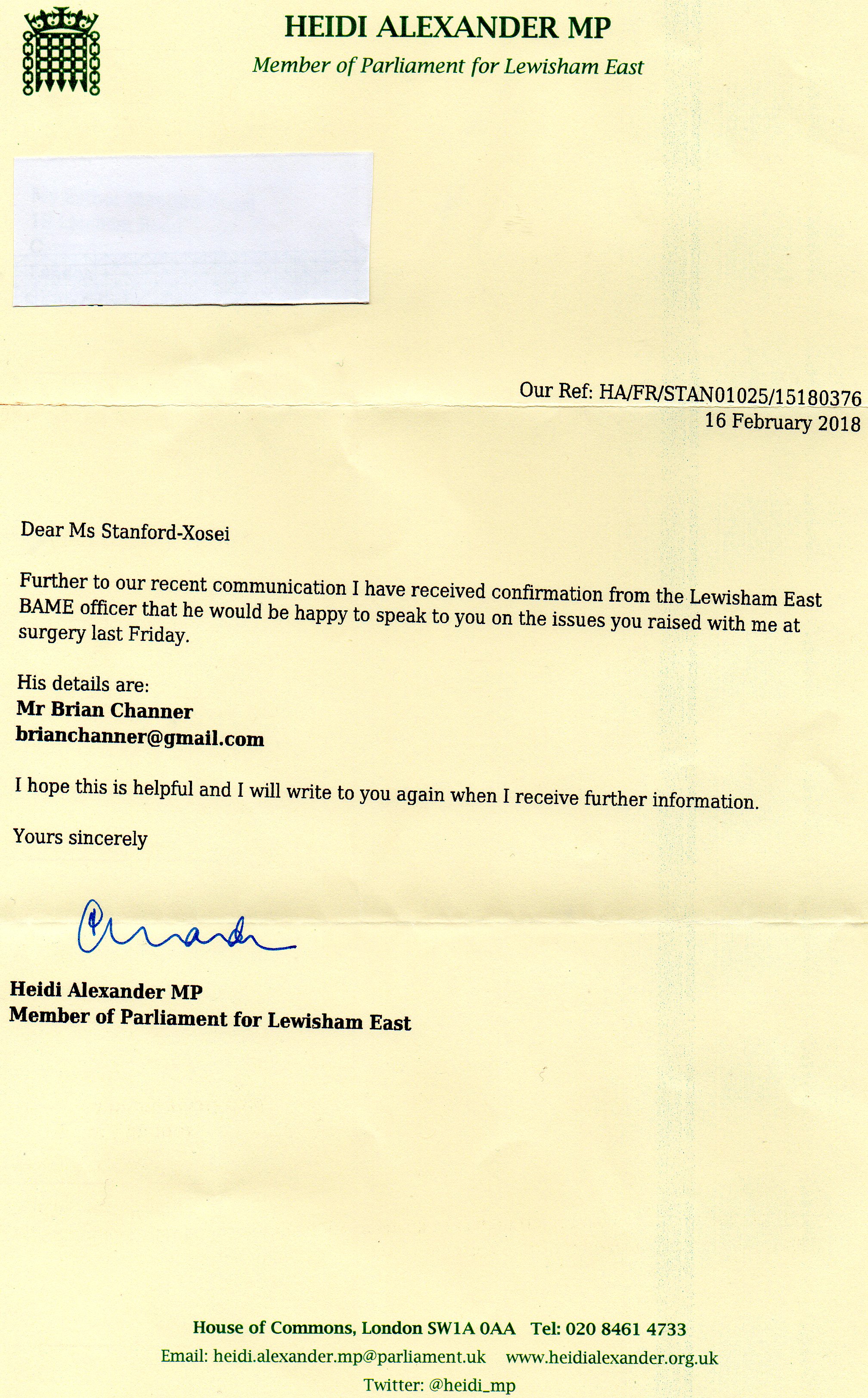
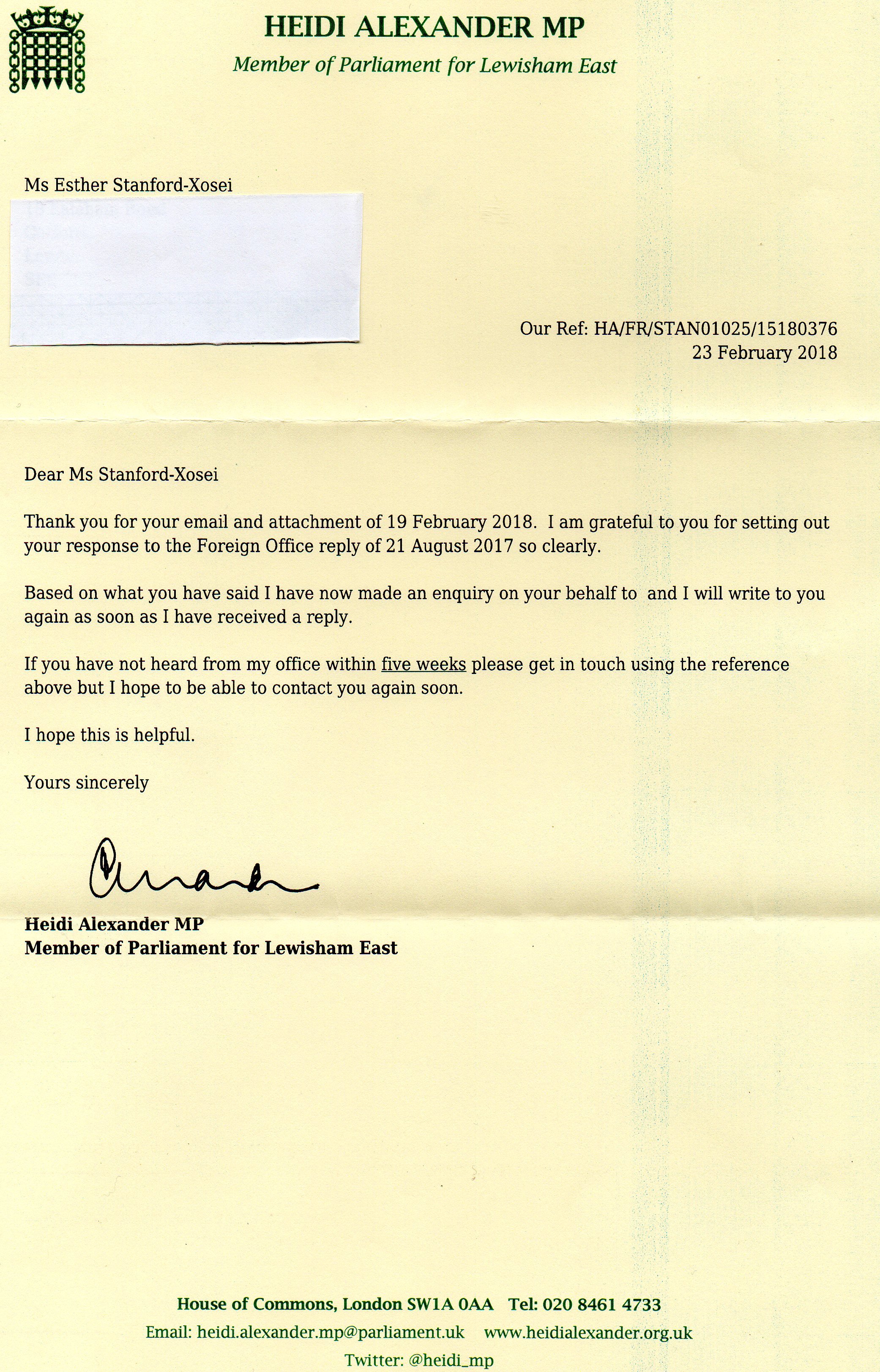
See the response below from Lord Ahmad of Wimbledon, Minister of State for the Commonwealth and the UN at the Foreign & Commonwealth Office (FCO) and Prime Minister Theresa May’s Special Representative for Preventing Sexual Violence in Conflict to the ‘Stop The Maangamizi: We Charge Genocide/Ecocide!’ Petition. This response was received after the intervention of Heidi Alexander MP for Lewisham East (London) who was lobbied to write to the FCO to seek a response from the relevant FCO Minister.
Previous correspondence can be found here:
https://stopthemaangamizi.com/2018/03/08/stop-the-maangamizi-postcard-advocacy-case-study/
The address of Esther Stanford-Xosei has been redacted

The address of Esther Stanford-Xosei has been redacted
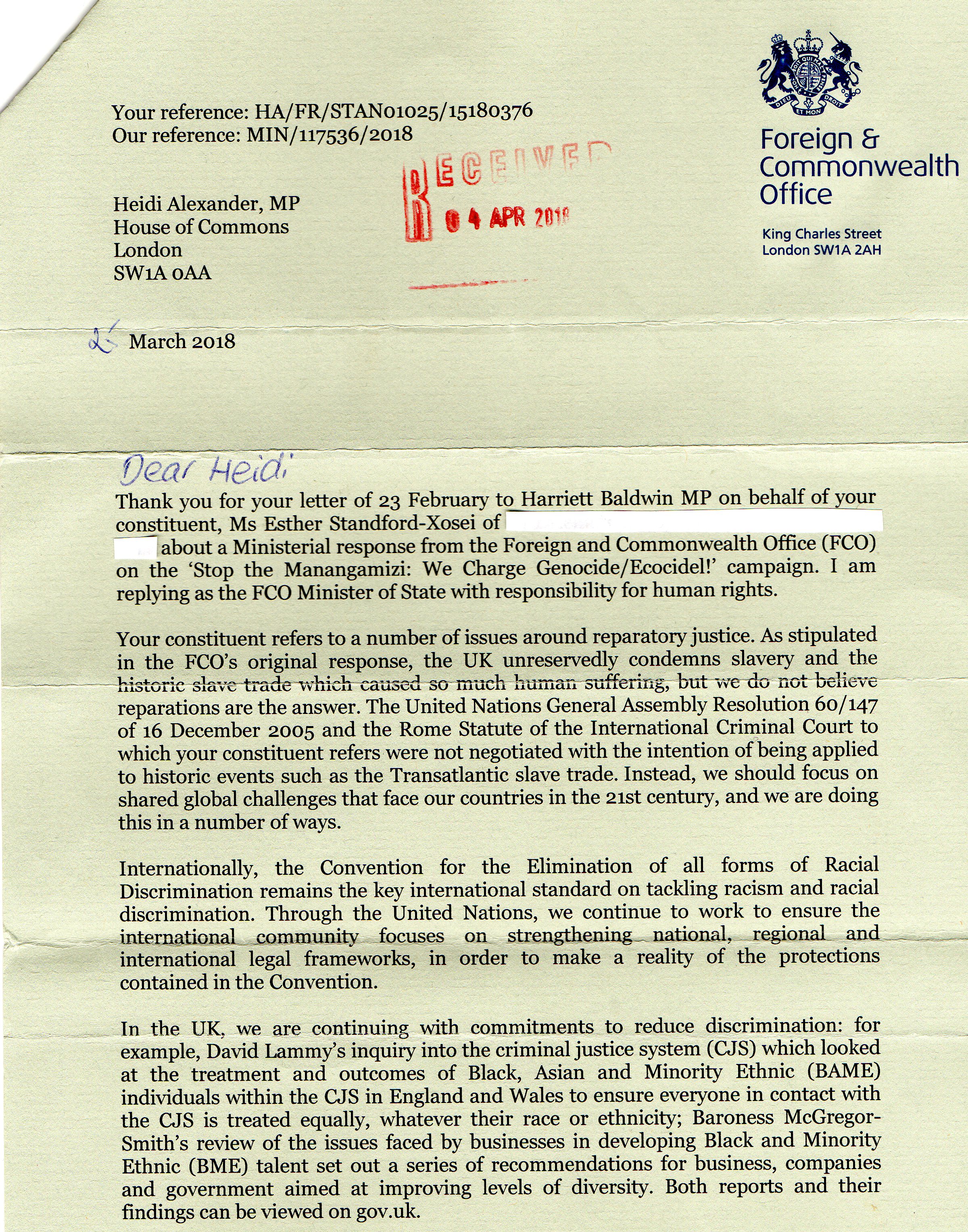

This link includes the response sent to Heidi Alexander MP further to receiving the above response from Lord Ahmad.
Stop the Maangamizi: We Charge Genocide/Ecocide! Campaign International Steering Committee Spearhead Team (ISC-SMWeCGEC)

Greetings Supporters of the ‘Stop the Maangamizi: We Charge Genocide/Ecocide!’ Campaign (SMWeCGEC)
This is a report-back of a meeting and series of correspondence between ‘Stop the Maangamizi: We Charge Genocide/Ecocide!’ Campaign (SMWeCGEC) Advocate Esther Stanford-Xosei and Heidi Alexander, Member of Parliament for Lewisham East.


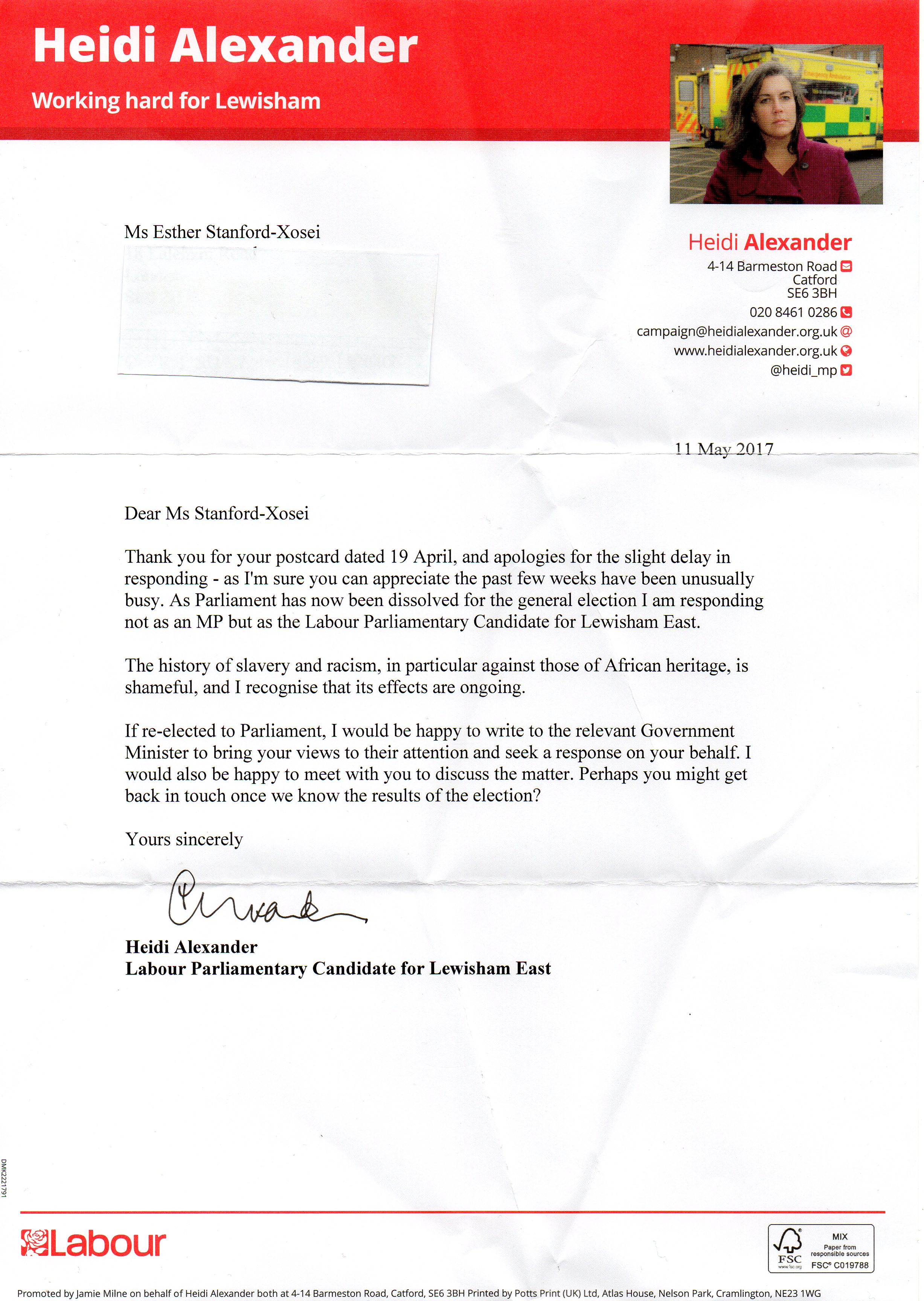
Follow-up letter to Heidi Alexander dated 20th January 2018 requesting her to take action on the ‘Stop the Maangamizi!’ Postcard
ESTHER STANFORD-XOSEI LETTER TO HEIDI ALEXANDER ON TAKING ACTION ON THE SMWeCGEC POSTCARD
On Friday 9th February 2018, Esther Stanford-Xosei went to see her MP Heidi Alexander regarding the demands in the ‘Stop the Maangamizi!’ Postcard campaign
Upon visiting Heidi at my local surgery, she was asked to explain the purpose of my visit and what I wanted which gave me some opportunity to explain the holistic meaning of reparations and why it is relevant to the local community development and campaigning efforts of Afrikan heritage community groups organising in the borough of Lewisham and working on Maangamizi legacy issues. She explained that the simple notion of ‘pay us’ is not what holistic reparations are about (and tend to close off discussions) and rather the starting point in addressing reparations is to take action on instituting the APPCITARJ.
It was acknowledged that the most focus of elected officials would be looking at reparations policy-making in addressing to meeting community development needs in all areas of people activity where our people are working to address the impact of the Maangamizi by way of community self-repairs. Therefore, prioritisation should be given to hearing our perspectives on these issues and hearing from us about the impact of the Maangamizi locally, nationally and internationally and also finding out from Afrikan heritage communities what efforts we are taking to redress it ourselves, irrespective of government responsibility or action to do the same. This made sense to her in light of a similar approach which was initiated with former Home Office Minister for Race & Communities Fiona McTaggert, MP in 2004 by the Rendezvous of Victory (ROV) which Esther Stanford-Xosei and Kofi Mawuli Klu, leading members of the SMWeCGEC, were founder-members of, (see flier below ‘Commemorations 2004-7: Time to Resolve the Big Question of Reparations’ where a programme was launched acknowledging reparations from the approach I have highlighted above).

This approach is also in alignment with the approach we are encouraging in the SMWeCGEC and support organisations in relation to Afrikan heritage community self-repairs (Maatubuntujamaa /Afrikan Heritage Community for National Self-Determination – AHC-NSD building as a model of a community repairing itself, see ). It was agreed that this is seen as a more viable approach to addressing reparations which is most likely to get support from elected officials who will be concerned with redress via local and central government policy-making and is most likely to secure short-medium term reparations goals in terms of what is referred to as administrative reparations processes. Heidi Alexander acknowledged that no issue facing people of Afrikan heritage today whether it is Anti-Black racism and/or Afriphobia, school exclusions, gun and knife crime, gangs, racial profiling, homelessness, health challenges, unemployment etc. could be tackled without acknowledging the impact of the Maangamizi on Afrikan heritage communities. Esther Stanford-Xosei that it is Afrikan heritage community self-repairs initiatives which need to be better resourced and supported as at the community level, we as Afrikans also have the responsibility to be and become the change we wish to see.

Indeed, part of the repair is about Afrikan heritage communities developing our own community capacity and power-base as well as our own community rebuilding plan, which the SMWeCGEC recognise as ‘Pempamsie’ Afrikan Heritage Community Self-Repairs planning (Pempamsie is the Adinkra symbol for sewing together in readiness -preparatory actions for reparatory justice. building our future out of our principled operational unity despite our diversity). This planning is something that was championed in the Black Quest for Justice Campaign (BQJC) plan which was developed in 2003 as a result of the BQJC legal challenge to the UK government on Pan-Afrikan Reparations for Global Justice and also contributed to the development of the SMWeCGEC.
Afrikan Community Self-Repairs are the self-determined efforts that need to be made in building our own power, in such a way, that Afrikan heritage communities are able to identify and enhance ongoing work towards stopping the contemporary manifestations of the Maangamizi, which are putting the individuals, families and other social groups that make up our communities into a state of disrepair; as well as reasoning and consciously carrying out the alternative solutions for glocally rebuilding our power base as communities, in such a way that that they are eventually transformed, in accordance with the principles and programmatic demands of Pan-Afrikan Reparations for Global Justice.
Esther Stanford-Xosei was therefore able to put into the context the importance and practicalities of the All-Party Parliamentary Commission of Inquiry for Truth & Reparatory Justice (APPCITARJ) and the need for local data and hearings to assess the situation of people of Afrikan heritage locally. With the emphasis being on – recognise our people’s agency and self-determining community development initiatives which should be receiving greater support and resourcing. This includes initiatives in relation to implementation of the UN International Decade for People of African Descent (IDPAD).

The main points raised with Heidi Alexander were:
· Hear what Afrikan people are trying to do for themselves (Afrikan Heritage Community self-repairs) within and beyond the borough of Lewisham;
· The intergenerational work being done to address the Maangamizi on the part of Afrikan heritage communities which will be as aspect of the proposed hearings of the APPCITARJ and provide an opportunity to hear about work being done to address the Maangamizi which should be recognised, better supported and resourced. It is not about saying to officials come and do something about our situation which reinforces our people’s powerlessness and denies their agency whilst the state and local government has responsibilities to support our self-determined efforts as we know best what is working and what is not working for our people.
· Addressing the impact of the Maangamizi requires embarking on international conversations and actions galvanised by the IDPAD as even our communities own solutions are global and many activists involved in the SMWeCGEC work glocally. It follows that the UK government cannot adequately support Afrikan heritage communities locally or even regionally without recognising Afrikan people’s international legal personality as Afrikans who are connected to other people of Afrikan heritage within and beyond the UK which is part of our own re-empowerment process.
The three asks of Heidi Alexander were:
1. Heidi to support APPCITARJ Glocal Roundtables which are local hearings which hear Afrikan heritage community roundtables on the Maangamizi, efforts to address it and the IDPAD. It was suggested that in Lewisham we can use the model of the Peoples Commission of Inquiry on Saving Lewisham Hospital as a template.
2. Heidi to write to the related appropriate Minister in support of the main goals of the ‘Stop the Maangamizi!’ Petition.
3. Heidi to host or support, with other MPs, a meeting in Parliament on ‘The Academic Legitimacy for the Afrikan Reparations Case in British State Policy Making & Political Lobbying’ in association with the International Network of Scholars & Activists for Afrikan Reparations (INOSAAR), where the SMWeCGEC in association with the Afrikan Emancipation Day Reparations March Committee which facilitates the organisation of the annual 1st August Afrikan Emancipation Day Reparations March and are engaged in UK reparations social movement-building actions which are contributing to knowledge-production through action-learning on reparations can be profiled. This is something which we are also encouraging other INOSAAR activists to do.

Outcome
Heidi Alexander wanted to know what was unsatisfactory about the response from the Foreign & Commonwealth Office (FCO) to the ‘Stop the Maangamizi!’ Petition and its accompanying letter presented to the office of the UK Prime Minister Theresa May on 1st August 2017. She asked Esther Stanford-Xosei to email her to guide her follow-up enquiry to the relevant minister. Heidi Alexander stated that that she believed the issues Esther raised are very important for the Afrikan Heritage Community in Lewisham (46% so-called Black and other racialised and minoritized groups population of which about 32% is Afrikan heritage and local schools having 76% youth from Black and other racialised and minoritized groups !!!).
Regarding glocal APPCITARJ hearings and addressing the concerns locally, Heidi wanted to know what work is being done in other boroughs that Lewisham could learn from and she specifically asked which other MPs have expressed a willingness to support the ‘Stop the Maangamizi!’ postcard campaign objectives. She said that Esther should provide info about what is happening in other boroughs which was good practice that Lewisham could perhaps also pilot.
In relation to the meeting in Parliament, Heidi said that it was unlikely that she could host such a meeting as most of her parliamentary work is focused on Brexit and reforms of the NHS (which was an indication about how to also further present/frame aspects of the SMWeCGEC to gain local interest from MPs such as herself).
Heidi also stated that the local Labour Party ‘BAME representative’ is someone she wanted to connect me with as he would be very interested in the issues Esther raised.
Going forward, we in the SMWeCGEC cannot stress enough the importance of more of us making similar approaches to other MPs and elected officials.
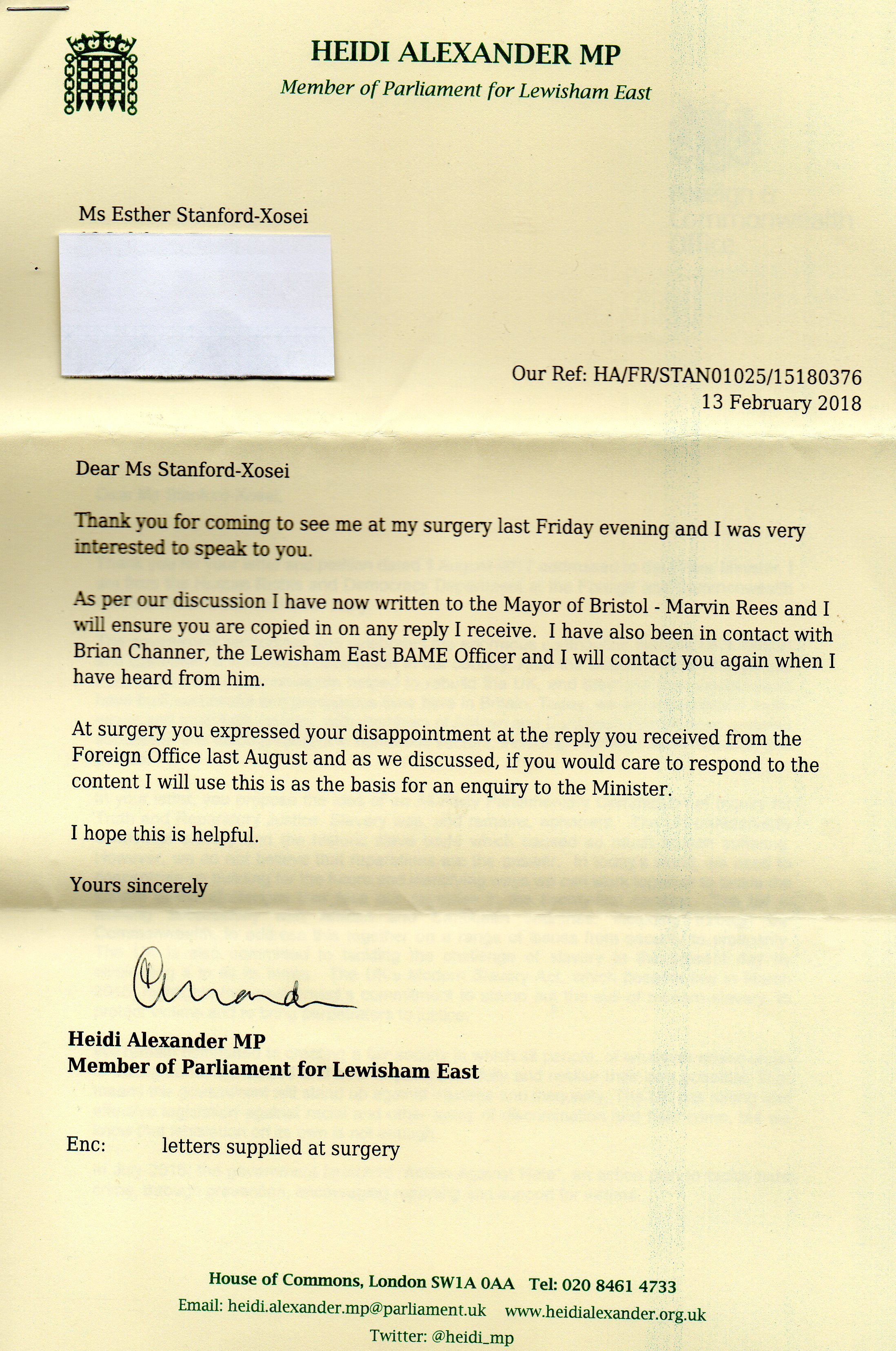
ESTHER STANFORD-XOSEI LETTER TO HEIDI ALEXANDER REGARDING THE FCO RESPONSE setting out what is wrong with the response received from the Foreign & Commonwealth Office to the 2017 ‘Stop the Maangamizi!’ Petition & its accompanying letter.


This link includes the response sent to Heidi Alexander MP further to receiving the above response from Lord Ahmad.
See here for the ‘Stop the Maangamizi!’ Postcard and template letter.
Check out this guidance on lobbying MPs and other elected officials.
In Service
Stop the Maangamizi: We Charge Genocide/Ecocide! Campaign International Steering Committee Spearhead Team (ISC-SMWeCGEC)
‘Stop the Maangamizi: We Charge Genocide/Ecocide’ Campaign (SMWeCGEC) guidance on lobbying your MP or other publicly elected officials such as Councillors
In a way, lobbying is something that ordinary people do all the time, it is part of human nature to advocate for a certain need or purpose. But in this context, we refer to lobbying as the act of attempting to influence the actions or policies or decisions of public officials as well as local and central government by pressuring them to do what you want them to do.
Lobbying is an essential aspect of the SMWeCGEC’s work, in implementation of the aim of aim 2 of the campaign which is “to gather evidence of the continuing impact of the Maangamizi as part of the process towards establishing the All-Party Parliamentary Commission of Inquiry for Truth & Reparatory Justice (APPCITARJ) at the levels of the Westminster Houses of Parliament and the European Parliament as well as the Ubuntukgotla Peoples International Tribunal for Global Justice (U-PITGJ)”.
When you assist in this lobbying, you help us in the SMWeCGEC raise the profile of the campaign and its demands as well as contribute to a participatory reparations process. These are some of your human and people’s rights under international law.
Please note, you do not need previous lobbying/campaigning experience as this guide is designed to assist you regardless if you are a beginner or more experienced action-learner or campaigner.
Find out who is your MP or other publicly elected official such as Councillors
We all have the power to shape and influence government policy through lobbying our Members of Parliament (MPs). Members of Parliament are elected to represent the views of the electorate in the House of Commons, particularly their own constituents and respond to their concerns, even if the MP doesn’t agree with their point of view. An MP can help influence the UK Parliament and government in many ways.
If you do not know who your MP is you can find out via the constituency location service at www.theyworkforyou.com/mp/ or www.parliament.uk You can search by postcode, name or constituency.
Councillors are people that are elected by their local community in order to make decisions about local services on your behalf. The primary role of a councillor is to represent the interests and concerns of their ward and the people who live in it to the local council. Whilst some local government wards are represented by one councillor, some will be represented by as many as three councillors. You can contact one or all. Councillors are not just interested in the council-wide relevance of what you are requesting, but also the local perspective and implications of the requests that you will make for their ward and how local constituents are also affected or the implications for them.
Finding an empathetic councillor if cultivated can be useful in a number of ways including:
• Providing inside information about what is happening in the local council, and where pressure points are;
• Representing your concerns to the council and in relevant committees;
• Influencing a decision which is about to be made or changing a decision that has already been made;
• Local political party influence;
• Influence over council officers.
Contacting your MP or Councillor
The easiest way to contact your MP is to write to them at the House of Commons, London SW1A OAA. It is recommended that you send this postcard/letter recorded delivery so that you have proof of postage. Alternatively, you can email them at their office – both the websites above have the email address of all MPs. You can also phone your MP’s office at the Commons by calling the switchboard (020 7219 3000) and asking to be connected.
Another route is to contact the MP’s local constituency office. Details of these and advice surgery times are printed in local papers and telephone directories. Many (but not all) MPs have their own websites – these are usually linked to www.epolitix.com.
You can meet your MP either at the House of Commons or at their surgery. Details of the time and location of the surgery will be available from their local party office/local libraries/local newspapers or via their website. Surgeries are often held in town halls, libraries or church halls. Some MPs insist on appointments and others operate on a first-come, first-served basis. It is sensible to find out in advance what you need to do to secure a meeting.
Be aware: for lobbying purposes, your MP can be either where you work, where you live or both.
Find out if your MP has any special interests relevant to the numerous points raised by the ‘Stop the Maangamizi!’ Petition and the wider SMWeCGEC. You can do so by checking www.theyworkforyou.com. The site also records MP’s speeches and how they have voted. You can also check out your MPs website and their page on www.wikipedia.org to find out more about them.
You can find out who your local Councillors are by visiting the ‘your Council’ area on the local council website or by contacting the council’s helpdesk. You can also visit www.theyworkforyou.com or www.gov.uk/find-your-local-council.

Writing to or emailing your MP or other publicly elected official
MPs and other elected officials regard postcards, letters and emails as an important barometer of public opinion and take notice if there are lots of postcards/letters on a particular issue.
Take the time to personalise the ‘Stop the Maangamizi!’ Postcard or template letter by also including references to how you, your family, or community group etc. are personally affected by the Maangamizi or Maangamizi denial. Include statements which speak to your own experience.
MPs appreciate brevity – try and stick to no more than two sides of A4 paper two at the most. You should always include your full address as there is a parliamentary convention that prevents MPs taking up cases for non-constituents.
The above information is also applicable to making contact with local Councillors. Whilst you can also make telephone contact, we advise written correspondence so there is an audit trail of your attempts to contact officials and any responses you may receive.
It is recommended that you provide further background information on a separate briefing note of no more than two sides of A4 including summary of the meaning of reparations according to the UN Framework on a Right to a Remedy and Reparation as well as an introduction to the United Nations International Decade of People of African Descent.
Meeting an MP or other publicly elected official
Prepare for the meeting by doing local research on the MP or other elected official and finding out what their priorities and interests are. In particular, try and find out where they stand on the issues that you will be raising. Party political allegiance and personal empathy will probably influence this. The leanings of MPs, Councillors and other elected officials can be gauged from their public pronouncements, by writing to them or attending public meetings or MPs/Councillors surgeries.

When lobbying councillors, find out as much as you can about the council or local authority’s past decisions on Maangamizi legacy/reparations related issues. Lots of information is freely available to the public such as minutes, agendas from meetings, for assistance contact the relevant department of your local council.
Before meeting your MP or other elected official, it is worth rehearsing your arguments and thinking about how you respond to these three questions:
1. Why you are visiting them;
2. Why the issue matters to you and your community e.g. how you/ and your community are impacted by the Maangamizi or Maangamizi denial;
3. What you want them to do about it e.g. take action on the asks in the ‘Stop the Maangamizi!’ postcard or template letter;
• don’t be intimidated, be aware of your own power as a voting constituent – your MP or other publicly elected official has a duty to listen and take official note of your issues/concerns;
• ascertain how much time you have and ensure key points get raised in the time you have;
• be concise, clear and persuasive, your job is to persuade elected officials who may not have hardly given Maangamizi- counteraction and redress or reparations, any serious thought or who may have very strong views about the efficacy of reparations on the basis of their most likely limited understanding and knowledge;
• introduce yourself, (if it applies, you may link this to the GAPP idea of Maatubuntuman if you see yourself as an aspiring member of the Maatubuntujamaa – Afrikan Heritage Community for National Self-Determination (AHC-NSD) say why you have visited him or her, (you may have to initially write your reasons for visiting MP or other elected official on a record-sheet if you are attending a local surgery);
• very early on in your discussion explain the holistic meaning of reparations and be prepared to enlighten and increase MP or other elected officials understanding. Don’t’ make general demands of ‘support reparations’ and giving a shopping list of measures. Please note that in many cases starting with the ‘how much money is owed’ ‘pay me’ argument shuts down dialogue so be prepared for this;
• speak their language and make your case in terms using examples they understand and also in relation to issues concerning your own personal and community development;
• explain the Maangamizi highlighting its relevance to Afriphobia as the specific form of racism you suffer as a person of Afrikan heritage and the need for redress by way of holistic reparations. Point out that this necessitates wholesome repairs including cessation of violations, restitution, rehabilitation, satisfaction, guarantees of non-repetition and also compensation according to the tenets of international law;
• explain the specifics asks in the ‘Stop the Maangamizi!’ Postcard and/or letter, the MP may be unaware of the issues, in this regard have some documentation with you that helps explain. For example, the ‘Stop the Maangamizi!’ and ‘Repay our Taxes Paid to Compensate Enslavers’ petitions and the response received from the Foreign & Commonwealth Office in 2017 to the ‘Stop the Maangamizi!’ Petition;
• give a few examples about how you, your family and community are affected by the Maangamizi. Personalise your briefing and make links to local data, issues, experiences, concerns or campaigns and how this interconnects with UK-wide and/or Pan-Afrikan/international concerns. As part of your preparation you should write down key points and hand over this document to your MP during your discussion;
• be prepared to talk about the issues contained in the postcard/letter as they relate to your local area, other constituents of Afrikan heritage as well as others e.g. what implications do the issues in the ‘Stop the Maangamizi!’ Petition have for young people, neighbourhood centres, schools and service provision locally;
• ask the MP or other elected officials his/her thoughts and comments on what you have said and then ask whether they are willing to support the SMWeCGEC asks in the postcard/letter and precisely what it is they will do to assist;
• make a note of what the MP or other elected official says; this will enable you to report-back to the SMWeCGEC and also follow-up on any promises or commitments that were made;
• be prepared for MPs or other elected officials asking what you know about any other MPs etc. taking action on the ‘Stop the Maangamizi!’ Petition and the wider campaign objectives;
• at the end thank the MP or other elected official for their time and recap on follow-up actions;
• follow-up with the MP or other elected official by writing or emailing to thank them for meeting and remind him/her of any agreed-follow-up actions that were agreed;
• be persistent, well-briefed, positive and professional. Remember, when lobbying you have an ambassadorial role on behalf of the SMWeCGEC and also as a constituent of the Afrikan heritage community of reparatory justice interest!

Be specific about what you want the MP to do, for example:
• write a letter to the relevant minister;
• ask a parliamentary question;
• sign an early day motion;
• raise Maangamizi/reparations related issues during a parliamentary debate;
• invite your MP or other elected official to attend a local SMWeCGEC reparations-related meeting of members one lunchtime/evening;
• invite your MP or other elected official to a glocal (local and global interconnections) session a trial APPCITARJ hearing which you should be prepared to assist convening with the support of the SMWeCGEC;
• ask your MP or other elected official to support an Afrikan heritage community self-repairs initiative, programme or activity you are involved in;
• ask the MP or other elected official to do press, publicity with your group in support of the SMWeCGEC;
• ask your MP or other elected official to keep in contact and to send you copies of any letters, responses, parliamentary questions etc. done on your behalf;
• ask the MP or other elected public what else he or she could do to help the SMWeCGEC (e.g. publicity, introductions to other groups and networks);
• ask MP or other elected public how you can best keep them informed of developments;
• If one course of action fails, write or email again to make sure they pursue an alternative;
• after you have lobbied an elected official, tell your friends, family members and colleagues to also get lobbying, talk to other people in your area and find like-minded individuals so that you can work together. Remember, elected officials want to get re-elected! So, the more people you can get in your community to take similar action, the greater likelihood the elected official will listen;
• Never give up, the realisation of holistic reparatory justice and the specific campaign goals of the SMWeCGEC can only get stronger and receive more support if we can demonstrate the impact we are making in achieving the building blocks to securing the APPCITARJ!
Local Councillors can also:
• contact the relevant department about the issues you raise;
• raise your concerns with the relevant cabinet member;
• refer an important issue to the council’s overview and scrutiny committee;
• raise your concerns at a full council meeting.
MPs and councillors of opposition parties are often keen to question the decisions of the ruling party. You can use this to your advantage when campaigning about an issue.
Other ways to lobby your MP or Councillor
• Organise a mass lobby of Parliament or the Council, but before attempting this we recommend you reading this SMWeCGEC parliamentary guidance.
• Organise a mass lobby of your local council where everyone turns up on the same day to meet councillors. For maximum impact, however, it is best however to speak to your council and councillors to organise this.
• Attend a council meeting. Local constituents can attend certain council meetings and may have a chance to speak at them. Watch out for Maangamizi counteraction/ reparations relevant cabinet meetings, full council meetings and committee meetings.
• Deputations – or speaking at council meetings are a way of lobbying the council to let them know about a concern that you have that is shared with people who you live or work near to. Most councils have arrangements for ‘receiving deputations’ usually at the start of full council meetings where a number of people (deputation) including a nominated spokesperson can make a short presentation directly to members of the council at the council assembly, the cabinet and other council meetings.

Each one teach and learn from many!
Finally, share your action-learning (learning through doing) by joining a wider group of reparations action-learners, that we in the SMWeCGEC can put you in touch with. Please also keep us updated about any progress you make and also challenges you may encounter. We are developing a page to identify Maangamizi desecrators and deniers so are interested to know if you encounter any public officials that can be characterised as such.
Feel free to also contact us if you need support with preparation for meeting your MP or other publicly elected official.
If you have any ideas on how better to lobby MPs or other elected officials which we could add to this guidance feel free to contact us.
Stop the Maangamizi: We Charge Genocide/Ecocide! Campaign International Steering Committee Spearhead Team (ISC-SMWeCGEC)

Greetings Supporter/s of the ‘Stop the Maangamizi: We Charge Genocide/Ecocide! Campaign (SMWeCGEC)
Now that you have signed the ‘Stop the Maangamizi!’ Petition, do you want to take action to get redress for the Maangamizi (Afrikan ‘Hellacaust’ of chattel, colonial and neo-colonial forms of enslavement) as it affects you, your family and community?
Here is an example of how you can do so; please see the ‘Stop the Maangamizi!’ Postcard template below, which we urge you to send to your MP. You can find out details about your MP here.
We also attach a template letter which has been revised to include reference to the issue of ‘compensation to enslavers tax fraud’ which is the subject of a separate but connected ‘Refund Our Taxes To Compensate Enslavers!’ petition. You can print off and sign the following letter here: SMWeCGEC Template Letter to MP- Elected Official. The letter is also drafted in such a way that you can send to any publicly elected official, not just MPs.
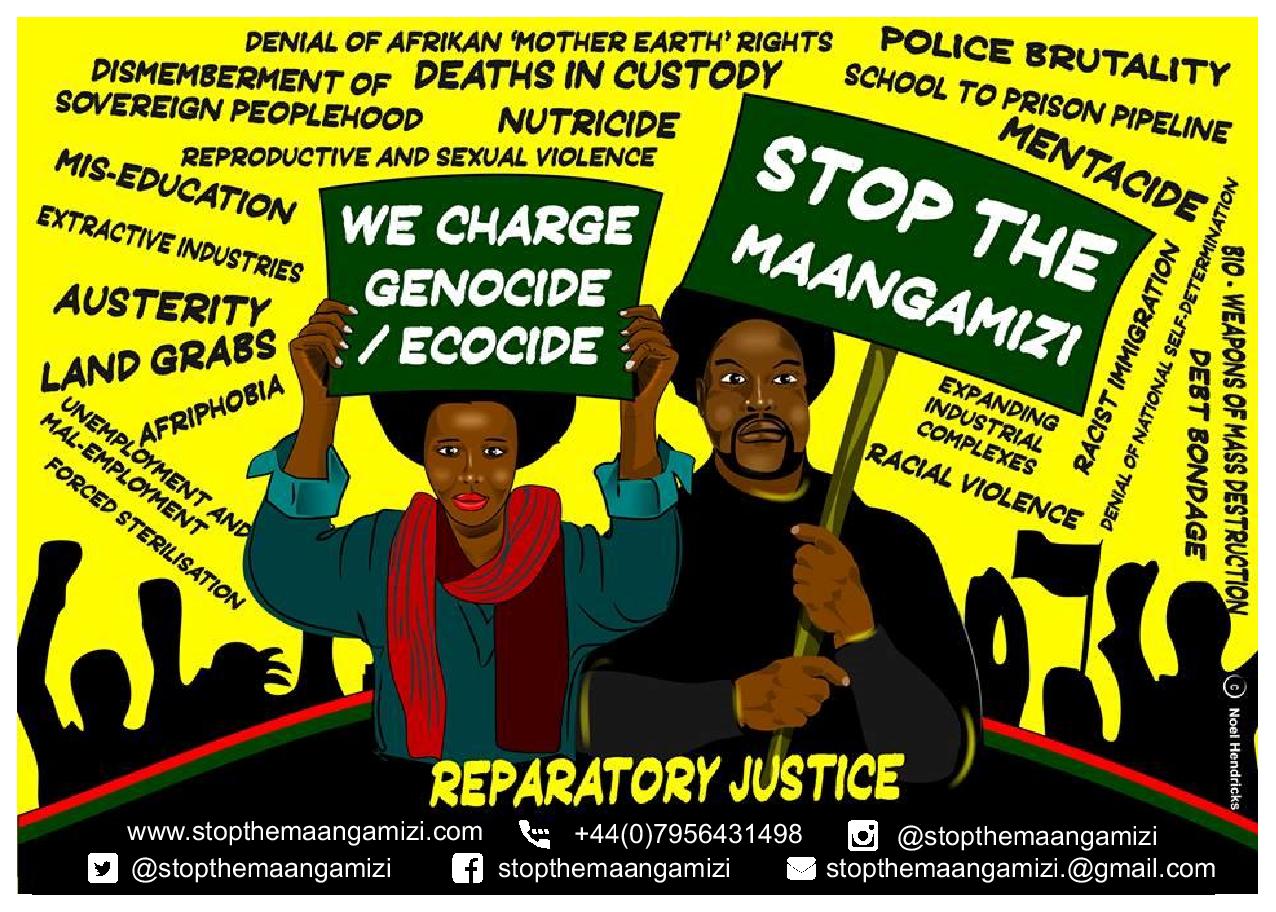
The postcard and letter are tools aimed at enabling you to better lobby and engage with establishment decision-makers about including Maangamizi impact issues as they affect you, your family and community in the constituency representational work and local, national and international policy-making they prioritise.
Please keep us updated in the SMWeCGEC about any progress you make as we are beginning to map which MPs are responding positively to the campaign aims, our contacts can be found here. This is very important because the experience we have so far is that MPs want to know who else is being lobbied and taking action on the campaign demands contained in the postcard and/or letter. It is essential for us to have this data and info about which individuals and groups are making what approaches to which publicly elected officials and in which geographical areas across the UK.
Check out this guidance on lobbying MPs and other elected officials.
You can also read this ‘Stop the Maangamizi!’ Postcard advocacy case-study.
See here for other ways that you can take action.
We look forward to hearing from you about any progress you make or any barriers you may encounter! We are developing a page to identify Maangamizi desecrators and deniers so are interested to know if you encounter any public officials that can be characterised as such.
In Service
‘Stop the Maangamizi: We Charge Genocide/Ecocide! Campaign (SMWeCGEC) Spearhead Team
“To be a slave was to be a human being under conditions in which that humanity was denied.
They were not slaves. They were [Afrikan] people.
Their condition was slavery.
They looked upon themselves and their servitude with the eyes and minds of human beings, conscious of all that went on around them”.
Julius Lester
“Most human behaviour is controlled by images. Image is a factor in how people look at themselves and what they use to reflect themselves. The control of images is a major factor in world power”
John Henrik Clarke

“Powerful people cannot afford to educate the people that they oppress, because once you are truly educated, you will not ask for power. You will take it.”
John Henrik Clarke
They say silence speaks louder than words; in what has been perceived to be our silence, we have also been speaking volumes. It is not that we have not been responding, it is simply that some are looking for us to respond in typical sorts of ways. We in the ‘Stop the Maangamizi: We Charge Genocide/Ecocide!’ Campaign (SMWeCGEC) do not pander to obscurantism, more so with misguiding populist decorations. Our priority focus is on educating, organising and mobilising people to ‘Stop the Maangamizi!’ through their own reparatory justice action-learning in order to build their own power to effect holistic reparatory justice. This is why we concur with Dr John Henrik Clarke as quoted above. What is happening in and around Libya is more than enslaved Afrikans being sold on auction blocks. Rather, this is one of the symptoms of an increasingly decadent, rotten and stinking neocolonialism as being perpetuated in Afrika by the Global Apartheid racist forces of Euro-Amerikkkan imperialism which is making our own homeland terribly more impossible to live in. If our own countries have not become hell on earth why wouldn’t Afrikans want to stay in Afrika?
Some people are making lots of noise and taking sporadically reactive actions about Afrikans being sold on auction blocks in Libya. It is not lost upon us that some of these noises and actions are being orchestrated and paid for from dodgy sources inimical to the best interests of Afrika. As justified in their spontaneity as some of such actions may appear, they raise lots more questions than answers. After these sorts of protests that we are seeing being organised in response largely to the imperialist corporate mouthpiece CNN reporting and dissemination of ‘controlling images’ of Afrikans being sold on auction-blocs, what do most of the participants who attend such protests, (including those who simply do so simply because they are paid bogus NGO bureaucrats and poverty-pimps, whose job it is to orchestrate and profit from such wild-goose chases), do as follow-up actions of every-day resistance to effect change in eradicating the root causes of such horrors? How long shall we continue to run helter-skelter in spontaneous protests actions, without taking effectively organised actions to prevent the killing of our freedom-fighting prophets and the violent destruction of the movements of resistance they have been trying to build? It would seem that there are some in our Afrikan Heritage Communities that seek to limit our activism to aimless protests, outside of the context of movement-building, with no clear goals or agreement on who should be the targets of our actions, the change we are seeking to bring about and no plan to build principled organizational unity or the capacity to facilitate such potentially change-making endeavours.
Why are those concerned not crying out and protesting louder about the mess being made of our Afrikan homeland by Euro-Amerikkkan imperialism through its neocolonial Afrikan and Arab elitist puppets; the stinking mess with all the brutalities of white-supremacy racist barbarism that is driving ordinary Afrikans away from their homes? Please be more critically aware, discerning and vigilant. Take the kind of well-planned ‘Stop the Maangamizi’ for Reparatory Justice! action/s that will prevent Afrikans from fleeing our own homeland in the first place and vacating it for more foreign setter-colonialists to move in, racially cleanse and occupy for nefarious geopolitical ends. It is high time that our people once again focused on the kinds of systematic actions that will effect systemic change and not simply respond in knee-jerk fashion to the various symptoms of the same system in such a way that these symptoms become the main focus of our protest actions.
A more useful starting point would be to target Euro-Amerikkkan imperialism and its agencies, institutions and quislings, including their Black puppets of neocolonialism, that are masterminding such horrific crimes of the Maangamizi; particularly with a view to shutting down the Maangamizi Crime Scenes that you can find anywhere near you or close to communities you can be engaged constructively with. For people in Afrika ‘Stop the Maangamizi!’ is not just a slogan, it is a life and death matter, hence why we initiated the SMWeCGEC with specific aims and objectives towards stopping the Maangamzi which manifests itself in the current system of neocolonialism with symptoms including variations of ‘modern-day slavery’, such as is becoming more highlighted currently in Libya. In our justified outrage about this form of modern-day enslavement of Afrikans, we must be mindful of who is pushing and profiting from this particular narrative and proliferation of ‘slave-auction controlling images’ and whose agenda is our people’s very predictable-spontaneous reactions to such narratives serving? It is indeed the same forces today as was the case yesteryear. After all, those that are most pushing the ‘modern day-slavery’ agenda and ‘it is Afrikans that are at it again‘ agenda are those actually responsible for creating, fuelling and perpetuating those conditions which continue to make it possible, including violently killing those freedom-fighters of ours who organise and build movements so stop such manifestations of the Maangamizi.
How comes this was not occurring under a Colonel Gaddafi led-Libya? Modern-day enslavement of Afrikans in Libya, in this aggravated form, is happening because NATO forces deliberately have chosen to make it happen in order to lend credence to their governments propaganda about us forgetting our intergenerational reparatory justice demands and rather begging them to clean up the Euro-Amerikkkan ‘mess’ they have created in Libya; and save us from horrors they contrive all the time in different ways and means. After all, isn’t Libya and its current neocolonial puppet-government a territory that is absolutely controlled in military and all other forms by the same forces of Euro-Amerikkkan imperialism and their creation of reactionary counterinsurgency terrorist forces like Al-Qaeda and Islamic State?
We must not allow ourselves to fall into the Hegelian Dialectic i.e. Roman Emperor Diocletian’s age-old problem-reaction-solution method for securing geopolitical interests. This highlighting of the modern-enslavement of Afrikans in Libya, divorced from the context and continuum of the Maangamizi, is an attempt by the Euro-Amerikkkan imperialist Establishment to assert its geopolitical interests in Afrika and to shift and misdirect the masses attention away from the task of every-day resistance movement building for Pan-Afrikan Power through effecting Pan-Afrikan Reparations for Global Justice by our own People’s Power.
Directing our protests at forces which right now have no interests in stopping the trafficking, incarceration and enslavement of Afrikans in Libya is the classic way we give up our own change-making power by thinking that ‘WE THE AFRIKAN PEOPLE’ do not have the power to set our own agenda and organise to achieve it. Our time, and difficult to harness resources, are better utilised in self-determinedly organising according to our own Pan-Afrikan Liberation agenda to put a full-stop to the Maangamizi in the process of effecting holistic reparatory justice by our own people’s power; a global force those of us in the Diaspora have the responsibility first and foremost, to develop through building Afrikan Heritage Communities for National Self-Determination (AHC’s NSDs/Maatubuntujamaas) to organically generate the MAATUBUNTUMANDLA Pan-Afrikan Government of Peoples Power Abroad which in our contemporary times will be the most effective way to uphold, defend and promote the best collective geo-political interests of Afrikan people throughout the World.
What is happening now in Libya and the disgraceful inability of governments and other state officials throughout the Continent and Diaspora of Afrika to do anything effective in addressing the situation makes it more imperative for Afrikans, outside of the Continent of Afrika, to prioritise the building of such MAATUBUNTUMANDLA as a step towards achieving MAATUBUNTUMAN (Pan-Afrikan Union of Communities at Home & Abroad); so that we are able to not only ‘substantively’ represent’ ourselves in positive action to make our Afrikan Lives actually matter in deed; but also amplify the voices of our Communities of Resistance on the Continent and support them in freedom-fighting actions that will enable them to stop such crimes of the Maangamizi upon their own initiatives. This is how best we in our time can fulfil our ‘mission’ and not betray it, as others have and are still doing, so as to win and guarantee our collective security and thereby provide a brighter future for us and our progeny on Planet Earth.
‘Stop the Maangamizi: We Charge Genocide/Ecocide!’ Campaign International Steering Committee (ISC-SMWeCGEC)
04/12/17 revised from original statement of Kofi Mawuli Klu on 28/11/17
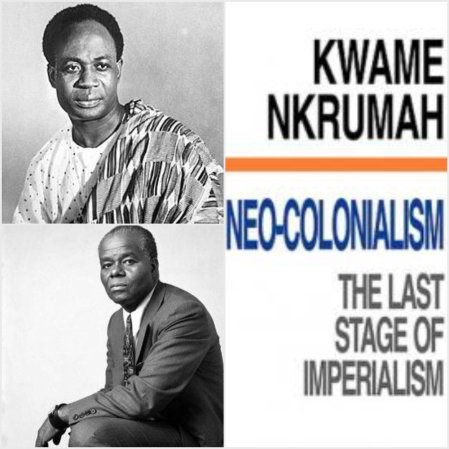
“The neo-colonialism of today represents imperialism in its final and perhaps its most dangerous stage. In the past it was possible to convert a country upon which a neo-colonial regime had been imposed — Egypt in the nineteenth century is an example — into a colonial territory. Today this process is no longer feasible. Old-fashioned colonialism is by no means entirely abolished. It still constitutes an African problem, but it is everywhere on the retreat. Once a territory has become nominally independent it is no longer possible, as it was in the last century, to reverse the process. Existing colonies may linger on, but no new colonies will be created. In place of colonialism as the main instrument of imperialism we have today neo-colonialism. The essence of neo-colonialism is that the State which is subject to it is, in theory, independent and has all the outward trappings of international sovereignty. In reality its economic system and thus its political policy is directed from outside.”
Osagyefo Dr Kwame Nkrumah, ‘Neocolonialism: The Last Stage of Imperialism’
“Those who do not learn from history are condemned to repeat it”
George Santayana

 stopthemaangamizi.com