Ithaka na wĩathi is Gĩkũyũ for land and freedom: what the freedom fighters the British called ‘Mau Mau’ named their army and their war for.
I write Afrika and Afrikan with a K, as Pan-Afrikanists have for generations. The K is the sound of Afrikan languages; the C was put there by Europeans. As Haki Madhubuti wrote in ‘From Plan to Planet: Life Studies. The Need for Afrikan Minds and Institutions’ (1973), ‘Europeans, particularly the Portuguese and British, polluted our languages by substituting C whenever they saw K or heard the K sound: as in Kongo and Congo, Akkra and Accra, Konakri and Conakry.’[1] Writing Afrika with a K is a choice to name ourselves and our continent in our own sound. Where an organisation, a title or a quotation spells it with a C, that is their spelling, kept as they wrote it.
Reflections on my visit to Kenya, October 2026
Esther Xosei, Executive Director, Maangamizi Educational Trust (MET), and Coordinator-General, Stop the Maangamizi: We Charge Genocide/Ecocide! Campaign · November 2026
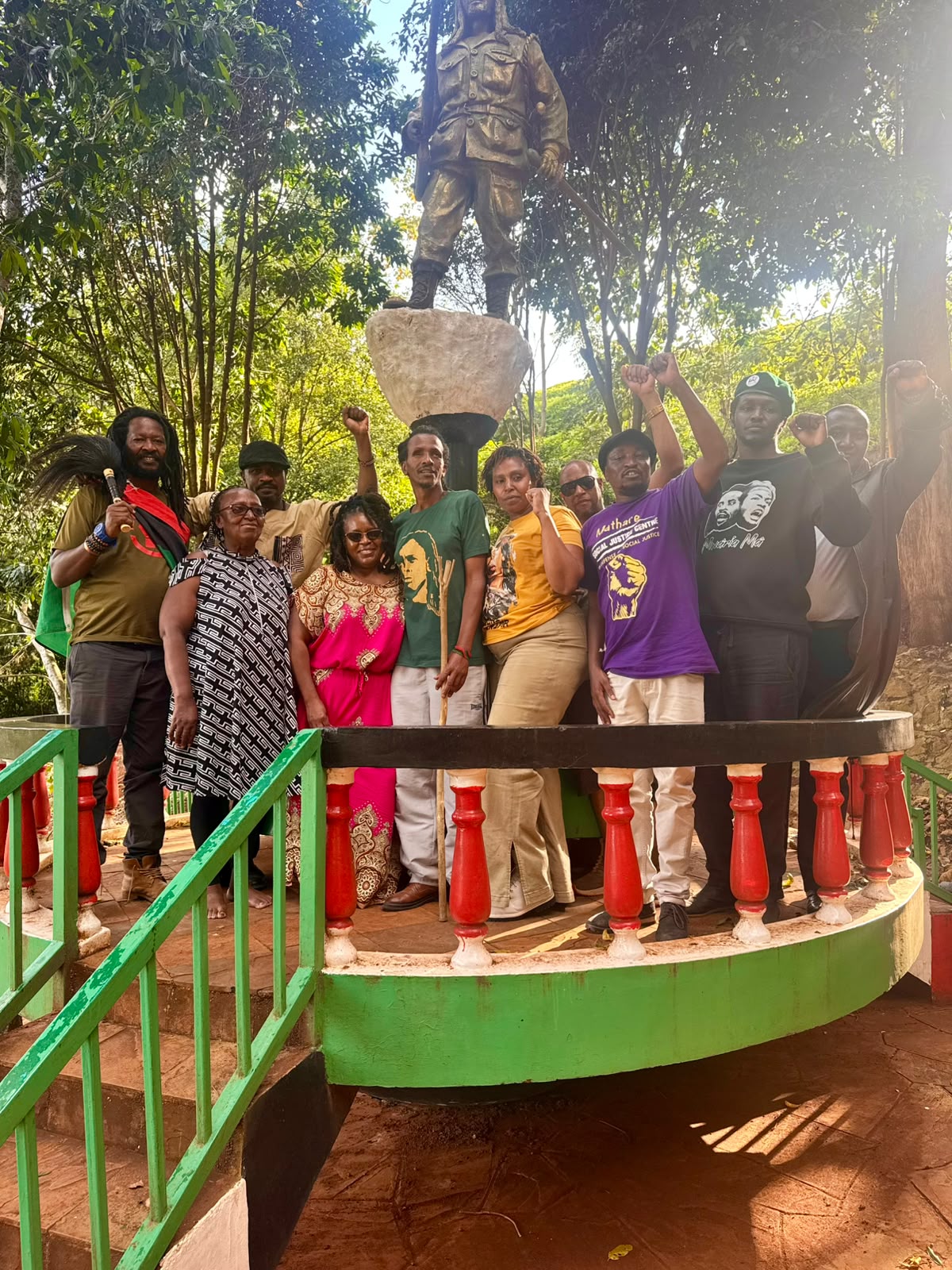
Fists raised beneath the statue of Field Marshal Dedan Kimathi at the memorial park, Kahiga-ini, Nyeri, where he was shot and captured on 21 October 1956, with sisters and brothers of the Racial Justice Network, the Mathare Social Justice Centre and Pan-African House.
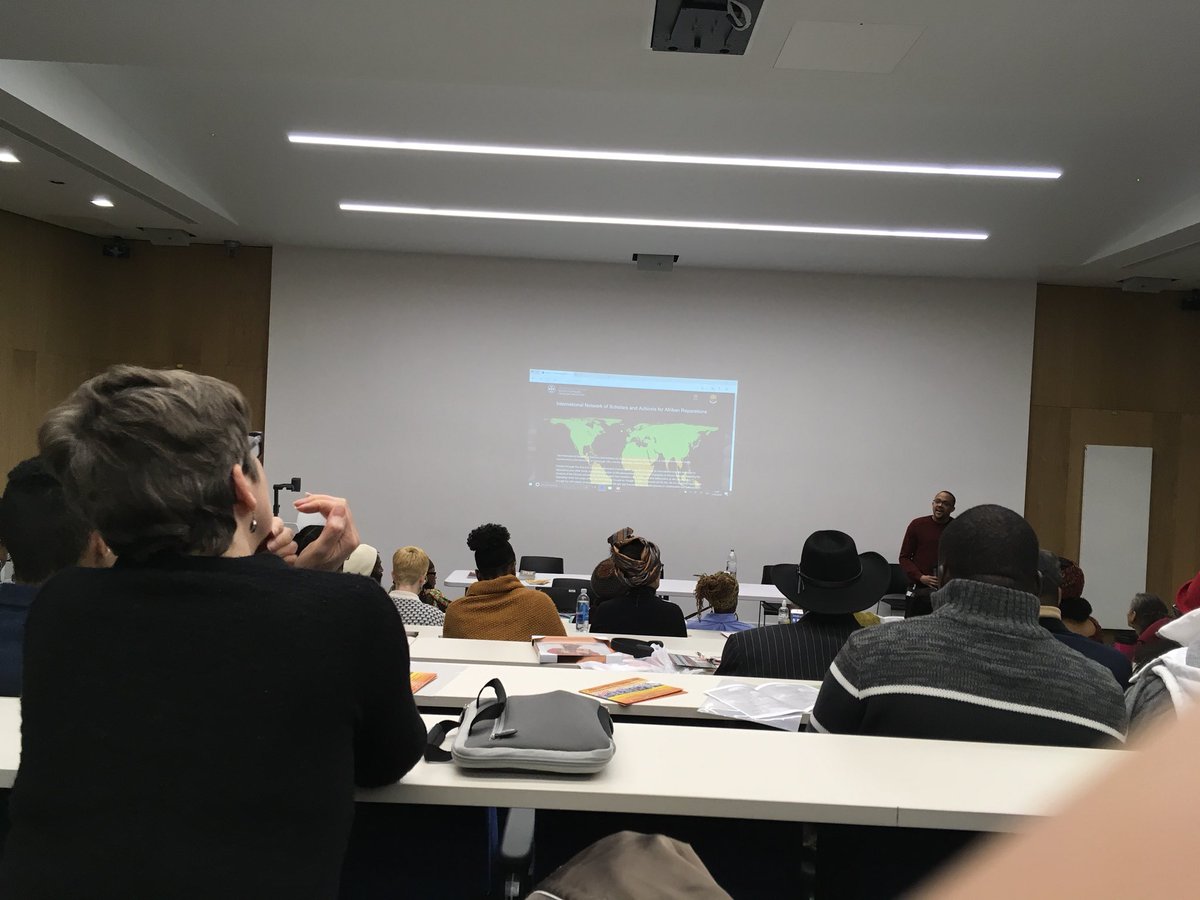
From 19 to 26 October 2026 I was in Kenya for the Tri-Sectoral Convening of Activists, Artivists and Scholars on Reparation and Decolonisation at Ufungamano House, Nairobi, convened by the Racial Justice Network (RJN) with the University of Nairobi and the Mashujaa Heritage Archives & Library. I was invited to give the keynote by RJN, of which I am also a Patron. I travelled principally in my role with MET, while representing both MET and the Stop the Maangamizi Campaign, which always work hand in hand, in the commitment we share to reinvigorating the Afrikan liberation struggle, in Afrika and across the Diaspora.
In this article
This is a long read. Each heading below is a link to that part of it.
Truth, re-membering and sovereignty · my keynote: naming, truth, the five forms of reparation, and the link between reparation and decolonisation; the slides and the convening programme.
In our own languages: Monaja’s intervention · why reparations and decolonisation must be discussed in Afrikan languages.
The 2013 settlement: what Britain calls closure · the Mutua and Kimathi cases, the settlement, and my reflection from the High Court in 2012.
Land and freedom: the sons and daughters of the freedom fighters · the testimony of the families, Wacera Itugu and her father, the Kimaathi Charter, the Commission of Inquiry, intergenerational harm and the Brattle report.
Unsung women of Kenya’s wars of liberation · the women who fought and led, the Nairobi Declaration, the young women organisers I met, and the Mbuya Nehanda project.
Honouring the Mashujaa: Nyeri and the Mashujaa Heritage Archives · the home of Field Marshal Mũthoni wa Kĩrĩma, Kahiga-ini where Field Marshal Kimathi was captured, the libation and my naming, the mountain’s names, and the Mashujaa Heritage Archives & Library.
Land at the heart of repair · the double theft of Kenya’s land, the Kipsigis and Talai, regret without apology, what the Maangamizi is, rematriation and Planet Repairs.
On air: ‘Fixing the Nation’ · my interview on the Nation FM radio programme, filmed for NTV Kenya.
A generation sharp and ready · the Gen Z Uprising, the killings and the state’s compensation offer, Sungu Oyoo’s presidential candidacy, the May 2026 arrests, wantam, and Cabral on ideas.
Reggae nights: the Caribbean in Kenya · conscious reggae in Nairobi and the music of Sonbeam.
Carrying it forward · what comes next, the book ‘From Mau Mau to Ruto-Must-Go’, and thanks.
Ufungamano House is itself a site of struggle: in November 1999 Kenya’s religious leaders met there with 54 civil society groups and launched the Ufungamano Initiative, a people-driven review of Kenya’s constitution. President Moi’s ruling party, the Kenya African National Union (KANU), had placed the review in the hands of a parliamentary select committee, which would have left the politicians who benefited from the old constitution to write the new one; the Ufungamano Initiative insisted that the people themselves should decide, and in 2001 it won its place in the Constitution of Kenya Review Commission that produced the 2010 Constitution.[2]
I arrived in time for Mashujaa Day on 20 October. Mashujaa is Kiswahili for heroes, and Mashujaa Day, Kenya’s Heroes’ Day, is a national day under Kenya’s 2010 Constitution honouring all who contributed to the freedom struggle. It took the place of Kenyatta Day, named after Jomo Kenyatta, Kenya’s first President. Kenyans chose 20 October because on that day in 1952 the British declared a State of Emergency, the eight years of military rule under which Britain fought the Kenya Land and Freedom Army, the liberation army that took up arms against British colonial rule from the forests of Kĩrĩnyaga and the Aberdares in what Kenyans name the Mau Mau War of Liberation, and detained the leaders of the Kenya African Union, Jomo Kenyatta among them, later tried at Kapenguria. There could be no more fitting day on which to begin a week on reparation and decolonisation.
I was fortunate enough to have been involved in commemorating Mashujaa Day in London long before this, my first visit to Kenya. In 2011 the Pan-Afrikan Reparations Coalition in Europe (PARCOE), with the Mau Mau Justice Network in the UK and Voice of Africa Radio, a London community radio station, hosted the first global commemoration of Mashujaa Day over the airwaves, featuring Professor Maina wa Kinyatti, Professor Ngũgĩ wa Thiong’o and Professor Mĩcere Gĩthae Mũgo, and we kept it each year after on my show ‘Africa Speaks with Sister Ekua’ on that station. The 2013 special asked, ‘Mau Mau Reparations: is there a Pan-Afrikan perspective?’[3], and put questions I carried to Nairobi thirteen years on: what was the role of women in the struggle for Kenyan independence; how have young people been influenced by the legacy of the freedom fighters; what are the legacies of dispossession on Kenyans and Kenya today; and what can be done to secure true justice.
The welcome from the Kenyan partners of the convening, the University of Nairobi, the Mashujaa Heritage Archives & Library and the activists, artivists and scholars who hosted us through the week, was warm from the first day to the last. Before I turn to the week itself, here is some of the music we played on air in that first commemoration in 2011.
Listen: Mashujaa Day on the airwaves
Music played at the Mashujaa Day celebrations in Kenya in 2010, provided by Charles Wainaina of the Mau Mau Justice Network.
‘Angalia Saa’ (Kiswahili: look at the clock), Ukoo Flani Mau Mau, 2008. Ukoo Flani Mau Mau grew out of Kalamashaka, the hip-hop crew founded in Dandora, Nairobi, in 1995, into a collective rapping in Kiswahili and Sheng, the street language of Nairobi’s youth that mixes Kiswahili, English and Kenya’s other languages, against corruption, police brutality and poverty, and took the fighters’ name as their own. ‘Angalia Saa’, by Kama of Kalamashaka, Kitu Sewer and the singer Winyo, is a wake-up call that time is running out: Kama’s verse names the Matigari, Gĩkũyũ for those who remained, the fighters who came out of the forest and were left without land while the ruling class took the trophies of independence, and in the hook they sing, wewe ni shujaa, usikate tamaa: you are a hero, do not give up.
‘Daima’ (‘Kenya Only’), Eric Wainaina. First released in English in 1998 as ‘Kenya Only’, written for unity and healing after the bombing of the US Embassy in Nairobi that year, and re-recorded in Kiswahili as ‘Daima’, always, on his 2001 album ‘Sawa Sawa’. In its chorus Eric Wainaina reads the Kenyan flag: black for the people, red for the blood shed in the struggle for independence, green for the land, white for peace. In its second verse he honours the Mashujaa who faced British bullets and imprisonment, and it calls Kenyans from the lake to the coast, north to south, to live as one. Kenyans sing it as a second national anthem in times of crisis and reconciliation.
‘Chebomuren’, Emmy Kosgei, from ‘Taunet Nelel’, 2009. Chebomuren is Kalenjin for daughter of a warrior. Emmy Kosgei’s song, which sets gospel praise to traditional Kalenjin rhythms, celebrates the resilience, faith and strength of Afrikan women.
Truth, re-membering and sovereignty
On 21 October I gave the opening keynote, ‘Repair Begins Within: Truth, Re-membering and the Reclaiming of Our Sovereignty’. The date is historically significant: seventy years earlier, on 21 October 1956, Field Marshal Dedan Kimathi, leader of the Kenya Land and Freedom Army, was shot and captured at Kahiga-ini, in Tetu, Nyeri, whose name in Gĩkũyũ means the place of the small stone.
I began with naming. The British called the liberation army ‘Mau Mau’; its fighters named it for what they fought for, ithaka na wĩathi, land and freedom. As Mwalimu (Kiswahili: teacher) Ngũgĩ wa Thiong’o, who joined the ancestors in 2025, reminded us in his preface to ‘Mau Mau From Within: The Story of the Kenya Land and Freedom Army’, ‘names and naming are part of warfare’.[4] The same conviction is why the Stop the Maangamizi Campaign names what has been perpetrated against Afrikan people the Maangamizi, Kiswahili for utter destruction, defined in full in the land section below.
My message was simple, and it followed from the name. Our visions of reparation come from within: from our own cultures, languages, stories and ways of setting wrongs right. Repair begins with truth-seeking and truth-telling: the whole truth, told unsanitised, including truths about ourselves.
So what does reparation consist of? The United Nations Basic Principles and Guidelines on the Right to a Remedy and Reparation, adopted by the UN General Assembly in 2005[5], set out the right to a remedy and reparation of people subjected to gross violations of human rights, and name five forms of reparation: restitution, compensation, rehabilitation, satisfaction and guarantees of non-repetition. Compensation is only one of the five. Every offer, from whatever government, is to be tested against all five, and against cessation first: has the harm stopped?
Full repair has one more test: what has it done for women? Full repair means wiping out what British rule did to Afrikan women. In Kenya, women head about a third of households yet individually hold title to about one per cent of land[6], so rematriation, the return to the Mother, which I say more about below, is here a practical programme: women holding title to land, women’s safety, and women deciding in our councils and our movements.
From truth I turned to decolonisation, the theme the convening was named for. Decolonisation is part of reparation when reparation means full repair. Decolonisation is the means; the restoration of Afrikan sovereignty is what it secures; and the end is larger than either: the transformation PARCOE and the Stop the Maangamizi Campaign name Planet Repairs, the remaking of the world itself, bringing together cognitive justice, environmental justice and reparatory justice, in the world that the International Social Movement for Afrikan Reparations (ISMAR), as part of a far wider movement of peoples, works towards: Maatubuntuman in Ubuntudunia, explained in the box below. The link between reparation and decolonisation, made plain, is this:
Reparation and decolonisation: the link, made plain
1. The Maangamizi broke worlds. Its perpetrators set out to destroy the personhood and peoplehood of Afrikan people, our nationhood and culture, and our environments and ecosystems, and colonialism and neocolonialism continue it.
2. Reparation, as full repair, remakes those worlds. Stop the harm, return what was taken, restore what was destroyed.
3. Decolonisation is part of that repair. It clears the ground: Afrikan peoples reclaim land and life, our languages and ways of knowing, and the power to decide. Decolonisation that leaves the loot in place changes only the flag; reparation paid inside the colonial order is only a payment.
4. What replaces colonisation is Afrikan peoples’ sovereignty restored, within a world remade. The ISMAR names the world it works towards, in Afrika and across the Diaspora, Maatubuntuman in Ubuntudunia. Maatubuntuman is the envisaged Pan-Afrikan union of communities in which Ubuntu, umuntu ngumuntu ngabantu, a person is a person through other persons, a becoming practised through relationship with the living, the ancestors, those yet to be born, other species, the land and Mother Earth, is lived under Ma’at, the order of truth, justice, balance and harmony which originates in Kemet (Ancient Egypt) and which many Afrikan people on the continent and across the Diaspora live by today. Ubuntudunia is a multipolar, pluriversal, anti-imperialist world of global justice for all. One vision, named from two sides: Afrikan peoples remade in sovereignty, within a world remade.
On the second day, 22 October, after an opening panel of activists, I returned to that message before a room of scholar-activists, activists and artivists and turned to practice. I asked us to carry one question into everything: on whose terms? As the Yaqui legal scholar Professor Rebecca Tsosie writes in ‘Acknowledging the Past to Heal the Future: The Role of Reparations for Native Nations’, ‘there is no “uniform” theory of reparations that fits all cultures, all nations, and all peoples.’[7] What repair requires is defined by peoples in struggle, from their own experience and their own ways of knowing; those who owe repair do not get to define it. With Professors Eve Tuck and K. Wayne Yang, whose 2012 essay is titled ‘Decolonization is not a metaphor’[8], I warned against decolonisation used to mean only the decolonising of institutions and knowledges, a curriculum here, a museum label there, while the land, the economy and the politics stay as they are. Used that way, decolonisation is a metaphor. Decolonisation means our peoples reclaiming land and life.
I closed with a question, and I offer it here as a reflective point for anyone working on reparation and decolonisation: how do we know? How do we know the truth? How do we know whose terms we are on? How do we tell repair from capture? How do we know decolonisation is really happening, that land, economy and power are returning to our peoples, when all that may have changed is that Afrikans now occupy the offices the colonisers built? A selection of the slides follows; the full deck, revised since the convening, is in the box beneath them.
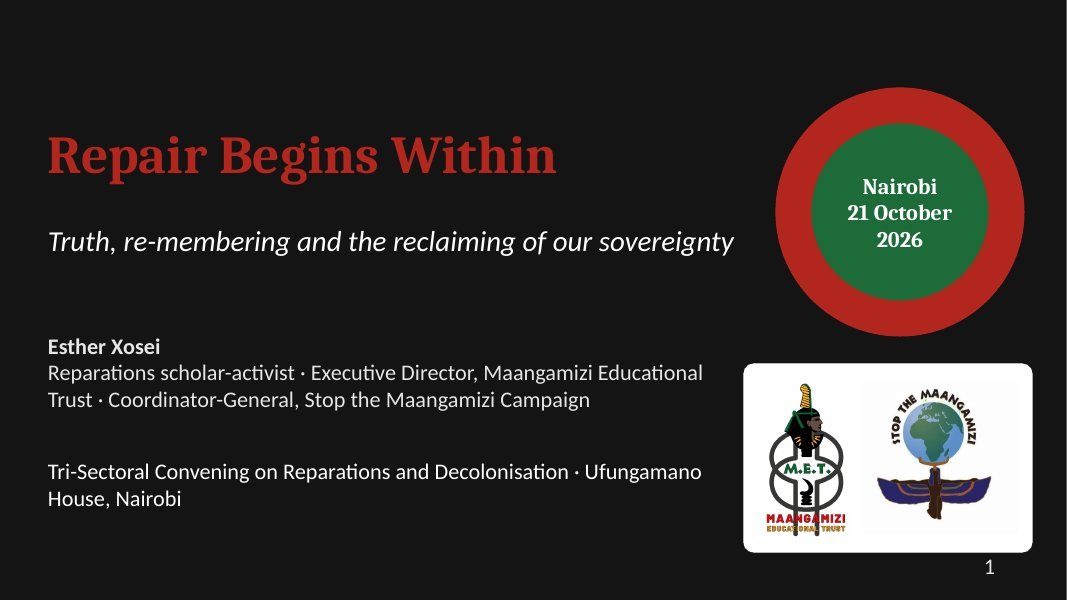
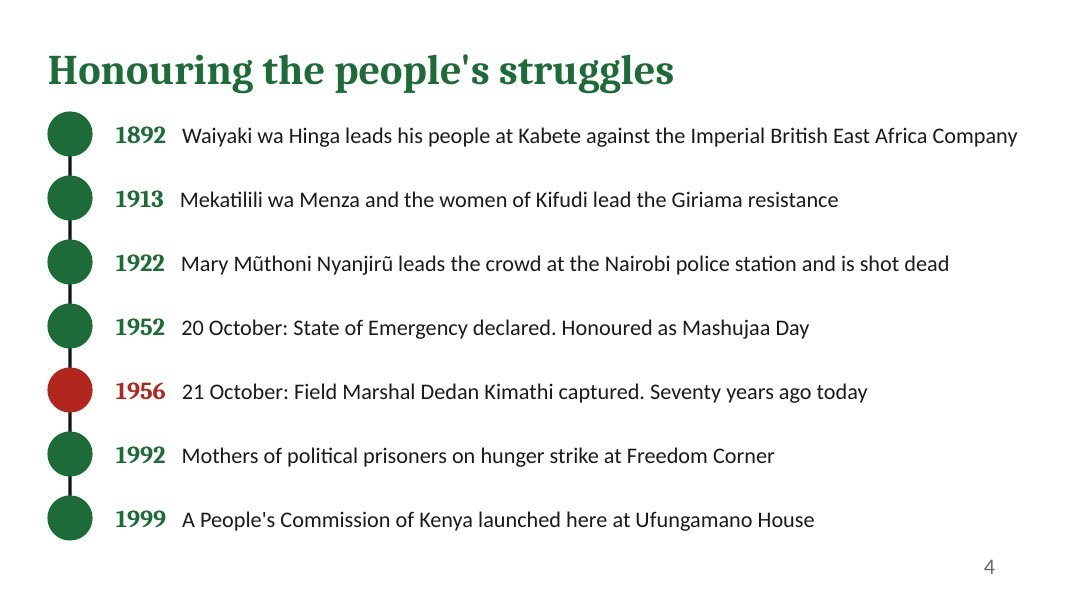
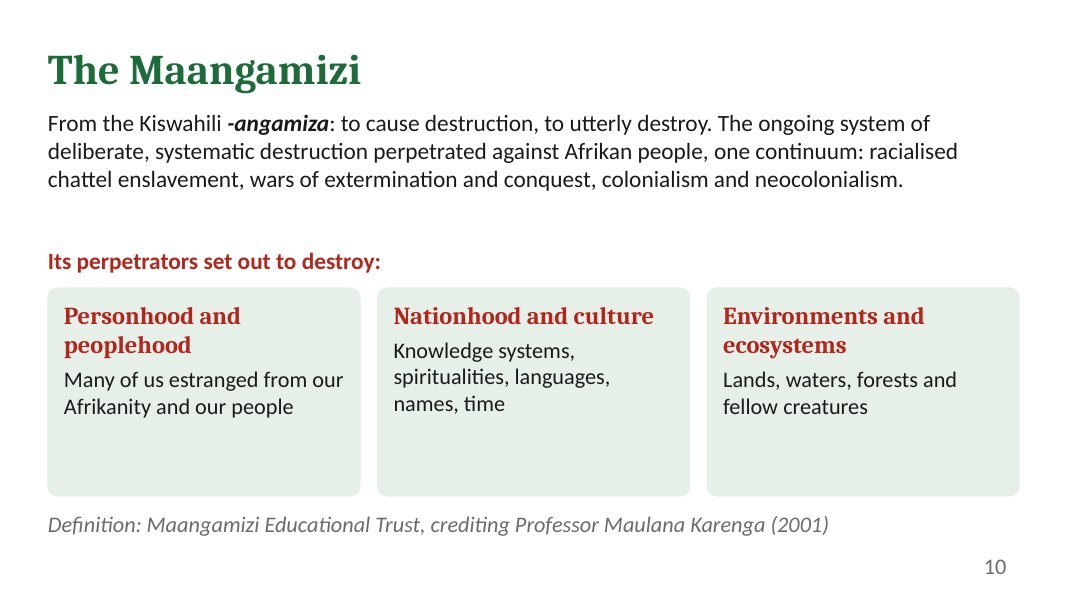
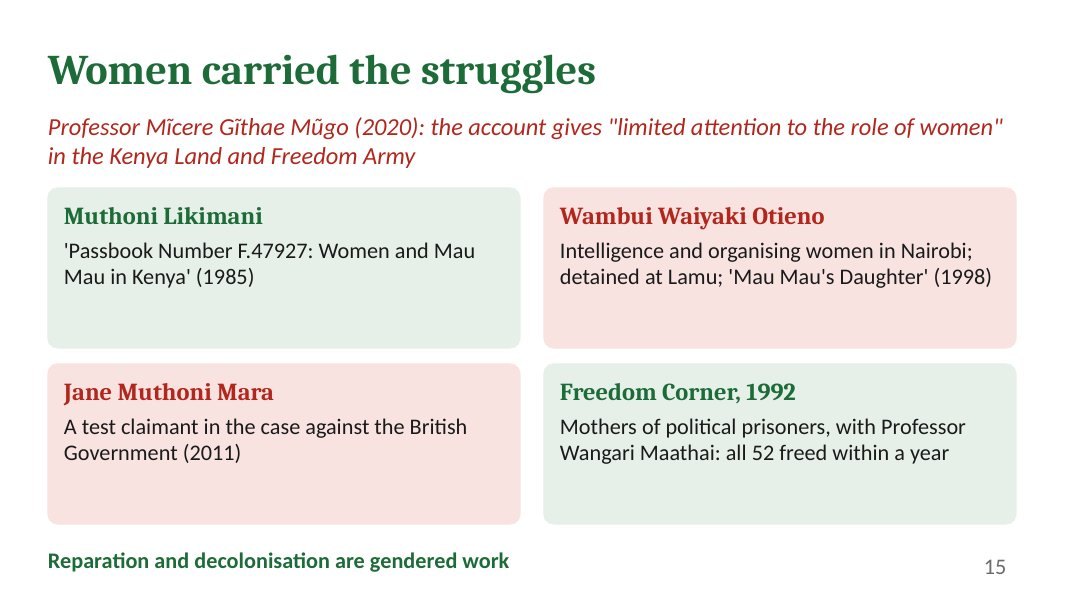
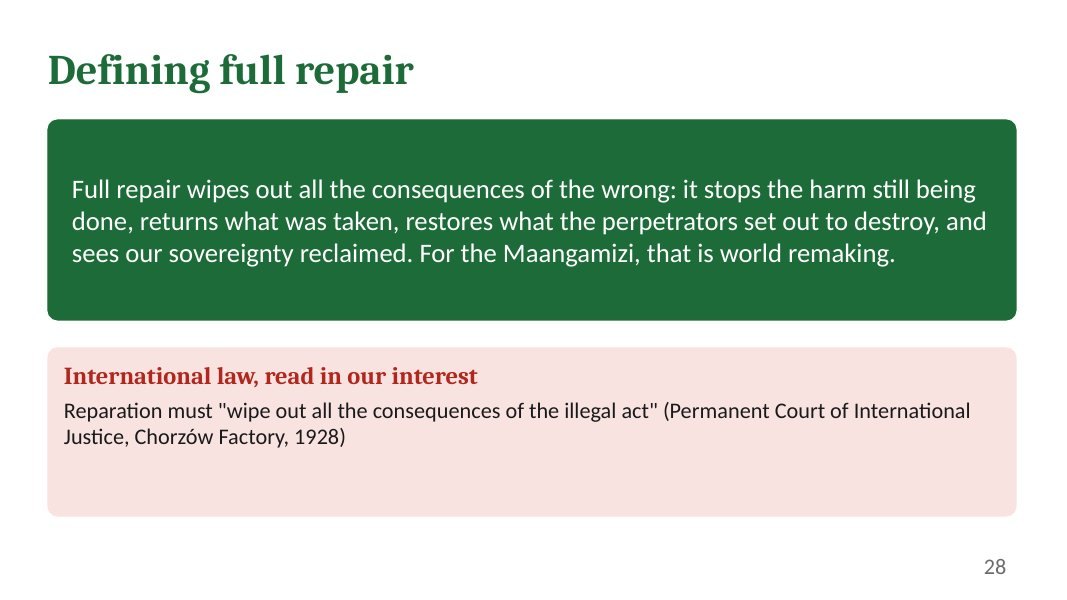
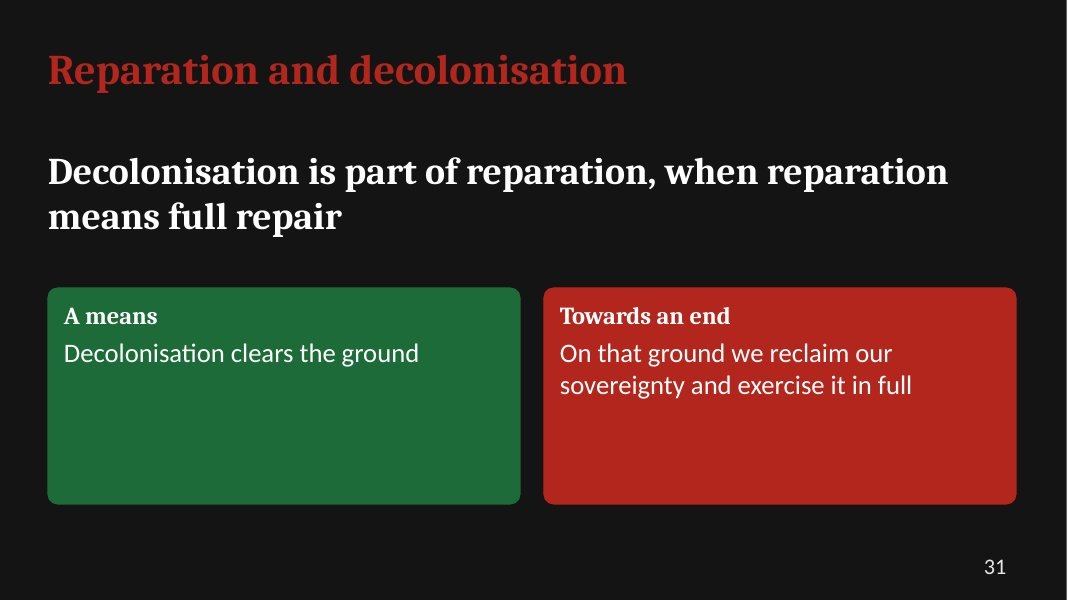
A selection of slides from the keynote, ‘Repair Begins Within: Truth, Re-membering and the Reclaiming of Our Sovereignty’, Ufungamano House, 21 October 2026.
The keynote slides: revised edition
I have revised the keynote slides since the convening to include what the week taught us: the testimony of the sons and daughters of the freedom fighters; the Kimaathi Charter, the fighters’ own statement of their demands; gender injustice; Kenya’s case for reparation, with land at the centre; the places we walked; the community archives we visited; and a stronger way forward linking reparation and decolonisation. The revised edition, with speaker notes, can be read and downloaded here:
The keynote opened a four-day programme built on the tri-sectoral idea: that activists, artivists and scholars hold distinct but connected kinds of knowledge, each to be heard in its own right, with lived experience, artistic expression and scholarship given equal standing. Each day foregrounded one of the three: the scholars on the first day, the activists on the second, the artivists on the third; on the fourth a small delegation travelled to Nyeri, to the places I describe below. Here is the convening programme in full, with the partners, speakers and sessions of the week.
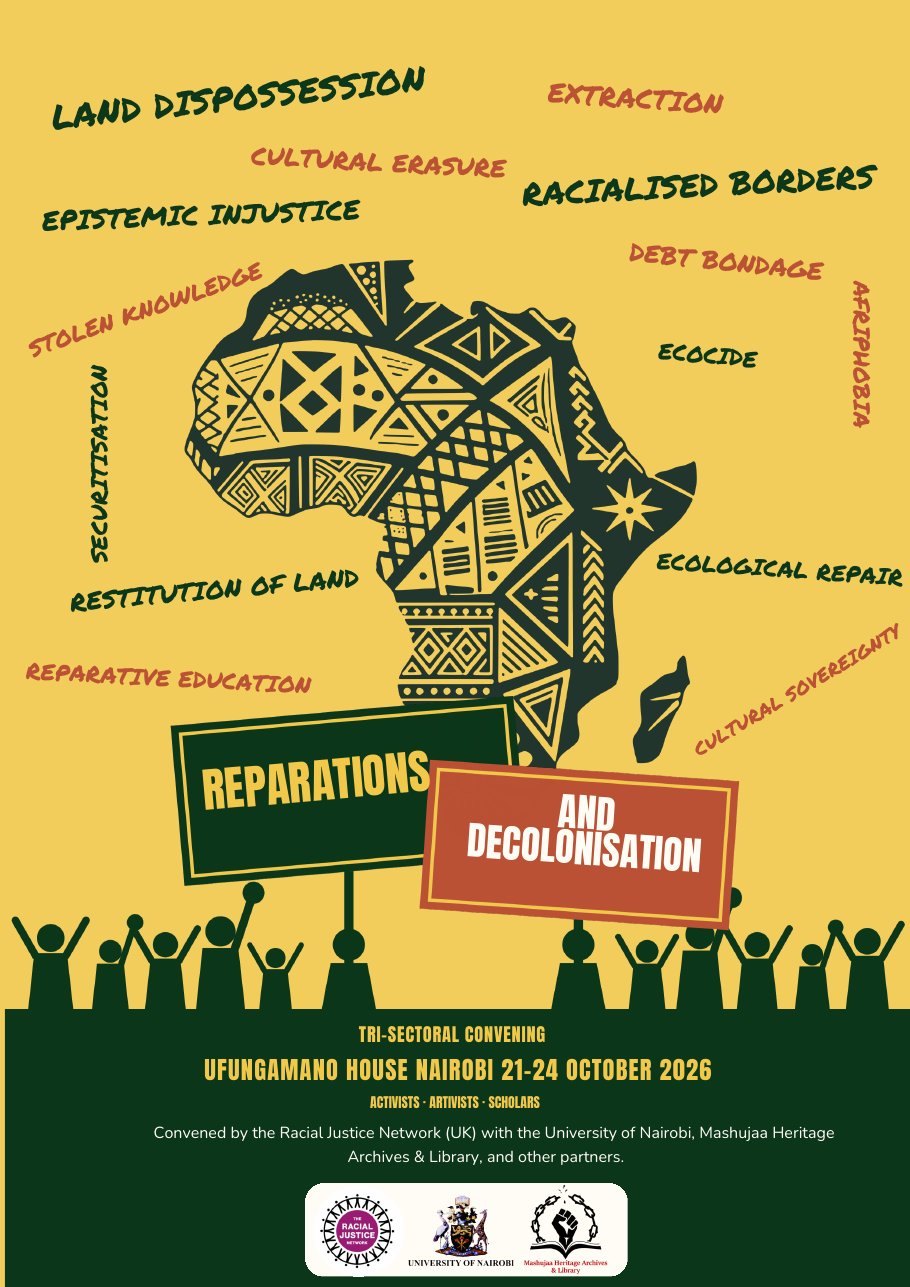
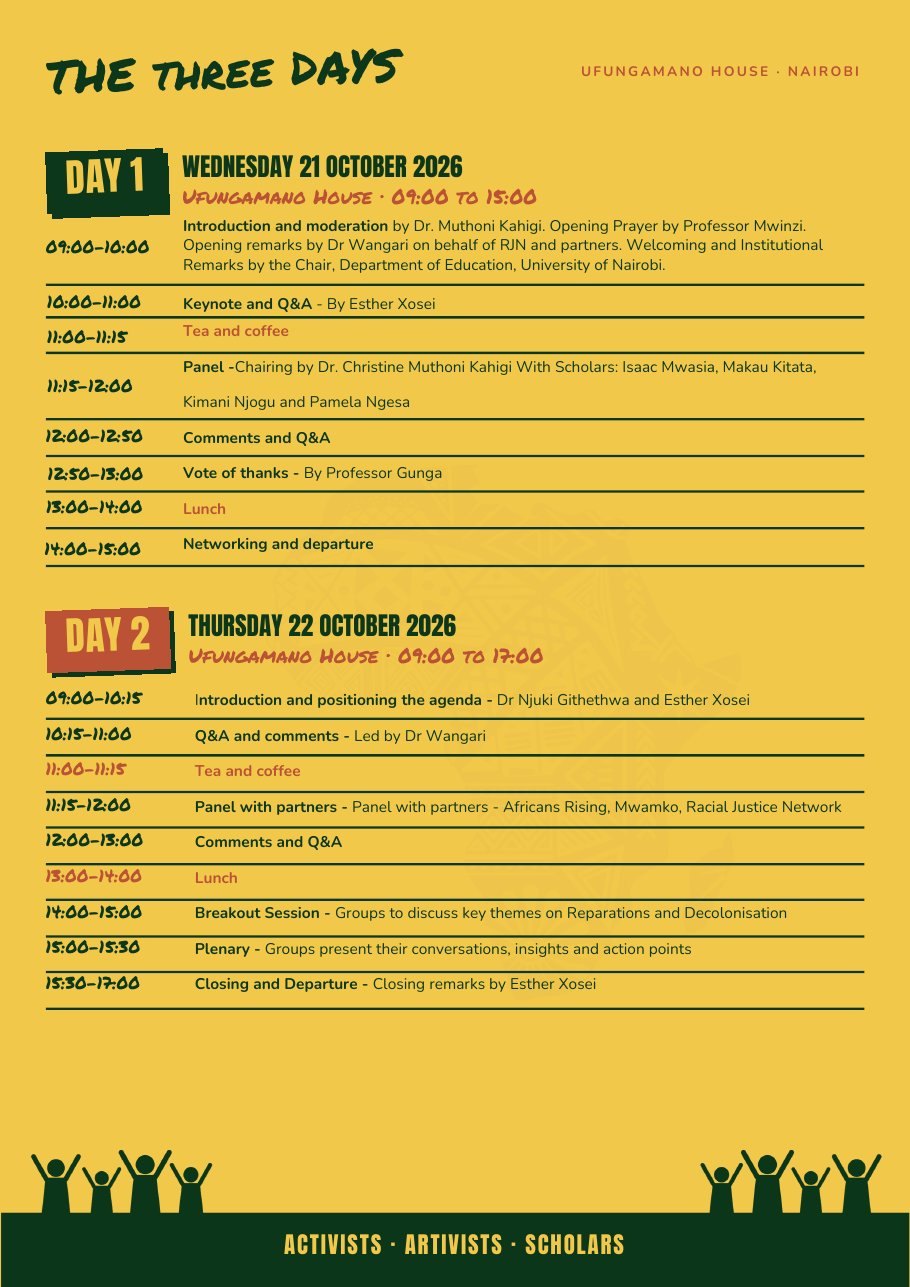
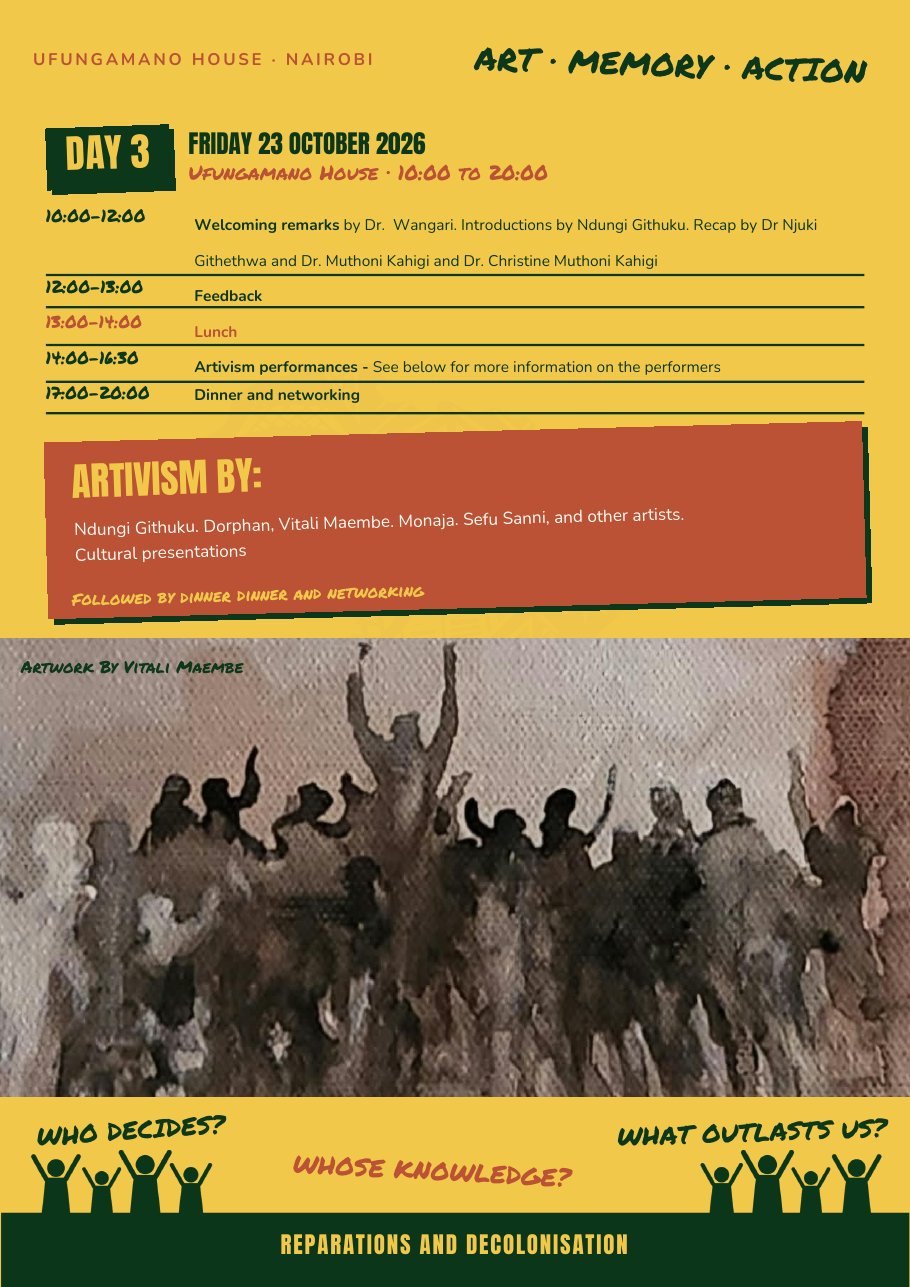
The convening programme: convened by the Racial Justice Network (UK) with the University of Nairobi, the Mashujaa Heritage Archives & Library and other partners, Ufungamano House, Nairobi, 21–24 October 2026.
In our own languages: Monaja’s intervention
One intervention at the convening resonated deeply with me. Monaja, Mwongela Kamencu, is a Kenyan performing artist, trained historian and activist who bridges the worlds of academia, conscious hip-hop and grassroots political organising in Nairobi. He writes and performs in Kiswahili and Sheng, and he made his 2024 project ‘June 25th’ in response to the youth-led uprising of that year. Drawing on Professor Ngũgĩ wa Thiong’o’s ‘Decolonising the Mind’[9], he argued that we should not be gathering in English at all to discuss decolonisation and reparation: Kiswahili is the language most people in the room spoke, and Kiswahili is what they would speak. On the artivists’ day a concerted effort was made to speak Kiswahili from the stage and the floor.
His point goes to the heart of the matter: the discussion of Afrikan reparations and decolonisation must be indigenised, held in the languages our peoples actually speak, Afrikan languages, beyond English and beyond every European language. Reparations debated only in the colonisers’ tongues are debated on the colonisers’ terms. Decoloniality applies to how we gather, and to the language in which we think and speak about repair, as much as to what we say. Monaja also gave powerful performances during the convening, and his argument and his art were of a piece.
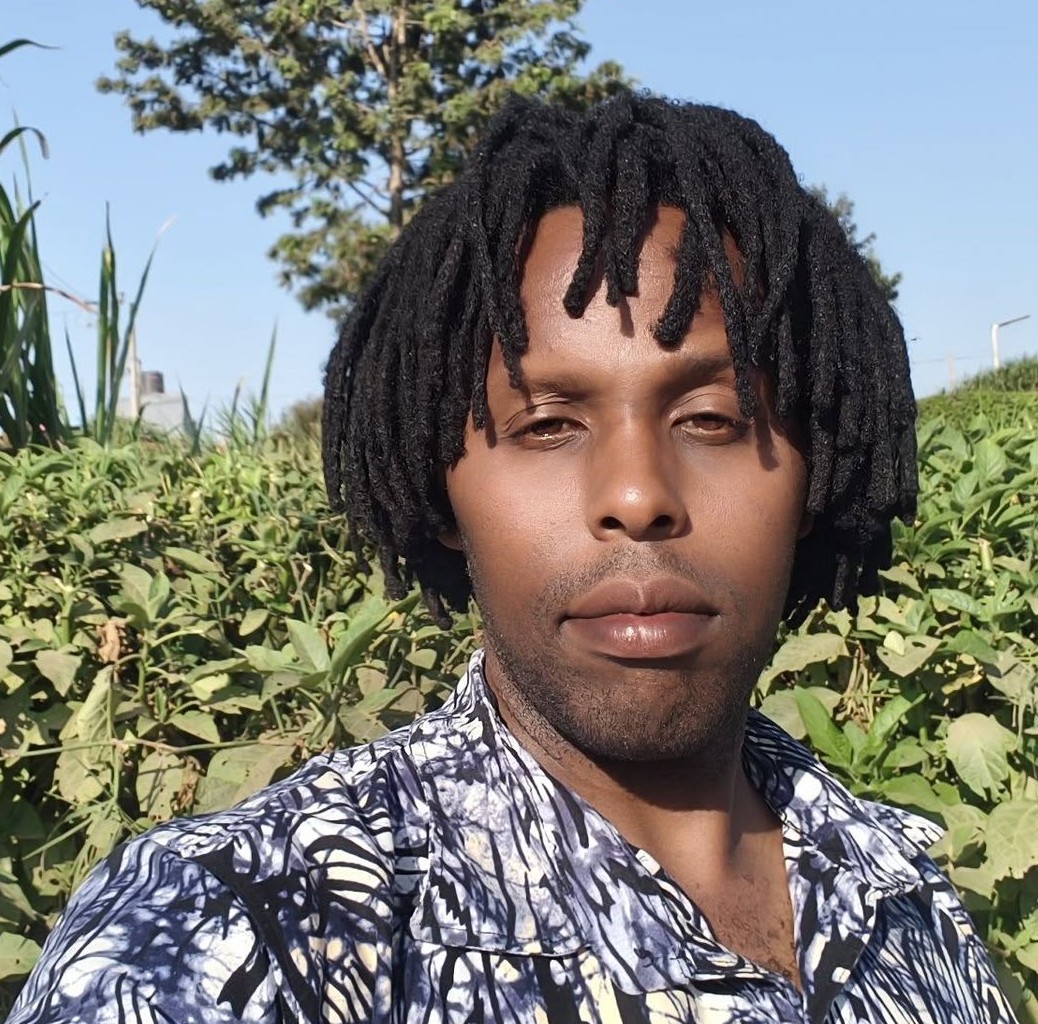
Monaja (Mwongela Kamencu), performing artist, historian and activist, at the convening.
The 2013 settlement: what Britain calls closure
The 2013 settlement came up again and again during the week, in the keynote, in the panels and in the testimony of the families. The UK Government’s settlement with Kenyan survivors of torture is what the British state now points to when it says that the matter of its colonisation of Kenya is closed. It is worth setting out exactly what it was.
What the 2013 settlement did, and did not do
The Mutua case. In 2009 the law firm Leigh Day, with the Kenya Human Rights Commission and the Mau Mau War Veterans Association, took the UK Government to the High Court in London in Mutua and Others v Foreign and Commonwealth Office[10], for five Kenyans the British had tortured in the camps of the Emergency. There were two systems of camps: the concentration camps the British called ‘Emergency villages’, into which they forced about a million Gĩkũyũ, Embu and Meru people, mostly women, children and the old, behind barbed wire and spiked trenches; and the detention camps, which the British ran as a ‘pipeline’ through which they moved at least 150,000 men detained without trial, to be ‘screened’, tortured and worked.[11][12] The UK Government argued that liability had passed to independent Kenya and that too much time had gone by. It lost on both points, and on the way was forced to disclose the Hanslope archive, some 17,000 files on the Emergency hidden for fifty years at Hanslope Park, which showed that the torture was authorised at Cabinet level in London.[13]
The settlement. On 6 June 2013 the UK Government settled: regret in Parliament, no liability[14]; 5,228 people paid 330,000 Kenyan shillings each, about £2,500, within £19.9 million that included £6.6 million in legal costs; a memorial in Nairobi. Of 50,000 people who came forward, 5,228 were put forward as cases the lawyers judged they could prove. Paul Muite, the Kenyan lawyer who advised the veterans, explained why they accepted so little: most were over eighty and dying every day, and refusing would have meant ten more years.[15] The Kenya Human Rights Commission said the case was never about the land confiscated, the education denied or the property lost.[16] I will say plainly what I think of that. It was abuse. Freedom fighters, and veterans of the war of liberation who had sustained them from the villages and in the camps, now in their eighties and nineties and having already waited sixty years, were made to choose between a pittance now and the near certainty of dying before any judgment. They were forced into it by the British state, which had hidden the evidence and run down the clock, and no Afrikan person should ever have to settle on those terms. Fighters and their families, and tens of thousands who lived through the camps, received nothing. The colonial land regime stood.
An impossible standard. To be counted, elderly freedom fighters had to prove, sixty years on and in a foreign court, what was done to them in camps whose records the British destroyed or carried away and hid, and whose guards and officers were dead or untraceable. The destruction was deliberate. As Simon Myerson QC told the High Court for the claimants in the second case in 2016, as the British prepared to leave, ‘Special Branch complained that it could not burn paper quickly enough… Anything “embarrassing” was to be destroyed… That includes the records of those kept in detention. This was a cover-up on an industrial scale.’[17] The British state destroyed the evidence, then pleaded the passage of time.
The second case. In 2013 a group action for some 44,000 people, Kimathi and Others v Foreign and Commonwealth Office[18], carrying the name of Mukami Kimathi, the Kenya Land and Freedom Army fighter and wife of Field Marshal Dedan Kimathi, was brought in London by the law firm Tandem Law. The claimants described beatings, rape, torture, forced labour and castration; freedom fighters and veterans in their nineties gave their testimony by video link from Nairobi, and by 2016 more than 2,000 of them had died waiting.[17] In 2018 the High Court stopped it because too much time had passed, recording the claimants’ own summary: ‘many people were abused, but none of the 40,000 people in this action can show they were abused.’[19] In 2023 the court struck out a negligence claim against the law firm and barristers who had represented them: no evidence could have changed the result.[20] In Kenya the veterans petitioned over stalled negotiations for those left out, while the people they fought for died. In January 2025 the British High Commissioner wrote that the 2013 agreement ‘resolved all claims relating to the Emergency Period’.[21] The injustice continues.
I was in the Royal Courts of Justice in London on 5 October 2012, the day Mr Justice McCombe ruled in Mutua and Others v Foreign and Commonwealth Office that the case could go to trial despite the passage of time. In my newsletter of that month, ‘Has there really been a victory for the Mau Mau?’[22], I opened with Malcolm X:
‘If you stick a knife in my back nine inches and pull it out six inches, that’s not progress. If you pull it all the way out, that’s not progress. The progress comes from healing the wound that the blow made. They haven’t even begun to pull the knife out. They won’t even admit the knife is there.’
Malcolm X
I wrote that the original liberation struggle for uhuru, freedom, cannot be traded for the narrow victories of a court case, however victory gets defined; that the right to sue the British Government is not the same thing as judges who swear an oath of allegiance to Queen Elizabeth II finding a department of Her Majesty’s Government guilty of torture; and that elderly Kenyan claimants had been forced over hurdle after hurdle simply to establish a right in law to sue, so that it was the whole British justice system that stood on trial. I was reminded of the Afrikan folk tale of what happens to Sister Goose in the Court of the Foxes: justice cannot be guaranteed for those who are not foxes. My work with the Mau Mau Justice Network in London at that time, providing legal literacy support and training in reparations, was under the auspices of PARCOE. The 2013 settlement, and the dismissal of the Kimathi case in 2018 because too much time had passed, have borne that reflection out.
Land and freedom: the sons and daughters of the freedom fighters
Among the most powerful contributions at the convening came from the sons and daughters of Kenya Land and Freedom Army freedom fighters, elders themselves now, who spoke of the redress and reparation their families have never had. Their own state has brought them no remedy either. Kenya’s Truth, Justice and Reconciliation Commission (TJRC), set up under the Truth, Justice and Reconciliation Act of 2008 after the post-election violence of 2007–08, took some 40,000 statements over four years and handed its 2,210-page report to President Uhuru Kenyatta on 21 May 2013. The report named land grievances as the single most important driver of conflict in Kenya. Its three international commissioners dissented, recording that the Office of the President had pressed the Commission to remove passages of the land chapter that implicated Jomo Kenyatta, the President’s father. In December 2013 Parliament amended the Act to remove the duty to begin implementation within six months, and the National Assembly has never debated or adopted the report. Thirteen years on, its recommendations lie unimplemented.[23]
The sons and daughters spoke too of the 2013 settlement described above. Fighters and their families were left off the list of 5,228 claimants, they told us, while people who had never been fighters appeared on it.[24] The families of those who sacrificed most live today in abject poverty, systematically impoverished by landlessness: the families’ and the peoples’ ancestral lands, seized by the British, were never reclaimed, and the fighters who came out of the forest or the camps came out to nothing. Their children grew up without land, without schooling their parents could pay for and without the means to recover, and they carry the consequences into the present.
The fighters themselves set out, in their own words, what they fought for. Read their demands beside the lives their families live today, and the whole distance of what remains unrepaired is laid bare.
In their own words: the fighters’ demands
The fighters set out their demands in the Kimaathi Charter, prepared by Field Marshal Dedan Kimathi under the authority of the Kenya Defence Council and widely circulated, reproduced in Shiraz Durrani’s ‘Kĩmaathi: Mau Mau’s First Prime Minister of Kenya’[25]. It opens: ‘We demand African self-government in Kenya.’ Among its demands:
‘We demand authorities of gold, markets, roads, co-operative societies, and auctions to be in the hands of Africans.’
‘We demand that the European foreigners, rascals, troops and police should be withdrawn from Kenya African Reserves.’
‘We reject criminal or death cases to be judged by foreigners.’
‘We condemn the dropping of poisons from the air as the colonialists in Kenya are doing to the African population.’
‘We reject the foreign laws in Kenya, for they were not made for Kenya and are not righteous.’
‘We reject being called terrorists when demanding our people’s rights.’
‘We demand a stop to the raping by foreigners of our wives and daughters; also female imprisonments and carrying of passes.’
‘We reject the colonization of Kenya, for in that state we are turned into slaves and beggars.’
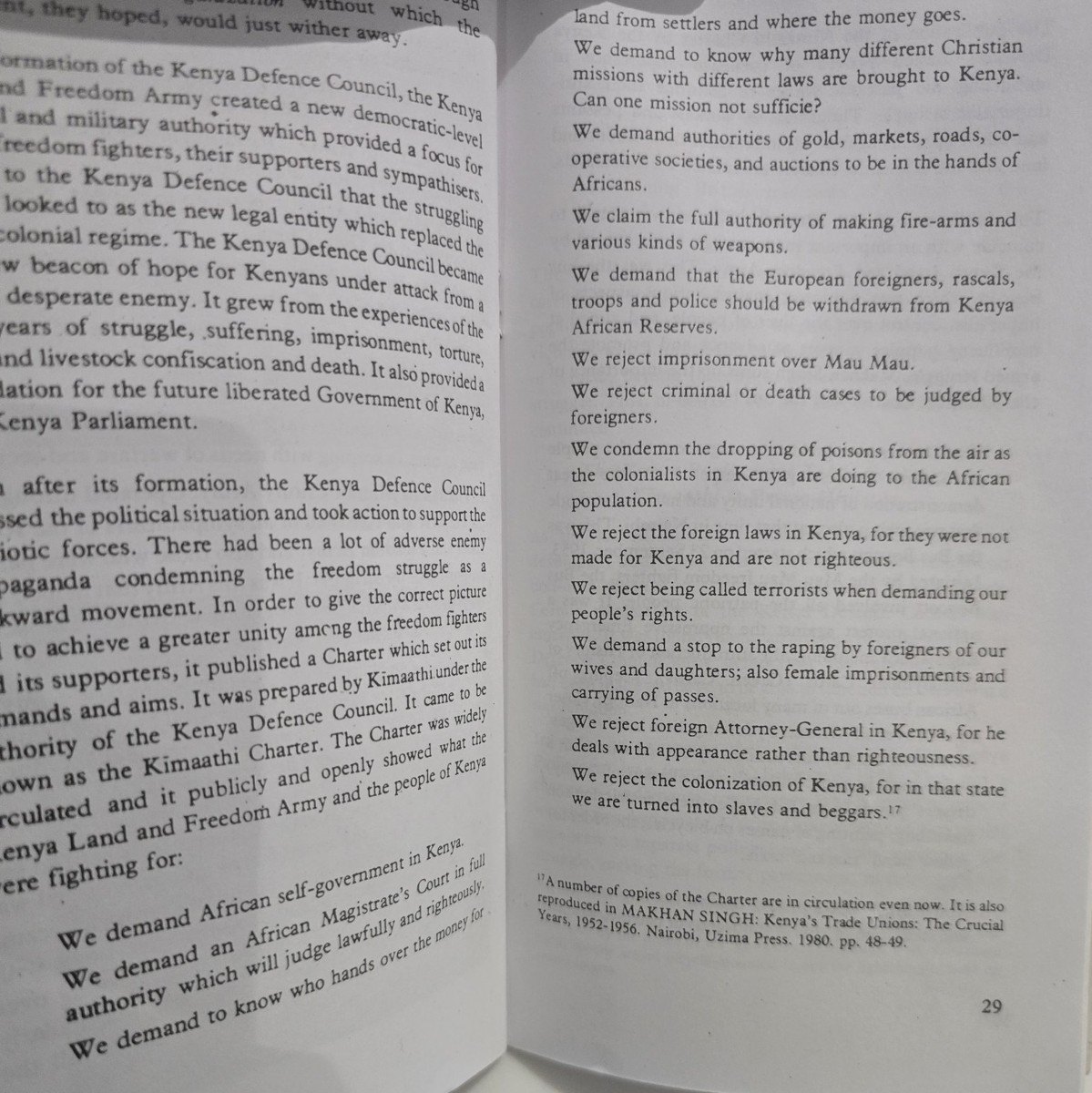
The Kimaathi Charter, as reproduced in Shiraz Durrani, ‘Kĩmaathi: Mau Mau’s First Prime Minister of Kenya’, pp. 28–29.
Among those who spoke was Wacera Itugu, the daughter of a fighter, who came to draw attention to what was done to her father and to her family.
Itugu, son of Kiburu: seven years in detention
The British imprisoned Wacera’s father, Itugu, son of Kiburu, without trial from 1954 to 1961: seven years of his life, taken for fighting for the freedom of his people and the land of his family and his people from the colonisers who had invaded it and waged war on them. Wacera told me that after his arrest the British took him first to Langata camp in Nairobi, then to Mackinnon Road, in the dry country on the road to Mombasa, and that he finished his detention at Hola. Hola is the camp where, on 3 March 1959, warders beat eleven detainees to death for refusing forced labour; the Hola massacre, once exposed, undermined the legitimacy of British rule and hastened the end of the Emergency.[17]
Like the other families who spoke, Itugu’s family has seen no redress. Wacera called for justice, and first of all for the right to be heard: to speak of what was done to her father and of what it did to her whole family.
Wacera began in English and, as her testimony deepened, moved into Gĩkũyũ. I do not speak Gĩkũyũ, and I understood her all the same, through the depth of the emotion she conveyed and the questioning that ran through everything she said. The question she put again and again, to the British state, was: ‘What did my father do?’ She asked it demanding an answer: what could Itugu, son of Kiburu, possibly have done to warrant seven years of brutal, unjustifiable imprisonment, with consequences that have run down the generations to her? He has passed on. The family’s quest for justice remains, and it will not go away.
Testimony like this is harrowing to give and to hear. It is also why any process that hears survivors and their descendants must build in support for them, including psychosocial support, from the start. It had a profound impact on me. I could not look the other way, and I resolved that, as someone involved in the process of establishing the Commission of Inquiry described below, I would see what can be done when I returned to the UK.
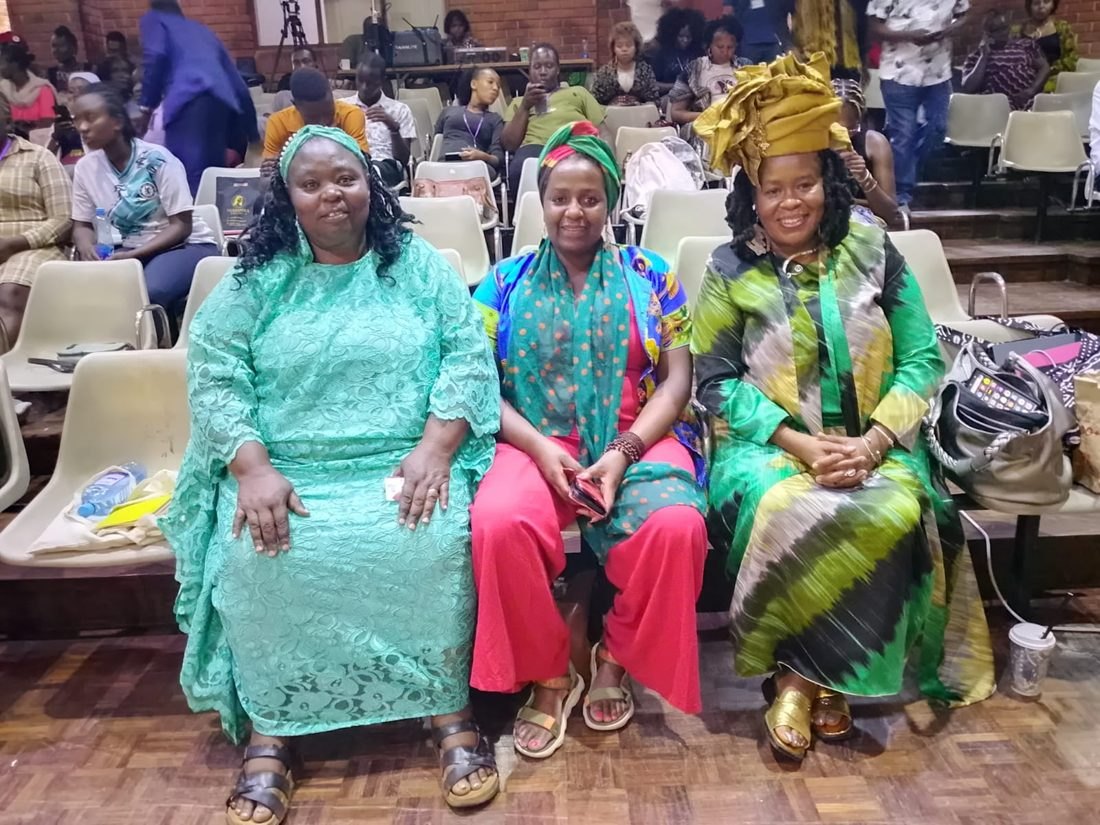
Wacera Itugu (left), daughter of the Kenya Land and Freedom Army fighter Itugu, son of Kiburu, with Dr Peninah Wangari-Jones and me at the convening.
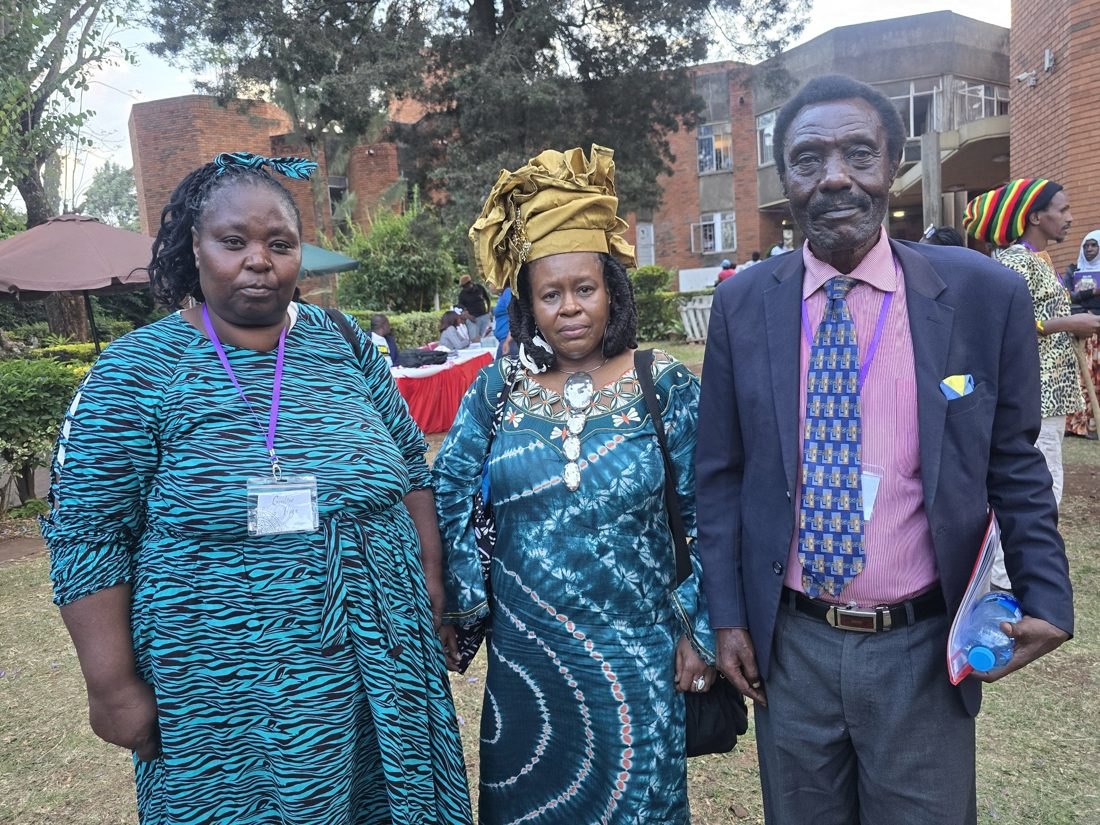
With Wacera Itugu (left) and, right, another daughter of a Kenya Land and Freedom Army fighter, whose family, like hers, lives with the destitution and injustice that followed and has its own case for redress.
The British state has given Wacera’s family no account of what was done to her father: the detention records were destroyed, as the claimants’ counsel told the High Court, and the state waited for the detained to die. What the family keeps is one piece of paper. It is a copy of a typed list dated 8 March 1961, drawn up in the name of ‘Mr. Itugu s/o Kiburu, ex-detainee’, setting out ‘the pieces of clothes taken from’ him and kept in the Government Store at Mackinnon Road Detention Camp on 16 April 1954, ‘and no receipt was given’. The British identified him by a bracelet number. Two suits, six shirts, trousers, shoes, a wristwatch, a suitcase, a stove, two sufurias (cooking pots), soap, towels and even two spoons are itemised and priced, to a total of 2,253 shillings and 25 cents.
Itugu, son of Kiburu, fought for the freedom of his people and the ancestral lands of his family. The state that had invaded that land and waged war on his people imprisoned him for seven years without trial, and recorded him as a number on a bracelet and a list of possessions down to his spoons. Records like this, and the testimony of the families who keep them, are part of what the Commission of Inquiry we are calling for would hear.
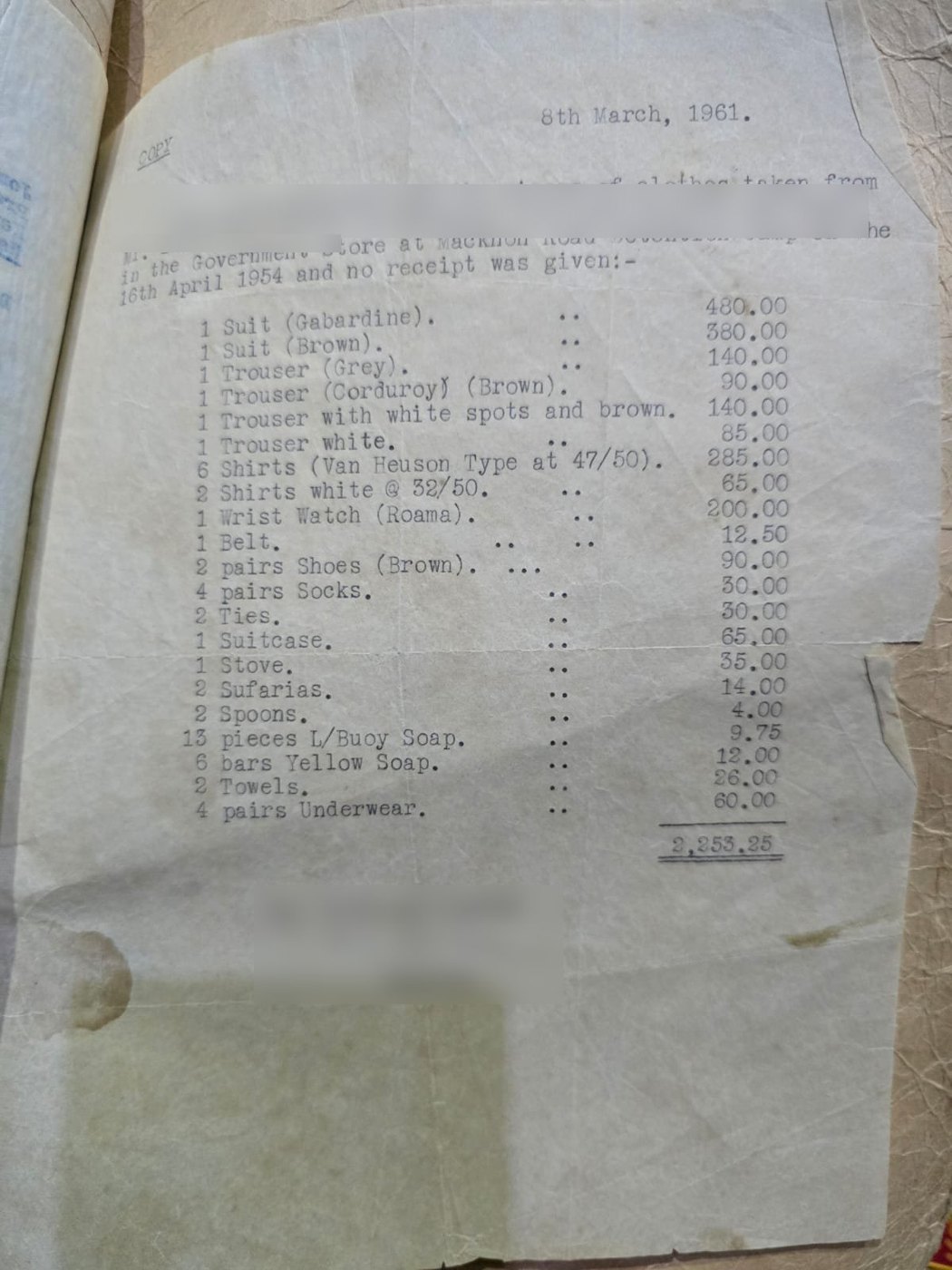
The list, dated 8 March 1961, of the clothes and belongings the British took from Itugu, son of Kiburu, at Mackinnon Road Detention Camp on 16 April 1954. Some details have been obscured.
The families were keen to hear about the All-Party Parliamentary Commission of Inquiry for Truth and Reparatory Justice (APPCITARJ), a demand first raised by PARCOE and carried forward by the Stop the Maangamizi Campaign, and announced as the key outcome of the All-Party Parliamentary Group (APPG) for Afrikan Reparations’ UK Reparations Conference on 17 October 2026, where a session was given to writing its mandate. The Commission is still to be established, and its mandate is being shaped now. Wacera and the other families made a plea that its scope include the fighters and their families, and the case for that is strong. Its subject is global Britain: what Britain did and does across the empire, Kenya included, has consequences for Afrikan heritage communities living in Britain, and it is those communities the Commission centres. The same British state, the same Crown and the same companies acted in Kenya and in the Caribbean, and the people harmed in Kenya are the parents and grandparents of people in Britain today. A mandate that stops at Britain’s shores would leave out the very people on whom the British state’s record is clearest and the evidence still living. International hearings, in Kenya and elsewhere, are part of our vision and aspirations for it.
The Commission of Inquiry and the families of the Kenya Land and Freedom Army
Beyond the 2013 settlement. The UK Government now treats the Mutua settlement as full and final, the argument it ran successfully in Kimathi. For the families, the Commission is the forum that remains. It would investigate what has been and is being done, from the camps to the land seized and never reclaimed and the records destroyed or hidden, and make recommendations for solutions, redress and repair.
Hearing the families. Wacera and the other families said they would be keen to appear at any international hearings of the Commission, because they are denied a voice and representation and have had no justice. We discussed how the Commission’s mandate should be constructed so that it can hear from, and amplify the voices of, people impacted overseas by the actions of the British Crown and state, the fighters and their families among them. That request I carry into my work with the APPG for Afrikan Reparations: any mandate must be able to hear from them.
Lessons from Kenya’s own Truth Commission. The TJRC’s report was altered under pressure from the Office of the President, never adopted by Parliament and never implemented. Recommendations need a way of being carried out that those implicated cannot rewrite, and survivors and their descendants must have a say in who decides.
I shared the Stop the Maangamizi Campaign’s postcard, whose QR code leads to stopthemaangamizi.com/citarj, together with MET’s materials.
More must be said. These families are living victims of the British state, with multifaceted unmet needs, social, political, economic and psychological, the result of systematic impoverishment through landlessness. The harm did not stop with the generation detained, and it has not stopped now. Land not returned is schooling not paid for, livelihoods not built, health not kept and life chances lost, in the children of the detained and in their children. The consequences of what the British state did are still playing out in these families, so their full extent is still to be counted; that is the plain meaning of intergenerational harm, and it is what the British state’s talk of closure refuses to recognise. There are ways of counting it. The Brattle Group’s ‘Report on Reparations for Transatlantic Chattel Slavery in the Americas and the Caribbean’, presented at the University of the West Indies in June 2023 with an introduction by Judge Patrick Robinson, then of the International Court of Justice[26], quantified the harm done to some 19 million people in thirty-one countries of the Americas and the Caribbean. I cite it for its method and for what it leaves out; the demands of the ISMAR are its own, and no valuation sets a standard for them. Its method separates the harm done during enslavement itself from the continuing harm inflicted on descendants after it; counts the years of life taken; and shows how wages withheld, liberty taken and injury and anguish inflicted can be valued, and how those losses compound across generations. What it leaves out is Afrika: every harm it counts was inflicted in the Americas and the Caribbean, and the harm done to Afrikan peoples on the continent, by the trade in captives and by colonialism, has yet to be quantified in the same way. The same method applies to the camps, the land seizures and the decades of destitution that followed for the families of the freedom fighters, and a Commission of Inquiry that hears them would have the evidence on which to recommend redress. Meeting those needs means remembering the families and reopening a matter closed over their heads by a settlement they were never part of. If there are organisations or people reading this who are in a position to support them, in whatever way, please contact me at estherxosei@gmail.com. I will connect you.
Unsung women of Kenya’s wars of liberation
The role of women came through strongly throughout the trip. Women fought and led in Kenya’s wars of liberation alongside men, and many of them remain unsung. Mekatilili wa Menza, of the Giriama, led resistance to British forced labour and taxation in 1913–14; the British exiled her, and she returned to continue the struggle. Mary Mũthoni Nyanjirũ led the crowd at the Nairobi police lines in March 1922, demanding the release of Harry Thuku of the East African Association, and was killed when British police and settlers opened fire. Field Marshal Mũthoni wa Kĩrĩma fought in the Aberdare forest for eleven years, was never captured, and became the only woman to hold the rank of Field Marshal; I write about her, and my visit to her home, below.
Wamuyu Gakuru, known as Cinda Reri, took the batuni warrior oath in 1951 and insisted that women who took the oaths were equally bound to take up arms. Working in settlers’ homes, she located their hidden guns for the fighters to take; through her contacts on the railways she moved weapons to the forest on such a scale that a railway wagon was needed to carry them, and from that the name Cinda Reri, Gĩkũyũ for the one who outdid the railway (cinda, to outdo; reri, the railway), was given to her[27]; she went on to serve in the Hika Hika battalion as a spy and ration commander, and later spoke out against the marginalisation of women in the struggle and after it. Mukami Kimathi joined the fighters in the forest in 1953 and took charge of their daily life: food, and the care of the sick and wounded. Sent to Nairobi, she organised communication, supplies and intelligence between the forest and the city and recruited young people to the war, moving unseen by the British, for which the fighters named her the Wasp. Arrested in April 1954 with her child, she escaped from Langata camp, was rearrested and sent to Kamiti, the camp for women. For six decades after the British hanged Field Marshal Dedan Kimathi, her husband, she demanded that Britain and Kenya show her where he lay, and she told her own story in ‘Mukami Kimathi: Mau Mau Woman Freedom Fighter’[28]. She joined the ancestors in May 2023, aged 96.
Many more are named in the record. Rebecca Njeri, who mobilised her community to build independent schools, was imprisoned without trial at Kamiti prison, outside Nairobi, from the start of the Emergency until 1960; songs heralded her as Mother of the Mau Mau Children.[29] The British detained some 8,000 women under the Emergency Powers between 1954 and 1960, most of them at Kamiti.[30] In 1966, women veterans of the Women War Council, writing to Mama Ngina Kenyatta about their neglect, put it in their own words: ‘We are stupefied by the fact that it seems to us that you forgot all about the women of the cooking pot and spoon.’[31]
Professor Mĩcere Gĩthae Mũgo set out a radical Afrikan feminist critique of how women have been written out of accounts of the Kenya Land and Freedom Army.[32] Reparations and decolonisation are a gendered project, and the standard for repairing what was done to women in war is already set, in Nairobi itself. The Nairobi Declaration on Women’s and Girls’ Right to a Remedy and Reparation[33], adopted in March 2007 by women’s rights advocates and survivors of conflict-related violence from Afrika, Asia, Europe and the Americas, holds that ‘reintegration and restitution by themselves are not sufficient goals of reparation’, because the violations women suffer in war grow out of inequalities that predate it; that ‘reparation must drive post-conflict transformation of socio-cultural injustices’; and that ‘full participation of women and girls victims should be guaranteed in every stage of the reparation process’.[33] Applied to the women of the Kenya Land and Freedom Army and of the camps, that means repair which transforms the condition of Kenyan women today, land, safety and the power to decide, designed with the women and the daughters of the war, and it means restoring these women to the record and honouring their families as part of it.
What I observed at the convening is part of this too. A striking number of those present were young women who introduced themselves as organisers in women’s organisations and activist networks, and several of them organise with young mothers, single mothers among them. The level of organisation was refreshing to see, and with it a high degree of sensitisation to patriarchy and to gender justice. It made for rich dialogue, in the sessions and in my own conversations, on the distinctions and interrelations between feminisms, Afrikan feminisms among them, womanism and Motherism, the Afrikan-centred alternative to feminism articulated by Professor Catherine Acholonu; I define myself as a Motherist. The politicisation of young women, and of young mothers, in Kenya is one of the most hopeful things I witnessed on this trip.
The work of MET most relevant to these women is the Mbuya Nehanda Afrikan Women and Reparations Project, launched in 2022. The project is named after Mbuya Nehanda, the Shona spirit medium who led the First Chimurenga, the 1896–97 war of resistance against British conquest in what is now Zimbabwe; the British hanged her in 1898 and took her head to Britain, where it is believed to lie still, and Zimbabwe continues to demand its return.[34] Through the project, women of Afrikan heritage co-produce knowledge of their gendered right to remedy and reparation, build their decision-making power within the ISMAR, and advance the restoration of Afrikan matriculture, the knowledge, authority and ways of living that Afrikan women lived by and passed on, and that the Maangamizi set out to destroy, as part of rematriation. The women I met in Nairobi are already organising on their own ground. One concrete recommendation I take from the week is that the Racial Justice Network, through which I met them, convene dedicated sessions on the gendered dimensions of decolonisation and reparation, so that the conversations begun at the convening continue with the women who began them, and the project can contribute to them there.
Honouring the Mashujaa: Nyeri and the Mashujaa Heritage Archives
From Ufungamano House our hosts took us to Nyeri, to the home of Field Marshal Mũthoni wa Kĩrĩma and to Kahiga-ini; back in Nairobi, where we were staying, we went to the Mashujaa Heritage Archives & Library and to Pan-African House.
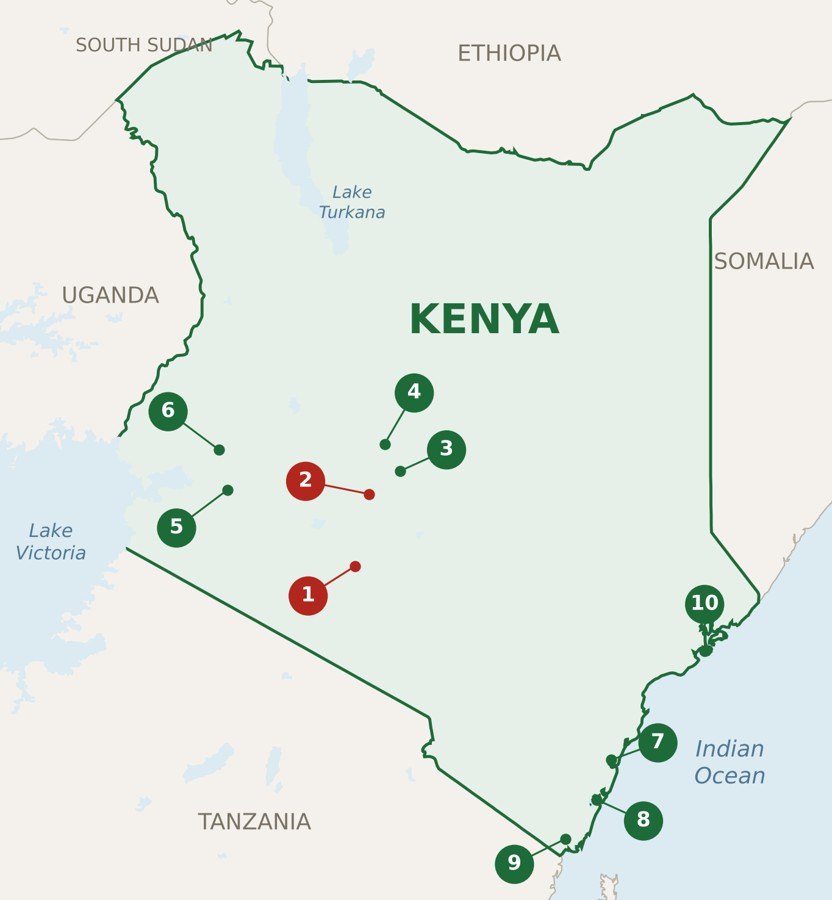
Where we walked (red): 1 Nairobi, Ufungamano House and Mwakenya House; 2 Nyeri, Kahiga-ini and the home of Field Marshal Mũthoni wa Kĩrĩma. Places in my keynote (green): 3 Kĩrĩnyaga (Mount Kenya) and the Aberdares; 4 Lolldaiga Hills, Laikipia; 5 Kericho; 6 Nandi; 7 Kilifi; 8 Mombasa, Owino Uhuru; 9 Kwale, Mrima Hill; 10 Lamu. Positions are approximate.
Nyeri. We travelled north from Nairobi to Nyeri, the country between the Aberdare range and the mountain the world calls Mount Kenya. This is the home ground of the Kenya Land and Freedom Army: the forests from which the fighters fought, and the land of both of its Field Marshals, Dedan Kimathi and Mũthoni wa Kĩrĩma. Our first stop was Field Marshal Mũthoni’s home.
Field Marshal Mũthoni wa Kĩrĩma is a legend in Kenya, and she earned it. Born in 1931 in Nairutia, Nyeri, she laboured as a child on a settler’s farm, where she watched Gĩkũyũ men and women beaten and abused, and resolved to fight. She took the oath in 1952 and organised oaths for others; after Chief Mũhoya’s men beat her on suspicion of her husband’s loyalties, she went into the Aberdare forest alone and found the fighters. She began by finding food, ammunition and grenades and nursing the wounded, then led platoons in combat, and rose to become the only woman to hold the rank of Field Marshal; Field Marshal Kimathi named her Nina wa Thonjo, the weaver bird, for the war strategies she wove. She fought for eleven years, never captured, and came out of the forest only after independence in 1963. She had a miscarriage in the forest and could not conceive afterwards. ‘Kenya is my only child,’ she said.
She came out to nothing. In words recorded by the Mashujaa Heritage Archives & Library: ‘I emerged from the forest after eleven years but was never given even an inch of land.’ The locks she grew in the forest she kept for seventy years, calling them ‘the history of Kenya’ and vowing to cut them only when she saw the fruits of the independence she had fought for. They were shaved in 2022, by Mama Ngina Kenyatta, amid controversy that continues. ‘I am still in the forest,’ she said. She joined the ancestors on 4 September 2023, aged 92, and was laid to rest at her home in Tetu.[35]
At the home we were received by Bernard Mungai Kamande, her adopted grandson, who lived with her and cared for her in her later years.
I felt deeply honoured to be in Field Marshal Mũthoni’s home, which she wanted preserved as it was, and to recognise her struggles, her sacrifices and all she stood for. Without children of her own after that loss, Field Marshal Mũthoni was a mother to many and a mother of the nation. I feel a deep affinity with her: as a woman who has given and sacrificed a great deal for the struggles for reparations, I see myself as a mother of this movement, the ISMAR.
Listen: a tribute to Field Marshal Mũthoni wa Kĩrĩma
‘Mutumia Ngatha’ by the South African collective Batuk, Carla Fonseca and Spoek Mathambo, from their 2020 audiovisual release ‘Again She Reigns’[36], honours her: ‘From her first breath, uprising legacy / Dread-locked mamba, warrior mystery / Mutumia Ngatha, live out your destiny.’ Mutumia Ngatha is Gĩkũyũ for a noble woman; the dreadlocked mamba is the hair she grew in the forest and kept for seventy years.
‘Mutumia Ngatha’, Batuk (2020).
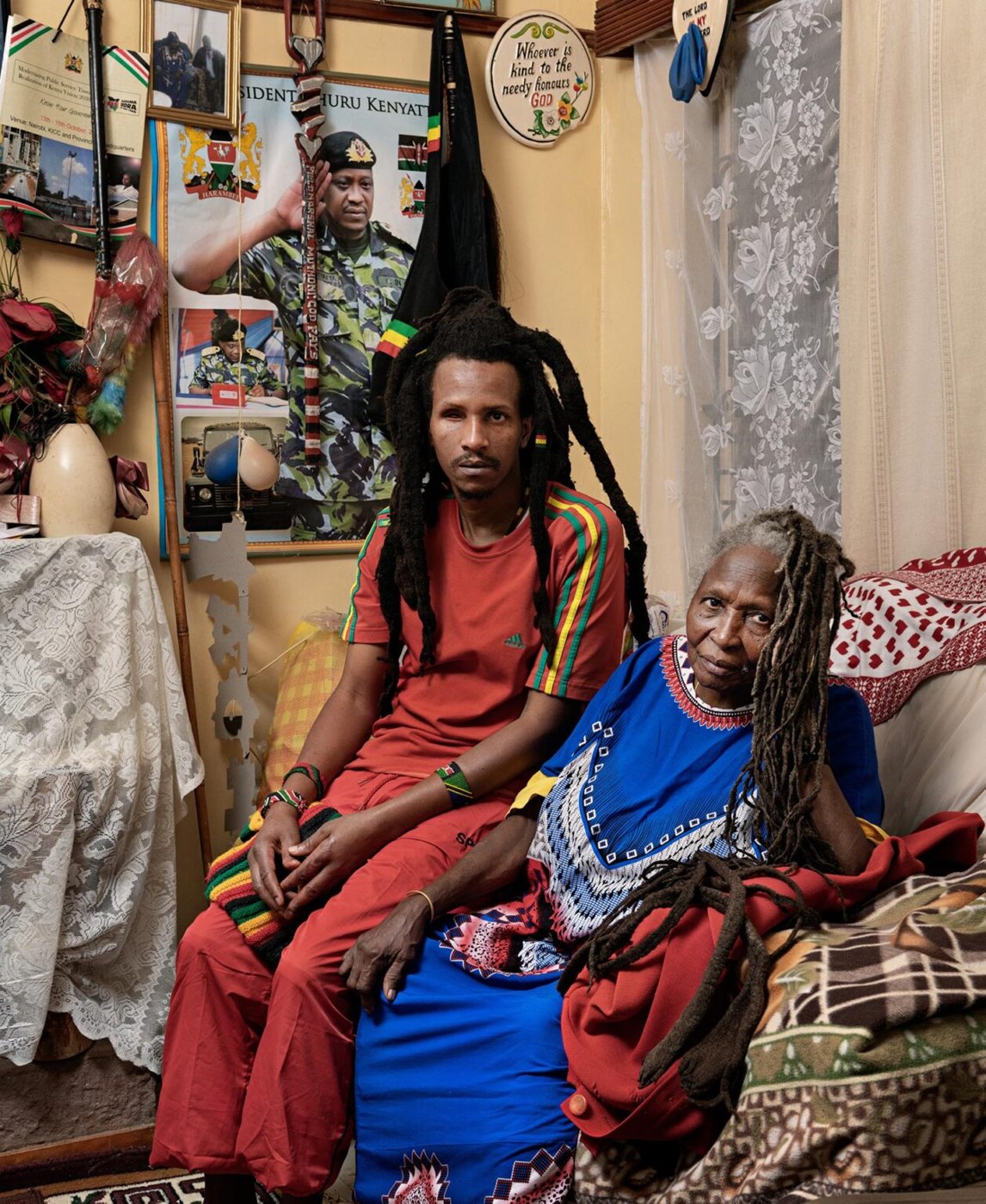
Field Marshal Mũthoni wa Kĩrĩma with her adopted grandson Bernard Mungai Kamande at her home in Nyeri, 2019. Photograph: Max Pinckers, ‘Unhistories’.[37]
During the visit we were shown the coat Field Marshal Mũthoni made in the forest, the original flag of the Kenya Land and Freedom Army, and the two vehicles she used to drive, kept as she left them.
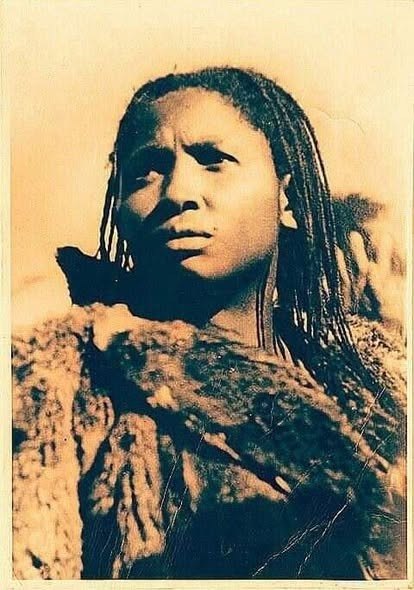
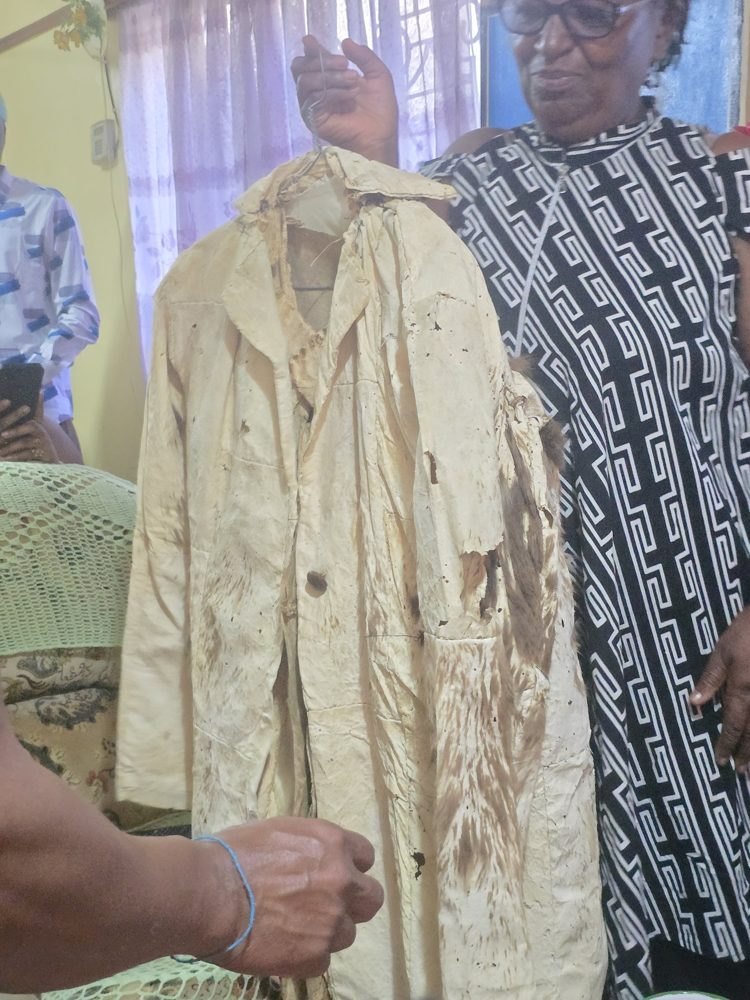
Field Marshal Mũthoni wa Kĩrĩma in the animal-skin coat she made in the forest, and the coat as it is today, preserved at her home and held up for us by Dr Christine Muthoni Kahigi, the historian who moderated the first day of the convening and chaired its panel of scholars.
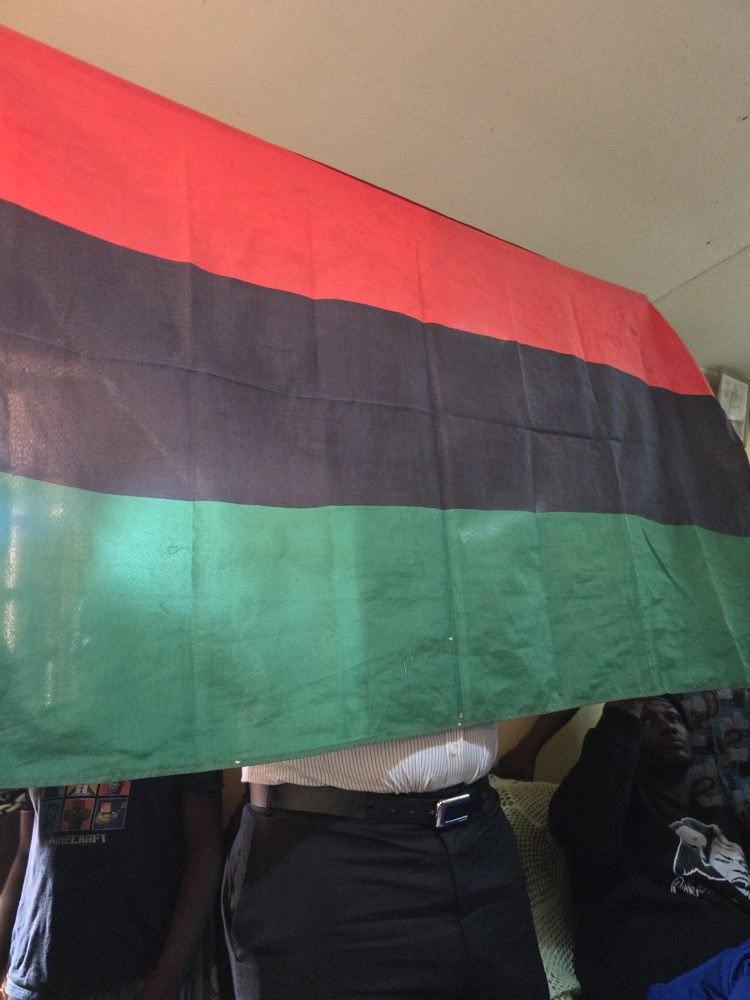
The original flag of the Kenya Land and Freedom Army, at the home of Field Marshal Mũthoni wa Kĩrĩma.
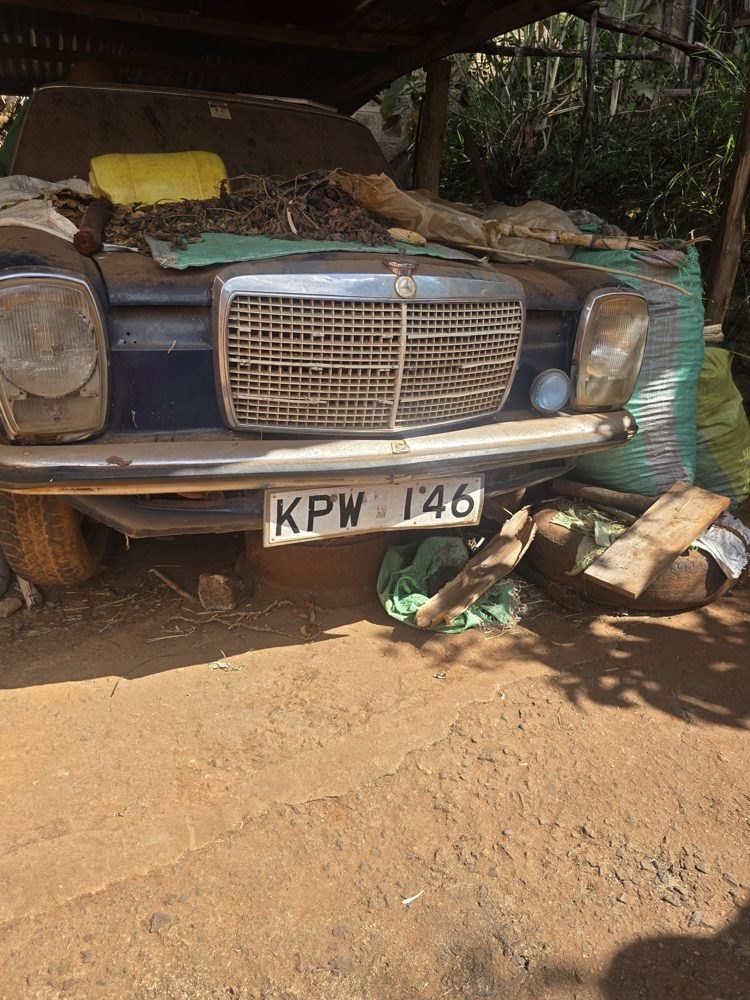
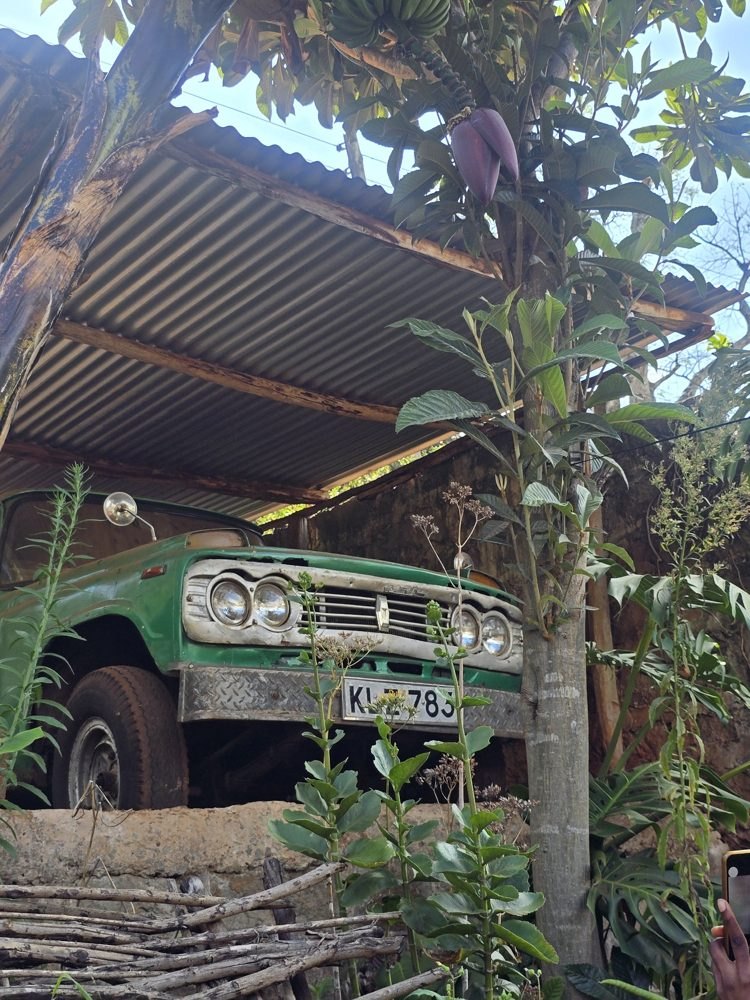
The two vehicles Field Marshal Mũthoni wa Kĩrĩma used to drive.
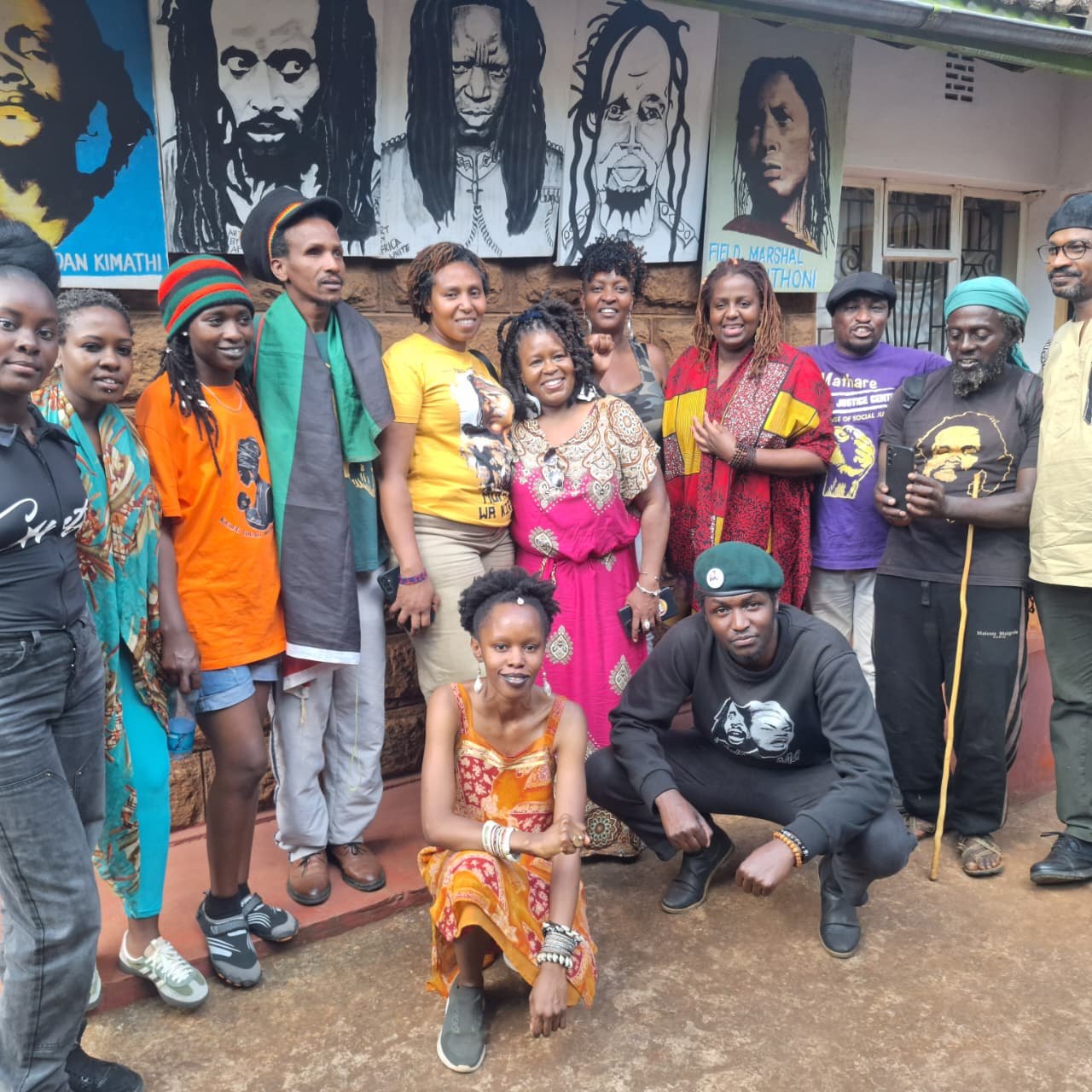
At Field Marshal Mũthoni wa Kĩrĩma’s home, beneath portraits of Field Marshal Dedan Kimathi, Field Marshal Mũthoni wa Kĩrĩma and other fighters of the Kenya Land and Freedom Army.
From Field Marshal Mũthoni’s home we went on, still in Nyeri, to Kahiga-ini, in Tetu, where on 21 October 1956 home guards, Kenyans armed and paid by the British to fight the forest fighters, shot and captured Field Marshal Dedan Kimathi, the leader of the Kenya Land and Freedom Army, the man on the British wanted posters, whom the British hanged four months later. The community has made the place the Dedan Kimathi–Mau Mau Memorial Park. We had two guides: Dr Njuki Githethwa, the historian who runs the Mashujaa Heritage Archives & Library, and a guide from the community of Kahiga-ini, who told us the story of the capture as he had gathered it from the elders, his own among them. He told it in Gĩkũyũ, the language of the place, and Ndungi Githuku of Pan-African House interpreted into English, principally for me. Ndungi is a prominent Kenyan human rights artivist, actor, director and musician who for decades has blended creative performance with political activism, using theatre, film and song to protest against systemic oppression in Kenya and to advocate for social change; later that day he would pour libation for me at this spot.
Our guide from the community of Kahiga-ini tells how Field Marshal Kimathi was shot and captured here on 21 October 1956. His full account follows.
Bernard Mungai Kamande, Field Marshal Mũthoni wa Kĩrĩma’s adopted grandson, at Kahiga-ini: we must protect this space.
Field Marshal Kimathi’s capture, as our guide told it
Field Marshal Kimathi had taught English at Karũnaini Primary School before working on a settler’s farm in Nyandarua, where he began organising. When he came back, the British were building concentration camps, the ‘Emergency villages’, ringed by a trench some twenty feet wide and lined with spikes, to cut the fighters in the forest off from the people and from the food the women brought them. Fighters who surrendered were sent back into the forest as pseudo-gangs, living as they had lived there, to find where their former fellow fighters were hiding; among them, he said, was Field Marshal Kimathi’s own brother, Wambararia. When Field Marshal Kimathi met one such gang in the forest he knew them for what they were, and fled many kilometres before coming back to his own village, Karũnaini, crossing the trench to the farms for sugar cane.
On a day when propaganda films were being shown, Field Marshal Kimathi knew there would be no curfew. He did not know that a bounty had been placed on him, or that he had been betrayed. Home guards sent by the British waited on his route back to the forest. Early in the morning, carrying a pistol, a sword, arrowroots and sweet potatoes, he met a commotion near the blue gum trees, changed course and tried to cross the spiked trench at this spot. A home guard on the far side called on him to stop, and shot him in the right thigh. The shot brought the other home guards running, and the man who fired it crossed over and said, ‘I have felled the giant.’
The guards tracked him through the dew to the thicket where he had crawled. A midwife, Priscilla wa Edward, gave him first aid. Carried on a stretcher, he asked to stop at a house he knew to drink tea, and people came from across the community to see the man so many had heard of and never seen. At Ihururu the forester Tiras Kimathi Murage took the photograph the world knows, of Field Marshal Kimathi lying wounded; it was he who later told how Field Marshal Kimathi had dressed in leopard and antelope skins as camouflage in the forest, and how the guards stripped them from him. He was taken on to the hospital in Nyeri, still in chains, where one of his former pupils treated him; then to trial, and to Kamiti Prison, where the British hanged him on 18 February 1957.
The community answered the betrayal in its own way. The home guards who shot him were rewarded. One bought a truck and turned it into a bus, and nobody in the community would ride in it; unable to do business, he watched it fall apart, and even the scrap metal dealers refused to take it. Another bought land in Nyeri, and people changed their routes so as never to pass it.
The ground where his blood was spilt, he told us, has stayed bare ever since: a patch in the tea where nothing grows. The monument at the memorial park stands because the community pressed the county government to build it, and they are pressing it now to protect this ground too.
Dr Njuki Githethwa at Kahiga-ini, where Field Marshal Kimathi was shot and captured, speaking about the moles.
Tiras Kimathi Murage had been a pupil of Field Marshal Kimathi; the two were namesakes, not relatives. Field Marshal Kimathi is remembered for saying, ‘My blood will water the tree of Independence.’ The British buried him in an unmarked grave at Kamiti, and his remains have yet to be brought home to his family. Mukami Kimathi, fighter and his wife, sought them for the rest of her life. The memorial park is cared for by the people of Kahiga-ini themselves, who raise their own funds for it and receive little support from the authorities; what is needed is proper support for the work they already do.
Ndirangu Mau, the Gĩkũyũ home guard who fired the shot that wounded Field Marshal Kimathi, was in a patrol led by Corporal Wanjohi, within the manhunt directed by the British police officer Ian Henderson. The British tried Field Marshal Kimathi from his hospital bed in Nyeri, for possession of a revolver and six rounds of ammunition under the Emergency Regulations, and sentenced him to death. The British rewarded Ndirangu Mau with £500. The lorry he bought with it his own people named Muthimo wa Kimathi, and they would not ride in it. He lived as an outcast until his death in 1986, and his children carried the name of a traitor into every school. The people of the mountain do not forgive betrayal. This too is part of what the fighters’ descendants live with: the British recruited Afrikan men to hunt the fighters, and that wound of division is unrepaired.
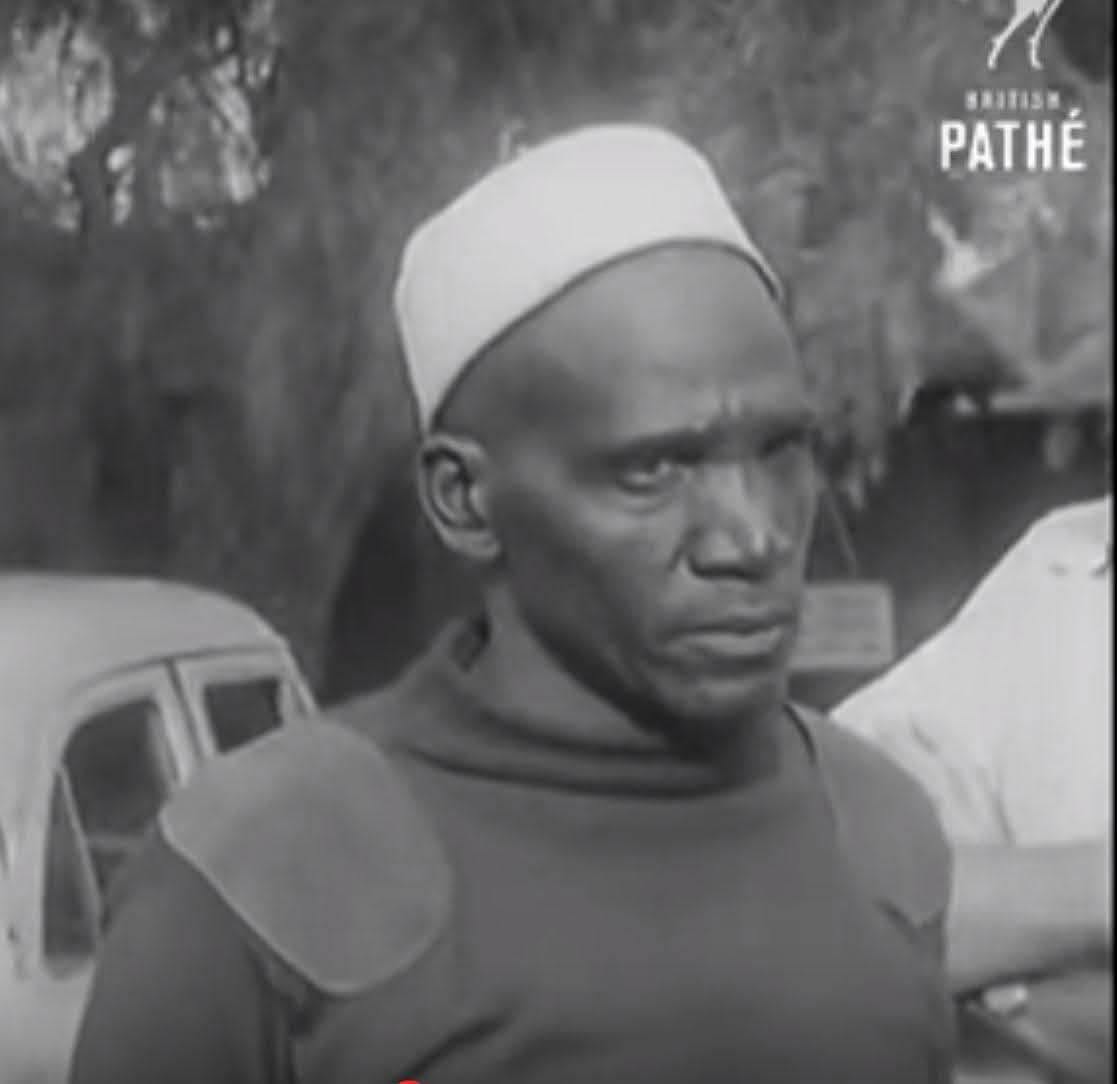
Ndirangu Mau, the home guard who fired the shot, in a still from the British Pathé newsreel of the capture, 1956. The British filmed him outside the Assistant Commissioner of Police’s office in Nyeri. Credit: British Pathé.
The British Pathé newsreel of the capture, 1956: Field Marshal Kimathi wounded on the stretcher, the leopard-skin coat the British held up for the camera, and the two home guards the British filmed outside the Assistant Commissioner of Police’s office in Nyeri. Credit: British Pathé.
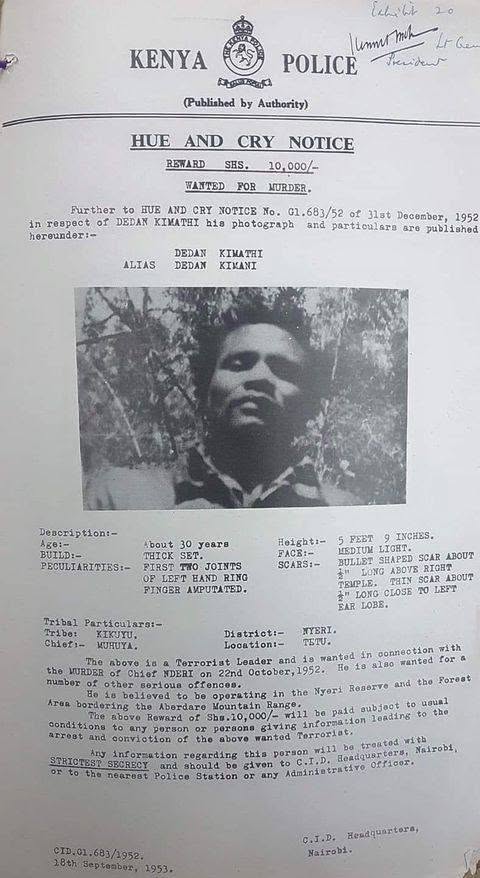
The British state’s own words: a Kenya Police ‘Hue and Cry Notice’ of 18 September 1953 offering a reward of 10,000 shillings for Field Marshal Dedan Kimathi, whom it calls a ‘Terrorist Leader’ wanted for the killing of Chief Nderi on 22 October 1952. The notice records the bullet scar above his right temple and the two amputated joints of his left ring finger. It is reproduced here as a record of how the British named the man who led the war of liberation for land and freedom; the language is theirs.
At the spot where Field Marshal Kimathi was shot, Ndungi Githuku poured libation and offered an invocation for me. Being there felt sacred. We went barefoot, for this is hallowed ground. Ndungi addressed the Creator and the ancestors and blessed the work of my hands and my feet: wherever I step, blessings; whatever I touch, blessings; whatever I write, blessings. He asked that my words be sharper than a razor and a sword, that they break the chains of enslavement, of mental enslavement and of colonialism, and that they inspire a generation. He prayed that the knowledge I gather, at the cost of the sacrifices made to restore knowledge of the rights of our people globally, locally and in Kenya, would spread wherever I go. It was here, in the libation, that Ndungi, speaking for the community of the mountain, gave me a Gĩkũyũ name: Wahito, to gather and to bring. The name was given, in his words, so that whatever I gather, whatever information I give and whatever knowledge I carry in the struggle for the respect and reparation of our community would be blessed, and he asked the Creator to make it so. The naming is on the third of the videos below. It was the second name I was blessed with in Kenya, both given in recognition of my mission. The first, Akinyi Adero, a Luo name, came after my appearance on the Nation FM radio programme ‘Fixing the Nation’, filmed and shown on NTV Kenya, when a viewer gave it to me. Luo names are given from the time and circumstances of a birth. Akinyi is from okinyi, the morning: a girl born at dawn, a new beginning. Adero is from dero, the granary: a girl born when the granaries are full, in a time of abundance. Born at dawn, in a time of plenty: I receive it as a blessing on the work and on what it gathers in.
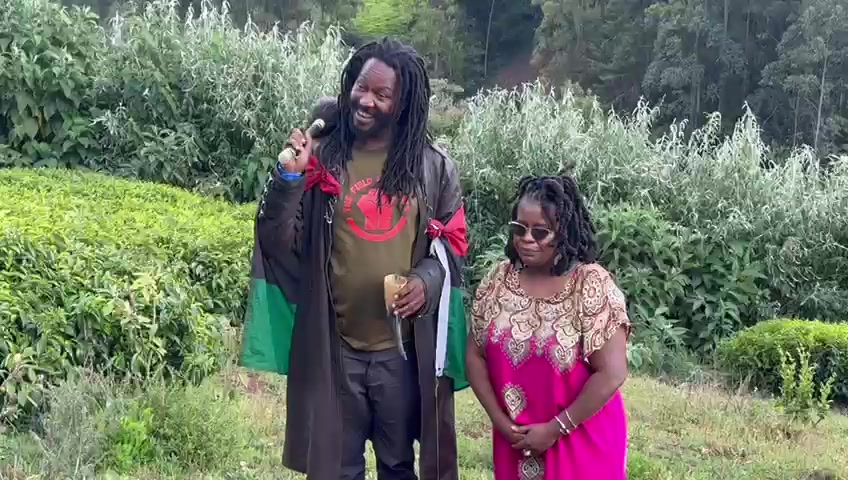
Ndungi pours libation and offers an invocation for me at the spot where Field Marshal Kimathi was shot, the tea of Kahiga-ini all around. Still from video.
The libation at Kahiga-ini, part one: Ndungi pours libation and offers an invocation for me at the spot where Field Marshal Kimathi was shot.
The libation, part two.
The libation, part three: the naming.
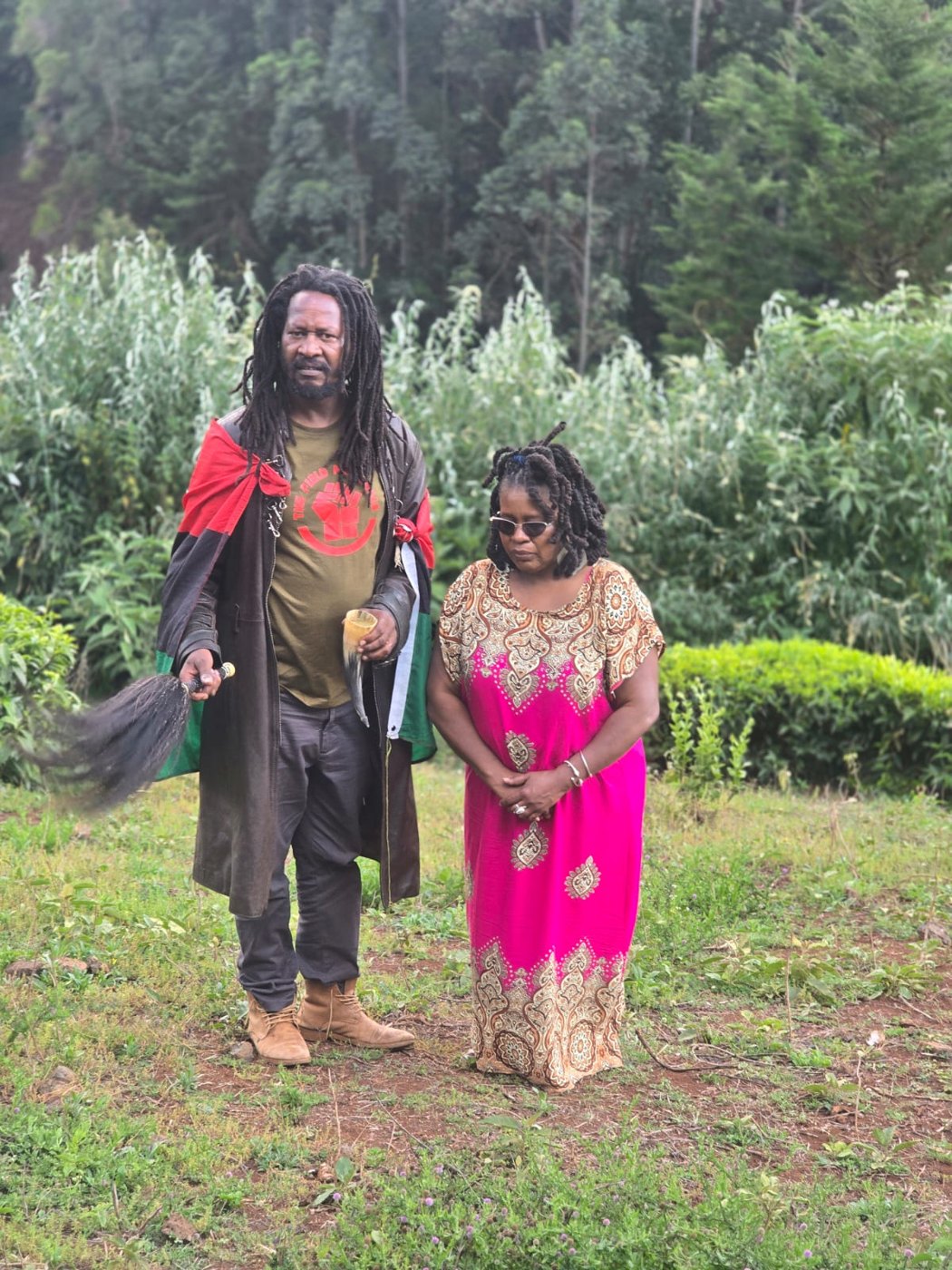
At Kahiga-ini, Tetu, Nyeri, where Field Marshal Dedan Kimathi was shot and captured on 21 October 1956, with Ndungi Githuku.
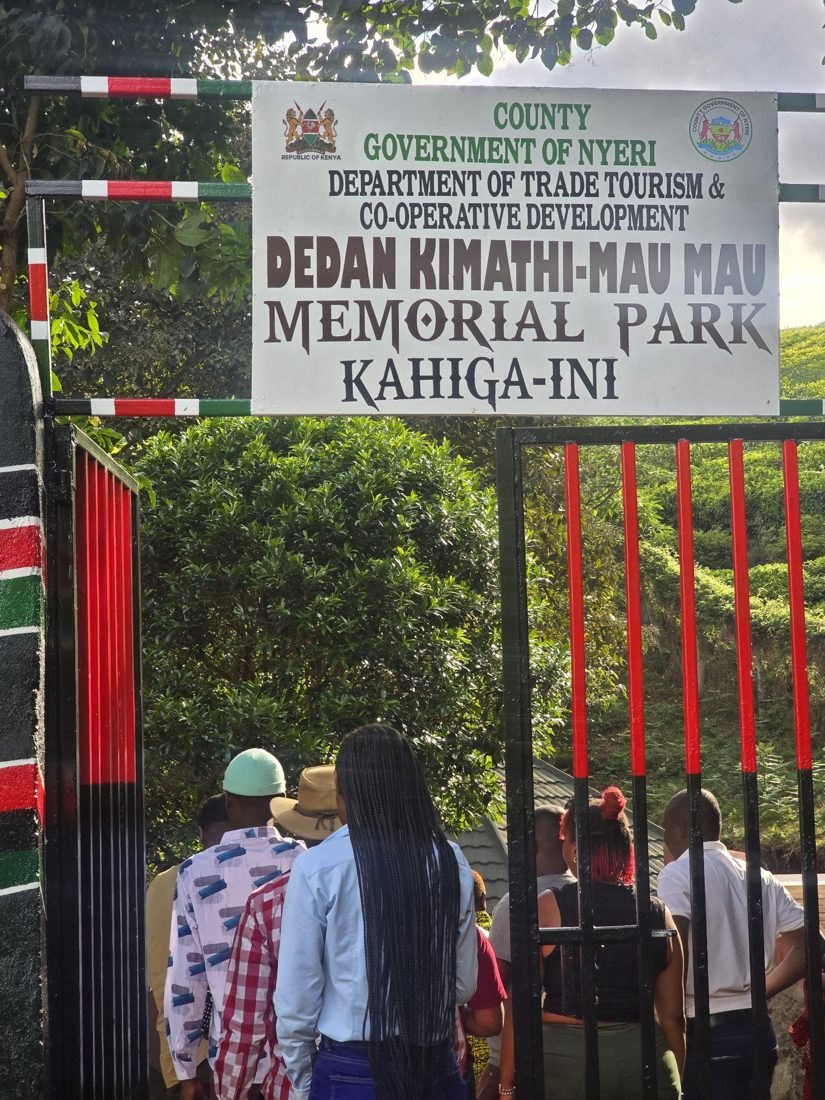
The entrance to the Dedan Kimathi–Mau Mau Memorial Park, Kahiga-ini.
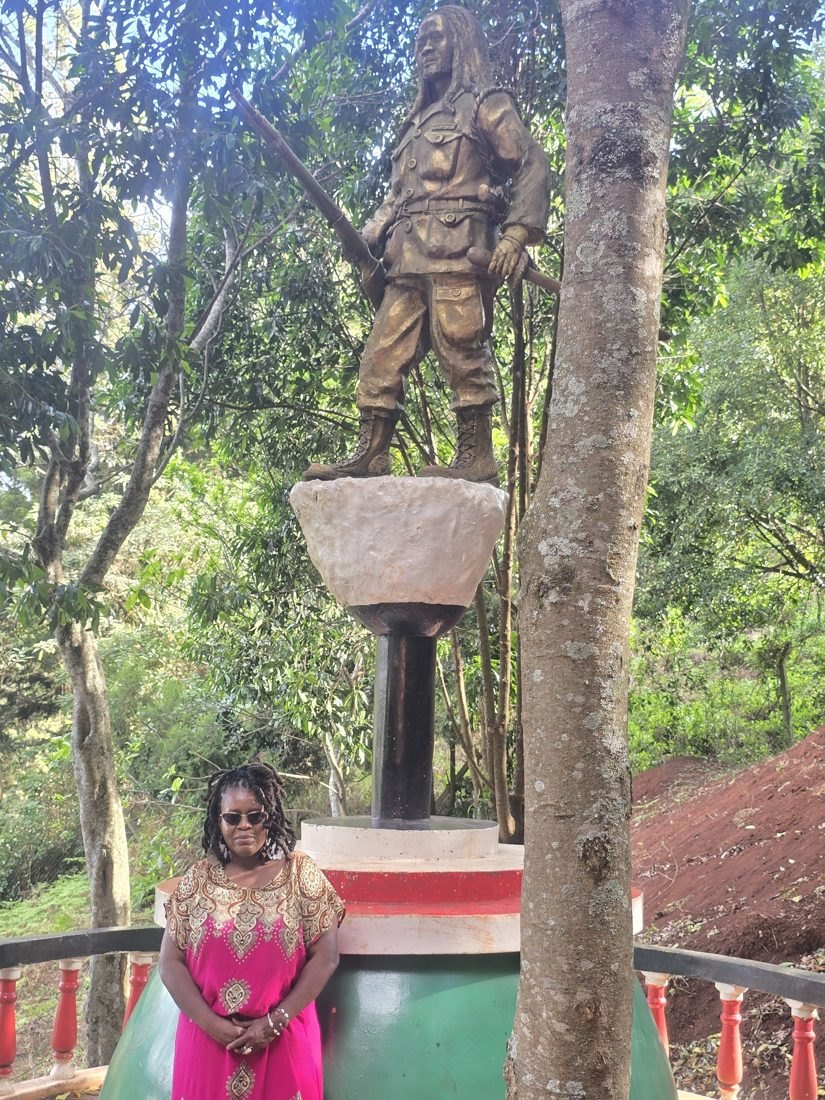
With the statue of Field Marshal Dedan Kimathi at the memorial park.
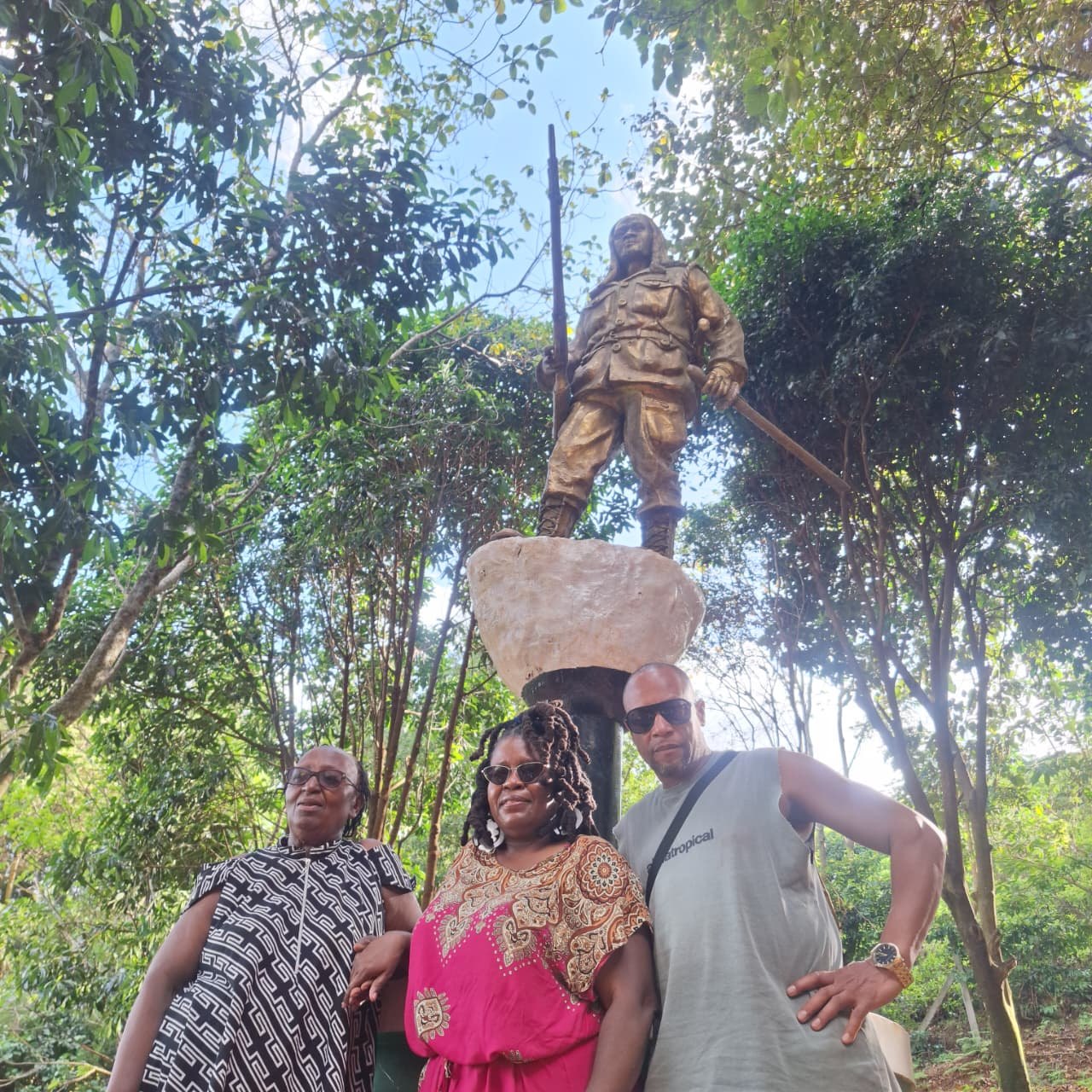
At the statue of Field Marshal Dedan Kimathi with Dr Muthoni Kahigi and the reggae artist Sonbeam.
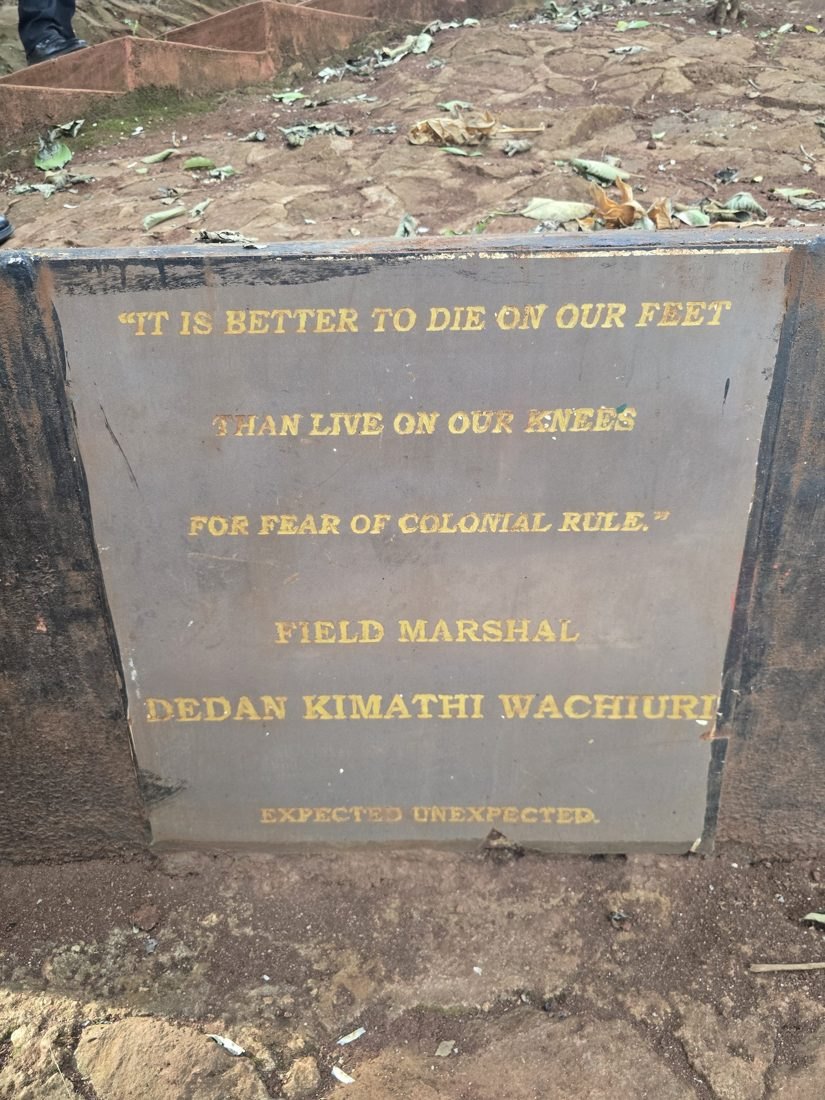
‘It is better to die on our feet than live on our knees for fear of colonial rule.’ Field Marshal Dedan Kimathi, as inscribed at Kahiga-ini.
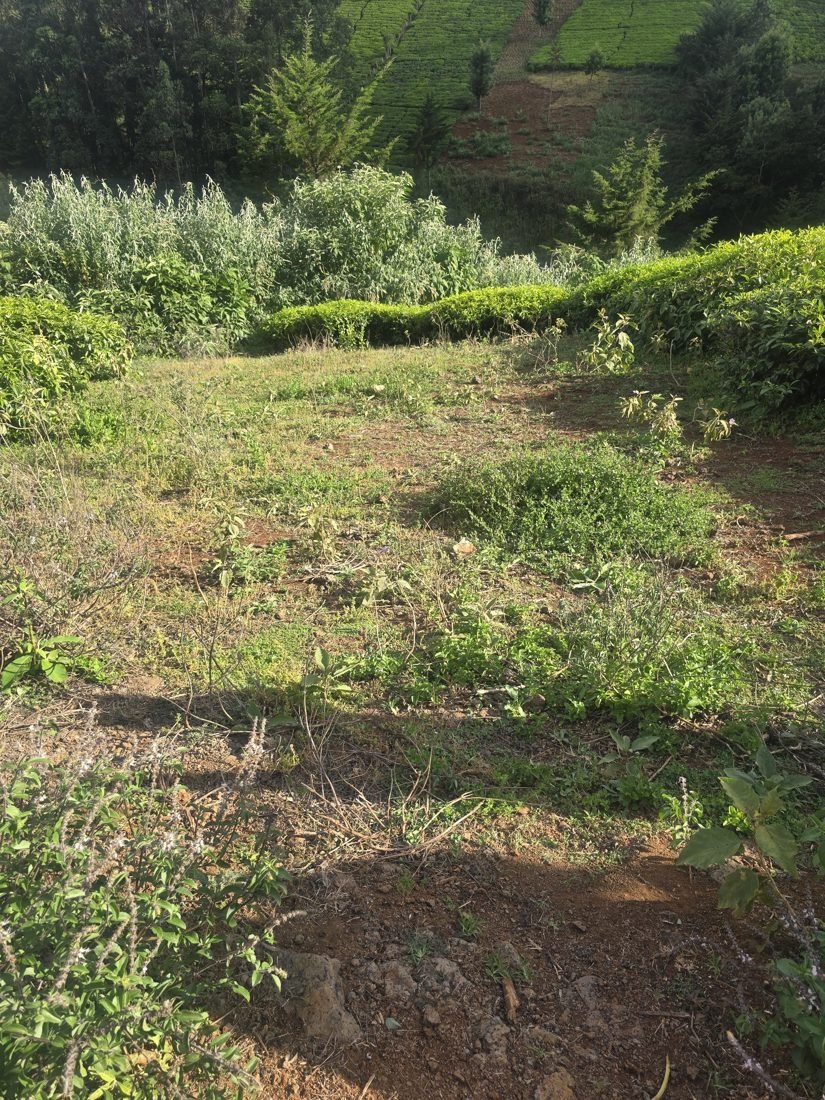
The ground where, as our guide told us, Field Marshal Kimathi’s blood was spilt, and where nothing has grown since.
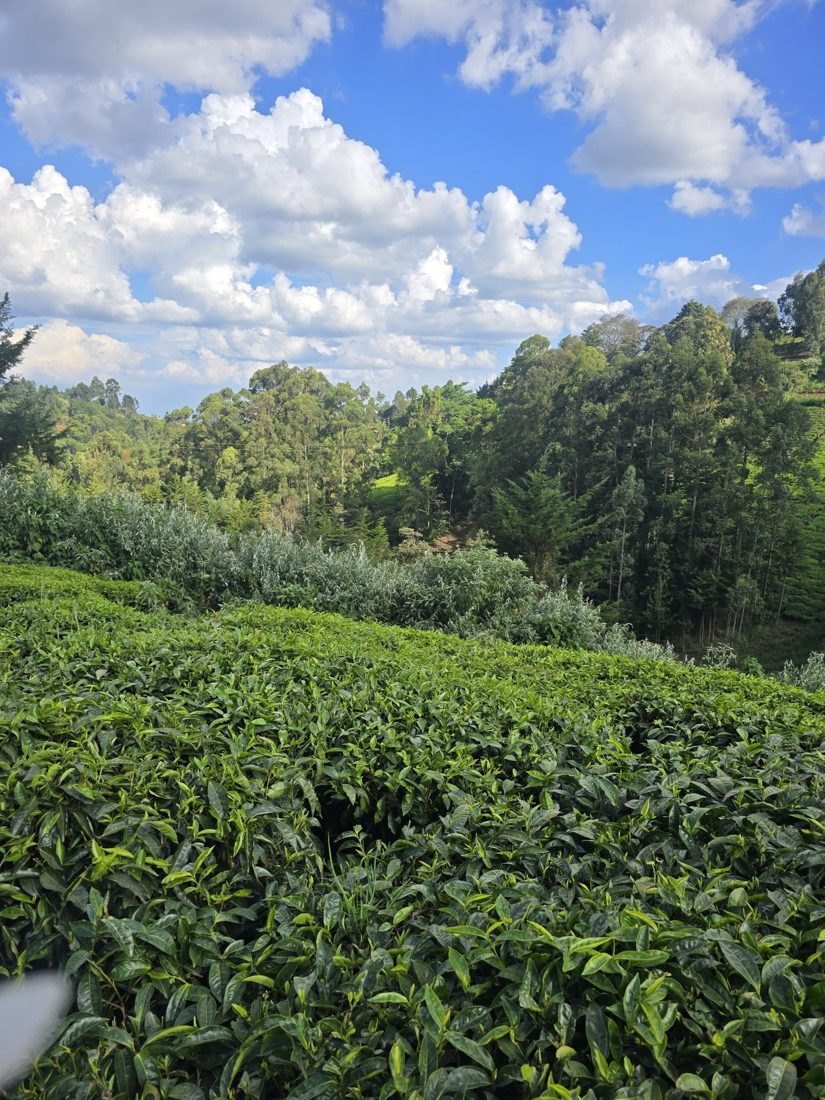
All around it, tea grows in abundance on the hills of Kahiga-ini, where Field Marshal Kimathi was shot.
Listen: a tribute to Field Marshal Dedan Kimathi
‘Dedan Kimathi’ by Jabali Afrika, from ‘Rebellion: 1963 to the Future’, 2014, came to me after the 2011 Mashujaa Day broadcast with which this piece opens. Jabali Afrika formed in Nairobi in the early 1990s among dancers, singers and drummers of the Kenya National Theatre. This reggae tribute asks why Field Marshal Kimathi still lies in an unmarked grave at Kamiti, and sings the words inscribed here at Kahiga-ini: ‘It’s better to die on our feet than to live on our knees… You can never erase history, it will always be there.’
‘Dedan Kimathi’, Jabali Afrika (2014).
Standing in the tea at Kahiga-ini, with the mountain beyond, I thought about what it is called. The mountain is Kĩrĩnyaga to the Gĩkũyũ people who live around it: the mountain of whiteness, for its snow-capped peak.[38] To the Akamba it is Kĩnyaa, Kiima kya Nyaa, the mountain of ostriches, for its black rock and white snow. In 1849 Chief Kivoi wa Mwendwa, the Akamba leader and long-distance trader, guided the German missionaries Johann Ludwig Krapf and Johannes Rebmann into the interior, and they became the first Europeans to see the mountain. When Krapf asked its name, Chief Kivoi gave him the Akamba one; Krapf could not pronounce it and wrote down ‘Kenia’.[39] The British took that misspelling for the whole territory when they declared the Colony of Kenya in 1920. Kenya bears the name the coloniser misheard. The peoples of the mountain still call it by its own names.
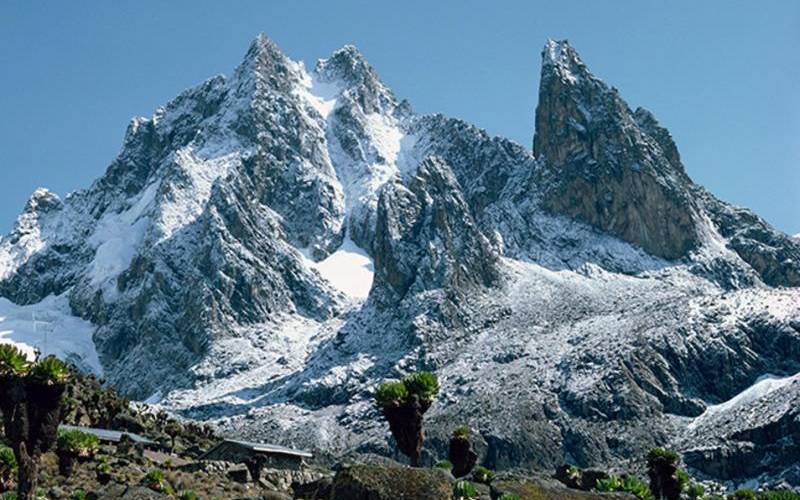
Kĩrĩnyaga, the mountain of whiteness: Batian and Nelion, its twin peaks, with giant groundsels below. Photo: ‘The Standard’, Kenya
Naming, the map and repair
A name is never only a name. Professor Ngũgĩ wa Thiong’o, whose words I quoted in the keynote, wrote that names and naming are part of warfare, and that we do not have to use the coloniser’s vocabulary to describe our struggles.[4] The British wrote ‘Mau Mau’ over an army that named itself for what it fought for, land and freedom, ithaka na wĩathi; wrote ‘Kenya’ over Kĩrĩnyaga; wrote ‘Victoria’ over Nam Lolwe, the lake the Luo people had named long before John Hanning Speke reached it in 1858; and at Berlin in 1884–85 drew the borders within which Kenya and every other state in Afrika still governs. The map of the world we are taught is colonial cartography: the conqueror’s names, the conqueror’s lines, the conqueror’s knowledge of who and where we are.
This is why the Stop the Maangamizi Campaign holds cognitive justice, the right of our peoples to know, name and order the world in our own knowledge systems, to be inseparable from reparatory justice. Decolonisation is world remaking, and part of that work is to re-member: to put back together what colonial cartography dismembered, in our languages and on our own terms. Professor Makau Mutua made the point for Kenya in 2021: ‘Europeans named us to demonstrate their power and authority over us,’ and the least the country could do is call itself by the mountain’s own name.[40] Reparation includes the restoration of our right to name ourselves, our lands and our struggles.
Back in Nairobi, we visited the Mashujaa Heritage Archives & Library, at Mwakenya House in Lower Kabete on the outskirts of Nairobi, founded by historians, activists and descendants of freedom fighters. It documents and preserves the memories and legacies of Kenya’s liberation heroines and heroes, collecting oral histories, photographs, documents and artefacts and making them available to researchers, students and the public (mashujaaheritagearchive.org).
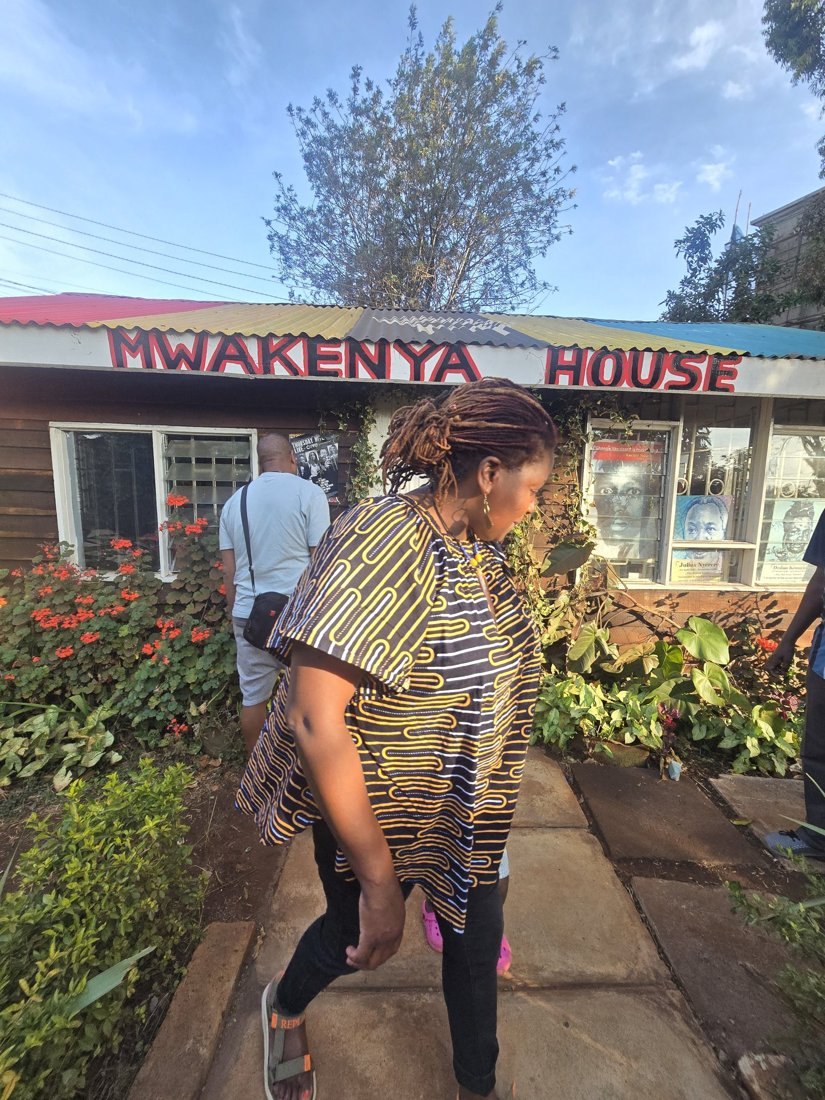
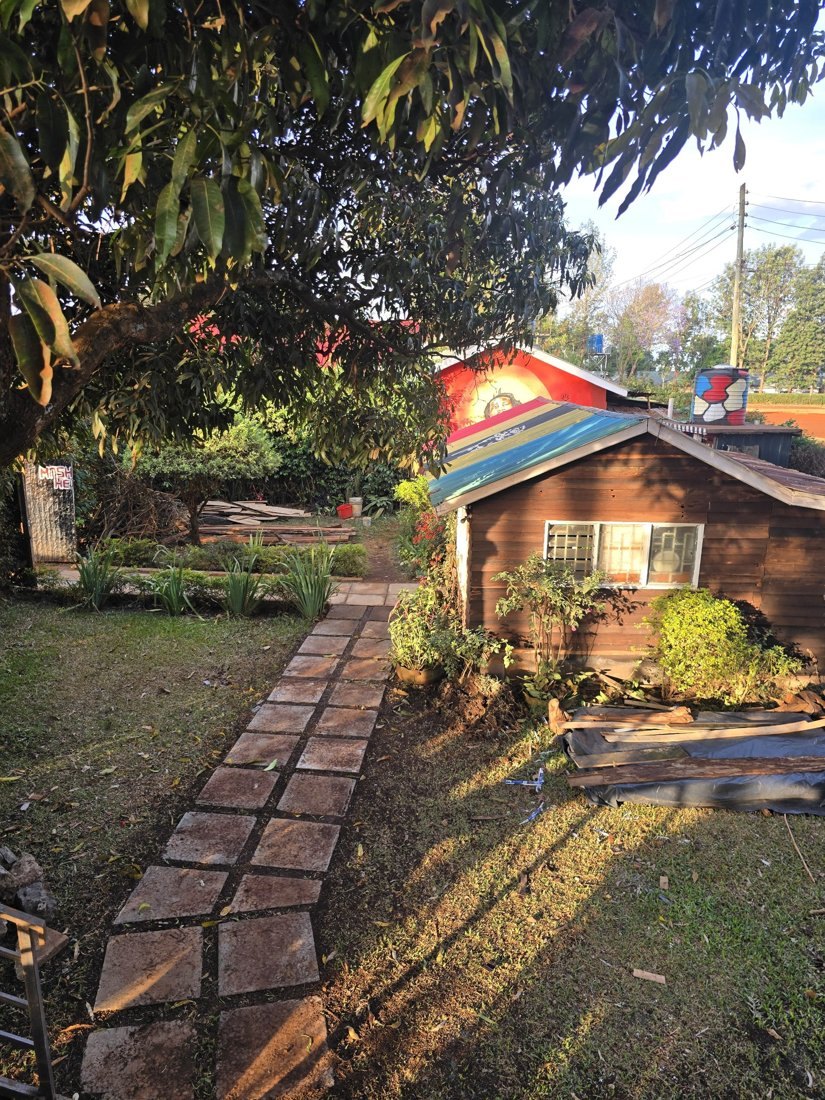
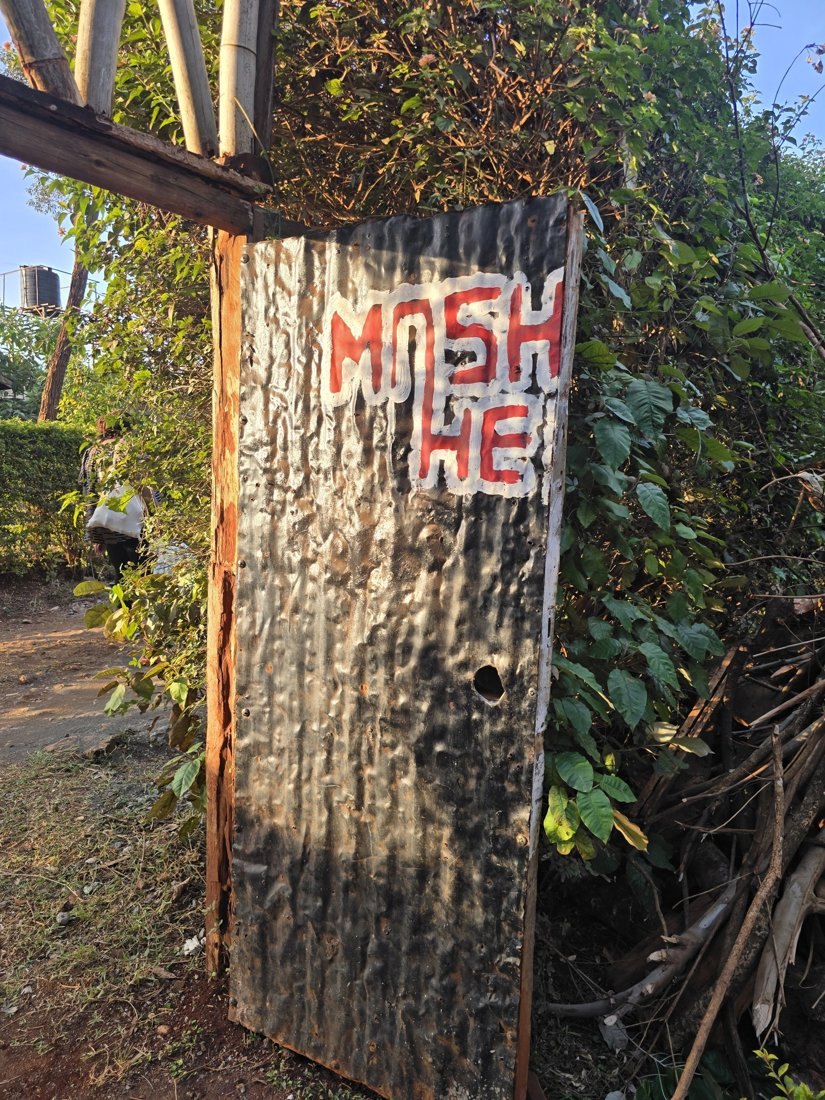
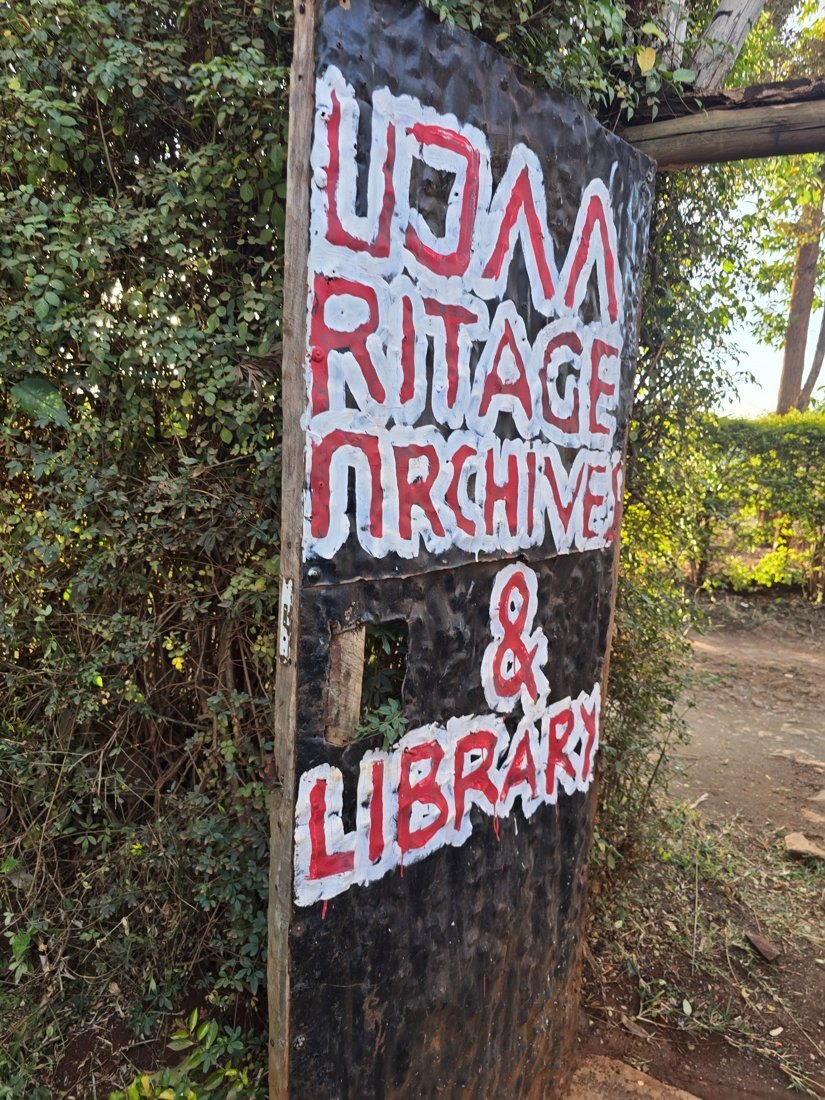
Mwakenya House, Lower Kabete, home of the Mashujaa Heritage Archives & Library.
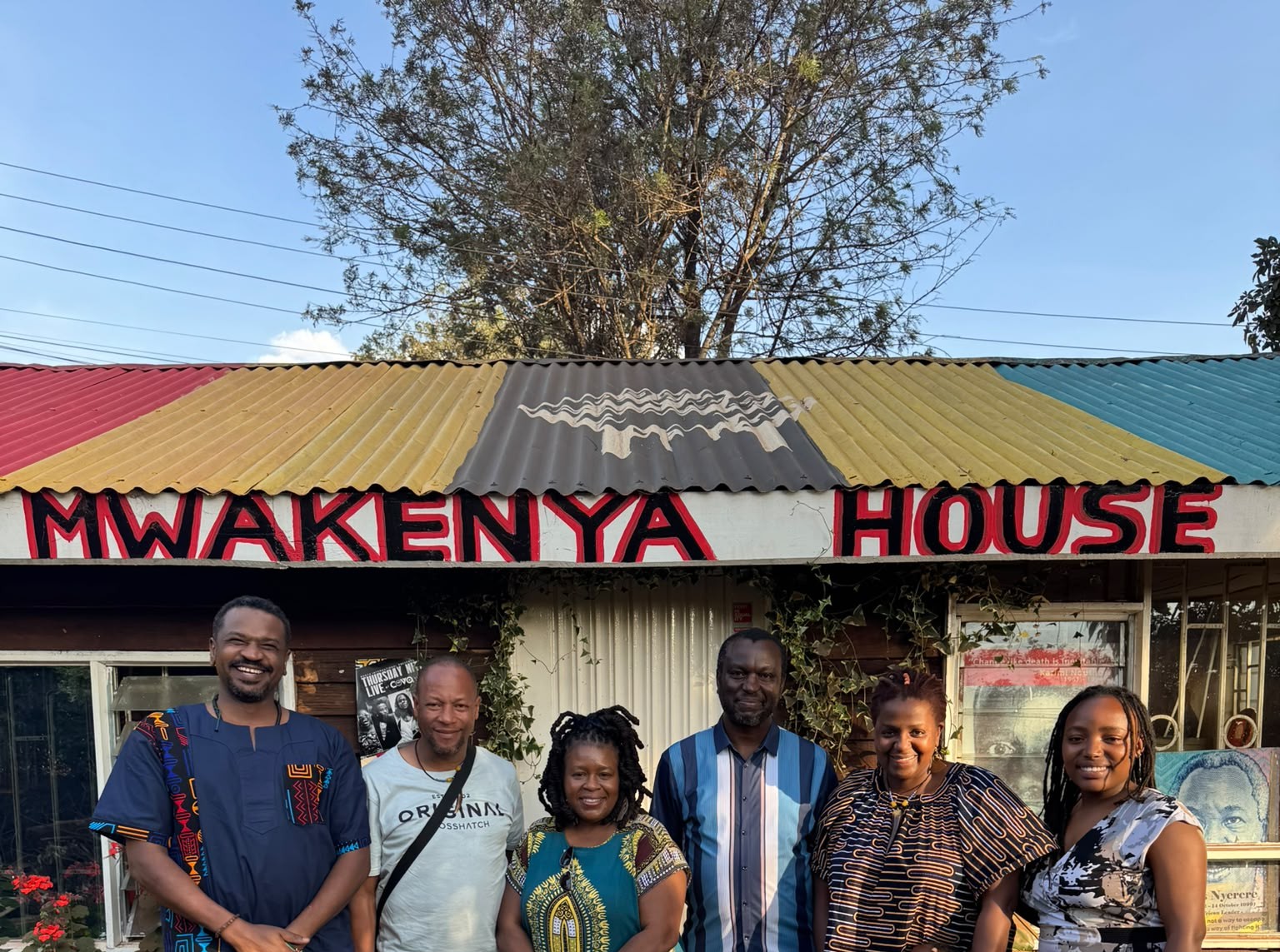
Outside Mwakenya House, under its painted roof, with Dr Njuki Githethwa, who runs the archives, and members of our delegation.
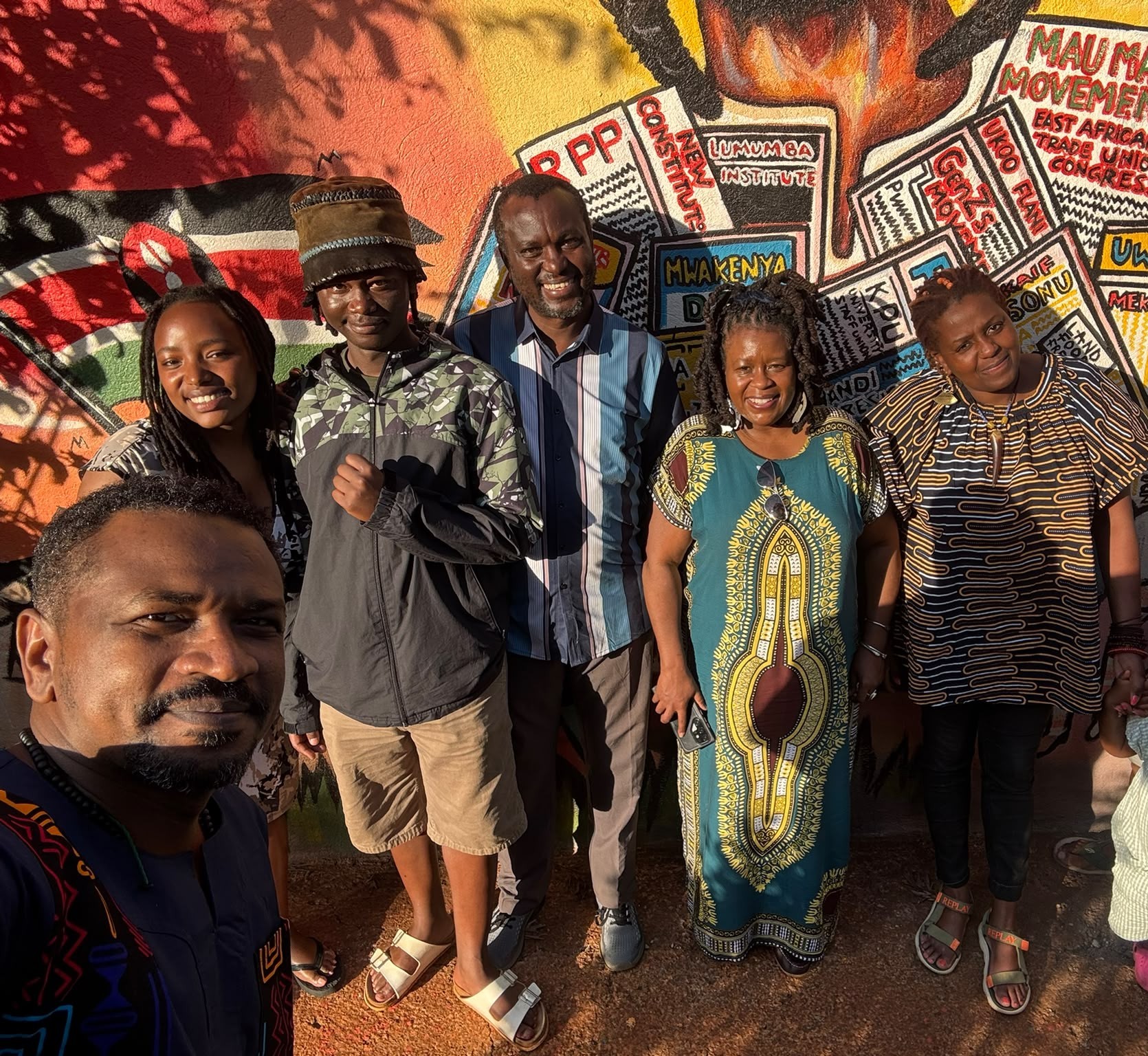
At the Mashujaa Heritage Archives & Library, before the mural that maps Kenya’s movements of struggle, from the Nandi resistance to the Gen Z Uprising.
As Dr Njuki writes in ‘Documenting and Archiving People’s Struggles and Social Movements in Kenya’[41], community archives of people’s struggles ‘have possibilities of resuscitating and reinvigorating voices of suppressed narratives and to counter hierarchies of knowledge, resources, and power’; they are ‘part of decolonial struggles’ and ‘a space to mentor the new generation of progressive human rights activists’.
The library is housed in a home gifted by a family of Mashujaa of the Kenya Land and Freedom Army, and is being developed into a community library, research space and community hub where people come to study the struggles of Kenya’s peoples.
As someone organising within the ISMAR, I felt a deep kinship with this work. Under the auspices of MET, I am developing the ISMAR/Pan-Afrikan Reparations Movement Archives, a public digital archive of the grassroots organising of the ISMAR: its organisations, campaigns, events and people, from the late 1980s to the present.
A mural painted on the library’s wall sets out Kenya’s movements of struggle one after another, each grown out of and built on those before: the Nandi resistance to the British under Koitalel Arap Samoei from 1895 to 1905; the Kenya Land and Freedom Army; Mwakenya, the underground movement of the 1980s against the Moi regime, from which the house takes its name; Saba Saba, Kiswahili for seven-seven, the pro-democracy uprising of 7 July 1990 against one-party rule; Release Political Prisoners, the campaign begun in 1992 by the mothers of detainees; and the Gen Z Uprising of 2024 and 2025. When we keep the archives of our own struggles, we make that lineage available to each new generation, so that today’s movements draw on what earlier ones learned. Community archives such as the Mashujaa Heritage Archives & Library are part of the liberation struggle itself.
At the library Dr Njuki gifted me a copy of Shiraz Durrani’s ‘Kĩmaathi: Mau Mau’s First Prime Minister of Kenya’, the book in which the Kimaathi Charter quoted above is reproduced.
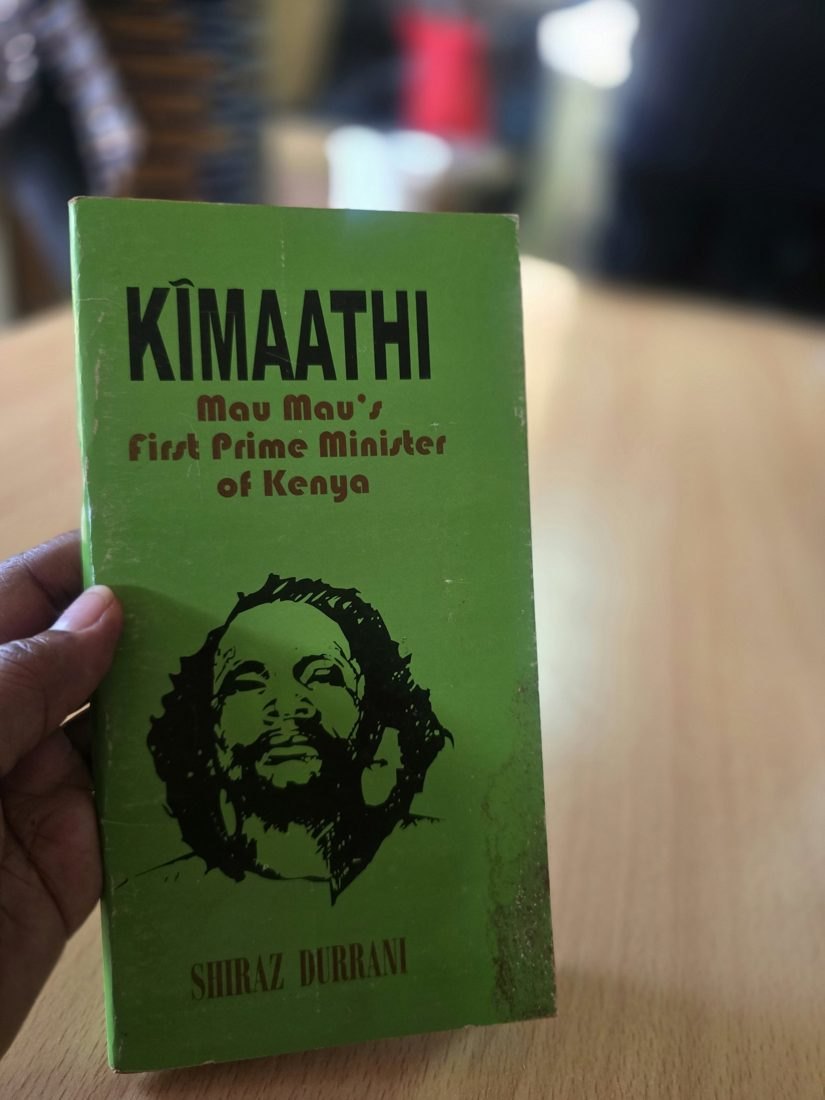
Shiraz Durrani, ‘Kĩmaathi: Mau Mau’s First Prime Minister of Kenya’ (London: Vita Books), gifted to me at the Mashujaa Heritage Archives & Library.
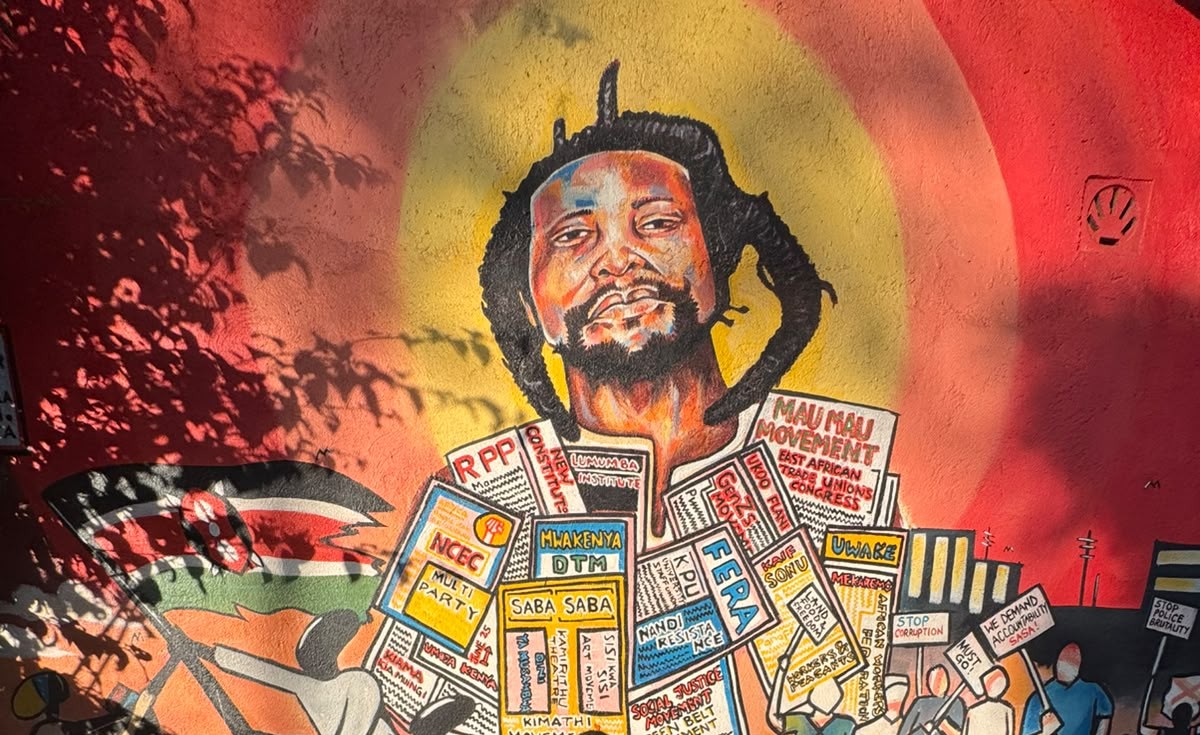
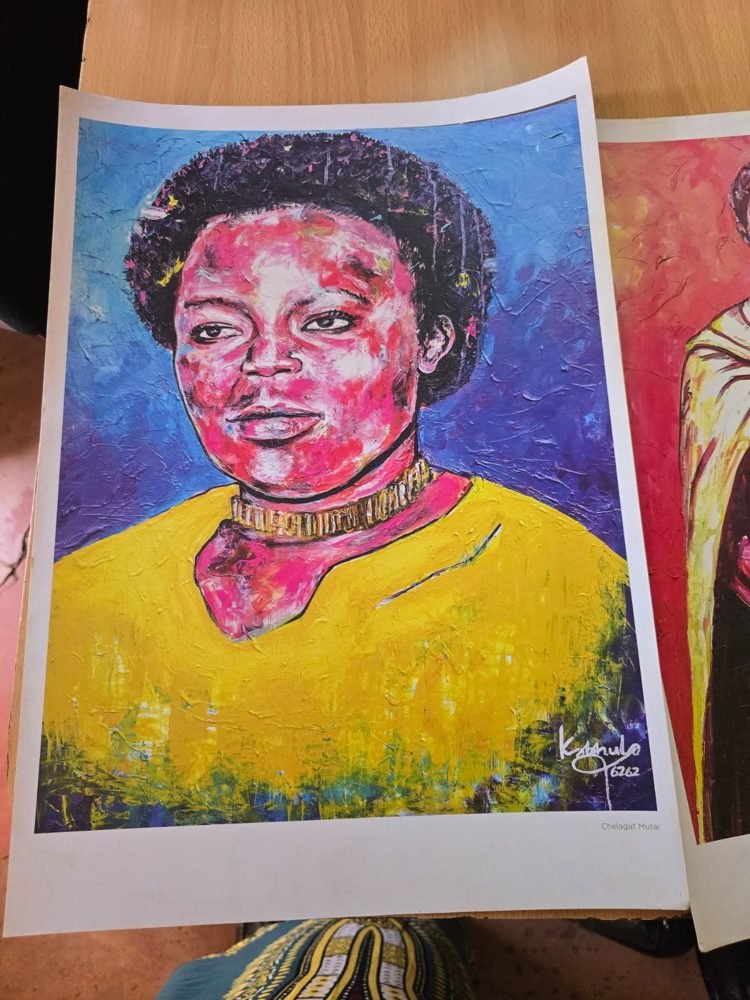
The mural at the Mashujaa Heritage Archives & Library, naming Kenya’s movements of struggle; and a portrait of Cinda Reri, as identified for us at the library, among the artworks available there.
Our last stop was Pan-African House, Ndungi Githuku’s space for community gathering, political dialogue, music and solidarity. It is a beautiful space in nature, and there, as everywhere in Kenya, I felt deeply connected to the land and to the people.
Land at the heart of repair
Everything I heard in Kenya, from the sons and daughters of the freedom fighters, in Field Marshal Mũthoni’s words from the forest and at the archives, came back to land. Settlers and the British state seized it, and the titles the British created still govern much of it. Shiraz Durrani puts it plainly in ‘From Mau Mau to Ruto-Must-Go: A Scrapbook of Essays on Kenya’s Struggle Against Imperialism’, the collection he edited with Ruo Kĩmani-Ruo[42], a copy of which I brought back from Kenya: the land of Kenya’s peoples was stolen twice. First by the colonisers; and then at independence, when the fighters’ land, handed to the home guards during the Emergency, stayed with those who became the new ruling class. The newly independent government bought settler farms with nearly £12.5 million in British loans, and the debt was laid on those settled. In 1969 the Kenya People’s Union called the failure to return the land stolen under British rule ‘the most serious in the string of broken promises since the end of colonial rule’.
Behind both thefts stands the British Crown’s claim to the land itself. In 1897 the British authorities declared all ‘waste and unoccupied land’ in the East Africa Protectorate to be Crown land, and in 1899 extended the claim to all land, occupied or not, so that Afrikan peoples living on their ancestral lands became, in colonial law, tenants at the will of the Crown.[43] Kevin Cahill, in ‘Who Owns the World: The Hidden Facts Behind Landownership’, followed that claim across the globe and put the matter plainly:
‘Poverty and wealth are not, as is often thought, opposites. Instead the two words predicate a problem, poverty, and indicate its solution, which is wealth. Land, that upon which we all stand, is the single most common characteristic of wealth worldwide. What the poor lack—land—the rich have in spades.’
Kevin Cahill, ‘Who Owns the World’[44]
The poverty imposed on Afrikan peoples in Kenya, across Afrika and across the Afrikan Diaspora is the other side of the land the Crown and settlers took. That is why any repair begins with land, and with who holds title to it now. And the land struggle in Kenya is live. The Kipsigis and Talai peoples of Kericho, driven from their ancestral lands for British tea estates, are still fighting to reclaim land that multinational tea companies farm today, and their case shows how far the 2013 settlement is from closing anything.
Not yet uhuru: the land struggle continues
The 2013 settlement, which the UK Government now cites to say that the matter is closed, covered the torture of 5,228 people during the Emergency and nothing else. The historical injustice done to Kenya’s peoples under British rule began long before 1952 and is unrepaired. From 1895 the British declared the East Africa Protectorate, in 1902 and 1915 passed Crown Lands Ordinances making all land the Crown’s, and in 1920 declared the Colony of Kenya. Under the sterile term ‘land alienation’ the British reserved the best-watered highlands, the ‘Scheduled Areas’, for European settlement and confined Afrikan peoples to ‘native reserves’: by 1934 settlers controlled about a third of the arable land[45]; by 1948, 1.5 million Gĩkũyũ were confined to 2,000 square miles while 30,000 settlers held title to 12,000[17]; and at independence in 1963 around 3,600 settler families held some three million hectares while millions of Kenyans were crowded onto what remained. This was theft of land and, in today’s language, ethnic cleansing: impoverishment, starvation, the loss of livestock, and killing by British forces and settlers.
In Kericho, British forces killed some 2,000 Kipsigis at Sotik in 1905, and in 1934 an order in King George V’s name deported the whole Talai people to Gwassi, two weeks’ walk away on the shore of Nam Lolwe, where malaria was endemic and water scarce; a British memo spoke of leaving ‘the old men to die out gradually’.[46] The Kipsigis and Talai say some 115,000 of their people were driven from between 98,000 and 200,000 acres, which British tea companies received on 99-year leases and which Lipton (formerly Unilever and Brooke Bond), James Finlay and Williamson Tea farm today. ‘There is blood in the tea,’ the historian Godfrey Sang told AFP.[47]
The struggle continues on every front. Kericho County wrote to Queen Elizabeth II in 2009 and received no answer. In 2019 Kenya’s National Land Commission ruled that the land should have reverted to the Kipsigis at independence and that the leases were void; the tea companies went to the High Court to overturn it. In 2021 six United Nations Special Rapporteurs wrote to the UK Government of gross human rights violations[48]; the Foreign Office answered with regret, and with the argument that the case should have been brought within thirty years of independence. In 2022 the Kipsigis and Talai took the UK to the European Court of Human Rights, seeking an apology and £168 billion.[49] ‘First of all, they need to acknowledge that it is stolen property,’ said Governor Paul Chepkwony of Kericho.
Inside Kenya the colonial land regime passed to the independent state largely intact. Jaramogi Oginga Odinga, of the Luo, a leader of the independence struggle who became Kenya’s first Vice-President and resigned in 1966 to lead the opposition Kenya People’s Union, named the condition in 1967 in the title of his autobiography: ‘Not Yet Uhuru’.[50] The 2004 Ndung’u Report documented the illegal and irregular allocation of public land to the politically connected[51]; and the 2010 Constitution created the National Land Commission and charged it with investigating historical land injustices, while the Truth, Justice and Reconciliation Commission’s findings on land, described above, lie unimplemented. From the Kenya Land and Freedom Army to the Kipsigis and Talai, from the families of Kahiga-ini to the generation in the streets in 2024 and 2025, the demand has stayed the same: ithaka na wĩathi, land and freedom.
What the Kipsigis and Talai have had from the UK Government, like the survivors of the camps before them, is regret. Regret is the word, and it is worth looking at who uses it and what it is for.
An apology to whom, and for what?
Regret is the word the UK Government used to Kenyans in 2013. It is the word the Foreign Office used in 2021, when six United Nations Special Rapporteurs wrote to it about the gross human rights violations against the Kipsigis and Talai peoples: ‘We regret that these abuses took place.’ In Kenya in 2023, King Charles III expressed ‘the greatest sorrow and the deepest regret’. On 3 November 2026, opening the Commonwealth Heads of Government Meeting in Antigua and Barbuda, he spoke of ‘the most profound personal sorrow’, and offered no apology.
Standing on Kenyan land, I saw one empire, one Crown and one pattern: dispossess, extract, kill, express regret and move on. Those who harmed our families in Kenya are those who harmed our families in the Caribbean, across Afrika and throughout the Diaspora. Kenya and the Caribbean are discussed in separate conversations, and that siloing is itself part of the harm: our dismemberment as a people makes it easier to settle with us one fragment at a time. That is why I advocate a Pan-Afrikan apology, one that carries responsibility, truth-telling, the full participation of our communities and concrete repair within it.
I set this out in full in ‘An Apology to Whom, and for What?’[52], on the Stop the Maangamizi Campaign website.
What is the Maangamizi?
Maangamizi is a Kiswahili word, from angamiza, to cause destruction, to utterly destroy. Professor Maulana Karenga asserted and promoted the term at the convention of the National Coalition of Blacks for Reparations in America (N’COBRA) in 2001, defining the Holocaust of enslavement as ‘the morally monstrous destruction of human life, human culture and human possibility’.[53] We name our reality in an Afrikan language because naming is the first act of knowing on our own terms. PARCOE and the Stop the Maangamizi Campaign developed the term in their own context.
As MET defines it, the Maangamizi is the ongoing system of deliberate, systematic destruction perpetrated against Afrikan people through racialised chattel enslavement, wars of extermination and conquest, colonialism and neocolonialism. Its perpetrators set out to destroy our personhood and peoplehood (genocide); our nationhood and culture (ethnocide), dismantling our knowledge systems, suppressing and demonising our spiritualities and imposing their languages, religions, names, ways of being and system of counting time; and our environments (ecocide): with them, our human possibility, the futures our peoples would have made.
An apology that carries concrete repair within it must say what the repair is, and in Kenya, as across Afrika and the Diaspora, it begins with land. For the Stop the Maangamizi Campaign, land has always stood at the centre of reparations, and the definition above says why. We charge ecocide alongside genocide because the perpetrators of the Maangamizi set out to destroy our environments and our relationship with them: tearing peoples from their ancestral lands, as the British tore the Gĩkũyũ, the Kipsigis and the Talai from theirs, desecrates the ecosystems of which those peoples are part. Repair of that destruction is the return to the land and to our peoples’ relationships with it, beyond any payment, and the ISMAR has its own names for that work.
Rematriation, named in the 2015 Stop the Maangamizi Petition, is the return to the Mother: physical return to the Motherland Afrika for those who choose it, the historical, cultural and spiritual restitution owed to the heirs of those forcibly removed, and the reclaiming of sacred relationships with ancestors, peoples, ancestral lands, living waters and all of Mother Earth.
Planet Repairs, championed by PARCOE and introduced above, brings cognitive justice, environmental justice and reparatory justice together as one work of repair, and is the change the Stop the Maangamizi Campaign works in service of.
In Kenya as everywhere, our peoples reclaiming the land, and our relationship with it, is how sovereignty is restored.
On air: ‘Fixing the Nation’
Land was central to what I said on Kenyan radio too. On Friday 23 October I was a guest on ‘Fixing the Nation’, the Nation FM radio programme, filmed in the studio and shown on NTV Kenya, under the title ‘Beyond Apologies: Who Owes Africa Reparations?’. I used it to reframe the question. Reparation is a right, held by Afrikan peoples in Afrika and across the Diaspora, and the obligation falls on those who perpetrated the Maangamizi and grew rich from it. I spoke about the repair Kenya needs, beginning with land: Kenya’s peoples reclaiming the land seized by settlers and the Crown. I spoke about the return of the remains of Kenya’s Mashujaa: Koitalel Arap Samoei, the Orkoiyot, spiritual and military leader of the Nandi, who led his people’s resistance to the British for a decade until a British officer, Richard Meinertzhagen, lured him to a supposed peace meeting on 19 October 1905, shot him, and took his severed head to Britain as proof of his death. The British have never said where it is; those who took it know where they took it, and it is believed to lie in a museum collection in Britain to this day. Koitalel’s family, the Talai clan and the Nandi elders have campaigned for its return for generations, joined in recent years by Nandi County under Governor Stephen Sang, who renewed the demand at the 120th anniversary of the killing in October 2025.[54] In 2006 Meinertzhagen’s family returned some of his belongings, which are kept at the Koitalel Samoei Museum in Nandi Hills; the head was not among them. I spoke too of Field Marshal Dedan Kimathi, whose remains lie in the unmarked grave inside Kamiti Prison where the British buried him in 1957, identified in 2019 and still to be exhumed and returned to his family for burial with the honour due to him. I spoke about implementing the findings of Kenya’s own Truth, Justice and Reconciliation Commission, which has gathered dust since 2013. And I spoke about ending the killing of young people by the Kenyan state.
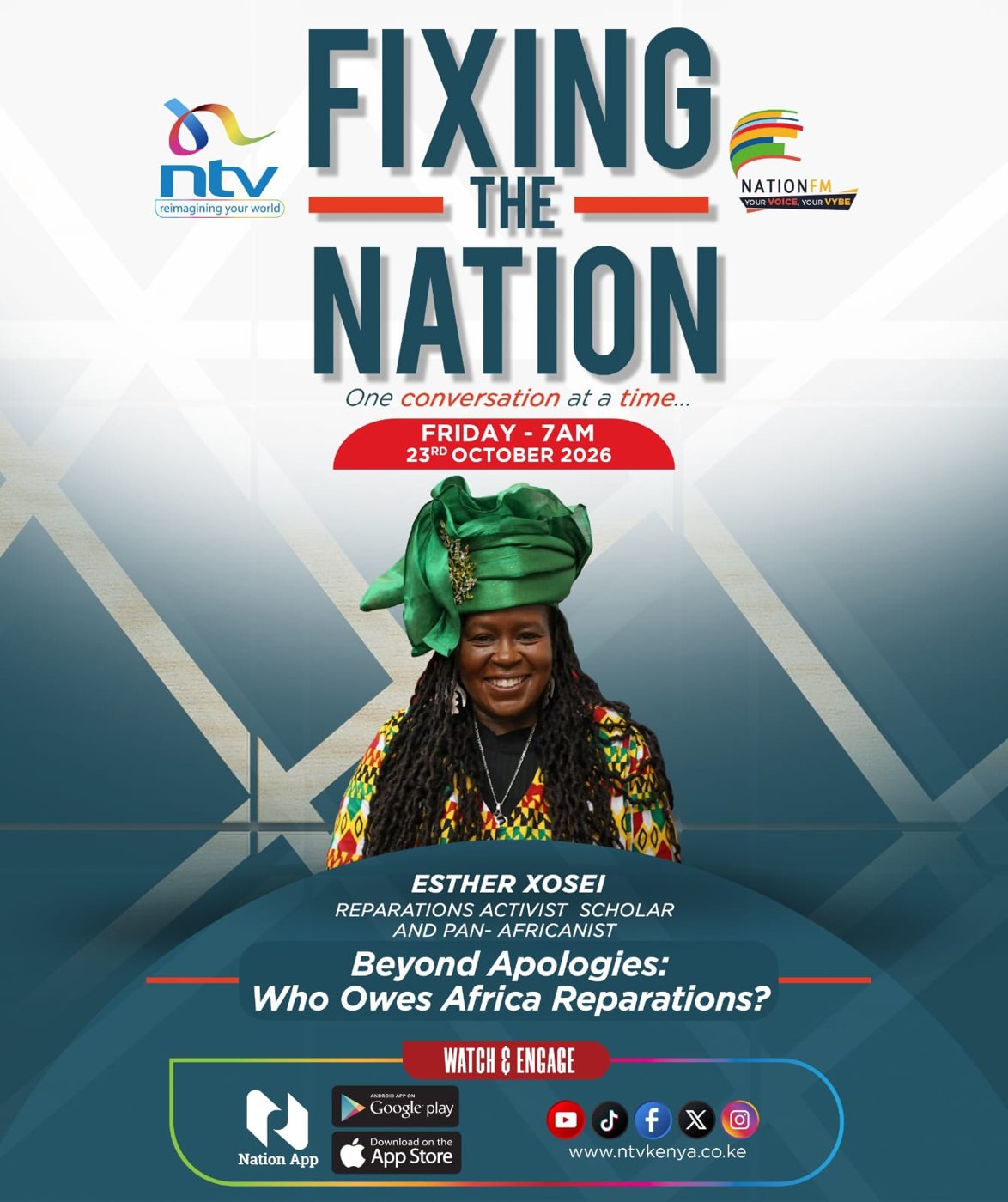
‘Fixing the Nation’, Nation FM and NTV Kenya, Friday 23 October 2026.
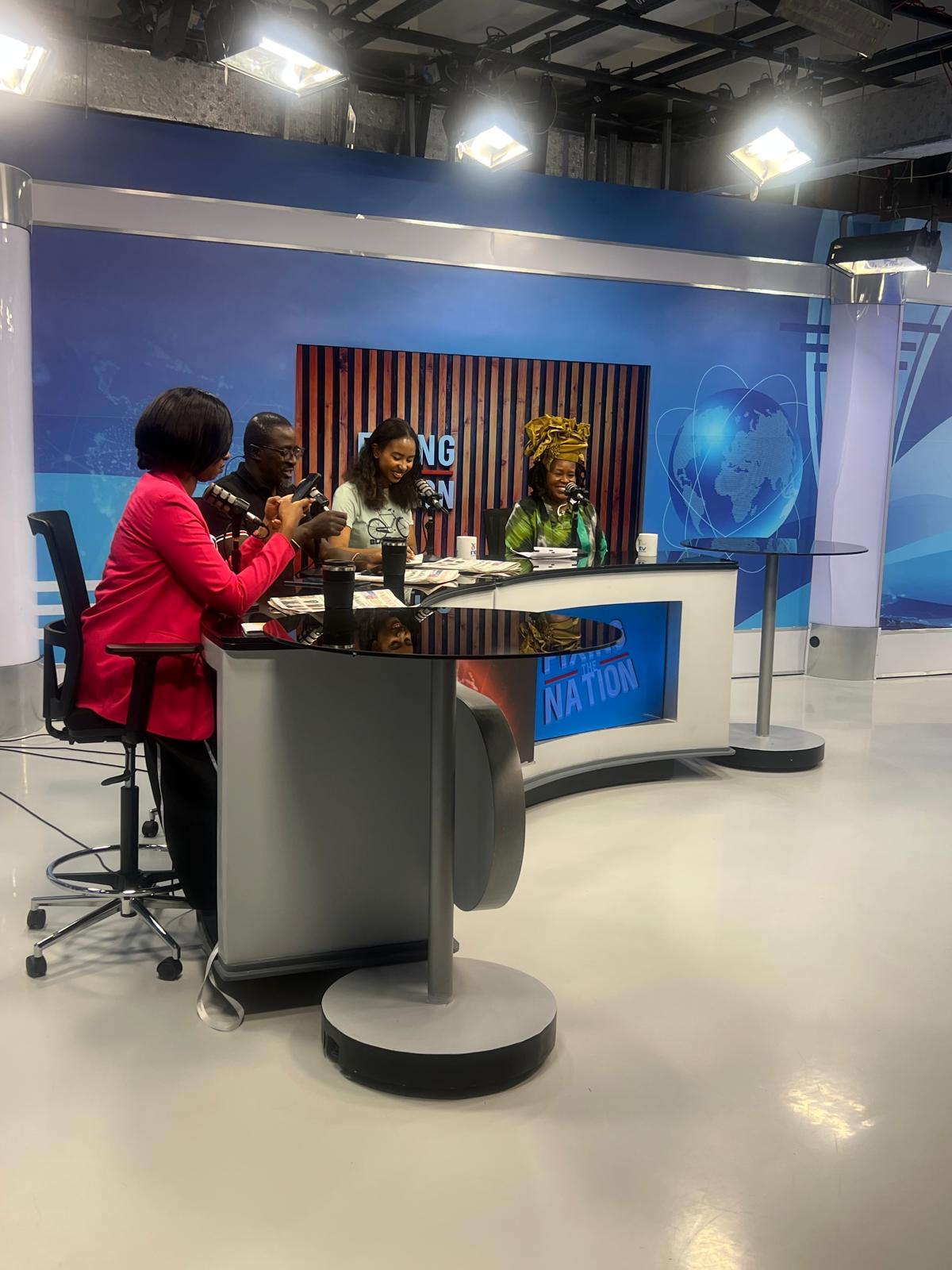
In the NTV studio in Nairobi for ‘Fixing the Nation’, 23 October 2026, with the presenter and fellow guests.
Esther Xosei on ‘Fixing the Nation’, Nation FM and NTV Kenya, 23 October 2026: an excerpt. Watch the full programme: ‘Reparations: Who Owes Africa?’ on YouTube.
A generation sharp and ready
Ending the killing of young people was no abstraction in that studio. Kenya’s Gen Z led the uprising of June 2024 against the Finance Bill, and rose again in June and July 2025 after the death in police custody of the teacher and blogger Albert Ojwang. The Kenyan state answered with live fire, abductions and enforced disappearances. Kenya’s Independent Policing Oversight Authority registered 60 killings in the 2024 protests; local media and human rights groups counted at least 65 killed and more than 400 seriously injured in 2025; and the Kenya National Commission on Human Rights reported at least 26 people still missing after the 2024 protests and at least 15 after 2025, abducted by plainclothes security forces for organising or for what they posted online.[55]
In June 2026 President William Ruto unveiled a Sh2 billion compensation framework for more than 1,100 claims of death, injury, torture, abduction and enforced disappearance, acknowledging ‘state excesses’ and calling the payments ‘the State’s acknowledgement that harm occurred’. Survivors and the families of the dead called it ‘an incomplete apology from the state’, and demanded a personal apology, a public list of beneficiaries and, above all, accountability: investigation and prosecution of the police officers responsible.[56] The essays in ‘From Mau Mau to Ruto-Must-Go’ describe this pattern plainly: a neo-colonial state, which inherited the British colonial order intact, that kills its young people for demanding the land and freedom the fighters died for, and then offers money without cessation, without truth and without anyone being held to account. The test I set out in the keynote applies to Nairobi as to London: every offer tested against all five forms of reparation, and against cessation first. Has the killing stopped?
Among the young Kenyans I met was Sungu Oyoo, a writer, human rights advocate and Pan-Afrikanist, National Spokesperson of Kongamano la Mapinduzi, Kiswahili for the congress of the revolution, a political movement in Kenya, and a candidate for President of Kenya in 2027 under the banner of the Kenya Left Alliance, the coalition of social justice movements and progressive parties which has declared that it will contest every elective seat in 2027, through the Ukweli Party (ukweli: truth).[57] In his declaration of his candidacy, Sungu puts in his own words what I saw: ‘A generation openly declaring that they will not live in poverty and humiliation. A generation saying it will not be cowed or intimidated into silence again.’[58] That generation is organising for power, in the streets and at the ballot.
State repression extends to Pan-Afrikanist organising too. In May 2026, when President Ruto co-hosted President Emmanuel Macron’s Africa Forward Summit in Nairobi, delegates to the Pan-Africanism Summit Against Imperialism, the counter-summit convened by the Communist Party Marxist–Kenya, marched towards the statue of Field Marshal Dedan Kimathi on Kimathi Street in the centre of Nairobi to oppose the new Kenya–France security partnership. Police tear-gassed the march and arrested thirteen people, Kenyan activists and international delegates among them; the Kenyans were later released without charge.[59]
One word followed us everywhere in Kenya: wantam. It is Sheng for ‘one term’, and it entered everyday speech in May 2025, when Rigathi Gachagua, the impeached former Deputy President, used it at a rally; Kenyans took it out of his mouth and made it their own, a people’s verdict on President Ruto’s administration and an invocation of the Constitution’s term limits.[60] A single finger raised says it without a word, and in the week we were there the gesture needed no explanation anywhere, from the convening hall to the clubs to the streets. It is chanted at concerts and rallies and when politicians appear in public, sung in version after version by Kenyan musicians, answered by the state with a counter-slogan of its own, tutam, ‘two terms’, and described by the opposition leader Kalonzo Musyoka as ‘basically our second national anthem’.[60] It began as a Gen Z anthem and has been embraced across the generations and classes of Kenyan society.
Song has always been part of the process of making revolution. The Kenya Land and Freedom Army composed and sang in the forest, and through song held together, taught the oath and the cause, and the songs of the war are still sung; Ukoo Flani Mau Mau carried the fighters’ name and the fighters’ grievance into hip-hop; conscious reggae plays in the clubs; and wantam is being sung into every corner of Kenyan life now. Song is how a people rehearses its demand until the demand is its own, and a demand that is sung in one word by a whole people is one the state cannot pretend not to have heard.
Listen: Wantam
Two of the many versions of the anthem.
‘Wantam (One Term)’, the Gen Z anthem, built around the voices of Rigathi Gachagua, Kalonzo Musyoka and Edwin Sifuna.
‘Wantam’, Choppa Strings.
The young people I met, at the convening and around it, are astute and politicised, with a high level of political literacy, and they discuss and debate ideas without fear. They think hard about their future, about youth unemployment and about the kind of society they want, and young women and men alike were naming and challenging the malevolent patriarchy at work in their lives and in Kenyan politics. Nothing needed simplifying for them. They were already thinking about the place of ideas and ideology in building movements for decolonisation and reparations.
The place of ideas in a movement is a question I take seriously, with the admonition of Amílcar Cabral, of Guinea-Bissau and Cape Verde, in mind. In the same 1965 directive to the African Party for the Independence of Guinea and Cape Verde (PAIGC) in which he told his cadres to ‘tell no lies, claim no easy victories’[61], Cabral warned: ‘Always bear in mind that the people are not fighting for ideas, for the things in anyone’s head. They are fighting to win material benefits, to live better and in peace, to see their lives go forward, to guarantee the future of their children.’ Ideas earn their place in a movement by serving that. They begin in the Pan-Afrikan radical imagination: the capacity to envision the transformed world, land reclaimed, sovereignty restored, Maatubuntuman in Ubuntudunia, before it exists. Ideology is that imagination given coherence: in a social movement, a coherent system of beliefs, values and principles that gives its members a shared understanding of the world, explains the problems the people face and sets out how to put them right. For the ISMAR that means an ideology which names the Maangamizi as the problem, holds stopping it to be the first task of repair, and sets out how Afrikan people effect and secure Planet Repairs, the remaking of the world itself. From it flow strategy, organisation and the discipline to win the material benefits Cabral named.
The generation I met in Kenya has the imagination and is forging the ideology, in its streets, its organisations and its songs. That is the conviction behind MET’s work, and the reason we say that education is preparation for reparations. The slogan was popularised by the former Afrikan Emancipation Day Reparations March Committee. Yɛresiesie yɛn ho, Akan for we are preparing ourselves, is the name of MET’s podcast, ‘Yɛresiesie Yɛn Ho: The Preparation for Reparations Podcast’. We prepare ourselves because reparation is effected, secured and ultimately taken by the people who organise for it, and what I saw in the young people of Kenya was a generation preparing itself for uhuru kamili, Kiswahili for complete freedom, the uhuru Jaramogi Oginga Odinga wrote was not yet: land and freedom, ithaka na wĩathi, in full.
Reggae nights: the Caribbean in Kenya
After the first day of the convening a group of us went out to eat, and the place turned out to be a scene: a club in all but name, with conscious reggae on the sound system all night. Kenyans love reggae, above all the young, and in the clubs they play conscious reggae, music with a message. For me, of Afrikan Guyanese and Afrikan Barbadian heritage, it was a joy to hear the Caribbean speaking to Afrika in a Nairobi night, and Afrika answering.
We were fortunate to have in our delegation Sonbeam, the Jamaican-born, UK-based reggae and dancehall singjay (a performer who both sings and chants in the deejay style), singer and songwriter, known for conscious and uplifting music that blends reggae, dancehall and traditional lyricism. He performed on the artivists’ day of the convening, and he was with us at Kahiga-ini. I am glad to have been introduced to his music, and to the talent of all the artists who made up that day’s programme. Here are three of his tracks.
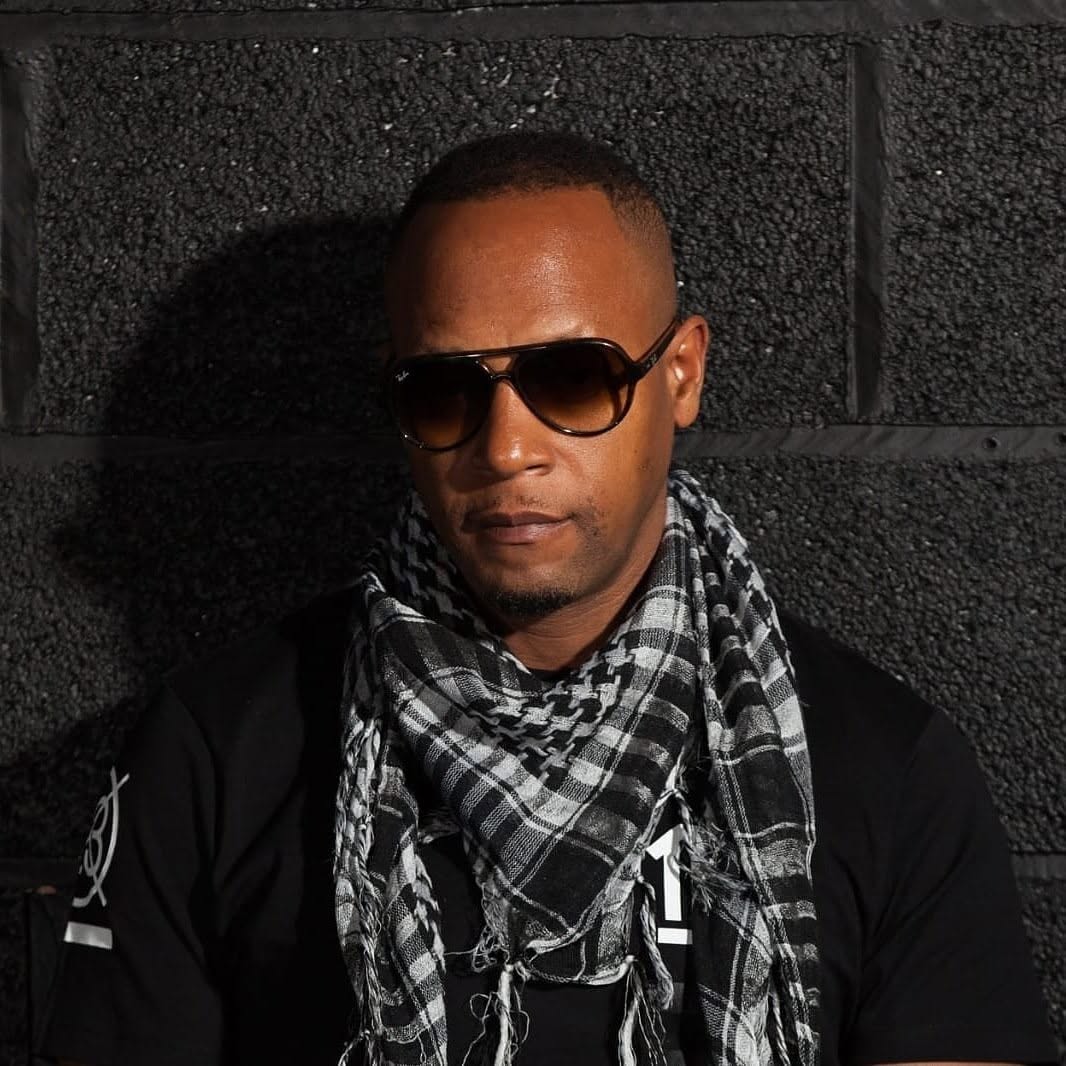
Sonbeam. Photograph © Sonbeam
Listen: Sonbeam
Three tracks by Sonbeam.
‘Battlefield’, Sonbeam.
‘Freedom’, Sonbeam.
‘Sunrise’, Sonbeam.
There was music at every stage of the convening, through to its close. On the last day we jammed together: musical edutainment, education and entertainment in one, as the artists and the rest of us sang the week out.
Jamming on the last day of the convening: musical edutainment at Ufungamano House.
Carrying it forward
At Kahiga-ini, in Nyeri, I was given the name Wahito, to gather and to bring, so that what I gather, the knowledge, the testimony, the truths of the sons and daughters of the freedom fighters and of the young people, would be carried back to Britain and brought to bear. That is the purpose for which the name was given, and it is the purpose of this piece. Repair begins with truth-seeking and truth-telling, and the truths gathered in Kenya, at the convening, in the testimony of the families, and on our visit to Nyeri and to the archives, will shape the work of MET and the Stop the Maangamizi Campaign in the months ahead: the construction of the Commission of Inquiry’s mandate so that it can hear the families; support for them now; and the deepening of the Pan-Afrikan bonds between our communities in Britain and the movements in Kenya. Next steps are being explored, and the signs are promising.
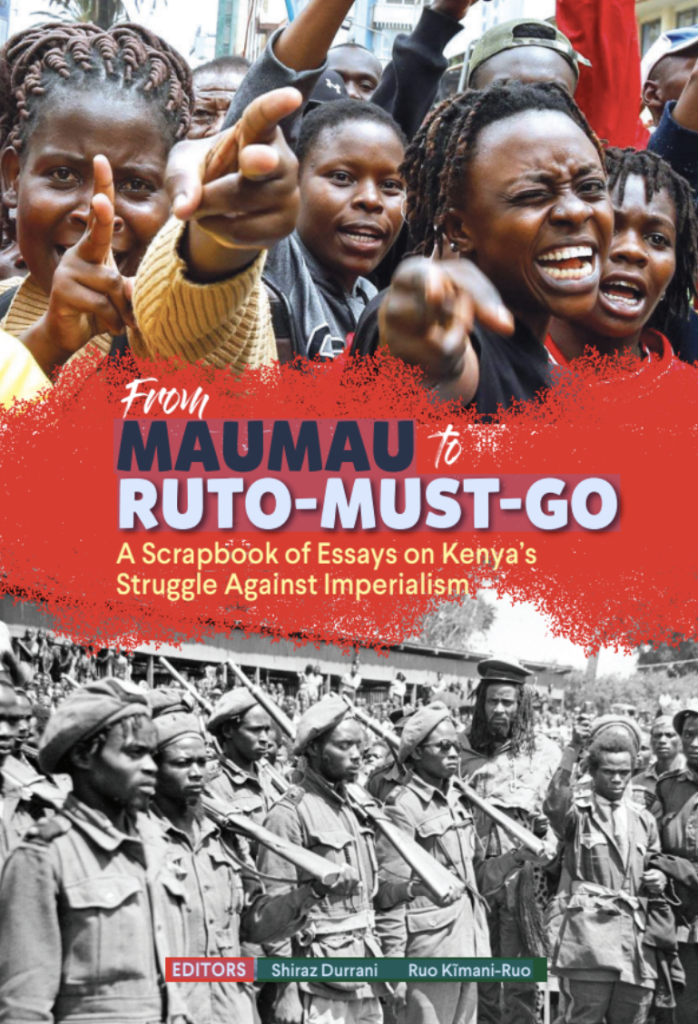
‘From Mau Mau to Ruto-Must-Go: A Scrapbook of Essays on Kenya’s Struggle Against Imperialism’, edited by Shiraz Durrani and Ruo Kĩmani-Ruo, 2026.
A book to read: ‘From Mau Mau to Ruto-Must-Go’
I have quoted from this collection twice above, on the double theft of Kenya’s land and on the neo-colonial state, and I recommend it whole. I met some of its contributors while I was in Kenya; among them is Dr Peninah Wangari-Jones, Chief Executive of the Racial Justice Network, which convened us in Nairobi; her chapter is on the role and significance of women in liberation struggles. The essays follow the resistance from the Kenya Land and Freedom Army to the Gen Z Uprising: land as the issue that has driven resistance throughout; the cartoonists who speak truth to power; the Social Justice Centres Travelling Theatre, performing in Nairobi’s informal settlements; and the conviction that the spirit of the fighters lives in the generation in the streets today.
Reviewing it, Dr Willy Mutunga, Chief Justice of Kenya from 2011 to 2016, writes that ‘the Mau Mau War of Liberation remains the greatest and the main beacon of our revolution’[62]; its co-editor Shiraz Durrani describes the resistance it records as ‘an on-going, incomplete struggle’. That is the spirit of the people I experienced in Kenya, and the name is the right one: the Kenya Land and Freedom Army fought a war of liberation, for land and freedom. Read it, and share it.
My thanks go to the three convening partners, the Racial Justice Network (UK), the University of Nairobi and the Mashujaa Heritage Archives & Library, and to all who represented them, as set out in the programme, and to everyone in Kenya who welcomed us so warmly. The convening resolved to work towards a Tri-Sectoral Network of Activists, Artivists and Scholars on Reparation and Decolonisation, a standing platform for the dialogue, learning, artistic production, organising and advocacy begun in Nairobi, across the three constituencies and across our geographies. The Racial Justice Network is compiling the official report of the convening, and I will share it here once it is ready.
References
Numbers in the text refer to the sources below, in the order they first appear.
- Haki R. Madhubuti, ‘From Plan to Planet: Life Studies. The Need for Afrikan Minds and Institutions’ (Detroit: Broadside Press; Chicago: Institute of Positive Education, 1973).
- Daily Nation, ‘Ghai unites factions in push for constitutional overhaul’, on the Ufungamano Initiative and the Constitution of Kenya Review Commission.
- ‘Mau Mau Reparations: Is there a Pan-Afrikan Perspective? A Mashujaa Day Special’, Africa Speaks with Sister Ekua, Voice of Africa Radio, 16 October 2013.
- Ngũgĩ wa Thiong’o, preface to Karari Njama and Donald L. Barnett, ‘Mau Mau From Within: The Story of the Kenya Land and Freedom Army’ (Daraja Press, 2021).
- United Nations, Basic Principles and Guidelines on the Right to a Remedy and Reparation for Victims of Gross Violations of International Human Rights Law and Serious Violations of International Humanitarian Law, General Assembly resolution 60/147, 16 December 2005.
- FIDA Kenya, on women and land title, as reported in ‘Kenyan women fight for land rights’, Climate Home News, 6 March 2020.
- Rebecca Tsosie, ‘Acknowledging the Past to Heal the Future: The Role of Reparations for Native Nations’, in Jon Miller and Rahul Kumar (eds), ‘Reparations: Interdisciplinary Inquiries’ (Oxford University Press, 2007).
- Eve Tuck and K. Wayne Yang, ‘Decolonization is not a metaphor’, Decolonization: Indigeneity, Education & Society 1(1), 2012.
- Ngũgĩ wa Thiong’o, ‘Decolonising the Mind: The Politics of Language in African Literature’ (London: James Currey; Nairobi: Heinemann Kenya, 1986).
- Mutua and Others v Foreign and Commonwealth Office [2011] EWHC 1913 (QB) (the case may proceed) and [2012] EWHC 2678 (QB) (the case may go to trial despite the passage of time).
- Caroline Elkins, ‘Imperial Reckoning: The Untold Story of Britain’s Gulag in Kenya’ (Henry Holt, 2005).
- David Anderson, ‘Histories of the Hanged: Britain’s Dirty War in Kenya and the End of Empire’ (Weidenfeld & Nicolson, 2005).
- Daniel Leader, ‘Learning the lessons from the cutting edge: the Mau Mau case’, Public Law Project conference, 4 March 2014, on the disclosure of the Hanslope archive.
- UK Government, statement to Parliament on the settlement of the Mau Mau claims, 6 June 2013.
- Paul Muite, interviewed by Deutsche Welle, June 2013, as reported in Kylie Kiunguyu, ‘Kenyan government accused of blocking British payout to Mau Mau victims’, This Is Africa, 17 May 2022.
- Kenya Human Rights Commission, ‘The Mau Mau Settlement: Setting the Record Straight’, press release, 6 June 2013.
- Owen Bowcott, ‘Mau Mau rebellion victims claim parliament was misled over torture’, The Guardian, 23 May 2016.
- Kimathi and Others v Foreign and Commonwealth Office [2018] EWHC 2066 (QB).
- Jo Moore, ‘Kenyan “Mau Mau” claim dismissed: fair trial not possible because of half century delay’, UK Human Rights Blog, 6 August 2018.
- Neil Rose, ‘High Court dismisses negligence claim over failed group action’, Legal Futures, 30 May 2023.
- Ella Obota, ‘British Gov’t dismisses claims of fresh Mau Mau compensation payouts’, Citizen Digital, 24 January 2025.
- Esther Xosei, ‘Has there really been a victory for the Mau Mau?’, newsletter, October 2012.
- Republic of Kenya, Report of the Truth, Justice and Reconciliation Commission (May 2013), with the international commissioners’ dissent, in the Seattle University School of Law digital collection; JusticeInfo, ‘How Kenya’s truth commission report became a political ghost’; The Elephant, ‘When killers become victims: the impunity project, Kenya and the burying of the TJRC report’, 8 September 2018.
- Kenya Human Rights Commission, ‘High Court rejects LSK Mau Mau claim against KHRC, Leigh Day, MMWVA’, press release, October 2015; Leigh Day, ‘The Mau Mau claims’; Nation, ‘UK law firm declines to release Mau Mau pay list’.
- Shiraz Durrani, ‘Kĩmaathi: Mau Mau’s First Prime Minister of Kenya’ (London: Vita Books), pp. 28–29, where the Kimaathi Charter is reproduced; the Charter is also in Makhan Singh, ‘Kenya’s Trade Unions: The Crucial Years, 1952–1956’ (Nairobi: Uzima Press, 1980).
- The Brattle Group, ‘Report on Reparations for Transatlantic Chattel Slavery in the Americas and the Caribbean’, with an introduction by Patrick Robinson, prepared for the American Society of International Law and the University of the West Indies Centre for Reparation Research, presented at the University of the West Indies, Mona, 8 June 2023.
- Wamuyu Gakuru, Wikipedia; Paukwa, ‘Cinda Reri’, on her gun-running by rail and the origin of the name.
- Mukami Kimathi, ‘Mukami Kimathi: Mau Mau Woman Freedom Fighter’ (memoir); ‘Mau Mau: Mukami Kimathi’s swansong to a city at war’, African Arguments, October 2024.
- Paukwa, ‘Rebecca Njeri’.
- Katherine Bruce-Lockhart, ‘“Unsound” minds and broken bodies: the detention of “hardcore” Mau Mau women at Kamiti and Gitamayu Detention Camps in Kenya, 1954–1960’, Journal of Eastern African Studies 8(4), 2014; summarised in University of Cambridge, ‘How the British treated “hardcore” Mau Mau women’.
- Nicholas Githuku and Lotte Hughes, ‘Sanitizing the Kenyattas’, Africa Is a Country, 22 April 2022, quoting the 1966 letter of Wanjiku Wariku for the Women War Council.
- Mĩcere Gĩthae Mũgo, ‘The Imperative of Utu / Ubuntu in Africana Scholarship’ (Quebec: Daraja Press, 2020).
- Nairobi Declaration on Women’s and Girls’ Right to a Remedy and Reparation, Nairobi, 19–21 March 2007.
- On Mbuya Nehanda and the demand for the return of her remains: ‘Zimbabwe ramps up pressure on Britain to return Nehanda skull’, The Hub; ‘Mbuya Nehanda’, Black Women Radicals.
- On Field Marshal Mũthoni wa Kĩrĩma: Wikipedia; ‘A symbol remains: the tonsuring of Field Marshal Muthoni wa Kirima’, This Is Africa, 2022.
- Batuk, ‘Mutumia Ngatha’, from ‘Again She Reigns’ (Teka Records, 2020); OkayAfrica, ‘Batuk’s audiovisual release “Again She Reigns” highlights iconic African women’, 2020.
- Max Pinckers, ‘Unhistories’ (2019), photograph of Field Marshal Mũthoni wa Kĩrĩma and Bernard Mungai Kamande.
- Embassy of the Republic of Kenya, Washington DC, ‘About Kenya: History’.
- Stevens Muendo, ‘How KiKamba’s Kinyaa became Kirinyaga, Kenya’, The Standard, 24 October 2021.
- Makau Mutua, Nation, 20 June 2021, as reported in ‘Makau Mutua Calls for Kenya to Change Its Name’, Kenyans.co.ke.
- Njuki Githethwa, ‘Documenting and Archiving People’s Struggles and Social Movements in Kenya’, British Institute in Eastern Africa, 19 June 2026; Mashujaa Heritage Archives & Library, mashujaaheritagearchive.org.
- Shiraz Durrani and Ruo Kĩmani-Ruo (eds), ‘From Mau Mau to Ruto-Must-Go: A Scrapbook of Essays on Kenya’s Struggle Against Imperialism’ (Nairobi: Editor House Facility, 2026).
- H. W. O. Okoth-Ogendo, ‘Tenants of the Crown: Evolution of Agrarian Law and Institutions in Kenya’ (Nairobi: ACTS Press, 1991).
- Kevin Cahill, ‘Who Owns the World: The Hidden Facts Behind Landownership’ (Edinburgh: Mainstream Publishing, 2006).
- World Resources Institute and Landesa, ‘Focus on Land in Africa Brief: Kenya’, 2011.
- Phil Miller, ‘Britain stole their land to plant tea. Now they want it back’, Declassified UK, 1 December 2022.
- AFP, ‘Colonial crimes: Kenyans turn to the UN’, JusticeInfo, 31 October 2019.
- United Nations Special Rapporteurs, communication to the UK Government on the Kipsigis and Talai (2021), as reported by Temple Garden Chambers, August 2021.
- Scottish Legal News, ‘Kenyan tribes launch £168bn case against UK in European Court of Human Rights’, 24 August 2022.
- Jaramogi Oginga Odinga, ‘Not Yet Uhuru’ (London: Heinemann, 1967).
- Republic of Kenya, ‘Report of the Commission of Inquiry into the Illegal/Irregular Allocation of Public Land’ (the Ndung’u Report), 2004.
- Esther Xosei, ‘An Apology to Whom, and for What?’, Stop the Maangamizi Campaign, November 2026.
- Maulana Karenga, ‘The Ethics of Reparations: Engaging the Holocaust of Enslavement’, address to the National Coalition of Blacks for Reparations in America (N’COBRA) convention, Baton Rouge, June 2001.
- The Star, ‘Governor Sang renews calls for return of Koitalel Arap Samoei’s skull’, 20 October 2025; AllAfrica, ‘The story behind British soldiers decapitating Chief Samoei and new demands for skull’s return’, 27 October 2023.
- Human Rights Watch, ‘World Report 2026: Kenya’; Amnesty International Kenya and partners, ‘Unbowed for Justice: Missing Voices 2025 Annual Report’.
- The Star, ‘Ruto unveils reparations framework for victims of protests’, 15 June 2026; Citizen Digital, ‘Protest victims reject Ruto’s apology, want compensation list made public’, 16 June 2026.
- The Star, ‘Kenya Left Alliance in bid to unseat ruling class parties in 2027’, 22 August 2025; Citizen Digital, ‘Kenyan activists form coalition to field candidates in 2027 polls’, August 2025.
- Sungu Oyoo, ‘Activist Sungu Oyoo declares his 2027 presidential bid’, video, YouTube.
- Nicholas Mwangi, ‘Police tear gas and arrest protesters at France-Africa counter summit in Nairobi’, Peoples Dispatch, republished by Black Agenda Report, 20 May 2026; Progressive International, ‘France’s New African Front’, Briefing No. 14, 18 May 2026.
- Idah Knowles, ‘“Wantam”: Kenyans’ slang for just one presidential term, and why it matters’, Accountability Research Center, 27 February 2026; People Daily, ‘Kalonzo: Wantam is basically our second national anthem’.
- Amílcar Cabral, ‘Tell No Lies, Claim No Easy Victories’, PAIGC party directive, 1965, in ‘Revolution in Guinea’ (London: Stage 1, 1969).
- Willy Mutunga, review of ‘From Mau Mau to Ruto-Must-Go’, Pambazuka News, 15 October 2026.
To support the call for the Commission of Inquiry, visit stopthemaangamizi.com/citarj. To learn more about the Stop the Maangamizi Campaign, visit stopthemaangamizi.com.
Ithaka na wĩathi: land and freedom.