stopthemaangamizi.com

Stop the harm as the first step to repairing the damage!

Menu

Skip to content
  • Home
  • ABOUT THE APP/CITARJ
  • CONTACTS
  • GLOBAL MAJORITY VS
  • I AM WITNESS
  • MAANGAMIZI DESECRATORS & DENIERS
  • MAANGAMIZI EDUCATIONAL TRUST (M.E.T)
  • SMWeCGEC PETITION
  • TAKE ACTION
  • PAN-AFRIKAN REPARATIONS REBELLION GROUNDINGS

Monthly Archives: November 2026

Ithaka na Wĩathi: Land, Freedom and Repair

Posted on November 17, 2026 by STOP THE MAANGAMIZI

Ithaka na wĩathi is Gĩkũyũ for land and freedom: what the freedom fighters the British called ‘Mau Mau’ named their army and their war for.

I write Afrika and Afrikan with a K, as Pan-Afrikanists have for generations. The K is the sound of Afrikan languages; the C was put there by Europeans. As Haki Madhubuti wrote in ‘From Plan to Planet: Life Studies. The Need for Afrikan Minds and Institutions’ (1973), ‘Europeans, particularly the Portuguese and British, polluted our languages by substituting C whenever they saw K or heard the K sound: as in Kongo and Congo, Akkra and Accra, Konakri and Conakry.’[1] Writing Afrika with a K is a choice to name ourselves and our continent in our own sound. Where an organisation, a title or a quotation spells it with a C, that is their spelling, kept as they wrote it.

Reflections on my visit to Kenya, October 2026

Esther Xosei, Executive Director, Maangamizi Educational Trust (MET), and Coordinator-General, Stop the Maangamizi: We Charge Genocide/Ecocide! Campaign · November 2026
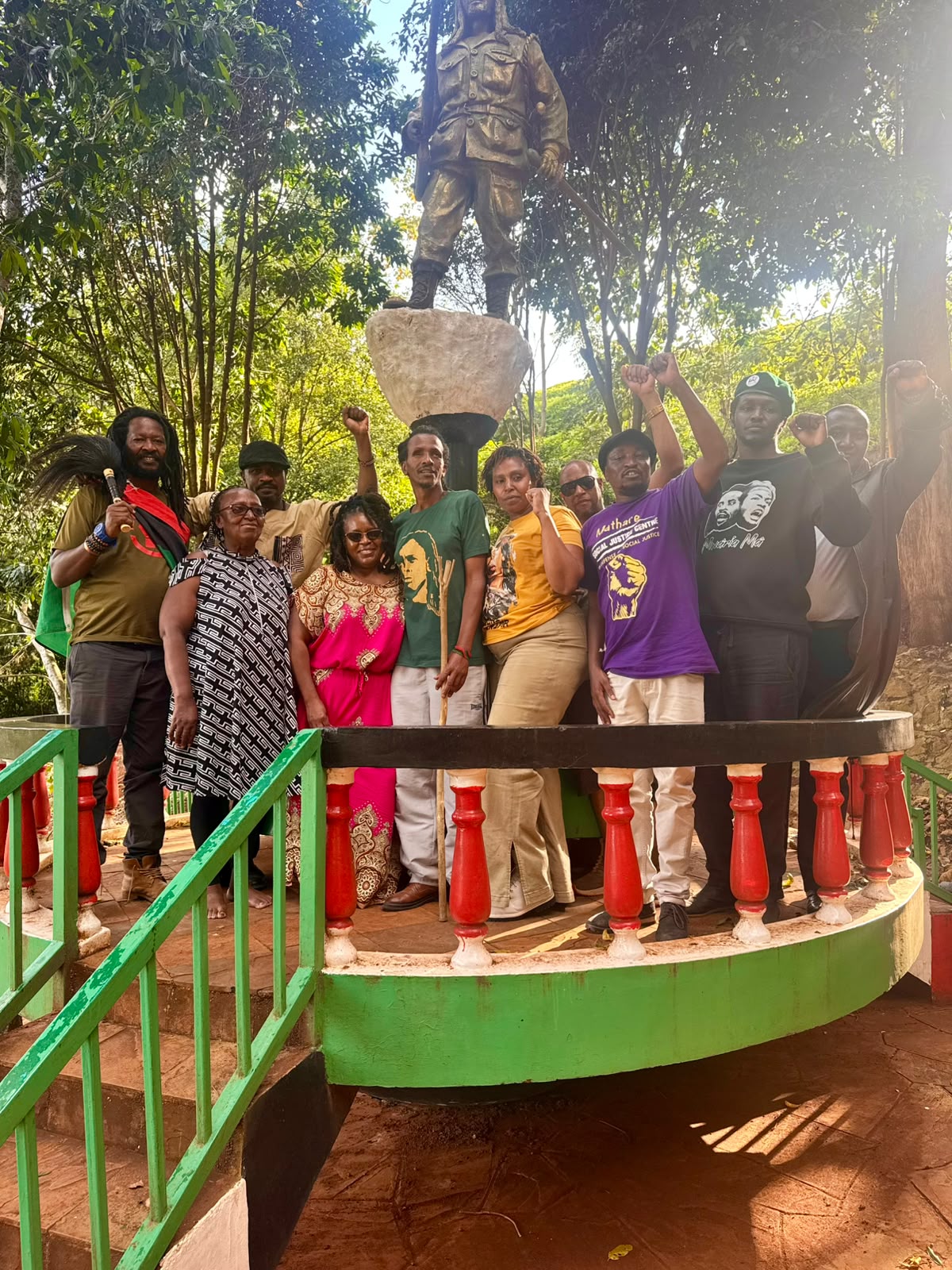
Fists raised beneath the statue of Field Marshal Dedan Kimathi at the memorial park, Kahiga-ini, Nyeri, where he was shot and captured on 21 October 1956, with sisters and brothers of the Racial Justice Network, the Mathare Social Justice Centre and Pan-African House.

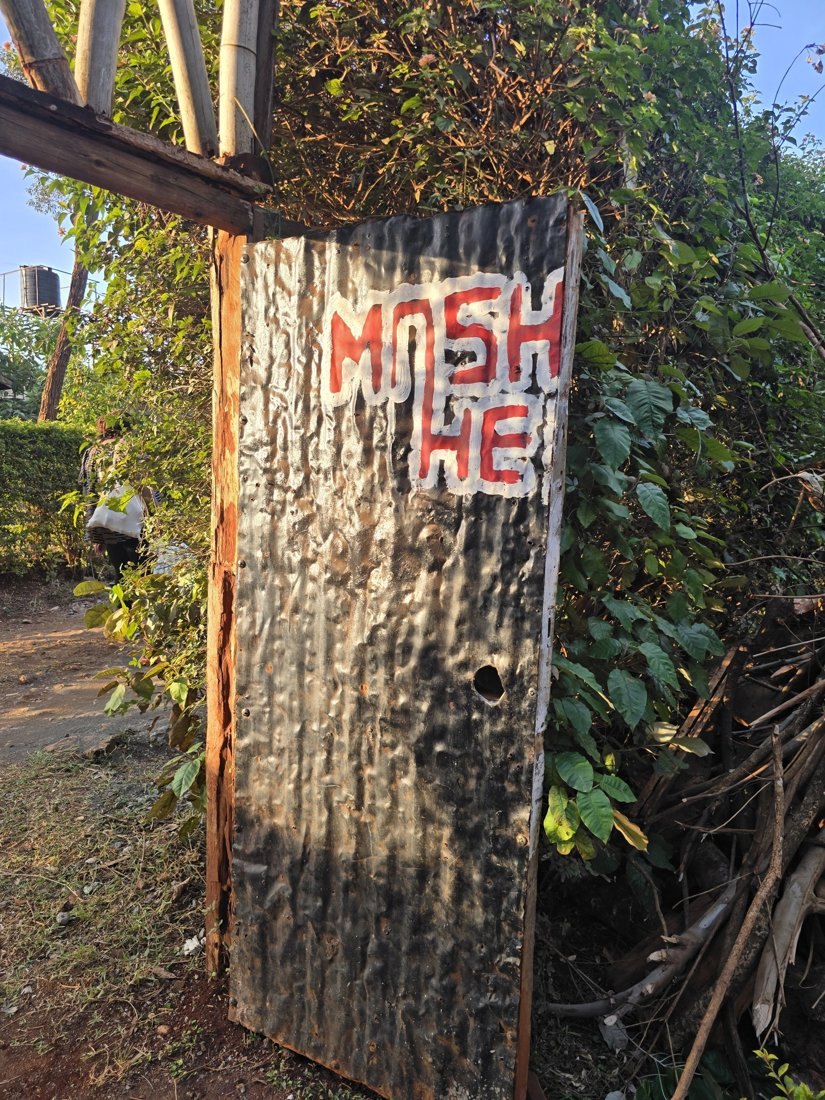
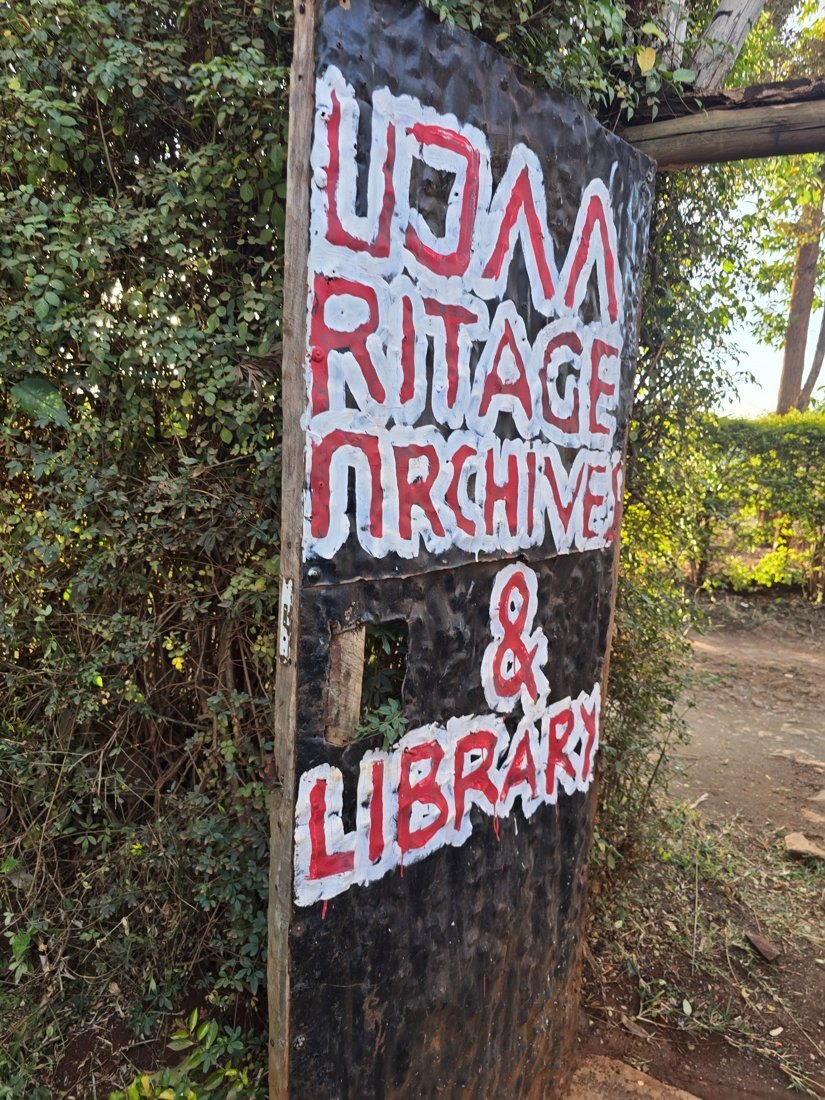
From 19 to 26 October 2026 I was in Kenya for the Tri-Sectoral Convening of Activists, Artivists and Scholars on Reparation and Decolonisation at Ufungamano House, Nairobi, convened by the Racial Justice Network (RJN) with the University of Nairobi and the Mashujaa Heritage Archives & Library. I was invited to give the keynote by RJN, of which I am also a Patron. I travelled principally in my role with MET, while representing both MET and the Stop the Maangamizi Campaign, which always work hand in hand, in the commitment we share to reinvigorating the Afrikan liberation struggle, in Afrika and across the Diaspora.

In this article

This is a long read. Each heading below is a link to that part of it.

Truth, re-membering and sovereignty · my keynote: naming, truth, the five forms of reparation, and the link between reparation and decolonisation; the slides and the convening programme.

In our own languages: Monaja’s intervention · why reparations and decolonisation must be discussed in Afrikan languages.

The 2013 settlement: what Britain calls closure · the Mutua and Kimathi cases, the settlement, and my reflection from the High Court in 2012.

Land and freedom: the sons and daughters of the freedom fighters · the testimony of the families, Wacera Itugu and her father, the Kimaathi Charter, the Commission of Inquiry, intergenerational harm and the Brattle report.

Unsung women of Kenya’s wars of liberation · the women who fought and led, the Nairobi Declaration, the young women organisers I met, and the Mbuya Nehanda project.

Honouring the Mashujaa: Nyeri and the Mashujaa Heritage Archives · the home of Field Marshal Mũthoni wa Kĩrĩma, Kahiga-ini where Field Marshal Kimathi was captured, the libation and my naming, the mountain’s names, and the Mashujaa Heritage Archives & Library.

Land at the heart of repair · the double theft of Kenya’s land, the Kipsigis and Talai, regret without apology, what the Maangamizi is, rematriation and Planet Repairs.

On air: ‘Fixing the Nation’ · my interview on the Nation FM radio programme, filmed for NTV Kenya.

A generation sharp and ready · the Gen Z Uprising, the killings and the state’s compensation offer, Sungu Oyoo’s presidential candidacy, the May 2026 arrests, wantam, and Cabral on ideas.

Reggae nights: the Caribbean in Kenya · conscious reggae in Nairobi and the music of Sonbeam.

Carrying it forward · what comes next, the book ‘From Mau Mau to Ruto-Must-Go’, and thanks.

References

Ufungamano House is itself a site of struggle: in November 1999 Kenya’s religious leaders met there with 54 civil society groups and launched the Ufungamano Initiative, a people-driven review of Kenya’s constitution. President Moi’s ruling party, the Kenya African National Union (KANU), had placed the review in the hands of a parliamentary select committee, which would have left the politicians who benefited from the old constitution to write the new one; the Ufungamano Initiative insisted that the people themselves should decide, and in 2001 it won its place in the Constitution of Kenya Review Commission that produced the 2010 Constitution.[2]

I arrived in time for Mashujaa Day on 20 October. Mashujaa is Kiswahili for heroes, and Mashujaa Day, Kenya’s Heroes’ Day, is a national day under Kenya’s 2010 Constitution honouring all who contributed to the freedom struggle. It took the place of Kenyatta Day, named after Jomo Kenyatta, Kenya’s first President. Kenyans chose 20 October because on that day in 1952 the British declared a State of Emergency, the eight years of military rule under which Britain fought the Kenya Land and Freedom Army, the liberation army that took up arms against British colonial rule from the forests of Kĩrĩnyaga and the Aberdares in what Kenyans name the Mau Mau War of Liberation, and detained the leaders of the Kenya African Union, Jomo Kenyatta among them, later tried at Kapenguria. There could be no more fitting day on which to begin a week on reparation and decolonisation.

I was fortunate enough to have been involved in commemorating Mashujaa Day in London long before this, my first visit to Kenya. In 2011 the Pan-Afrikan Reparations Coalition in Europe (PARCOE), with the Mau Mau Justice Network in the UK and Voice of Africa Radio, a London community radio station, hosted the first global commemoration of Mashujaa Day over the airwaves, featuring Professor Maina wa Kinyatti, Professor Ngũgĩ wa Thiong’o and Professor Mĩcere Gĩthae Mũgo, and we kept it each year after on my show ‘Africa Speaks with Sister Ekua’ on that station. The 2013 special asked, ‘Mau Mau Reparations: is there a Pan-Afrikan perspective?’[3], and put questions I carried to Nairobi thirteen years on: what was the role of women in the struggle for Kenyan independence; how have young people been influenced by the legacy of the freedom fighters; what are the legacies of dispossession on Kenyans and Kenya today; and what can be done to secure true justice.

The welcome from the Kenyan partners of the convening, the University of Nairobi, the Mashujaa Heritage Archives & Library and the activists, artivists and scholars who hosted us through the week, was warm from the first day to the last. Before I turn to the week itself, here is some of the music we played on air in that first commemoration in 2011.

Listen: Mashujaa Day on the airwaves

Music played at the Mashujaa Day celebrations in Kenya in 2010, provided by Charles Wainaina of the Mau Mau Justice Network.

‘Angalia Saa’ (Kiswahili: look at the clock), Ukoo Flani Mau Mau, 2008. Ukoo Flani Mau Mau grew out of Kalamashaka, the hip-hop crew founded in Dandora, Nairobi, in 1995, into a collective rapping in Kiswahili and Sheng, the street language of Nairobi’s youth that mixes Kiswahili, English and Kenya’s other languages, against corruption, police brutality and poverty, and took the fighters’ name as their own. ‘Angalia Saa’, by Kama of Kalamashaka, Kitu Sewer and the singer Winyo, is a wake-up call that time is running out: Kama’s verse names the Matigari, Gĩkũyũ for those who remained, the fighters who came out of the forest and were left without land while the ruling class took the trophies of independence, and in the hook they sing, wewe ni shujaa, usikate tamaa: you are a hero, do not give up.

‘Daima’ (‘Kenya Only’), Eric Wainaina. First released in English in 1998 as ‘Kenya Only’, written for unity and healing after the bombing of the US Embassy in Nairobi that year, and re-recorded in Kiswahili as ‘Daima’, always, on his 2001 album ‘Sawa Sawa’. In its chorus Eric Wainaina reads the Kenyan flag: black for the people, red for the blood shed in the struggle for independence, green for the land, white for peace. In its second verse he honours the Mashujaa who faced British bullets and imprisonment, and it calls Kenyans from the lake to the coast, north to south, to live as one. Kenyans sing it as a second national anthem in times of crisis and reconciliation.

‘Chebomuren’, Emmy Kosgei, from ‘Taunet Nelel’, 2009. Chebomuren is Kalenjin for daughter of a warrior. Emmy Kosgei’s song, which sets gospel praise to traditional Kalenjin rhythms, celebrates the resilience, faith and strength of Afrikan women.

Truth, re-membering and sovereignty

On 21 October I gave the opening keynote, ‘Repair Begins Within: Truth, Re-membering and the Reclaiming of Our Sovereignty’. The date is historically significant: seventy years earlier, on 21 October 1956, Field Marshal Dedan Kimathi, leader of the Kenya Land and Freedom Army, was shot and captured at Kahiga-ini, in Tetu, Nyeri, whose name in Gĩkũyũ means the place of the small stone.

I began with naming. The British called the liberation army ‘Mau Mau’; its fighters named it for what they fought for, ithaka na wĩathi, land and freedom. As Mwalimu (Kiswahili: teacher) Ngũgĩ wa Thiong’o, who joined the ancestors in 2025, reminded us in his preface to ‘Mau Mau From Within: The Story of the Kenya Land and Freedom Army’, ‘names and naming are part of warfare’.[4] The same conviction is why the Stop the Maangamizi Campaign names what has been perpetrated against Afrikan people the Maangamizi, Kiswahili for utter destruction, defined in full in the land section below.

My message was simple, and it followed from the name. Our visions of reparation come from within: from our own cultures, languages, stories and ways of setting wrongs right. Repair begins with truth-seeking and truth-telling: the whole truth, told unsanitised, including truths about ourselves.

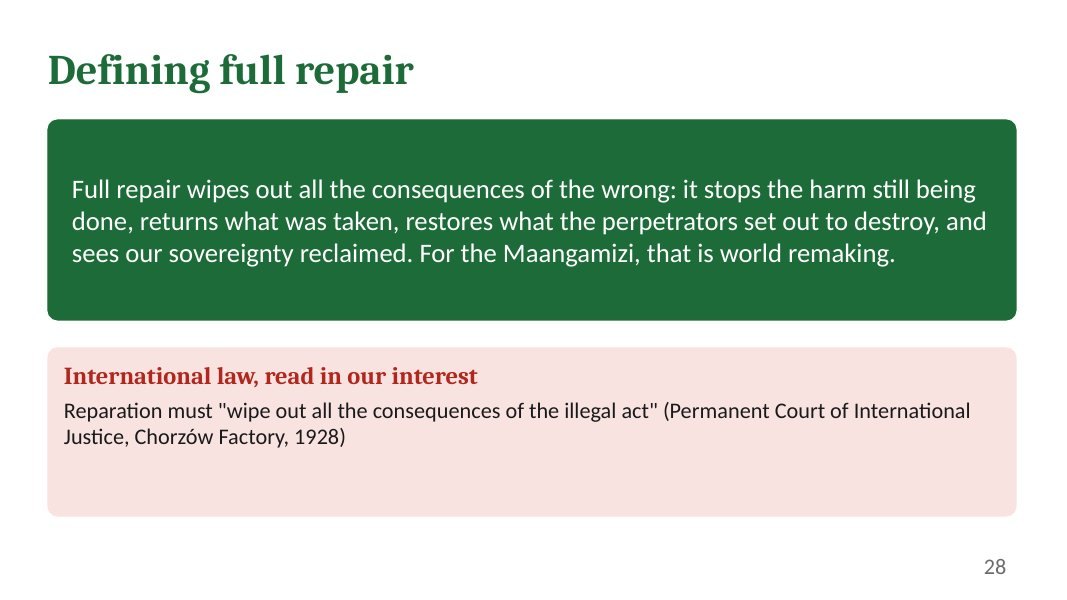
So what does reparation consist of? The United Nations Basic Principles and Guidelines on the Right to a Remedy and Reparation, adopted by the UN General Assembly in 2005[5], set out the right to a remedy and reparation of people subjected to gross violations of human rights, and name five forms of reparation: restitution, compensation, rehabilitation, satisfaction and guarantees of non-repetition. Compensation is only one of the five. Every offer, from whatever government, is to be tested against all five, and against cessation first: has the harm stopped?

Full repair has one more test: what has it done for women? Full repair means wiping out what British rule did to Afrikan women. In Kenya, women head about a third of households yet individually hold title to about one per cent of land[6], so rematriation, the return to the Mother, which I say more about below, is here a practical programme: women holding title to land, women’s safety, and women deciding in our councils and our movements.

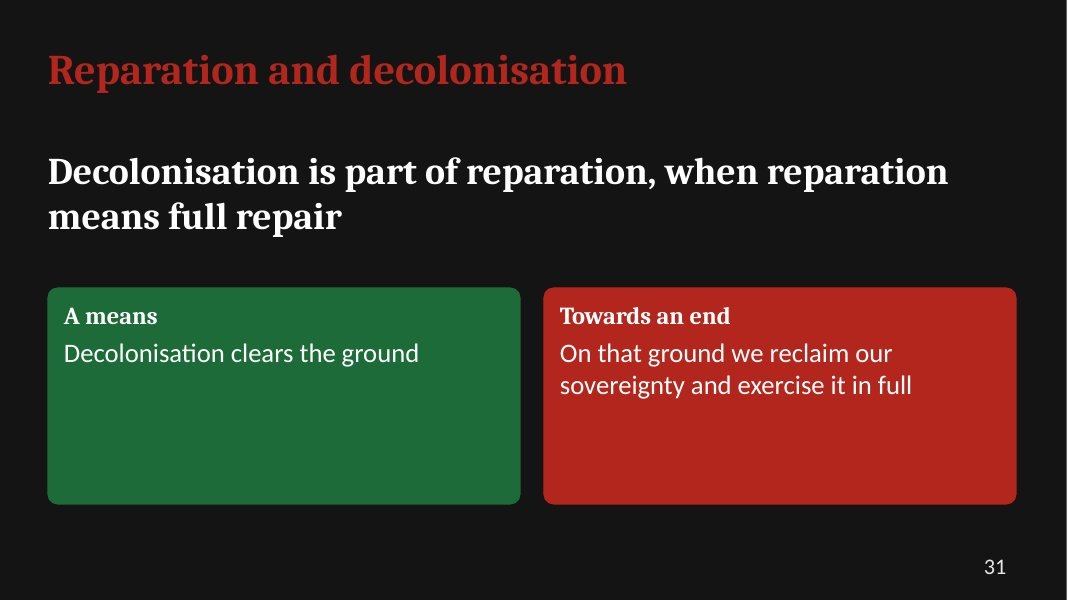
From truth I turned to decolonisation, the theme the convening was named for. Decolonisation is part of reparation when reparation means full repair. Decolonisation is the means; the restoration of Afrikan sovereignty is what it secures; and the end is larger than either: the transformation PARCOE and the Stop the Maangamizi Campaign name Planet Repairs, the remaking of the world itself, bringing together cognitive justice, environmental justice and reparatory justice, in the world that the International Social Movement for Afrikan Reparations (ISMAR), as part of a far wider movement of peoples, works towards: Maatubuntuman in Ubuntudunia, explained in the box below. The link between reparation and decolonisation, made plain, is this:

Reparation and decolonisation: the link, made plain

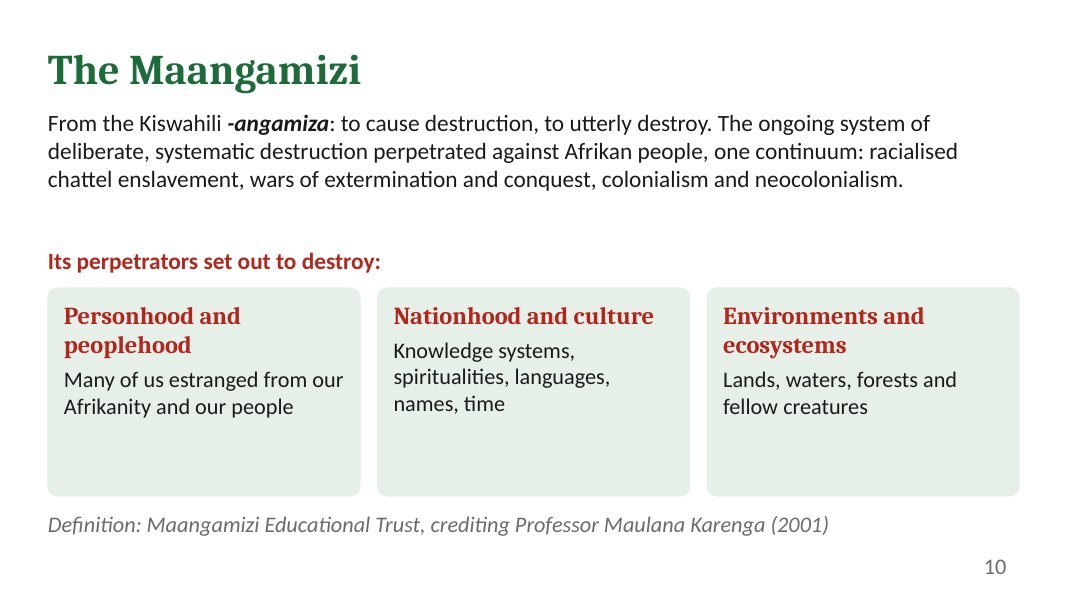
1. The Maangamizi broke worlds. Its perpetrators set out to destroy the personhood and peoplehood of Afrikan people, our nationhood and culture, and our environments and ecosystems, and colonialism and neocolonialism continue it.

2. Reparation, as full repair, remakes those worlds. Stop the harm, return what was taken, restore what was destroyed.

3. Decolonisation is part of that repair. It clears the ground: Afrikan peoples reclaim land and life, our languages and ways of knowing, and the power to decide. Decolonisation that leaves the loot in place changes only the flag; reparation paid inside the colonial order is only a payment.

4. What replaces colonisation is Afrikan peoples’ sovereignty restored, within a world remade. The ISMAR names the world it works towards, in Afrika and across the Diaspora, Maatubuntuman in Ubuntudunia. Maatubuntuman is the envisaged Pan-Afrikan union of communities in which Ubuntu, umuntu ngumuntu ngabantu, a person is a person through other persons, a becoming practised through relationship with the living, the ancestors, those yet to be born, other species, the land and Mother Earth, is lived under Ma’at, the order of truth, justice, balance and harmony which originates in Kemet (Ancient Egypt) and which many Afrikan people on the continent and across the Diaspora live by today. Ubuntudunia is a multipolar, pluriversal, anti-imperialist world of global justice for all. One vision, named from two sides: Afrikan peoples remade in sovereignty, within a world remade.

On the second day, 22 October, after an opening panel of activists, I returned to that message before a room of scholar-activists, activists and artivists and turned to practice. I asked us to carry one question into everything: on whose terms? As the Yaqui legal scholar Professor Rebecca Tsosie writes in ‘Acknowledging the Past to Heal the Future: The Role of Reparations for Native Nations’, ‘there is no “uniform” theory of reparations that fits all cultures, all nations, and all peoples.’[7] What repair requires is defined by peoples in struggle, from their own experience and their own ways of knowing; those who owe repair do not get to define it. With Professors Eve Tuck and K. Wayne Yang, whose 2012 essay is titled ‘Decolonization is not a metaphor’[8], I warned against decolonisation used to mean only the decolonising of institutions and knowledges, a curriculum here, a museum label there, while the land, the economy and the politics stay as they are. Used that way, decolonisation is a metaphor. Decolonisation means our peoples reclaiming land and life.

I closed with a question, and I offer it here as a reflective point for anyone working on reparation and decolonisation: how do we know? How do we know the truth? How do we know whose terms we are on? How do we tell repair from capture? How do we know decolonisation is really happening, that land, economy and power are returning to our peoples, when all that may have changed is that Afrikans now occupy the offices the colonisers built? A selection of the slides follows; the full deck, revised since the convening, is in the box beneath them.
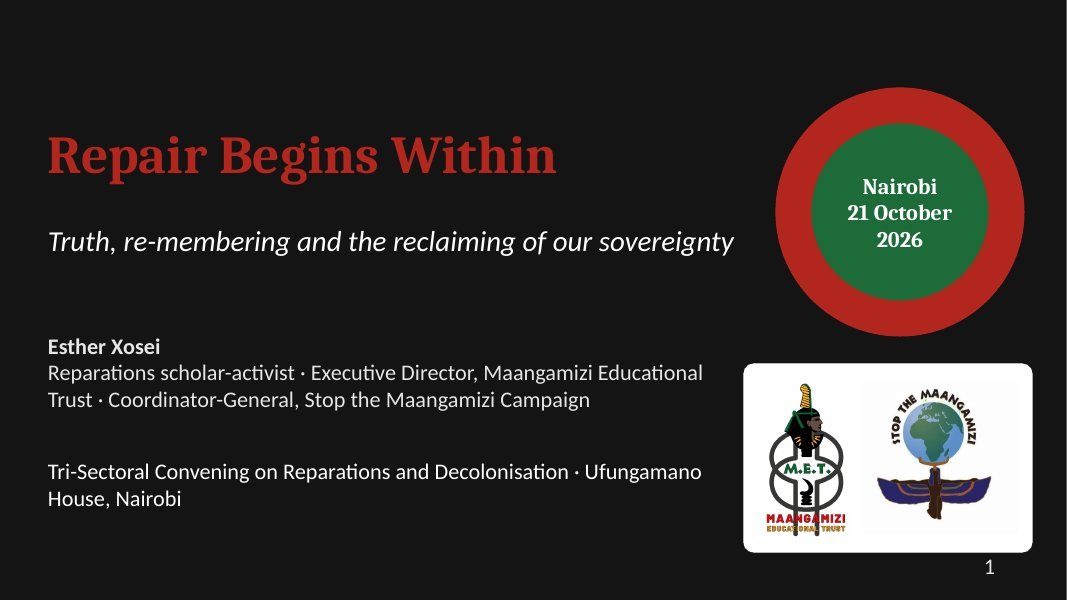
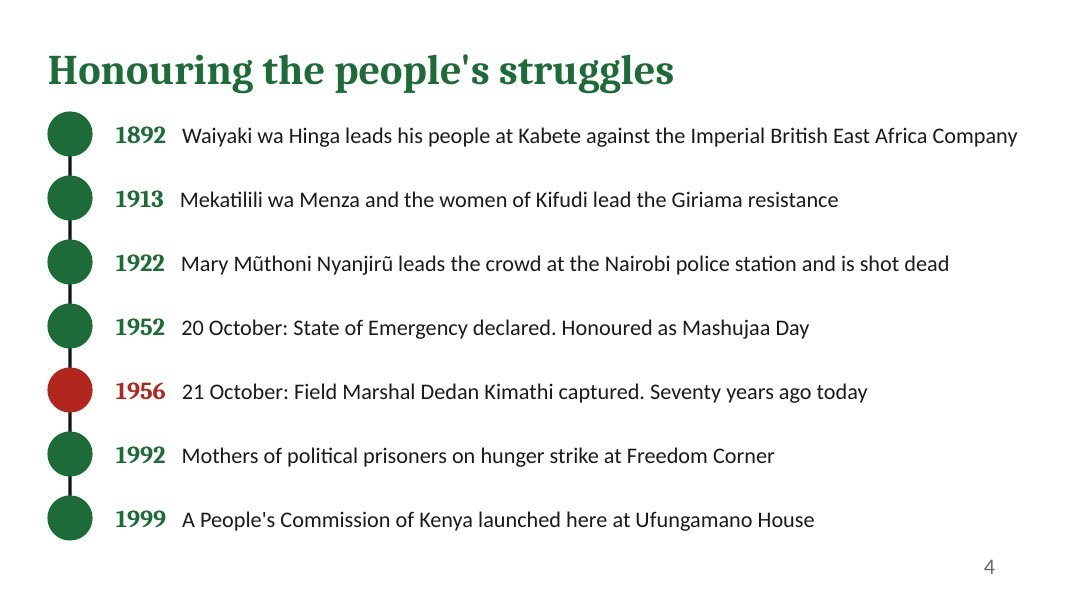
A selection of slides from the keynote, ‘Repair Begins Within: Truth, Re-membering and the Reclaiming of Our Sovereignty’, Ufungamano House, 21 October 2026.

The keynote slides: revised edition

I have revised the keynote slides since the convening to include what the week taught us: the testimony of the sons and daughters of the freedom fighters; the Kimaathi Charter, the fighters’ own statement of their demands; gender injustice; Kenya’s case for reparation, with land at the centre; the places we walked; the community archives we visited; and a stronger way forward linking reparation and decolonisation. The revised edition, with speaker notes, can be read and downloaded here:

Repair Begins Within: revised keynote slides (PDF)Download

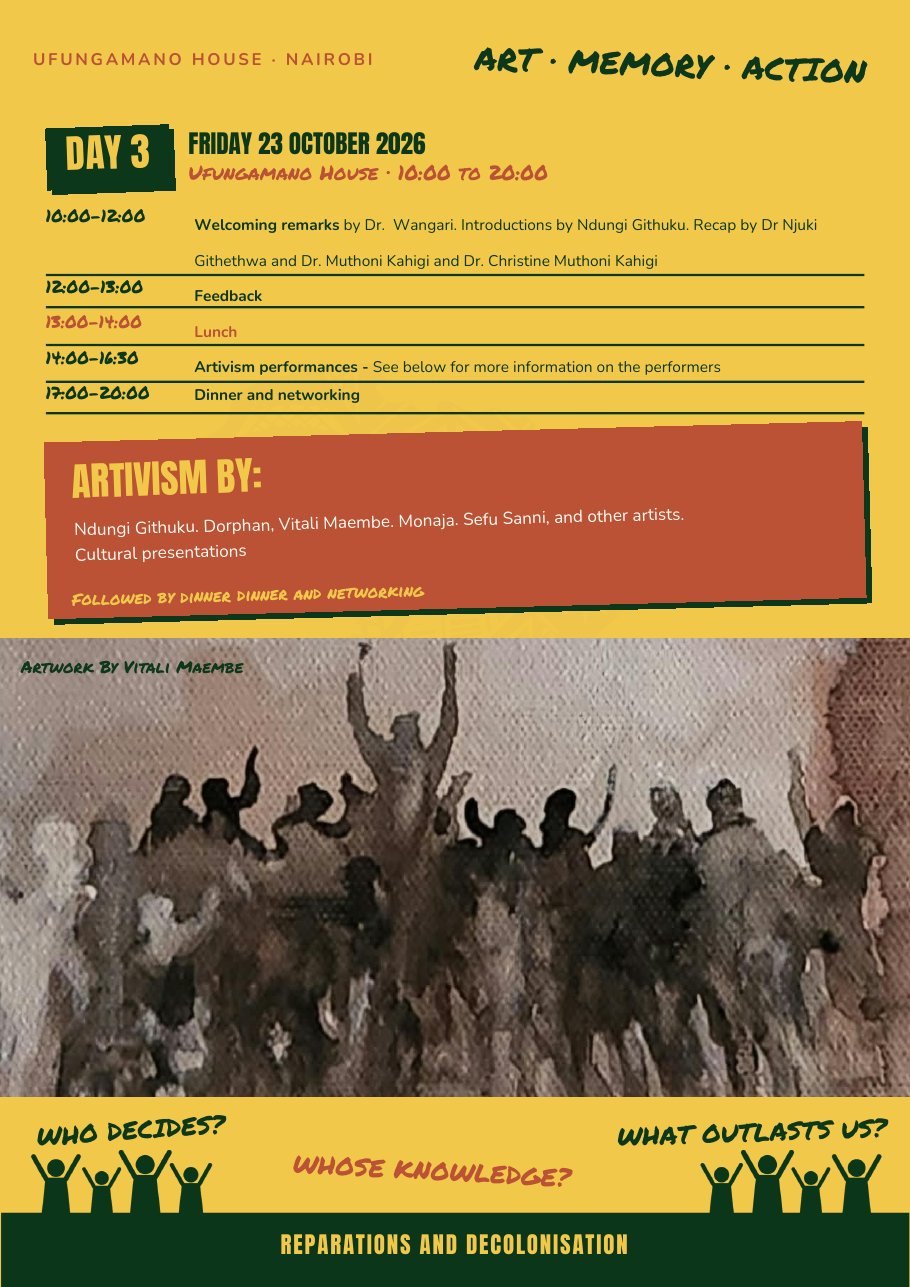
The keynote opened a four-day programme built on the tri-sectoral idea: that activists, artivists and scholars hold distinct but connected kinds of knowledge, each to be heard in its own right, with lived experience, artistic expression and scholarship given equal standing. Each day foregrounded one of the three: the scholars on the first day, the activists on the second, the artivists on the third; on the fourth a small delegation travelled to Nyeri, to the places I describe below. Here is the convening programme in full, with the partners, speakers and sessions of the week.
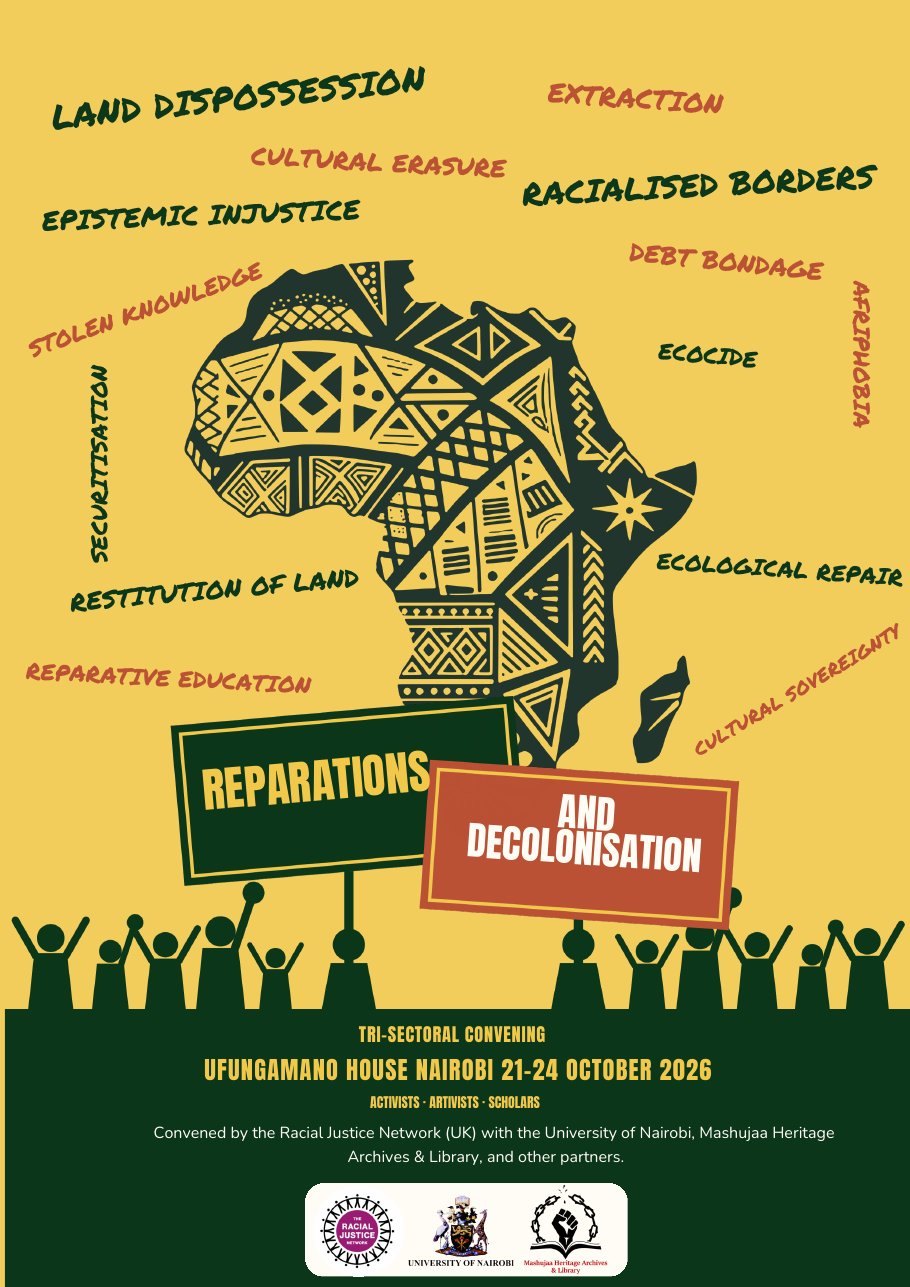
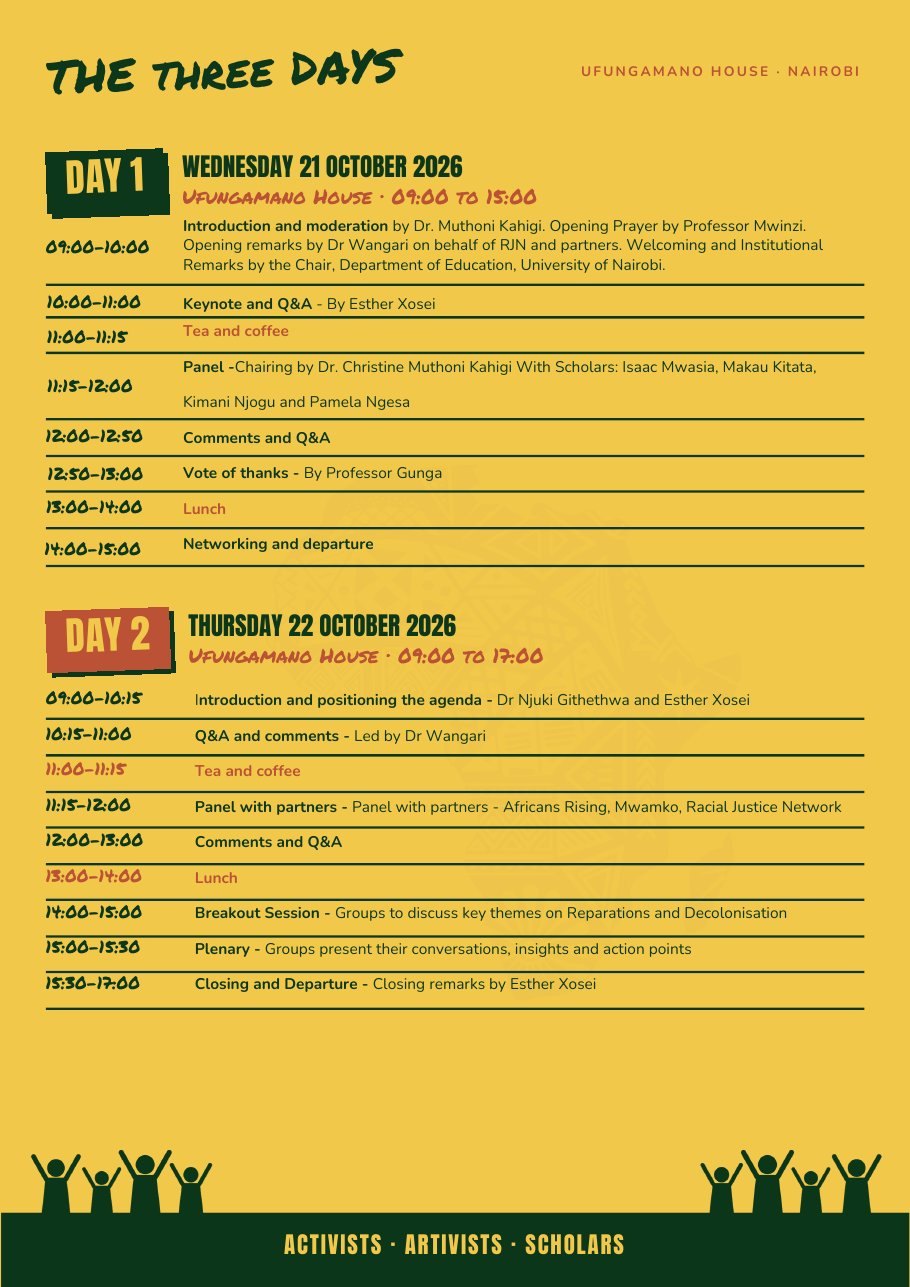
The convening programme: convened by the Racial Justice Network (UK) with the University of Nairobi, the Mashujaa Heritage Archives & Library and other partners, Ufungamano House, Nairobi, 21–24 October 2026.

The convening programme (PDF)Download

In our own languages: Monaja’s intervention

One intervention at the convening resonated deeply with me. Monaja, Mwongela Kamencu, is a Kenyan performing artist, trained historian and activist who bridges the worlds of academia, conscious hip-hop and grassroots political organising in Nairobi. He writes and performs in Kiswahili and Sheng, and he made his 2024 project ‘June 25th’ in response to the youth-led uprising of that year. Drawing on Professor Ngũgĩ wa Thiong’o’s ‘Decolonising the Mind’[9], he argued that we should not be gathering in English at all to discuss decolonisation and reparation: Kiswahili is the language most people in the room spoke, and Kiswahili is what they would speak. On the artivists’ day a concerted effort was made to speak Kiswahili from the stage and the floor.

His point goes to the heart of the matter: the discussion of Afrikan reparations and decolonisation must be indigenised, held in the languages our peoples actually speak, Afrikan languages, beyond English and beyond every European language. Reparations debated only in the colonisers’ tongues are debated on the colonisers’ terms. Decoloniality applies to how we gather, and to the language in which we think and speak about repair, as much as to what we say. Monaja also gave powerful performances during the convening, and his argument and his art were of a piece.
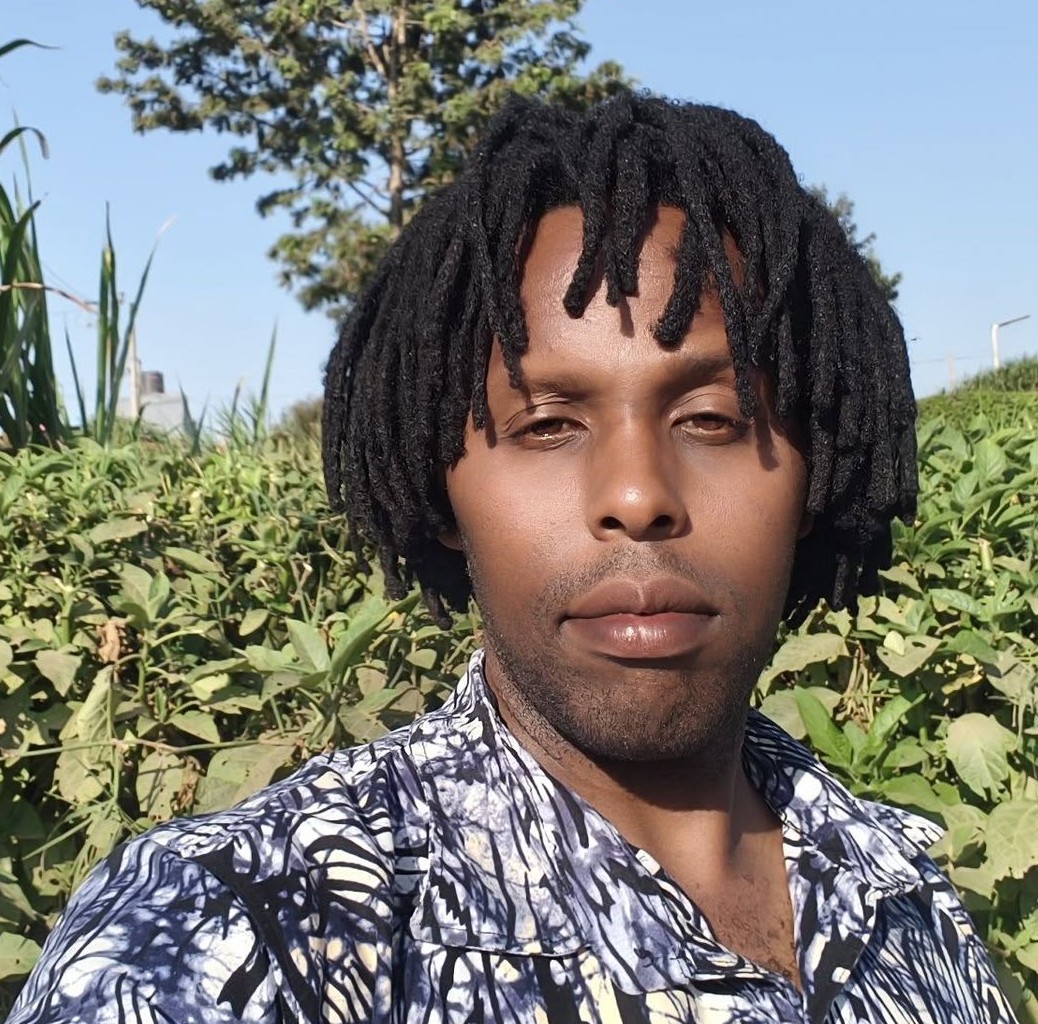
Monaja (Mwongela Kamencu), performing artist, historian and activist, at the convening.

The 2013 settlement: what Britain calls closure

The 2013 settlement came up again and again during the week, in the keynote, in the panels and in the testimony of the families. The UK Government’s settlement with Kenyan survivors of torture is what the British state now points to when it says that the matter of its colonisation of Kenya is closed. It is worth setting out exactly what it was.

What the 2013 settlement did, and did not do

The Mutua case. In 2009 the law firm Leigh Day, with the Kenya Human Rights Commission and the Mau Mau War Veterans Association, took the UK Government to the High Court in London in Mutua and Others v Foreign and Commonwealth Office[10], for five Kenyans the British had tortured in the camps of the Emergency. There were two systems of camps: the concentration camps the British called ‘Emergency villages’, into which they forced about a million Gĩkũyũ, Embu and Meru people, mostly women, children and the old, behind barbed wire and spiked trenches; and the detention camps, which the British ran as a ‘pipeline’ through which they moved at least 150,000 men detained without trial, to be ‘screened’, tortured and worked.[11][12] The UK Government argued that liability had passed to independent Kenya and that too much time had gone by. It lost on both points, and on the way was forced to disclose the Hanslope archive, some 17,000 files on the Emergency hidden for fifty years at Hanslope Park, which showed that the torture was authorised at Cabinet level in London.[13]

The settlement. On 6 June 2013 the UK Government settled: regret in Parliament, no liability[14]; 5,228 people paid 330,000 Kenyan shillings each, about £2,500, within £19.9 million that included £6.6 million in legal costs; a memorial in Nairobi. Of 50,000 people who came forward, 5,228 were put forward as cases the lawyers judged they could prove. Paul Muite, the Kenyan lawyer who advised the veterans, explained why they accepted so little: most were over eighty and dying every day, and refusing would have meant ten more years.[15] The Kenya Human Rights Commission said the case was never about the land confiscated, the education denied or the property lost.[16] I will say plainly what I think of that. It was abuse. Freedom fighters, and veterans of the war of liberation who had sustained them from the villages and in the camps, now in their eighties and nineties and having already waited sixty years, were made to choose between a pittance now and the near certainty of dying before any judgment. They were forced into it by the British state, which had hidden the evidence and run down the clock, and no Afrikan person should ever have to settle on those terms. Fighters and their families, and tens of thousands who lived through the camps, received nothing. The colonial land regime stood.

An impossible standard. To be counted, elderly freedom fighters had to prove, sixty years on and in a foreign court, what was done to them in camps whose records the British destroyed or carried away and hid, and whose guards and officers were dead or untraceable. The destruction was deliberate. As Simon Myerson QC told the High Court for the claimants in the second case in 2016, as the British prepared to leave, ‘Special Branch complained that it could not burn paper quickly enough… Anything “embarrassing” was to be destroyed… That includes the records of those kept in detention. This was a cover-up on an industrial scale.’[17] The British state destroyed the evidence, then pleaded the passage of time.

The second case. In 2013 a group action for some 44,000 people, Kimathi and Others v Foreign and Commonwealth Office[18], carrying the name of Mukami Kimathi, the Kenya Land and Freedom Army fighter and wife of Field Marshal Dedan Kimathi, was brought in London by the law firm Tandem Law. The claimants described beatings, rape, torture, forced labour and castration; freedom fighters and veterans in their nineties gave their testimony by video link from Nairobi, and by 2016 more than 2,000 of them had died waiting.[17] In 2018 the High Court stopped it because too much time had passed, recording the claimants’ own summary: ‘many people were abused, but none of the 40,000 people in this action can show they were abused.’[19] In 2023 the court struck out a negligence claim against the law firm and barristers who had represented them: no evidence could have changed the result.[20] In Kenya the veterans petitioned over stalled negotiations for those left out, while the people they fought for died. In January 2025 the British High Commissioner wrote that the 2013 agreement ‘resolved all claims relating to the Emergency Period’.[21] The injustice continues.

I was in the Royal Courts of Justice in London on 5 October 2012, the day Mr Justice McCombe ruled in Mutua and Others v Foreign and Commonwealth Office that the case could go to trial despite the passage of time. In my newsletter of that month, ‘Has there really been a victory for the Mau Mau?’[22], I opened with Malcolm X:

‘If you stick a knife in my back nine inches and pull it out six inches, that’s not progress. If you pull it all the way out, that’s not progress. The progress comes from healing the wound that the blow made. They haven’t even begun to pull the knife out. They won’t even admit the knife is there.’

Malcolm X

I wrote that the original liberation struggle for uhuru, freedom, cannot be traded for the narrow victories of a court case, however victory gets defined; that the right to sue the British Government is not the same thing as judges who swear an oath of allegiance to Queen Elizabeth II finding a department of Her Majesty’s Government guilty of torture; and that elderly Kenyan claimants had been forced over hurdle after hurdle simply to establish a right in law to sue, so that it was the whole British justice system that stood on trial. I was reminded of the Afrikan folk tale of what happens to Sister Goose in the Court of the Foxes: justice cannot be guaranteed for those who are not foxes. My work with the Mau Mau Justice Network in London at that time, providing legal literacy support and training in reparations, was under the auspices of PARCOE. The 2013 settlement, and the dismissal of the Kimathi case in 2018 because too much time had passed, have borne that reflection out.

Land and freedom: the sons and daughters of the freedom fighters

Among the most powerful contributions at the convening came from the sons and daughters of Kenya Land and Freedom Army freedom fighters, elders themselves now, who spoke of the redress and reparation their families have never had. Their own state has brought them no remedy either. Kenya’s Truth, Justice and Reconciliation Commission (TJRC), set up under the Truth, Justice and Reconciliation Act of 2008 after the post-election violence of 2007–08, took some 40,000 statements over four years and handed its 2,210-page report to President Uhuru Kenyatta on 21 May 2013. The report named land grievances as the single most important driver of conflict in Kenya. Its three international commissioners dissented, recording that the Office of the President had pressed the Commission to remove passages of the land chapter that implicated Jomo Kenyatta, the President’s father. In December 2013 Parliament amended the Act to remove the duty to begin implementation within six months, and the National Assembly has never debated or adopted the report. Thirteen years on, its recommendations lie unimplemented.[23]

The sons and daughters spoke too of the 2013 settlement described above. Fighters and their families were left off the list of 5,228 claimants, they told us, while people who had never been fighters appeared on it.[24] The families of those who sacrificed most live today in abject poverty, systematically impoverished by landlessness: the families’ and the peoples’ ancestral lands, seized by the British, were never reclaimed, and the fighters who came out of the forest or the camps came out to nothing. Their children grew up without land, without schooling their parents could pay for and without the means to recover, and they carry the consequences into the present.

The fighters themselves set out, in their own words, what they fought for. Read their demands beside the lives their families live today, and the whole distance of what remains unrepaired is laid bare.

In their own words: the fighters’ demands

The fighters set out their demands in the Kimaathi Charter, prepared by Field Marshal Dedan Kimathi under the authority of the Kenya Defence Council and widely circulated, reproduced in Shiraz Durrani’s ‘Kĩmaathi: Mau Mau’s First Prime Minister of Kenya’[25]. It opens: ‘We demand African self-government in Kenya.’ Among its demands:

‘We demand authorities of gold, markets, roads, co-operative societies, and auctions to be in the hands of Africans.’

‘We demand that the European foreigners, rascals, troops and police should be withdrawn from Kenya African Reserves.’

‘We reject criminal or death cases to be judged by foreigners.’

‘We condemn the dropping of poisons from the air as the colonialists in Kenya are doing to the African population.’

‘We reject the foreign laws in Kenya, for they were not made for Kenya and are not righteous.’

‘We reject being called terrorists when demanding our people’s rights.’

‘We demand a stop to the raping by foreigners of our wives and daughters; also female imprisonments and carrying of passes.’

‘We reject the colonization of Kenya, for in that state we are turned into slaves and beggars.’
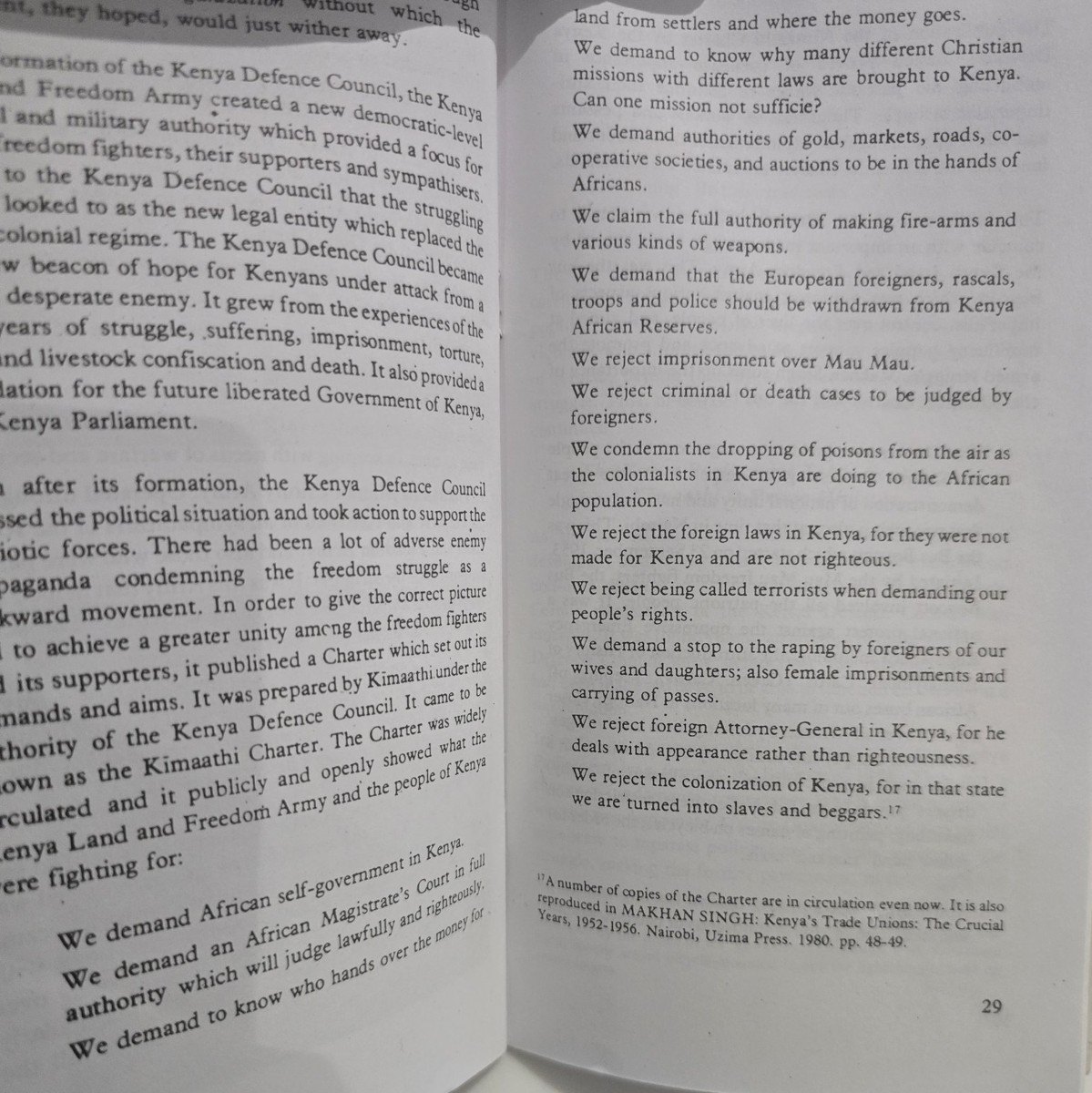
The Kimaathi Charter, as reproduced in Shiraz Durrani, ‘Kĩmaathi: Mau Mau’s First Prime Minister of Kenya’, pp. 28–29.

Among those who spoke was Wacera Itugu, the daughter of a fighter, who came to draw attention to what was done to her father and to her family.

Itugu, son of Kiburu: seven years in detention

The British imprisoned Wacera’s father, Itugu, son of Kiburu, without trial from 1954 to 1961: seven years of his life, taken for fighting for the freedom of his people and the land of his family and his people from the colonisers who had invaded it and waged war on them. Wacera told me that after his arrest the British took him first to Langata camp in Nairobi, then to Mackinnon Road, in the dry country on the road to Mombasa, and that he finished his detention at Hola. Hola is the camp where, on 3 March 1959, warders beat eleven detainees to death for refusing forced labour; the Hola massacre, once exposed, undermined the legitimacy of British rule and hastened the end of the Emergency.[17]

Like the other families who spoke, Itugu’s family has seen no redress. Wacera called for justice, and first of all for the right to be heard: to speak of what was done to her father and of what it did to her whole family.

Wacera began in English and, as her testimony deepened, moved into Gĩkũyũ. I do not speak Gĩkũyũ, and I understood her all the same, through the depth of the emotion she conveyed and the questioning that ran through everything she said. The question she put again and again, to the British state, was: ‘What did my father do?’ She asked it demanding an answer: what could Itugu, son of Kiburu, possibly have done to warrant seven years of brutal, unjustifiable imprisonment, with consequences that have run down the generations to her? He has passed on. The family’s quest for justice remains, and it will not go away.

Testimony like this is harrowing to give and to hear. It is also why any process that hears survivors and their descendants must build in support for them, including psychosocial support, from the start. It had a profound impact on me. I could not look the other way, and I resolved that, as someone involved in the process of establishing the Commission of Inquiry described below, I would see what can be done when I returned to the UK.
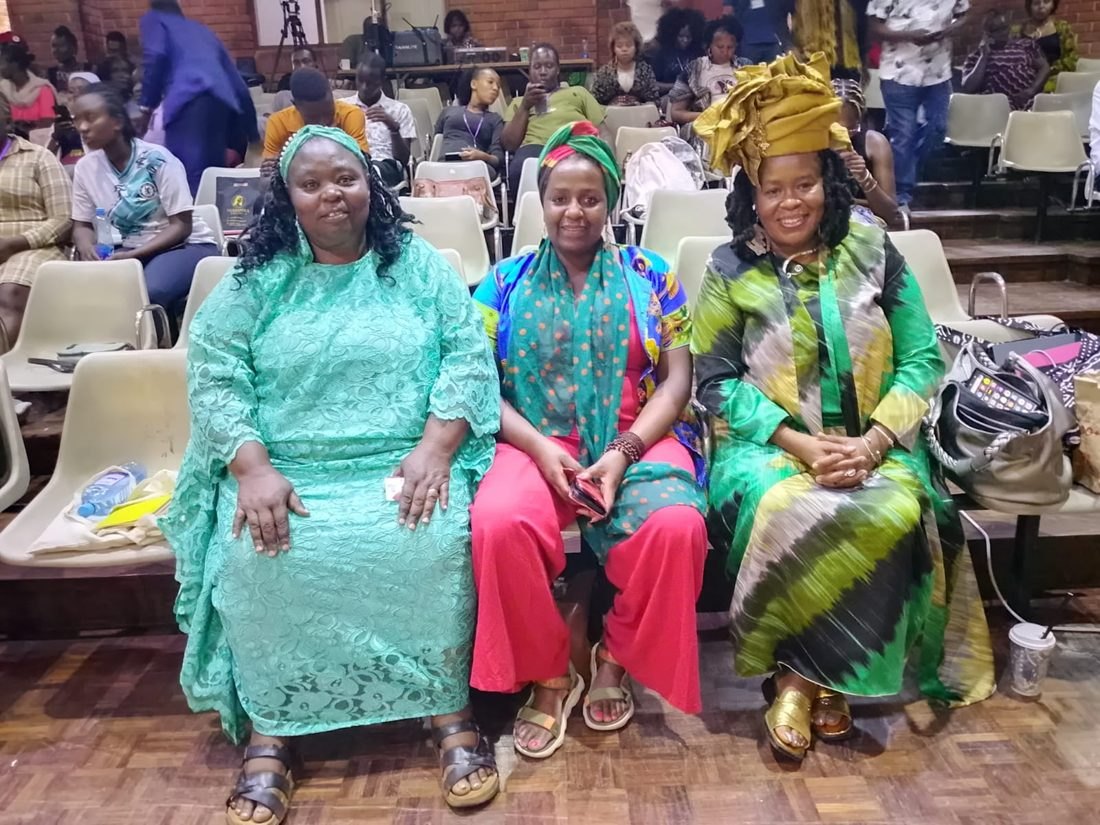
Wacera Itugu (left), daughter of the Kenya Land and Freedom Army fighter Itugu, son of Kiburu, with Dr Peninah Wangari-Jones and me at the convening.
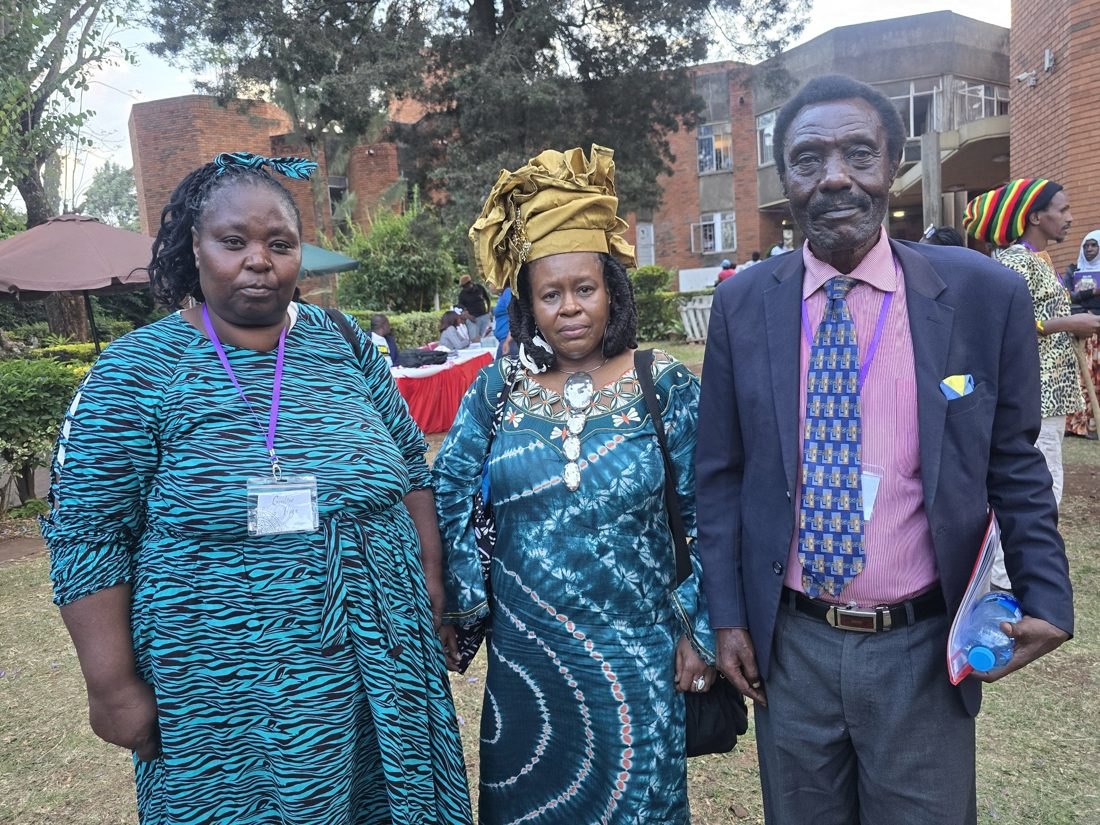
With Wacera Itugu (left) and, right, another daughter of a Kenya Land and Freedom Army fighter, whose family, like hers, lives with the destitution and injustice that followed and has its own case for redress.

The British state has given Wacera’s family no account of what was done to her father: the detention records were destroyed, as the claimants’ counsel told the High Court, and the state waited for the detained to die. What the family keeps is one piece of paper. It is a copy of a typed list dated 8 March 1961, drawn up in the name of ‘Mr. Itugu s/o Kiburu, ex-detainee’, setting out ‘the pieces of clothes taken from’ him and kept in the Government Store at Mackinnon Road Detention Camp on 16 April 1954, ‘and no receipt was given’. The British identified him by a bracelet number. Two suits, six shirts, trousers, shoes, a wristwatch, a suitcase, a stove, two sufurias (cooking pots), soap, towels and even two spoons are itemised and priced, to a total of 2,253 shillings and 25 cents.

Itugu, son of Kiburu, fought for the freedom of his people and the ancestral lands of his family. The state that had invaded that land and waged war on his people imprisoned him for seven years without trial, and recorded him as a number on a bracelet and a list of possessions down to his spoons. Records like this, and the testimony of the families who keep them, are part of what the Commission of Inquiry we are calling for would hear.
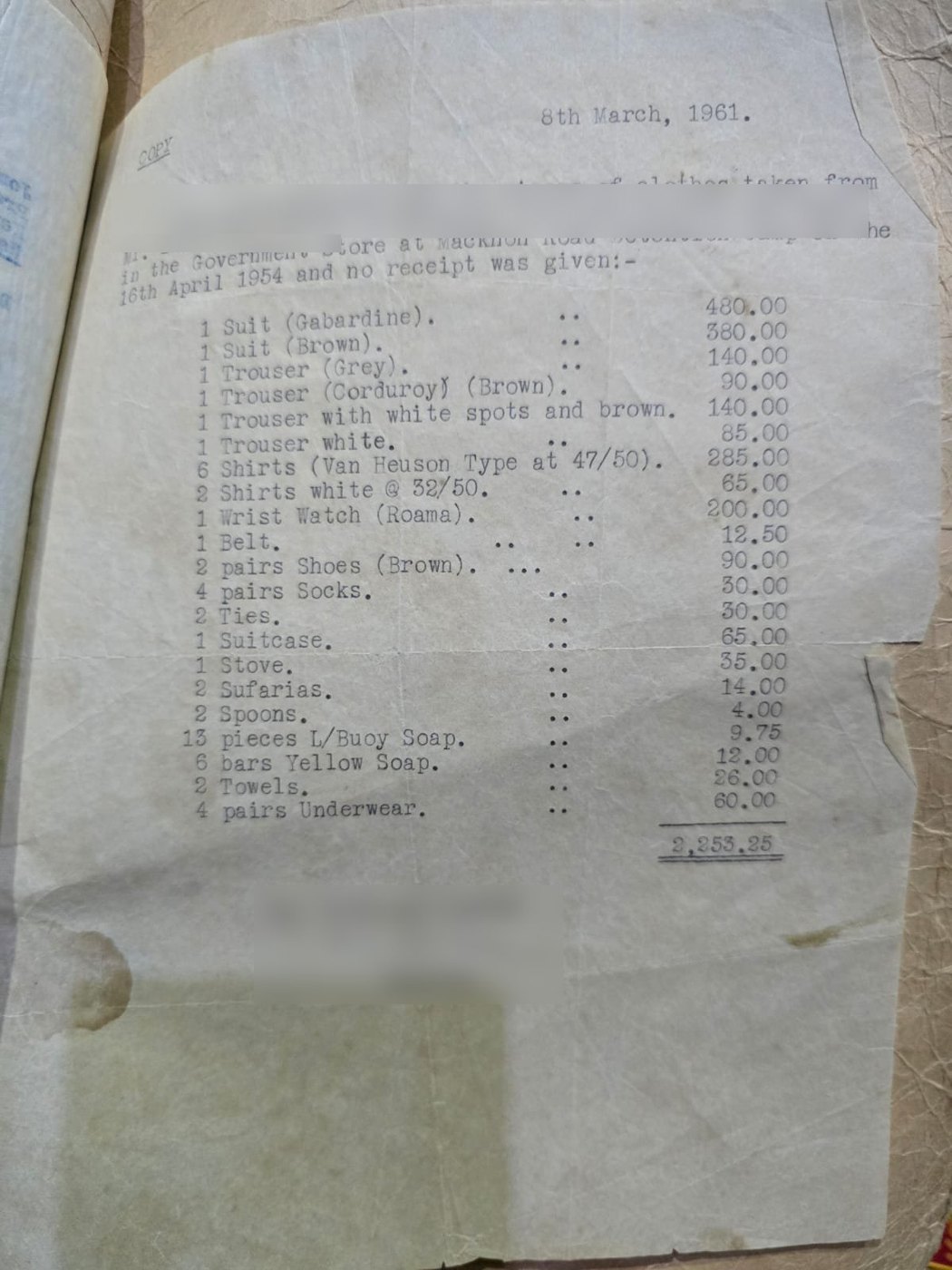
The list, dated 8 March 1961, of the clothes and belongings the British took from Itugu, son of Kiburu, at Mackinnon Road Detention Camp on 16 April 1954. Some details have been obscured.

The families were keen to hear about the All-Party Parliamentary Commission of Inquiry for Truth and Reparatory Justice (APPCITARJ), a demand first raised by PARCOE and carried forward by the Stop the Maangamizi Campaign, and announced as the key outcome of the All-Party Parliamentary Group (APPG) for Afrikan Reparations’ UK Reparations Conference on 17 October 2026, where a session was given to writing its mandate. The Commission is still to be established, and its mandate is being shaped now. Wacera and the other families made a plea that its scope include the fighters and their families, and the case for that is strong. Its subject is global Britain: what Britain did and does across the empire, Kenya included, has consequences for Afrikan heritage communities living in Britain, and it is those communities the Commission centres. The same British state, the same Crown and the same companies acted in Kenya and in the Caribbean, and the people harmed in Kenya are the parents and grandparents of people in Britain today. A mandate that stops at Britain’s shores would leave out the very people on whom the British state’s record is clearest and the evidence still living. International hearings, in Kenya and elsewhere, are part of our vision and aspirations for it.

The Commission of Inquiry and the families of the Kenya Land and Freedom Army

Beyond the 2013 settlement. The UK Government now treats the Mutua settlement as full and final, the argument it ran successfully in Kimathi. For the families, the Commission is the forum that remains. It would investigate what has been and is being done, from the camps to the land seized and never reclaimed and the records destroyed or hidden, and make recommendations for solutions, redress and repair.

Hearing the families. Wacera and the other families said they would be keen to appear at any international hearings of the Commission, because they are denied a voice and representation and have had no justice. We discussed how the Commission’s mandate should be constructed so that it can hear from, and amplify the voices of, people impacted overseas by the actions of the British Crown and state, the fighters and their families among them. That request I carry into my work with the APPG for Afrikan Reparations: any mandate must be able to hear from them.

Lessons from Kenya’s own Truth Commission. The TJRC’s report was altered under pressure from the Office of the President, never adopted by Parliament and never implemented. Recommendations need a way of being carried out that those implicated cannot rewrite, and survivors and their descendants must have a say in who decides.

I shared the Stop the Maangamizi Campaign’s postcard, whose QR code leads to stopthemaangamizi.com/citarj, together with MET’s materials.

More must be said. These families are living victims of the British state, with multifaceted unmet needs, social, political, economic and psychological, the result of systematic impoverishment through landlessness. The harm did not stop with the generation detained, and it has not stopped now. Land not returned is schooling not paid for, livelihoods not built, health not kept and life chances lost, in the children of the detained and in their children. The consequences of what the British state did are still playing out in these families, so their full extent is still to be counted; that is the plain meaning of intergenerational harm, and it is what the British state’s talk of closure refuses to recognise. There are ways of counting it. The Brattle Group’s ‘Report on Reparations for Transatlantic Chattel Slavery in the Americas and the Caribbean’, presented at the University of the West Indies in June 2023 with an introduction by Judge Patrick Robinson, then of the International Court of Justice[26], quantified the harm done to some 19 million people in thirty-one countries of the Americas and the Caribbean. I cite it for its method and for what it leaves out; the demands of the ISMAR are its own, and no valuation sets a standard for them. Its method separates the harm done during enslavement itself from the continuing harm inflicted on descendants after it; counts the years of life taken; and shows how wages withheld, liberty taken and injury and anguish inflicted can be valued, and how those losses compound across generations. What it leaves out is Afrika: every harm it counts was inflicted in the Americas and the Caribbean, and the harm done to Afrikan peoples on the continent, by the trade in captives and by colonialism, has yet to be quantified in the same way. The same method applies to the camps, the land seizures and the decades of destitution that followed for the families of the freedom fighters, and a Commission of Inquiry that hears them would have the evidence on which to recommend redress. Meeting those needs means remembering the families and reopening a matter closed over their heads by a settlement they were never part of. If there are organisations or people reading this who are in a position to support them, in whatever way, please contact me at estherxosei@gmail.com. I will connect you.

Unsung women of Kenya’s wars of liberation

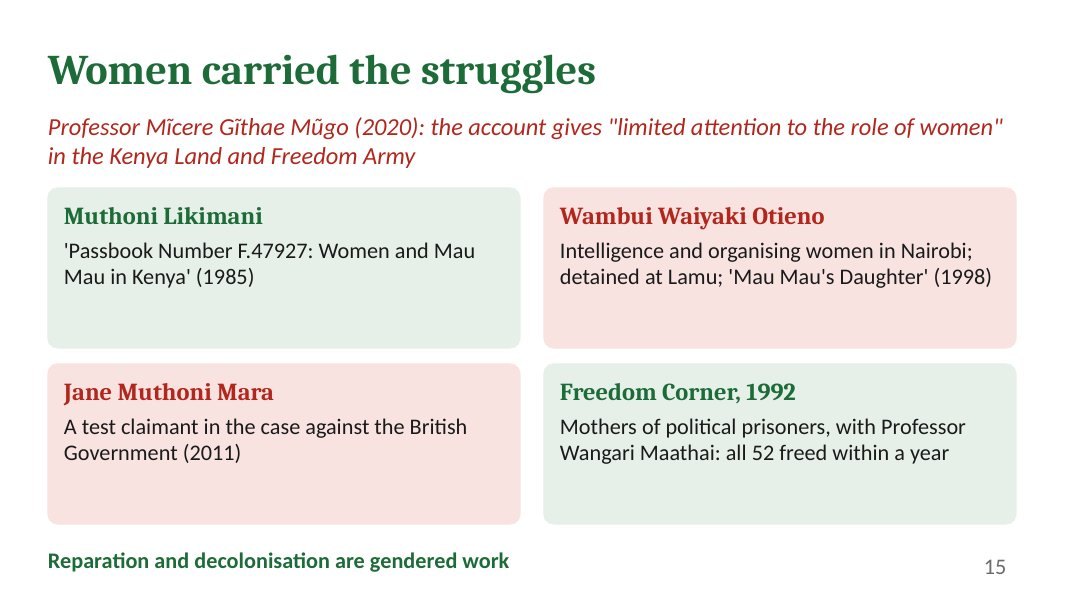
The role of women came through strongly throughout the trip. Women fought and led in Kenya’s wars of liberation alongside men, and many of them remain unsung. Mekatilili wa Menza, of the Giriama, led resistance to British forced labour and taxation in 1913–14; the British exiled her, and she returned to continue the struggle. Mary Mũthoni Nyanjirũ led the crowd at the Nairobi police lines in March 1922, demanding the release of Harry Thuku of the East African Association, and was killed when British police and settlers opened fire. Field Marshal Mũthoni wa Kĩrĩma fought in the Aberdare forest for eleven years, was never captured, and became the only woman to hold the rank of Field Marshal; I write about her, and my visit to her home, below.

Wamuyu Gakuru, known as Cinda Reri, took the batuni warrior oath in 1951 and insisted that women who took the oaths were equally bound to take up arms. Working in settlers’ homes, she located their hidden guns for the fighters to take; through her contacts on the railways she moved weapons to the forest on such a scale that a railway wagon was needed to carry them, and from that the name Cinda Reri, Gĩkũyũ for the one who outdid the railway (cinda, to outdo; reri, the railway), was given to her[27]; she went on to serve in the Hika Hika battalion as a spy and ration commander, and later spoke out against the marginalisation of women in the struggle and after it. Mukami Kimathi joined the fighters in the forest in 1953 and took charge of their daily life: food, and the care of the sick and wounded. Sent to Nairobi, she organised communication, supplies and intelligence between the forest and the city and recruited young people to the war, moving unseen by the British, for which the fighters named her the Wasp. Arrested in April 1954 with her child, she escaped from Langata camp, was rearrested and sent to Kamiti, the camp for women. For six decades after the British hanged Field Marshal Dedan Kimathi, her husband, she demanded that Britain and Kenya show her where he lay, and she told her own story in ‘Mukami Kimathi: Mau Mau Woman Freedom Fighter’[28]. She joined the ancestors in May 2023, aged 96.

Many more are named in the record. Rebecca Njeri, who mobilised her community to build independent schools, was imprisoned without trial at Kamiti prison, outside Nairobi, from the start of the Emergency until 1960; songs heralded her as Mother of the Mau Mau Children.[29] The British detained some 8,000 women under the Emergency Powers between 1954 and 1960, most of them at Kamiti.[30] In 1966, women veterans of the Women War Council, writing to Mama Ngina Kenyatta about their neglect, put it in their own words: ‘We are stupefied by the fact that it seems to us that you forgot all about the women of the cooking pot and spoon.’[31]

Professor Mĩcere Gĩthae Mũgo set out a radical Afrikan feminist critique of how women have been written out of accounts of the Kenya Land and Freedom Army.[32] Reparations and decolonisation are a gendered project, and the standard for repairing what was done to women in war is already set, in Nairobi itself. The Nairobi Declaration on Women’s and Girls’ Right to a Remedy and Reparation[33], adopted in March 2007 by women’s rights advocates and survivors of conflict-related violence from Afrika, Asia, Europe and the Americas, holds that ‘reintegration and restitution by themselves are not sufficient goals of reparation’, because the violations women suffer in war grow out of inequalities that predate it; that ‘reparation must drive post-conflict transformation of socio-cultural injustices’; and that ‘full participation of women and girls victims should be guaranteed in every stage of the reparation process’.[33] Applied to the women of the Kenya Land and Freedom Army and of the camps, that means repair which transforms the condition of Kenyan women today, land, safety and the power to decide, designed with the women and the daughters of the war, and it means restoring these women to the record and honouring their families as part of it.

What I observed at the convening is part of this too. A striking number of those present were young women who introduced themselves as organisers in women’s organisations and activist networks, and several of them organise with young mothers, single mothers among them. The level of organisation was refreshing to see, and with it a high degree of sensitisation to patriarchy and to gender justice. It made for rich dialogue, in the sessions and in my own conversations, on the distinctions and interrelations between feminisms, Afrikan feminisms among them, womanism and Motherism, the Afrikan-centred alternative to feminism articulated by Professor Catherine Acholonu; I define myself as a Motherist. The politicisation of young women, and of young mothers, in Kenya is one of the most hopeful things I witnessed on this trip.

The work of MET most relevant to these women is the Mbuya Nehanda Afrikan Women and Reparations Project, launched in 2022. The project is named after Mbuya Nehanda, the Shona spirit medium who led the First Chimurenga, the 1896–97 war of resistance against British conquest in what is now Zimbabwe; the British hanged her in 1898 and took her head to Britain, where it is believed to lie still, and Zimbabwe continues to demand its return.[34] Through the project, women of Afrikan heritage co-produce knowledge of their gendered right to remedy and reparation, build their decision-making power within the ISMAR, and advance the restoration of Afrikan matriculture, the knowledge, authority and ways of living that Afrikan women lived by and passed on, and that the Maangamizi set out to destroy, as part of rematriation. The women I met in Nairobi are already organising on their own ground. One concrete recommendation I take from the week is that the Racial Justice Network, through which I met them, convene dedicated sessions on the gendered dimensions of decolonisation and reparation, so that the conversations begun at the convening continue with the women who began them, and the project can contribute to them there.

Honouring the Mashujaa: Nyeri and the Mashujaa Heritage Archives

From Ufungamano House our hosts took us to Nyeri, to the home of Field Marshal Mũthoni wa Kĩrĩma and to Kahiga-ini; back in Nairobi, where we were staying, we went to the Mashujaa Heritage Archives & Library and to Pan-African House.
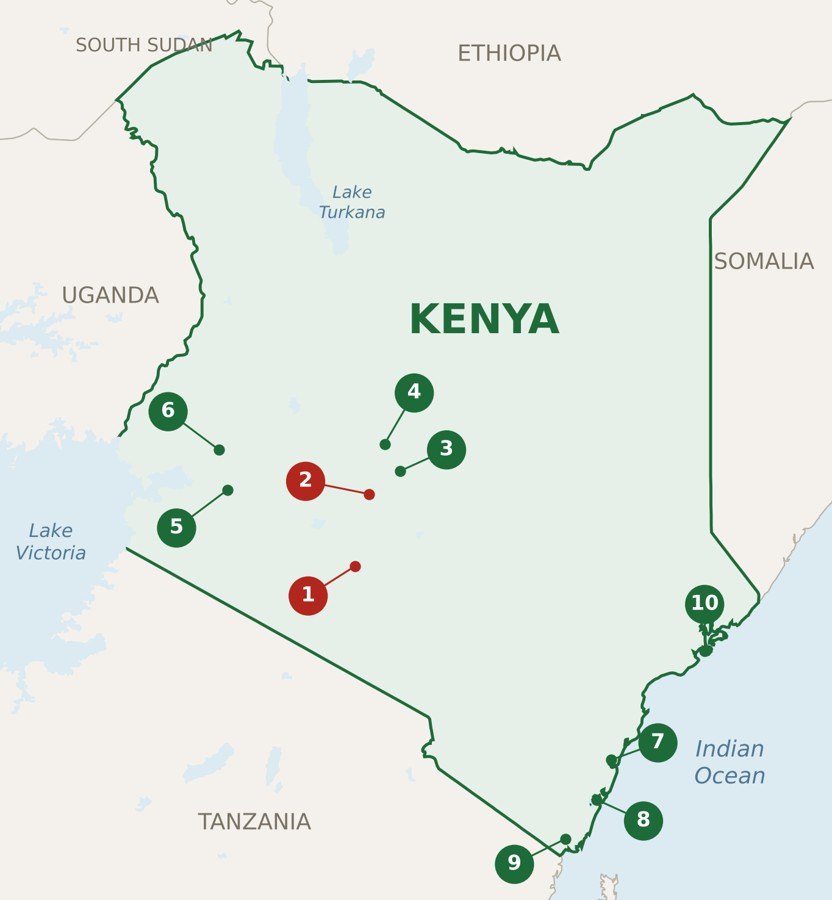
Where we walked (red): 1 Nairobi, Ufungamano House and Mwakenya House; 2 Nyeri, Kahiga-ini and the home of Field Marshal Mũthoni wa Kĩrĩma. Places in my keynote (green): 3 Kĩrĩnyaga (Mount Kenya) and the Aberdares; 4 Lolldaiga Hills, Laikipia; 5 Kericho; 6 Nandi; 7 Kilifi; 8 Mombasa, Owino Uhuru; 9 Kwale, Mrima Hill; 10 Lamu. Positions are approximate.

Nyeri. We travelled north from Nairobi to Nyeri, the country between the Aberdare range and the mountain the world calls Mount Kenya. This is the home ground of the Kenya Land and Freedom Army: the forests from which the fighters fought, and the land of both of its Field Marshals, Dedan Kimathi and Mũthoni wa Kĩrĩma. Our first stop was Field Marshal Mũthoni’s home.

Field Marshal Mũthoni wa Kĩrĩma is a legend in Kenya, and she earned it. Born in 1931 in Nairutia, Nyeri, she laboured as a child on a settler’s farm, where she watched Gĩkũyũ men and women beaten and abused, and resolved to fight. She took the oath in 1952 and organised oaths for others; after Chief Mũhoya’s men beat her on suspicion of her husband’s loyalties, she went into the Aberdare forest alone and found the fighters. She began by finding food, ammunition and grenades and nursing the wounded, then led platoons in combat, and rose to become the only woman to hold the rank of Field Marshal; Field Marshal Kimathi named her Nina wa Thonjo, the weaver bird, for the war strategies she wove. She fought for eleven years, never captured, and came out of the forest only after independence in 1963. She had a miscarriage in the forest and could not conceive afterwards. ‘Kenya is my only child,’ she said.

She came out to nothing. In words recorded by the Mashujaa Heritage Archives & Library: ‘I emerged from the forest after eleven years but was never given even an inch of land.’ The locks she grew in the forest she kept for seventy years, calling them ‘the history of Kenya’ and vowing to cut them only when she saw the fruits of the independence she had fought for. They were shaved in 2022, by Mama Ngina Kenyatta, amid controversy that continues. ‘I am still in the forest,’ she said. She joined the ancestors on 4 September 2023, aged 92, and was laid to rest at her home in Tetu.[35]

At the home we were received by Bernard Mungai Kamande, her adopted grandson, who lived with her and cared for her in her later years.

I felt deeply honoured to be in Field Marshal Mũthoni’s home, which she wanted preserved as it was, and to recognise her struggles, her sacrifices and all she stood for. Without children of her own after that loss, Field Marshal Mũthoni was a mother to many and a mother of the nation. I feel a deep affinity with her: as a woman who has given and sacrificed a great deal for the struggles for reparations, I see myself as a mother of this movement, the ISMAR.

Listen: a tribute to Field Marshal Mũthoni wa Kĩrĩma

‘Mutumia Ngatha’ by the South African collective Batuk, Carla Fonseca and Spoek Mathambo, from their 2020 audiovisual release ‘Again She Reigns’[36], honours her: ‘From her first breath, uprising legacy / Dread-locked mamba, warrior mystery / Mutumia Ngatha, live out your destiny.’ Mutumia Ngatha is Gĩkũyũ for a noble woman; the dreadlocked mamba is the hair she grew in the forest and kept for seventy years.

‘Mutumia Ngatha’, Batuk (2020).
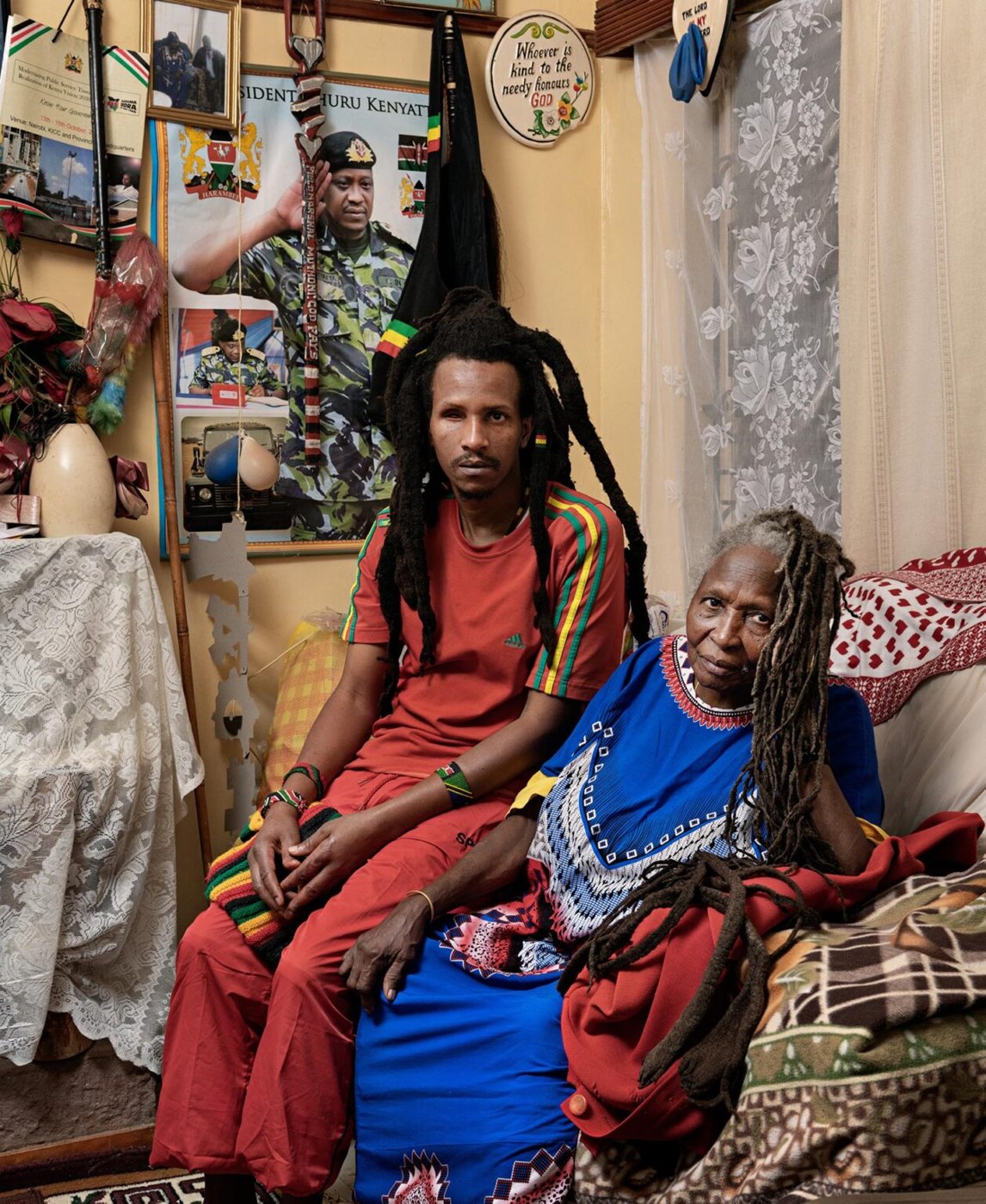
Field Marshal Mũthoni wa Kĩrĩma with her adopted grandson Bernard Mungai Kamande at her home in Nyeri, 2019. Photograph: Max Pinckers, ‘Unhistories’.[37]

During the visit we were shown the coat Field Marshal Mũthoni made in the forest, the original flag of the Kenya Land and Freedom Army, and the two vehicles she used to drive, kept as she left them.
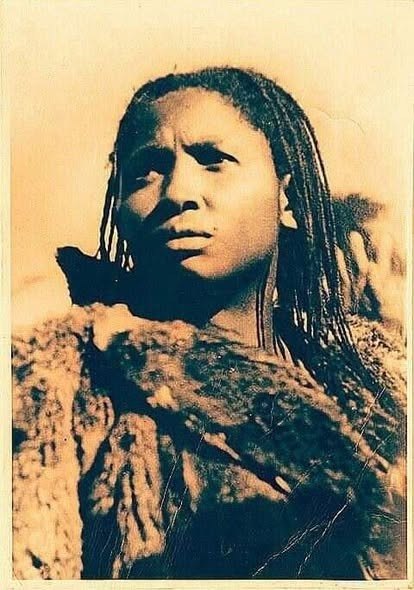
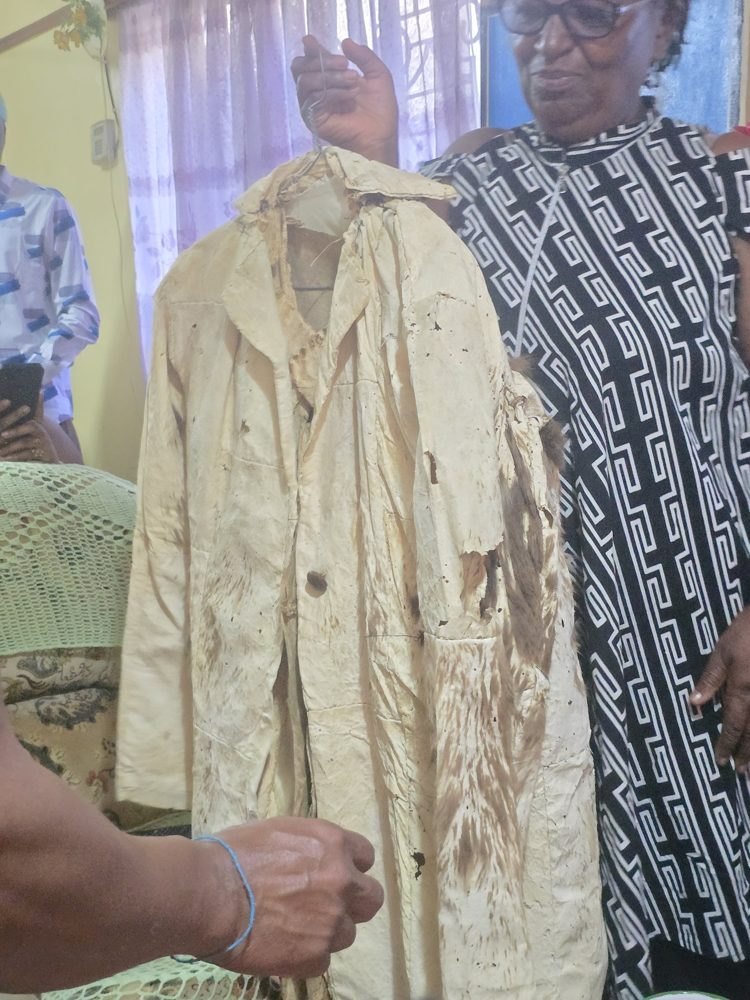
Field Marshal Mũthoni wa Kĩrĩma in the animal-skin coat she made in the forest, and the coat as it is today, preserved at her home and held up for us by Dr Christine Muthoni Kahigi, the historian who moderated the first day of the convening and chaired its panel of scholars.
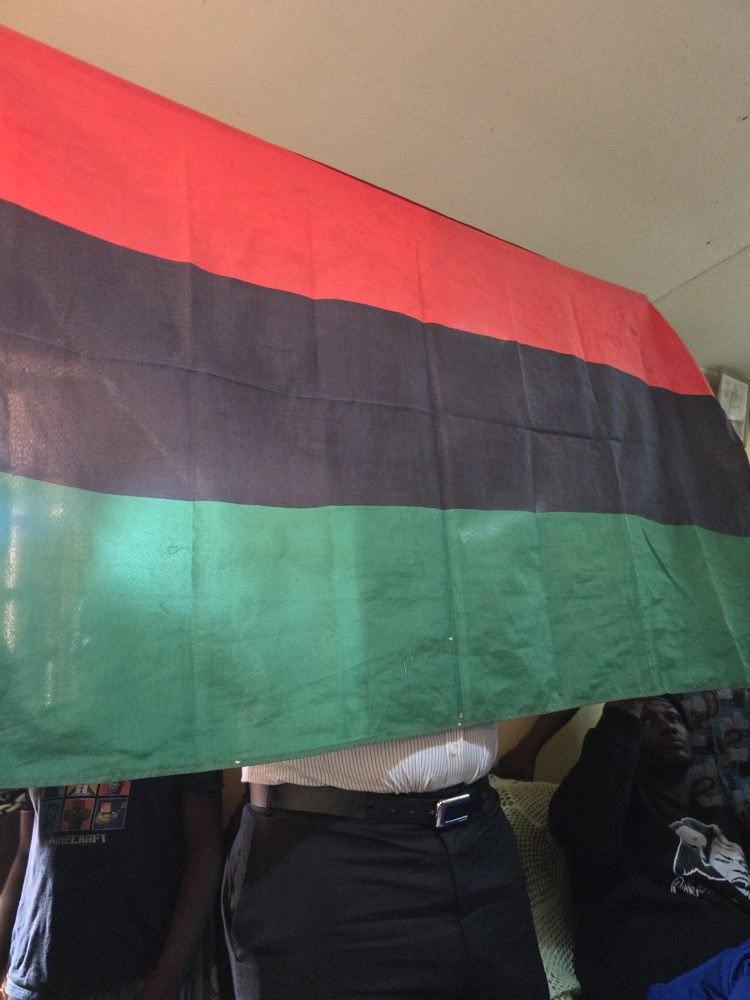
The original flag of the Kenya Land and Freedom Army, at the home of Field Marshal Mũthoni wa Kĩrĩma.
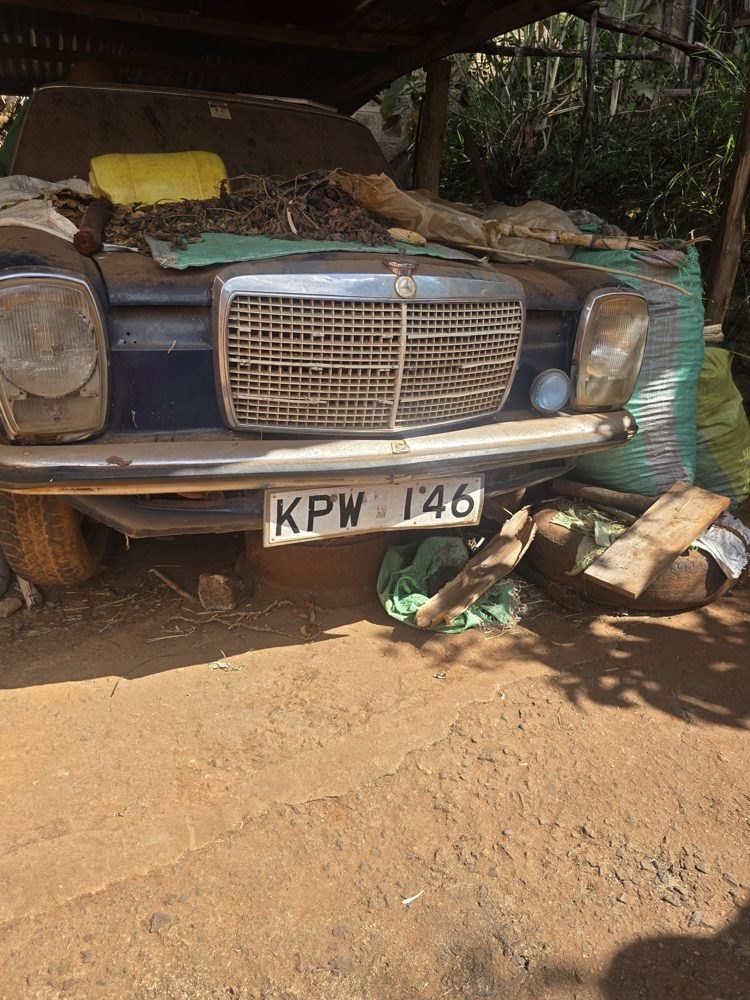
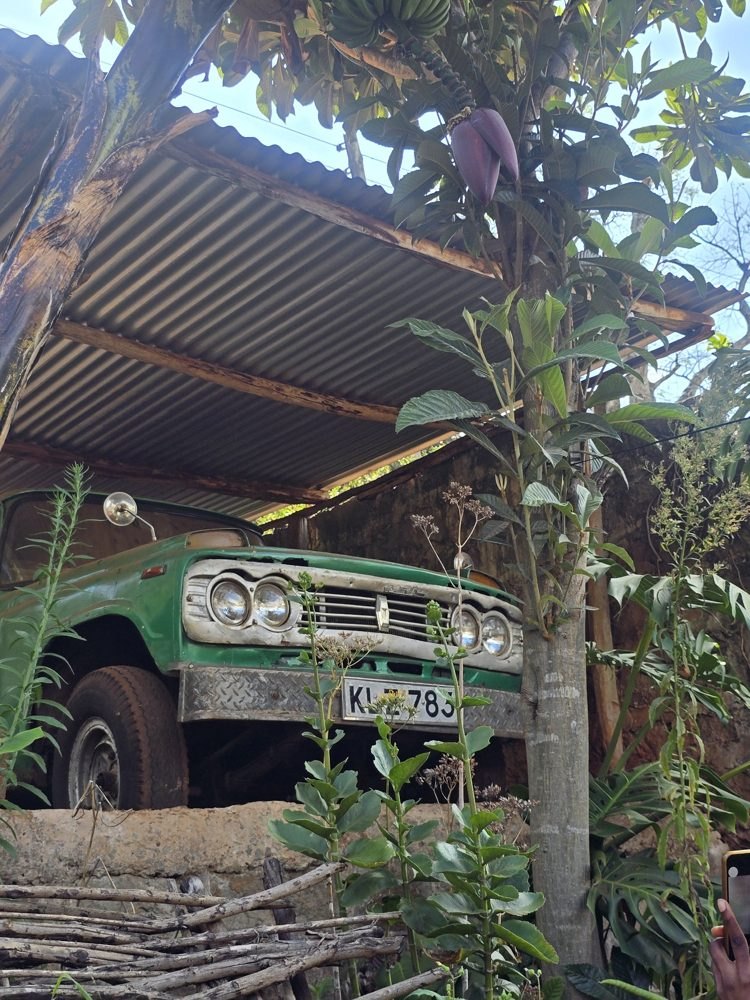
The two vehicles Field Marshal Mũthoni wa Kĩrĩma used to drive.
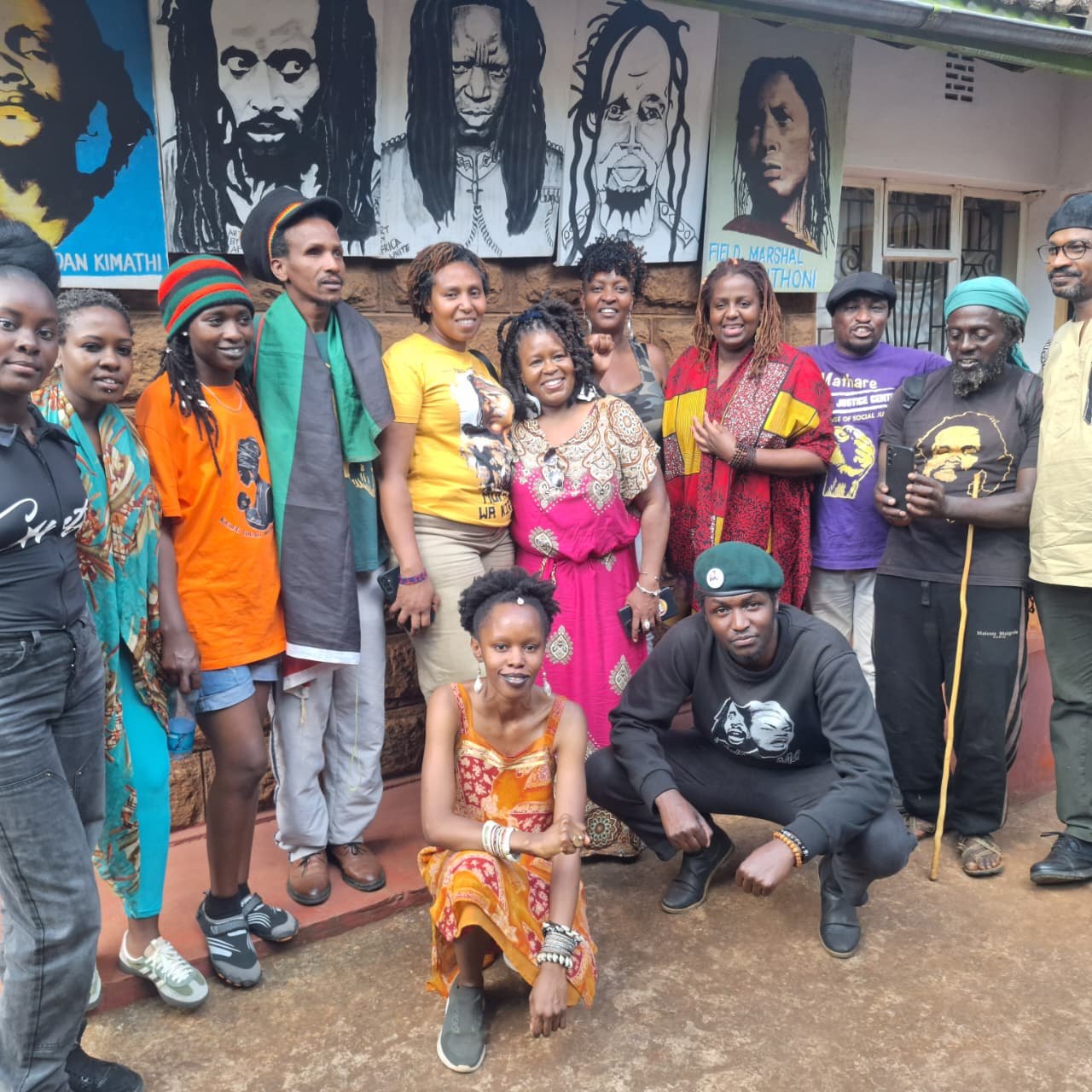
At Field Marshal Mũthoni wa Kĩrĩma’s home, beneath portraits of Field Marshal Dedan Kimathi, Field Marshal Mũthoni wa Kĩrĩma and other fighters of the Kenya Land and Freedom Army.

From Field Marshal Mũthoni’s home we went on, still in Nyeri, to Kahiga-ini, in Tetu, where on 21 October 1956 home guards, Kenyans armed and paid by the British to fight the forest fighters, shot and captured Field Marshal Dedan Kimathi, the leader of the Kenya Land and Freedom Army, the man on the British wanted posters, whom the British hanged four months later. The community has made the place the Dedan Kimathi–Mau Mau Memorial Park. We had two guides: Dr Njuki Githethwa, the historian who runs the Mashujaa Heritage Archives & Library, and a guide from the community of Kahiga-ini, who told us the story of the capture as he had gathered it from the elders, his own among them. He told it in Gĩkũyũ, the language of the place, and Ndungi Githuku of Pan-African House interpreted into English, principally for me. Ndungi is a prominent Kenyan human rights artivist, actor, director and musician who for decades has blended creative performance with political activism, using theatre, film and song to protest against systemic oppression in Kenya and to advocate for social change; later that day he would pour libation for me at this spot.

Our guide from the community of Kahiga-ini tells how Field Marshal Kimathi was shot and captured here on 21 October 1956. His full account follows.

Bernard Mungai Kamande, Field Marshal Mũthoni wa Kĩrĩma’s adopted grandson, at Kahiga-ini: we must protect this space.

Field Marshal Kimathi’s capture, as our guide told it

Field Marshal Kimathi had taught English at Karũnaini Primary School before working on a settler’s farm in Nyandarua, where he began organising. When he came back, the British were building concentration camps, the ‘Emergency villages’, ringed by a trench some twenty feet wide and lined with spikes, to cut the fighters in the forest off from the people and from the food the women brought them. Fighters who surrendered were sent back into the forest as pseudo-gangs, living as they had lived there, to find where their former fellow fighters were hiding; among them, he said, was Field Marshal Kimathi’s own brother, Wambararia. When Field Marshal Kimathi met one such gang in the forest he knew them for what they were, and fled many kilometres before coming back to his own village, Karũnaini, crossing the trench to the farms for sugar cane.

On a day when propaganda films were being shown, Field Marshal Kimathi knew there would be no curfew. He did not know that a bounty had been placed on him, or that he had been betrayed. Home guards sent by the British waited on his route back to the forest. Early in the morning, carrying a pistol, a sword, arrowroots and sweet potatoes, he met a commotion near the blue gum trees, changed course and tried to cross the spiked trench at this spot. A home guard on the far side called on him to stop, and shot him in the right thigh. The shot brought the other home guards running, and the man who fired it crossed over and said, ‘I have felled the giant.’

The guards tracked him through the dew to the thicket where he had crawled. A midwife, Priscilla wa Edward, gave him first aid. Carried on a stretcher, he asked to stop at a house he knew to drink tea, and people came from across the community to see the man so many had heard of and never seen. At Ihururu the forester Tiras Kimathi Murage took the photograph the world knows, of Field Marshal Kimathi lying wounded; it was he who later told how Field Marshal Kimathi had dressed in leopard and antelope skins as camouflage in the forest, and how the guards stripped them from him. He was taken on to the hospital in Nyeri, still in chains, where one of his former pupils treated him; then to trial, and to Kamiti Prison, where the British hanged him on 18 February 1957.

The community answered the betrayal in its own way. The home guards who shot him were rewarded. One bought a truck and turned it into a bus, and nobody in the community would ride in it; unable to do business, he watched it fall apart, and even the scrap metal dealers refused to take it. Another bought land in Nyeri, and people changed their routes so as never to pass it.

The ground where his blood was spilt, he told us, has stayed bare ever since: a patch in the tea where nothing grows. The monument at the memorial park stands because the community pressed the county government to build it, and they are pressing it now to protect this ground too.

Dr Njuki Githethwa at Kahiga-ini, where Field Marshal Kimathi was shot and captured, speaking about the moles.

Tiras Kimathi Murage had been a pupil of Field Marshal Kimathi; the two were namesakes, not relatives. Field Marshal Kimathi is remembered for saying, ‘My blood will water the tree of Independence.’ The British buried him in an unmarked grave at Kamiti, and his remains have yet to be brought home to his family. Mukami Kimathi, fighter and his wife, sought them for the rest of her life. The memorial park is cared for by the people of Kahiga-ini themselves, who raise their own funds for it and receive little support from the authorities; what is needed is proper support for the work they already do.

Ndirangu Mau, the Gĩkũyũ home guard who fired the shot that wounded Field Marshal Kimathi, was in a patrol led by Corporal Wanjohi, within the manhunt directed by the British police officer Ian Henderson. The British tried Field Marshal Kimathi from his hospital bed in Nyeri, for possession of a revolver and six rounds of ammunition under the Emergency Regulations, and sentenced him to death. The British rewarded Ndirangu Mau with £500. The lorry he bought with it his own people named Muthimo wa Kimathi, and they would not ride in it. He lived as an outcast until his death in 1986, and his children carried the name of a traitor into every school. The people of the mountain do not forgive betrayal. This too is part of what the fighters’ descendants live with: the British recruited Afrikan men to hunt the fighters, and that wound of division is unrepaired.
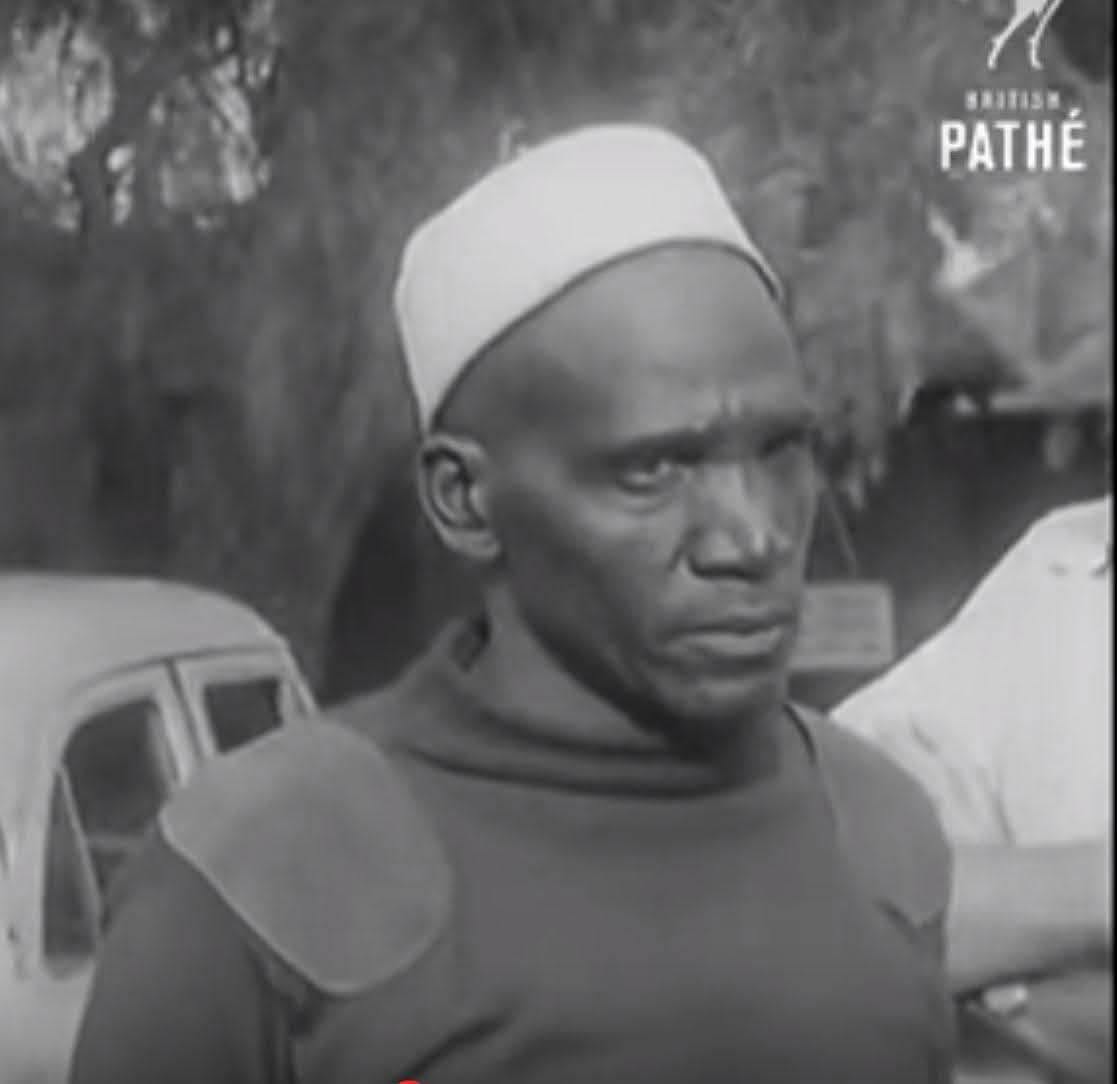
Ndirangu Mau, the home guard who fired the shot, in a still from the British Pathé newsreel of the capture, 1956. The British filmed him outside the Assistant Commissioner of Police’s office in Nyeri. Credit: British Pathé.

The British Pathé newsreel of the capture, 1956: Field Marshal Kimathi wounded on the stretcher, the leopard-skin coat the British held up for the camera, and the two home guards the British filmed outside the Assistant Commissioner of Police’s office in Nyeri. Credit: British Pathé.
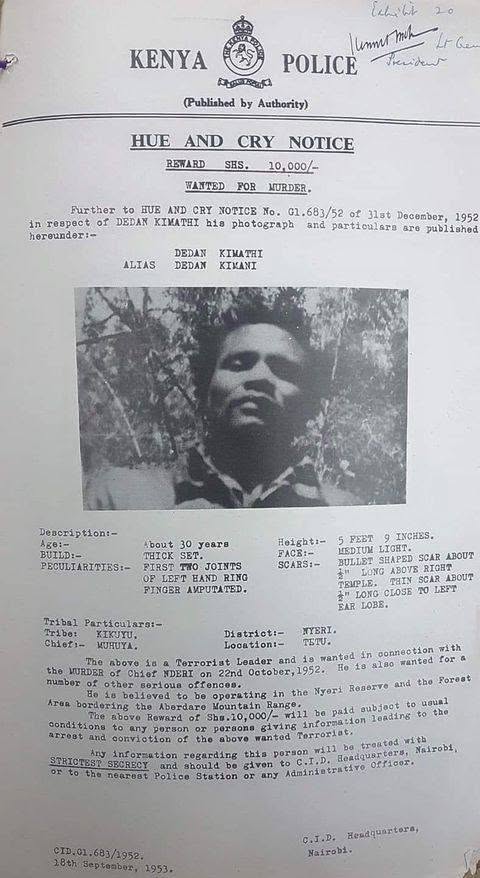
The British state’s own words: a Kenya Police ‘Hue and Cry Notice’ of 18 September 1953 offering a reward of 10,000 shillings for Field Marshal Dedan Kimathi, whom it calls a ‘Terrorist Leader’ wanted for the killing of Chief Nderi on 22 October 1952. The notice records the bullet scar above his right temple and the two amputated joints of his left ring finger. It is reproduced here as a record of how the British named the man who led the war of liberation for land and freedom; the language is theirs.

At the spot where Field Marshal Kimathi was shot, Ndungi Githuku poured libation and offered an invocation for me. Being there felt sacred. We went barefoot, for this is hallowed ground. Ndungi addressed the Creator and the ancestors and blessed the work of my hands and my feet: wherever I step, blessings; whatever I touch, blessings; whatever I write, blessings. He asked that my words be sharper than a razor and a sword, that they break the chains of enslavement, of mental enslavement and of colonialism, and that they inspire a generation. He prayed that the knowledge I gather, at the cost of the sacrifices made to restore knowledge of the rights of our people globally, locally and in Kenya, would spread wherever I go. It was here, in the libation, that Ndungi, speaking for the community of the mountain, gave me a Gĩkũyũ name: Wahito, to gather and to bring. The name was given, in his words, so that whatever I gather, whatever information I give and whatever knowledge I carry in the struggle for the respect and reparation of our community would be blessed, and he asked the Creator to make it so. The naming is on the third of the videos below. It was the second name I was blessed with in Kenya, both given in recognition of my mission. The first, Akinyi Adero, a Luo name, came after my appearance on the Nation FM radio programme ‘Fixing the Nation’, filmed and shown on NTV Kenya, when a viewer gave it to me. Luo names are given from the time and circumstances of a birth. Akinyi is from okinyi, the morning: a girl born at dawn, a new beginning. Adero is from dero, the granary: a girl born when the granaries are full, in a time of abundance. Born at dawn, in a time of plenty: I receive it as a blessing on the work and on what it gathers in.
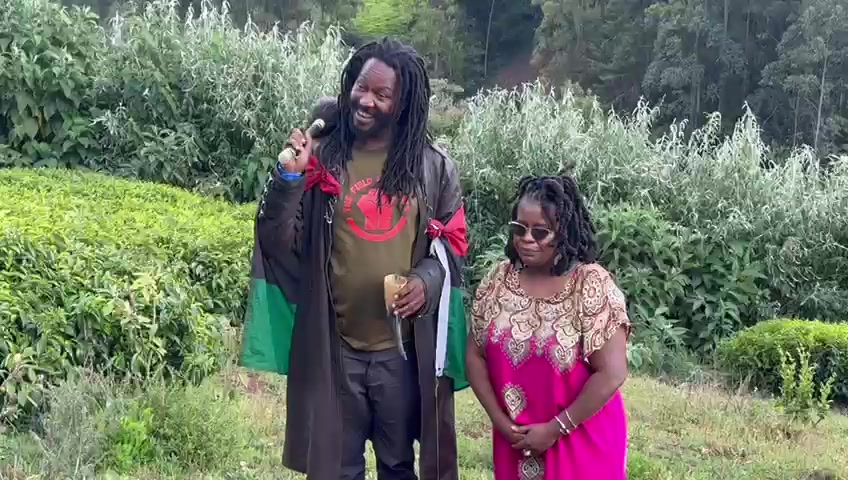
Ndungi pours libation and offers an invocation for me at the spot where Field Marshal Kimathi was shot, the tea of Kahiga-ini all around. Still from video.

The libation at Kahiga-ini, part one: Ndungi pours libation and offers an invocation for me at the spot where Field Marshal Kimathi was shot.

The libation, part two.

The libation, part three: the naming.
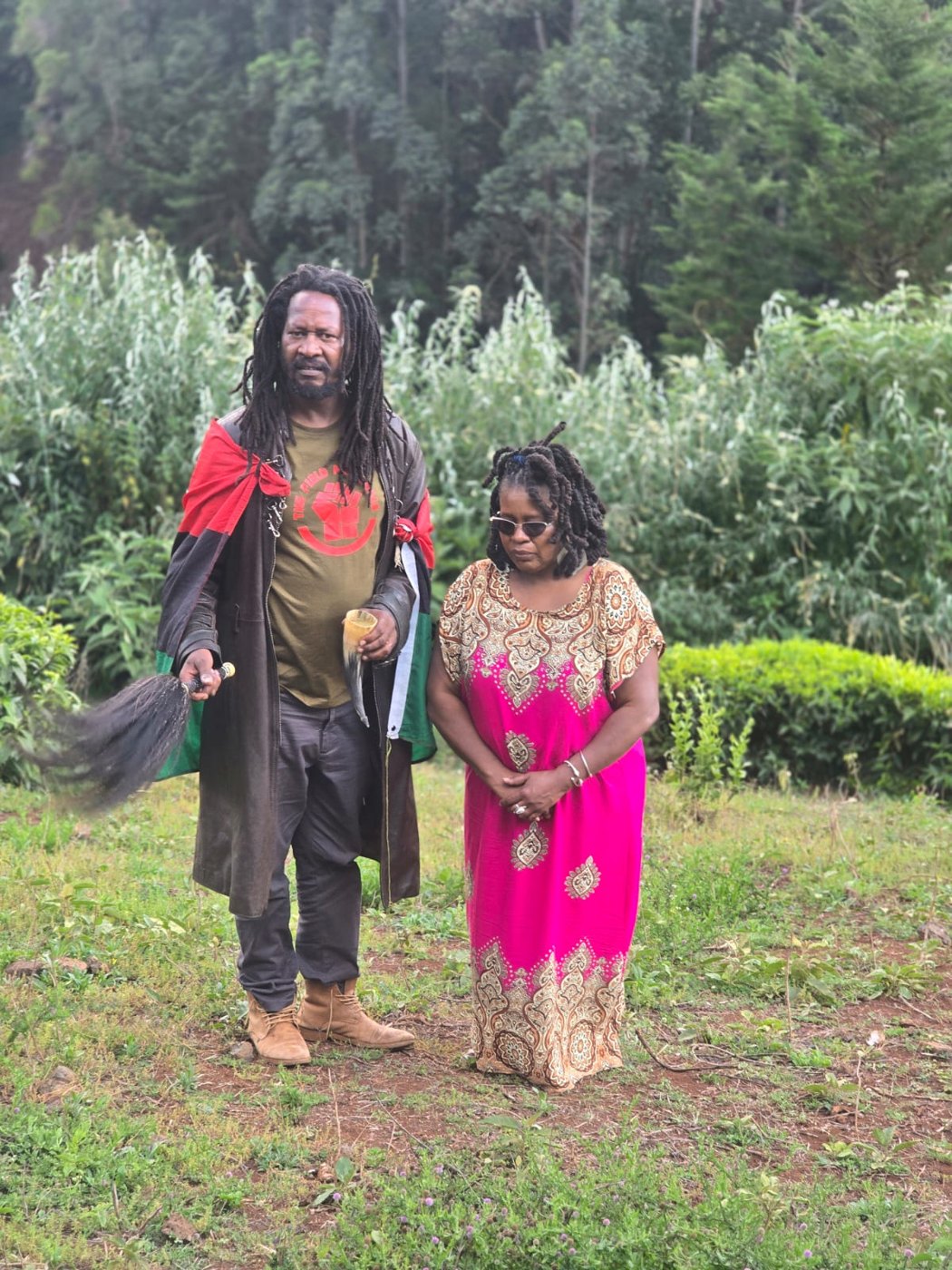
At Kahiga-ini, Tetu, Nyeri, where Field Marshal Dedan Kimathi was shot and captured on 21 October 1956, with Ndungi Githuku.
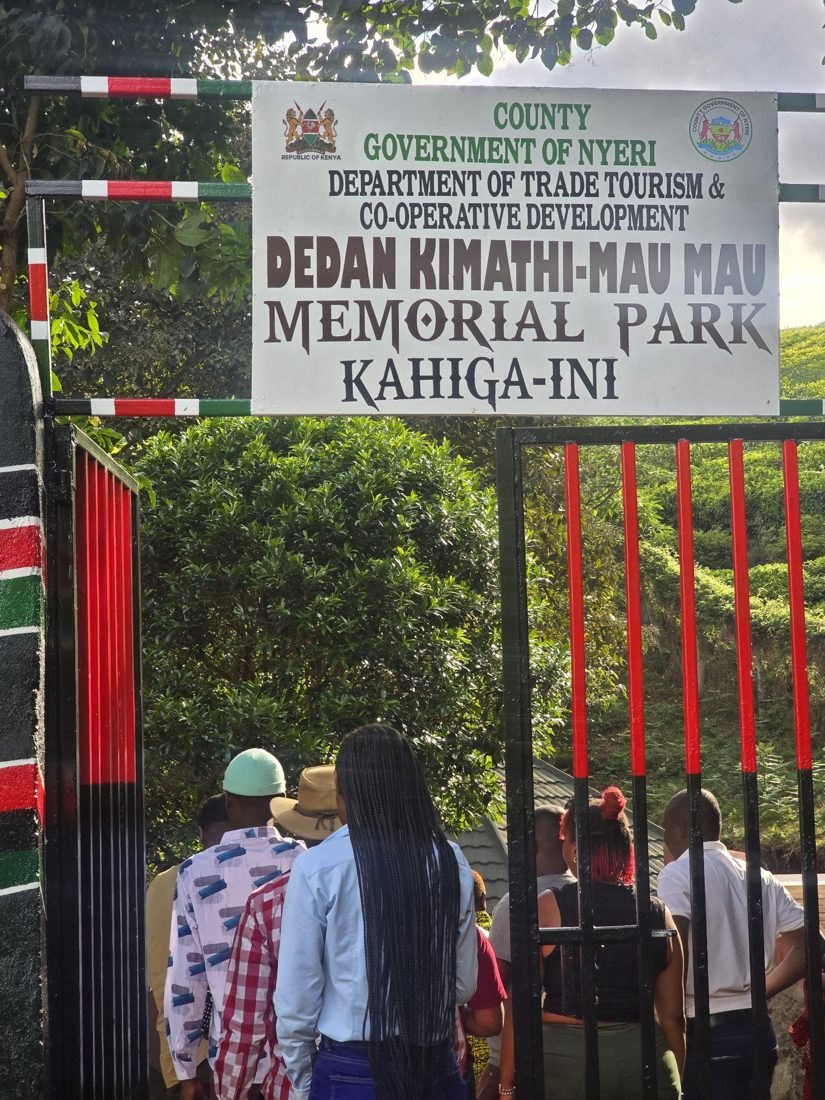
The entrance to the Dedan Kimathi–Mau Mau Memorial Park, Kahiga-ini.
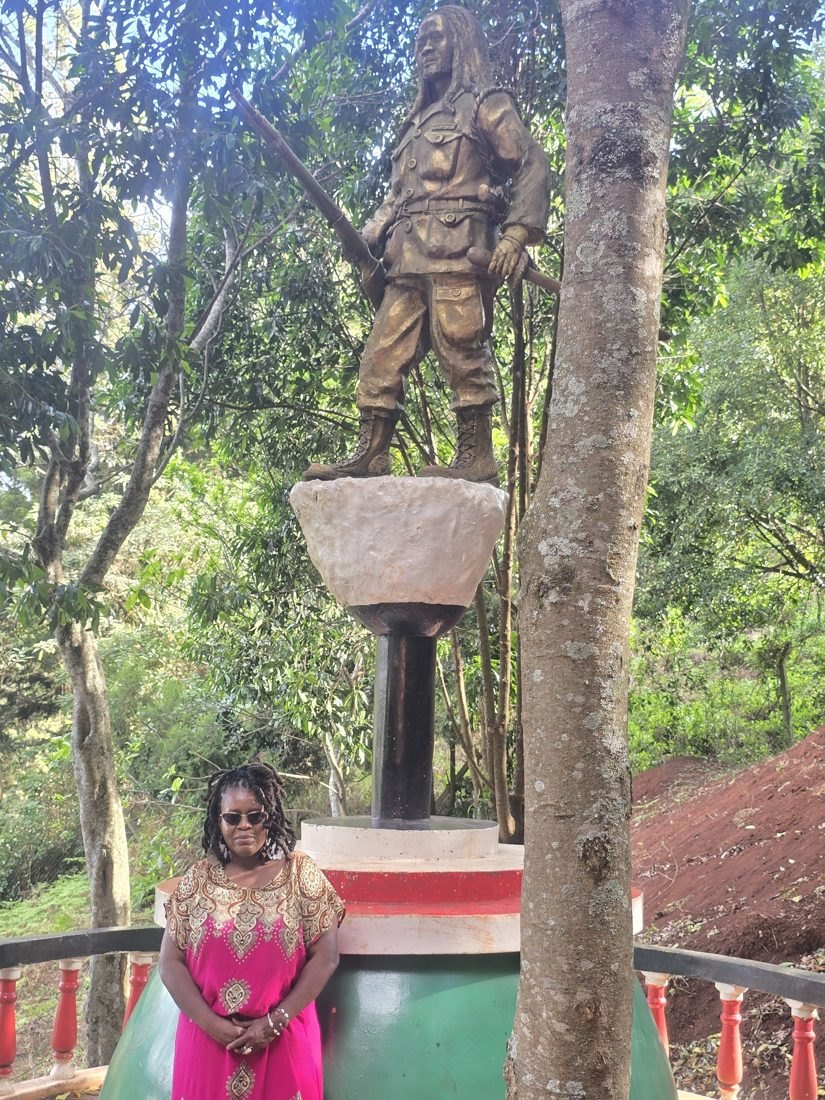
With the statue of Field Marshal Dedan Kimathi at the memorial park.
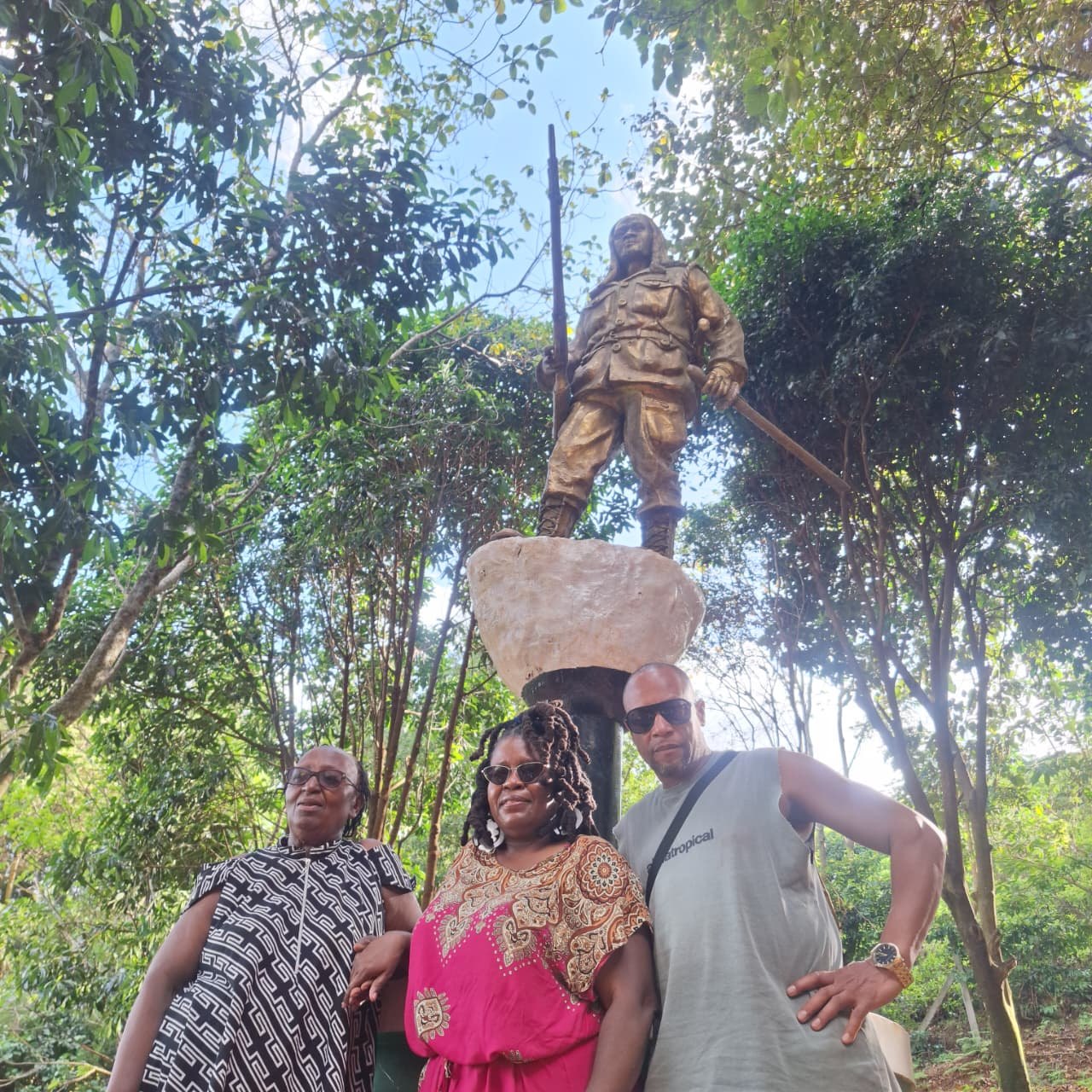
At the statue of Field Marshal Dedan Kimathi with Dr Muthoni Kahigi and the reggae artist Sonbeam.
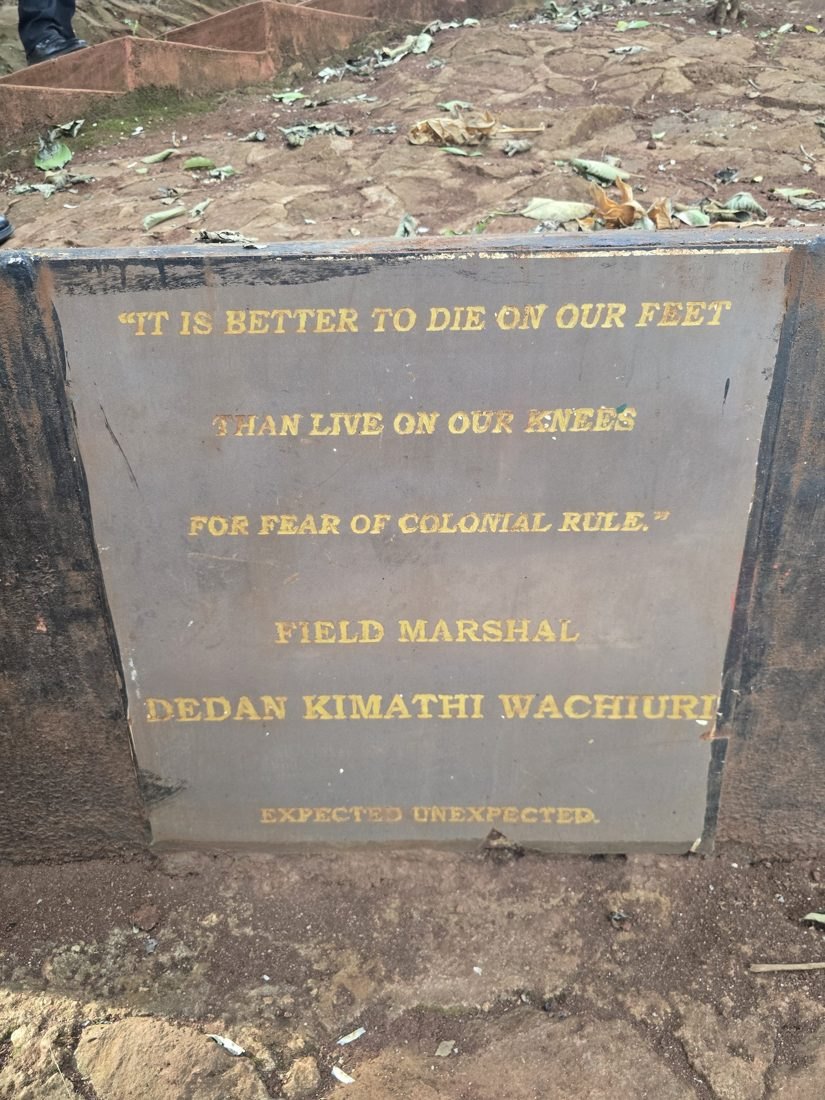
‘It is better to die on our feet than live on our knees for fear of colonial rule.’ Field Marshal Dedan Kimathi, as inscribed at Kahiga-ini.
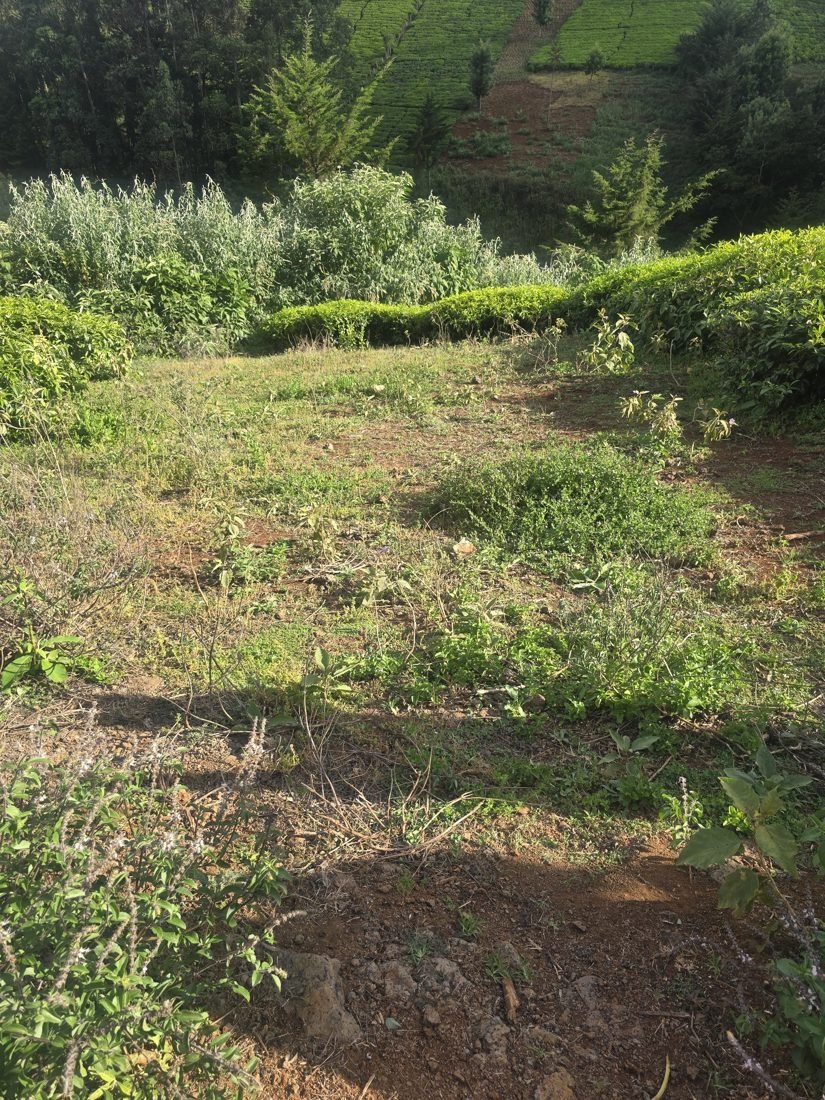
The ground where, as our guide told us, Field Marshal Kimathi’s blood was spilt, and where nothing has grown since.
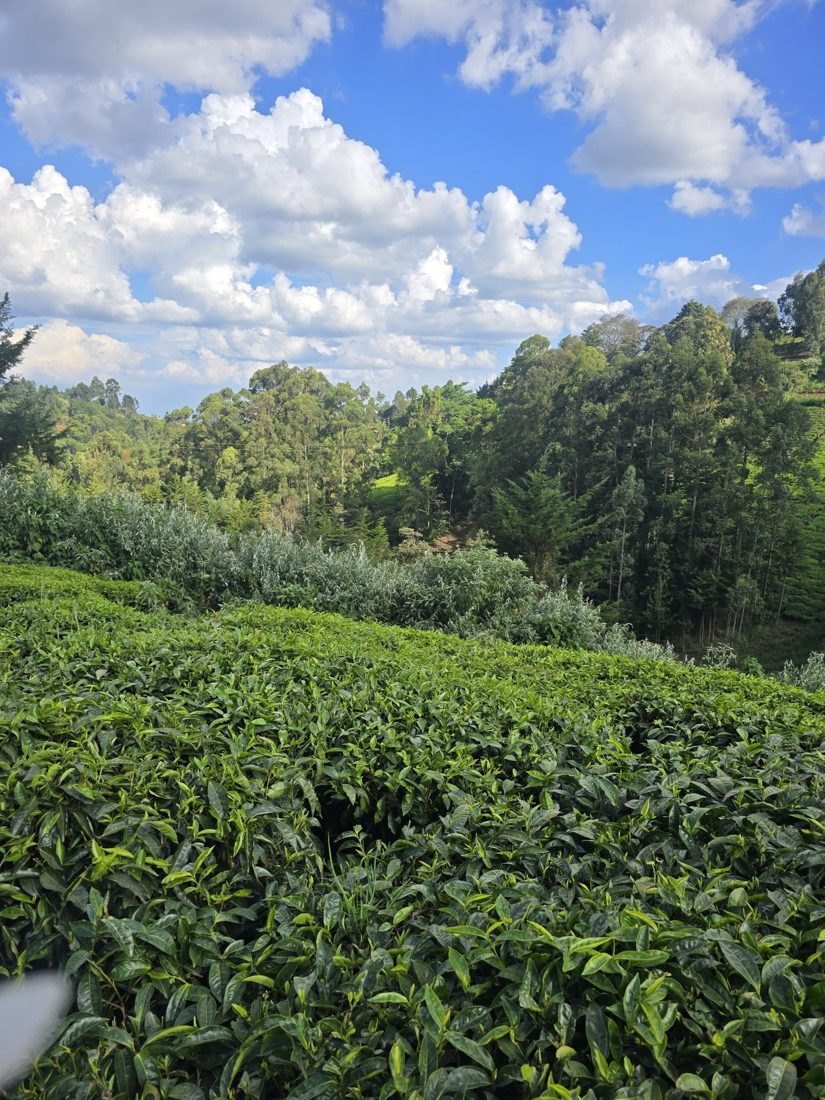
All around it, tea grows in abundance on the hills of Kahiga-ini, where Field Marshal Kimathi was shot.

Listen: a tribute to Field Marshal Dedan Kimathi

‘Dedan Kimathi’ by Jabali Afrika, from ‘Rebellion: 1963 to the Future’, 2014, came to me after the 2011 Mashujaa Day broadcast with which this piece opens. Jabali Afrika formed in Nairobi in the early 1990s among dancers, singers and drummers of the Kenya National Theatre. This reggae tribute asks why Field Marshal Kimathi still lies in an unmarked grave at Kamiti, and sings the words inscribed here at Kahiga-ini: ‘It’s better to die on our feet than to live on our knees… You can never erase history, it will always be there.’

‘Dedan Kimathi’, Jabali Afrika (2014).

Standing in the tea at Kahiga-ini, with the mountain beyond, I thought about what it is called. The mountain is Kĩrĩnyaga to the Gĩkũyũ people who live around it: the mountain of whiteness, for its snow-capped peak.[38] To the Akamba it is Kĩnyaa, Kiima kya Nyaa, the mountain of ostriches, for its black rock and white snow. In 1849 Chief Kivoi wa Mwendwa, the Akamba leader and long-distance trader, guided the German missionaries Johann Ludwig Krapf and Johannes Rebmann into the interior, and they became the first Europeans to see the mountain. When Krapf asked its name, Chief Kivoi gave him the Akamba one; Krapf could not pronounce it and wrote down ‘Kenia’.[39] The British took that misspelling for the whole territory when they declared the Colony of Kenya in 1920. Kenya bears the name the coloniser misheard. The peoples of the mountain still call it by its own names.
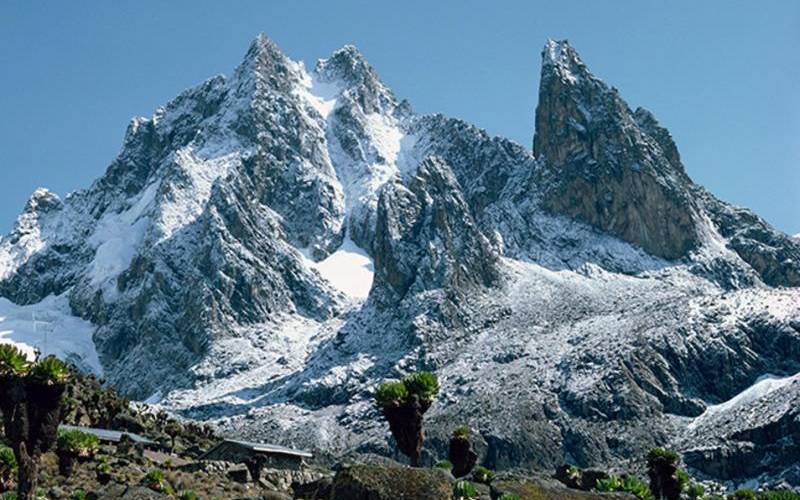
Kĩrĩnyaga, the mountain of whiteness: Batian and Nelion, its twin peaks, with giant groundsels below. Photo: ‘The Standard’, Kenya

Naming, the map and repair

A name is never only a name. Professor Ngũgĩ wa Thiong’o, whose words I quoted in the keynote, wrote that names and naming are part of warfare, and that we do not have to use the coloniser’s vocabulary to describe our struggles.[4] The British wrote ‘Mau Mau’ over an army that named itself for what it fought for, land and freedom, ithaka na wĩathi; wrote ‘Kenya’ over Kĩrĩnyaga; wrote ‘Victoria’ over Nam Lolwe, the lake the Luo people had named long before John Hanning Speke reached it in 1858; and at Berlin in 1884–85 drew the borders within which Kenya and every other state in Afrika still governs. The map of the world we are taught is colonial cartography: the conqueror’s names, the conqueror’s lines, the conqueror’s knowledge of who and where we are.

This is why the Stop the Maangamizi Campaign holds cognitive justice, the right of our peoples to know, name and order the world in our own knowledge systems, to be inseparable from reparatory justice. Decolonisation is world remaking, and part of that work is to re-member: to put back together what colonial cartography dismembered, in our languages and on our own terms. Professor Makau Mutua made the point for Kenya in 2021: ‘Europeans named us to demonstrate their power and authority over us,’ and the least the country could do is call itself by the mountain’s own name.[40] Reparation includes the restoration of our right to name ourselves, our lands and our struggles.

Back in Nairobi, we visited the Mashujaa Heritage Archives & Library, at Mwakenya House in Lower Kabete on the outskirts of Nairobi, founded by historians, activists and descendants of freedom fighters. It documents and preserves the memories and legacies of Kenya’s liberation heroines and heroes, collecting oral histories, photographs, documents and artefacts and making them available to researchers, students and the public (mashujaaheritagearchive.org).
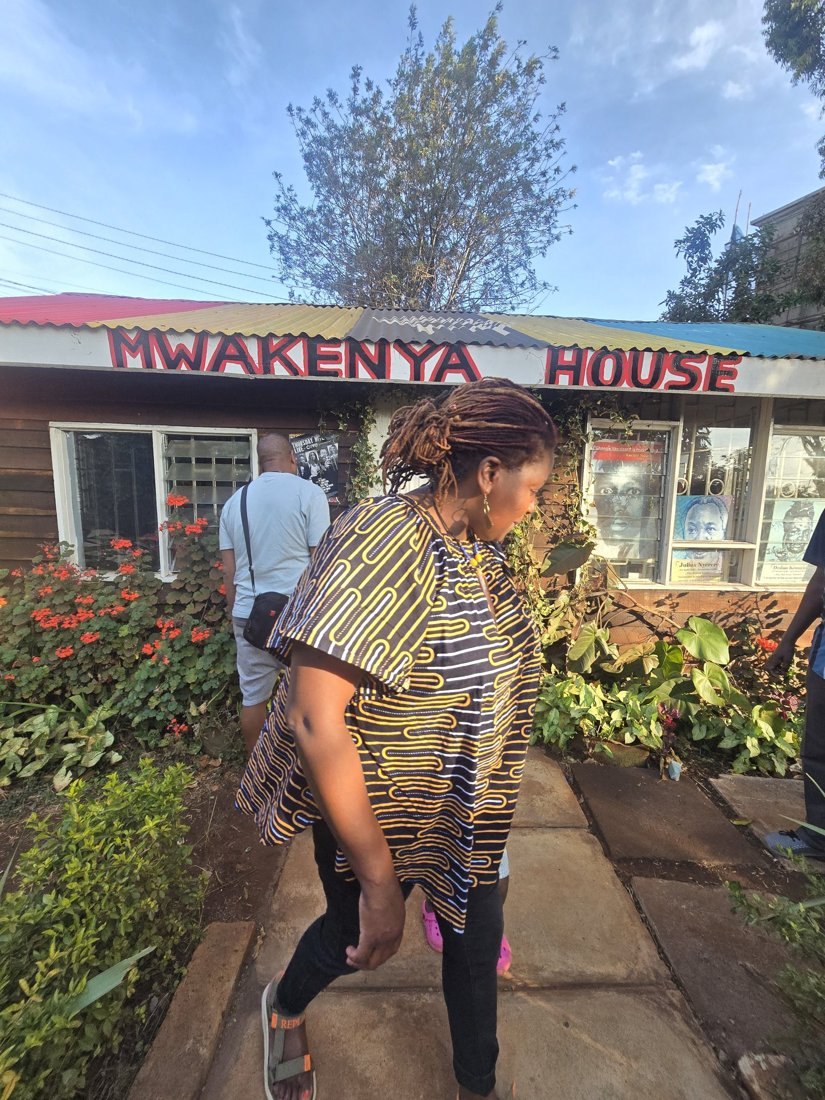
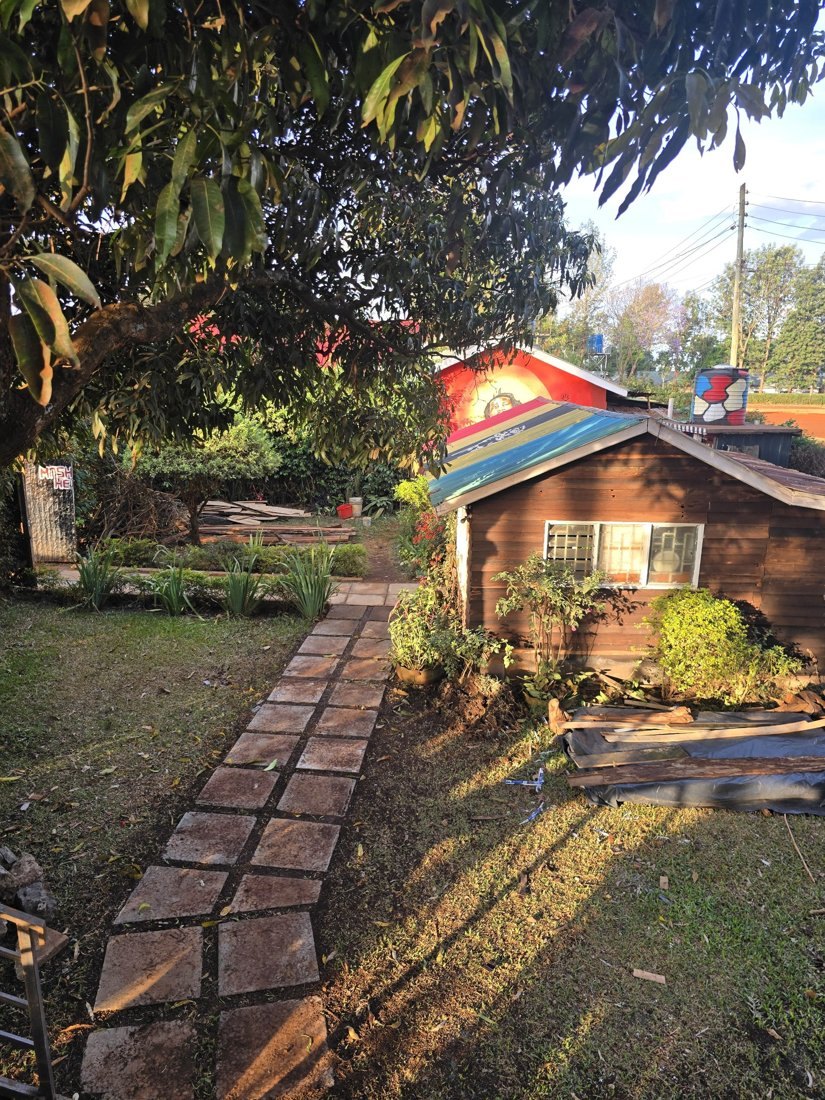
Mwakenya House, Lower Kabete, home of the Mashujaa Heritage Archives & Library.
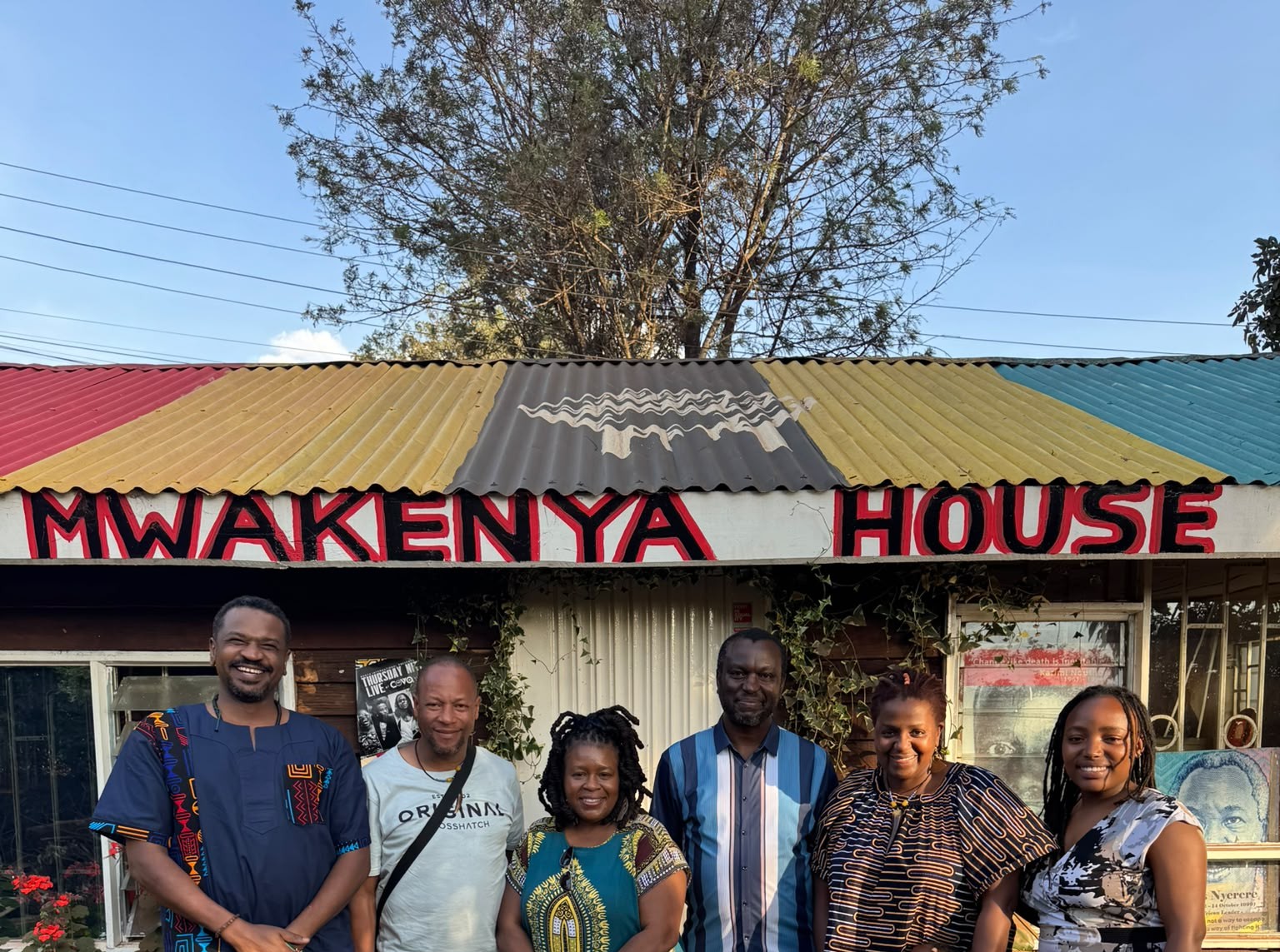
Outside Mwakenya House, under its painted roof, with Dr Njuki Githethwa, who runs the archives, and members of our delegation.
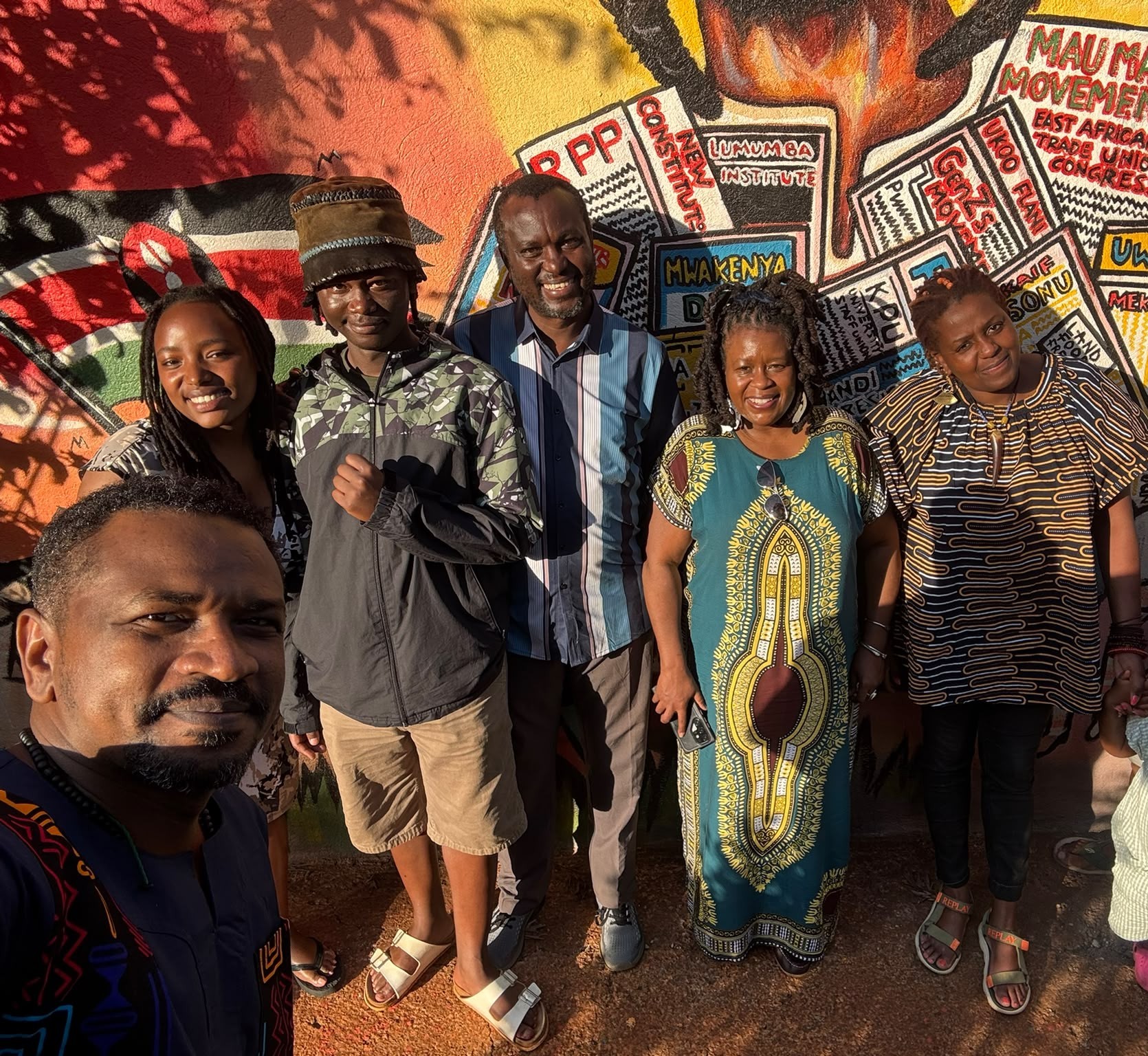
At the Mashujaa Heritage Archives & Library, before the mural that maps Kenya’s movements of struggle, from the Nandi resistance to the Gen Z Uprising.

As Dr Njuki writes in ‘Documenting and Archiving People’s Struggles and Social Movements in Kenya’[41], community archives of people’s struggles ‘have possibilities of resuscitating and reinvigorating voices of suppressed narratives and to counter hierarchies of knowledge, resources, and power’; they are ‘part of decolonial struggles’ and ‘a space to mentor the new generation of progressive human rights activists’.

The library is housed in a home gifted by a family of Mashujaa of the Kenya Land and Freedom Army, and is being developed into a community library, research space and community hub where people come to study the struggles of Kenya’s peoples.

As someone organising within the ISMAR, I felt a deep kinship with this work. Under the auspices of MET, I am developing the ISMAR/Pan-Afrikan Reparations Movement Archives, a public digital archive of the grassroots organising of the ISMAR: its organisations, campaigns, events and people, from the late 1980s to the present.

A mural painted on the library’s wall sets out Kenya’s movements of struggle one after another, each grown out of and built on those before: the Nandi resistance to the British under Koitalel Arap Samoei from 1895 to 1905; the Kenya Land and Freedom Army; Mwakenya, the underground movement of the 1980s against the Moi regime, from which the house takes its name; Saba Saba, Kiswahili for seven-seven, the pro-democracy uprising of 7 July 1990 against one-party rule; Release Political Prisoners, the campaign begun in 1992 by the mothers of detainees; and the Gen Z Uprising of 2024 and 2025. When we keep the archives of our own struggles, we make that lineage available to each new generation, so that today’s movements draw on what earlier ones learned. Community archives such as the Mashujaa Heritage Archives & Library are part of the liberation struggle itself.

At the library Dr Njuki gifted me a copy of Shiraz Durrani’s ‘Kĩmaathi: Mau Mau’s First Prime Minister of Kenya’, the book in which the Kimaathi Charter quoted above is reproduced.
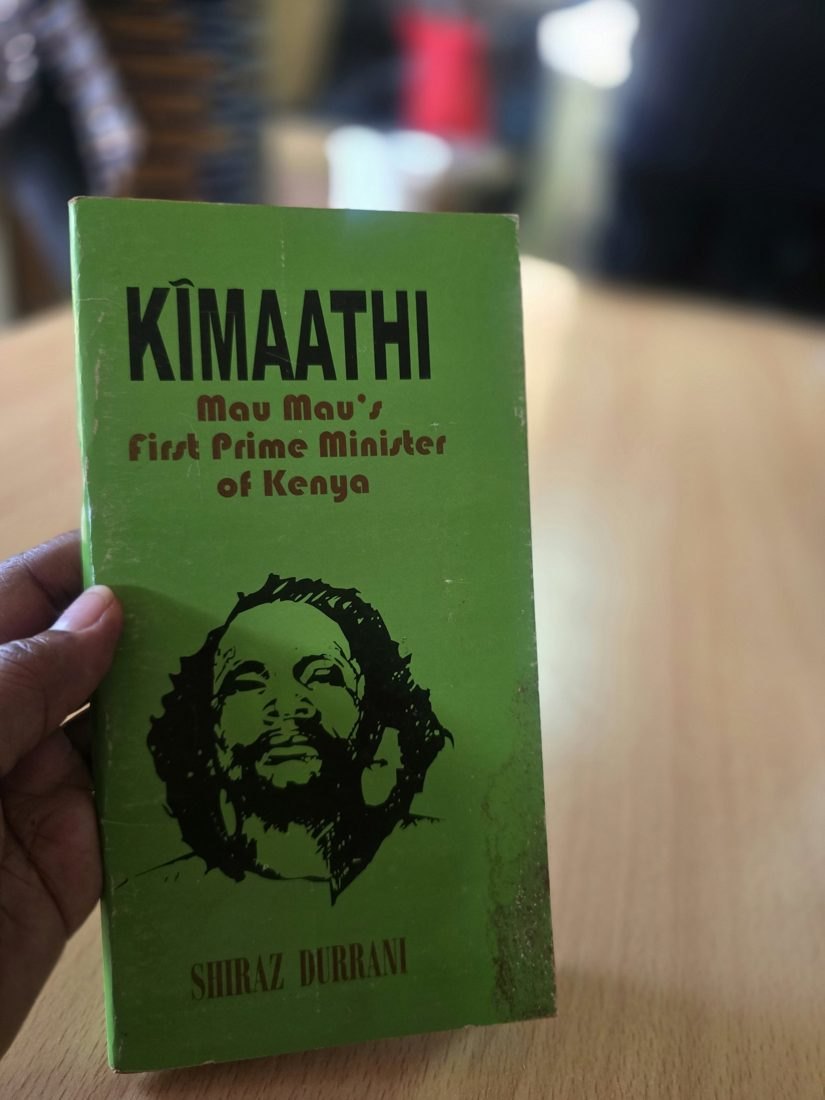
Shiraz Durrani, ‘Kĩmaathi: Mau Mau’s First Prime Minister of Kenya’ (London: Vita Books), gifted to me at the Mashujaa Heritage Archives & Library.
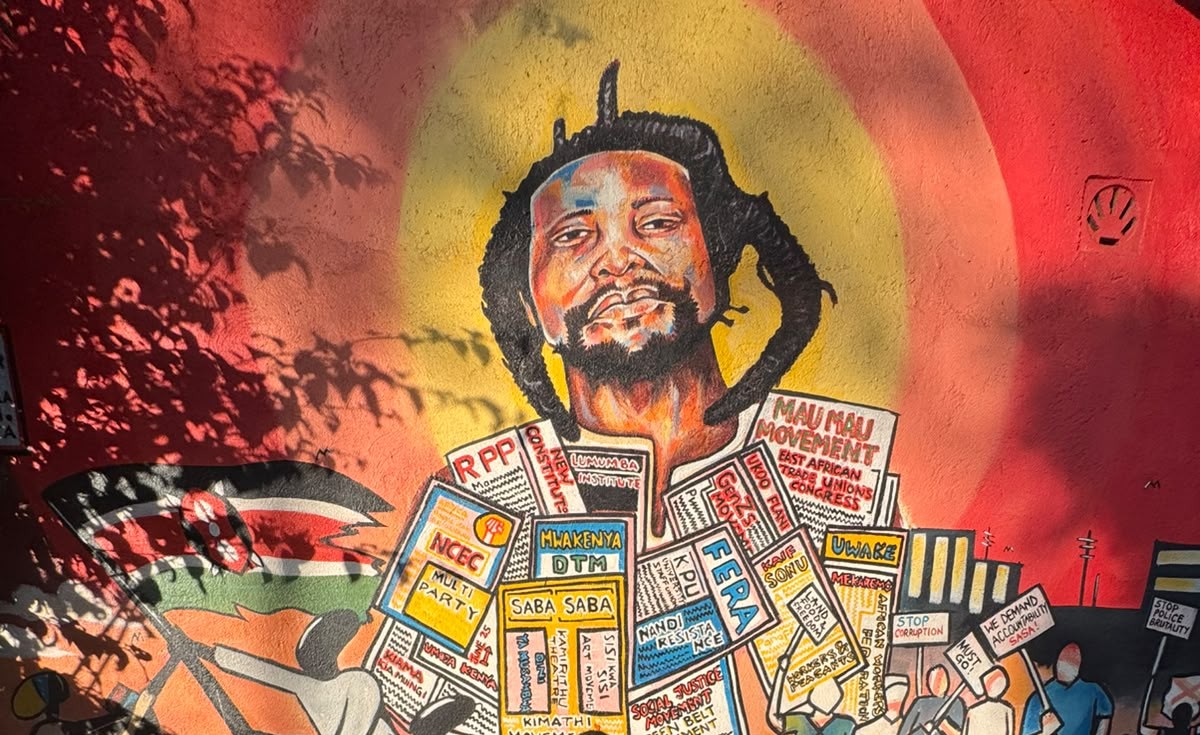
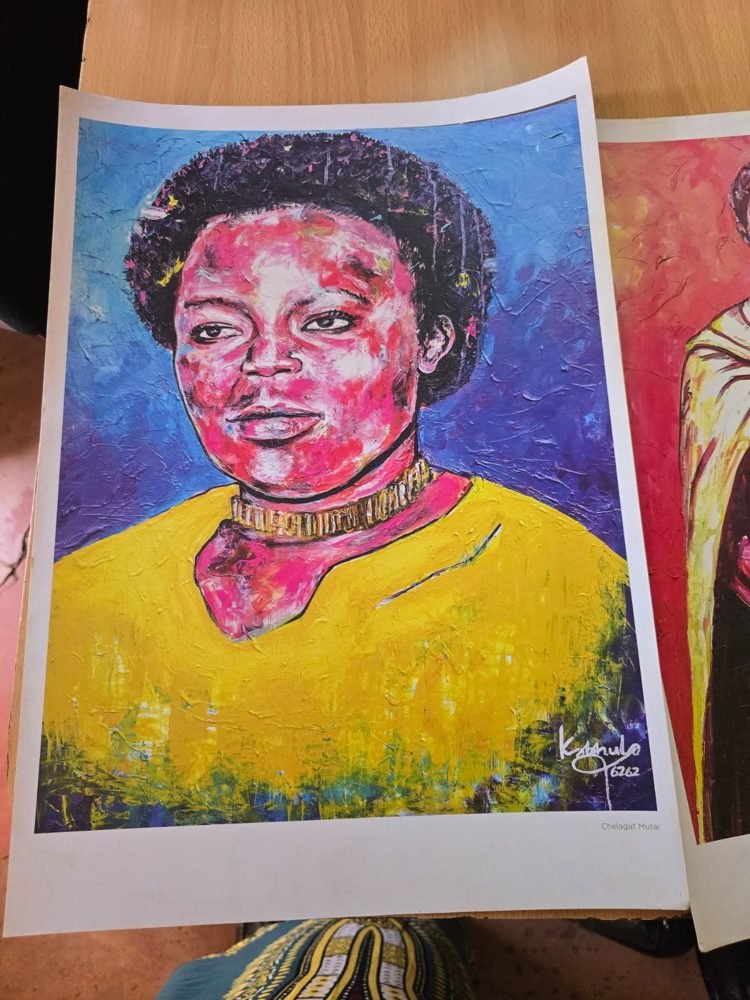
The mural at the Mashujaa Heritage Archives & Library, naming Kenya’s movements of struggle; and a portrait of Cinda Reri, as identified for us at the library, among the artworks available there.

Our last stop was Pan-African House, Ndungi Githuku’s space for community gathering, political dialogue, music and solidarity. It is a beautiful space in nature, and there, as everywhere in Kenya, I felt deeply connected to the land and to the people.

Land at the heart of repair

Everything I heard in Kenya, from the sons and daughters of the freedom fighters, in Field Marshal Mũthoni’s words from the forest and at the archives, came back to land. Settlers and the British state seized it, and the titles the British created still govern much of it. Shiraz Durrani puts it plainly in ‘From Mau Mau to Ruto-Must-Go: A Scrapbook of Essays on Kenya’s Struggle Against Imperialism’, the collection he edited with Ruo Kĩmani-Ruo[42], a copy of which I brought back from Kenya: the land of Kenya’s peoples was stolen twice. First by the colonisers; and then at independence, when the fighters’ land, handed to the home guards during the Emergency, stayed with those who became the new ruling class. The newly independent government bought settler farms with nearly £12.5 million in British loans, and the debt was laid on those settled. In 1969 the Kenya People’s Union called the failure to return the land stolen under British rule ‘the most serious in the string of broken promises since the end of colonial rule’.

Behind both thefts stands the British Crown’s claim to the land itself. In 1897 the British authorities declared all ‘waste and unoccupied land’ in the East Africa Protectorate to be Crown land, and in 1899 extended the claim to all land, occupied or not, so that Afrikan peoples living on their ancestral lands became, in colonial law, tenants at the will of the Crown.[43] Kevin Cahill, in ‘Who Owns the World: The Hidden Facts Behind Landownership’, followed that claim across the globe and put the matter plainly:

‘Poverty and wealth are not, as is often thought, opposites. Instead the two words predicate a problem, poverty, and indicate its solution, which is wealth. Land, that upon which we all stand, is the single most common characteristic of wealth worldwide. What the poor lack—land—the rich have in spades.’

Kevin Cahill, ‘Who Owns the World’[44]

The poverty imposed on Afrikan peoples in Kenya, across Afrika and across the Afrikan Diaspora is the other side of the land the Crown and settlers took. That is why any repair begins with land, and with who holds title to it now. And the land struggle in Kenya is live. The Kipsigis and Talai peoples of Kericho, driven from their ancestral lands for British tea estates, are still fighting to reclaim land that multinational tea companies farm today, and their case shows how far the 2013 settlement is from closing anything.

Not yet uhuru: the land struggle continues

The 2013 settlement, which the UK Government now cites to say that the matter is closed, covered the torture of 5,228 people during the Emergency and nothing else. The historical injustice done to Kenya’s peoples under British rule began long before 1952 and is unrepaired. From 1895 the British declared the East Africa Protectorate, in 1902 and 1915 passed Crown Lands Ordinances making all land the Crown’s, and in 1920 declared the Colony of Kenya. Under the sterile term ‘land alienation’ the British reserved the best-watered highlands, the ‘Scheduled Areas’, for European settlement and confined Afrikan peoples to ‘native reserves’: by 1934 settlers controlled about a third of the arable land[45]; by 1948, 1.5 million Gĩkũyũ were confined to 2,000 square miles while 30,000 settlers held title to 12,000[17]; and at independence in 1963 around 3,600 settler families held some three million hectares while millions of Kenyans were crowded onto what remained. This was theft of land and, in today’s language, ethnic cleansing: impoverishment, starvation, the loss of livestock, and killing by British forces and settlers.

In Kericho, British forces killed some 2,000 Kipsigis at Sotik in 1905, and in 1934 an order in King George V’s name deported the whole Talai people to Gwassi, two weeks’ walk away on the shore of Nam Lolwe, where malaria was endemic and water scarce; a British memo spoke of leaving ‘the old men to die out gradually’.[46] The Kipsigis and Talai say some 115,000 of their people were driven from between 98,000 and 200,000 acres, which British tea companies received on 99-year leases and which Lipton (formerly Unilever and Brooke Bond), James Finlay and Williamson Tea farm today. ‘There is blood in the tea,’ the historian Godfrey Sang told AFP.[47]

The struggle continues on every front. Kericho County wrote to Queen Elizabeth II in 2009 and received no answer. In 2019 Kenya’s National Land Commission ruled that the land should have reverted to the Kipsigis at independence and that the leases were void; the tea companies went to the High Court to overturn it. In 2021 six United Nations Special Rapporteurs wrote to the UK Government of gross human rights violations[48]; the Foreign Office answered with regret, and with the argument that the case should have been brought within thirty years of independence. In 2022 the Kipsigis and Talai took the UK to the European Court of Human Rights, seeking an apology and £168 billion.[49] ‘First of all, they need to acknowledge that it is stolen property,’ said Governor Paul Chepkwony of Kericho.

Inside Kenya the colonial land regime passed to the independent state largely intact. Jaramogi Oginga Odinga, of the Luo, a leader of the independence struggle who became Kenya’s first Vice-President and resigned in 1966 to lead the opposition Kenya People’s Union, named the condition in 1967 in the title of his autobiography: ‘Not Yet Uhuru’.[50] The 2004 Ndung’u Report documented the illegal and irregular allocation of public land to the politically connected[51]; and the 2010 Constitution created the National Land Commission and charged it with investigating historical land injustices, while the Truth, Justice and Reconciliation Commission’s findings on land, described above, lie unimplemented. From the Kenya Land and Freedom Army to the Kipsigis and Talai, from the families of Kahiga-ini to the generation in the streets in 2024 and 2025, the demand has stayed the same: ithaka na wĩathi, land and freedom.

What the Kipsigis and Talai have had from the UK Government, like the survivors of the camps before them, is regret. Regret is the word, and it is worth looking at who uses it and what it is for.

An apology to whom, and for what?

Regret is the word the UK Government used to Kenyans in 2013. It is the word the Foreign Office used in 2021, when six United Nations Special Rapporteurs wrote to it about the gross human rights violations against the Kipsigis and Talai peoples: ‘We regret that these abuses took place.’ In Kenya in 2023, King Charles III expressed ‘the greatest sorrow and the deepest regret’. On 3 November 2026, opening the Commonwealth Heads of Government Meeting in Antigua and Barbuda, he spoke of ‘the most profound personal sorrow’, and offered no apology.

Standing on Kenyan land, I saw one empire, one Crown and one pattern: dispossess, extract, kill, express regret and move on. Those who harmed our families in Kenya are those who harmed our families in the Caribbean, across Afrika and throughout the Diaspora. Kenya and the Caribbean are discussed in separate conversations, and that siloing is itself part of the harm: our dismemberment as a people makes it easier to settle with us one fragment at a time. That is why I advocate a Pan-Afrikan apology, one that carries responsibility, truth-telling, the full participation of our communities and concrete repair within it.

I set this out in full in ‘An Apology to Whom, and for What?’[52], on the Stop the Maangamizi Campaign website.

What is the Maangamizi?

Maangamizi is a Kiswahili word, from angamiza, to cause destruction, to utterly destroy. Professor Maulana Karenga asserted and promoted the term at the convention of the National Coalition of Blacks for Reparations in America (N’COBRA) in 2001, defining the Holocaust of enslavement as ‘the morally monstrous destruction of human life, human culture and human possibility’.[53] We name our reality in an Afrikan language because naming is the first act of knowing on our own terms. PARCOE and the Stop the Maangamizi Campaign developed the term in their own context.

As MET defines it, the Maangamizi is the ongoing system of deliberate, systematic destruction perpetrated against Afrikan people through racialised chattel enslavement, wars of extermination and conquest, colonialism and neocolonialism. Its perpetrators set out to destroy our personhood and peoplehood (genocide); our nationhood and culture (ethnocide), dismantling our knowledge systems, suppressing and demonising our spiritualities and imposing their languages, religions, names, ways of being and system of counting time; and our environments (ecocide): with them, our human possibility, the futures our peoples would have made.

An apology that carries concrete repair within it must say what the repair is, and in Kenya, as across Afrika and the Diaspora, it begins with land. For the Stop the Maangamizi Campaign, land has always stood at the centre of reparations, and the definition above says why. We charge ecocide alongside genocide because the perpetrators of the Maangamizi set out to destroy our environments and our relationship with them: tearing peoples from their ancestral lands, as the British tore the Gĩkũyũ, the Kipsigis and the Talai from theirs, desecrates the ecosystems of which those peoples are part. Repair of that destruction is the return to the land and to our peoples’ relationships with it, beyond any payment, and the ISMAR has its own names for that work.

Rematriation, named in the 2015 Stop the Maangamizi Petition, is the return to the Mother: physical return to the Motherland Afrika for those who choose it, the historical, cultural and spiritual restitution owed to the heirs of those forcibly removed, and the reclaiming of sacred relationships with ancestors, peoples, ancestral lands, living waters and all of Mother Earth.

Planet Repairs, championed by PARCOE and introduced above, brings cognitive justice, environmental justice and reparatory justice together as one work of repair, and is the change the Stop the Maangamizi Campaign works in service of.

In Kenya as everywhere, our peoples reclaiming the land, and our relationship with it, is how sovereignty is restored.

On air: ‘Fixing the Nation’

Land was central to what I said on Kenyan radio too. On Friday 23 October I was a guest on ‘Fixing the Nation’, the Nation FM radio programme, filmed in the studio and shown on NTV Kenya, under the title ‘Beyond Apologies: Who Owes Africa Reparations?’. I used it to reframe the question. Reparation is a right, held by Afrikan peoples in Afrika and across the Diaspora, and the obligation falls on those who perpetrated the Maangamizi and grew rich from it. I spoke about the repair Kenya needs, beginning with land: Kenya’s peoples reclaiming the land seized by settlers and the Crown. I spoke about the return of the remains of Kenya’s Mashujaa: Koitalel Arap Samoei, the Orkoiyot, spiritual and military leader of the Nandi, who led his people’s resistance to the British for a decade until a British officer, Richard Meinertzhagen, lured him to a supposed peace meeting on 19 October 1905, shot him, and took his severed head to Britain as proof of his death. The British have never said where it is; those who took it know where they took it, and it is believed to lie in a museum collection in Britain to this day. Koitalel’s family, the Talai clan and the Nandi elders have campaigned for its return for generations, joined in recent years by Nandi County under Governor Stephen Sang, who renewed the demand at the 120th anniversary of the killing in October 2025.[54] In 2006 Meinertzhagen’s family returned some of his belongings, which are kept at the Koitalel Samoei Museum in Nandi Hills; the head was not among them. I spoke too of Field Marshal Dedan Kimathi, whose remains lie in the unmarked grave inside Kamiti Prison where the British buried him in 1957, identified in 2019 and still to be exhumed and returned to his family for burial with the honour due to him. I spoke about implementing the findings of Kenya’s own Truth, Justice and Reconciliation Commission, which has gathered dust since 2013. And I spoke about ending the killing of young people by the Kenyan state.
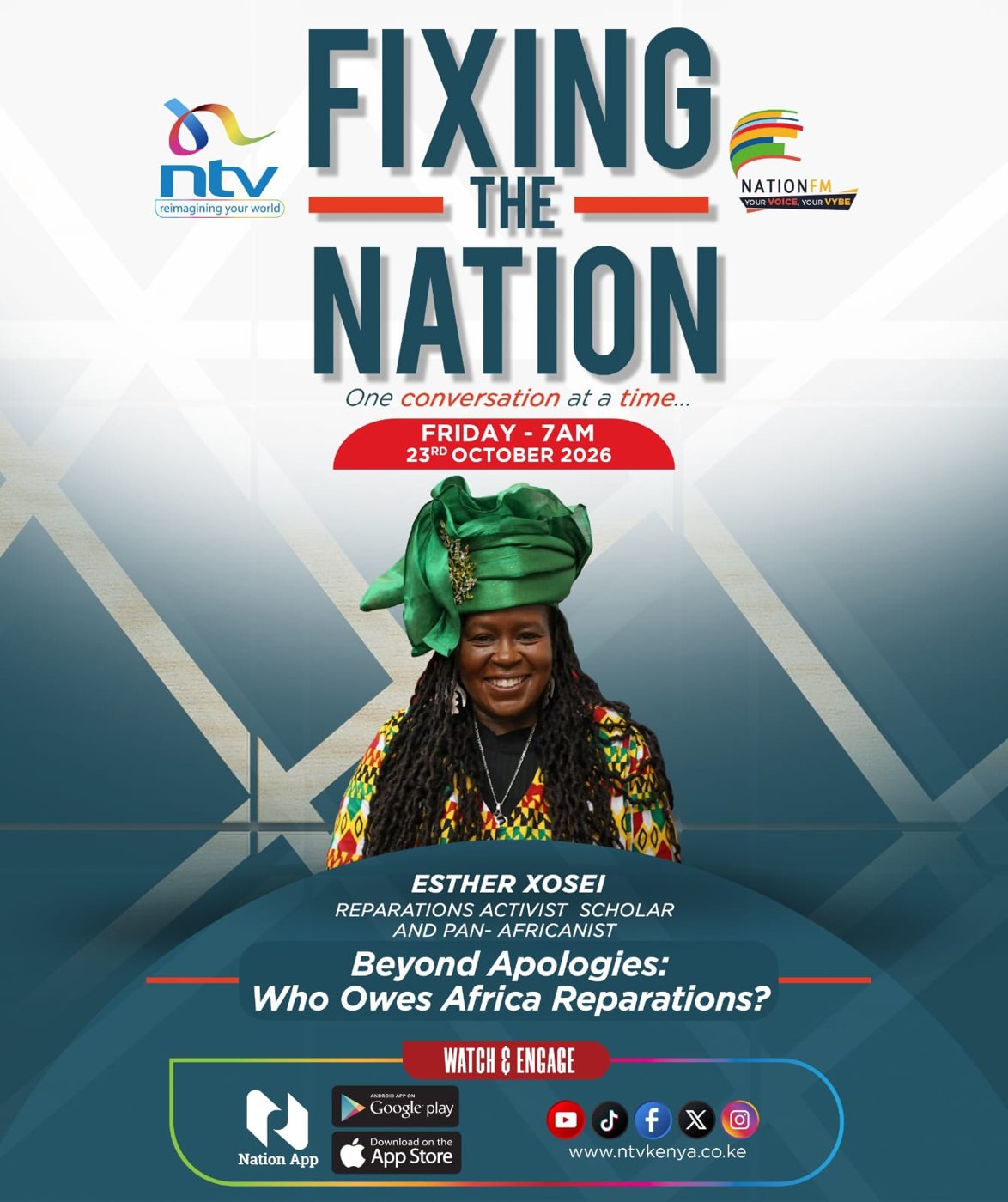
‘Fixing the Nation’, Nation FM and NTV Kenya, Friday 23 October 2026.
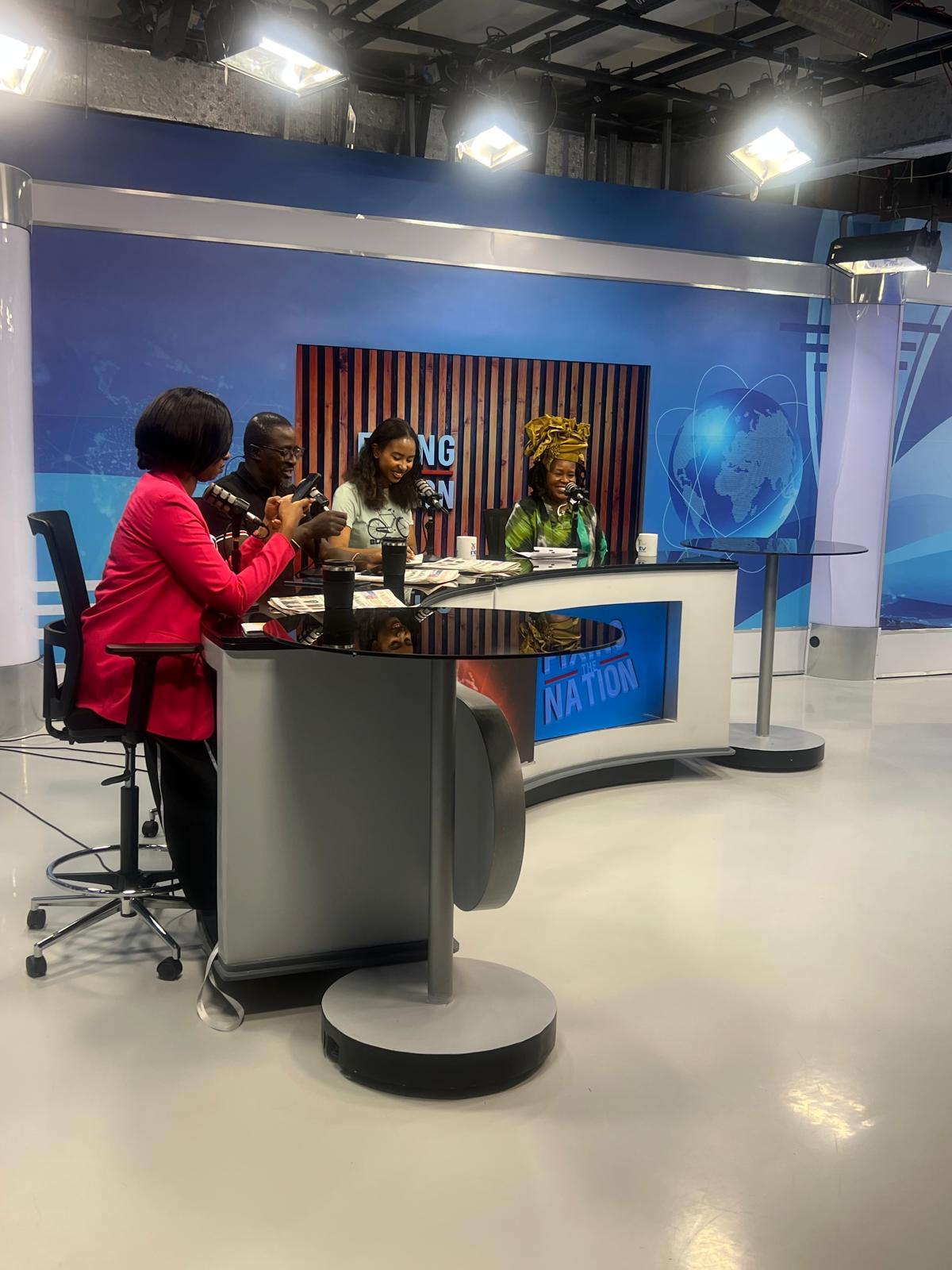
In the NTV studio in Nairobi for ‘Fixing the Nation’, 23 October 2026, with the presenter and fellow guests.

Esther Xosei on ‘Fixing the Nation’, Nation FM and NTV Kenya, 23 October 2026: an excerpt. Watch the full programme: ‘Reparations: Who Owes Africa?’ on YouTube.

A generation sharp and ready

Ending the killing of young people was no abstraction in that studio. Kenya’s Gen Z led the uprising of June 2024 against the Finance Bill, and rose again in June and July 2025 after the death in police custody of the teacher and blogger Albert Ojwang. The Kenyan state answered with live fire, abductions and enforced disappearances. Kenya’s Independent Policing Oversight Authority registered 60 killings in the 2024 protests; local media and human rights groups counted at least 65 killed and more than 400 seriously injured in 2025; and the Kenya National Commission on Human Rights reported at least 26 people still missing after the 2024 protests and at least 15 after 2025, abducted by plainclothes security forces for organising or for what they posted online.[55]

In June 2026 President William Ruto unveiled a Sh2 billion compensation framework for more than 1,100 claims of death, injury, torture, abduction and enforced disappearance, acknowledging ‘state excesses’ and calling the payments ‘the State’s acknowledgement that harm occurred’. Survivors and the families of the dead called it ‘an incomplete apology from the state’, and demanded a personal apology, a public list of beneficiaries and, above all, accountability: investigation and prosecution of the police officers responsible.[56] The essays in ‘From Mau Mau to Ruto-Must-Go’ describe this pattern plainly: a neo-colonial state, which inherited the British colonial order intact, that kills its young people for demanding the land and freedom the fighters died for, and then offers money without cessation, without truth and without anyone being held to account. The test I set out in the keynote applies to Nairobi as to London: every offer tested against all five forms of reparation, and against cessation first. Has the killing stopped?

Among the young Kenyans I met was Sungu Oyoo, a writer, human rights advocate and Pan-Afrikanist, National Spokesperson of Kongamano la Mapinduzi, Kiswahili for the congress of the revolution, a political movement in Kenya, and a candidate for President of Kenya in 2027 under the banner of the Kenya Left Alliance, the coalition of social justice movements and progressive parties which has declared that it will contest every elective seat in 2027, through the Ukweli Party (ukweli: truth).[57] In his declaration of his candidacy, Sungu puts in his own words what I saw: ‘A generation openly declaring that they will not live in poverty and humiliation. A generation saying it will not be cowed or intimidated into silence again.’[58] That generation is organising for power, in the streets and at the ballot.

State repression extends to Pan-Afrikanist organising too. In May 2026, when President Ruto co-hosted President Emmanuel Macron’s Africa Forward Summit in Nairobi, delegates to the Pan-Africanism Summit Against Imperialism, the counter-summit convened by the Communist Party Marxist–Kenya, marched towards the statue of Field Marshal Dedan Kimathi on Kimathi Street in the centre of Nairobi to oppose the new Kenya–France security partnership. Police tear-gassed the march and arrested thirteen people, Kenyan activists and international delegates among them; the Kenyans were later released without charge.[59]

One word followed us everywhere in Kenya: wantam. It is Sheng for ‘one term’, and it entered everyday speech in May 2025, when Rigathi Gachagua, the impeached former Deputy President, used it at a rally; Kenyans took it out of his mouth and made it their own, a people’s verdict on President Ruto’s administration and an invocation of the Constitution’s term limits.[60] A single finger raised says it without a word, and in the week we were there the gesture needed no explanation anywhere, from the convening hall to the clubs to the streets. It is chanted at concerts and rallies and when politicians appear in public, sung in version after version by Kenyan musicians, answered by the state with a counter-slogan of its own, tutam, ‘two terms’, and described by the opposition leader Kalonzo Musyoka as ‘basically our second national anthem’.[60] It began as a Gen Z anthem and has been embraced across the generations and classes of Kenyan society.

Song has always been part of the process of making revolution. The Kenya Land and Freedom Army composed and sang in the forest, and through song held together, taught the oath and the cause, and the songs of the war are still sung; Ukoo Flani Mau Mau carried the fighters’ name and the fighters’ grievance into hip-hop; conscious reggae plays in the clubs; and wantam is being sung into every corner of Kenyan life now. Song is how a people rehearses its demand until the demand is its own, and a demand that is sung in one word by a whole people is one the state cannot pretend not to have heard.

Listen: Wantam

Two of the many versions of the anthem.

‘Wantam (One Term)’, the Gen Z anthem, built around the voices of Rigathi Gachagua, Kalonzo Musyoka and Edwin Sifuna.

‘Wantam’, Choppa Strings.

The young people I met, at the convening and around it, are astute and politicised, with a high level of political literacy, and they discuss and debate ideas without fear. They think hard about their future, about youth unemployment and about the kind of society they want, and young women and men alike were naming and challenging the malevolent patriarchy at work in their lives and in Kenyan politics. Nothing needed simplifying for them. They were already thinking about the place of ideas and ideology in building movements for decolonisation and reparations.

The place of ideas in a movement is a question I take seriously, with the admonition of Amílcar Cabral, of Guinea-Bissau and Cape Verde, in mind. In the same 1965 directive to the African Party for the Independence of Guinea and Cape Verde (PAIGC) in which he told his cadres to ‘tell no lies, claim no easy victories’[61], Cabral warned: ‘Always bear in mind that the people are not fighting for ideas, for the things in anyone’s head. They are fighting to win material benefits, to live better and in peace, to see their lives go forward, to guarantee the future of their children.’ Ideas earn their place in a movement by serving that. They begin in the Pan-Afrikan radical imagination: the capacity to envision the transformed world, land reclaimed, sovereignty restored, Maatubuntuman in Ubuntudunia, before it exists. Ideology is that imagination given coherence: in a social movement, a coherent system of beliefs, values and principles that gives its members a shared understanding of the world, explains the problems the people face and sets out how to put them right. For the ISMAR that means an ideology which names the Maangamizi as the problem, holds stopping it to be the first task of repair, and sets out how Afrikan people effect and secure Planet Repairs, the remaking of the world itself. From it flow strategy, organisation and the discipline to win the material benefits Cabral named.

The generation I met in Kenya has the imagination and is forging the ideology, in its streets, its organisations and its songs. That is the conviction behind MET’s work, and the reason we say that education is preparation for reparations. The slogan was popularised by the former Afrikan Emancipation Day Reparations March Committee. Yɛresiesie yɛn ho, Akan for we are preparing ourselves, is the name of MET’s podcast, ‘Yɛresiesie Yɛn Ho: The Preparation for Reparations Podcast’. We prepare ourselves because reparation is effected, secured and ultimately taken by the people who organise for it, and what I saw in the young people of Kenya was a generation preparing itself for uhuru kamili, Kiswahili for complete freedom, the uhuru Jaramogi Oginga Odinga wrote was not yet: land and freedom, ithaka na wĩathi, in full.

Reggae nights: the Caribbean in Kenya

After the first day of the convening a group of us went out to eat, and the place turned out to be a scene: a club in all but name, with conscious reggae on the sound system all night. Kenyans love reggae, above all the young, and in the clubs they play conscious reggae, music with a message. For me, of Afrikan Guyanese and Afrikan Barbadian heritage, it was a joy to hear the Caribbean speaking to Afrika in a Nairobi night, and Afrika answering.

We were fortunate to have in our delegation Sonbeam, the Jamaican-born, UK-based reggae and dancehall singjay (a performer who both sings and chants in the deejay style), singer and songwriter, known for conscious and uplifting music that blends reggae, dancehall and traditional lyricism. He performed on the artivists’ day of the convening, and he was with us at Kahiga-ini. I am glad to have been introduced to his music, and to the talent of all the artists who made up that day’s programme. Here are three of his tracks.
Sonbeam. Photograph © Sonbeam

Listen: Sonbeam

Three tracks by Sonbeam.

‘Battlefield’, Sonbeam.

‘Freedom’, Sonbeam.

‘Sunrise’, Sonbeam.

There was music at every stage of the convening, through to its close. On the last day we jammed together: musical edutainment, education and entertainment in one, as the artists and the rest of us sang the week out.

Jamming on the last day of the convening: musical edutainment at Ufungamano House.

Carrying it forward

At Kahiga-ini, in Nyeri, I was given the name Wahito, to gather and to bring, so that what I gather, the knowledge, the testimony, the truths of the sons and daughters of the freedom fighters and of the young people, would be carried back to Britain and brought to bear. That is the purpose for which the name was given, and it is the purpose of this piece. Repair begins with truth-seeking and truth-telling, and the truths gathered in Kenya, at the convening, in the testimony of the families, and on our visit to Nyeri and to the archives, will shape the work of MET and the Stop the Maangamizi Campaign in the months ahead: the construction of the Commission of Inquiry’s mandate so that it can hear the families; support for them now; and the deepening of the Pan-Afrikan bonds between our communities in Britain and the movements in Kenya. Next steps are being explored, and the signs are promising.
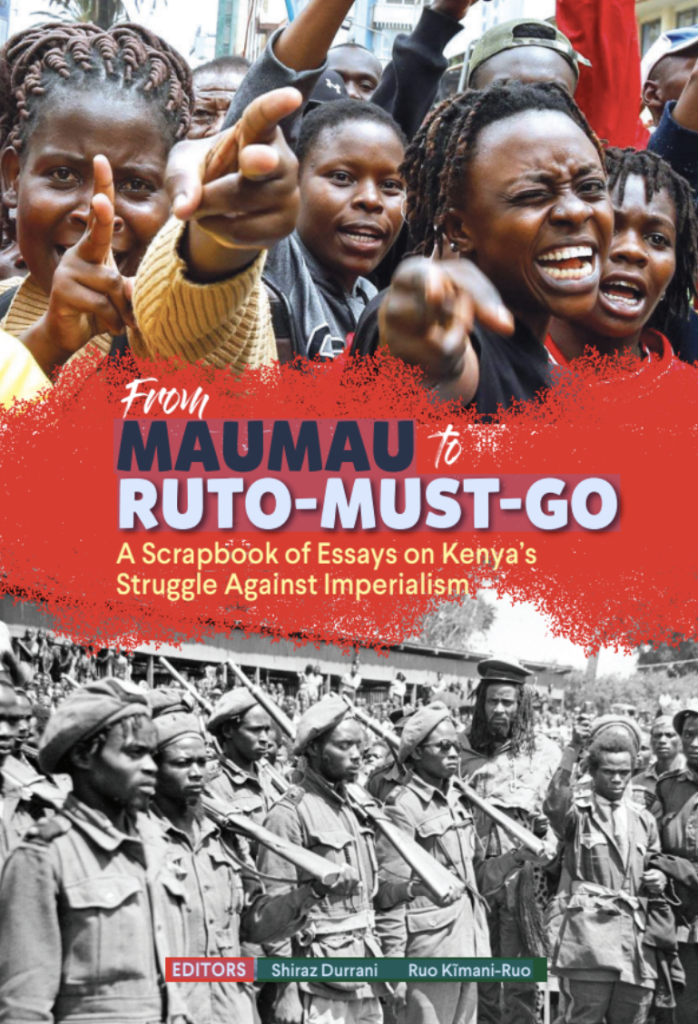
‘From Mau Mau to Ruto-Must-Go: A Scrapbook of Essays on Kenya’s Struggle Against Imperialism’, edited by Shiraz Durrani and Ruo Kĩmani-Ruo, 2026.

A book to read: ‘From Mau Mau to Ruto-Must-Go’

I have quoted from this collection twice above, on the double theft of Kenya’s land and on the neo-colonial state, and I recommend it whole. I met some of its contributors while I was in Kenya; among them is Dr Peninah Wangari-Jones, Chief Executive of the Racial Justice Network, which convened us in Nairobi; her chapter is on the role and significance of women in liberation struggles. The essays follow the resistance from the Kenya Land and Freedom Army to the Gen Z Uprising: land as the issue that has driven resistance throughout; the cartoonists who speak truth to power; the Social Justice Centres Travelling Theatre, performing in Nairobi’s informal settlements; and the conviction that the spirit of the fighters lives in the generation in the streets today.

Reviewing it, Dr Willy Mutunga, Chief Justice of Kenya from 2011 to 2016, writes that ‘the Mau Mau War of Liberation remains the greatest and the main beacon of our revolution’[62]; its co-editor Shiraz Durrani describes the resistance it records as ‘an on-going, incomplete struggle’. That is the spirit of the people I experienced in Kenya, and the name is the right one: the Kenya Land and Freedom Army fought a war of liberation, for land and freedom. Read it, and share it.

My thanks go to the three convening partners, the Racial Justice Network (UK), the University of Nairobi and the Mashujaa Heritage Archives & Library, and to all who represented them, as set out in the programme, and to everyone in Kenya who welcomed us so warmly. The convening resolved to work towards a Tri-Sectoral Network of Activists, Artivists and Scholars on Reparation and Decolonisation, a standing platform for the dialogue, learning, artistic production, organising and advocacy begun in Nairobi, across the three constituencies and across our geographies. The Racial Justice Network is compiling the official report of the convening, and I will share it here once it is ready.

References

Numbers in the text refer to the sources below, in the order they first appear.

  1. Haki R. Madhubuti, ‘From Plan to Planet: Life Studies. The Need for Afrikan Minds and Institutions’ (Detroit: Broadside Press; Chicago: Institute of Positive Education, 1973).
  2. Daily Nation, ‘Ghai unites factions in push for constitutional overhaul’, on the Ufungamano Initiative and the Constitution of Kenya Review Commission.
  3. ‘Mau Mau Reparations: Is there a Pan-Afrikan Perspective? A Mashujaa Day Special’, Africa Speaks with Sister Ekua, Voice of Africa Radio, 16 October 2013.
  4. Ngũgĩ wa Thiong’o, preface to Karari Njama and Donald L. Barnett, ‘Mau Mau From Within: The Story of the Kenya Land and Freedom Army’ (Daraja Press, 2021).
  5. United Nations, Basic Principles and Guidelines on the Right to a Remedy and Reparation for Victims of Gross Violations of International Human Rights Law and Serious Violations of International Humanitarian Law, General Assembly resolution 60/147, 16 December 2005.
  6. FIDA Kenya, on women and land title, as reported in ‘Kenyan women fight for land rights’, Climate Home News, 6 March 2020.
  7. Rebecca Tsosie, ‘Acknowledging the Past to Heal the Future: The Role of Reparations for Native Nations’, in Jon Miller and Rahul Kumar (eds), ‘Reparations: Interdisciplinary Inquiries’ (Oxford University Press, 2007).
  8. Eve Tuck and K. Wayne Yang, ‘Decolonization is not a metaphor’, Decolonization: Indigeneity, Education & Society 1(1), 2012.
  9. Ngũgĩ wa Thiong’o, ‘Decolonising the Mind: The Politics of Language in African Literature’ (London: James Currey; Nairobi: Heinemann Kenya, 1986).
  10. Mutua and Others v Foreign and Commonwealth Office [2011] EWHC 1913 (QB) (the case may proceed) and [2012] EWHC 2678 (QB) (the case may go to trial despite the passage of time).
  11. Caroline Elkins, ‘Imperial Reckoning: The Untold Story of Britain’s Gulag in Kenya’ (Henry Holt, 2005).
  12. David Anderson, ‘Histories of the Hanged: Britain’s Dirty War in Kenya and the End of Empire’ (Weidenfeld & Nicolson, 2005).
  13. Daniel Leader, ‘Learning the lessons from the cutting edge: the Mau Mau case’, Public Law Project conference, 4 March 2014, on the disclosure of the Hanslope archive.
  14. UK Government, statement to Parliament on the settlement of the Mau Mau claims, 6 June 2013.
  15. Paul Muite, interviewed by Deutsche Welle, June 2013, as reported in Kylie Kiunguyu, ‘Kenyan government accused of blocking British payout to Mau Mau victims’, This Is Africa, 17 May 2022.
  16. Kenya Human Rights Commission, ‘The Mau Mau Settlement: Setting the Record Straight’, press release, 6 June 2013.
  17. Owen Bowcott, ‘Mau Mau rebellion victims claim parliament was misled over torture’, The Guardian, 23 May 2016.
  18. Kimathi and Others v Foreign and Commonwealth Office [2018] EWHC 2066 (QB).
  19. Jo Moore, ‘Kenyan “Mau Mau” claim dismissed: fair trial not possible because of half century delay’, UK Human Rights Blog, 6 August 2018.
  20. Neil Rose, ‘High Court dismisses negligence claim over failed group action’, Legal Futures, 30 May 2023.
  21. Ella Obota, ‘British Gov’t dismisses claims of fresh Mau Mau compensation payouts’, Citizen Digital, 24 January 2025.
  22. Esther Xosei, ‘Has there really been a victory for the Mau Mau?’, newsletter, October 2012.
  23. Republic of Kenya, Report of the Truth, Justice and Reconciliation Commission (May 2013), with the international commissioners’ dissent, in the Seattle University School of Law digital collection; JusticeInfo, ‘How Kenya’s truth commission report became a political ghost’; The Elephant, ‘When killers become victims: the impunity project, Kenya and the burying of the TJRC report’, 8 September 2018.
  24. Kenya Human Rights Commission, ‘High Court rejects LSK Mau Mau claim against KHRC, Leigh Day, MMWVA’, press release, October 2015; Leigh Day, ‘The Mau Mau claims’; Nation, ‘UK law firm declines to release Mau Mau pay list’.
  25. Shiraz Durrani, ‘Kĩmaathi: Mau Mau’s First Prime Minister of Kenya’ (London: Vita Books), pp. 28–29, where the Kimaathi Charter is reproduced; the Charter is also in Makhan Singh, ‘Kenya’s Trade Unions: The Crucial Years, 1952–1956’ (Nairobi: Uzima Press, 1980).
  26. The Brattle Group, ‘Report on Reparations for Transatlantic Chattel Slavery in the Americas and the Caribbean’, with an introduction by Patrick Robinson, prepared for the American Society of International Law and the University of the West Indies Centre for Reparation Research, presented at the University of the West Indies, Mona, 8 June 2023.
  27. Wamuyu Gakuru, Wikipedia; Paukwa, ‘Cinda Reri’, on her gun-running by rail and the origin of the name.
  28. Mukami Kimathi, ‘Mukami Kimathi: Mau Mau Woman Freedom Fighter’ (memoir); ‘Mau Mau: Mukami Kimathi’s swansong to a city at war’, African Arguments, October 2024.
  29. Paukwa, ‘Rebecca Njeri’.
  30. Katherine Bruce-Lockhart, ‘“Unsound” minds and broken bodies: the detention of “hardcore” Mau Mau women at Kamiti and Gitamayu Detention Camps in Kenya, 1954–1960’, Journal of Eastern African Studies 8(4), 2014; summarised in University of Cambridge, ‘How the British treated “hardcore” Mau Mau women’.
  31. Nicholas Githuku and Lotte Hughes, ‘Sanitizing the Kenyattas’, Africa Is a Country, 22 April 2022, quoting the 1966 letter of Wanjiku Wariku for the Women War Council.
  32. Mĩcere Gĩthae Mũgo, ‘The Imperative of Utu / Ubuntu in Africana Scholarship’ (Quebec: Daraja Press, 2020).
  33. Nairobi Declaration on Women’s and Girls’ Right to a Remedy and Reparation, Nairobi, 19–21 March 2007.
  34. On Mbuya Nehanda and the demand for the return of her remains: ‘Zimbabwe ramps up pressure on Britain to return Nehanda skull’, The Hub; ‘Mbuya Nehanda’, Black Women Radicals.
  35. On Field Marshal Mũthoni wa Kĩrĩma: Wikipedia; ‘A symbol remains: the tonsuring of Field Marshal Muthoni wa Kirima’, This Is Africa, 2022.
  36. Batuk, ‘Mutumia Ngatha’, from ‘Again She Reigns’ (Teka Records, 2020); OkayAfrica, ‘Batuk’s audiovisual release “Again She Reigns” highlights iconic African women’, 2020.
  37. Max Pinckers, ‘Unhistories’ (2019), photograph of Field Marshal Mũthoni wa Kĩrĩma and Bernard Mungai Kamande.
  38. Embassy of the Republic of Kenya, Washington DC, ‘About Kenya: History’.
  39. Stevens Muendo, ‘How KiKamba’s Kinyaa became Kirinyaga, Kenya’, The Standard, 24 October 2021.
  40. Makau Mutua, Nation, 20 June 2021, as reported in ‘Makau Mutua Calls for Kenya to Change Its Name’, Kenyans.co.ke.
  41. Njuki Githethwa, ‘Documenting and Archiving People’s Struggles and Social Movements in Kenya’, British Institute in Eastern Africa, 19 June 2026; Mashujaa Heritage Archives & Library, mashujaaheritagearchive.org.
  42. Shiraz Durrani and Ruo Kĩmani-Ruo (eds), ‘From Mau Mau to Ruto-Must-Go: A Scrapbook of Essays on Kenya’s Struggle Against Imperialism’ (Nairobi: Editor House Facility, 2026).
  43. H. W. O. Okoth-Ogendo, ‘Tenants of the Crown: Evolution of Agrarian Law and Institutions in Kenya’ (Nairobi: ACTS Press, 1991).
  44. Kevin Cahill, ‘Who Owns the World: The Hidden Facts Behind Landownership’ (Edinburgh: Mainstream Publishing, 2006).
  45. World Resources Institute and Landesa, ‘Focus on Land in Africa Brief: Kenya’, 2011.
  46. Phil Miller, ‘Britain stole their land to plant tea. Now they want it back’, Declassified UK, 1 December 2022.
  47. AFP, ‘Colonial crimes: Kenyans turn to the UN’, JusticeInfo, 31 October 2019.
  48. United Nations Special Rapporteurs, communication to the UK Government on the Kipsigis and Talai (2021), as reported by Temple Garden Chambers, August 2021.
  49. Scottish Legal News, ‘Kenyan tribes launch £168bn case against UK in European Court of Human Rights’, 24 August 2022.
  50. Jaramogi Oginga Odinga, ‘Not Yet Uhuru’ (London: Heinemann, 1967).
  51. Republic of Kenya, ‘Report of the Commission of Inquiry into the Illegal/Irregular Allocation of Public Land’ (the Ndung’u Report), 2004.
  52. Esther Xosei, ‘An Apology to Whom, and for What?’, Stop the Maangamizi Campaign, November 2026.
  53. Maulana Karenga, ‘The Ethics of Reparations: Engaging the Holocaust of Enslavement’, address to the National Coalition of Blacks for Reparations in America (N’COBRA) convention, Baton Rouge, June 2001.
  54. The Star, ‘Governor Sang renews calls for return of Koitalel Arap Samoei’s skull’, 20 October 2025; AllAfrica, ‘The story behind British soldiers decapitating Chief Samoei and new demands for skull’s return’, 27 October 2023.
  55. Human Rights Watch, ‘World Report 2026: Kenya’; Amnesty International Kenya and partners, ‘Unbowed for Justice: Missing Voices 2025 Annual Report’.
  56. The Star, ‘Ruto unveils reparations framework for victims of protests’, 15 June 2026; Citizen Digital, ‘Protest victims reject Ruto’s apology, want compensation list made public’, 16 June 2026.
  57. The Star, ‘Kenya Left Alliance in bid to unseat ruling class parties in 2027’, 22 August 2025; Citizen Digital, ‘Kenyan activists form coalition to field candidates in 2027 polls’, August 2025.
  58. Sungu Oyoo, ‘Activist Sungu Oyoo declares his 2027 presidential bid’, video, YouTube.
  59. Nicholas Mwangi, ‘Police tear gas and arrest protesters at France-Africa counter summit in Nairobi’, Peoples Dispatch, republished by Black Agenda Report, 20 May 2026; Progressive International, ‘France’s New African Front’, Briefing No. 14, 18 May 2026.
  60. Idah Knowles, ‘“Wantam”: Kenyans’ slang for just one presidential term, and why it matters’, Accountability Research Center, 27 February 2026; People Daily, ‘Kalonzo: Wantam is basically our second national anthem’.
  61. Amílcar Cabral, ‘Tell No Lies, Claim No Easy Victories’, PAIGC party directive, 1965, in ‘Revolution in Guinea’ (London: Stage 1, 1969).
  62. Willy Mutunga, review of ‘From Mau Mau to Ruto-Must-Go’, Pambazuka News, 15 October 2026.

To support the call for the Commission of Inquiry, visit stopthemaangamizi.com/citarj. To learn more about the Stop the Maangamizi Campaign, visit stopthemaangamizi.com.

Ithaka na wĩathi: land and freedom.
Posted in AFRIKAN RESISTANCE, ALL PARTY PARLIAMENTARY COMMISSION OF INQUIRY (APPCITARJ), CITARJ, INTERNATIONAL SOCIAL MOVEMENT FOR AFRIKAN REPARATIONS, ISMAR, MAANGAMIZI RESISTANCE, MAANGAMIZI RESISTERS, PALM, Pan-Afrikan Liberation Movement, REPARATIONS, SMWeCGEC, STOP ECOCIDE, STOP THE MAANGAMIZI CAMPAIGN, Uncategorized | Tagged Afrikan Heritage, Afrikan Women and Reparations, APPG for Afrikan Reparations, British Colonialism, British Empire, British Government, Decolonisation, Dedan Kimathi, Field-Marshal Mũthoni Kĩrĩma, Fixing the Nation, Gen Z Uprising, Genocide, Grassroots Leadership, Ithaka na Wĩathi, Kahiga-ini, Kenya Land & Freedom Army, Kipsigis and Talai, Land Justice, Maangamizi, MAATUBUNTUMAN, Mashujaa Day, Mashujaa Heritage Archives, Mathare Social Justice Centre, Mau Mau, Mau Mau Rebellion, Mau Mau Reparations, Motherism, Movement-Building, Nairobi, new-media, Ngugi Wa Thiongo, Pan-African House, People Power, Planet Repairs, politics, revolution, Ruto Must Go, Truth-Seeking, Truth-Telling, Ubuntudunia, Ufungamano House, un, vision, Wantam | Leave a comment

An Apology to Whom, and for What?

Posted on November 5, 2026 by STOP THE MAANGAMIZI

STOP THE MAANGAMIZI: WE CHARGE GENOCIDE/ECOCIDE! CAMPAIGN

An Apology to Whom, and for What?

What international law and the UN require of an apology, what our movements have long called for, and the pitfalls a British apology must avoid

Esther Xosei, Pan-Afrikan Internationalist Jurisconsult, Decolonial Reparations Scholar-Activist, Ourstorian and Interfaith Minister: Executive Director, Maangamizi Educational Trust (MET); Coordinator-General, Stop the Maangamizi: We Charge Genocide/Ecocide! Campaign; Co-founder and Co-Vice Chair, Pan-Afrikan Reparations Coalition in Europe (PARCOE); Co-founder and Co-Facilitator, International Network of Scholars and Activists for Afrikan Reparations (INOSAAR); Community Researcher, Re-PAIR: Reparations as Pan-Afrikan Indigenous Repairs; Co-Chair, International Affairs Commission of the National Coalition of Blacks for Reparations in America (N’COBRA); UK/Caribbean Mobiliser, Restitution Study Group; Patron, Racial Justice Network; Trustee, Plan B. Earth

November 2026 · 92 min read · 205 notes

Talk of a British apology is everywhere this week. Hardly anyone is asking what it would say, for which crimes, to whom, in whose words, or through what process. The Maangamizi, a Kiswahili name for the continuum of crimes perpetrated against Afrikan people over centuries, from the trafficking and enslavement of our ancestors through colonialism to the harms still being done today, broke the world, and the visions of the movements from below, the International Social Movement for Afrikan Reparations (ISMAR) and the Pan-Afrikan Reparations Movement it is becoming, have been about reparations as world remaking. An apology shaped between states risks the capture of these struggles by states, elites and institutions. This article sets out what international law and United Nations (UN) good practice require of an apology, what our movements have called for over more than two centuries, and a process for an apology at whose centre is the Commission of Inquiry for Truth and Reparatory Justice (CITARJ), a demand that has come out of the ISMAR, championed by the Pan-Afrikan Reparations Coalition in Europe (PARCOE) and the Stop the Maangamizi Campaign: an inquiry into what has been done and is still being done to Afrikan people, which would recommend solutions, redress and repair.

Who “we” means. In this article, we, us and our mean Afrikan heritage communities of reparatory justice interest, whose belonging transcends state borders, including the borders of African Union and Caribbean Community (CARICOM) states, which colonisers largely drew, and our movements from below: the ISMAR, the broad alliance of social forces within Afrikan heritage communities worldwide working for reparatory justice, and the Pan-Afrikan Reparations Movement.

In brief

  • The UK Prime Minister has offered “sorrow and regret” and says he is open to an apology, while ruling out financial reparations; King Charles III spoke of “the most profound personal sorrow” and offered no apology.
  • The UK Government’s £40 million and “debt reset” are aid and debt management, a different thing from reparation, and the obligation to repair rests with the Crown and the British state.
  • Calls for restoration and an inquiry go back to 1787, and calls for an apology of substance long predate the CARICOM Ten Point Plan of 2014.
  • An apology addressed to Caribbean states alone leaves out Afrika, Afrikan peoples and polities, and Afrikan heritage communities denationalised through the Maangamizi.
  • Under international law, cessation comes first: stop the harm and return what was taken. Only the peoples harmed can say whether satisfaction has been given.
  • The Stop the Maangamizi Campaign looks to the Commission of Inquiry for Truth and Reparatory Justice to set the process of repair in motion.
Contents
  1. Sorrow, regret and a “structured dialogue”
  2. King Charles at CHOGM: the speech read closely
  3. Why an apology, and why now?
  4. The debt reset: a different thing from reparation
  5. Whose agenda? Capture, and who speaks for us
  6. An old demand: before the Ten Point Plan
  7. An apology for what?
  8. An apology to whom?
  9. A crime does not rot: our ancestors, ourselves and those yet to be born
  10. A Pan-Afrikan apology
  11. What international law and the UN require of an apology
  12. What other apologies show: the Netherlands, Aotearoa New Zealand and the United States
  13. Apology and forgiveness: two different acts
  14. A process for an apology
  15. Pitfalls to avoid
  16. What we in the Stop the Maangamizi Campaign are calling for
  17. Notes and sources

A note on language

Some quotations, laws and book titles in this article use words such as “slave” and “slave trade”, which define our ancestors by the condition enslavers imposed on them and present a multitude of crimes as commerce. They appear only where others are quoted or a law or book is named. In the article’s own voice I write of enslaved Afrikans, enslavers and traffickers, and of the trafficking of enslaved Afrikans, as Professor Maulana Karenga, Professor Chinweizu and PARCOE have each advocated. The Association of Charitable Foundations’ ‘Origins of Wealth’ toolkit (2024), whose language guidance I contributed to as a subject matter expert on its reference group, recommends the same terms, because “the word ‘slave’ is objectifying and dehumanising” and “‘Trafficking’ recognises the inherent immorality and criminality involved in practices and processes of enslavement”1.

Sorrow, regret and a “structured dialogue”

On 30 October 2026 the UK Prime Minister, Andy Burnham, wrote in ‘The Guardian’ that he was open to a formal apology. He wrote: “I want to express my sorrow and regret for the pain and suffering of so many millions”2. He ruled out financial reparations, arguing that British citizens today should not be held liable for crimes committed before they were born. The obligation to repair rests with the perpetrators: the Crown and the British state, which continue in law and still benefit from what was taken. Individual guilt was never the question.

On 2 November No 10 Downing Street, the UK Prime Minister’s office, said he would use the Commonwealth Heads of Government Meeting (CHOGM) in Antigua and Barbuda to open a “structured dialogue”, led by the Foreign Office, asking “countries affected by Britain’s role in slavery” to help shape an apology, and would offer debt restructuring while ruling out reparations again3. “Britain’s role in slavery” makes the perpetrator one participant among many, when the Crown and the British state led these crimes. Philip J. Pierre, Prime Minister of Saint Lucia and Chair of CARICOM, welcomed the offer as “an important first step”4. He also warned: “A dialogue that begins by placing reparations outside the room cannot be a complete dialogue”5. As the summit drew to a close, Gaston Browne, Prime Minister of Antigua and Barbuda and the summit’s host, said Commonwealth heads of government had reached a “consensus” that the dialogue would begin within twelve months, with its framework agreed by the end of this year or early next, and that reparations “must be part of this structured dialogue”6.

The UK Government has set out what it offers instead: £40 million over three years for infrastructure and renewable energy in the Caribbean7, and a “debt reset”, with the former Prime Minister Gordon Brown taking part in the talks, to help Commonwealth countries with “the growing costs of paying interest on their debts”. The Foreign Secretary, Ed Miliband, has said: “we don’t think the right response is to ask British taxpayers today to make financial payments for these historic acts”8. What he calls “historic acts” are crimes against humanity, and the harm is still being done. Both offers are aid and debt management, a different thing from reparation. Aid is money the UK Government chooses to give, on terms it sets, and a debt reset eases the interest on debts the creditors still claim. Neither names a crime or repairs one. Ralph Gonsalves, former Prime Minister of Saint Vincent and the Grenadines and a senior figure in the Repair Campaign, which advocates for reparatory justice alongside the CARICOM Reparations Commission, draws the same line, warning that development assistance stays at the UK’s discretion: “We have to understand the specificities of reparatory justice as distinct from general sustainable development goals”9. Announced in the week reparations were ruled out, and reported as Britain handing the Caribbean money to “atone”10, the two offers feed a fear being stoked in the British public: that reparations means money taken out of their pockets. The monarchy’s public funding puts the offer in proportion: the Sovereign Grant, drawn from the profits of the Crown Estate, came to £132.1 million in 2025–2611, about ten times the yearly sum now offered to the whole Caribbean, and the £40 million comes to less than £2 a year for each person in the twelve independent Commonwealth Caribbean states12.

King Charles III, too, offered sorrow and no apology when he opened the summit. In Kenya in 2023 he expressed “the greatest sorrow and the deepest regret” for the “abhorrent and unjustifiable acts of violence committed against Kenyans” under colonial rule13.

“Greatest sorrow and deepest regret.”
King Charles III, Kenya, 2023

Sorrow in Kenya, sorrow in the Caribbean, regret from the Prime Minister: the pattern runs across the Afrikan world, and so does the absence of an apology. Sorrow is what a bystander feels, and the Crown was no bystander.

Meanwhile the UK Government’s own spokesperson goes on calling a multitude of crimes, committed over centuries, by a single name: “the transatlantic slave trade”14. No apology has yet been offered, and who will shape one is still unsettled.

The voices most quoted this week are the UK Prime Minister and his officials; opposition politicians such as Kemi Badenoch, the Conservative Party leader, who dismissed an apology for these crimes as a “navel-gazing distraction”15 and as “a lever to wedge open the door to ask for cash”16; the Palace; Caribbean prime ministers and the reparations commissions of Caribbean states; and a handful of commentators. Missing from this coverage are the crimes an apology would name, the people it would be addressed to, the law, the process and the harms still being done.

Many have answered Kemi Badenoch’s words, and the answer bears repeating. The British state perpetrated the Maangamizi against Afrikan people, and Afrikan heritage communities worldwide live with its consequences. To call an apology for crimes against humanity a “navel-gazing distraction” is to deny the gravity of those crimes and to disregard those who still suffer the harms they cause. That the dismissal comes from a politician of so-called Nigerian heritage, Nigeria itself being a colonial construct17, shows why shared heritage is no mandate. In my view it displays internalised Afriphobia, the racism directed at Afrikan people and all things Afrikan, turned inward, which is itself one of the harms of the Maangamizi. Imperialists increasingly use those who share our skin and not our kinship to lend cover to their racism and Afriphobic anti-Blackness: all skinfolk ain’t kinfolk.

Very little attention is paid to what Afrikan heritage communities in Britain think, or to what any apology would mean for us. We are part of the Afrikan Diaspora, which the African Union recognises as its Sixth Region18. Many of us are also part of the diasporas of Caribbean countries whose governments do not recognise us in their reparations work. When those governments make overtures to Britain without us, and without recognising what we are calling for, they lend credence to the notion that Afrikan people are not unified.

Kenya and the Caribbean: one empire

I returned in October 2026 from Nairobi, from the Tri-Sectoral Convening of Activists, Artivists and Scholars on Reparation and Decolonisation, co-organised by the Racial Justice Network, the Mashujaa Heritage Archives and the University of Nairobi. Through its International Solidarity programme, the Network is building a tri-sectoral network of academics, activists and artivists across the UK, Europe, the Caribbean and the Global South19. Kenya is central to the case this article makes. I stood at Kahiga-ini, in Nyeri, where Field Marshal Dedan Kimathi of the Kenya Land and Freedom Army, which fought British colonial rule and the theft of Kenyan land in the 1950s, was shot and captured on 21 October 1956. The colonial authorities hanged him at Kamiti Prison on 18 February 1957 and buried him in an unmarked grave, and his family are still seeking his remains; his widow, Mukami Kimathi, sought them until she joined the ancestors in May 202320. I visited the home of Field Marshal Mũthoni wa Kĩrĩma, the only woman to reach that rank in the Kenya Land and Freedom Army. What I saw in Kenya is the same British Empire whose devastation I know from the Caribbean, and its taking of life, labour and land goes on.

The Crown and British enslavers kidnapped and enslaved our ancestors in Afrika, trafficked them across the Atlantic and worked them to death on the plantations of the Caribbean. In Kenya, from the 1920s, the colonial authorities forcibly removed the Kipsigis and Talai peoples from their ancestral lands in Kericho to make way for European settlers, and turned those lands into tea estates run for British and multinational companies. In 2021 six UN Special Rapporteurs wrote to the UK Government about “gross human rights violations” against the Kipsigis and Talai, including unlawful killings, torture, sexual violence and arbitrary displacement, and reminded it of its obligation to ensure justice, truth, reparation and guarantees of non-recurrence. The UK Government did not respond formally; the Foreign Office said, “We regret that these abuses took place”21. The Kipsigis and Talai have since taken their case to the European Court of Human Rights22. Regret again: the word the UK Government used in 2013, when it settled with Kenyan survivors of its detention camps, is the word it offers the Caribbean now. What the Foreign Office calls abuses were unlawful killings, torture and sexual violence.

The harm goes on in the present. In 2012 Agnes Wanjiru, a 21-year-old mother of a five-month-old daughter, was killed in Nanyuki, where British soldiers train; a Kenyan inquest found in 2019 that she was unlawfully killed by one or two British soldiers. A former British soldier, arrested in Britain in November 2025, denies her murder and is contesting extradition to Kenya, and his extradition hearing has been put back to May 2027, which her family say will take their wait for a trial past fifteen years23.

Politicians and the media discuss Kenya and the Caribbean separately, and coverage that reports each statement of sorrow on its own silences the connections between them. Standing on Kenyan land, I saw one empire, one Crown and one pattern: dispossess, extract, kill, express regret and move on. Those who harmed our families in Kenya are those who harmed our families across Afrika, in the Caribbean and throughout the rest of the diaspora. As Afrikan people we owe equal concern to all our family harmed by those who harmed us: our sisters and brothers, our cousins, our kin wherever they now live. That is why I advocate a Pan-Afrikan apology: an apology addressed to Afrikan peoples wherever we now live, on the continent and across the diaspora. Professor Ngũgĩ wa Thiong’o, the author, playwright and academic who championed decolonisation through Afrikan languages, named what the colonisers did to us as dismemberment: the severing of Afrikan peoples from their lands, languages and memory, and of the diaspora from the continent. The siloing is itself part of that dismemberment, and the UK Government exploits it, because a people kept in fragments can be settled with one fragment at a time. Professor Ngũgĩ wa Thiong’o called for re-membering: remembering in order to put our peoples back together24. Our struggles for reparatory justice are emerging into one Pan-Afrikan movement, and that movement is the re-membering.

King Charles at CHOGM: the speech read closely

Opening CHOGM in St John’s on 3 November 2026, King Charles III spoke of the trafficking of our ancestors as “the transatlantic trade in enslaved persons” and “that shameful chapter of history”, which “fills my heart with horror and my soul with the most profound personal sorrow”. He made no apology.

In the next breath he turned to abolition: “history also teaches us that evil need not have the last word; that character and courage can combine to overcome the most monstrous injustice, as they did with the determination to end international trade in enslaved people, in which the Royal Navy played such a leading role”25. Our ancestors’ resistance, and those who have documented it, show what really ended the trafficking.

“History is not ours to choose or to change,” King Charles said; it is “bequeathed to us in complex synthesis by forebears we can never know.” These forebears are known. “We cannot change the actions of those who came before us,” he also said26. Those who came before acted in the Crown’s name, and the Crown they served is the Crown King Charles now heads. King Charles II chartered the Company of Royal Adventurers Trading to Africa in 1660, and its governor, his brother James, Duke of York, was at the same time Lord High Admiral, at the head of the navy27.

In calling it a “shameful chapter”, King Charles closes the book on crimes still being committed. Sorrow, offered as “personal”, turns the responsibility of an institution, the Crown, into the private feeling of one man. “We cannot command the winds,” King Charles went on, “least of all where the winds of yesterday have delivered us.” Under charters the Crown granted, British traffickers kidnapped and chained our ancestors and carried them in ships fitted out in British ports.

King Charles then set out what he offers in place of repair: “modern partnership to address the wrongs of the past with action for the future”, through education, jobs, intra-Commonwealth trade and climate resilience, to “help lift up those who struggle against hardship and disadvantage”. The hardship is named and those who caused it are not, and development aid and trade are offered where reparation is owed. The UK Government’s £40 million for Caribbean infrastructure is an offer of the same kind: aid, which carries no acknowledgement that any wrong was committed.

Climate finance is to come “through the private sector”, with a Commonwealth insurance mechanism, for island states that, as King Charles himself said, “have contributed little to the causes of climate change”. The “shared legal traditions” and “the English language”, imposed on our peoples by colonial authorities, are presented as “a remarkable common advantage” that makes it “twenty-one per cent cheaper to do business across the Commonwealth”. King Charles offers our peoples private insurance and trade for a climate crisis they did not cause, and sells back to them, as an advantage, that language and those laws.

Why an apology, and why now?

Why is an apology at the centre of everything this week? The UK Government has given its own reasons. Andy Burnham, his spokesperson said, “wants to strengthen the Commonwealth as a family of nations with shared values that can support growth around the world through trade and economic collaboration”. UK officials at the summit said the offer of a dialogue on an apology “could help talks on separate issues such as trade and the climate”28. Andy Burnham, Ed Miliband and Gordon Brown hope their talks “will help detoxify the debate about reparations”, and the apology is expected to be timed to the UK’s presidency of the Group of Twenty (G20) next year29. The UK Government is setting the date by its own diplomatic calendar.

An apology is the smallest ask on the table. It costs the UK Government nothing, because it has already ruled out reparations. It keeps the conversation in the past, as though the crimes were over and only their memory remained. And it lets the UK Government set the terms, the timetable and the words. In my view, the perpetrators, meaning the Crown, the perpetrator state and the nation and institutions that profited, have no moral authority to lead the process of their own apology.

There is also something deeply disturbing in the psychology of the demand itself: that a people should have to press those who enslaved, colonised and abused their ancestors, and who still oppress them, to say sorry. And when acknowledgement does come, it comes in muted terms that carry no consequence.

An apology matters to many of our people, and an apology alone does not signal the beginning of repair. Repair begins when the harm stops, when what was taken is returned, and when the peoples harmed lead the process. In Kenya the UK Government expressed regret in 2013, and no repair began. In the Netherlands, the then Prime Minister, Mark Rutte, apologised in 2022 and King Willem-Alexander in 2023, and neither made reparation. Words can be spoken and nothing change. Repair begins with acts.

A hand-made placard framed in red, black and green reading: Re-pair-nation is reparations.
“Re-pair-nation is reparations.” At the Afrikan Emancipation Day Reparations March.

The debt reset: a different thing from reparation

Debt restructuring is debt management, a different thing from reparation. The “debt reset” the UK Government offers, to help Commonwealth countries with the growing costs of paying interest on their debts30, changes the terms on which a debt is paid and leaves the creditors’ claims standing. Offered alongside an apology, it confuses relief for the debtor with repair for the wronged.

The debt question is critical. In 2024 alone, payments on Jamaica’s external debt came to US$2.45 billion31, and across Latin America and the Caribbean, central government interest payments in 2023 equalled 70 per cent of what governments spent on education and 86 per cent of what they spent on health32.

Antigua and Barbuda, host of this summit, still owes money to the Paris Club, a group of creditor governments, the UK among them, that act together when they negotiate repayment with the states that owe them money33. In November 2017, after Hurricane Irma, Prime Minister Gaston Browne said one of those loans, granted while Antigua and Barbuda was a British colony, should be the UK Government’s to repay: “In our books, it should have been written off but we’re still being held responsible for paying it”34. In February 2026 the International Monetary Fund (IMF) still reported “substantial arrears to Paris Club” creditors35. These debts were contracted within the colonial order the Crown and the British state built, and the neocolonial order that followed independence.

Point ten of the CARICOM Ten Point Plan for Reparatory Justice (2014) calls for debt cancellation36. Cancellation and repudiation are different acts. Cancellation is a gift the creditor confers: the debt is treated as legitimate, and the creditor decides whether to forgive it. Repudiation is an act the debtor people performs: through its government or its own institutions, a people refuses to pay a debt it holds to be illegitimate, and names the debt as part of the wrong. Under the doctrine of odious debt, formalised by the legal scholar Professor Alexander Sack in 1927, a debt is unenforceable where it was contracted without the people’s consent, brought the people no benefit, and the creditors knew or should have known it37.

In July 1987, when he was President of Burkina Faso, Thomas Sankara told the Organisation of African Unity (OAU) in Addis Ababa that debt is “a skillfully managed reconquest of Africa” and that “we cannot repay the debt”38. He was assassinated three months later, on 15 October 1987, in the coup that brought Blaise Compaoré to power. Our movements in Britain have called for repudiation for decades: the Black Quest for Justice Campaign (BQJC), a Pan-Afrikan reparations campaign in Britain supported by PARCOE, for which I was legal adviser, called in its Ten-Point Plan of 5 May 2003 for “recognition of the so-called Foreign Debts as [a human tragedy, an] Odious Debt”, and for the “justification of Debt Repudiations”. Debts arising from the colonial order are to be repudiated; debt relief offered as a favour treats those debts as legitimate.

Whose agenda? Capture, and who speaks for us

That an apology is on the agenda of states at all is a sign of what our movements have achieved. For decades, formations of the ISMAR raised demands that governments dismissed, until governments took them up. It is also a moment of danger, because three kinds of capture are at work, and any discussion of an apology that leaves them out goes along with an agenda without thinking through its implications.

State capture, a concept coined by the World Bank economists Joel Hellman, Geraint Jones and Daniel Kaufmann for powerful interests shaping the state to their own ends, was applied to reparations by the legal scholar Professor Luke Moffett: the use of reparation processes by governments to extend their own power and reward their own supporters39. Elite capture is the speaking for a people by those whose class position in the global order of imperialism and white supremacy gives them platforms, in parliaments, commissions, corporate and state media and international fora, without being authorised by or answerable to the people they speak for. Dr Frantz Fanon, the psychiatrist and revolutionary; Amílcar Cabral, leader of the liberation struggle in Guinea-Bissau and Cape Verde; Professor Walter Rodney, the historian; and Professor Issa Shivji, the legal scholar, raised awareness of the role of class interests in our liberation struggles in Afrika and the Caribbean. Movement capture is the taking over of what our movements from below produced, the demands, the language and the energy, by states, institutions and elites, who turn it to their own agendas while the people who built it are sidelined. Professor Megan Ming Francis, a key advocate of the concept, showed how funders of the National Association for the Advancement of Colored People (NAACP) “used their financial leverage to redirect the NAACP’s agenda away from the issue of racial violence” in the early twentieth century, and warned that the interaction between funders and movements “often creates gaps between what activists want and what funders think movements should do”40. States, elites and institutions capture our movements deliberately, wherever Afrikan heritage communities lack representatives who answer to them.

An apology shaped in a “structured dialogue” between the UK Government and Caribbean states, run by the Foreign Office and opened at a Commonwealth summit, shows all three at work: governments set the agenda and the perpetrator sets the terms (state capture), elites speak for the peoples harmed (elite capture), and the demand our movements raised is taken over (movement capture).

The difference between descriptive representation and substantive representation, drawn by the political theorist Professor Hanna Pitkin in ‘The Concept of Representation’ (University of California Press, 1967), matters here. Descriptive representation is presence: people of Afrikan heritage in parliaments, commissions and governments. Substantive representation means representatives who speak for, act for and look after the interests of Afrikan heritage communities, and who are accountable to us. Many of those now shaping an apology are of Afrikan heritage. A mandate comes from the people a representative answers to. As I put it in 2016, on behalf of the Global Afrikan Peoples Parliament (GAPP), which I co-founded in 2015 to work for the national self-determination of the Afrikan Heritage Community in the UK, “a descriptive representative does not need to act for his/her constituents”, and a focus on descriptive attributes “distracts us from their actions and prevents us from holding such representatives to account” (Esther Stanford-Xosei, solidarity message of the Global Afrikan Peoples Parliament to the Africans for Jeremy Corbyn Values Conference, 30 April 2016).

What is at stake is the vision of reparations as world remaking. Captured, reparations shrink into development packages, trade deals and debt restructuring: neoliberal development models within the same world order that produced the harm, and that will only further impoverish and dispossess Afrikan people.

I have raised these questions for more than two decades, in Barbados in 2002 and again in 2007. The boxes headed From the ISMAR Archives, here and throughout this article, quote press coverage of our organising and reproduce the clippings from the ISMAR Archives Project, which preserves the documentary record of Afrikan reparations organising in Britain.

From the ISMAR Archives

In Barbados in 2002, before the African and African Descendants World Conference Against Racism, I said that the reparation claim is about who decides: “We look at the world and recognise that we do not have true power, and this is the essence of the reparation claim. It’s about power, it’s about the oppressed of the world taking their rightful place. No longer are we going to be excluded from determining our own destinies”.

‘Sunday Sun’, Barbados, September 2002, Andrea King, ‘Esther taking fight to Brits’

Newspaper clipping: 'Sunday Sun', Barbados, September 2002. Courtesy of the ISMAR Archives Project.
‘Sunday Sun’, Barbados, September 2002. Courtesy of the ISMAR Archives Project.

From the ISMAR Archives

Speaking in Barbados again in 2007, I cautioned fellow Pan-Afrikanists against letting the UK Government dictate the strategy and pace of our struggles for reparations, and said of the Europeans then presenting their views on reparations: “They come to the Caribbean, they come to Africa to try and co-op some of you and if you don’t dialogue with us you will fall into the trap”.

‘Daily Nation’, Barbados, 30 August 2007, ‘Don’t give in to Britain’

Newspaper clipping: 'Daily Nation', Barbados, 30 August 2007. Courtesy of the ISMAR Archives Project.
‘Daily Nation’, Barbados, 30 August 2007. Courtesy of the ISMAR Archives Project.

The CARICOM Ten Point Plan, and the framework it was written in

The CARICOM Ten Point Plan for Reparatory Justice, first adopted by CARICOM Heads of Government in 2014 and revised in 2026, put reparations on the world’s table, and our movements recognise that. It was written by governments, through an inter-governmental commission, and it says what reparations means within the frame those governments work in. Eleven years earlier, on 5 May 2003, the Black Quest for Justice Campaign published its own Ten-Point Plan, as part of a legal and extra-legal strategy to effect and secure Pan-Afrikan Reparations41. Its first point was a “Declaration endorsing the Maangamizi in it[s] three phases constitutes Crimes against Humanity necessitating Reparations and other measures of restorative justice”. It called for “measures to facilitate the repatriation and resettlement of those who wish to return to Afrika”; for “an Afrikan self-determined programme of Pan-Afrikan Community Regeneration, Holistic Development and Internationalist Neighbourhood Renewal for Global Justice”; for the “return of treasures and works of art which come from Afrika, many of which are to be found in Britain’s museums as a result of acts of theft and robbery e.g. the Benin Bronzes”; and for the repudiation of debts, as set out above42.

Judge Patrick Robinson, formerly of the International Court of Justice, has pressed the Plan hard. He notes that the revised Plan itself cites the historian Professor Kris Manjapra’s ‘Black Ghost of Empire’, where “to ghost someone is to ignore them, to see through them, and to look past them”, and turns the words back on it: “The Plan has ghosted our enslaved ancestors; it has ignored them, seen through them and looked past them. As far as reparations are concerned, they simply did not exist.” Every point of the Plan except the one on Indigenous peoples, he observes, addresses the descendants of enslaved Afrikans, so that the Plan “appears to proceed on the basis that life in the Caribbean commenced in 1838 after the formal abolition” (Judge Patrick Robinson, ‘Comments on the Revised Caribbean Ten Point Action Plan for Reparations’, submission to the UN Committee on the Elimination of Racial Discrimination).

Judge Robinson also takes apart the CARICOM Reparations Commission’s description of the revised Plan as “a development package not dissimilar to the 60 billion dollars US Marshall Plan”. “Unlike reparations,” he writes, “aid does not come with an understanding that the State or institution offering the aid committed any wrong”, and so “reparations and aid are entirely different concepts; they are mutually exclusive”. In his words: “To offer aid in relation to our ancestors is to disrespect and insult them.” His point runs through this article: an apology, and any repair that follows, must name the crimes committed against our ancestors, and acknowledge them as crimes.

An old demand: before the Ten Point Plan

“Make restoration, as far as could be, for the injuries already done.”
Quobna Ottobah Cugoano, of the Sons of Africa, 1787

Politicians, commentators and some state reparations commissions speak as though calls for an apology began with the CARICOM Ten Point Plan in 2014. Calls for an apology, and for what it must carry, were made long before, by movements, by states and by institutions, and they were never one call. The timeline marks which is which.

  1. 1787Our ancestors

    Quobna Ottobah Cugoano, of the Sons of Africa, a group of Afrikan abolitionists in London, in ‘Thoughts and Sentiments on the Evil and Wicked Traffic of the Slavery and Commerce of the Human Species’, demands abolition and emancipation, rejects compensation to enslavers, calls for an inquiry to “devise what ought to be done”, and says Britain must “make restoration, as far as could be, for the injuries already done”43.

  2. 1993State

    The First Pan-African Conference on Reparations, convened by the OAU in Abuja, proclaims that “what matters is not the guilt but the responsibility”44.

  3. 1993Movement

    The Africa Reparations Movement (UK) forms in Britain, led by Bernie Grant MP, of Tottenham45.

  4. 1994Movement

    The Birmingham Declaration, adopted by people of Afrikan origin resident in Britain at the Birmingham Conference on Reparations of 11 December 1993 under the auspices of the Africa Reparations Movement (UK), and dated 1 January 1994, demands “an apology from the British Queen as Britain’s Head of State”, reparations and “full compensation” from the British Government, and the restitution of “African monuments, artefacts, and religious objects residing in British Museums”46.

  5. 1999Institution

    Liverpool City Council apologises unreservedly, committing to programmes developed “with full participation of Liverpool’s Black communities” (Liverpool City Council, motion of 9 December 1999).

  6. 2001UN and states

    The Durban Declaration of the UN World Conference against Racism recognises that “slavery and the slave trade” are “a crime against humanity and should always have been so”; European Union states refuse an apology47. Human Rights Watch, in ‘An Approach to Reparations’, distinguishes knowledge of a wrong from its official acknowledgement (19 July 2001).

  7. 2002Movement

    On 23 August, reparations campaigners announce plans to take legal action against the UK Government over Afrikan debt, timed for the tenth anniversary of Bernie Grant MP first raising reparations in the House of Commons. Speaking as a member of the Society of Black Lawyers, I tell BBC News: “When we talk about reparations, people think that it’s about money. But it’s about making repairs, be they economic or social, to Africa and for African descendents in Europe”, and that Afrika “still does not have self-determination”48.

  8. 2003Movement

    PARCOE, a formation of the ISMAR, launches the We Charge Genocide Petition, originating today’s demand for the CITARJ. The Black Quest for Justice Campaign calls on Queen Elizabeth II to make an official apology during the 2007 bicentenary of An Act for the Abolition of the Slave Trade (1807)49.

  9. 2004Movement

    Rendezvous of Victory, an Afrikan-led abolitionist heritage learning cross-community network that PARCOE co-initiated and that no longer exists, calls on Queen Elizabeth II for an “apology of substance”, tied to educational reform and changes to global economic rules, without which “sorry” would be worthless, and for holistic reparations50.

  10. 2006Institution

    The Church of England General Synod votes to apologise51.

  11. 2006Movement

    Toyin Agbetu of Ligali, the Pan-Afrikan human rights organisation, publishes ‘Jesus Says Sorry: The Anatomy of a Political Apology for Slavery’ (Ligali, 2006).

  12. 2006State

    Prime Minister Tony Blair writes of “deep sorrow” and makes no apology52.

  13. 2006Movement

    On BBC Breakfast on 27 November, as Tony Blair’s statement is published, I debate the value of an apology with the historian Antony Beevor, who asks how any government can apologise for something for which it was not responsible. The UK Government governs the same continuing state whose Crown and Parliament committed these crimes and profited from them, and responsibility passes with the state. For PARCOE, I say that “an apology is just the start”, to be followed by reparations for the loss of language, culture and heritage53. I also tell BBC News that what is needed is “an apology of substance which would then be followed by various reparative measures”, and that “if we do not deal with this now it is tantamount to saying that you can commit crimes against humanity”54. The same day, on BBC Radio 4’s ‘Today’ programme, and in ‘The Daily Telegraph’ the next morning, I call for a national commission55.

  14. 2007Local government

    Ken Livingstone, Mayor of London, apologises and calls the UK Government’s refusal “squalid”56.

  15. 2007Movement

    On 27 March, Rendezvous of Victory, PARCOE, the Pan-Afrikan Youth and Students Internationalist Link, the National Union of Students (NUS) Black Students’ Campaign and the Global Justice Forum protest outside Westminster Abbey, calling for an apology of substance and holistic reparations, under placards reading “Apology of substance: reparations now!” and “Maangamizi: our resistance continues!”, while Toyin Agbetu interrupts the bicentenary service inside, demanding an apology from the Queen and the Prime Minister57.

  16. 2009State

    The US Senate apologises for the enslavement of Afrikans, with a disclaimer against any claim58.

  17. 2013–14Movement

    PARCOE writes an open letter to CARICOM Heads of Government (July 2013) on their top-down approach, and a position paper (August 2013) on the difference between states and movements.

  18. 2013–14States

    CARICOM forms its Reparations Commission, and the Ten Point Plan (2014) makes a “full formal apology” its first point59.

  19. 2013–14Movement

    The We Charge Genocide Petition becomes the Stop the Maangamizi: We Charge Genocide/Ecocide Petition.

From the ISMAR Archives

In November 2006, as secretary of Rendezvous of Victory and vice-chair of PARCOE, I called Tony Blair’s statement of “deep sorrow” “empty words, empty gestures” and said that “if he wants to do something that will restore his credibility he needs to set up a national commission”. I set out what repair means: “Reparation means to repair the harm. We need to have a full assessment made of the injuries done to us. We are talking about educational repairs, economic repairs, family repairs, cultural repairs, repairs of every kind that we need to sustain ourselves.” By a national commission I meant a UK commission of inquiry: the CITARJ that PARCOE had called for since 2003. The scope of that commission was always the crimes of the British Empire against Afrikan people in Britain and across Afrika, the Caribbean and the rest of Abya Yala, and wherever else in the diaspora our people live. Abya Yala, from the Guna language, is the name many Indigenous peoples use for the Americas, the Caribbean included.

‘The Daily Telegraph’, 28 November 2006, Jonathan Petre, ‘Blair’s deep sorrow for slavery “is not enough”‘

Newspaper clipping: 'The Daily Telegraph', 28 November 2006. Courtesy of the ISMAR Archives Project.
‘The Daily Telegraph’, 28 November 2006. Courtesy of the ISMAR Archives Project.

From the ISMAR Archives

Outside Westminster Abbey on 27 March 2007, I said that “our heroes and ‘sheroes’ should be honoured”, that “the Queen hasn’t given a statement or apologised, but now she’s centre of the service today. It is a mockery”, and that “there is a need for reparations and not a token gesture. We want our land back, our raw materials, true holistic reparations.”

‘The Voice’, 2–8 April 2007, Maxine Myers, ‘Protesters call for action, not words’

Newspaper clipping: 'The Voice', 2–8 April 2007. Courtesy of the ISMAR Archives Project.
‘The Voice’, 2–8 April 2007. Courtesy of the ISMAR Archives Project.

Across this history, formations of the ISMAR have called for an apology of substance: one that carries responsibility, truth-telling, the full participation of our communities and concrete repair within it. States and institutions have mostly offered sorrow and regret. We carried that demand on our placards outside Westminster Abbey in 2007. Nearly twenty years later, sorrow, regret and the prospect of an apology without substance are what is on offer. The call for an inquiry runs from Quobna Ottobah Cugoano in 1787, through PARCOE, to the Stop the Maangamizi Campaign.

An apology for what?

A woman at a march holds a placard reading: We will never forget Britain’s role in the enslavement and colonization of our people. Red, black and green flags fly behind her.
“We will never forget Britain’s role in the enslavement & colonization of our people.” At the Afrikan Emancipation Day Reparations March.

Naming the crimes: the Maangamizi

On 25 March 2026 the UN General Assembly declared “the trafficking of enslaved Africans and racialized chattel enslavement of Africans as the gravest crime against humanity”. The UK abstained60. The Stop the Maangamizi Campaign, with formations across the ISMAR, calls for these crimes to be named as what they are, and Afrikan thinkers have named them in different ways.

Professor Maulana Karenga popularised the Kiswahili term Maangamizi, from angamiza, to destroy utterly, in ‘The Ethics of Reparations: Engaging the Holocaust of Enslavement’ (2001), describing “the morally monstrous destruction of human life, human culture and human possibility”. Professor Chinweizu, in ‘What Slave Trade?’, argued that what happened was war: the Black Chattelization Wars, waged to seize Afrikans as chattel, in which the sale was a minor moment61. Both reject “the slave trade”, a term that reduces our ancestors to merchandise and these crimes to commerce.

The Stop the Maangamizi Campaign and the Maangamizi Educational Trust have developed Professor Karenga’s term to name the whole continuum: the ongoing system of destruction aimed at our peoplehood, our nationhood and culture, and our relationships with our environments, perpetrated against Afrikan people through racialised chattel enslavement, wars of extermination and conquest, colonialism, neocolonialism and present-day Afriphobia.

The Maangamizi is a multitude of crimes, perpetrated over centuries by many perpetrators against many Afrikan peoples, each with its own victims and its own heirs. It is a continuum because it went on after emancipation and after the independence our peoples won. Kwame Nkrumah, first President of Ghana, named what followed: neocolonialism. In ‘Neo-Colonialism: The Last Stage of Imperialism’ (1965) he described a state that is “in theory, independent”, while “its economic system and thus its political policy is directed from outside”62.

Why does naming matter so much? Whoever names an experience frames it: what happened, who did it, and what is owed. Naming our experience in an Afrikan language asserts our authority to interpret our own history, a matter of cognitive justice, the right of every people to its own knowledge and concepts with equal standing. Adopting the perpetrators’ word means adopting their framing.

The Stop the Maangamizi Campaign advocates explicitly for recognition of the Maangamizi in the text of any apology, in the mandate the Campaign has proposed for the CITARJ, and in international instruments. That recognition is ground still to be won.

Afrika, the first crime scene

The Maangamizi began in Afrika. Professor Chinweizu showed that the Black Chattelization Wars were fought across three zones. Afrika was the war front: the zone of raids, kidnappings, ambushes and wars that yielded captives. The diaspora was the rear area: the Atlantic crossing and the plantations of Abya Yala, the Caribbean islands among them, held under permanent martial law and met by constant resistance, from escapes and revolts to Maroon wars and wars of liberation. Europe was the headquarters, from which the whole system was planned, armed and financed, and to which most of the wealth was taken (‘What Slave Trade?’). An apology that begins in the Caribbean begins in the second zone.

The harm to Afrika is measured first in people. European traffickers and their agents took millions, and killed many others in the raids and wars they waged to seize them, on the forced marches to the coast and in the forts on the West Afrikan coast before they were shipped across the Atlantic. The economist Professor Nathan Nunn found that the parts of Afrika from which the most people were taken are among the poorest today, and estimated that without the trafficking, “72% of the average income gap between Africa and the rest of the world would not exist today”63.

The most cited estimate of what is owed leaves this out. The Brattle Group’s 2023 report, initiated by Judge Patrick Robinson and launched at the University of the West Indies, put the reparations owed for the transatlantic chattel enslavement of Afrikans at US$107.8 trillion, owed by at least 31 states to the peoples of the Caribbean and the rest of Abya Yala64. That figure is calculated within the diaspora zone. The war front and the headquarters lie outside it, and so do the harms no sum can carry: the destruction of Afrikan polities, knowledge, spiritual life and peoplehood.

Our movements named the crimes against Afrika long ago. In the Birmingham Declaration of 1 January 1994, people of Afrikan origin resident in Britain, meeting under the auspices of the Africa Reparations Movement (UK), named “the destruction of African culture and civilisation, the interruption and usurpation of African advances in mathematics, science, medicine and theology, and the killing of African people in genocidal proportions”65. On 5 May 2003 the Black Quest for Justice Campaign’s Originating Application to the International Criminal Court charged the British Crown with genocide and crimes against humanity, naming the harm as the Maangamizi. Any apology must therefore begin with the crimes committed in Afrika, where the harm began.

The Crown and Parliament as perpetrators

The Crown led these crimes. From Queen Elizabeth I, who backed the first English voyages to traffic Afrikans in the 1560s, to King William IV, who opposed abolition for decades, British monarchs backed, invested in and profited from the trafficking and enslavement of our ancestors66. In 1672 the Company of Royal Adventurers was re-chartered as the Royal African Company, with James, Duke of York, later King James II, as its governor. Under that royal charter the Company seized Afrikans, imprisoned them in its forts on the West Afrikan coast and shipped them in chains across the Atlantic to the plantations of the Caribbean and the rest of Abya Yala, for decades67. The Company’s meetings, where the trafficking was directed, were held in James’s own apartments in Whitehall Palace, and the Royal African Company trafficked more Afrikan men, women and children than any other single organisation in the history of the trafficking. At its forts and factories on the West Afrikan coast it branded the Afrikans it seized, with DY for the Duke of York and RACE for the Royal African Company of England. Its directors instructed their agent at Sherbro, off present-day Sierra Leone: “You are to mark them … on the right breast RACE and the children of them at three years of age”68. Charles II and James II were grandsons of James VI of Scotland and I of England, from whom King Charles III descends through Sophia of Hanover, mother of George I69.

In 1713 Queen Anne secured from Spain the asiento, the contract to supply Spain’s colonies in Abya Yala with enslaved Afrikans, for thirty years, and announced it in the House of Lords as her own achievement. She was an investor in the South Sea Company, with rights to almost a quarter of its profits, and gave it the asiento; George I and George II invested in it too. Between 1714 and 1740 the South Sea Company trafficked 43,220 Afrikans from West Afrika and Madagascar, and almost 7,000 died on its ships. Its directors in London sent their agents in Buenos Aires a silver brand bearing a crown, with instructions to heat it red hot and burn it into the left shoulder of each Afrikan, overriding a doctor’s warning that the mark could endanger their lives. Dr Nicholas Radburn of Lancaster University found the directors’ letter in the Company’s papers at the British Library70. The South Sea Company’s agents burned the emblem of the Crown into our ancestors’ flesh.

Parliament passed the Slavery Abolition Act 1833 and the Slave Compensation Act 1837, which compensated the enslavers and left our ancestors, the Afrikan people they had enslaved, with nothing; the loan the UK Treasury raised to pay the enslavers was not finally repaid until 201571.

Wherever the Crown ruled, its governors, soldiers and officials tortured, massacred and razed towns and homes. In Jamaica in October 1865, after Paul Bogle led a protest to the courthouse at Morant Bay, Governor Edward John Eyre declared martial law; by early November his forces had killed 469 Afrikans in Jamaica, through hasty courts-martial or other killings, flogged about 600 and burned about 1,000 homes. Paul Bogle and George William Gordon, now National Heroes of Jamaica, were hanged. Eyre was suspended and never punished72. Nearly a century later, the Crown’s colonial authorities did the same in Kenya. In October 1952, eight months after Queen Elizabeth II came to the throne, they declared a State of Emergency, under which they detained tens of thousands of Kenyans without trial; on 3 March 1959 guards at Hola detention camp beat eleven detainees to death73. The Crown under which our ancestors were branded and shipped to the Caribbean is the same Crown under which Kenyans were detained, tortured and killed three centuries later. These were crimes: kidnapping, enslavement, torture, massacre and the razing of towns and homes, committed in the Crown’s name, by its forces, and to its profit.

The Crown also claimed the land itself. In the East Africa Protectorate, as Kenya was then called, the British authorities declared all “waste and unoccupied land” to be Crown land in 1897; in 1899 the Crown’s Law Officers advised that all land had passed to the Crown, occupied or not, and in the Crown Lands Ordinance of 1915 the colonial authorities wrote that into colonial law. Afrikan peoples living on their ancestral lands became, in colonial law, tenants at the will of the Crown, and by 1934 European settlers controlled about a third of the arable land in Kenya74. This is the dispossession the Kenya Land and Freedom Army fought, and the land the Kipsigis and Talai are still seeking.

The writer Kevin Cahill traced this claim across the world in ‘Who Owns the World: The Hidden Facts Behind Landownership’ (Mainstream, 2006). As head of state of her realms, he calculated, Queen Elizabeth II was the legal owner of some 6.6 billion acres, about one sixth of the Earth’s land surface, and in England and Wales “the Crown is the only absolute owner of land”, with everyone else holding an estate in it75. His analysis is directly relevant to reparations: “Land, that upon which we all stand, is the single most common characteristic of wealth worldwide. What the poor lack—land—the rich have in spades.” The poverty imposed on Afrikan peoples in Kenya, across Afrika and in the Caribbean is the other side of the land the Crown and settlers took. The Crown’s claim to land passed to King Charles III, who remains head of state of Antigua and Barbuda, host of this Commonwealth summit, and of Saint Lucia, whose Prime Minister chairs CARICOM.

From the ISMAR Archives

The Crown has been charged before. In 2003 the Black Quest for Justice Campaign wrote to the Attorney General seeking the prosecution of Queen Elizabeth II, as head of state, for crimes against humanity. The aim was to show the limits of the legal system in the struggles for reparations. The reply stated: “The British Crown has no legal personality and is not an entity that can be prosecuted as such”, and, as ‘New Nation’ reported, the law did not apply to crimes against humanity committed before 2001. In other words, the Crown cannot be prosecuted in its own courts. In Town Investments v Department of the Environment the House of Lords described the Crown as a legal person: “in law a corporation sole”, in the words of Lord Diplock, and “a corporation aggregate headed by The Queen”, in the words of Lord Simon of Glaisdale ([1978] AC 359). What places the Crown beyond prosecution is that prosecutions are brought in its own name and that the monarch personally is immune: the Crown sits above the courts that would try its own crimes. The Crown that the Attorney General would not prosecute is the Crown whose head now offers sorrow and no apology.

‘New Nation’, 26 June 2006, Angela Foster, ‘Black freedom fighters ended slavery not the so-called British abolitionists’

Newspaper clipping: 'New Nation', 26 June 2006, Angela Foster, 'Black freedom fighters ended slavery not the so-called British abolitionists', the full double-page spread. Courtesy of the ISMAR Archives Project.
‘New Nation’, 26 June 2006, Angela Foster, ‘Black freedom fighters ended slavery not the so-called British abolitionists’, the full double-page spread. Courtesy of the ISMAR Archives Project.

The abolition myth

When King Charles turned to the Royal Navy, he repeated a national myth: that Britain ended the trafficking of Afrikans out of a moral awakening, and that the Crown’s forces were its heroes. Historians of abolition have shown otherwise.

The mythThe record
“Character and courage” ended the trafficking.Our ancestors’ resistance drove abolition: the Haitian Revolution of 1791 to 1804, and the risings in Barbados in 1816, Demerara in 1823 and Jamaica in 1831 and 1832.
The Royal Navy “played such a leading role”.The UK Government sent the West Africa Squadron “a particularly old, slow going tub”, in the words of Lord Palmerston, then Prime Minister, while traffickers carried millions of Afrikans across the Atlantic after 1808.
1807 ended Britain’s part in the trafficking.British ‘merchants’, bankers and shipyards went on profiting from the enslavement and trafficking of Afrikans until at least the 1880s.
Abolition set our ancestors free.Under the 1833 Act, Parliament forced our ancestors into unpaid “apprenticeship” until 1838, and paid the enslavers £20 million.
Abolition was a humanitarian mission.The UK Government used its abolitionist stance to justify invading Afrikan polities across the continent, from the bombardment of Lagos in 1851 to the wars of conquest that followed the Berlin Conference.

Our ancestors drove abolition

Our ancestors fought for their freedom, and their resistance drove abolition. In Saint-Domingue, our ancestors rose in 1791, ended enslavement there, and in 1804 founded Haiti, the first Black republic76. In Barbados in 1816, Bussa, head ranger at Bayley’s plantation, coordinated a rising across half the island, with Nanny Grigg among the organisers; the colonial forces killed some 120 in battle and in the field, and the colonial authorities executed 144 more after trial and deported 13277.

In Demerara in 1823, some 10,000 enslaved Afrikans rose under Jack Gladstone, son of Quamina, and the colonial authorities killed hundreds78. In Jamaica in 1831 and 1832, more than 60,000 enslaved Afrikans joined the rising led by Samuel Sharpe, a Baptist deacon; the colonial authorities hanged him on 23 May 1832 and executed more than 300 others. A week after his execution, Parliament appointed a committee on abolition, and the Slavery Abolition Act followed in 183379.

From the ISMAR Archives

Ahead of the bicentenary in 2006, I said that Britain, in celebrating abolition, was leaving out its “role in perpetrating enslavement and actually developing this system in the Americas, the Caribbean, Europe and Africa”, and that our freedom fighters forced the change: “Many of those freedom fighters were actually sentenced to death for their resistance. It was that resistance that forced the British to concede”.

‘New Nation’, 26 June 2006, Angela Foster, ‘Black freedom fighters ended slavery not the so-called British abolitionists’

After 1807

An Act for the Abolition of the Slave Trade (1807) ended the trafficking of Afrikans in British ships; it ended no one’s enslavement. The UK Government underfunded the West Africa Squadron: in 1862 the Prime Minister, Lord Palmerston, admitted that “if there was a particularly old, slow going tub in the navy, she was sure to be sent to the coast of Africa to try to catch the fast sailing American clippers”80. The historian Dr Marika Sherwood, in ‘After Abolition: Britain and the Slave Trade Since 1807’ (2007), sets out the “huge profits” British ‘merchants’ and bankers went on making from the enslavement and trafficking of Afrikans until at least the 1880s, while traffickers carried millions more Afrikans in ships financed, built or equipped in Britain, and the colonial authorities kept enslavement in force in parts of the Empire long after 1833: in India until 1848, in what is now Ghana until 1874, and in Nigeria until 190181.

From “suppression” to invasion: why any apology must name both

The suppression of the trafficking became the British state’s reason for invading Afrikan polities. In December 1851 Royal Navy warships shelled the palace of Oba Kosoko, ruler of Lagos, and drove him out. The British put back on the throne Akitoye, an earlier Oba whom Kosoko had removed in 1845, and on 1 January 1852 Akitoye signed a treaty with Britain. In August 1861, under threat of force, the British state compelled Oba Dosunmu, who resisted for eleven days, to cede Lagos82. Sherwood shows the wider pattern: when British business could no longer profit from enslavement in Abya Yala, the UK Government used its abolitionist stance to declare a “civilizing mission” in Afrika83.

That “civilizing mission” was written into the General Act of the Berlin Conference of 1884 to 1885, convened by the German Chancellor, Otto von Bismarck. The fourteen colonial powers gathered there, Britain among them, with no Afrikan present, bound themselves on paper (Article 6) to watch over the well-being of Afrikan peoples and to help suppress enslavement and the trafficking, while they set the rules by which they would claim our lands84. What followed was invasion and conquest, carried out by force: punitive expeditions, machine guns, scorched earth, the killing of the leaders who resisted, and the carving of our lands into colonial territories that served the colonisers, the Bantustans of a continent. And the claim to civilise us was a lie: Afrikan peoples originated civilisation, as Professor Cheikh Anta Diop, the historian, set out in ‘The African Origin of Civilization: Myth or Reality’ (Lawrence Hill, 1974), and Aimé Césaire, the poet and politician, answered the colonisers’ claim in ‘Discourse on Colonialism’ (1950): “between colonization and civilization there is an infinite distance”.

This is why any apology must name the trafficking and the colonisation together. To apologise for “the transatlantic trade in enslaved persons”, however King Charles chooses to name it, and say nothing of the colonisation of our homelands carried out in the name of ending it, is to apologise for one form of the Maangamizi while defending the next. The trafficking of our ancestors, the invasion, conquest and colonisation of Afrika, neocolonialism and present-day Afriphobia are forms of one continuum, perpetrated by the same Crown and the same state. Any apology must name the whole continuum.

What emancipation was

Under the Slavery Abolition Act 1833, Parliament forced our ancestors into “apprenticeship”, unpaid labour for their former enslavers, which the British state ended in 1838 after continued resistance85. The £20 million paid to the enslavers came to around 40 per cent of the UK Government’s spending in 183386. Professor Sir Hilary Beckles, Chair of the CARICOM Reparations Commission, told a meeting in the House of Commons in July 2014 that Parliament valued the 800,000 enslaved people in the Caribbean at £47 million, and that the four years of unpaid “apprenticeship” represented “the enforced extraction of £27 million by the state”, “forcing the enslaved to pay more than 50% of the financial cost of their own freedom”87. Professor Kris Manjapra, in ‘Black Ghost of Empire: The Long Death of Slavery and the Failure of Emancipation’ (2022), shows that abolition continued the crimes it claimed to end: “the emancipations – the acts meant to end slavery – only extended the war forward in time”88. Afrikan people “were dispossessed by the moves that were meant to free them”, and none of these emancipations “involved atonement by the enslavers and their governments for wrongs committed”89.

Emancipation in the British Empire was compensated emancipation: the Crown and Parliament paid the perpetrators and charged the people they had enslaved. When King Charles moved from “personal sorrow” to the heroism of the Royal Navy, that was spin. It casts the British state as the liberator of the people it enslaved, and it puts self-congratulation where an apology should be. Any apology worth the name would have to correct this myth as part of its truth-telling.

The crimes of colonialism, and why they continue

An apology must also name the crimes of colonialism, and the harm they still do. In February 1897 British forces invaded Benin City, capital of the Kingdom of Benin, killed many of its people, burned the city, looted thousands of sacred and royal objects and exiled Oba Ovonramwen Nogbaisi90. The dispossession continues: hundreds of those objects are still held by the British Museum, which the British Museum Act 1963 bars from disposing of them except in narrow cases91, and the Kingdom of Benin and its heirs, including those of us in the diaspora, are still deprived of them.

In Kenya, during the struggle of the Kenya Land and Freedom Army in the 1950s, British colonial officials and guards tortured, sexually abused and killed many of the tens of thousands of Kenyans they held in detention camps92. In 2013 the UK Government settled with 5,228 survivors for £19.9 million, of which about £6 million went in legal costs, leaving roughly £2,600 each. It said it “sincerely regrets” what it called abuses, the torture, sexual violence and killings of Kenyans, admitted no liability and made no apology, and the colonial land regime under which Kenyans were dispossessed stayed in place93. That is why the settlement was an injustice: a payment that closed claims, named no crime and repaired nothing. PARCOE said so at the time, in its open letter of 12 July 2013 to CARICOM Heads of Government, who had just engaged Leigh Day, the law firm that negotiated the Kenyan settlement, to advise on their own claim94. The letter called the settlement a “paltry sum”, “not commensurate with the torture and suffering of the Kenyans”, and “a well orchestrated imperialist swindle”, and insisted that “what Britain owes the descendants of the enslaved in the Caribbean is not just a matter for those currently living in the Caribbean to determine”95.

The harm that continues

The Maangamizi continues, here and across the Afrikan world. In Britain, report after report from MBRRACE-UK, the national enquiry into maternal deaths, has found Black women dying during pregnancy or within a year of it at several times the rate of white women: almost five times in 2014 to 201696, and still nearly three times in 2022 to 202497. The same pattern runs wherever our women live: in the United States in 2023, Black women died at about three and a half times the rate of white women98. In Britain, at least 53 people of the Windrush generation died waiting for compensation from the UK Government’s Windrush Compensation Scheme99. Across Afrika, corporations and elites go on plundering our wealth: the UN Conference on Trade and Development (UNCTAD) estimated in 2020 that Afrika loses some US$88.6 billion a year in illicit capital flight100. Alongside the apology talks, the UK Government announced a Commonwealth task force “focused on critical mineral assets and vulnerabilities in supply chains”101. The UK Government is still pursuing the minerals of Afrikan lands. In 2016 War on Want’s report ‘The New Colonialism: Britain’s scramble for Africa’s energy and mineral resources’ found 101 companies listed on the London Stock Exchange, most of them British, mining in 37 countries of sub-Saharan Afrika and controlling over US$1 trillion worth of Afrika’s most valuable resources102.

In the Caribbean, the Ten Point Plan itself names a public health crisis, with the Caribbean population of Afrikan heritage suffering the highest incidence of hypertension and type two diabetes in the world, and calls for debt cancellation for states burdened by debts incurred in the colonial and post-colonial order103. The borders the colonial powers drew still divide and endanger our peoples, and the ecocide, the destruction of the ecosystems our peoples live within, that began with colonial plunder continues across Afrika and the Caribbean.

An apology for crimes still being committed

Every statement so far speaks of the past: “the pain and suffering of so many millions”, and the way the trafficking of our ancestors “still shapes our world today”104. “Shapes” is the language of legacy, as though the crimes had ended and left only effects behind. Under the International Law Commission’s ‘Articles on Responsibility of States for Internationally Wrongful Acts’ (2001), a wrongful act “having a continuing character extends over the entire period during which the act continues”105, and the first obligation it creates is to cease (Article 30)106.

An apology for something still being done must begin by stopping it: naming the continuing violations, committing to their cessation, and guaranteeing non-repetition. An apology for the past, offered in the middle of the present harm, satisfies none of these requirements.

An apology to whom?

An apology cannot be addressed to Caribbean states alone. The Crown and the British state trafficked our ancestors out of West and Central Afrika, and British colonial authorities went on to rule much of the continent. The African Union made “Justice for Africans and People of African Descent Through Reparations” its theme for 2025, and Ghana led the March 2026 resolution at the UN107. When Mark Rutte, then Prime Minister of the Netherlands, apologised in 2022, he addressed the apology to enslaved people of the past and to all their descendants: to people, wherever they live108.

Who is a victim, and who is owed?

In international law the term is victims. We speak of ourselves as survivors of the Maangamizi and as rights-holders, and it matters who is counted as a victim. Under the UN ‘Basic Principles and Guidelines on the Right to a Remedy and Reparation’ (2005), victims are “persons who individually or collectively suffered harm”, including “the immediate family or dependents of the direct victim” (Principle 8)109.

The law of state responsibility was written for relations between states. The International Law Commission’s Articles speak of the “injured State”, which may invoke the responsibility of another (Article 42), while recognising rights that “may accrue directly to any person or entity other than a State” (Article 33(2))110. In my reading, something new is happening in today’s calls for an apology. The idea of the victim state has entered popular political discourse: Caribbean states are presenting themselves as the primary victims, the injured parties to whom an apology and reparations are owed, in place of the peoples who live in them and the peoples dispersed from them. Those peoples had the choice made for them. Our ancestors were trafficked out of Afrika with no say over where they were taken, what they would be called or what national identity would be imposed on them, and that imposition stands uncorrected: at independence our peoples were given no referendum and no vote on the polity they would live under.

Yet these states, and their borders, are themselves products of colonial rule, and they could have been different. Our ancestors had other visions of freedom and statecraft. In Barbados in 1675 King Cuffee, of the Akan, paramount leader of the island-wide Freedom Plan, drew on Akan statecraft in what Professor Sir Hilary Beckles presents as the first comprehensive revolutionary plan “to topple a colonial regime and replace it with an African government”111. In Jamaica in 1760 Chief Tacky, of Saint Mary, a Fante paramount chief, led a war to take the island from the British and found a free and independent state112. The African Charter on Human and Peoples’ Rights points to the peoples: “all peoples shall have the right to existence” (Article 20), and “the dispossessed people shall have the right to the lawful recovery of its property as well as to an adequate compensation” (Article 21)113.

Afrikan heritage communities in Britain are rights-holders under the International Convention on the Elimination of All Forms of Racial Discrimination in our own right, with no need for CARICOM or the African Union to speak on our behalf, and under General Recommendation 40 of the UN Committee on the Elimination of Racial Discrimination (CERD), adopted in August 2026, reparatory justice measures are to be “developed with the meaningful participation of people of African descent and affected communities”, and the independent commissions that investigate the historical record are to include people of Afrikan descent and civil society114. That is a floor. Our position is that Afrikan heritage communities lead the processes that concern us, as rights-holders.

A partial apology: the Caribbeanisation of Afrikan reparations

The apology now being discussed between governments is being shaped as an apology to the states of one region of the Afrikan world, the Caribbean, to which our ancestors were trafficked. It is incomplete. Since 2013 and 2014, when CARICOM formed its Reparations Commission and published the Ten Point Plan, a global Afrikan cause has been Caribbeanised, a process I have named the Caribbeanisation of Afrikan reparations and which the legal scholar Dr Nora Wittmann has also identified115. Afrika itself began to get a look in only from the Accra Reparations Conference of November 2023116.

It could have been otherwise. In 1993 the First Pan-African Conference on Reparations in Abuja addressed the damage done to Afrikans on the continent and in the diaspora together. The Africa Reparations Movement (UK) grew out of the Abuja process and its recognition that reparations had to be a Pan-Afrikan cause. Bernie Grant MP, of Tottenham, born in Guyana, co-founded it and chaired it from its founding in December 1993117. That month, people of Afrikan origin resident in Britain met in Birmingham under its auspices, “taking account of the Abuja Proclamation of the Group of Eminent Persons, and the call by the Organisation of African Unity (OAU), to Africans in Africa and the diaspora, to set up National Committees for Reparations”. In the Birmingham Declaration they accepted “our responsibility and obligation to our ancestors for ensuring that the African identity is proclaimed, maintained, and developed; and that Africa is restored to its rightful place at the centre of world politics”, and called “upon all people of African origin in the Caribbean, Africa, Europe the Americas and elsewhere to support the movement for reparations and join forces with a view to forming a strong united front capable of exposing, confronting and overcoming the psychological, economic and cultural harm inflicted upon us by peoples of European origin”118. From the start, our movements here were Pan-Afrikan. Had the Pan-Afrikan direction set at Abuja been carried forward, our movements could have grown as one holistic, unified movement.

What happened instead runs the other way: the Caribbean first, then Afrika added and stirred in. That is what I mean by the Caribbeanisation of Afrikan reparations. Caribbean identity and Pan-Afrikanism are different things, and Pan-Afrikanism has to be the foundation. A CARICOM plan that the African Union is then asked to support turns the foundation into an add-on. Where were Afrikan peoples on the continent, and the Afrikan Diaspora beyond the Caribbean, when the Ten Point Plan was drawn up? That process was closed to us.

There is also a Caribbean exceptionalism at work: the belief that the Caribbean is the vanguard of Afrikan reparations, and that the rest of the Afrikan world follows its lead. As someone of Afrikan Guyanese and Afrikan Barbadian heritage, raised by parents born in Guyana and Barbados, I am well placed to name it, because I see it within Afrikan Caribbean communities, my own among them. As I have written of the Windrush scandal, whose harm continues, what is being cultivated is “Caribbean exceptionalism based on a special relationship to ‘Britishness'”, deepening what Professor Gus John called “the divisions, generated and reinforced by the British themselves, between African Caribbean people and African people as two separate ethnic groups, rather than as one people with a common heritage and with an interrupted history”119. The same exceptionalism now shapes the apology talks. The question is who sees themselves as the vanguard, and on whose terms.

In my view, proximity to Eurocentrism is also at work. Those of us denationalised out of Afrika and classified as African Caribbean are perceived as closer to Europeans in language, aesthetics, taste and culture. That perceived closeness makes us easier to co-opt, and through us Afrika, and the Afrikan identity the enslavers and colonisers set out to destroy, can more easily be pushed to the margins.

That ranking began on the plantations. The plantocracy, the class of enslavers who ruled these colonies, graded our ancestors and their children by colour. Jamaica’s legislators drew “careful delineations of racial categories based upon percentages of African and European blood”, treating blood as the carrier of “character, mind, and temperament”120, and after a ruling of 1733 anyone with “less than an eighth African ancestry could become white in the eyes of the law”121. In that order, the closer a person stood to Afrika, the more “savage” the enslavers deemed them: a hierarchy of colour that lives on today as colourism.

Behind all of this lies a fear of Afrikanity that runs deep in the history of the Caribbean. The enslavers and colonisers who ran the plantations put newly trafficked Afrikans through seasoning: one to three years of forced labour, violence and an imposed new language, designed to beat the Afrikan out of our ancestors and force them into plantation life, as Dr Nicholas Radburn has shown of eighteenth-century Jamaica122. Our ancestors were tortured, in mind and body, to break their spirit and force obedience, and estimates of the deaths in seasoning run from one in five of those who reached Abya Yala to as many as half123. The enslavers deliberately separated our ancestors from their own peoples and languages, mixing captives from different Afrikan nations on each estate so that, without a common language, they could not unite124: a Jamaican estate manager wrote in 1804 of keeping “a mixture of nations so as to balance one set against another”, divide and rule as plantation policy125. They imposed European names and suppressed our ancestors’ customs in a deliberate effort to erase their Afrikan identity126. The colonial authorities wrote the same drive into law. In Jamaica, An Act for the more effectual punishing of Crimes committed by Slaves (1717) forbade the beating of our drums on the plantations, which it called “Instruments of Noise”127, and after Chief Tacky’s war a law of 1760 made obeah, a body of Afrikan spiritual and healing practice, punishable by death or transportation128. The sociologist Professor Orlando Patterson, who studied the society the enslavers built in Jamaica in ‘The Sociology of Slavery: Black Society in Jamaica, 1655–1838’ (1967), later named what this imposed natal alienation: the severing of the enslaved from all ties of birth, kinship and ancestry129. Creolisation as the enslavers drove it, through the forced loss of our ancestors’ names, languages, drums and spiritual life, was part of the same subjugation of Afrikanity, and our ancestors resisted it at every stage.

Put in terms of family, Afrika is the mother, the Caribbean is the child, and those of us in Britain and elsewhere in the diaspora are the grandchildren. The child has stepped ahead of the mother, saying: we will get our reparations, we will fight for you, and then you can join us. That puts the order the wrong way round. The Caribbean lacks the physical, geopolitical, environmental and cultural capacity to sustain the Afrikan world, and the rest of us cannot fit ourselves into it.

Afrikan peoples, polities and colonial borders

The crimes were committed against Afrikan peoples and polities, most of which differ from today’s states. In 1900 Yaa Asantewaa, Queen Mother of Ejisu, led the War of the Golden Stool against the British, who had exiled the Asantehene, Prempeh I, of the Asante Kingdom130. In the First Chimurenga of 1896 to 1897, the war of the Ndebele and Shona against the British South Africa Company, which operated under a royal charter, the colonial authorities hanged the spirit medium Nehanda Charwe Nyakasikana131.

In 1913 to 1914 the colonial authorities detained and exiled Mekatilili wa Menza, who led the Giriama resistance in Kenya132. British forces invaded the Zulu Kingdom in 1879 and exiled King Cetshwayo kaMpande, invaded the Kingdom of Benin in 1897, and conquered the Sokoto Caliphate in 1903133. In the Caribbean, the colonial authorities deported the Trelawny Maroons of Jamaica to Nova Scotia in 1796, and the Garifuna of St Vincent to Roatán in 1797134. Many of these peoples and their institutions continue today, through their monarchs, traditional authorities, councils and communities.

The same General Act, signed in Berlin on 26 February 1885, also set the terms of the partition. Under Articles 34 and 35, a power taking possession of land on the coasts of Afrika had only to notify the other signatories and establish “authority … sufficient to protect existing rights”: the rule known as effective occupation, which meant occupation by force135. In the treaties that followed, the colonial powers drew the borders and divided peoples between them, as Professor Anthony Asiwaju documented in ‘Partitioned Africans: Ethnic Relations Across Africa’s International Boundaries, 1884–1984’ (1985). At independence the Pan-Afrikan alternative, Kwame Nkrumah’s call for a Union Government of Africa, lost the argument among the new governments, and in Cairo in July 1964 the OAU resolved that member states “pledge themselves to respect the borders existing on their achievement of national independence”136: colonial borders kept on the colonisers’ terms. The borders remain sites of harm, on the continent and at the borders of Europe, where Afrikan people are detained, turned back and die in the Mediterranean: at least 990 people died crossing it between January and early April 2026 alone, most of them on the central route from Libya and Tunisia137.

The colonisers thus drew most of the borders of African Union and CARICOM states. We often speak of these states as ours. Our ancestors had no choice in them, and current generations have inherited the colonial cartography of the world. Holistic repair includes redressing that cartography and transforming the world order the colonisers built on it, and that asks far more of us than questioning the borders. When Mali, Burkina Faso and Niger moved to reorder their relations through the Alliance of Sahel States, formed in September 2023, the Economic Community of West African States (ECOWAS) had already suspended all three and threatened military intervention in Niger, and the African Union had suspended Niger; the three states then withdrew from ECOWAS138. The governments of the regional order built on colonial borders closed ranks. That is why some of us advocate Maatubuntuman, a repaired Afrika reunited with its Diaspora: borders that cut across our indigenous nations have to be dismantled, along with state structures the colonisers designed to serve Europe and, judged by the needs of Afrikan people, set up to fail. An apology that fits our peoples into those borders as they stand would confirm the colonial map.

The “failed state” label hides who built these states. The colonial administrations drew Afrika’s borders to suit their own purposes, so that post-colonial states “such as Burundi, Rwanda, Nigeria and Kenya spanned a mosaic of ethnic groups” while other peoples were divided between several states139. The colonial authorities governed through indirect rule, which separated subjects from citizens and ran the countryside as a despotism, and Dr Jonathan Di John of SOAS University of London identifies “the legacy of indirect rule of colonialism” as a key historical root of the patronage politics that followed independence140. Many states gained “juridical recognition” at independence while lacking “empirical sovereignty”, and critics have exposed the “top-down, selective nature” of the “failed state” label, applied to states that refuse Western demands141. States built to answer to London and Paris were never built to answer to Afrikan people.

What these states go on inflicting is structural violence: harm built into the social, political and economic order, which keeps people from meeting their basic needs, or in the words of Susan Forde, Stefanie Kappler and Annika Björkdahl, harm that “increases the distance between the potential and the actual”. In South Africa, “Segregation … was instigated by colonial powers”, and the Natives Land Act of 1913 “cut land ownership of Black South Africans to 7 per cent”; those inequalities in land and space persist, and the authors call for spatial reparations, repairing “access to space in terms of its material, functional, and symbolic iterations”142. Across the continent, economies of “enclave production” in mines, plantations and oil wells let elites enrich themselves through deals with foreign companies143. “Violence was a structuring element of colonial systems”, and scholars of Afrika have long recognised a “structural violence” that survived decolonisation144. Structural violence is harm still being done, and cessation comes first.

The Tri-Sectoral Convening on Reparation and Decolonisation that I attended in Nairobi in October was built around this link between the two. How can reparations be effected and secured through states that have yet to decolonise their own architecture: their constitutions and machinery of government, their legal systems and judiciaries, their political institutions and their education systems? Professor Eve Tuck and Professor K. Wayne Yang insist that decolonisation means “the repatriation of Indigenous land and life”145. A state can change its flag and its anthem and still govern through the constitution, the laws and the land regime the colonisers left behind. In my view decolonisation is part of reparation, when reparation is understood as full repair, and it is a means towards an end: what replaces colonisation is the restoration of Afrikan peoples’ sovereignty. Maatubuntuman is where the two meet: a repaired and decolonised Afrika in which our peoples are sovereign once more.

“The present is where we get lost if we forget our past and have no vision of the future.”
Ayi Kwei Armah

The novelist Ayi Kwei Armah, whose essays in ‘Remembering the Dismembered Continent’ take up the same work of re-membering, wrote: “The present is where we get lost if we forget our past and have no vision of the future.” Many are getting lost in presentism: this is the Caribbean today, this is the world today, this is the map the European colonisers drew, and so liberation can only be imagined within it. Some of us reject that starting point and that framework, because we remember, and re-membering, as Professor Ngũgĩ wa Thiong’o names it, is part of repair. Armah’s words go to the heart of how time, the generations and our cultures meet in the struggles for reparatory justice. Whose knowledge is leading? Whose frameworks set the terms of reference, of discourse, dialogue and debate? Whose sense of justice, of time, of lineage and of identity? A process that takes today’s map and today’s states as its starting point has already answered those questions on the colonisers’ terms.

Getting lost in this way shows how far our imaginations have been colonised. Enslavement, colonial schooling and the imposed forgetting of our peoplehood have stifled our imaginations, so that many of us fit ourselves into structures, and into framings of identity and heritage, that further restrict us and bind us to other people’s constructions of reality. Repair, as a matter of cognitive justice, includes reclaiming what the novelist George Lamming called the sovereignty of the imagination146. Professor Robin D. G. Kelley has traced the Black radical imagination, which “recovers the dreams of the future worlds Black radicals struggled to achieve”, reparations among them, on the premise that to build a better world, people must first imagine it147. For many of us that imagination is Pan-Afrikan as well as Black, rooted in our peoplehood, and we call it a Pan-Afrikan radical imagination. It is sovereign enough to envision, on our own terms, Maatubuntuman in Ubuntudunia: a repaired Afrika reunited with its Diaspora, standing in Ubuntudunia, a multipolar, pluriversal and anti-imperialist world of global justice for all, pluriversal in that it makes room for many ways of knowing and being.

Maatubuntuman, the vision the ISMAR works towards, rests on Afrikan polities and on recognition of Afrikan indigeneity. Treating the artificial states the colonial powers made as the only units of repair continues the imposed forgetting of our peoples and polities, which existed before those states and continue through them.

Afrikan peoples denationalised: why states cannot speak for all of us

The denationalisation of the Afrikan peoples trafficked to the Caribbean and the rest of Abya Yala, and of their heirs, began on the Afrikan continent, in the kidnapping, trafficking and forced deportation of our ancestors, and continued through the colonial invasion and occupation of our lands. Many of us are heirs of Afrikans taken before today’s states existed, and few states on the continent recognise us as their nationals. Many of our people came to Britain as British subjects, and here we live as minorities, with our Afrikan nationality unrecognised in Britain and on the continent alike. Stripping a people of their nationality is ethnocide: the destruction of a people’s culture and identity.

For many of us, the restoration of our Indigenous Afrikan ethnicities and nationalities is part of our self-repair, and it is bound up with lineage restoration: knowing who our peoples are, and restoring our connection with them. This is the re-membering Professor Ngũgĩ wa Thiong’o called for, and re-membering is a concept I use as a reparationist.

On what basis, then, could any government claim to represent us? Citizenship alone does not give us a vote. In the Commonwealth Caribbean the right to vote generally depends on living in the constituency, so those of us in Britain who hold, or acquire, the citizenship of a Caribbean state still cannot vote in its elections148. We cannot choose who sits in its parliament, and no elected official there answers to us. There has been no referendum, and we have no say in what these governments put forward in the name of our people, the people to whom we in the diaspora are connected.

Marchers in London, among them a child carrying a placard reading: We organise, speak and act for ourselves.
“We organise, speak & act for ourselves.” At the Afrikan Emancipation Day Reparations March.

Plans with consequences for us in the diaspora are being drawn up without us, by governments that do not recognise us as a constituency to be engaged. European states, institutions and corporations pass us over too, because by default they deal only with states. In doing so they set aside international law: under the UN ‘Basic Principles and Guidelines on the Right to a Remedy and Reparation’, the right to a remedy and reparation belongs to victims, individually and collectively, and reparations are far more than negotiations between states. Many of those states are themselves part of the problem. The colonisers made them, and since formal independence the ruling elites governing them have carried on the patterns of power, knowledge and rule the colonisers set up. Professor Aníbal Quijano named this coloniality in ‘Coloniality of Power, Eurocentrism, and Latin America’ (2000). This is our double marginalisation: shut out by the states that claim to speak for us, and passed over by the powers that owe repair because we are not a state. It is one of the great legacies of enslavement and colonialism: political exclusion, the denial of effective representation. There is a democratic deficit: no one holding a mandate from Afrikan heritage communities of reparatory justice interest sits at the tables where an apology is being discussed.

The Crown and the UK Government owe an apology; Caribbean and Afrikan governments advocate for their own states, while our people on the continent and in the Caribbean raise their own objections about how far those governments speak for them.

We stand with our people in Afrika and the Caribbean. We are of the continent, the Caribbean and the rest of Abya Yala. Many of our families live there, and the demands arising there are ours too. Many of us are citizens of Caribbean and Afrikan states, and many more of us hold no recognised Afrikan nationality at all.

For the ISMAR and the emerging Pan-Afrikan Reparations Movement, the concern is for our people there as well as here. Grassroots organisers, Rastafari, Pan-Afrikan and Black Power formations, traditional authorities and communities in the Caribbean and on the continent are also denied a say when governments negotiate over their heads, and governments silence or suppress their voices too. A process that hears only governments would silence them as it would silence us.

Financial compensation: to whom, and for what?

The questions this article asks of an apology, to whom and for what, apply to money too. If compensation is paid, to whom will it be paid, and for what? If it is paid to states, what will it mean for those of us who have not been able to make a home in the countries to which enslavers trafficked our ancestors, or in countries that have become, for some of our people, prisons? An apology and a payment settled between governments can close the matter in the name of peoples who had no say in it. The money goes to state treasuries and government programmes, the harms our people suffer go on, and the peoples harmed are left without the remedy and reparation that is theirs by right.

From the ISMAR Archives

Reparation has never been only about money. In 2006 I put it this way: “Essentially, reparation means to repair the harm and right the wrong. It’s not just about money. We in the reparations movement recognise that we no longer want to legitimise the commodification of Africa[n] flesh and that’s what putting a monetary price on it does”.

‘New Nation’, 26 June 2006, Angela Foster, ‘Black freedom fighters ended slavery not the so-called British abolitionists’

PARCOE’s Statement of Purpose sets out a principle long held within the ISMAR: “Receiving the financial component of Reparations will be meaningful only if it serves the holistic purpose and strengthens the integral whole of our self-repair process. Although no sum of money could ever erase our pain, or wash away the blood our glorious ancestors shed at the hands of their enslavers, we must have all that is necessary for restoring ourselves and future generations to the correct Pan-Afrikan heights of Global Justice for all” (Pan-Afrikan Reparations Coalition in Europe, ‘Statement of Purpose’).

The UK Government has agreed no reparations with any Caribbean or Afrikan state. If payments were ever agreed, they would go to Caribbean and Afrikan states that the colonial powers shaped through conquest. The Crown, the British state and the other colonial powers waged war on our peoples, killed the leaders who resisted, conquered our polities and reordered our nations, and they cultivated and installed elites to govern in their interest. Since independence, the former colonial powers have gone on working through those elites, in Afrika and across the diaspora, in the Caribbean and the rest of Abya Yala, and in Europe: this is neocolonialism at work. Our peoples resisted at every stage, and they go on resisting today. The grassroots organisers, Rastafari, Pan-Afrikan and Black Power formations, traditional authorities and communities who object to governments negotiating over their heads are challenging the states that govern them to serve the people over the elites, organising for their own say in any process of repair, and pressing their demands in the face of governments that silence and suppress them.

Reparations, as formations of the ISMAR such as PARCOE, GAPP and the Stop the Maangamizi Campaign understand them, are effected and secured by our own people’s power: the repair of our peoplehood, our lands, our institutions and our relationships, of which financial compensation is one part. Afrika is largely absent from the figures put on these crimes, which measure the harm done in the Caribbean and the rest of Abya Yala. Any sum fixed before the harm done across Afrika has been accounted for would leave the first crime scene out. That is the danger of pursuing reparations without a Pan-Afrikan approach. Our peoples’ rights, there and here, must never be surrendered, or subordinated to state formations that were never built to meet our peoples’ needs.

The dangers of state-to-state reparations

The states we are asked to recognise, and to fit ourselves into, are themselves part of what needs repair. Most are built on the European Westphalian model of one nation in one state (named after the Peace of Westphalia of 1648), a model the colonial powers used to separate Afrikan peoples from their nationhood. At independence the UK Government gave many of them constitutions modelled on Westminster, Jamaica’s brought into force by a UK Order in Council (Jamaica (Constitution) Order in Council 1962): frameworks our peoples did not determine, and which only the peoples they govern can transform.

And there are other models today. In Abya Yala, Indigenous peoples’ movements won plurinational constitutions: Ecuador’s constitution of 2008 declares an “intercultural and plurinational” state, and Bolivia’s of 2009 a “Plurinational Communitarian” state, recognising many nations, their languages, their own institutions and their own forms of justice within one state149.

In a plurinational state, peoples, and not only individual citizens, have standing in their own right, with collective rights the state is bound to respect. Afrikan heritage communities have secured that standing too: the constitutions of Ecuador and Bolivia recognise the Afro-Ecuadorian and Afro-Bolivian peoples as peoples, with the collective rights recognised for Indigenous peoples150. Recognition on paper has not, by itself, changed the conditions those communities live in. It does give a people the standing to claim a remedy and reparation as a people.

This matters for Afrikan heritage communities in the Caribbean. In many Caribbean states Afrikan heritage communities are the majority, yet their constitutions recognise citizens only. The Afrikan nations from which our ancestors were taken, and the peoplehood they renewed through resistance, have no standing in them, and the state speaks for everyone. A plurinational approach would recognise Afrikan heritage communities as peoples within those states, entitled to a remedy and reparation in their own right and to their own say in how repair is pursued. That is the kind of polity in which states meet their obligation of reparatory justice to the peoples harmed.

Treating reparatory justice as a matter between states exposes it to the state, elite and movement capture set out earlier, in ‘Whose agenda? Capture, and who speaks for us’. Governments can bargain it away in exchange for trade or climate agreements, and UK officials have now said openly that the dialogue could help talks on trade and the climate151. A settlement between states can then be presented as settling the matter for peoples who were never at the table.

Consider Namibia. In May 2021 the governments of Germany and Namibia initialled a joint declaration on the genocide of the Ovaherero and Nama, framing €1.1 billion over thirty years as development aid, without using the word reparations152. In it the German Government acknowledges only that the atrocities “culminated in events that, from today’s perspective, would be called genocide”. It was genocide at the time, carried out under the extermination order the German commander, General Lothar von Trotha, issued on 2 October 1904153. Both governments declare that the apology “shall close the painful chapter of the past” and that the sum would “settle all financial aspects of the issues relating to the past”154. The two governments excluded the Ovaherero and Nama, the peoples against whom the genocide was committed, from the negotiations. In February 2023 seven UN Special Rapporteurs wrote to both governments, expressing “grave concern” and stressing that the Ovaherero and Nama have “their own participation and representation rights”155.

When the declaration came before the National Assembly, the Speaker noted it and referred it back to the executive without putting it to a vote. According to the applicants, the Cabinet then decided to implement it. Bernadus Swartbooi, leader of the Landless People’s Movement, together with Ovaherero, Nama and other traditional authorities, took the matter to the High Court in Windhoek. They ask the court to declare the declaration unlawful, arguing that it was never ratified by the National Assembly, that it is inconsistent with the Constitution, with the National Assembly’s own 2006 motion on the genocide and with international law, that it was made without the participation of the Ovaherero and Nama, and that development aid “does not constitute the payment of reparations”156. The case matters here because it is the clearest example of peoples harmed by a crime refusing a settlement made over their heads between two states.

PARCOE raised this question in July 2013, in its open letter to CARICOM Heads of Government, warning “that the top down approach being taken to this issue will end up not achieving the reparations aspirations of the masses of Afrikan descendant and indigenous citizens in the Caribbean”, and calling for “constructive engagement” through “dialogue, debate and deliberation within and between civil society, non-governmental organisations and social movements”157. Its position paper of 23 August 2013 set out the difference between states and the movements from below: “no government in any neo-colony of imperialism is capable of successfully leading a campaign of true reparations to victory entirely by its own efforts alone”158. States take part in the field of reparatory justice. Rights-holders lead, and those who bear obligations meet them.

A crime does not rot: our ancestors, ourselves and those yet to be born

A woman with her eyes closed marches in a crowd beneath a red, gold and green placard reading: We walk with our ancestors.
“We walk with our ancestors.” At the Afrikan Emancipation Day Reparations March.

The Maangamizi was perpetrated across generations, and so is the right to its repair. Enslavers’ laws in the British colonies classified the children of enslaved women as enslaved from birth, so these crimes were perpetrated through our lineages, through our mothers159. In Ubuntu, the Bantu concept of the communion of humanity from the Nguni languages of Southern Afrika, a person is a person through other persons, umuntu ngumuntu ngabantu: a becoming realised through relationship that takes in the living, the ancestors, those yet to be born, other species, the land and Mother Earth. The harm done to our ancestors is therefore done to us, and our right to its repair passes on to those yet to be born.

Key term

Partus sequitur ventrem, Latin for “that which is born follows the womb”: the rule enslavers wrote into colonial law and practice so that every child born to an enslaved Afrikan woman was enslaved from birth. Through it, enslavers extended their crimes through our Afrikan mothers to every generation born to them.

Sesotho and Setswana speakers say molato ga o bole, “a crime does not rot”: the passage of time does not extinguish a wrong, or the obligation to repair it. In isiXhosa the same principle is ityala aliboli, and in isiZulu icala aliboli. Justice, as Professor Mogobe Ramose, the philosopher, has shown, is the restoration of the equilibrium the wrong destroyed160.

The enslavers severed our ancestors’ lineages and attempted to destroy them, for their own ends. To prevent rebellion, they separated captives from their own peoples and languages and mixed Afrikans of different nations on each estate, as set out above. To keep their labour force and their profits growing, they controlled our ancestors’ childbearing. When our ancestors’ resistance and the campaigns to end the trafficking threatened their supply of captives, enslavers in the British Caribbean shifted, in Dr Sarah Thomas’s words, from “‘buying’ to ‘breeding'” as their way of securing labour161, and enslavers, British politicians and the doctors who served the plantations set out to exploit the fertility of Afrikan women through plantation nurseries, rewards for childbirth and other measures162. Enslavers also fathered children through sexual violence against Afrikan women, and then ranked those children by colour. The wrong lies in what the enslavers did and why. The peoplehood we renewed includes all our people, whatever their lineage. Our lineages continued: some of us remember, and through genealogical research and DNA testing many of us are reconnecting with the peoples from whom our ancestors were taken. Out of those severed lineages we were forced to become a new people, and we also made ourselves one, through our own resilience, renewing what we carried with us. This process is ethnogenesis: the forming of a new people.

So the right to repair is ours in two ways. First, we are heirs. The crimes were committed against our ancestors and against the Akan, the Igbo, the Yorùbá and the many other Afrikan peoples from whom they were taken, who lost their members and their lineages, and whose connection with those taken was, in some cases, severed. Because a crime does not rot, the obligation to repair did not die with those first harmed: their descendants inherit the claim, through the very lineages the enslavers attempted to destroy. Second, we are a people harmed in our own right. We, the new people formed through ethnogenesis, have ourselves suffered the continuing harms of the Maangamizi, from enslavement and colonial rule to the denationalisation and Afriphobia we live with today, and so we have our own claim as a people. Judge Robinson’s charge that the CARICOM Plan has ghosted our Afrikan ancestors points to what an apology must do instead: see our ancestors, name what was done to them, and answer to them.

Stop ghosting our Afrikan ancestors. Stop. Just stop.

Any apology must therefore be measured against every generation the crimes reached: our ancestors, our lineages, ourselves and those yet to be born. In the talk of an apology today, our ancestors are hardly being considered at all. They did not choose the states that now speak in their name, or the identities imposed on them. The enslavers stripped them of their nationalities, their peoplehood and their sense of time.

The Haudenosaunee, the People of the Longhouse, known in colonial records as the Iroquois, are united by the Great Law of Peace, Kaianere’kó:wa163. Under it, as Faithkeeper Chief Oren Lyons, of the Onondaga Nation, told the UN General Assembly in 1992, their leaders were instructed “to make every decision on behalf of the seventh generation to come”164. Our ancestors had principles of their own that bound the living to the ancestors and to those yet to be born, Ubuntu, set out above, among them. The enslavers set out to make us forget them. Through the seasoning, the separation of those who shared a language, and the bans on our drums and our spiritual practices, they imposed a forgetting that reached our very sense of time. Learning from the Haudenosaunee helps us remember our own. Measured against the seventh generation, a settlement framed as closing the matter in our lifetime leaves out both our ancestors and those yet to be born.

The Maangamizi broke the world, and many of us have come to live within a world order built on it. In that order the victors still set the terms of redress, and the powerlessness of the harmed is part of the settlement on offer. No government, and no single generation, can settle away the rights of our ancestors or of those yet to be born, and any apology framed as closure, or as settling all claims, would attempt exactly that.

Enslavers severed our genealogies, imposing names and selling families apart, so repair includes the restoration of lineages, routes to Afrikan nationality, and the facilitated self-repair that brings back languages and spiritual life. Diasporised, our Afrikan indigeneity continued and became Pan-Afrikan, drawn from many Afrikan heritages and experiences: what I name Pan-Afrikan Indigeneity, the core concept of Re-PAIR, Reparations as Pan-Afrikan Indigenous Repairs, a research project of the International Network of Scholars and Activists for Afrikan Reparations (INOSAAR).

If the Crown and the UK Government do apologise, the words they choose will become a record our grandchildren read. To call the kidnapping, trafficking and enslavement of our ancestors “the slave trade” is epistemic violence, Professor Gayatri Chakravorty Spivak’s term for harm done through knowledge and language165: it harms our ancestors through the very words by which they are known, reducing Afrikan people to goods that were “traded”. An apology worded that way would whitewash the crimes against them, and leave future generations to repair that harm too, along with any part we played in accepting it.

A Pan-Afrikan apology

Most discussion of an apology imagines one state speaking to another, or to a bloc of states such as CARICOM or the African Union. By a Pan-Afrikan apology I mean an apology that is Pan-Afrikan and transnational: addressed to Afrikan peoples as peoples, across the borders and oceans the colonial powers placed between us, and grounded in how Afrikan peoples overstand repair, in principles such as Ubuntu and molato ga o bole set out above (overstanding, a word from Rastafari, is an understanding that rises above the view imposed on us).

It rests on a distinction the standard discourse leaves out, between citizenship and nationality. Citizenship is a legal status a state grants. Nationality, as the ISMAR and the emerging Pan-Afrikan Reparations Movement use it, means belonging to a nation-people, such as the Akan, the Igbo or the Yorùbá, whose people share their own language, lineages, lands, laws, ancestors and ways of governing themselves. Many such nations existed long before the colonial powers drew their states around them, and many continue through those states.

A personal example

Many of us hold citizenships layered one on another by the history of empire. I will use myself as an example. I was born in Britain. My family have lived for generations in Mile and a Quarter, in the parish of St Peter, Barbados, and in Georgetown, Guyana, where my mother was born. I am a citizen of one Caribbean country and entitled to citizenship of a second, Guyana, the land of my mother’s birth. Each layer records a stage of colonial history: the trafficking, the colony, the Crown’s subjects, the new states, the citizenship of the former imperial power.

Beneath those layers lies my Afrikan ancestry, which genealogical research and DNA testing trace across Afrika: to the Yorùbá of the Oyo Empire, the Akan of the Asante Kingdom, the Mossi kingdoms, the Esan kingdoms, the Bamum Kingdom, the Mende chiefdoms and the Mandinka, heirs of the Mali Empire, among others. One DNA test reports this ancestry by the countries the colonial powers made, among them Côte d’Ivoire and Ghana, Benin and Togo, Nigeria, Cameroon and the Congo, Mali and Senegal. Those lands are home to many more peoples, among them the Fon of the Kingdom of Dahomey and the Ewe, in what is now Benin and Togo; the Igbo, in what is now south-eastern Nigeria; the Bakongo of the Kingdom of Kongo; and the Wolof and Serer, in what is now Senegal. To honour my ancestors, I would have to honour all of their peoples, and the polities and ways of governing through which those peoples ordered their societies, across lands now divided between more than ten states.

From the ISMAR Archives

What I now name Pan-Afrikan Indigeneity goes back to my childhood. In 2002 I said: “As a child I had always been very conscious of who I am, my identity, my nationhood in terms of my African-ness and recognising the position of people of African descent throughout the world”.

‘Sunday Sun’, Barbados, September 2002, Andrea King, ‘Esther taking fight to Brits’

My citizenships record none of that belonging, and none of my Afrikan nationality. That absence is the denationalisation perpetrated through the Maangamizi, and denationalisation is itself a crime. Under Article 15 of the Universal Declaration of Human Rights, “no one shall be arbitrarily deprived of his nationality”166; the deportation of a population is a crime against humanity under the Rome Statute of the International Criminal Court (Article 7)167; and the jurist Raphael Lemkin, who coined the term genocide, wrote that “Genocide has two phases: one, destruction of the national pattern of the oppressed group; the other, the imposition of the national pattern of the oppressor”168. An apology addressed state by state would inscribe that crime once more.

A Pan-Afrikan apology would be addressed to Afrikan peoples wherever our lineages now live, on the continent, in the Caribbean and the rest of Abya Yala, in Britain and across Europe. It would recognise our lineages across those borders, name our denationalisation as one of the crimes, and commit the Crown and the British state to support our routes back to Afrikan nationality, in line with the African Union’s recognition of the Afrikan Diaspora as the Sixth Region of Afrika, a recognition still to be implemented in practice169.

The formations of the ISMAR and of the emerging Pan-Afrikan Reparations Movement, which transcend national borders, and the institutions of Afrikan peoples and polities would receive such an apology, alongside states.

The horizon the ISMAR works towards is Maatubuntuman in Ubuntudunia: a repaired Afrika, ordered by Ma’at, the principle from Kemet (Ancient Egypt) of truth, justice, balance and order, and by Ubuntu, with borders that honour our indigenous nation formations, reunited with its global Diaspora as a Pan-Afrikan Union of Communities, standing in Ubuntudunia, a multipolar, pluriversal, anti-imperialist world of global justice for all. A Pan-Afrikan apology is a step towards it.

A Pan-Afrikan apology and that horizon rest on one fact: we are peoples. Our peoplehood and nationhood, our indigenous Afrikan nationalities, are older than the colonial states and continue to exist. Those who perpetrated the Maangamizi set out to sever them: through the trafficking that scattered our lineages, through the names, languages and spiritual lives our ancestors were forced to give up, and through colonial states that recorded us only as their subjects and later their citizens. What they imposed on us is a forgetting of our pre-colonial peoplehood. A Pan-Afrikan apology would name that imposed forgetting as one of the crimes, and recognise us as the peoples we are and have continued to be.

Afrikan notions of apology and repair

The standard discourse on apologies is Eurocentric. Afrikan peoples have their own ways of overstanding wrongs and their repair. Under Ma’at, which Professor Maulana Karenga sets out through its seven cardinal virtues of truth, justice, propriety, harmony, balance, reciprocity and order, repair is a duty: serudj ta, to repair and renew the world. He renders it as a sevenfold duty: to raise up what is in ruins, repair what is damaged, rejoin what is severed, replenish what is lacking, strengthen what is weakened, set right what is wrong, and make flourish what is insecure and undeveloped170.

For Afrikan peoples who live by Ubuntu, and who hold that molato ga o bole and ityala aliboli, as set out above, a wrong endures until the equilibrium it destroyed is restored. Dr Panashe Chigumadzi, Rapporteur of the African Union Committee of Experts on Reparations, writes that under ityala aliboli “a person may be held accountable for and made to offer inhlawulo, reparations for the transgressions of their deceased relations”, so that “Ubuntu’s demand for restorative justice therefore holds no statute of limitations”171. She conceptualised and drafted the African Union framework ‘A Crime Does Not Rot: 1441 to Present’, on which Ghana drew for its resolution at the UN in March 2026172.

Among the Acholi of northern Uganda, mato oput begins with the wrongdoer’s full account of what was done, continues with negotiation between the clans of the wrongdoer and the wronged over compensation, moderated by elders, and ends in a ceremony reuniting the clans173.

Other Afrikan peoples have their own institutions for acknowledging and repairing a wrong. Among the Shona of Zimbabwe, people teach that the spirit of a person wrongfully killed, ngozi, pursues “the killer and his blood line” until the wrong is set right174. In kuripa ngozi, the settling of ngozi, the family of the one who did the wrong first gives a token, traditionally “one cow and a goat”, described as “a sign of acceptance of wrong doing”, and then negotiates full compensation with the family of the dead, under the guidance of chiefs175. The acknowledgement is an act with substance, made by a lineage to a lineage, and the wronged dead have standing in it.

Among the Igbo of Nigeria, offences against Ala, also called Ani, the Earth Mother and guardian of Igbo morality176, must be “redressed and cleansed by the offender”, through restitution or compensation and through ikpu aru, the cleansing of abomination; until then, “the whole community suffers”177. A wrong against the land is a wrong against all who live on it, and its repair is owed to the land as well as the people.

Read together, these Afrikan ways of acknowledging and repairing a wrong set a standard the Crown and the British state have not met. The wrong is acknowledged by the collectivity that committed it, to the collectivity it harmed, ancestors included. The acknowledgement comes with an act of substance from the outset, a token of accepted guilt, and leads to restitution negotiated with the wronged. The land, and the community’s relationship with it, is cleansed and restored. And time does not close the matter: molato ga o bole, ityala aliboli, a crime does not rot, and ngozi pursues the bloodline. Measured by these standards, King Charles, offering his “most profound personal sorrow” at CHOGM while the UK Government rules out liability in advance, falls short at every step. These are the standards by which many of us will weigh any apology from the Crown and the British state.

What international law and the UN require of an apology

The UN General Assembly adopted the ‘Basic Principles and Guidelines on the Right to a Remedy and Reparation’ in 2005 (resolution 60/147). Under them, reparation takes five forms: restitution, compensation, rehabilitation, satisfaction and guarantees of non-repetition, which UN bodies also call guarantees of non-recurrence. An apology belongs to satisfaction. The first measure of satisfaction listed, Principle 22(a), is “effective measures aimed at the cessation of continuing violations”. Principle 22(e) is a “public apology, including acknowledgement of the facts and acceptance of responsibility”178.

Under the International Law Commission’s ‘Articles on Responsibility of States for Internationally Wrongful Acts’ (2001), which codify the customary law of state responsibility, a state must first cease a wrongful act (Article 30), and restitution comes first among the forms of reparation (Article 35). Satisfaction, which may be “an acknowledgement of the breach, an expression of regret, a formal apology”, is owed “insofar as it cannot be made good by restitution or compensation” (Article 37)179.

What the law sets out

Where an apology sits in law

Under the law of state responsibility and the Basic Principles, the obligations stand together: stop the harm, return what was taken, make good what can be made good, and give satisfaction, which includes an apology, for what restitution and compensation cannot make good. An apology is a residual remedy. Treating it as the “first step” towards justice turns that on its head.

Satisfaction is owed to the victims, and only the peoples harmed can say whether satisfaction has been given.

In 2019 the UN Special Rapporteur on truth, justice, reparation and guarantees of non-recurrence, Fabián Salvioli, devoted a report to apologies180. He sets out as good practice that an apology acknowledge the wrong by name, truthfully admit responsibility, express remorse publicly and guarantee that the wrong will not recur. The people harmed should be consulted and may review drafts; the apology should name the nature, scale and duration of the harm without justifying it; ideally it comes at the conclusion of a public inquiry; and it is never a substitute for justice.

The UN Committee on the Elimination of Racial Discrimination (CERD), in its General Recommendation 40 of August 2026, stated that apologies alone cannot substitute for concrete reparatory action181.

What other apologies show: the Netherlands, Aotearoa New Zealand and the United States

The Netherlands is the precedent most often held up to Britain, and the wording is instructive. On 19 December 2022 the Prime Minister, Mark Rutte, named the perpetrator: “For centuries, the Dutch State and its representatives facilitated, stimulated, preserved and profited from slavery.” He named what was done to people: “in the name of the Dutch State, human beings were made into commodities, exploited and abused”. He addressed the apology to people, “to enslaved people in the past, everywhere in the world, who suffered as a consequence of those actions, as well as to their daughters and sons, and to all their descendants, up to the present day”, and spoke it in Sranantongo and Papiamento as well as Dutch.

“In the name of the Dutch State, human beings were made into commodities.”
Mark Rutte, Prime Minister of the Netherlands, 19 December 2022

He named the resistance leaders Tula, Boni, Baron, Jolicoeur and One-Tété Lohkay, and named who was paid at abolition: “not the enslaved people… but the slave owners”. He said, as Andy Burnham does, that “no one alive now is personally to blame”, and drew the opposite conclusion: “the Dutch State, in all its manifestations through history, bears responsibility”182.

Afrikan organisations from Suriname and the rest of the Dutch-colonised Caribbean had asked that the apology be made on 1 July 2023, Keti Koti, Sranantongo for “the chains are cut”, the day of abolition in Suriname and the rest of the Dutch-colonised Caribbean. The Dutch government chose 19 December 2022 instead, and a judge refused six Surinamese organisations’ request to move the date183. Silveria Jacobs, then Prime Minister of Sint Maarten, said she would not accept an apology that did not come through proper dialogue with the heirs of enslaved Afrikans.

On Keti Koti 2023, at the National Slavery Monument in Amsterdam, King Willem-Alexander apologised in his own name and for his own house, the House of Orange-Nassau. He also confronted the defence that enslavement was lawful at the time, the premise Tony Blair stated in 2006 when he said it was hard to believe that what would now be a crime against humanity had been “legal at the time”184, and the one that lies behind the UK Government’s refusal of liability today.

His ancestors, he said, “acted in accordance with laws which at the time were considered acceptable. But the system of slavery illustrated the injustice of those laws”, and “you cannot hide behind laws when your fellow human beings are reduced to animals”185. Acceptable to whom? Those laws were made by enslavers and colonisers, for themselves, and they were never acceptable to Afrikan people: our ancestors’ resistance was their judgement on them. To call them “acceptable at the time” takes the enslavers’ framework as the measure and lends their criminality a legitimacy it never had. Whose law, whose framework, whose justice? Both Dutch apologies left out reparation, and King Willem-Alexander still spoke of “the slave trade”.

At the UN in March 2026 the UK argued that the concept of continuing harms cannot override the principle that acts are judged by the law of their time, and the European Union dismissed the Pan-Afrikan principle of continuing obligation as “regional jurisprudence”186. Why is what comes out of Afrika “regional”, while the rule the UK relies on counts as international? That rule, known as intertemporal law, was laid down in 1928 by a Swiss arbitrator, Max Huber, in the Island of Palmas case, a dispute between two colonial powers, the United States and the Netherlands, over an island whose own people were never asked187. It is the colonisers’ rule for judging the colonisers, and it does not bind us: in Afrikan jurisprudence there is no prescription, the extinguishing of a claim by the passing of time, and under Ubuntu law, as Professor Mogobe Ramose has shown, molato ga o bole, a crime does not rot. Enslavers and colonisers committed many of these crimes by brute force, with no law at all. The laws that were made were Maangamizi laws, made by the enslavers and colonisers to serve themselves. Britain has itself rejected this defence: the Charter of the International Military Tribunal at Nuremberg (1945), which Britain helped to draft, defines crimes against humanity as crimes “whether or not in violation of the domestic law of the country where perpetrated” (Article 6(c))188. No one accepts that the crimes against the Jewish people were lawful because their perpetrators had legislated for them. In Somerset’s case (1772), Lord Mansfield, the Lord Chief Justice, held “the state of slavery” to be “so odious, that nothing can be suffered to support it, but positive law” (Somerset v Stewart (1772) 98 ER 499), and the only positive laws were those the enslavers wrote for themselves. The Crown itself set this defence aside in New Zealand in 1995.

The Crown has already apologised and returned land: Waikato-Tainui, 1995

In 1863 British imperial forces invaded the Waikato in Aotearoa New Zealand, and the colonial authorities confiscated about 1.2 million acres. In 1884 the Māori King Tāwhiao took a petition to London asking for an independent commission of inquiry into the confiscations. The Colonial Secretary, Lord Derby, referred it to the New Zealand government, whose Premier declined to discuss events before 1865, when the imperial government was responsible189.

After Māori movements won the Waitangi Tribunal, a standing body that hears claims and recommends settlements, the Crown settled with Waikato-Tainui in 1995. In section 6 of the Waikato Raupatu Claims Settlement Act 1995, negotiated with Waikato-Tainui, the Crown acknowledges that it “acted unjustly”, that the confiscations were “wrongful”, that they had “a crippling impact” and “made a significant contribution to the wealth and development of New Zealand”. It “apologises unreservedly” and returns land190. Queen Elizabeth II gave royal assent to the Act herself, at a ceremony at Government House, Wellington, on 3 November 1995191.

In law that apology came from the Crown in right of New Zealand. The invasion it apologises for was carried out by British imperial forces under the Crown that King Charles III now heads. The Crown has already accepted that a wrong done generations ago, under the laws of the time, can be named, apologised for in statute and repaired with land returned.

The Japanese American redress of 1988 shows the same sequence: a community campaign, a commission that heard more than 750 witnesses, published findings, and then an apology written into law with compensation and an education fund192. That is the sequence the CITARJ is designed to begin: hearing the peoples harmed first, so that any apology and every other form of reparation answers to what they have said.

Apology and forgiveness: two different acts

King Willem-Alexander ended his apology by asking for forgiveness; in Dutch, “vergiffenis”193. Apology and forgiveness are different acts, though asking forgiveness is often presented as the natural partner of an apology. An apology is an act of those who committed the crimes, and part of their obligation to make reparation. Forgiveness is an act only the wronged can choose. It can never be demanded, scheduled or made a condition of anything. To ask for forgiveness in the same breath as an apology moves the burden onto the peoples harmed, who are then judged by whether they grant it.

Whose forgiveness is being asked for? Our ancestors are the first among the wronged. Our peoples have ways of consulting the ancestors, through divination and other forms of Afrikan spirituality, and any question of forgiveness has to be put to them. Yet I know of no Afrikan or Afrikan Caribbean leader or state that has said it has engaged in divination or other such practices to solicit the views and agreement of our Afrikan ancestors on their plans and commitments, before accepting an apology or reparation in their names. And the question reaches beyond our ancestors: much of what is being negotiated concerns harms that the generations who came after them, and Afrikan heritage communities today, on the continent and across the diaspora, are living with. As Afrikan heritage communities, we have the right to take part in, and to lead, the reparatory justice processes that involve or concern us, our families and our communities, and governments are leaving that right unrecognised. Bell Ribeiro-Addy MP, chair of the All-Party Parliamentary Group for Afrikan Reparations, put it plainly in Antigua this week, at the launch of the global reparations caravan, which will travel across countries to educate and engage people in the reparations movement: “it has to be about agency … because agency was the crime”, and “if it is done to us, it is not reparations”194.

Afrikan people have also seen the language of forgiveness and reconciliation used against us. The drafters of South Africa’s interim Constitution of 1993 wrote of “a need for ubuntu but not for victimisation”, and on that basis made provision for amnesty195. When the families of Steve Biko, of the Black Consciousness Movement, the human rights lawyer Griffiths Mxenge and Dr Fabian Ribeiro challenged that amnesty, the Constitutional Court upheld it on 25 July 1996, citing those words, and barred both prosecutions and civil claims against the perpetrators and against the apartheid state itself196. The Court turned Ubuntu against the victims. Dr Lebohang Liepollo Pheko has shown how Ubuntu was “sanitized” into “a discourse of reconciliation and corporate branding”, rethought as “a philosophy that prioritises peace and reconciliation above justice and resistance”, and, drawing on Professor Tshepo Madlingozi, how it was co-opted into South African jurisprudence “to legitimate reconciliation without redistribution”. She reclaims Ubuntu/Botho as “an insurgent, justice-oriented ontology of being”, and recalls Professor Mogobe Ramose’s judgement that forgiveness without restitution is “metaphysically incoherent”197. The Truth and Reconciliation Commission that followed was limited to gross violations committed between 1960 and 1994198. The dispossession of land under colonial and apartheid laws fell outside its mandate, and the land stayed in the hands of those who held title to it.

To speak of reconciliation is to assume that two parties were once together and were driven apart. That was never our relationship with those who enslaved and colonised our peoples. This is one reason the Stop the Maangamizi Campaign calls for the CITARJ, a different body from a truth and reconciliation commission. In Afrikan legal thought, justice is the restoration of equilibrium. Repair comes first. Whether, when and how any of us forgives is ours to decide, in our own time.

A process for an apology

An elder in a gold tunic and a white cap bearing a red, gold and green star marches in London beneath a placard reading: Demanding a Commission of Inquiry NOW, drawn with a map of Afrika.
“Demanding a Commission of Inquiry NOW.” At the Afrikan Emancipation Day Reparations March.

An apology can be more than a statement when it is the outcome of a process that the peoples harmed lead. PARCOE has championed the CITARJ since 2003, and the Stop the Maangamizi Campaign carries it forward, pursuing it in Parliament as an All-Party Parliamentary Commission of Inquiry for Truth and Reparatory Justice (APPCITARJ).

The CITARJ would investigate what has been done and is still being done, with Afrikan heritage communities engaged from the start, and recommend solutions, redress and repair. The wording of any apology is a matter for that process, which would run through these stages.

  1. 1

    Stop the harm

    The UK Government commits to cessation of the harms the British state continues to perpetrate against Afrikan people.

  2. 2

    Inquire

    The CITARJ investigates the crimes of enslavement and colonialism and the harms that continue. It begins with Afrikan heritage communities in Britain and can hear testimony from Afrika, the Caribbean and the rest of Abya Yala, and wherever else our peoples live.

  3. 3

    A multilateral process, convened by the peoples and nations harmed

    We, Afrikan peoples and nations, on the continent and across the diaspora, in the Caribbean and the rest of Abya Yala, in Britain and the rest of Europe, convene the process ourselves, organised through our own formations: the formations of the ISMAR, and the institutions, monarchs, traditional authorities and councils of Afrikan peoples and polities. Through them we choose who speaks for us, including for those of us whom no state represents. Afrikan and Caribbean states, the African Union and CARICOM take part alongside us. The process is multilateral, going beyond bilateral talks between the UK Government and one bloc of states. The UK Government’s obligation is to resource the process and take part in it on the terms the rights-holders set (CERD General Recommendation 40).

  4. 4

    Set out the content

    From the findings of the Commission of Inquiry, the rights-holders set out what the apology must name: the crimes, as crimes against humanity; the perpetrators, the Crown and Parliament among them; who benefited; the peoples harmed; and the harm that continues. The UK Government is bound to name them.

  5. 5

    Draft together

    Representatives of the peoples harmed review and amend drafts. Drafts carry full acceptance of liability.

  6. 6

    Speaker, time and place

    King Charles III and the UK Prime Minister both apologise, in Parliament and where the crimes took place, on dates agreed with the peoples harmed, and in our languages as well as English.

  7. 7

    Reparation in all its forms

    Reparation is a right of the peoples harmed and an obligation of the Crown and the British state. The UK Government and Parliament set restitution, compensation, rehabilitation, satisfaction and guarantees of non-repetition in law; the apology is one part of satisfaction.

  8. 8

    Satisfaction

    Satisfaction is a form of reparation in international law, and whether it has been given is for the peoples harmed to judge, through their own formations, against the standards set out in this article.

  9. 9

    Follow through

    Afrikan heritage communities review progress and carry the truth forward through education and commemoration.

Pitfalls to avoid

Regret in place of apology

“Sorrow and regret” names feelings. Regret is an expression of feeling, a different thing from legal acknowledgement of what was done, and the Crown and the UK Government use it to evade legal responsibility, liability and accountability. An apology must admit responsibility, that the Crown and the British state committed the crimes, and accept accountability: being held to account, with consequences, including the obligation to make reparation.

The wrong terminology for the crimes

“The slave trade” presents kidnapping, trafficking and enslavement as commerce. A trade has buyers and sellers and goods changing hands, so in that word our ancestors become merchandise, and the Crown, the companies it chartered and the enslavers become ‘merchants’ going about their business, when they were war criminals, waging what Professor Chinweizu named the Black Chattelization Wars. “Tragedies” presents the same crimes as misfortune, something that befell our ancestors like a storm or a shipwreck, with no one who did it. In both, the perpetrators drop out of the sentence, and with them the responsibility an apology exists to accept. An apology must name the crimes as crimes against humanity, kidnapping, trafficking, enslavement, torture, massacre and dispossession among them, and name who committed them. That is why the Stop the Maangamizi Campaign advocates for recognition of the Maangamizi in any apology: a continuum of crimes perpetrated by the Crown, the British state and others against Afrikan people, which continues today.

Beginning the apology in the Caribbean

Afrika was the first crime scene, and any apology must begin with the crimes against Afrika, our mother.

A dialogue on the perpetrator’s terms

A “structured dialogue” opened at a Commonwealth summit and run by the Foreign Office is a dialogue on the UK Government’s terms and on its platform. The perpetrator state cannot set the terms of its own redress. The perpetrators of the Shoah did not set the terms of its redress: the Jewish people, through Israel and the Conference on Jewish Material Claims Against Germany, advanced their own claims and negotiated the Luxembourg Agreements with West Germany, signed on 10 September 1952199.

States accepting for us, and settling for our lineages

Most of us, on the continent and across the diaspora, carry lineages that predate the colonial nation states and cross the borders the colonial powers drew, and no single Afrikan or Caribbean state holds the political, spiritual or cultural mandate to represent those lineages.

A disclaimer of liability

A disclaimer lets those who apologise say sorry while shutting the door on any claim for reparation, so that the apology admits the wrong and accepts none of its consequences. The US Senate’s apology of 2009 for the enslavement of Afrikans did this in writing: it states that nothing in it “authorizes or supports any claim against the United States”200. Andy Burnham has done the same in advance: by insisting that British citizens today cannot be held liable, and ruling out reparations, he has attached the disclaimer to any British apology before a word of it is written.

The “laws of the time” defence

The claim that enslavement and colonial rule were lawful under the laws of their day has its answer: those laws were the enslavers’ own, and much was done by brute force. Britain itself rejected the defence in 1945, when it signed the London Agreement setting up the International Military Tribunal at Nuremberg: the Tribunal’s Charter defines crimes against humanity as crimes “whether or not in violation of the domestic law of the country where perpetrated” (Article 6(c))201.

The abolition myth

Sorrow followed by praise for the Royal Navy casts the British state as liberator, as set out above; an apology that repeats it adds a falsehood to the record it should correct.

The bystander stance and the request for forgiveness

Sorrow casts the Crown as an onlooker when it was a perpetrator, and asking forgiveness moves the burden onto the peoples harmed.

An apology for the past while the harm continues

The harms set out above, in Britain, across Afrika and in the Caribbean, are still being perpetrated. An apology for a continuing crime begins with cessation and a guarantee of non-repetition.

An apology ahead of the inquiry

An apology made before the CITARJ has heard the peoples harmed would be shaped on the UK Government’s terms.

Debt relief in place of debt repudiation and reparation

A debt reset leaves the creditors’ claims standing; debts arising from the colonial order are to be repudiated, as set out under ‘The debt reset’ above.

Treating an apology as the end of the matter

Called “a first step”, an apology can become the last. In the law of state responsibility, satisfaction, which may take the form of “a formal apology”, is owed for injury that “cannot be made good by restitution or compensation” (Article 37 of the International Law Commission’s Articles). It comes in addition to the obligation to cease a continuing wrong (Article 30) and the obligation to make full reparation (Article 31)202. Under the UN Basic Principles, satisfaction itself includes “effective measures aimed at the cessation of continuing violations” alongside a public apology, “including acknowledgement of the facts and acceptance of responsibility” (Principle 22)203. An apology is one part of reparation, owed together with all the rest.

What we in the Stop the Maangamizi Campaign are calling for

The Stop the Maangamizi Campaign looks to the CITARJ to set in motion the process set out above, and makes no request for an apology on anyone’s behalf.

The first obligations in law are cessation and restitution: the Crown and the British state must stop the harm still being done and return what was taken, our ancestors’ remains, our sacred and cultural heritage, and the wealth extracted from our labour and our lands. What was destroyed cannot be restored by those who destroyed it. As Professor Chinweizu told the First Pan-African Conference on Reparations in Abuja in April 1993, “Reparation is not just about money: it is not even mostly about money”; “the most important part of Reparation is our self-repair; the change it will bring about in our understanding of our history, of ourselves, and of our destiny; the change it will bring about in our place in the world”204. The obligation on the Crown and the British state is to provide the means, on the terms of Afrikan heritage communities, for the restoration that we lead.

An offer of sorrow and regret that names no crime, no perpetrator and no responsibility, with liability ruled out in advance, is regret without accountability. An apology of substance, and reparation in all its forms, are obligations the Crown and the British state owe under law: ours to claim as rights-holders, and theirs to meet. Before anyone accepts an apology on our behalf, the questions must be answered: to whom is it owed, for what crimes, in whose words, and through what process? The Stop the Maangamizi Campaign’s answer is the CITARJ, which Afrikan heritage communities lead as rights-holders.

Stop the Maangamizi Campaign

Anything about us without us will be against us. Decisions made in our name, even by people who share our heritage, serve the interests of those who make them unless the decision-makers hold a mandate from Afrikan heritage communities and answer to us.

What you can do

As Afrikan heritage communities of reparatory justice interest, and as movements from below, we must stop tailism: following behind agendas that our movements drove until governments took them up. Stopping tailism means keeping our role and leading from it. Movements have to move the people, and movements have always gone further than governments, which are bound by all kinds of dictates and obstacles of their own, many of them set by the frameworks they inherited. Debates shaped in the public arena by governments and elites often have little to do with how our people live, in Afrika, in the Caribbean and here. Our task is to bring every debate on an apology back to our people’s lives.

None of us can afford to be bystanders, or cheerleaders, in our own people’s self-repair while governments in Afrika, the Caribbean and Britain carry on with their own agendas. Begin the conversation in your home, your family, your circles and your workplace: what would an apology have to name for your lineage, and what would repair mean for your people? This has to be a whole-society endeavour.

If states seek redress in the name of our families and lineages, the least each of us can do is make sure our people’s voices are heard. That is what the CITARJ is for. Find out more at stopthemaangamizi.com/citarj, ask your MP to join the All-Party Parliamentary Group for Afrikan Reparations, join the Groundings, the gatherings where our communities reason together on what the Commission must do, and take the following questions to every report you read and share on an apology.

Does each step proposed stop any harm still being done? Does it change who decides, giving rights-holders a mandate, a vote or a veto? Does it name the crimes in terms the peoples harmed recognise? Does it bind the state to anything, in law or in resources? Does a second step follow, or is the “first step” also the last? We take up Amílcar Cabral’s watchword: “Tell no lies, claim no easy victories.”205

Find out about the CITARJ

Notes

  1. Association of Charitable Foundations, ‘Origins of Wealth’ toolkit, p. 7 ↩
  2. The Guardian, 30 October 2026 ↩
  3. Peter Walker, ‘The Guardian’, 2 November 2026 ↩
  4. Caribbean National Weekly ↩
  5. Richard Sudan, ‘King Charles calls slavery shameful but falls short of apology’, ‘The Voice’, 3 November 2026 ↩
  6. Natricia Duncan, ‘UK and Caribbean to begin “dialogue” within next year after slavery reparations call’, ‘The Guardian’, 4 November 2026 ↩
  7. Complex ↩
  8. Chris Mason, ‘PM plans debt reset for Commonwealth nations as slavery apology talks begin’, BBC News, 3 November 2026 ↩
  9. Natricia Duncan, ‘UK and Caribbean to begin “dialogue” within next year after slavery reparations call’, ‘The Guardian’, 4 November 2026 ↩
  10. Daniel Martin, ‘Burnham hands Caribbean £40m after demands to atone for slave trade’, ‘The Daily Telegraph’, 2 November 2026 ↩
  11. The Royal Household ↩
  12. United Nations, ‘World Population Prospects 2024’ ↩
  13. The Royal Household ↩
  14. ‘The Guardian’, 2 November 2026 ↩
  15. Raoul de Jong, ‘The Guardian’, 2 November 2026 ↩
  16. Chris Mason, ‘PM plans debt reset for Commonwealth nations as slavery apology talks begin’, BBC News, 3 November 2026 ↩
  17. Olakunle Agboola, ‘Badenoch’s heritage comments spark outrage in Nigeria’, Central Bylines, 30 January 2025 ↩
  18. Protocol on Amendments to the Constitutive Act of the African Union, 2003 ↩
  19. Racial Justice Network, ‘RJN’s Renewed Strategic Directions (2026–2031)’ ↩
  20. The Standard ↩
  21. Gabriella Swerling, ‘The Telegraph’, 2 August 2021; Garden Court Chambers ↩
  22. The Standard ↩
  23. Sahara Reporters ↩
  24. Ngũgĩ wa Thiong’o, ‘Something Torn and New: An African Renaissance’, Basic Civitas, 2009 ↩
  25. ‘Palace shares full text of King Charles speech at Commonwealth Heads of Government Meeting’, The News Digital, 3 November 2026 ↩
  26. Richard Sudan, ‘King Charles calls slavery shameful but falls short of apology’, ‘The Voice’, 3 November 2026 ↩
  27. Royal Museums Greenwich ↩
  28. ‘The Guardian’, 2 November 2026 ↩
  29. Chris Mason, ‘PM plans debt reset for Commonwealth nations as slavery apology talks begin’, BBC News, 3 November 2026 ↩
  30. Chris Mason, ‘PM plans debt reset for Commonwealth nations as slavery apology talks begin’, BBC News, 3 November 2026 ↩
  31. World Bank, ‘International Debt Statistics’, via Trading Economics ↩
  32. United Nations Economic Commission for Latin America and the Caribbean (ECLAC), ‘Preliminary Overview of the Economies of Latin America and the Caribbean 2025’, reported by Kaieteur News ↩
  33. Paris Club, 16 September 2010 ↩
  34. ‘Browne calls for Paris Club debt relief’, Antigua Observer, November 2017 ↩
  35. IMF, 2 February 2026 ↩
  36. CARICOM Reparations Commission ↩
  37. Alexander N. Sack, ‘Les effets des transformations des États sur leurs dettes publiques’, 1927; Jeff King, ‘The Doctrine of Odious Debt in International Law’, Cambridge University Press, 2016 ↩
  38. Marxists Internet Archive ↩
  39. World Bank; Luke Moffett, ‘Reparations and War’, Oxford University Press, 2023, ch. 6 ↩
  40. ‘The Price of Civil Rights: Black Lives, White Funding, and Movement Capture’, Law & Society Review 53(1), 2019 ↩
  41. Stop the Maangamizi Campaign ↩
  42. Black Quest for Justice Campaign, ‘Ten-Point Plan’, 5 May 2003 ↩
  43. Documenting the American South ↩
  44. African Union ↩
  45. CNRS ↩
  46. ‘Birmingham Declaration’, 1994; INOSAAR archive ↩
  47. OHCHR ↩
  48. Dominic Casciani, ‘Campaigners demand slavery compensation’, BBC News, 23 August 2002 ↩
  49. CNRS ↩
  50. ‘The Observer’, 5 December 2004; MayDay Rooms archive ↩
  51. Irish Times ↩
  52. ‘New Nation’, November 2006; History News Network ↩
  53. ‘Blair apologises for slave trade’, BBC Breakfast, 27 November 2006 ↩
  54. Searchlight ↩
  55. Jonathan Petre, ‘Blair’s deep sorrow for slavery “is not enough”‘, The Daily Telegraph, 28 November 2006 ↩
  56. Anti-Slavery International ↩
  57. CNRS; Maxine Myers, ‘Protesters call for action, not words’, The Voice, 2–8 April 2007 ↩
  58. Congress.gov ↩
  59. CARICOM Reparations Commission ↩
  60. UN Ghana; The Guardian Nigeria ↩
  61. BusinessDay ↩
  62. Marxists Internet Archive ↩
  63. Nathan Nunn, ‘The Long-Term Effects of Africa’s Slave Trades’, Quarterly Journal of Economics 123(1), 2008; VoxEU ↩
  64. IBW21 ↩
  65. ‘Birmingham Declaration’, 1994; INOSAAR archive ↩
  66. Brooke Newman, ‘The Crown’s Silence: The Hidden History of the British Monarchy and Slavery’, 2026 ↩
  67. William A. Pettigrew, ‘Freedom’s Debt: The Royal African Company and the Politics of the Atlantic Slave Trade, 1672–1752’, University of North Carolina Press, 2013 ↩
  68. Newman, ‘The Crown’s Silence’, 2026; Register of British Slave Traders, Lancaster University; David Conn, ‘The royal crown branded on enslaved Africans’, ‘The Guardian’, 14 September 2026 ↩
  69. Act of Settlement 1701 ↩
  70. Register of British Slave Traders; Lancaster University; David Conn, ‘The Guardian’, 14 September 2026 ↩
  71. HM Treasury FOI 2018/00186; CARICOM Today ↩
  72. The National Archives ↩
  73. Caroline Elkins, ‘Imperial Reckoning: The Untold Story of Britain’s Gulag in Kenya’, 2005 ↩
  74. H. W. O. Okoth-Ogendo, ‘Tenants of the Crown: Evolution of Agrarian Law and Institutions in Kenya’, ACTS Press, 1991; World Resources Institute and Landesa, Focus on Land in Africa: Kenya, 2011 ↩
  75. Kevin Cahill, Q&A, 2007 ↩
  76. C. L. R. James, ‘The Black Jacobins: Toussaint L’Ouverture and the San Domingo Revolution’, 1938 ↩
  77. Hilary McD. Beckles, ‘Bussa: The 1816 Revolution in Barbados’, 1998; The National Archives ↩
  78. Emilia Viotti da Costa, ‘Crowns of Glory, Tears of Blood: The Demerara Slave Rebellion of 1823’, Oxford University Press, 1994 ↩
  79. Understanding Slavery Initiative ↩
  80. Christian Hogsbjerg, review for H-Atlantic, 2007, ScholarWorks@UMass Amherst ↩
  81. Origins, Ohio State University ↩
  82. Robert S. Smith, ‘The Lagos Consulate, 1851–1861’, 1978 ↩
  83. Christian Hogsbjerg, review for H-Atlantic, 2007, ScholarWorks@UMass Amherst ↩
  84. General Act of the Berlin Conference ↩
  85. Eric Herschthal, ‘A Reckoning With How Slavery Ended’, The New Republic, 15 April 2022 ↩
  86. Full Fact ↩
  87. Professor Sir Hilary Beckles, address at the House of Commons, 16 July 2014 ↩
  88. African Business ↩
  89. British Academy ↩
  90. National Commission for Museums and Monuments, Nigeria ↩
  91. British Museum Act 1963, section 5 ↩
  92. Caroline Elkins, ‘Imperial Reckoning: The Untold Story of Britain’s Gulag in Kenya’, 2005; David Anderson, ‘Histories of the Hanged’, 2005 ↩
  93. GOV.UK ↩
  94. ‘Slavery compensation: Caribbean nations propose Mau Mau model’, ‘The Guardian’, July 2013 ↩
  95. Pan-Afrikan Reparations Coalition in Europe, open letter to CARICOM Heads of Government, 12 July 2013; Radio Jamaica News ↩
  96. AIMS ↩
  97. MBRRACE-UK ↩
  98. PBS NewsHour, reporting CDC figures ↩
  99. The Independent, via Yahoo ↩
  100. UNCTAD ↩
  101. Chris Mason, ‘PM plans debt reset for Commonwealth nations as slavery apology talks begin’, BBC News, 3 November 2026 ↩
  102. War on Want ↩
  103. CARICOM Reparations Commission ↩
  104. Andy Burnham, The Guardian, 30 October 2026 ↩
  105. Article 14(2) of the International Law Commission’s ‘Articles on Responsibility of States for Internationally Wrongful Acts’, 2001 ↩
  106. UN Office of Legal Affairs ↩
  107. African Union; UN Ghana ↩
  108. Government of the Netherlands ↩
  109. OHCHR ↩
  110. UN Office of Legal Affairs ↩
  111. Professor Sir Hilary McD. Beckles, ‘Barbados: Cuffee’s Kingdom: First Black New World Freedom Plan’, Ian Randle Publishers, 2021; Ian Randle Publishers ↩
  112. Professor Vincent Brown, ‘Tacky’s Revolt: The Story of an Atlantic Slave War’, Harvard University Press, 2020; National Humanities Center ↩
  113. African Commission on Human and Peoples’ Rights ↩
  114. Ghana News Agency ↩
  115. Nora Wittmann, keynote, ‘Reparations in a Pan-African Context’, Global Africa ↩
  116. University of Pretoria ↩
  117. Archives Hub ↩
  118. ‘Birmingham Declaration’, 1994; INOSAAR archive ↩
  119. Esther Stanford-Xosei, ‘Caribbean Exceptionalism: Countering Windrush Misuse’, Stop the Maangamizi Campaign, 6 November 2018 ↩
  120. Brooke N. Newman, ‘A Dark Inheritance: Blood, Race, and Sex in Colonial Jamaica’, Yale University Press, 2018, as reviewed by Katherine Johnston, Eighteenth-Century Studies, 2020 ↩
  121. Daniel Livesay, ‘Children of Uncertain Fortune’, reviewed by Professor Catherine Hall, London Review of Books, 2018 ↩
  122. Nicholas Radburn, ‘”[M]anaged at first as if they were beasts”: The seasoning of enslaved Africans in eighteenth-century Jamaica’, ‘Journal of Global Slavery’ 6(1), 2021; Lancaster University ↩
  123. BBC Bitesize, ‘How were enslaved Africans treated in the Caribbean?’; Herbert S. Klein and others, ‘Transoceanic Mortality: The Slave Trade in Comparative Perspective’, ‘William and Mary Quarterly’ 58(1), 2001; Stanford University ↩
  124. BBC Bitesize, ‘How were enslaved Africans treated in the Caribbean?’ ↩
  125. Professor Christer Petley, ‘How did slaveholders in the Caribbean maintain control?’, ‘Aeon’ ↩
  126. Discovering Bristol ↩
  127. Slavery and Freedom Laws, University of New Brunswick ↩
  128. Obeah Histories ↩
  129. Orlando Patterson, ‘Slavery and Social Death: A Comparative Study’, Harvard University Press, 1982 ↩
  130. A. Adu Boahen, ‘Yaa Asantewaa and the Asante–British War of 1900–1’, 2003 ↩
  131. Terence Ranger, ‘Revolt in Southern Rhodesia, 1896–7’, 1967 ↩
  132. Cynthia Brantley, ‘The Giriama and Colonial Resistance in Kenya, 1800–1920’, 1981 ↩
  133. Jeff Guy, ‘The Destruction of the Zulu Kingdom’, 1979; Philip A. Igbafe, ‘Benin under British Administration’, 1979; Murray Last, ‘The Sokoto Caliphate’, 1967 ↩
  134. Mavis C. Campbell, ‘The Maroons of Jamaica, 1655–1796’, 1988; Christopher Taylor, ‘The Black Carib Wars’, 2012 ↩
  135. Political Archive of the German Federal Foreign Office ↩
  136. AHG/Res. 16(I) ↩
  137. International Organization for Migration, via ReliefWeb, 7 April 2026 ↩
  138. Africanews; Green Left ↩
  139. Adam Groves, ‘Explaining African State “Failure”‘, ‘e-International Relations’, 2008 ↩
  140. Jonathan Di John, ‘Conceptualising the Causes and Consequences of Failed States’, Crisis States Research Centre, 2008 ↩
  141. Hisham Aidi, ‘State Capacity and Decolonial Critique’, Policy Center for the New South, 2023 ↩
  142. Susan Forde, Stefanie Kappler and Annika Björkdahl, ‘Peacebuilding, Structural Violence and Spatial Reparations in Post-Colonial South Africa’, ‘Journal of Intervention and Statebuilding’ 15(3), 2021 ↩
  143. Jesse Driscoll, ‘Social Conflict and Political Violence in Africa’, Stanford Program on International and Cross-Cultural Education ↩
  144. Gustau Nerín Abad and Celeste Muñoz Martínez, ‘Violence in Africa: from the colonial system to the post-colonial world’, Iberian Congress of African Studies ↩
  145. ‘Decolonization is not a metaphor’, ‘Decolonization: Indigeneity, Education & Society’ 1(1), 2012 ↩
  146. ‘The Sovereignty of the Imagination’, 2004; UWI Today ↩
  147. Robin D. G. Kelley, ‘Freedom Dreams: The Black Radical Imagination’, Beacon Press, 2002; Beacon Press ↩
  148. Jamaica Observer ↩
  149. Bolivia, Constitution of 2009; Constitution of Ecuador, 2008, Article 1 ↩
  150. John Herlyn Antón Sánchez, ‘Latin American International Law and Afro-Descendant Peoples’, AJIL Unbound, 2022; Minority Rights Group ↩
  151. ‘The Guardian’, 2 November 2026 ↩
  152. Human Rights Watch ↩
  153. German History in Documents and Images ↩
  154. ‘Joint Declaration by the Federal Republic of Germany and the Republic of Namibia’, 2021, paras 10, 14 and 20 ↩
  155. Human Rights Watch ↩
  156. The Namibian; Namibian Sun ↩
  157. Radio Jamaica News ↩
  158. stopthemaangamizi.com ↩
  159. Jennifer L. Morgan, ‘Partus sequitur ventrem: Law, Race, and Reproduction in Colonial Slavery’, Small Axe, 2018 ↩
  160. Mogobe Ramose, ‘An African Perspective on Justice and Race’, polylog 3, 2001 ↩
  161. Sarah Thomas, ‘Envisaging a Future for Slavery’, Eighteenth-Century Studies, 2018 ↩
  162. Katherine Paugh, ‘The Politics of Reproduction: Race, Medicine, and Fertility in the Age of Abolition’, Oxford University Press, 2017 ↩
  163. Peter G. Ramsden, ‘Haudenosaunee (Iroquois)’, The Canadian Encyclopedia ↩
  164. Oren Lyons, address to the UN General Assembly, 10 December 1992 ↩
  165. Gayatri Chakravorty Spivak, ‘Can the Subaltern Speak?’, in Cary Nelson and Lawrence Grossberg (eds), ‘Marxism and the Interpretation of Culture’, 1988 ↩
  166. United Nations ↩
  167. International Criminal Court ↩
  168. Raphael Lemkin, ‘Axis Rule in Occupied Europe’, Carnegie Endowment for International Peace, 1944, ch. IX; Military Times ↩
  169. African Union ↩
  170. Maulana Karenga, ‘Maat, the Moral Ideal in Ancient Egypt’, Routledge, 2004 ↩
  171. The Funambulist ↩
  172. Stellenbosch University ↩
  173. The New Humanitarian ↩
  174. The Herald ↩
  175. Zim Now ↩
  176. Chuka Odike, ‘Ala, the Earth Mother: The Sacred Guardian of Igbo Morality and Fertility’, Ozikoro, 2025 ↩
  177. Ignatius Chukwumah, ‘Retheorising the Pharmakos: The Nso Concept in Narratives of the Igbo of Nigeria’, Journal of Literary Studies, 2015 ↩
  178. OHCHR ↩
  179. UN Office of Legal Affairs ↩
  180. A/74/147 ↩
  181. JusticeInfo ↩
  182. Government of the Netherlands ↩
  183. Al Jazeera ↩
  184. History News Network ↩
  185. NL Times ↩
  186. SOAS ↩
  187. Reports of International Arbitral Awards, vol. II ↩
  188. Avalon Project, Yale Law School ↩
  189. Te Ara ↩
  190. New Zealand Legislation ↩
  191. Governor-General of New Zealand ↩
  192. Densho Encyclopedia ↩
  193. ‘Koning biedt excuses aan voor slavernijverleden en vraagt om vergiffenis’ ↩
  194. Natricia Duncan, ‘UK and Caribbean to begin “dialogue” within next year after slavery reparations call’, ‘The Guardian’, 4 November 2026 ↩
  195. O’Malley Archive ↩
  196. Azanian Peoples Organization (AZAPO) v President of the Republic of South Africa, 1996; Constitutional Court of South Africa ↩
  197. Dr Lebohang Liepollo Pheko, ‘Ubuntu’, Dictionary of Radical Alternatives ↩
  198. TRC Report, vol. 6 ↩
  199. World Jewish Congress ↩
  200. Congress.gov ↩
  201. Avalon Project, Yale Law School ↩
  202. UN Office of Legal Affairs ↩
  203. OHCHR ↩
  204. Professor Chinweizu, ‘Reparations and a New Global Order: A Comparative Overview’, paper presented at the First Pan-African Conference on Reparations, Abuja, 1993; Stop the Maangamizi Campaign ↩
  205. ‘Revolution in Guinea’, 1969 ↩
All sources (209)
  1. Association of Charitable Foundations, ‘Origins of Wealth Toolkit: A Guide for Foundations Exploring the Origins of their Wealth in Connection to Historical Enslavement’, commissioned with support from Barrow Cadbury Trust, 2024. ACF (PDF)
  2. Andy Burnham, ‘British people can’t be made to pay for the wrongs of slavery – but we must confront our complicated history’, The Guardian, 30 October 2026. The Guardian
  3. King Charles III, speech opening the Commonwealth Heads of Government Meeting, St John’s, Antigua and Barbuda, 3 November 2026, full text in ‘Palace shares full text of King Charles speech at Commonwealth Heads of Government Meeting’, The News Digital, 3 November 2026.
  4. Peter Walker, ‘PM to ask countries affected by UK’s role in slavery to help shape formal apology’, The Guardian, 2 November 2026.
  5. ‘CARICOM welcomes UK PM’s openness to slavery apology’, Caribbean National Weekly, 1 November 2026. Caribbean National Weekly
  6. Richard Sudan, ‘King Charles calls slavery shameful but falls short of apology’, The Voice, 3 November 2026.
  7. Natricia Duncan, ‘UK and Caribbean to begin “dialogue” within next year after slavery reparations call’, The Guardian, 4 November 2026.
  8. Bernadette Giacomazzo, ‘Britain Pledges $54M to Caribbean as Slavery Apology Talks Move Forward Without Reparations’, Complex, 3 November 2026. Complex
  9. Chris Mason, ‘PM plans debt reset for Commonwealth nations as slavery apology talks begin’, BBC News, 3 November 2026. BBC News
  10. The Royal Household, ‘Sovereign Grant Report 2025–26: summary’, June 2026. royal.uk
  11. United Nations, Department of Economic and Social Affairs, Population Division, ‘World Population Prospects 2024’.
  12. The Royal Household, ‘A Speech by His Majesty The King at the State Banquet, Kenya’, 31 October 2023. royal.uk
  13. Raoul de Jong, letter on the Dutch apology, The Guardian, 2 November 2026.
  14. Olakunle Agboola, ‘Badenoch’s heritage comments spark outrage in Nigeria’, Central Bylines, 30 January 2025. Central Bylines
  15. African Union, Protocol on Amendments to the Constitutive Act of the African Union, 2003, Article 3(q). ULII
  16. Racial Justice Network, ‘RJN’s Renewed Strategic Directions (2026–2031)’. Racial Justice Network
  17. ‘Family marks 66th anniversary of Dedan Kimathi’s execution’, The Standard (Kenya), February 2023. The Standard
  18. Gabriella Swerling, ‘Storm in a tea plantation: UK should pay for forcing Kenyan tribes off their land, says UN’, The Telegraph, 2 August 2021.
  19. ‘UN Special Rapporteurs express serious concern about colonial human rights abuses in Kericho County, Kenya’, Garden Court Chambers, 17 August 2021. Garden Court Chambers
  20. ‘Talai, Kipsigis sue the UK over land injustices’, The Standard (Kenya), 25 August 2022. The Standard
  21. ‘Kenyan family condemns delay in extradition hearing of ex-British soldier accused of murdering Agnes Wanjiru’, Sahara Reporters, 28 October 2026. Sahara Reporters
  22. Ngũgĩ wa Thiong’o, ‘Something Torn and New: An African Renaissance’, 2009.
  23. Royal Museums Greenwich, ‘James, Duke of York, later James II, 1633-1701’. RMG
  24. World Bank, ‘Debt service on external debt, total (TDS, current US$): Jamaica’, International Debt Statistics. Trading Economics
  25. United Nations Economic Commission for Latin America and the Caribbean (ECLAC), ‘Preliminary Overview of the Economies of Latin America and the Caribbean 2025’, December 2025; reported in ‘Rising debt servicing crowds out social spending across Latin America and the Caribbean: ECLAC’, Kaieteur News, 17 December 2025. Kaieteur News
  26. Paris Club, ‘The Paris Club agrees to reschedule the debt of Antigua and Barbuda’, press release, 16 September 2010. Paris Club
  27. ‘Browne calls for Paris Club debt relief’, Antigua Observer, November 2017. Antigua Observer
  28. International Monetary Fund, ‘Antigua and Barbuda: Staff Concluding Statement of the 2026 Article IV Mission’, 2 February 2026. IMF
  29. CARICOM Reparations Commission, ‘Ten Point Plan for Reparatory Justice’, 2014. CARICOM Reparations Commission
  30. Alexander N. Sack, ‘Les effets des transformations des États sur leurs dettes publiques et autres obligations financières’, Sirey, 1927.
  31. Jeff King, ‘The Doctrine of Odious Debt in International Law: A Restatement’, Cambridge University Press, 2016.
  32. Thomas Sankara, speech to the OAU, Addis Ababa, 29 July 1987. Marxists Internet Archive
  33. Black Quest for Justice Campaign (BQJC), ‘Ten-Point Plan’, 5 May 2003.
  34. Joel Hellman, Geraint Jones and Daniel Kaufmann, ‘Seize the State, Seize the Day: State Capture, Corruption, and Influence in Transition’, World Bank Policy Research Working Paper 2444, 2000. World Bank
  35. Luke Moffett, ‘Reparations and War: Finding Balance in Repairing the Past’, Oxford University Press, 2023.
  36. Frantz Fanon, ‘The Pitfalls of National Consciousness’, in ‘The Wretched of the Earth’, 1961.
  37. Walter Rodney, ‘How Europe Underdeveloped Africa’, 1972.
  38. Megan Ming Francis, ‘The Price of Civil Rights: Black Lives, White Funding, and Movement Capture’, Law & Society Review 53(1), 2019, pp. 275–309. Cambridge Core
  39. Hanna Fenichel Pitkin, ‘The Concept of Representation’, University of California Press, 1967.
  40. Esther Stanford-Xosei, solidarity message of the Global Afrikan Peoples Parliament (GAPP) to the Africans for Jeremy Corbyn Values Conference, 30 April 2016.
  41. Andrea King, ‘Esther taking fight to Brits’, Sunday Sun (Barbados), September 2002 (print edition; ISMAR Archives Project).
  42. ‘Don’t give in to Britain’, Daily Nation (Barbados), 30 August 2007, p. 21 (print edition; ISMAR Archives Project).
  43. Pan-Afrikan Reparations Coalition in Europe (PARCOE), position paper, 23 August 2013. stopthemaangamizi.com
  44. Stop the Maangamizi Campaign, ‘As we approach 3rd year of marching: what has been achieved?’, 13 July 2016. stopthemaangamizi.com
  45. Judge Patrick Robinson, ‘Comments on the Revised Caribbean Ten Point Action Plan for Reparations’, submission to the UN Committee on the Elimination of Racial Discrimination.
  46. Quobna Ottobah Cugoano, ‘Thoughts and Sentiments on the Evil and Wicked Traffic of the Slavery and Commerce of the Human Species’, 1787. Documenting the American South
  47. Organisation of African Unity, ‘The Abuja Proclamation’, First Pan-African Conference on Reparations, 1993. African Union
  48. CNRS, ‘Repairs: Royaume-Uni’ (timeline of reparations organising in the UK). CNRS
  49. Africa Reparations Movement (UK), ‘Birmingham Declaration’, 1 January 1994. INOSAAR archive
  50. UN, ‘Durban Declaration and Programme of Action’, 2001. OHCHR
  51. Human Rights Watch, ‘An Approach to Reparations’, 19 July 2001.
  52. Dominic Casciani, ‘Campaigners demand slavery compensation’, BBC News, 23 August 2002. BBC News
  53. Stop the Maangamizi: We Charge Genocide/Ecocide (Petition Recognizing Genocide/Ecocide by the British State Against Afrikan People Worldwide). change.org
  54. ‘Rendezvous of Victory’ archive. MayDay Rooms
  55. ‘Church of England apologises for slavery’, The Irish Times, February 2006. Irish Times
  56. Toyin Agbetu, ‘Jesus Says Sorry: The Anatomy of a Political Apology for Slavery’, Ligali, 2006.
  57. ‘Blair “sorrow” over slave trade’, History News Network. HNN
  58. ‘Blair apologises for slave trade’, BBC Breakfast, 27 November 2006.
  59. Searchlight, ‘Blair expresses sorrow over slavery’, 1 December 2006, citing BBC News. Searchlight
  60. Jonathan Petre, ‘Blair’s deep sorrow for slavery “is not enough”‘, The Daily Telegraph, 28 November 2006 (print edition; ISMAR Archives Project).
  61. ‘Mayor says sorry for London slave trade role’, Anti-Slavery International, 2007. Anti-Slavery International
  62. Maxine Myers, ‘Protesters call for action, not words’, The Voice, 2–8 April 2007, p. 4 (print edition; ISMAR Archives Project).
  63. US Senate, S.Con.Res.26, 111th Congress, 2009. Congress.gov
  64. UN General Assembly resolution on the trafficking of enslaved Africans, March 2026. UN Ghana
  65. Maulana Karenga, ‘The Ethics of Reparations: Engaging the Holocaust of Enslavement’, N’COBRA Convention, Baton Rouge, 2001.
  66. Chinweizu, ‘What Slave Trade?’.
  67. Kwame Nkrumah, ‘Neo-Colonialism: The Last Stage of Imperialism’, 1965.
  68. Kwame Nkrumah, ‘Neo-Colonialism’, introduction. Marxists Internet Archive
  69. Nathan Nunn, ‘The Long-Term Effects of Africa’s Slave Trades’, Quarterly Journal of Economics, 2008.
  70. Nathan Nunn, ‘The Long-Term Effects of Africa’s Slave Trades’, Quarterly Journal of Economics 123(1), 2008. VoxEU summary
  71. The Brattle Group, ‘Report on Reparations for Transatlantic Chattel Slavery in the Americas and the Caribbean’, 2023. IBW21 report of the launch
  72. Black Quest for Justice Campaign, Originating Application to the International Criminal Court, 5 May 2003.
  73. Brooke Newman, ‘The Crown’s Silence: The Hidden History of the British Monarchy and Slavery’, William Collins, 2026.
  74. William A. Pettigrew, ‘Freedom’s Debt: The Royal African Company and the Politics of the Atlantic Slave Trade, 1672–1752’, University of North Carolina Press, 2013.
  75. Register of British Slave Traders, Lancaster University, 2026. britishslavetraders.org
  76. David Conn, ‘The royal crown branded on enslaved Africans: Britain’s monarchy and the slave trade’, The Guardian, 14 September 2026.
  77. Act of Settlement 1701. legislation.gov.uk
  78. ‘New Register reveals extent of Britain’s slave-trading past’, Lancaster University, 16 September 2026. Lancaster University
  79. HM Treasury, Freedom of Information response FOI2018/00186, Slavery Abolition Act 1833. Tax Justice Network
  80. ‘The Morant Bay Rebellion, October 1865’, The National Archives blog. The National Archives
  81. Caroline Elkins, ‘Imperial Reckoning: The Untold Story of Britain’s Gulag in Kenya’, Henry Holt, 2005.
  82. H. W. O. Okoth-Ogendo, ‘Tenants of the Crown: Evolution of Agrarian Law and Institutions in Kenya’, ACTS Press, 1991.
  83. World Resources Institute and Landesa, ‘Focus on Land in Africa Brief: Kenya’, 2011. Land Portal
  84. Kevin Cahill, ‘Who Owns the World: The Hidden Facts Behind Landownership’, Mainstream Publishing, 2006.
  85. ‘Who owns the world? Kevin Cahill Q & A (2007)’, markwrite.co.uk. markwrite
  86. Town Investments Ltd v Department of the Environment [1978] AC 359 (House of Lords).
  87. Angela Foster, ‘Black freedom fighters ended slavery not the so-called British abolitionists’, New Nation, 26 June 2006 (print edition; ISMAR Archives Project).
  88. C. L. R. James, ‘The Black Jacobins: Toussaint L’Ouverture and the San Domingo Revolution’, 1938.
  89. Hilary McD. Beckles, ‘Bussa: The 1816 Revolution in Barbados’, 1998.
  90. Emilia Viotti da Costa, ‘Crowns of Glory, Tears of Blood: The Demerara Slave Rebellion of 1823’, Oxford University Press, 1994.
  91. Understanding Slavery Initiative, ‘Bussa and Christmas Rebellions’. Understanding Slavery
  92. Christian Hogsbjerg, review of Marika Sherwood, ‘After Abolition’, H-Atlantic, November 2007; African Diaspora Archaeology Newsletter 11(1), 2008. ScholarWorks@UMass Amherst
  93. Marika Sherwood, ‘After Abolition: Britain and the Slave Trade Since 1807’, I.B. Tauris, 2007; reviewed by Stephen Shapiro, Origins, Ohio State University. Origins
  94. Robert S. Smith, ‘The Lagos Consulate, 1851–1861’, 1978.
  95. General Act of the Berlin Conference, 26 February 1885. South African History Online
  96. Cheikh Anta Diop, ‘The African Origin of Civilization: Myth or Reality’, trans. Mercer Cook, Lawrence Hill, 1974.
  97. Aimé Césaire, ‘Discourse on Colonialism’ (1950), trans. Joan Pinkham, Monthly Review Press, 1972.
  98. Eric Herschthal, ‘A Reckoning With How Slavery Ended’, The New Republic, 15 April 2022. The New Republic
  99. Full Fact, ‘This is what we know about the government loan to pay slave owners compensation after slavery was abolished in 1833’. Full Fact
  100. Professor Sir Hilary Beckles, Chairman of the CARICOM Reparations Commission, address delivered at the House of Commons, 16 July 2014. UWI (PDF)
  101. Kris Manjapra, ‘Black Ghost of Empire: The Long Death of Slavery and the Failure of Emancipation’, Allen Lane / Scribner, 2022.
  102. ‘Reparations for slavery: the day of reckoning must come’, review of Kris Manjapra, ‘Black Ghost of Empire’, African Business, August 2022. African Business
  103. British Academy Book Prize 2023, ‘Black Ghost of Empire: The Long Death of Slavery and the Failure of Emancipation’. British Academy
  104. British Museum Act 1963, section 5. legislation.gov.uk
  105. David Anderson, ‘Histories of the Hanged: The Dirty War in Kenya and the End of Empire’, W. W. Norton, 2005.
  106. Foreign Secretary William Hague, statement to Parliament on the settlement of Mau Mau claims, 6 June 2013. GOV.UK
  107. Pan-Afrikan Reparations Coalition in Europe (PARCOE), open letter to CARICOM Heads of Government, 12 July 2013, as reported in ‘Reparations group concerned about CARICOM’s approach to reparation’, Radio Jamaica News. Radio Jamaica News
  108. AIMS, ‘MBRRACE and the disproportionate number of BAME deaths’, on the MBRRACE-UK report covering 2014–16. AIMS
  109. MBRRACE-UK, September 2026. NPEU
  110. ‘Racial gap widens in maternal mortality around time of childbirth’, PBS NewsHour, February 2025, reporting CDC figures for 2023. PBS
  111. ‘More than 50 Windrush victims die before receiving compensation’, The Independent. Yahoo News
  112. UNCTAD, ‘Economic Development in Africa Report 2020: Tackling Illicit Financial Flows for Sustainable Development in Africa’, 2020.
  113. UNCTAD, ‘Africa could gain $89 billion annually by curbing illicit financial flows’. UNCTAD
  114. War on Want, ‘The New Colonialism: Britain’s scramble for Africa’s energy and mineral resources’, July 2016. War on Want
  115. International Law Commission, ‘Articles on Responsibility of States for Internationally Wrongful Acts’, 2001. UN Office of Legal Affairs
  116. African Union, Theme of the Year 2025. African Union
  117. Mark Rutte, speech, 19 December 2022. Government of the Netherlands
  118. UN General Assembly, ‘Basic Principles and Guidelines on the Right to a Remedy and Reparation…’, resolution 60/147, 2005. OHCHR
  119. Hilary McD. Beckles, ‘Barbados: Cuffee’s Kingdom: First Black New World Freedom Plan’, Ian Randle Publishers, 2021. Ian Randle Publishers
  120. Vincent Brown, ‘Tacky’s Revolt: The Story of an Atlantic Slave War’, Harvard University Press, 2020.
  121. UN Committee on the Elimination of Racial Discrimination, General Recommendation 40, August 2026.
  122. ‘UN Committee calls for reparatory justice for slavery’, Ghana News Agency, September 2026, reporting CERD General Recommendation 40. GNA
  123. Nora Wittmann, ‘Reparations in a Pan-African Context’, Global Africa. Global Africa
  124. University of Pretoria, ‘Africa’s 30-year struggle for reparations continues’. University of Pretoria
  125. Archives Hub, ‘Africa Reparations Movement (UK)’, collection description. Archives Hub
  126. Esther Stanford-Xosei, ‘Caribbean Exceptionalism: Countering Windrush Misuse’, Stop the Maangamizi Campaign, 6 November 2018 (written 19 April 2018). Stop the Maangamizi Campaign
  127. Brooke N. Newman, ‘A Dark Inheritance: Blood, Race, and Sex in Colonial Jamaica’, Yale University Press, 2018; review by Katherine Johnston, Eighteenth-Century Studies 53(2), 2020. Mixed Race Studies
  128. Catherine Hall, ‘Persons outside the Law’, review of Daniel Livesay, ‘Children of Uncertain Fortune: Mixed-Race Jamaicans in Britain and the Atlantic Family, 1733–1833’, London Review of Books 40(14), 2018. London Review of Books
  129. Nicholas Radburn, ‘”[M]anaged at first as if they were beasts”: The seasoning of enslaved Africans in eighteenth-century Jamaica’, Journal of Global Slavery 6(1), 2021, pp. 11–30. Lancaster University
  130. BBC Bitesize, ‘How were enslaved Africans treated in the Caribbean?’. BBC Bitesize
  131. Herbert S. Klein, Stanley L. Engerman, Robin Haines and Ralph Shlomowitz, ‘Transoceanic Mortality: The Slave Trade in Comparative Perspective’, William and Mary Quarterly 58(1), 2001, pp. 93–118. Stanford University
  132. Christer Petley, ‘How did slaveholders in the Caribbean maintain control?’, Aeon. Aeon
  133. Discovering Bristol, ‘Identity and roots’. Discovering Bristol
  134. Jamaica, ‘An Act for the more effectual punishing of Crimes committed by Slaves’, 1717. Slavery and Freedom Laws, University of New Brunswick
  135. Jamaica, ‘An Act to Remedy the Evils arising from Irregular Assemblies of Slaves’, 1760. Obeah Histories
  136. Orlando Patterson, ‘The Sociology of Slavery: Black Society in Jamaica, 1655–1838’, MacGibbon & Kee, 1967; new edition Polity, 2022.
  137. Orlando Patterson, ‘Slavery and Social Death: A Comparative Study’, Harvard University Press, 1982.
  138. A. Adu Boahen, ‘Yaa Asantewaa and the Asante–British War of 1900–1’, Sub-Saharan Publishers, 2003.
  139. Terence Ranger, ‘Revolt in Southern Rhodesia, 1896–7’, Heinemann, 1967.
  140. Cynthia Brantley, ‘The Giriama and Colonial Resistance in Kenya, 1800–1920’, University of California Press, 1981.
  141. Jeff Guy, ‘The Destruction of the Zulu Kingdom’, Longman, 1979.
  142. Philip A. Igbafe, ‘Benin under British Administration’, Longman, 1979.
  143. Murray Last, ‘The Sokoto Caliphate’, Longman, 1967.
  144. Mavis C. Campbell, ‘The Maroons of Jamaica, 1655–1796’, Bergin and Garvey, 1988.
  145. Christopher Taylor, ‘The Black Carib Wars: Freedom, Survival, and the Making of the Garifuna’, University Press of Mississippi, 2012.
  146. Political Archive of the German Federal Foreign Office, ‘General Act’ of the Berlin Conference, 26 February 1885. Federal Foreign Office
  147. A. I. Asiwaju (ed.), ‘Partitioned Africans: Ethnic Relations Across Africa’s International Boundaries, 1884–1984’, 1985.
  148. Organisation of African Unity, Resolution on Border Disputes among African States, AHG/Res. 16(I), Cairo, 1964.
  149. International Organization for Migration, ‘Over 180 feared dead in the Mediterranean as death toll nears 1,000 in 2026’, 7 April 2026. ReliefWeb
  150. ‘African Union suspends Niger due to military coup’, Africanews, 22 August 2023. Africanews
  151. ‘Burkina Faso, Mali and Niger exit ECOWAS, form separate alliance’, Green Left, 1 February 2024. Green Left
  152. Adam Groves, ‘Explaining African State “Failure”: Does the State Make the Nation or the Nation Make the State?’, e-International Relations, 2008, via Global Policy Forum. Global Policy Forum
  153. Jonathan Di John, ‘Conceptualising the Causes and Consequences of Failed States: A Critical Review of the Literature’, Crisis States Research Centre Working Paper 25.2, January 2008. LSE
  154. Hisham Aidi, ‘State Capacity and Decolonial Critique’, Policy Center for the New South, Policy Brief PB-07/23, February 2023. Policy Center for the New South
  155. Susan Forde, Stefanie Kappler and Annika Björkdahl, ‘Peacebuilding, Structural Violence and Spatial Reparations in Post-Colonial South Africa’, Journal of Intervention and Statebuilding 15(3), 2021, pp. 327–346. White Rose eprints
  156. Jesse Driscoll, ‘Social Conflict and Political Violence in Africa’, Stanford Program on International and Cross-Cultural Education. SPICE
  157. Gustau Nerín Abad and Celeste Muñoz Martínez, panel ‘Violence in Africa: from the colonial system to the post-colonial world’, Iberian Congress of African Studies. Red de Estudios Africanos
  158. Eve Tuck and K. Wayne Yang, ‘Decolonization is not a metaphor’, Decolonization: Indigeneity, Education & Society 1(1), 2012, pp. 1–40. Northern Arizona University
  159. George Lamming, ‘The Sovereignty of the Imagination’, 2004; see Alfrena Jamie Pierre, ‘From Castle to Kingdom’, UWI Today, July 2022. UWI Today
  160. Robin D. G. Kelley, ‘Freedom Dreams: The Black Radical Imagination’, Beacon Press, 2002. Beacon Press
  161. Alicia Nicholls and Kevon Edey, ‘Diaspora voting rights: A contentious issue’, Jamaica Observer, 10 May 2023. https://www.jamaicaobserver.com/2023/05/10/diaspora-voting-rights-a-contentious-issue/
  162. Aníbal Quijano, ‘Coloniality of Power, Eurocentrism, and Latin America’, Nepantla: Views from South 1(3), 2000, pp. 533–580.
  163. Pan-Afrikan Reparations Coalition in Europe (PARCOE), ‘Statement of Purpose’ (PARCOE leaflet).
  164. Constitution of the Plurinational State of Bolivia, 2009. Constitute Project
  165. John Herlyn Antón Sánchez, ‘Latin American International Law and Afro-Descendant Peoples’, AJIL Unbound, vol. 116, 2022, pp. 334–339. doi:10.1017/aju.2022.51
  166. Minority Rights Group, ‘Afro-Ecuadorians’, World Directory of Minorities and Indigenous Peoples. https://minorityrights.org/communities/afro-ecuadorians/
  167. ‘Germany, Namibia need rights-respecting reparations process’, Human Rights Watch, 7 June 2023. Human Rights Watch
  168. ‘Lothar von Trotha’s Extermination Order (October 2, 1904)’, German History in Documents and Images. GHDI
  169. Government of the Federal Republic of Germany and Government of the Republic of Namibia, ‘Joint Declaration by the Federal Republic of Germany and the Republic of Namibia: United in Remembrance of Our Colonial Past, United in Our Will to Reconcile, United in Our Vision of the Future’, initialled May 2021.
  170. Namibian Sun, ‘Govt sued over N$18bn genocide package’, 20 January 2023. https://namibiansun.com/justice/govt-sued-over-n18bn-genocide-package2023-01-20
  171. Jennifer L. Morgan, ‘Partus sequitur ventrem: Law, Race, and Reproduction in Colonial Slavery’, Small Axe 22(1), 2018. Columbia Law School
  172. ‘Icala aliboli’, Labour Guide. Labour Guide
  173. Mogobe B. Ramose, ‘An African Perspective on Justice and Race’, polylog 3, 2001.
  174. Sarah Thomas, ‘Envisaging a Future for Slavery: Agostino Brunias and the Imperial Politics of Labor and Reproduction’, Eighteenth-Century Studies 52(1), 2018. Kingston University
  175. Katherine Paugh, ‘The Politics of Reproduction: Race, Medicine, and Fertility in the Age of Abolition’, Oxford University Press, 2017.
  176. Peter G. Ramsden, ‘Haudenosaunee (Iroquois)’, The Canadian Encyclopedia. The Canadian Encyclopedia
  177. Oren Lyons, Faithkeeper, Onondaga Nation, address to the UN General Assembly opening the International Year of the World’s Indigenous People, 10 December 1992. SMU
  178. Gayatri Chakravorty Spivak, ‘Can the Subaltern Speak?’, in Cary Nelson and Lawrence Grossberg (eds), ‘Marxism and the Interpretation of Culture’, University of Illinois Press, 1988, pp. 271–313.
  179. Universal Declaration of Human Rights, 1948, Article 15. United Nations
  180. Rome Statute of the International Criminal Court, 1998, Article 7. ICC
  181. Raphael Lemkin, ‘Axis Rule in Occupied Europe: Laws of Occupation, Analysis of Government, Proposals for Redress’, Carnegie Endowment for International Peace, 1944, ch. IX.
  182. Maulana Karenga, ‘Maat, the Moral Ideal in Ancient Egypt: A Study in Classical African Ethics’, Routledge, 2004.
  183. Panashe Chigumadzi, ‘Ubuntu: A Black Radical Demand for Reparations’, The Funambulist. The Funambulist
  184. African Union, ‘A Crime Does Not Rot: 1441 to Present’, AU Framework for Reparations, conceptualised and drafted by Dr Panashe Chigumadzi. Stellenbosch University
  185. Sekuru Friday Chisanyu, ‘Tracing African Roots: Exploring the concept of ngozi’, The Herald (Zimbabwe). The Herald
  186. Eddie Zvinonzwa, ‘Practice of appeasing deceased spirits key conflict resolution and justice-seeking model’, Zim Now, 17 January 2024. Zim Now
  187. Chuka Odike, ‘Ala, the Earth Mother: The Sacred Guardian of Igbo Morality and Fertility’, Ozikoro, 9 February 2025. Ozikoro
  188. Ignatius Chukwumah, ‘Retheorising the Pharmakos: The Nso Concept in Narratives of the Igbo of Nigeria’, Journal of Literary Studies 31(4), 2015. Unisa Press
  189. Fabián Salvioli, report on apologies, A/74/147, 12 July 2019. UN Documents
  190. ‘UN committee presents legal case for broad slavery reparations’, JusticeInfo. JusticeInfo
  191. ‘Netherlands apologises for Dutch government’s role in slavery’, Al Jazeera, 19 December 2022. Al Jazeera
  192. King Willem-Alexander, Keti Koti speech, 1 July 2023. NL Times
  193. SOAS Centre for Global and Comparative Philosophies, ‘A Crime Does Not Rot: Pan-African Reparations Jurisprudence and its British Colonial Suppression’, lecture by Dr Panashe Chigumadzi, 20 May 2026. SOAS
  194. Island of Palmas case (Netherlands v United States of America), award of 4 April 1928, Reports of International Arbitral Awards, vol. II, pp. 829–871. UN Office of Legal Affairs
  195. Charter of the International Military Tribunal, London, 8 August 1945, Article 6(c). Avalon Project, Yale Law School
  196. Somerset v Stewart (1772) 98 ER 499.
  197. Te Ara, ‘Tāwhiao’. Te Ara
  198. Waikato Raupatu Claims Settlement Act 1995, section 6. New Zealand Legislation
  199. Governor-General of New Zealand, ‘Royal Assent given to Waikato River legislation’. gg.govt.nz
  200. Densho Encyclopedia, ‘Civil Liberties Act of 1988’. Densho
  201. Constitution of the Republic of South Africa Act 200 of 1993, postamble.
  202. Nelson Mandela Foundation, O’Malley Archive, interim Constitution 1993, ‘National Unity and Reconciliation’. O’Malley Archive
  203. Azanian Peoples Organization (AZAPO) and Others v President of the Republic of South Africa and Others, Constitutional Court of South Africa, 25 July 1996. derechos.org
  204. Tshepo Madlingozi, ‘Social Justice in a Time of Neo-Apartheid Constitutionalism: Critiquing the Anti-Black Economy of Recognition, Incorporation and Distribution’, Stellenbosch Law Review 28(1), 2017.
  205. Lebohang Liepollo Pheko (DPhil), ‘Ubuntu’, Dictionary of Radical Alternatives, Global Tapestry of Alternatives. Dictionary of Radical Alternatives
  206. Truth and Reconciliation Commission of South Africa Report, volume 6. SAHA
  207. World Jewish Congress, ‘This week in Jewish history: Germany signs reparations agreements with Israel and the Jewish people’, 2020. World Jewish Congress
  208. Professor Chinweizu, ‘Reparations and a New Global Order: A Comparative Overview’, paper presented at the First Pan-African Conference on Reparations, Abuja, April 1993; text published by the National Coalition of Blacks for Reparations in America (N’COBRA), and quoted by PARCOE and in ‘Overstanding Reparations’, Stop the Maangamizi Campaign, 21 April 2016. Stop the Maangamizi Campaign
  209. Amílcar Cabral, ‘Revolution in Guinea’, 1969.
Stop the Maangamizi: We Charge Genocide/Ecocide! Campaign logoMaangamizi Educational Trust logo
Posted in ALL PARTY PARLIAMENTARY COMMISSION OF INQUIRY (APPCITARJ), APPGAR, CITARJ, INTERNATIONAL SOCIAL MOVEMENT FOR AFRIKAN REPARATIONS, ISMAR, MAANGAMIZI RESISTANCE, REPARATIONS, SMWeCGEC, STOP THE MAANGAMIZI CAMPAIGN | Tagged Activist Knowledge-Production, African Union, Apology of Substance, Battle of Ideas, British Government, Caribbean, CARICOM, Grassroots Leadership, Justice, Movement-Building, Reparatory Justice, Right to Reparations, Right to Truth, Rights Holders, Substantive Representation, Truth-Telling | Leave a comment

Recent Posts

  • Ithaka na Wĩathi: Land, Freedom and Repair
  • An Apology to Whom, and for What?
  • SMWeCGEC MP Letter Template Guidance
  • MET brokers partnerships in Belize to advance reparations education & campaigning initiatives
  • Statement Issued by the Afrikan Emancipation Day Reparations March Committee & The Stop The Maangamizi: We Charge Genocide/Ecocide Campaign regarding Co-Organising the 1st Mosiah 2024

Recent Comments

Kitchen Kara's avatarKitchen Kara on METRO NEWSPAPER ADVERT 21, 25…
Enita Barrett's avatarEnita Barrett on MET brokers partnerships in Be…
Adé Olaiya, M.A.'s avatarAdé Olaiya, M.A. on Ourstory continues to be made:…
Morgan Moss, JR's avatarMorgan Moss, JR on Ourstory continues to be made:…
Morgan Moss, JR's avatarMorgan Moss, JR on Response to 2nd written questi…

Archives

  • November 2026
  • March 2025
  • August 2024
  • June 2024
  • July 2023
  • June 2022
  • February 2022
  • December 2021
  • November 2021
  • October 2021
  • September 2021
  • June 2021
  • May 2021
  • March 2021
  • February 2021
  • January 2021
  • December 2020
  • November 2020
  • October 2020
  • September 2020
  • August 2020
  • July 2020
  • June 2020
  • December 2019
  • November 2019
  • August 2019
  • June 2019
  • May 2019
  • March 2019
  • February 2019
  • January 2019
  • December 2018
  • November 2018
  • October 2018
  • August 2018
  • July 2018
  • April 2018
  • March 2018
  • February 2018
  • December 2017
  • November 2017
  • October 2017
  • September 2017
  • August 2017
  • July 2017
  • June 2017
  • May 2017
  • March 2017
  • February 2017
  • December 2016
  • November 2016
  • September 2016
  • August 2016
  • July 2016
  • May 2016
  • April 2016
  • March 2016
  • January 2016
  • October 2015

Categories

  • 2019 AFRIKAN EMANCIPATION DAY REPARATIONS MARCH
  • AEDRMC
  • AFRIKAN HELLACAUST
  • AFRIKAN RESISTANCE
  • ALL PARTY PARLIAMENTARY COMMISSION OF INQUIRY (APPCITARJ)
  • APPGAR
  • CITARJ
  • Ecocide
  • EVENTS/TRAINING
  • Extinction Rebellion
  • I AM WITNESS
  • INTERNATIONAL SOCIAL MOVEMENT FOR AFRIKAN REPARATIONS
  • ISMAR
  • Jerry Amokwandoh
  • MAANGAMIZI RESISTANCE
  • MAANGAMIZI RESISTERS
  • MAANGAMIZI RESISTORS
  • PALM
  • Pan-Afrikan Liberation Movement
  • PARRG 2022
  • PARRG 2023
  • POPSAR
  • PREFIGURATIVE POLITICS
  • PRIM
  • REPARATIONS
  • Reparations Rebellion
  • REPARATIONS REBELLION 2020
  • REPARATIONS REBELLION GROUNDINGS
  • Reparatory Justice
  • SMWeCGEC
  • SMWeCGEC CAMPAIGNING TOOLS
  • STOP ECOCIDE
  • STOP THE MAANGAMIZI CAMPAIGN
  • STOP THE MAANGAMIZI PETITION
  • THE 2016 1ST AUGUST AFRIKAN EMANCIPATION DAY REPARATIONS MARCH
  • THE 2017 AFRIKAN EMANCIPATION DAY REPARATIONS MARCH
  • THE 2018 AFRIKAN EMANCIPATION DAY REPARATIONS MARCH
  • UBUNTUKGOTLA/PITGJ
  • Uncategorized
  • YOUNG PEOPLE/ GLOBAL MAJORITY V UK GOV

Meta

  • Create account
  • Log in
  • Entries feed
  • Comments feed
  • WordPress.com
Blog at WordPress.com.
  • Subscribe Subscribed
    stopthemaangamizi.com
    Join 48 other subscribers

    Have a WordPress.com account? Log in now.

  • stopthemaangamizi.com
    View site in Reader
    Manage subscriptionsSign upLog in
    Report this content
    Collapse this bar
Loading Comments...