






Thought-Piece on the Pitfalls of Windrush Generation Caribbean
Exceptionalism and the Potential for Increased Divide & Rule in the Quest to
Effect and Secure Afrikan Heritage Reparatory Justice
Please note, these are notes written by ‘Stop the Maangamizi: We Charge Genocide/Ecocide!’ Campaign (SMWeCGEC) Coordinator-General, Esther Stanford-Xosei; co-produced as a result of scholar-activism under the auspices of the Pan-Afrikan Reparations Coalition in Europe (PARCOE), the Global Afrikan People’s Parliament (GAPP) and the SMWeCGEC.
These notes were produced for the purposes of a reparations WhatsApp action-learners group that I a part of. I have decided to share these notes more publicly. They were originally written on 19/04/2018.
“I Is a Long-Memoried Woman“
Grace Nichols
“You must not abandon discussion out of tact . . . There should be no
concession where there is a question of establishing a scientific truth . . .
Remember we are focused on a quest for truth and not on a sacrosanct idol
we must avoid debasing”
Cheikh Anta Diop [quoted in Ivan Van Sertima, 1986: 13]
“…and when we speak we are afraid
our words will not be heard
nor welcomed
but when we are silent
we are still afraid
So, it is better to speak
remembering
we were never meant to survive”
Audre Lorde, A Litany for Survival, 1978
Greetings Reparations Action-learners!
I am offering some, more thoughts for the purpose of this group and reparations action-learning. I am interested in feedback on the viewpoints I am sharing in the spirit of Maatian ‘reparations dialogue’.


Taken whilst working at the Barbados High Commission, (London) Esther Stanford-Xosei & her father, the late Courtney Stanford
First of all, let me say that I am of the Caribbean to some degree in that I was raised by parents, who were born in the region and continued to maintain links with the countries of Barbados and Guyana where they were born. Despite the fact that my Mother came to the UK in the late 1950’s and my father in 1960, my family and I have maintained these links with community, family, friends and associates in the Caribbean. I have worked at the Barbados High Commission with my late father, who was a ‘British’ Royalist and through him, was entitled to claim citizenship of Barbados by descent which I took out in my 20’s. I have therefore, been on a journey and now locate my identity, journey and struggle (as did my predecessors) within the context of Afrikan people globally not as ‘Black Britisher’ or a ‘Caribbean’ person which are socially engineered identities which have particularly been cultivated within the past 15-20 years.
Many of my reflections and political responses have therefore been shaped by my own experience and what has been learned by my family and communities struggles for advancement, belonging, recognition, justice and development. I must also say that despite the differences in my self-identification and that of my parents, I continue to love them and other family members dearly although we have chosen different life paths in our quest to realise our full-humanity as a result of the damage caused by the Maangamizi.
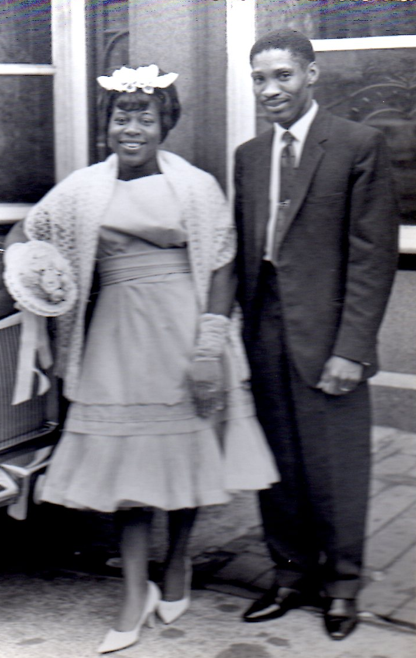
Esther Stanford-Xosei’s parents, Yvonne Stanford & Courtney Stanford, circa 1963
It is important to realise that we are in a political moment, this can help advance the movement, (International Social Movement for Afrikan Reparations (ISMAR), but not the way much of the campaigning and public discourse has been directed so far. The intergenerational mission and goals of the ISMAR is totally absent from this self congratulatory fervour about the apology to so-called “British Caribbeans” and promises of compensation, (remember when we were referred to as ‘Afro-Caribbean’ and then saw ourselves as African-Caribbean?).
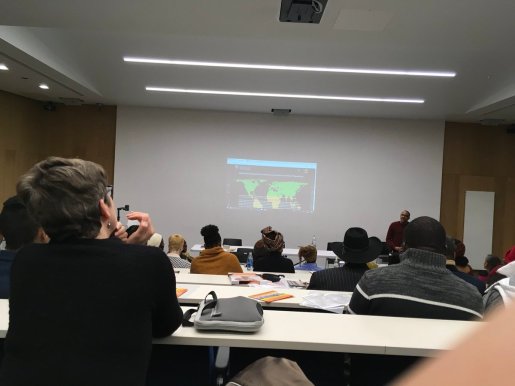
As promoted at the recent INOSAAR (International Network of Scholars & Activists for Afrikan Reparations) Birmingham Conference which took place in March, according to PARCOE the intergenerational goals of applied reparations are to:
1. Learn about, recognise and ‘Stop the Maangamizi’ including the horrors of enslavement, colonisation, neocolonisation, recolonization and other imperialist and foreign impositions on Afrikans at home and aboard, including forced Europeanisation and Arabisation.
2. Counter Afriphobia as a manifestation of white-supremacy, eradicating Afrikan dehumanisation, and assertion of the Afrikan personality.
3. Restore Afrikan sovereignty by redressing with MAATUBUNTUMANDLA (Pan-Afrikan Government of Peoples Power) the disrepair in our power and usher in a fundamental change of the existing world order that would definitively bring about new geopolitical realities such as MAATUBUNTUMAN; the antiimperialist sovereign Pan-Afrikan Union of Communities/polity of Afrikan people’s power.
4. Effect systemic change globally to ensure the expropriation and redistribution of ill-gotten wealth, resources and income worldwide.
5. Implement New paradigms of development including a new, international, legal, political, cultural and economic order.
6. Institutionalise the Afrikan cosmovisions and ethical principles of Maat and ubuntu in terms of global justice for all. 1
7. Enforce environmental elements of global justice full respect for Mother Earth/
Nana Asase Yaa rights. 2
We can actually measure how consonant the approaches being taken to campaigning for the ‘Windrush generation’ with the pre-existing and ongoing struggle for Afrikan Reparatory Justice by looking how much or little Windrush campaigning is relating to the aforementioned political goals.
I shall say more about the Caribbean case in relation to the Global Afrikan case for reparations later in this thought-piece.
First of all let me say that we must be mindful that our historical and contemporary oppressors are masters at deception and psychological manipulation.
At the risk of mistakenly being considered insensitive, in the awareness of so many harrowing testimonies of Windrush generation affected persons, I am also interested in why there is so much media and governmental focus on the ‘Windrush Generation’ to the exclusion of all other atrocities and injustices against people of Afrikan heritage. Perhaps it has something to do with the forthcoming 70th anniversary of the landing of the Empire Windrush in 1948, the British establishment-promoted re-conditioning, contemporary ‘seasoning process’ and re-affirmations of benevolent notions of Britishness etc. as well as the elevation of the ‘special relationship’ Britain has with the Caribbean, as did their forebears who colonised the peoples found and brought there.
I have been wondering about the other Commonwealth citizens who may be affected by this British governmental ‘hostile environment’ created around the situation of economic and political migrants who came from the Caribbean and Afrika. Are we certain that it is only ‘Windrush generationers’ that are being affected? Or is this an issue that is happening to other so-called Commonwealth citizens?
The former head of the civil service, Lord Kerslake, said that some ministers were “deeply unhappy” about the introduction of the “hostile environment” strategy under then Home Secretary Theresa May. Speaking to BBC Newsnight, Lord Kerslake, said some saw the policy, which has come under the spotlight during the Windrush row, “as almost reminiscent of Nazi Germany in the way it’s working”, i.e. genocidal!!!3
This matters, because we must be on guard against a select group of us as members of the Afrikan Diaspora being elevated for special concern (apology, compensation etc. which is not being framed as part of Afrikan people’s struggle for reparatory struggles) and not others.
In a recent Guardian article by Kate Osamor, Shadow Secretary of State for International Development, she points out that she is dealing with a number of cases within her constituency of Commonwealth citizens being threatened with deportation. Notably, she points out that some of these constituencies come from Uganda, Ghana, Nigeria, Barbados and Antigua and Barbuda – all Commonwealth countries and emphasises that countless people came to the UK from Commonwealth countries before 1973. 4
So, I am wondering why we are not hearing the testimonies and further news reporting on other Afrikan people who are citizens of Commonwealth countries. Whose voices and lives are being deemed not to matter, and how are we advertently or inadvertently feeding into this silencing and marginalisation of the narratives of other Afrikans?
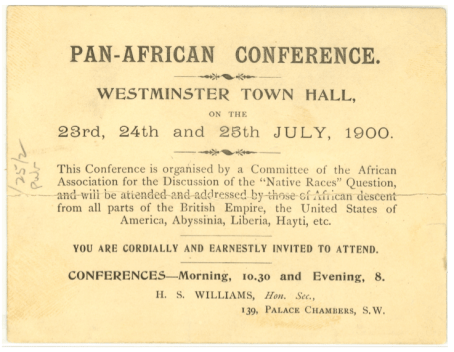
As Professor Gus John has stated in his recent commentary ‘70th Anniversary of Windrush 1948 – A View by Professor Gus John’ 70th Anniversary of Windrush 1948 – A View by Brofessor Gus John:
“To focus upon and make iconic the arrival of the Windrush in 1948 carrying 492 members of the Global African Diaspora from the Caribbean, a region that imperial Britain had made home to their enslaved Ancestors, is to suggest that there was not an African presence in Britain prior to 1948, including a sizeable number of people from the Caribbean”
It is important to remind ourselves that they were part of the Afrikan Diaspora in Britain and made common cause with their brothers and sisters from the Afrikan continent (and other parts of the Afrikan Diaspora) who were/are also resident in Britain. By projecting ‘The Windrush Generation’ above other Afrikan Diaspora and Afrikan ‘Commonwealth citizens’ we are not only in danger of erasing the contributions and struggles of earlier generations of Afrikans from the Continent of Afrika and from the Caribbean in Britain, we are also feeding into compounding:
“the divisions, generated and reinforced by the British themselves, between African Caribbean people and African people as two separate ethnic groups, rather than as one people with a common heritage and with an interrupted history.”
– Taken from ’70th Anniversary of Windrush 1948 – A View by Professor Gus John’

What is being cultivated in this political moment of spotlight on Windrush is Caribbean exceptionalism based on a special relationship to ‘Britishness’. The Caribbean has been portrayed as a place where people are being sent to as though they are criminals and have done something wrong, this is coming from the testimonies of those who have been affected. There are assertions of people’s right to be British and some of those affected have gone so far as to say “I am an Englishman” (e.g. Junior Green, aged 60, who arrived in the UK when he was 15 months old as part of the Windrush generation). These are all examples of identity erasure and misrecognition. Identity erasure is the act of neglecting, looking past, minimizing, ignoring or rendering invisible an other.
In my view, this distorted sense of self, i.e. individual, collective and community self, is one of the greatest Maangamizi crimes perpetrated by the British state in creating and misusing the economic, political and cultural conditions which compelled many of the so-called Windrush Generation to come to these shores – For it cultivated a sense of natal alienation, the seeds of which were already planted by the systematic dispossession of the descendants of the Afrikan enslaved, social and civil death of Afrikan personhood and personality as well as the subsequent erasure of Afrikan identity which began in the colonies and continued in the British metropolis. All this could only be done because of the British colonial and post-independence CARICOM states-induced forgetting and disassociation from the Afrikan Motherland, as well as devaluation of Afrikan heritage and culture, designed to inculcate in us defence of and servility to the British Empire.
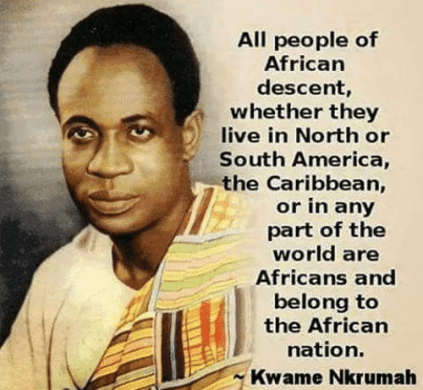
I have even heard reference to the phrase descendants of the Windrush Generation which is a historical departure to the notion of being of Afrikan decent or ‘African descendants’ a term that was popularised following the 2001 World Conference Against Racism, Racial Discrimination, Xenophobia and Related Intolerance. In effect reducing us to just a small aspect of our history and experience of the Maangamizi (i.e. The Windrush Experience); thereby inadvertently denying people of Afrikan heritage a right to everything that has been taken from us and that we are entitled to by virtue of our people’s experiences of the Maangamizi. The entitlement of the whole is being misguidedly reduced to the compromised position of going after a part of our entitlement in terms of narrow proposals for Windrush compensation.
More disturbingly, we are witnessing a weaponizing of the cultivation of ‘Windrush Generation Consciousness’ as an effective form of British state counterinsurgency in order to further prolong aspects of the Maangamizi and counter Afrikan heritage communities resistance to the Maangamizi today; especially in terms of seeking to undermine Afrikan Heritage Communities struggles and advocacy of holistic reparations. In addition to dissuading people of Afrikan ancestry and heritage from identifying as ‘Afrikan’ or of ‘Afrikan heritage’ thereby completely diverting us from waging any real struggle in our own group (collective) best interests resulting in us appealing to our historical oppressors and contemporary oppressors as saviours inculcating in us more forms of servility. What comes to mind in this regard is to look at how fowls are caught, often all it takes is to throw the fowls some corn or feed. The fowl will often go after it, not examining who is throwing the feed, whether it is good for them, genetically modified, or even being used as a bait to kill them etc. On the contrary there are members of the Animal Family that will instead sense some form of danger even when it may appear that they are being offered something good.
What is happening causes a great dilemma e.g.: what is the nature of the fight that we wage in support and defence of those affected? What are we and they fighting for and are they the same thing? This is a question which is not just a personal but also a historical question.
In the GAPP emerging position on CARICOM reparations, it states:
“Claims and case of Afrikan reparations are based on the principle of intergenerational justice and therefore has transgenerational, transnational and intercultural dimensions…As descendants of Afrikans who were enslaved, we are mindful of our ancestral responsibility to ensure that when we speak in their names we do not allow the enslaver’s visions of justice to prevail in advocating what are considered to be adequate reparations. The discourse on reparations has to move beyond merely calling on the name of our ancestors as justification for the genesis of our entitlements to redress today to truly recognising the personhood, worldviews and visions of justice of the Afrikans that were enslaved in the Americas and the Caribbean. … To give primacy to their enslaved status and legal and justice frameworks of their enslavers and their descendants; continues their deracination, invisibilisation and dehumanisation…We therefore endorse the view of Professor Chinweizu that our own search for reparations must, of necessity, be tailored to our peculiar condition, to our peculiar experience. In this regard, the measures of reparations must be flexible and account for the ethnic and cultural diversity amongst Afrikans as well as the diverse historical experiences of enslavement, colonialism and their legacies today. Frameworks for Afrikan reparations (including reparations for people of Afrikan origin in the Diaspora), must also address Afrikan & Afrikan Diaspora epistemologies (ways of knowing) concerning what ‘repair’ means and looks like…Equally, we have a responsibility to future generations to ensure that the decisions we make today do not negatively impact the interests or wellbeing of the unborn and each generation to come. This means that whatever reparations outcomes we seek to effect and secure today leave a better legacy for our children and our children’s children and do not end up looting their freedom account and ability to live lives of dignity as Afrikans and people of Afrikan heritage on this earth.”
Reflecting on several British anti-establishment dramas/films that have been screened in recent times to prepare our minds for the ‘defender of Empire’ role that many of us are being socially-engineered to assume:
‘Undercover’ 5
‘Hard Sun’ 6
‘Guerrilla’ 7
‘The Foreigner’ 8
…it become more visibly apparent that some of us as Afrikan Caribbean people actually end up being the most trusted and loyal servants, defenders and advocates of the British empire/establishment. This defence of the British Empire is not to be conflated with the claim for Afrikan Reparatory Justice which has always been in opposition to Empire and for Afrikan Self-Determination, locally, nationally and internationally.
I am re-sharing aspects of the analysis of I’Nora Kamala (Dr Nora Wittman) in her article ‘Slavery Reparations – A Caribbean or Global African Claim’:
“Indeed, there is a fundamental problem with the recent CARICOM reparations initiative. Basically, that problem is that it is a Caribbean initiative, based on the conceptualization of a ‘Caribbean’ reparations claim. But the claim for transatlantic slavery reparations is not a Caribbean claim, it is a global African entitlement to reparations, and intrinsically so…It is thus crucial to grasp that it is not Caribbean societies and states as such that have a claim to transatlantic slavery reparations – though they will undoubtedly profit in their entirety from comprehensive global African reparations. The structural and most ferocious violence against the African by Europeans is what Caribbean societies were founded upon. Thus, without reparations and healing directed specifically at the African, no healing can come for Caribbean societies. Global African reparations are the heartpiece of healing for Caribbean societies…Yes, Caribbean nations need healing, but the violence that was and still is perpetrated against the African part of the Caribbean was so fundamental to the coming into existence of Caribbean societies that the healing also has the be directed specifically at Africans. And not only Africans
in the Caribbean, but Africans globally and especially also on the African continent.”9
In proclaiming the United Nations International ‘Decade for People of African Descent’, Flavia Pansieri (former United Nations Deputy High Commissioner for Human Rights) said: “people of African descent represent a distinct group whose human rights must be promoted and protected”. People of Afrikan descent’s legal personality is based on being Afrikan not ‘British’, ‘English, ‘Afropean’ or ‘European’. Afrikan people have other options than to confine themselves to a second-class deracinated status of Britishness, they can be also fighting for their ‘right to Afrika’ as is being championed by ENGOCCAR, (the Europe-wide Consultative Council for Afrikan Reparations), who are partners to the ‘Stop the Maangamizi!’ Campaign, in Europe.
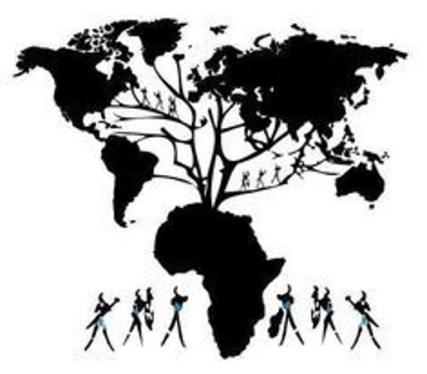
What is the Right to Afrika?
Right to return (repatriation) and belong (rematriation) which is one process. One cannot happen without the other. It encompasses the Akan Sankofa principle of going back to fetch your Afrikan personality in material and spiritual terms all routed in the land of Afrika. Your personality includes the continent of Afrika, the land, peoplehood and wealth for Afrikans at home and in the Diaspora. This does not mean that everyone physically has to up and return to Afrika, but that one can enjoy the citizenship rights and responsibilities of being an Afrikan wherever we are. Ultimately it is about seeing yourself as having the right to all the material and spiritual wealth of Afrika to the point that such wealth as a whole ought to be utilised first and foremost for your own personal and community development, wellbeing, security and prosperity in the present and in the future wherever you are.
So here in Britain, for example, anyone of Afrikan heritage should feel entitled to being the main determinant and stakeholder in how the British State and Society best relates to the people and continent of Afrika in order to ensure that the benefits of that relationship first and foremost uplift the dignity and standard of living of people in our Afrikan Heritage Communities in this country. Nothing should be done about Afrika by the British State or any of its organisational and individual representatives without respecting the agency of our Afrikan Heritage Communities in determining how this should be done. In effect this means that the power inherent in determining what Britain gets or does not get from Afrika is entirely in the hands of people in our Afrikan heritage communities here in Britain shared only with other Afrikan people throughout the Continent of Afrika and the Diaspora. This gives Afrikan Heritage Communities here in Britain a decisive say in the affairs not only of Afrika but of Britain and the rest of the Euro-American world;which cannot exist and wields the kind of global might and influence they currently have without the stranglehold they have had on Afrika since the full imposition of the chattel enslavement phase of the Maangamizi.
That is why instead of craving for the fake carrot stick of Britishness we should be demanding and fighting to secure global Afrikan citizenship that will entitle people from our Afrikan Heritage Communities to belong not only to one particular country in the Euro-American World but more importantly to Afrika and anywhere else in the World where the crimes of the Maangamizi have been perpetrated and continue to be committed against us by all the powers of European imperialism.
What is glaringly obvious is the betrayal of CARICOM heads of government and their Caribbean Reparations Commission in terms of saying noting at these CHOGMs (Commonwealth Heads of Government Meetings) about reparations. Despite recent Emily Thornberry’s assertions about the need for the UK PM to apologise for historic wrongs, this has resulted instead with Theresa May’s apology to ‘LGBT’ communities for “colonial-era anti-gay laws.” 10 It is said that May was responding to calls from LGBT activists for an apology over the UK’s legacy on the issue. Yet despite all this talk of colonial-era legacies, we have not heard a dickie bird from any of the Heads of Government present at these CHOGMs about the cause of reparatory justice for the Afrikan people in the Caribbean, or indeed their own CARICOM ten-point plan!
Rather, the focus has been on decriminalisation of ‘anti-sodomy’ laws in Afrika and the Caribbean. The ongoing struggle for reparatory justice which is at its core a struggle for Afrikan people’s liberation at home and abroad, features nowhere!
Whereas support for and recognition of homonationalism and LGBTI minority rights is what seems to be gaining unprecedented recognition. 11 There is some interesting scholarship on how LGBTI social movement organizations have been engaging internationally and focused on engagement in the Commonwealth as a terrain of struggle.12 It has generally been under-theorised how human rights can be co-opted into imperial political projects, particularly concerning the elevation and promotion of sexual nationalisms:
“Since its formation in 2011, the Kaleidoscope Trust has emerged in the United Kingdom (UK) as the leading institutional actor working internationally on lesbian, gay, bisexual, transgender and intersex (LGBTI) human rights. In particular Kaleidoscope as a non-governmental organization (NGO) has been pivotal in defining and developing the Commonwealth as an intergovernmental structure to be engaged by LGBTI social movements. A particularly interesting development has been Kaleidoscope’s leading role in creating The Commonwealth Equality Network (TCEN) as a transnational network of national LGBTI NGOs, to lobby the Commonwealth. 13
In fact, there is a sinister silence from them! After all, the CARICOM claim is based on reparations for Afrikan slavery and native genocide. So, it is clear that CARICOM Heads of Government do not mind seeking to receive benefits on behalf of Afrikan heritage citizenries but fail to represent their interests in international gatherings. Not only have they failed to represent the interests of their citizenries on reparations in these CHOGMs, they are also marginalising the interests of those communities in the Caribbean who have always been linking with Afrika and promoting Afrikan identity such as the Rastafari Community etc. (see the video below for a discussion on LBC radio PARCOE as well as SMWeCGEC Co-Vice Chair, Kofi Mawuli Klu which highlights this point). Instead, we can see them contributing to a form of genocidal ethnic cleansing of Afrikan heritage communities in the Caribbean and denial/marginalisation of the their ancestral as well as contemporary links to Afrika and by extension other Afrikan Diaspora communities.
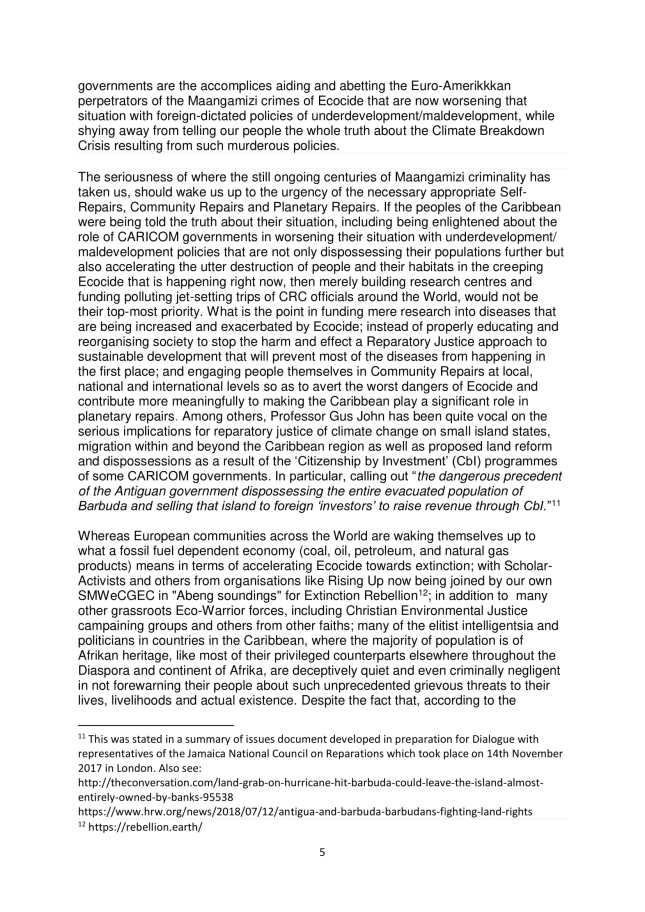
We as various constituencies of the ISMAR within Europe, Abya Yala (the so-called Americas), including the Caribbean and indeed Afrika should have been better prepared to find raise to raise the issue of reparations for these CHOGMs. This issue was raised with the delegation from the Jamaica National Council on Reparations that visited the UK in November 2017 among a number of other proposals for action that we could take together. However, we have not heard back from them about our proposal for joint-working since. 14
“You cannot successfully oppress a consciously historical people”
John Henrik Clarke
Endnotes
1 Cosmovision is a view of the basic nature of the Cosmos, it is fundamentally different than that of European culture. This means that we can’t simply force Afrikan ideas into Western and Eurocentric conceptual categories. A people’s cosmovision can be manifested in and studied via its material culture.
2 https://en.wikipedia.org/wiki/Law_of_the_Rights_of_Mother_Earth
Nana Asasa Yaa is the Earth goddess/deity of the Ashanti people also known as is Nyamewaa (goddess) and is the personification of the planet many people call Earth. She is also identified as the First Woman in the form of Aberewa. She is wife and consort of Nyame Anansi Kokuroko, the Creator of All. There is an Afrikan equivalent of Mother Earth Rights.
5 http://www.bbc.co.uk/programmes/b076vdbc
6 http://www.bbc.co.uk/programmes/p05pc0xs
7 https://en.wikipedia.org/wiki/Guerrilla_(miniseries)
8 https://en.wikipedia.org/wiki/The_Foreigner_(2017_film)
10 http://www.bbc.co.uk/news/uk-politics-43751518
http://novaramedia.com/2016/06/19/gay-pride-capitalism-what-is-pinkwashing/
https://www.pinknews.co.uk/2018/04/17/theresa-may-commonwealth-anti-gay-laws/
11 Homonationalism, coined by Rutgers University professor Jasbir K. Puar in 2007 is the intersection of gay identity and nationalist ideology. According to Puar, as gay people have become “normalized” in Euro-American consciousness, these victories in their struggle for recognition have created space for the homonationalist who abandons intersectional activism and advocates racist, xenophobic, capitalistic self-interest. Homonationalism involves conceptually realigning the ideas invested within the realm of LGBT activism to fit the goals and ideologies of neoliberalism and the far-right. This reframing is used primarily to justify and rationalize racist and xenophobic perspectives. It remains notoriously difficult to define who makes up the “LGBT community”, and particularly what identifying as LGBT means in terms of lifestyle, political goals etc.
https://www.huffingtonpost.co.uk/entry/gay-people-supporting-trumphomonationalism_
us_57f3e545e4b01b16aaff4bff
Other concepts to be familiar with are homocolonialism and pink-washing: Homocolonialism – Building upon Lisa Duggan’s notion of homonormativity, and Puar’s homonationalism, Momin Rahman conceptualises homocolonialism as a process of triangulation that legitimises Western exceptionalism illustrating how LGBTI politics is caught up in the promotion of the assumed civilizational superiority of western modernity, and thus opposition to SOGI rights (Sexual Orientation, Gay & Intersex) becomes framed as resistance to western cultural colonialism.
https://dismantlinghomonormativity.weebly.com/index.html
https://static1.squarespace.com/static/55120ecae4b01593abadc441/t/581286792994ca39cb11ce88/1
477609082756/LGBTI+and+Muslims+Rahman.pdf
Pink-washing is the invocation of gay rights in order to divert attention from and justify the occupation of the lands and territories as well as the violation of the group rights of colonised and oppressed peoples. The term combines the words pink and whitewashing. In the context of LGBT rights, it is used to also describe a variety of marketing and political strategies aimed at promoting products, countries, people or entities through an appeal to gay-friendliness, in order to be perceived as civilised, progressive, modern and tolerant. Celebrating LGBT rights is a fashionable topic in marketing land. Its main usage is to describe the Israeli government’s ‘deliberate strategy to conceal the continuing violations of Palestinians’ human rights behind an image of modernity signified by Israeli gay life’. http://www.nopinkwashing.org.uk/
See this link for my own encounters with homonationalism/s in the workplace
http://www.africanholocaust.net/africanwoman.html
13 http://eprints.gla.ac.uk/122728/1/122728.pdf

Greetings Supporter of the ‘Stop the Maangamizi: We Charge Genocide/Ecocide!’ Campaign (SMWeCGEC)
This is the response from Dr David Duncan, Chief Operating Officer and University Secretary to the SMWeCGEC open letter sent to the University of Glasgow History of Slavery Steering Committee.

Until next time!
‘Stop the Maangamizi: We Charge Genocide/Ecocide! Campaign International Steering Committee Spearhead Team (ISC-SMWeCGEC)
#StopTheMaangamizi!
#Educational Repairs!
#Institutional Repairs!
#Decolonise!
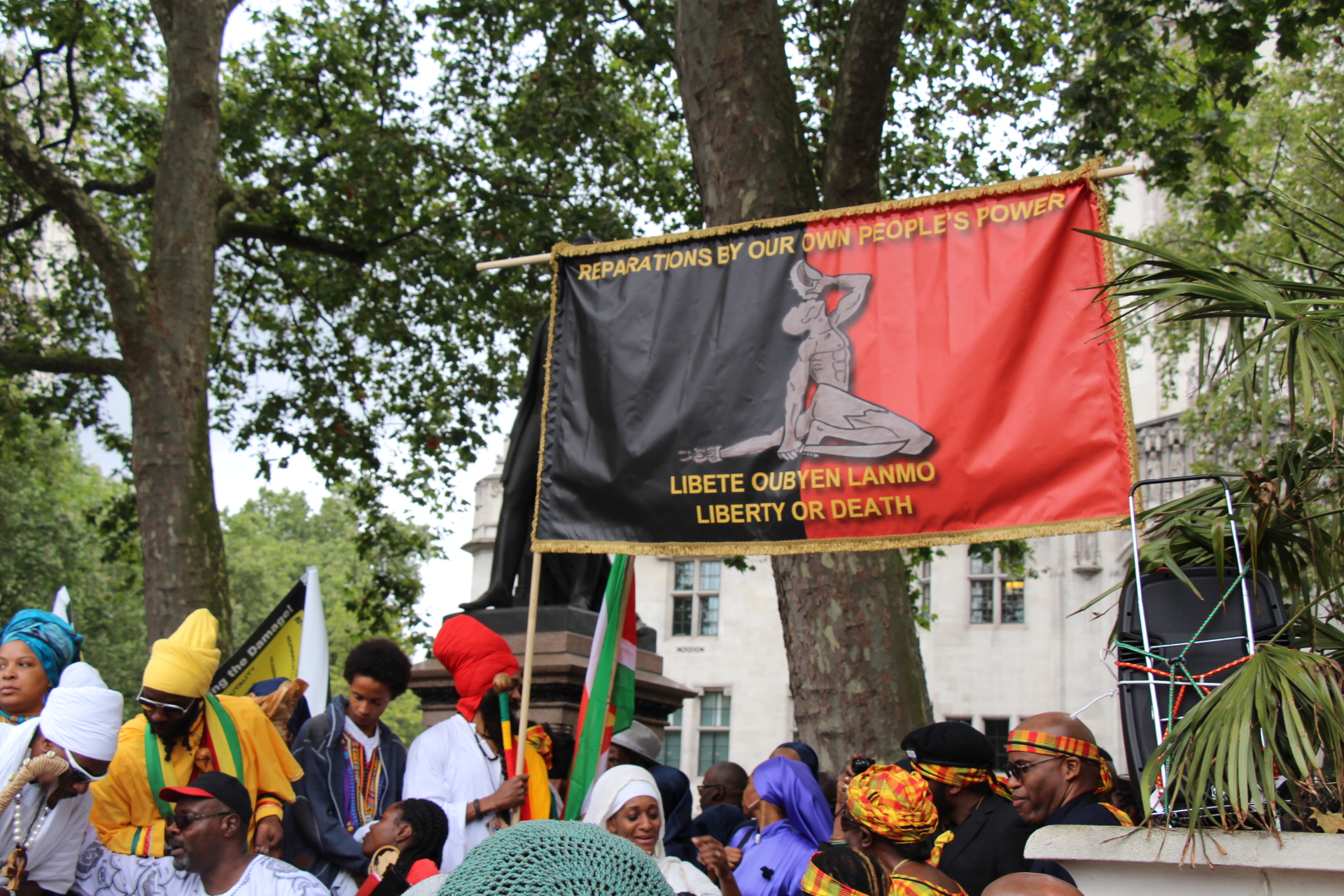
Selected images from the 2018 Afrikan Emancipation Day Reparations March
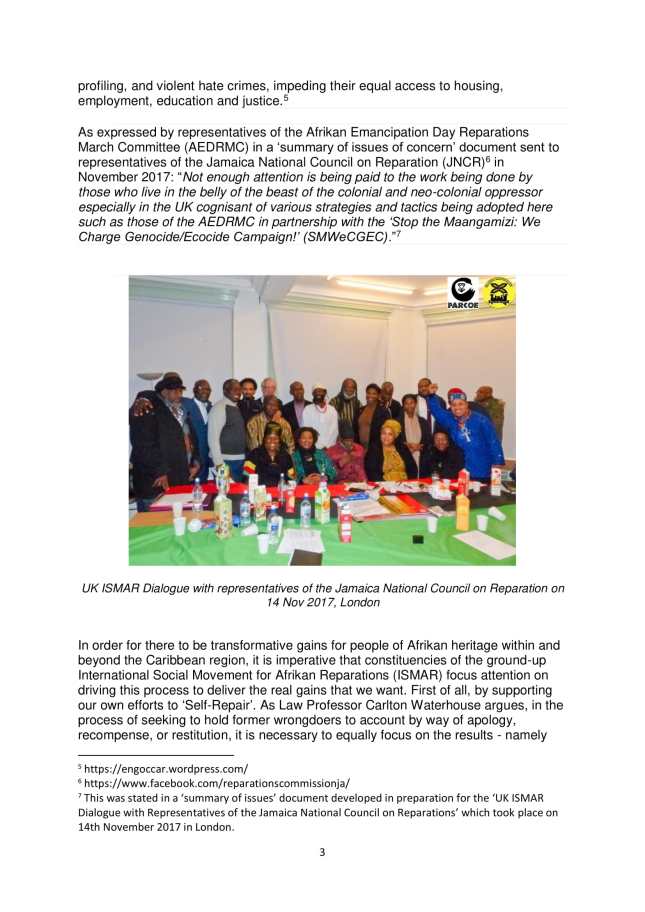
We see that our Afrikan Reparatory Justice efforts in general, and the work of the Afrikan Emancipation Day Reparations March Committee (AEDRMC) in particular, is now beginning to impact on British establishment political thinking; in terms of how to respond to our own community self-repair endeavours and the demands we are making, out of such endeavours, upon others. This is evidenced in the recently published Huffington Post article: ‘In the Wake of Windrush, Marking Emancipation Day is More Important Than Ever‘ by Dawn Butler MP, Shadow Minister for Women and Equalities and Labour MP for Brent Central.
It is encouraging to note that our criticism of the repugnant name of a Slavery Educational Trust which was made in AEDRMC promotional videos here and here has resulted in an attempt to rename such a proposed body to become the Emancipation Educational Trust. This still misses the whole point. Our preference for a name like the Afrikan Anti-Slavery Resistance Educational Trust (AASRET) still holds. It is mind-boggling that even some leading British Labour Party members, including MPs from our own Afrikan heritage communities, are still so engulfed by Afriphobia that they run away from including and explicitly identifying with anything Afrikan in the name of initiatives that are supposed to be about the Afrikan experience. This is even more shocking given that we are in the United Nations International Decade for People of African Descent which has the theme ‘People of African Descent: Recognition, Justice and Development.’ Indeed, there is nothing more unique to the global experience of Afrikan people other than the Maangamizi, (Afrikan Hellacaust) in relation to which this educational trust is being proposed.
So pervasive is this Afriphobia, and so strongly does the British State hold unto it, that it is inherent in the processes of white supremacy racist brainwashing through which all those selected, even from our Afrikan heritage communities, to serve in various positions of the establishment are infected with it. Hence its prevalence amongst virtually all members of the British State legislature, executive, civil and public services, judiciary, armed forces, police, intelligence and other security agencies. It appears that not only submission to but an overt display of Afriphobia is a requirement for service in the institutions and agencies of the British State. No wonder it is those selected from our Afrikan heritage communities to serve in these institutions and agencies who appear to exhibit the worst traits of Afriphobic epistemic and structural violence upon Afrikan Heritage Community people. That is why the ‘Stop the Maangamizi: We Charge Genocide/Ecocide!’ Campaign (SMWeCGEC) regards all these institutions and agencies of the British State as ‘Maangamizi crime scenes’.

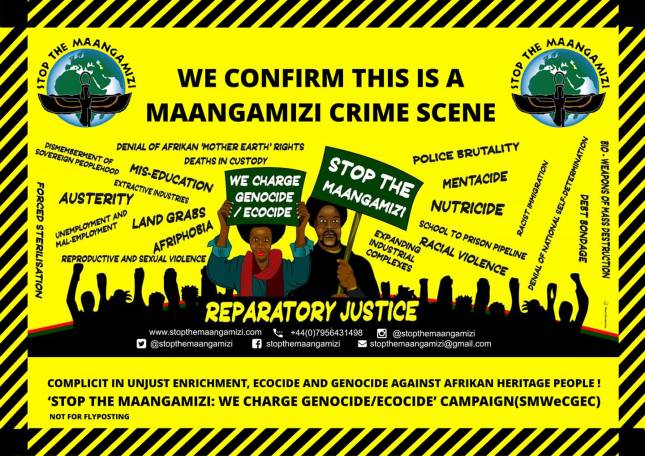
The proposed Emancipation Educational Trust will be nothing but another Maangamizi crime scene if it is established with the same intention of avoiding explicit Afrikan identification, whilst seeking to make it simply distortedly flirt with a commoditised form of Afrikan history and experiences. So, we urge Jeremy Corbyn, as leader of the Labour Party and the Party itself to study carefully, the themes and messages, which were promoted on the 1st August Afrikan Emancipation Day Reparations March: ‘Nothing About Us Without Us!: Actualizing the Reparatory Justice Change We Envisage’. It is about time the Labour Party stopped this nonsensical beating about the bush, openly confronts its deeply ingrained Afriphobic racism and seeks to honestly counteract it. This includes taking clear steps to initiate open dialogue with the legitimate grassroots representatives of our Afrikan heritage communities of reparations interest in the UK. Such representatives are clearly known through their visible work in organising endeavours such as the annual Afrikan Emancipation Day Reparations March and its related ‘Stop the Maangamizi!’ campaign activities.
The continuing attempts to evade substantive representation of our Afrikan heritage communities; by bringing members of the Labour Party far removed from such activities and also afflicted with white supremacy racist indoctrination to simply express, their ‘masters’ voices and prejudices in toying with vital matters concerning the survival of Afrikan people in the world today, such as reparatory justice, must be understood as no longer acceptable to us at all. We expect Jeremy Corbyn as leader of the Labour Party, to embrace this firm, non-negotiable standpoint of ours, against all Afriphobic expressions of the Maangamizi as part of the ‘new politics’ he promised Britain, the Commonwealth and the World.
We know Jeremy Corbyn can do better because in his laudable solidarity work for the Anti-Apartheid Movement he displayed some of his best efforts to date of internationalist solidarity with our Afrikan Liberation Struggle. We therefore hope that he will go back to such track-records of his own best practice and do the correct thing once again. The correct thing begins with him taking steps to initiate the dialogue we have been calling for by meeting, to start with, representatives from the Afrikan Emancipation Day Reparations March Committee (AEDRMC), the organisers of the annual 1st August Afrikan Emancipation Day Reparations March and their partners in the SMWeCGEC.
In Service
Esther Stanford-Xosei
Coordinator-General ‘Stop the Maangamizi: We Charge Genocide/Ecocide!’ Campaign


All images are the © copyright of Thabo Jaiyesimi and must be accredited as such
14,590 Signatures of the ‘Stop the Maangamizi: We Charge Genocide/Ecocide!’ Petition handed-in
The 6-member delegation for the 2018 hand-in of the ‘Stop the Maangamizi!’ Petition were:
From Right to Left
1. Hon. Prophet Kweme Abubaka (Afrikan Emancipation Day Reparations March Committee, Ethiopia African Black International Congress)
2. Dr Barryl Biekman, (Europe-wide NGO Consultative Council for Afrikan Reparations, Netherlands)
3. Mama Lindiwe Tsele (Pan-African Congress of Azania)
4. Ms Kambanda Veii (Ovaherero Genocide Foundation, Namibia)
5. Cllr Joshua Brown-Smith, age 12 (Office of the Young Mayor, London Borough of Lewisham)
6. Professor Gus John (Gus John Associates, Member of the African Union Technical Union Technical Committee of Experts on the 6th Region).
The delegation which handed-in the 2018 ‘Stop the Maangamizi: We Charge Genocide!’ Petition represents a selection of the diversity within our Afrikan Heritage Community. The Young, The Elders, Born on the Continent, Born in the Diaspora, Male and Female, and as in previous members some members flew in from Afrika and Europe!
#ReparationsMarch2018
#Parliament is a Crime Scene!
#StopTheMaangamizi!
See the following letter which accompanied the hand-in of the ‘Stop the Maangamizi!’ Petition
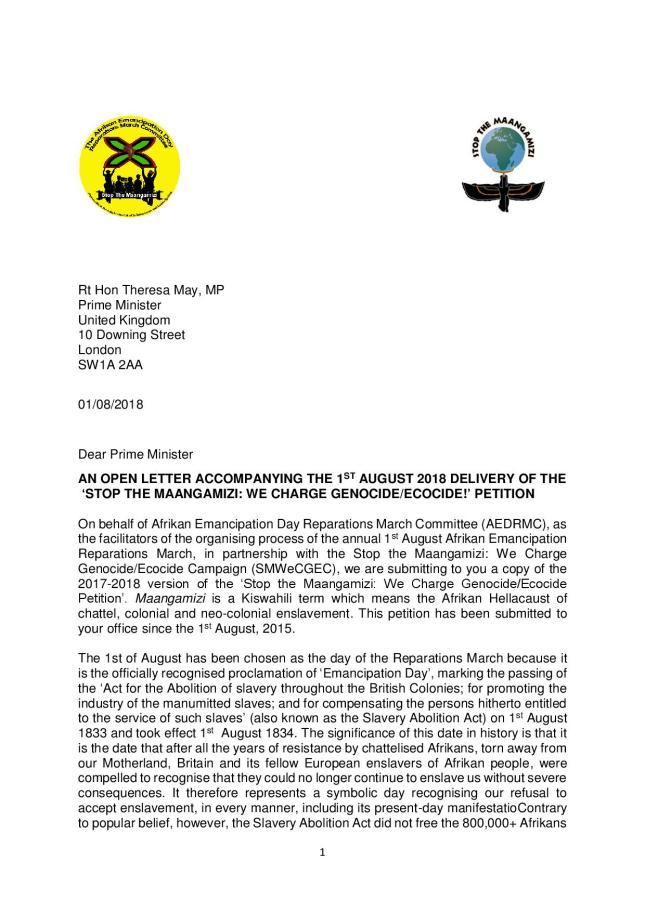
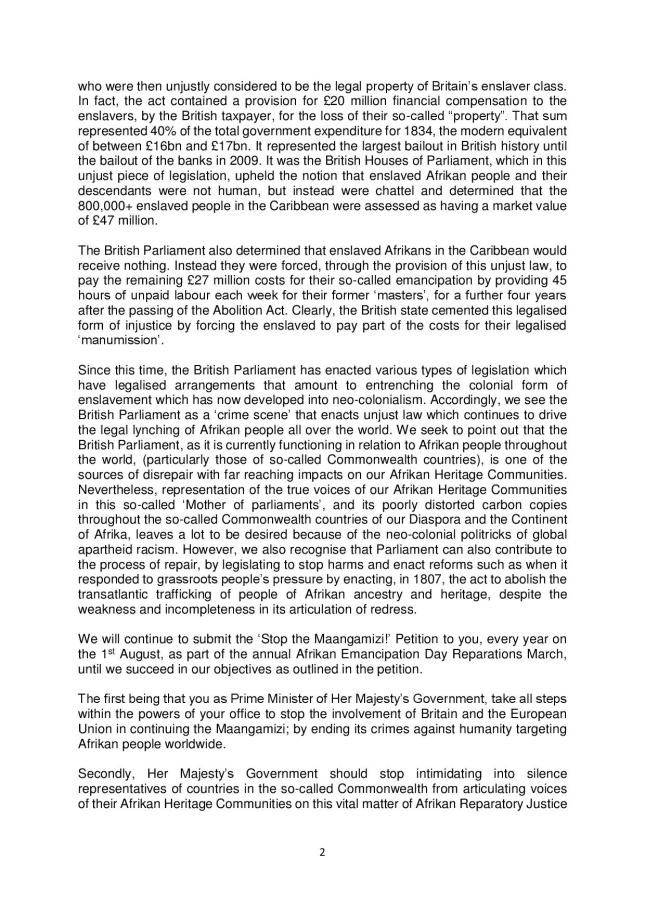



Please note, the ‘Stop the Maangamizi!’ Petition has been handed-in since 2015, in 2016 no signatures were handed in just the petition and a cover letter. In 2016, 5811 signatures were handed in, in 2017, 9636 signatures were handed in.
It is important to note that the ‘Stop the Maangamizi!’ Petition is not the only tactic we are adopting, the petition signatures accompany a Maangamizi Crime Scene sticker operation and lobbying of MPs strategy via the ‘Stop the Maangamizi!’ Postcard involving support for developing Afrikan Heritage Community advocacy on the points contained in the petition.
It is also important to note that we in the International Steering Committee Spearhead Team of the ‘Stop the Maangamizi!’ Campaign (ISC-SMWeCGEC) know that reparations will not be achieved simply by submitting this petition, if one reads the petition it is clear that this is not our thinking. In numerous articles and documents we talk about the March and the petition being part of revolutionary strategy and tactics that we are engaged in, which also involve all forms and levels of liberation struggle waged by various contingents of the International Social Movement for Afrikans (ISMAR).
The Afrikan Emancipation Day Reparations March and the annual hand-in of the petition is about building a broad public support base for consolidating the ISMAR in order to strengthen the harnessing and building of Afrikan people’s power to advance reparations to definitive victory; whiincluding the establishment of MAATUBUNTUMAN Pan-Afrikan Union of Communities.
See the following links for further info about the strategy and tactics of the ‘Stop the Maangamizi!’ Campaign in association with the Afrikan Emancipation Day Reparations March Committee:
As we approach the 3rd year of marching, what has been achieved? (2016)
https://stopthemaangamizi.com/2016/07/13/approaching-3rd-year-of-marching-what-has-been-achieved/
After 4 years of marching, what has been achieved? (2017)
https://stopthemaangamizi.com/2017/08/07/after-4-years-of-marching-what-has-been-achieved/
Rationale for Afrikan Reparations March (2018)
This video is of a workshop which took place on Friday 27th July, 2018 and provides some elaboration on the revolutionary thinking and work into for the long-term results that the March is meant to produce and to which it is already contributing.
This is a link to the initial response that was received from the Foreign & Commonwealth Office (FCO) in response to the 2017 ‘Stop of the Maangamizi!’ Petition and its covering letter, and also the further response from FCO Minister Lord Ahmad.
“Pan-Afrika, and not Eurafrica, should be our watchword, and the guide to our policies.”
– OSAGYEFO KWAME NKRUMAH, ‘Africa Must Unite’, 1963.
“It will be gross self-delusive wishful thinking to believe that those wielding the reins of White racist supremacy are going to pay any serious heed to the Afrikan demand for Reparations, unless their hold on the machinery of global power is effectively challenged by the well-organised, upsurgent and self-empowering masses of Afrikan people, and their allied progressive forces throughout the World.”
Kofi Mawuli Klu ‘Charting an Afrikan Self-Determined Path of Legal Struggle for Reparations’: A Draft Paper for Presentation to the 11th December 1993 Birmingham Working Conference of the African Reparations Movement, UK, 1993.
“At this juncture in our history, there is no way forward in addressing the problems that Afrikans and people of Afrikan descent and all other Black peoples face without seriously grasping the truth of the necessity for holistic reparatory justice. This includes restoring self-determination and sovereignty, implementing measures of cessation of contemporary violations, restitution.”
Esther Stanford-Xosei, 2016
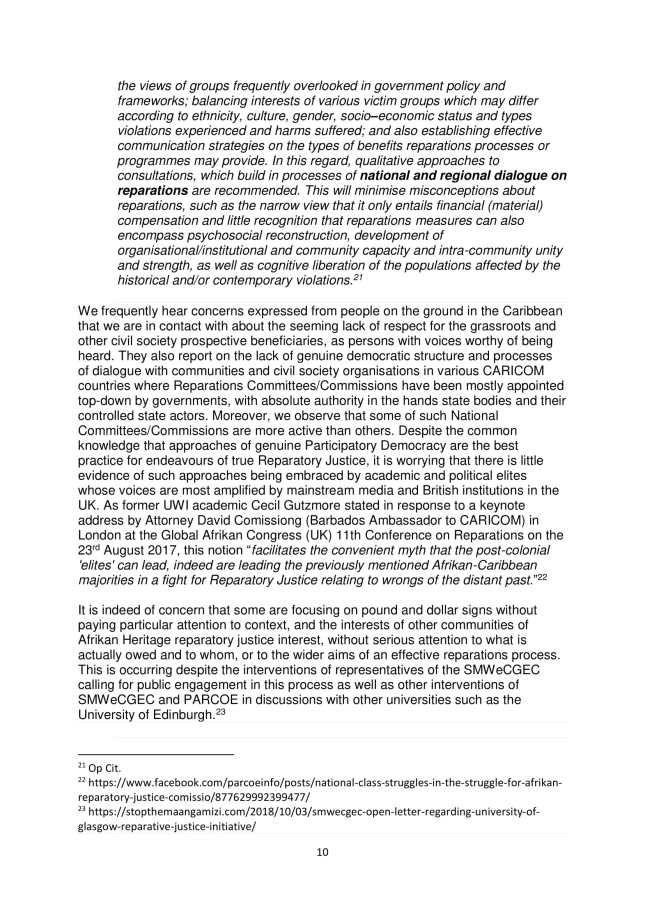
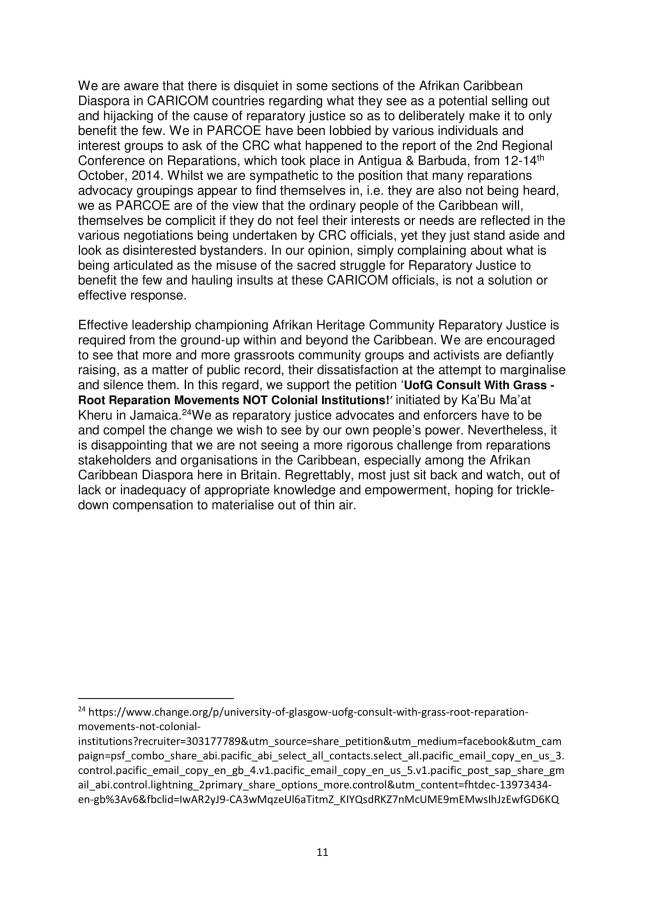
This workshop will explore the meaning of the theme for the 5th annual Afrikan Emancipation Day Reparations March on 1st August 2018: ‘Nothing About Us Without Us: Actualizing the Reparatory Justice Change We Envisage.’ The main question we will discuss is: What kinds of tackling of problems and injustices that Afrikan people encounter can be deemed as the everyday repairs starting point of reparatory justice work? In this regard, we will highlight the outreach and other mobilizational work of the Afrikan Emancipation Day Reparations March Committee (AEDRMC), in association with the ‘Stop the Maangamizi: We Charge Genocide/Ecocide!’ Campaign (SMWeCGEC) with a view to making people see themselves as the actual ‘makers’ and ‘drivers’ of reparatory justice rather than being passive recipients of the benevolence of government and other state actors. This kind of thinking in views expressed by the likes of CARICOM Reparations Commission, Chairperson, Professor Sir Hilary Beckles when he reportedly stated in a recent interview published in the Barbados Advocate (12/07/18):“…reparations is ultimately a government to government conversation. It is about how governments talk to each other. How governments sit down and work out strategies to resolve issues of this nature.”.
In this connection, this workshop will also further explain the revolutionary substance of the rationale for the Reparations March given in the following video.
The difficulty of grasping reparations differently from what the white supremacist racist establishment defines it to be for us as Afrikan people, is largely as a result of miseducation and the coloniality of our mindsets in even how we are made to think about the cause, nature, consequences and solutions to the problems and injustices that we are encountering as a result of the Maangamizi (Afrikan Hellacaust). It is still largely the case that many who claim to be pro-reparations are inadvertently merely ‘supporters’ or reparations; waiting for the day when someone is going to say “here is your reparations,” or when they and/or Afrikan and Caribbean nation states receive some award of compensation from the British and other European Governments. The whole notion of exercising agency in conceptualising, effecting, securing and taking reparatory justice is completely absent for most of our people, across the world, who are sympathisers or adherents of the cause of reparatory justice.
Taking into account the criticism some establishment scholars make of Black reparations activism, in terms of not seeing its revolutionary tendencies, this workshop will therefore highlight those constituencies of the International Social Movement for Afrikan Reparations (ISMAR), like PARCOE and the Global Afrikan People’s Parliament (GAPP) that advance radical change-making perspectives. Examples of such perspectives are: the concept and methodology of Pan-Afrikan Reparations for Global Justice which embraces the world revolutionary transformational strategy of ‘Maatubuntusa’ (the art of Pan-Afrikan revolutionary freedom- fighting) for achieving MAATUBUNTUMAN. MAATUBUNTUMAN is the name being popularised for the envisaged future Pan-Afrikan Union of Communities, championed by PARCOE and GAPP and the Global Afrikan Family Reunion International Council (GAFRIC) in Ghana. Coined from the conjunction of “Maat” (the holistic Justice concept from Kemet, Ancient Egypt), with “Ubuntu” (the Bantu concept of the Communion of Humanity from Southern Afrika) and “Oman” (the Akan concept of egalitarian Polity from West Afrika). MAATUBUNTUMAN promotes the concept of a global Afrikan polity (“Oman”), which is an organic embodiment of “Maat” and therefore practices “Ubuntu” in relation to her own citizens and the entirety of Humanity, Mother Earth and the Universe.
PRESENTERS
Esther Stanford-Xosei is a jurisconsult, community advocate specialising in the critical legal praxis of ‘law as resistance’ and internationally acclaimed Reparationist. She is the official spokesperson for the Afrikan Emancipation Day Reparations March Committee (AEDRMC) which organises the annual 1st August Reparations March in London. In addition, Esther is the co-initiator of the ‘Stop the Maangamizi: We Charge Genocide/Ecocide!’ Petition and its wider campaign (SMWeCGEC). Esther also serves as the Co-Vice Chair of the Pan-Afrikan Reparations Coalition in Europe (PARCOE), co-founder of the Global Afrikan Peoples Parliament (GAPP), the Afrikan Reparations Transnational Community of Practice (ARTCoP) and the Europe-Wide NGO Consultative Council on Afrikan Reparations (ENGOCCAR). On behalf of PARCOE, Esther and other PARCOE members are involved as an activist partner in the building process of the International Network of Scholars & Activists for Afrikan Reparations (INOSAAR).
Oleye Gege is an emerging grassroots community scholar-activist, community radio broadcaster who promotes participatory approaches to effecting community self-repairs and addressing the intergenerational impacts of the psycho-social manifestations of the Maangamizi. He serves as the head of security and outreach facilitator on the Afrikan Emancipation Day Reparations March Committee and advocate of the ‘Stop the Maangamizi: We Charge Genocide Ecocide!’ Campaign (SMWeCGEC). He is also a member of Afrikan Reparations Transnational Community of Practice (ARTCoP) and the International Network of Scholars & Activists for Afrikan Reparations (INOSAAR).
Kofi Mawuli Klu is Chief Executive Commissioner of PANAFRIINDABA, a grassroots Pan-Afrikan Community Advocacy, Research and Think Tank based in London, UK and Accra, Ghana. He is also co-Vice Chair, Pan-Afrikan Reparation Coalition in Europe (PARCOE) in London and Joint Co-ordinator of the Global Justice Forum based in London and a founding member of the Global Afrikan People’s Parliament. Bro Kofi runs his own Law-Related Educational Services Agency, UEQUIPOISE. His scholarly activism has and continue to make a significant contribution within institutions of education in and outside of the UK [various courses, seminars, workshops, conferences and Groundings on Afrika and Pan-Afrikanism] and serves Afrikan students/communities as a conscientising tool for grassroots resistance and social change.
For further info about the Afrikan Emancipation Day Reparations March & the SMWeCGEC visit:
https://www.change.org/p/stop- the-maangamizi-we-charge- genocide-ecocide
Date: Friday 27th July 2018
Time: Prompt Start @ 7.00pm [Doors Open 6.30PM]
Venue: 336 Brixton Road, London SW9 7DA (over from Max Roach Park) DISABLED ACCESS
Donations Welcome
Please Spread The Word, Attend And Bring A Friend!
We look forward to welcoming you.
Bless,
Sis Maureen
On Behalf of PASCF (Pan Afrikan Society Community Forum
This is a video recording filmed by ‘joanjoan.london’ who attended the 2017 Afrikan Emancipation Day Reparations March on the 1st August. She recently released this edited version of the closing speech made at Parliament Square which is still relevant to the various aspects of the year-round mobilising and organising that the ‘Stop the Maangamizi: We Charge Genocide/Ecocide!’ Campaign (SMWeCGEC) engages in and advocates in association with the Afrikan Emancipation Day Reparations March Committee.
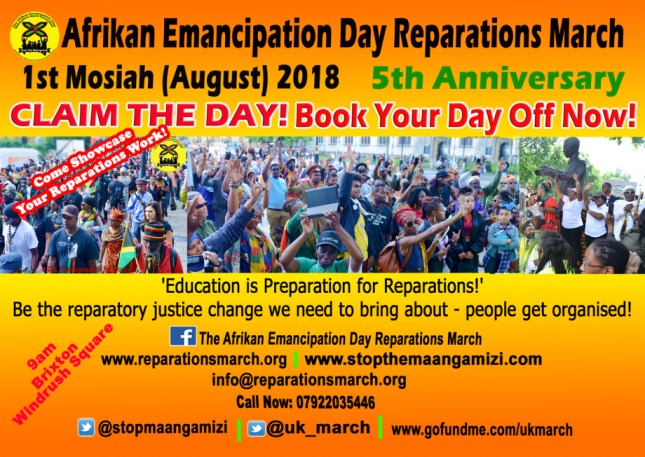
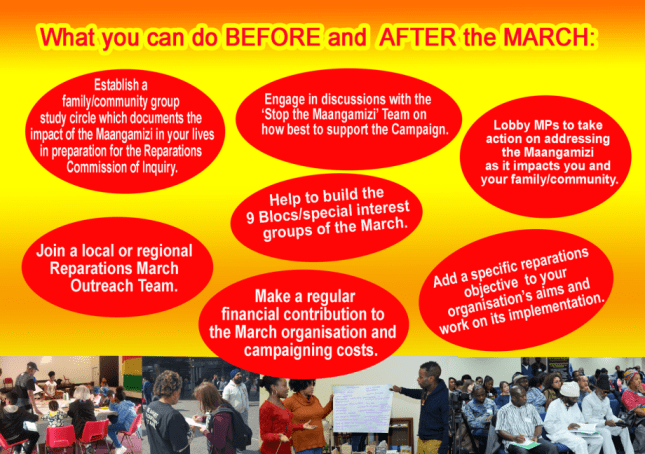
2018 PROMOTIONAL FLYER
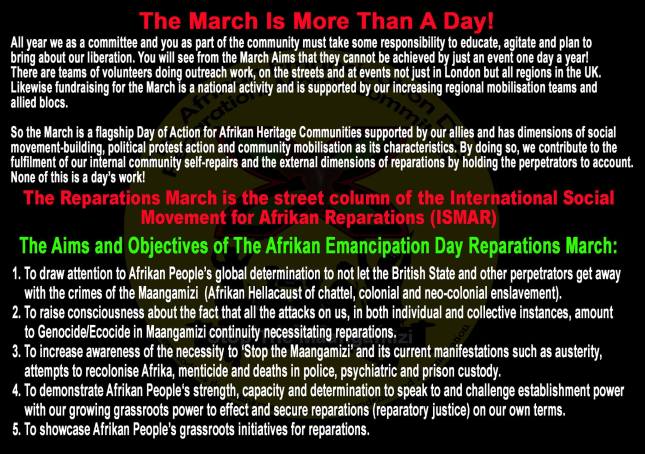
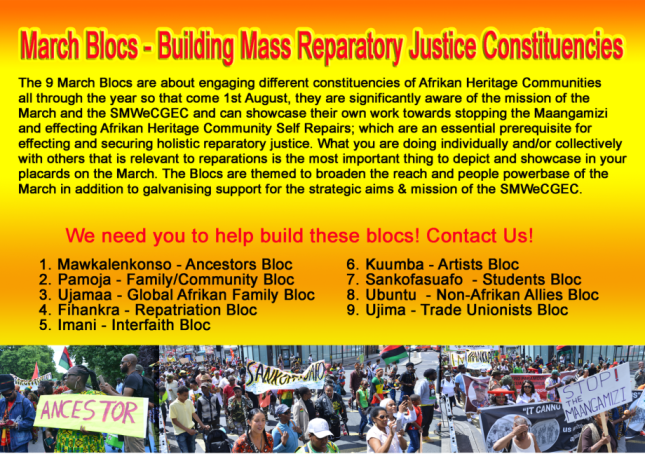
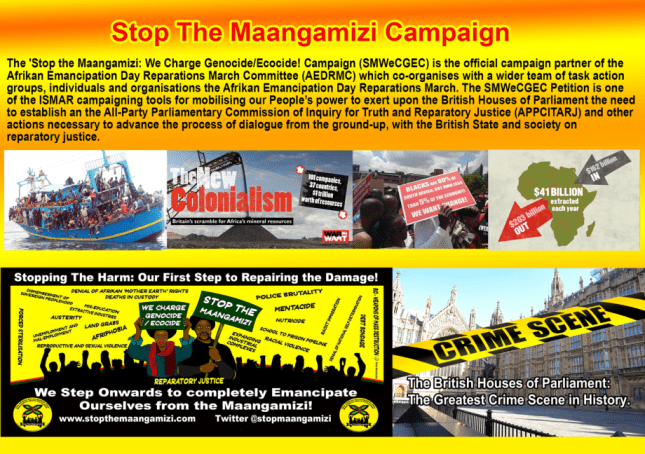
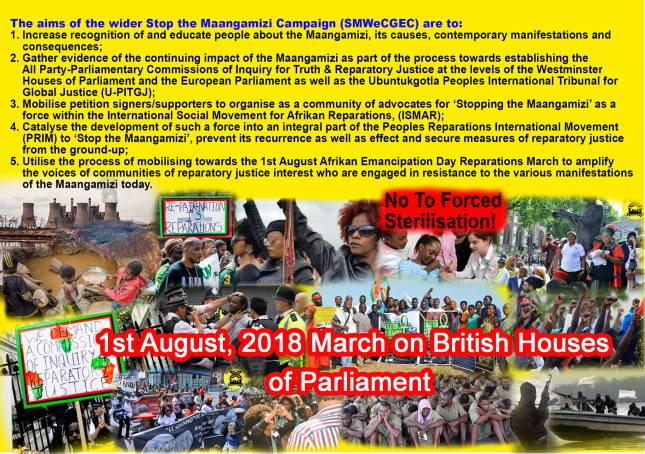
2018 PROMOTIONAL VIDEOS
Call to action video:
Rationale for why we march video
Link to jingles for radio
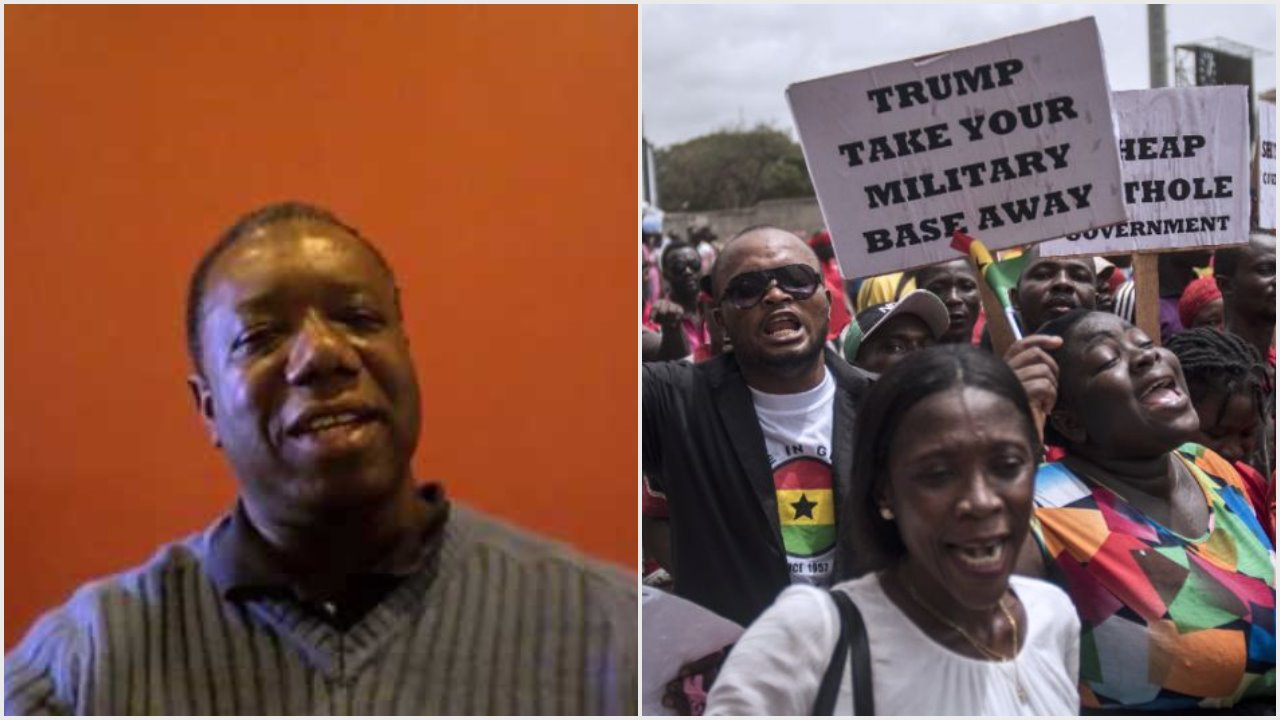
This is a recording from the Pan-Afrikan Society Community Forum (PASCF) workshop – USAFRICOM: GLOBALISING PAN-AFRIKAN RESISTANCE FROM GHANA TODAY” with Kofi Mawuli Klu, Co-Vice Chairperson of the ‘Stop the Maangamizi: We Charge Genocide/Ecocide!’ Campaign (SMWeCGEC) which took place on 13th April in London.
An outcome of this workshop was that a demonstration was organised by Ghana Action for Pan-Afrikan Resistance (GAPAR) to take place today, 21st April at the London School of Economics were President Nana Akufo-Addo of the Republic of Ghana is a keynote speaker at the 5th Annual ‘LSE Africa Summit’.
The synopsis for the workshop is as follows:
Osagyefo Kwame Nkrumah, Ghana’s first president, defined neocolonialism as “the last stage of imperialism” – understanding this as a violation of Afrikan sovereignty as Afrikan states are independent in name only and imperialism/white supremacy manipulates economic and political control, through globalization, capitalism and cultural expansionism. So, in effect foreign interests, are what dictate everything.
In ‘USAFRICOM: GLOBALISING PAN-AFRIKAN RESISTANCE FROM GHANA TODAY’ esteemed scholar-activist Kofi Mawuli Klu looks at the wider historical trajectory of neo-colonial relations between Ghana and the USA/white supremacy in view of their expanding and unrestricted access to a host of Ghanaian facilities, recently agreed by Ghana’s Cabinet.
The emphasis of Bro Kofi’s presentation is to facilitate public discussion on the 5th April 2018 joint statement issued by the Global Afrikan People’s Parliament (GAPP) and the Stop the Maangamizi: We Charge Genocide/Ecocide Campaign (SMWeCGEC) entitled “Opposing the USAFRICOM Base of Maangamizi in Ghana: Globalising Pan-Afrikan Resistance for Reparatory Justice is the Way to Victory”. Kofi explains the strategy and tactics being pursued by some of the Freedomfighting forces still upholding the teachings of Osagyefo Kwame Nkrumah in trying to steer the growing Resistance to the USA-Ghana Deal on Strengthening the Militarisation of Neocolonialism in West Afrika towards the goals of Pan-Afrikan Reparations for Global Justice.
He highlights the necessity of better meeting the challenge in and beyond Britain today of utilising Internationalist Solidarity mobilisation for such Resistance in Afrika for its best purpose of reclaiming authentic Pan-Afrikanism as an intellectually sharpening practical weapon for globally advancing emancipatory struggle towards what GAPP envisions as the Maatubuntuman achievement of the total liberation, unification and self-determined progress of Afrikan people all over the World.
PRESENTER: Bro Kofi Mawuli Klu is Chief Executive Commissioner of PANAFRIINDABA, a grassroots Pan-Afrikan Community Advocacy, Research and Think Tank based in London, UK and Accra, Ghana. He is also co-Vice Chair, Pan-Afrikan Reparation Coalition in Europe (PARCOE) in London and Joint Co-ordinator of the Global Justice Forum based in London as well as Co-Vice Chair of the ‘Stop the Maangamizi: We Charge Genocide/Ecocide’ Campaign (SMWeCGEC). Bro Kofi runs his own Law-Related Educational Services Agency, UEQUIPOISE. His scholarly activism has and continue to make a significant contribution within institutions of education in and outside of the United Kingdom [various courses, seminars, workshops, conferences and Groundings on Afrika and Pan-Afrikanism] and serves Afrikan students/communities as a conscientising tool for grassroots resistance and social change.
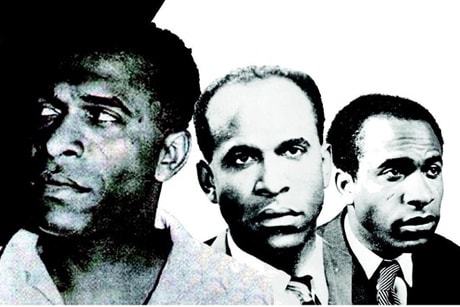
“The future will have no pity for those men and women who possess the exceptional privilege to speak the words of truth, instead have taken refuge in an attitude of cold complicity and mute indifference.“
Revised quote from Frantz Fanon, ‘Toward the African Revolution: Political Essays’, 1994
Greetings Supporters of the ‘Stop the Maangamizi: We Charge Genocide/Ecocide!’ Campaign (SMWeCGEC)
The letter below is the latest in the ongoing correspondence between Esther Stanford-Xosei and MP, Heidi Alexander, on issues to do with the SMWeCGEC and the campaign’s work for reparatory justice:
ESTHER STANFORD-XOSEI LETTER TO HEIDI ALEXANDER MP RE RESPONSE FROM FCO MINISTER LORD AHMAD
The letter from Esther Stanford-Xosei deals with the response from Foreign & Commonwealth Minister of State for the Commonwealth and the UN, Lord Ahmad to the 2017 ‘Stop the Maangamizi!’ Petition and its accompanying correspondence.
The exchanges so far show that as much as sections of the Labour Movement are becoming more interested in communications with certain constituencies of the International Social Movement for Afrikan Reparations (ISMAR), there is a greater need to ensure that the Labour Party is challenged to develop a correct way of dealing with the issues raised in the correspondence and our Afrikan Heritage Communities in consonance with the ethics of reparatory justice. This must also be done in such a way that recognises Afrikan people’s human and people’s right to Substantive Afrikan Heritage Community Representation.
What this means is that Labour Party is being challenged by SMWeCGEC and other Afrikan Reparations campaigners to engage in ‘institutional self-repairs’ in the ways it deals with Afrikan Heritage Communities and our autonomous community organisations as well as the issues that concern us. Only by doing so, will it become a worthy stakeholder with locus standi in Afrikan Heritage Community reparatory justice engagements.
In livicated Service!
Stop the Maangamizi: We Charge Genocide/Ecocide! Campaign International Steering Committee Spearhead Team (ISC-SMWeCGEC)
 stopthemaangamizi.com