stopthemaangamizi.com

Stop the harm as the first step to repairing the damage!

Menu

Skip to content
  • Home
  • CONTACTS
  • GLOBAL MAJORITY VS
  • I AM WITNESS
  • MAANGAMIZI DESECRATORS & DENIERS
  • MAANGAMIZI EDUCATIONAL TRUST (M.E.T)
  • SMWeCGEC PETITION
  • TAKE ACTION
  • PAN-AFRIKAN REPARATIONS REBELLION GROUNDINGS

Tag Archives: Lobbying

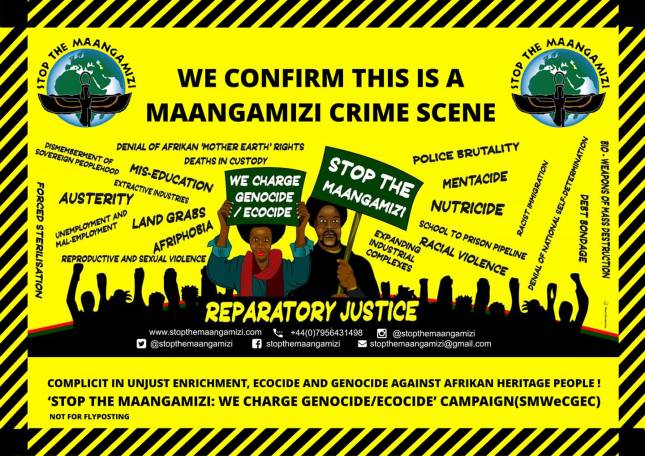
OPERATION MAANGAMIZI CRIME SCENE EXPOSURE STICKER GUIDANCE

Posted on August 4, 2018 by STOP THE MAANGAMIZI


MAANGAMIZI CRIME SCENE


Guidance on how to use your Maangamizi Crime Scene Stickers


We all have Maangamizi crime scenes around us!!

These are some examples:

A school, college or university –Are our boys or girls being excluded at an alarming rate? Is it guilty of perpetuating a Eurocentric and mentacidal curriculum? Are they guilty of epistemicide? Or is it not adequately dealing with incidents of Afriphobic and/or academic racism? Are they engaged in Maangamizi-denial? Something else?

A Bank or other financial institution – Do they have a history of being built through unjust and immoral means involving the labour of enslaved or colonised Afrikan people? Are they providing a safe haven for illicit financial flows, stolen money and other ill-gotten gains? Are they financing Maangamizi crimes? Are they involved in laundering the proceeds of Maangamizi crimes? Something else?

A Museum – Does it contain any spoils of enslavement or colonialism looted from the people without their permission? Does it contain the bodies of our Ancestors on show with no regard for our dignity? Is it misrepresenting our history, deceiving the public with its narratives about our history? Is it engaged in Maangamizi-denial Statues/Relics/Historic Hotspots – Do they contain any artefacts, statues, plaques, pictures that are offensive to us due to their historic or present-day role in the continuing genocide, terrorism and oppression or negative misrepresentation of our people? Are they engaged in Maangamizi-denial?

Stately Homes – What is their history? Were they built, purchased or refurbished from the proceeds of enslavement, or compensation paid to enslavers? Are they any way complicit in Maangamizi crimes past or present? Are they engaged in Maangamizi-denial?

Companies/Major Corporations/Small Businesses – What is their history? Are they any way complicit in Maangamizi crimes past or present? Are they found to be complicit in looting resources and exploiting our motherland Afrika and our people? Have they waged any offensive marketing campaigns or found to have committed acts of Afriphobic racism against people of Afrikan Heritage? Are they engaged in harmful practices and human rights violations that are devastating vulnerable communities. Are they found to have forms of enslavement in their supply chains? Are they polluting or destroying the environment (ecocide)?

Events/ Festivals/Calendar Day Celebrations – Are any such guilty of an anti- Afrikan narrative either in its imagery or focus e.g. Darkie Day in Cornwall, seafaring festivals, Columbus Day, Remembrance Sunday, Zwarte Piet (Black Pete).

Something else!!! Someone else!! Somewhere else!

Be thoughtful, strategic and work with intention. Raising this awareness is a critical piece of work.

What you should do:

• Stick your sticker in a prominent spot. • Take a picture showing the sticker in context and then a close up shot. Take it with or without you in it.

• Post those pictures on social media with the hashtags: #MaangamiziCrimeScene #StopTheMaangamizi.

• Tag the ‘Stop the Maangamizi!’ campaign and the Afrikan Emancipation Day Reparations March and all your friends and key people who you want to make aware, what you are doing e.g. local councillor, MPs, City Mayor, celebrities and people connected to the crime scene itself, (links below).

• Say a couple of sentences about why the sticker is there. You should not say you put it there!

• Post/Tweet/Tag/Share


Let the world recognise that we see them and we are not letting them get away with continuing the Maangamizi towards our demise, destruction and detriment – in all areas of people activity (e.g. economics, education, entertainment, labour, law, politics, religion, sex, war/counter war).

Web:
https://stopthemaangamizi.com/

http://www.reparationsmarch.org/

Facebook:
https://www.facebook.com/stopthemaangamizi/

https://www.facebook.com/ReparationsmarchUK/

FB Profile: TheMarch August

Email: stopthemaangamizi.@gmail.com.
Keep us posted on how your activism is being received or maybe you’d like to get more stickers – for you or a friend!

Twitter:
@Stopmaangamizi
@uk_march

Call/Text/WhatsApp:
07956431498


To obtain copies of the ‘Maangamizi Crime Scene Sticker Pack’ please email stopthemaangamizi@gmail.com or text/call 07956431498.


This slideshow requires JavaScript.


Posted in AFRIKAN HELLACAUST, AFRIKAN RESISTANCE, INTERNATIONAL SOCIAL MOVEMENT FOR AFRIKAN REPARATIONS, ISMAR, MAANGAMIZI RESISTANCE, MAANGAMIZI RESISTORS, SMWeCGEC, STOP THE MAANGAMIZI CAMPAIGN, THE 2018 AFRIKAN EMANCIPATION DAY REPARATIONS MARCH, Uncategorized | Tagged Afrika, British Empire, British Government, Debating, Direct Action, Genocide, Geopolitics, Global Justice, Grassroots Leadership, Holocaust, International Law, Legal Imagination, Lobbying, Maangamizi Crime Scene, Maangamizi Denier, Modern Day Slavery, Neocolonialism, Pan-Afrikan Revolution, People Power, PRIM, Protest history, Resisting Unjust Law, Social Movement | Leave a comment

STILL NO TO AN EMANCIPATION EDUCATIONAL TRUST!!!

Posted on August 4, 2018 by STOP THE MAANGAMIZI


This slideshow requires JavaScript.

Selected images from the 2018 Afrikan Emancipation Day Reparations March


We see that our Afrikan Reparatory Justice efforts in general, and the work of the Afrikan Emancipation Day Reparations March Committee (AEDRMC) in particular, is now beginning to impact on British establishment political thinking; in terms of how to respond to our own community self-repair endeavours and the demands we are making, out of such endeavours, upon others. This is evidenced in the recently published Huffington Post article: ‘In the Wake of Windrush, Marking Emancipation Day is More Important Than Ever‘ by Dawn Butler MP, Shadow Minister for Women and Equalities and Labour MP for Brent Central.

It is encouraging to note that our criticism of the repugnant name of a Slavery Educational Trust which was made in AEDRMC promotional videos here and here has resulted in an attempt to rename such a proposed body to become the Emancipation Educational Trust. This still misses the whole point. Our preference for a name like the Afrikan Anti-Slavery Resistance Educational Trust (AASRET) still holds. It is mind-boggling that even some leading British Labour Party members, including MPs from our own Afrikan heritage communities, are still so engulfed by Afriphobia that they run away from including and explicitly identifying with anything Afrikan in the name of initiatives that are supposed to be about the Afrikan experience. This is even more shocking given that we are in the United Nations International Decade for People of African Descent which has the theme ‘People of African Descent: Recognition, Justice and Development.’ Indeed, there is nothing more unique to the global experience of Afrikan people other than the Maangamizi, (Afrikan Hellacaust) in relation to which this educational trust is being proposed.

So pervasive is this Afriphobia, and so strongly does the British State hold unto it, that it is inherent in the processes of white supremacy racist brainwashing through which all those selected, even from our Afrikan heritage communities,  to serve in various positions of the establishment are infected with it. Hence its prevalence amongst virtually all members of the British State legislature, executive, civil and public services, judiciary, armed forces, police, intelligence and other security agencies.  It appears that not only submission to but an overt display of Afriphobia is a requirement for service in the institutions and agencies of the British State. No wonder it is those selected from our Afrikan heritage communities to serve in these institutions and agencies who appear to exhibit the worst traits of Afriphobic epistemic and structural violence upon Afrikan Heritage Community people. That is why the ‘Stop the Maangamizi: We Charge Genocide/Ecocide!’ Campaign (SMWeCGEC) regards all these institutions and agencies of the British State as ‘Maangamizi crime scenes’.


vintage-calligraphic-elements-1nyoWZ-clipart

MAANGAMIZI CRIME SCENE


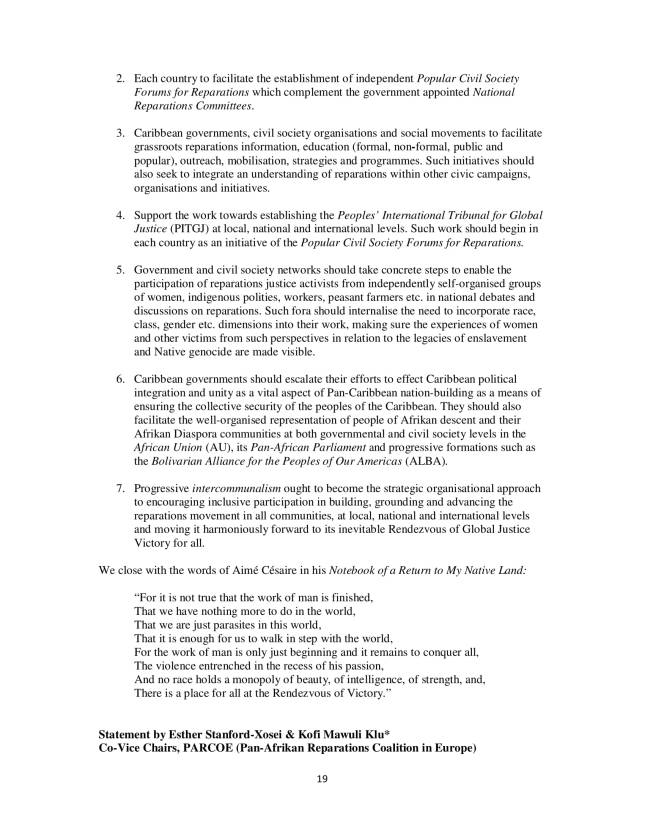
The proposed Emancipation Educational Trust will be nothing but another Maangamizi crime scene if it is established with the same intention of avoiding explicit Afrikan identification, whilst seeking to make it simply distortedly flirt with a commoditised form of Afrikan history and experiences. So, we urge Jeremy Corbyn, as leader of the Labour Party and the Party itself to study carefully, the themes and messages, which were promoted on the 1st August Afrikan Emancipation Day Reparations March: ‘Nothing About Us Without Us!: Actualizing the Reparatory Justice Change We Envisage’. It is about time the Labour Party stopped this nonsensical beating about the bush, openly confronts its deeply ingrained Afriphobic racism and seeks to honestly counteract it. This includes taking clear steps to initiate open dialogue with the legitimate grassroots representatives of our Afrikan heritage communities of reparations interest in the UK. Such representatives are clearly known through their visible work in organising endeavours such as the annual Afrikan Emancipation Day Reparations March and its related ‘Stop the Maangamizi!’ campaign activities.

The continuing attempts to evade substantive representation of our Afrikan heritage communities; by bringing members of the Labour Party far removed from such activities and also afflicted with white supremacy racist indoctrination to simply express, their ‘masters’ voices and prejudices in toying with vital matters concerning the survival of Afrikan people in the world today, such as reparatory justice, must be understood as no longer acceptable to us at all. We expect Jeremy Corbyn as leader of the Labour Party, to embrace this firm, non-negotiable standpoint of ours, against all Afriphobic expressions of the Maangamizi as part of the ‘new politics’ he promised Britain, the Commonwealth and the World.

We know Jeremy Corbyn can do better because in his laudable solidarity work for the Anti-Apartheid Movement he displayed some of his best efforts to date of internationalist solidarity with our Afrikan Liberation Struggle. We therefore hope that he will go back to such track-records of his own best practice and do the correct thing once again. The correct thing begins with him taking steps to initiate the dialogue we have been calling for by meeting, to start with, representatives from the Afrikan Emancipation Day Reparations March Committee (AEDRMC), the organisers of the annual 1st August Afrikan Emancipation Day Reparations March and their partners in the SMWeCGEC.


In Service

Esther Stanford-Xosei
Coordinator-General ‘Stop the Maangamizi: We Charge Genocide/Ecocide!’ Campaign

Posted in AEDRMC, AFRIKAN HELLACAUST, AFRIKAN RESISTANCE, INTERNATIONAL SOCIAL MOVEMENT FOR AFRIKAN REPARATIONS, ISMAR, MAANGAMIZI RESISTANCE, MAANGAMIZI RESISTORS, PREFIGURATIVE POLITICS, REPARATIONS, SMWeCGEC, STOP THE MAANGAMIZI CAMPAIGN, STOP THE MAANGAMIZI PETITION, THE 2018 AFRIKAN EMANCIPATION DAY REPARATIONS MARCH, Uncategorized | Tagged Afrika, Afrikan Diaspora, Afrikan Heritage, Afrikan Heritage Community for National Self-Determination, Afrikan Liberation, Afrikan Reparations, Afriphobia, AHC-NSD, Apartheid, BlackVotingCanonFodderNoMore!, British Empire, Community Service, Critical Dialogue, Ecocide, Emancipation Day, Emancipation Educational Trust, GAPP, Genocide, Geopolitics, Global Afrikan People's Parliament, Grassroots Academia, Grassroots Leadership, Grassroots lobbying, Internalised Afriphobia, International Decade for People of African Descent, Jeremy Corbyn, Labour Movement, Labour Party, Lobbying, Maangamizi Criminal, Maangamizi Denier, Marching, Modern Day Slavery, Nothing About Us Without Us!, NothingAboutUsWithoutUs!, Ourstory, People Power, Social Movement, Substantive Afrikan Representation, Theresa May, UN-IDPAD | Leave a comment

2018 HAND-IN OF STOP THE MAANGAMIZI PETITION

Posted on August 3, 2018 by STOP THE MAANGAMIZI

THABO P 1Thabo Downing StreetTHABO P 8

All images are the © copyright of  Thabo Jaiyesimi and must be accredited as such

14,590 Signatures of the ‘Stop the Maangamizi: We Charge Genocide/Ecocide!’ Petition handed-in


The 6-member delegation for the 2018 hand-in of the ‘Stop the Maangamizi!’ Petition were:

From Right to Left

1. Hon. Prophet Kweme Abubaka (Afrikan Emancipation Day Reparations March Committee, Ethiopia African Black International Congress)

2. Dr Barryl Biekman, (Europe-wide NGO Consultative Council for Afrikan Reparations, Netherlands)

3. Mama Lindiwe Tsele (Pan-African Congress of Azania)

4. Ms Kambanda Veii (Ovaherero Genocide Foundation, Namibia)

5. Cllr Joshua Brown-Smith, age 12 (Office of the Young Mayor, London Borough of Lewisham)

6. Professor Gus John (Gus John Associates, Member of the African Union Technical    Union Technical Committee of Experts on the 6th Region).

The delegation which handed-in the 2018 ‘Stop the Maangamizi: We Charge Genocide!’ Petition represents a selection of the diversity within our Afrikan Heritage Community. The Young, The Elders, Born on the Continent, Born in the Diaspora, Male and Female, and as in previous members some members flew in from Afrika and Europe!

#ReparationsMarch2018
#Parliament is a Crime Scene!
#StopTheMaangamizi!


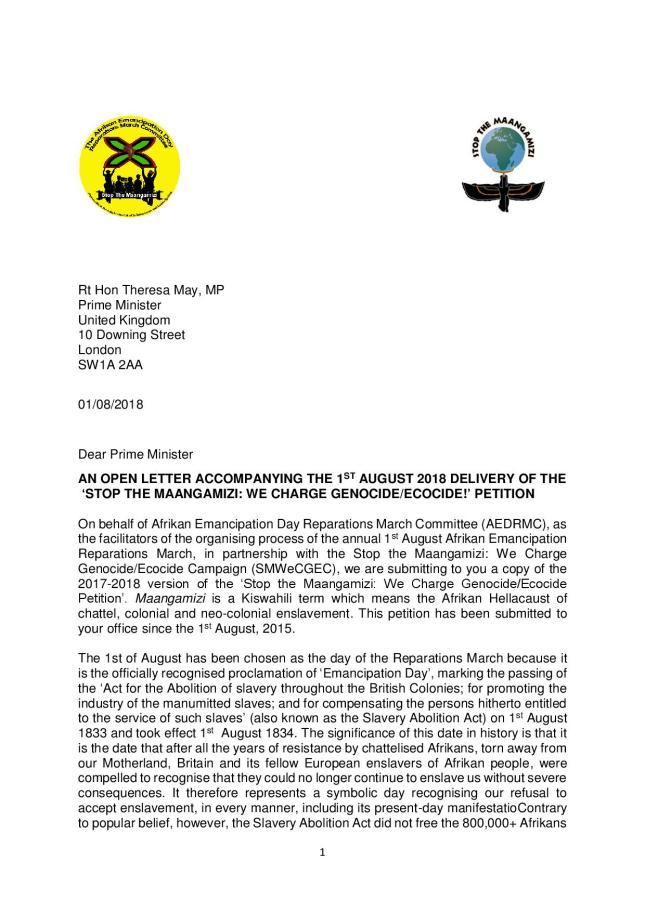
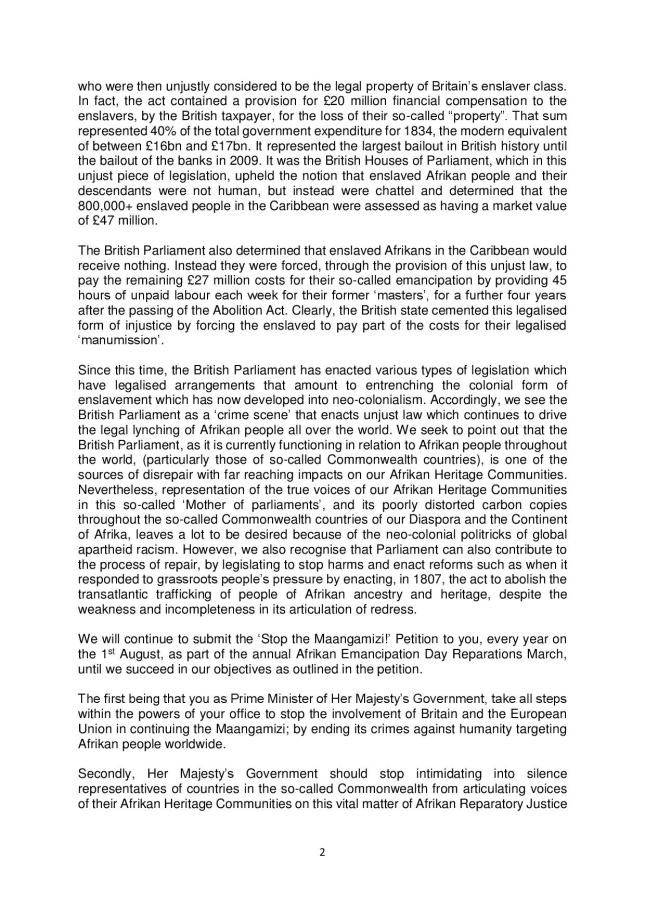
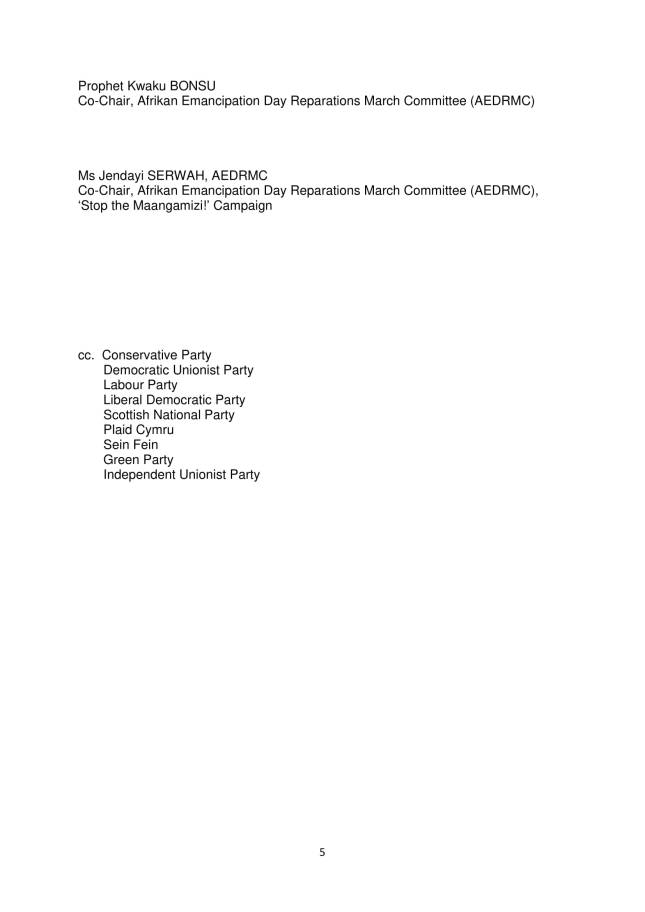
See the following letter which accompanied the hand-in of the ‘Stop the Maangamizi!’ Petition

LETTER TO THERESA MAY 2018 FINAL-page-001LETTER TO THERESA MAY 2018 FINAL-page-002LETTER TO THERESA MAY 2018 FINAL-page-003

PAGE 4-1

LETTER TO THERESA MAY 2018 FINAL PAGE 5-5


PAGE 6 2018-1

Please note, the ‘Stop the Maangamizi!’ Petition has been handed-in since 2015, in 2016 no signatures were handed in just the petition and a cover letter. In 2016, 5811 signatures were handed in, in 2017, 9636 signatures were handed in.

It is important to note that the ‘Stop the Maangamizi!’ Petition is not the only tactic we are adopting, the petition signatures accompany a Maangamizi Crime Scene sticker operation and lobbying of MPs strategy via the ‘Stop the Maangamizi!’ Postcard involving support for developing Afrikan Heritage Community advocacy on the points contained in the petition.

It is also important to note that we in the International Steering Committee Spearhead Team of the ‘Stop the Maangamizi!’ Campaign (ISC-SMWeCGEC) know that reparations will not be achieved simply by submitting this petition, if one reads the petition it is clear that this is not our thinking. In numerous articles and documents we talk about the March and the petition being part of revolutionary strategy and tactics that we are engaged in, which also involve all forms and levels of liberation struggle waged by various contingents of the International Social Movement for Afrikans (ISMAR).

The Afrikan Emancipation Day Reparations March and the annual hand-in of the petition is about building a broad public support base for consolidating the ISMAR in order to strengthen the harnessing and building of Afrikan people’s power to advance reparations to definitive victory; whiincluding the establishment of MAATUBUNTUMAN Pan-Afrikan Union of Communities.

See the following links for further info about the strategy and tactics of the ‘Stop the Maangamizi!’ Campaign in association with the Afrikan Emancipation Day Reparations March Committee:

As we approach the 3rd year of marching, what has been achieved? (2016)

https://stopthemaangamizi.com/2016/07/13/approaching-3rd-year-of-marching-what-has-been-achieved/

After 4 years of marching, what has been achieved? (2017)

https://stopthemaangamizi.com/2017/08/07/after-4-years-of-marching-what-has-been-achieved/

Rationale for Afrikan Reparations March (2018)


This video is of a workshop which took place on Friday 27th July, 2018 and provides some elaboration on the revolutionary thinking and work into for the long-term results that the March is meant to produce and to which it is already contributing.

This is a link to the initial response that was received from the Foreign & Commonwealth Office (FCO) in response to the 2017 ‘Stop of the Maangamizi!’ Petition and its covering letter, and also the further response from FCO Minister Lord Ahmad.


Posted in AEDRMC, AFRIKAN HELLACAUST, AFRIKAN RESISTANCE, ALL PARTY PARLIAMENTARY COMMISSION OF INQUIRY (APPCITARJ), INTERNATIONAL SOCIAL MOVEMENT FOR AFRIKAN REPARATIONS, ISMAR, MAANGAMIZI RESISTANCE, POPSAR, PRIM, REPARATIONS, SMWeCGEC, STOP THE MAANGAMIZI PETITION, THE 2018 AFRIKAN EMANCIPATION DAY REPARATIONS MARCH, UBUNTUKGOTLA/PITGJ, Uncategorized | Tagged 1st August, Activist Knowledge-Production, Afrika, Afrikan Emancipation Day Reparations March, Afrikan Heritage, Afrikan Heritage Community, Afrikan Heritage Community for National Self-Determination, Afrikan Liberation, Afrikan Reparations, Afrikan Sovereignty, Afriphobia, APPCITARJ, Black Radical Imagination, Bobo Shanti, British Colonialism, British Government, CHOGM 2018, Cllr Joshua Brown-Smith, Commission of Inquiry, Dr Barryl Biekman, EABIC, Ecocide, Education is Preparation for Reparations, Emancipation Day, ENGOCCAR, Ethiopia Africa Black International Congress, FCO, Genocide, Geopolitics, Global Apartheid, Grassroots Leadership, Grassroots lobbying, Hellacaust, Holocaust, ISMAR-Building, Kambanda Veii, Lindiwe Tsele, Lobbying, Lord Ahmad, Maangamizi, Maangamizi Crime Scene, Marching, Movement-Building, Namibia, Neocolonialism, Nothing About Us Without Us!, NothingAboutUsWithoutUs!, OGF, Ovaherero Genocide Foundation, Pan-Afrikan Revolution, Pan-Afrikanism, People Power, People's Power, Peoples Tribunal, Professor Gus John, Prophet Kweme Abubaka, REPARATIONS, Reparations Action-Learners, Reparations March, Reparatory Justice, Self-Repairs, SMWeCGE Petition, SMWeCGEC, Social Movement, Stop the Maangamizi, U-PITGJ, UK Reparations Activism, We Charge Genocide/Ecocide! | Leave a comment

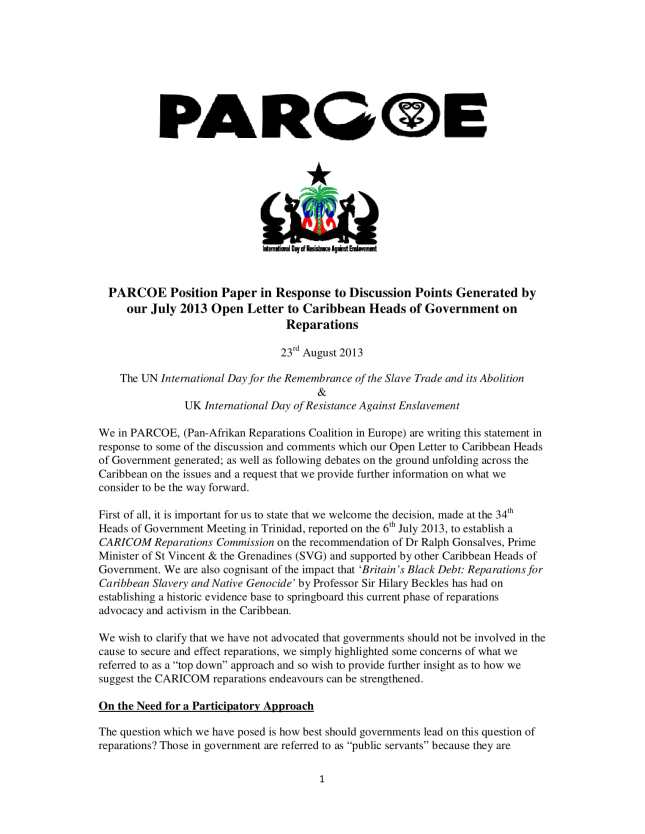
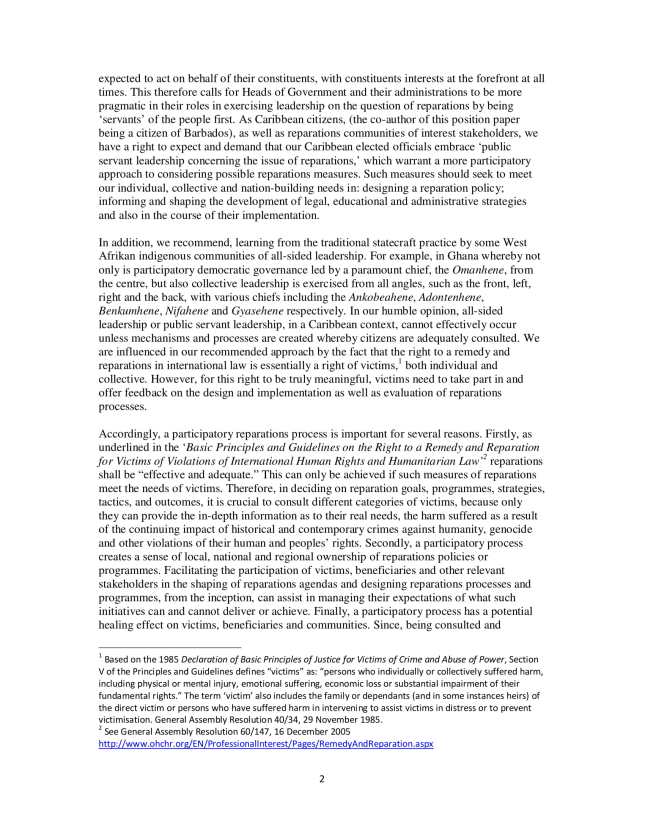
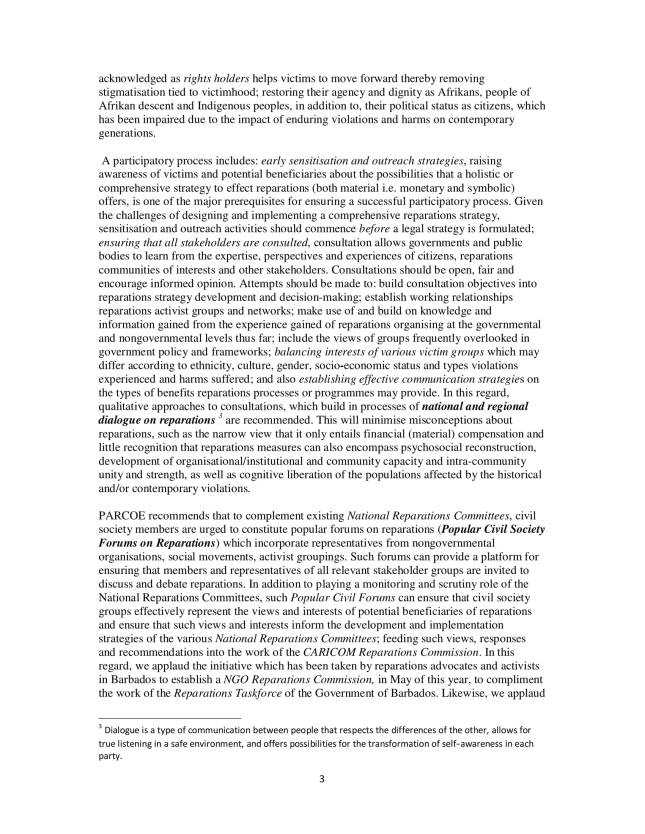
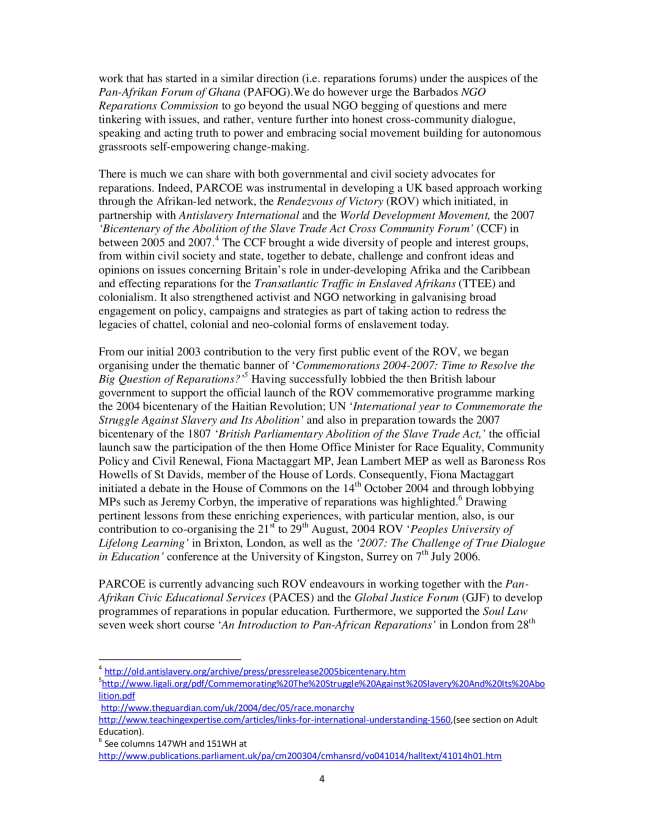
SOME UK ISMAR POSITION PAPERS ON CARICOM REPARATIONS

Posted on July 16, 2018 by STOP THE MAANGAMIZI

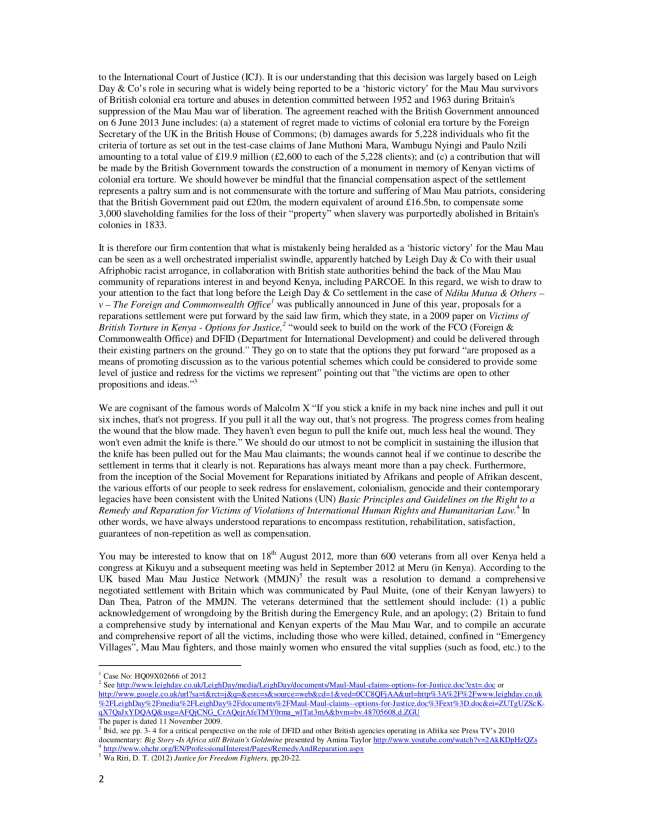
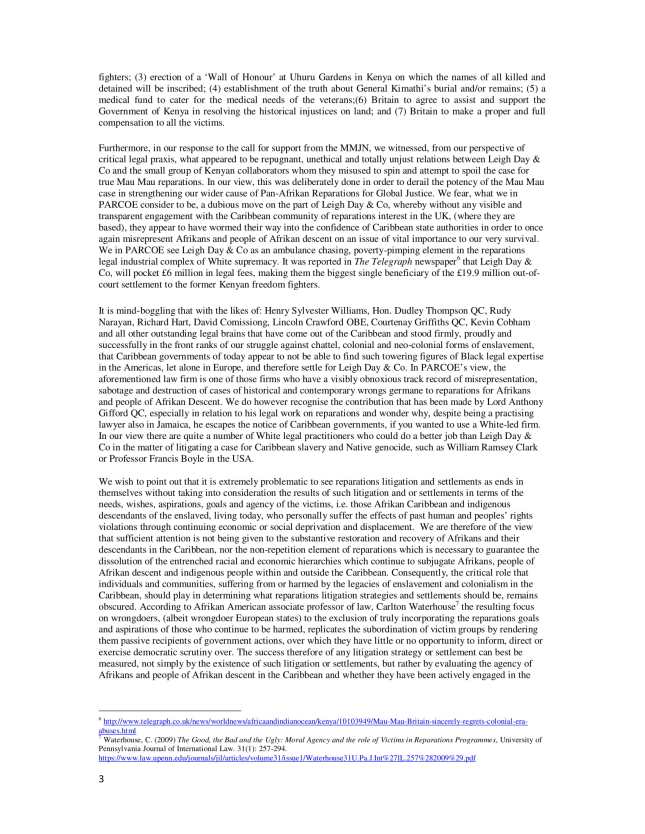
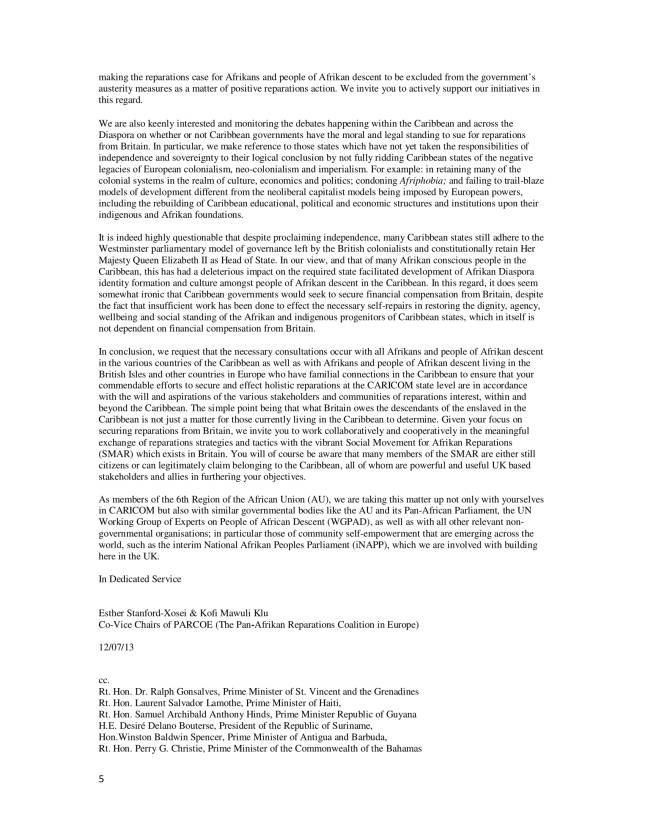
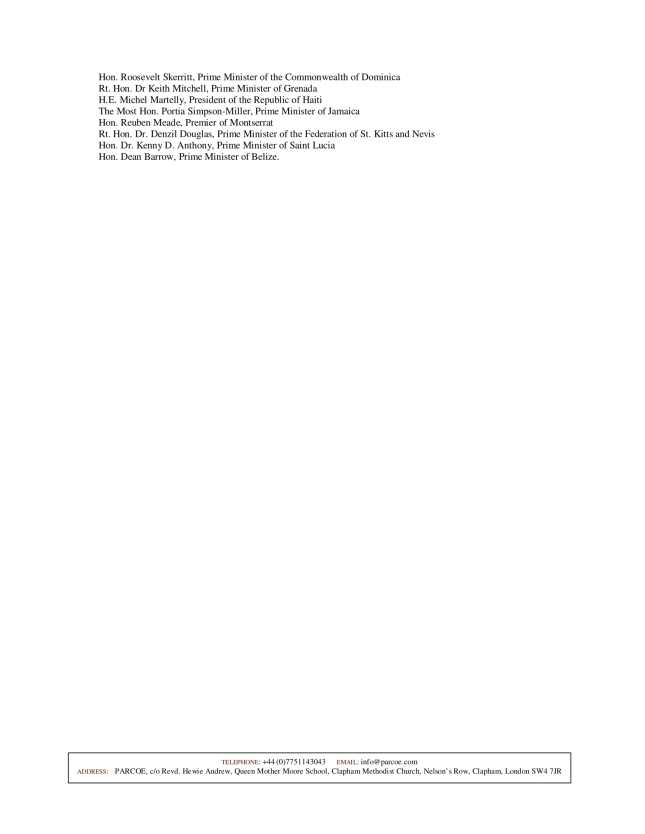
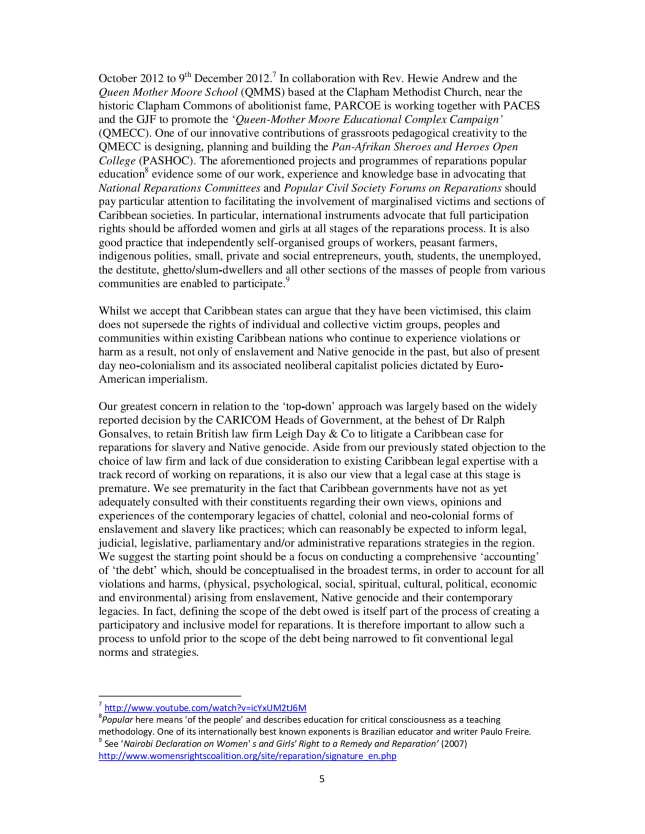
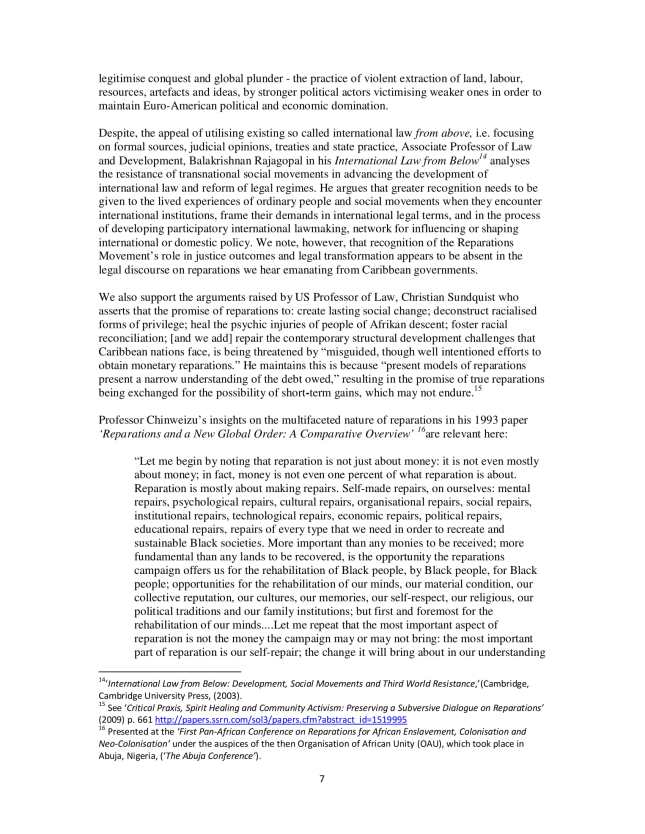
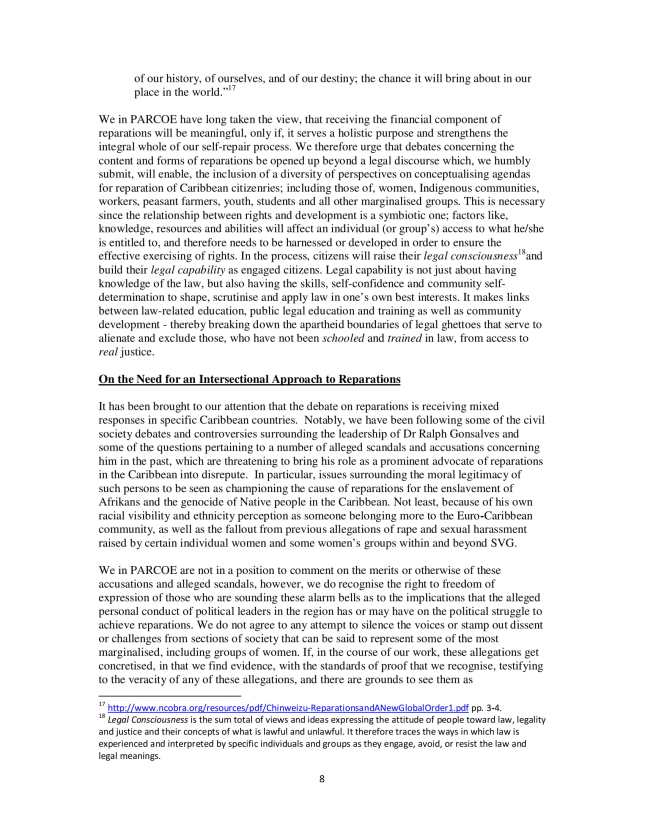
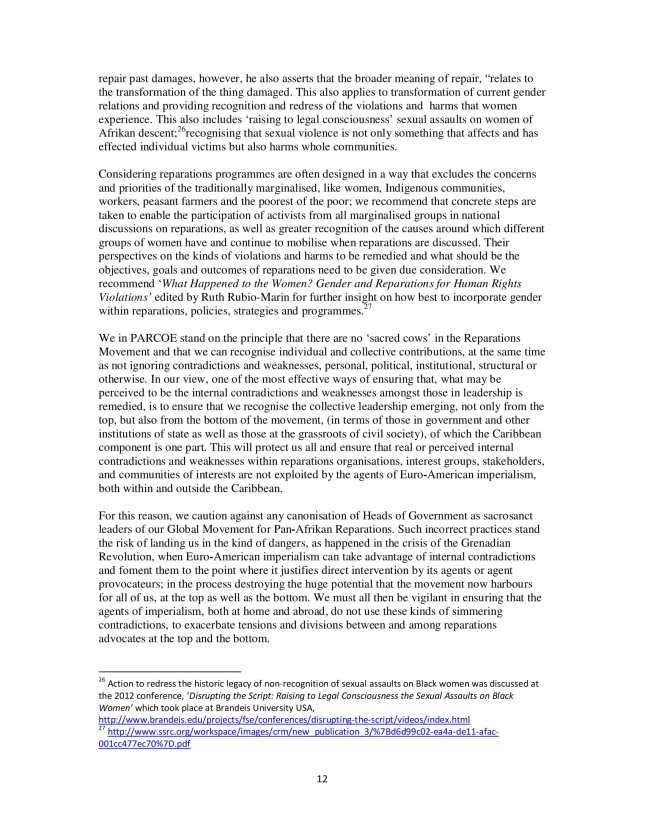
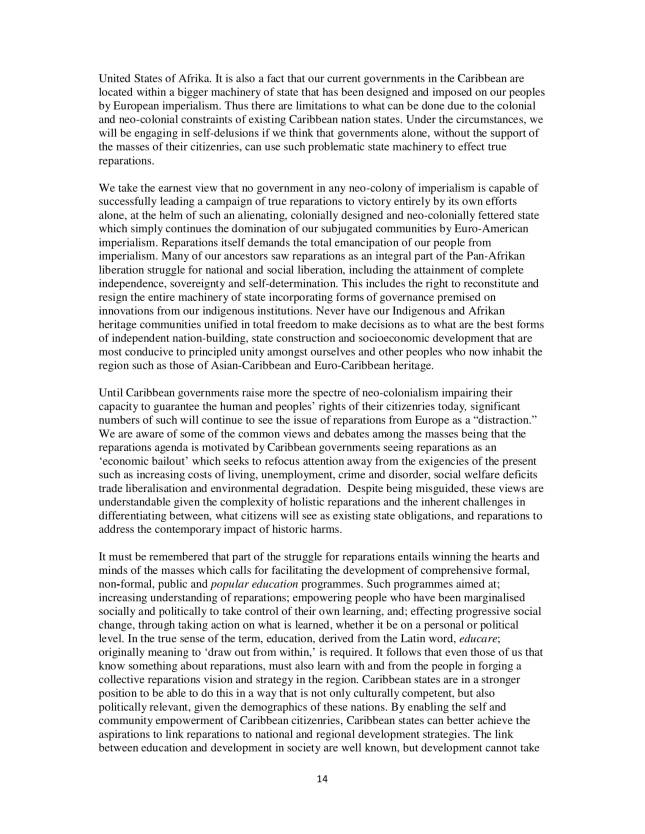
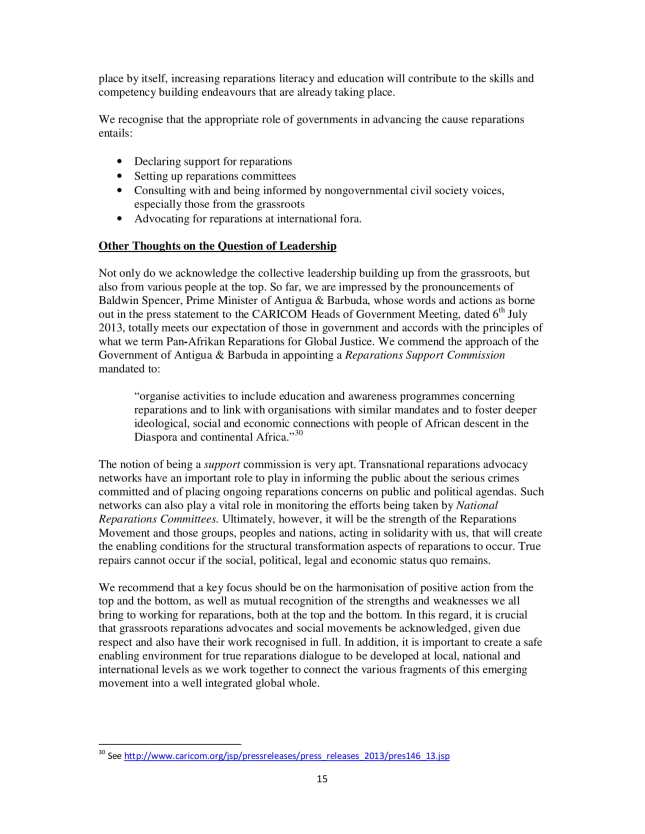
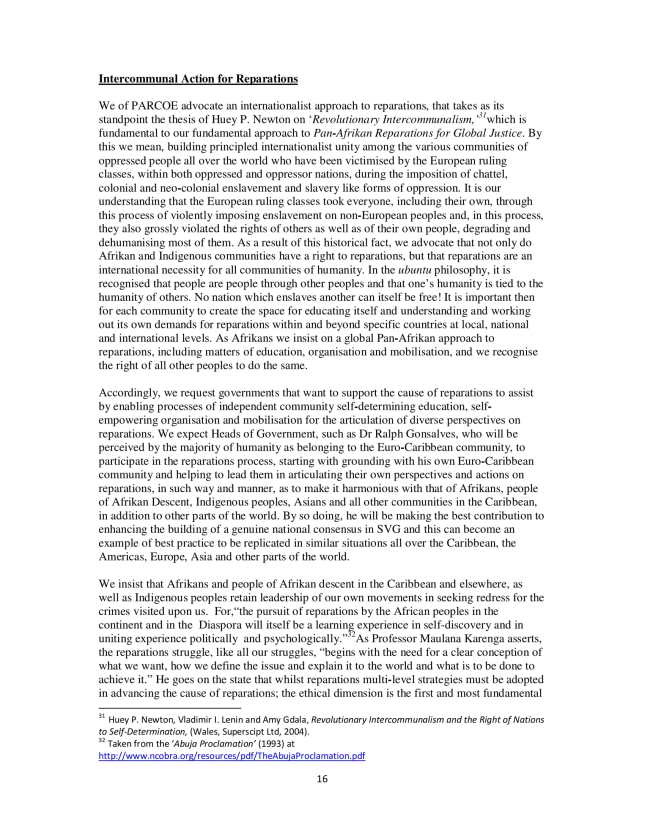
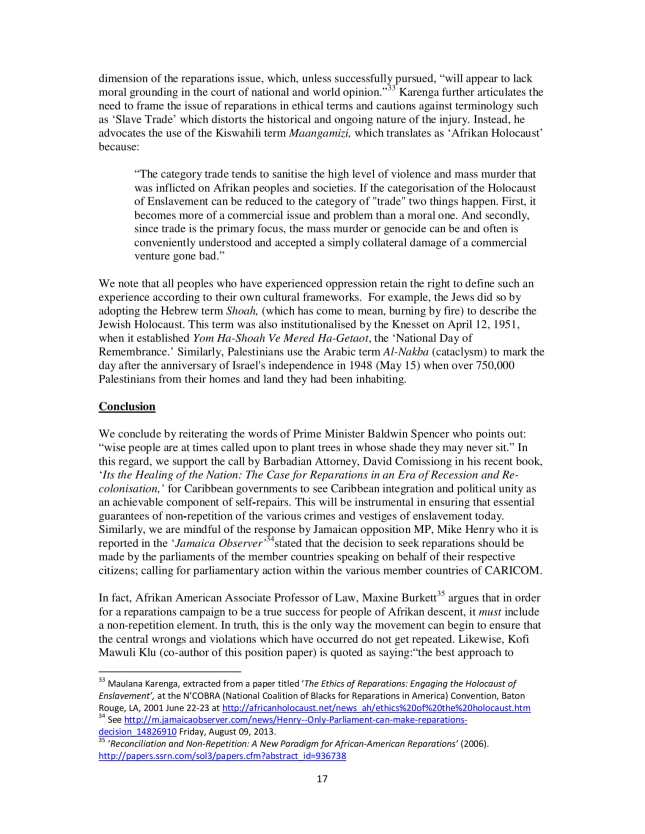
PARCOE Open Letter to CARICOM Heads of Government corrected version-1PARCOE Open Letter to CARICOM Heads of Government corrected version-2PARCOE Open Letter to CARICOM Heads of Government corrected version-3PARCOE Open Letter to CARICOM Heads of Government corrected version-4PARCOE Open Letter to CARICOM Heads of Government corrected version-5


PARCOE Open Letter to CARICOM Heads of Government corrected version-6


PARCOE CARICOM REPARATIONS POSITION PAPER-01PARCOE CARICOM REPARATIONS POSITION PAPER-02PARCOE CARICOM REPARATIONS POSITION PAPER-03PARCOE CARICOM REPARATIONS POSITION PAPER-04PARCOE CARICOM REPARATIONS POSITION PAPER-05PARCOE CARICOM REPARATIONS POSITION PAPER-06PARCOE CARICOM REPARATIONS POSITION PAPER-07PARCOE CARICOM REPARATIONS POSITION PAPER-08PARCOE CARICOM REPARATIONS POSITION PAPER-09PARCOE CARICOM REPARATIONS POSITION PAPER-10PARCOE CARICOM REPARATIONS POSITION PAPER-11PARCOE CARICOM REPARATIONS POSITION PAPER-12PARCOE CARICOM REPARATIONS POSITION PAPER-13PARCOE CARICOM REPARATIONS POSITION PAPER-14PARCOE CARICOM REPARATIONS POSITION PAPER-15PARCOE CARICOM REPARATIONS POSITION PAPER-16PARCOE CARICOM REPARATIONS POSITION PAPER-17PARCOE CARICOM REPARATIONS POSITION PAPER-18PARCOE CARICOM REPARATIONS POSITION PAPER-19PARCOE CARICOM REPARATIONS POSITION PAPER-20

This is a link to a further Position Paper on CARICOM Reparations adopted by the Global Afrikan People’s Parliament (GAPP) in 2015.

Posted in AFRIKAN RESISTANCE, INTERNATIONAL SOCIAL MOVEMENT FOR AFRIKAN REPARATIONS, ISMAR, PREFIGURATIVE POLITICS, REPARATIONS, Uncategorized | Tagged Activist Knowledge-Production, Afrika, Afrikan Caribbean, Afrikan Diaspora, Afrikan Heritage, Afrikan National Question, Afrikan Reparations, Afrikan Vote, Afriphobia, Black Radical Imagination, BlackVotingCanonFodderNoMore!, British Colonialism, British Government, CARICOM, CARICOM Ten-Point Plan, Cause Lawyering, Cognitive Justice, Critical Dialogue, Epistemic Justice, Establishment Academia, Extra-Legal Activism, GAPP, Global Afrikan People's Parliament, Global Apartheid, Global Justice, Grassroots Academia, Grassroots Leadership, Ground-Up Stuggles, International Law, Lobbying, Maangamizi Denier, Movement Intellectuals, Movement Lawyering, Movement-Building, Neocolonilaism, NothingAboutUsWithoutUs!, Pan-Afrikan Reaparations Coalition in Europe, Pan-Afrikan Reparations 4 Global Justice, Pan-Afrikan Reparations for Global Justice, PARCOE, Pempamsie Plan, People Power, Peoples Law, Reparations debate, Reparations Ethics, Repatriation, Self-Repairs, Social Justice Lawyering, Social Movement, Speaking Truth to Establishment Power, Stop the Maangamizi, UK Reparations Activism | Leave a comment

‘STOP THE MAANGAMIZI!’ 2017-2018 CAMPAIGN MESSAGE

Posted on July 3, 2018 by STOP THE MAANGAMIZI


This is a video recording filmed by ‘joanjoan.london’ who attended the 2017 Afrikan Emancipation Day Reparations March on the 1st August. She recently released this edited version of the closing speech made at Parliament Square which is still relevant to the various aspects of the year-round mobilising and organising that the ‘Stop the Maangamizi: We Charge Genocide/Ecocide!’ Campaign (SMWeCGEC) engages in and advocates in association with the Afrikan Emancipation Day Reparations March Committee.

Posted in AEDRMC, AFRIKAN HELLACAUST, AFRIKAN RESISTANCE, ALL PARTY PARLIAMENTARY COMMISSION OF INQUIRY (APPCITARJ), EVENTS/TRAINING, INTERNATIONAL SOCIAL MOVEMENT FOR AFRIKAN REPARATIONS, ISMAR, MAANGAMIZI RESISTANCE, MAANGAMIZI RESISTORS, PREFIGURATIVE POLITICS, PRIM, REPARATIONS, Reparatory Justice, SMWeCGEC, STOP THE MAANGAMIZI CAMPAIGN, STOP THE MAANGAMIZI PETITION, THE 2017 AFRIKAN EMANCIPATION DAY REPARATIONS MARCH, THE 2018 AFRIKAN EMANCIPATION DAY REPARATIONS MARCH, UBUNTUKGOTLA/PITGJ | Tagged 1st August, Afrikan Heritage, Afrikan Liberation, Afrikan Sovereignty, APPCITARJ, Black Radical Imagination, British Colonialism, British Government, Commission of Inquiry, Ecocide, Emancipation Day, Genocide, Grassroots Leadership, Grassroots lobbying, Hellacaust, International Social Movment for Afrikan Reparations, ISMAR-Building, Lobbying, Maangamizi, Marching, Movement-Building, Pan-Afrikanism, People Power, Peoples Tribunal, Reparations March, Reparatory Justice, Self-Repairs, SMWeCGEC, SMWeCGEC Petition, Social Movement, Stop the Maangamizi, U-PITGJ, We Charge Genocide/Ecocide! | Leave a comment

2018 POPSAR @PARLIAMENT SQUARE

Posted on July 1, 2018 by STOP THE MAANGAMIZI


PQ SISTER
CALUM 23
SIETR PQ
ED POPSAR 10
ED POPSAR 6
MARCHhereo-js-ojf
LEO PAQ
alex ps
ED POPSAR 13
ED CLARE SHEPHERD JJ
ED POPSAR 7
ED POPSAR 9
CALUM 23 (2)
ED CLARE SHEPHERD 77
ED POPSAR 5
ED POPSAR 8


“Debate is combat, but your weapons are words”

Melvin B. Tolson (Denzil Washington) in the ‘Great Debaters’


What is the POPSAR?

The People’s Open Parliamentary Session on Afrikan Reparations (POPSAR) at Parliament Square is a mass consciousness-raising forum for public debate and discourse on manifestations of the Maangamizi necessitating Afrikan Reparations which takes place as part of the programme of the annual 1st August, Afrikan Emancipation Day Reparations March. It is a public forum where we rehearse our arguments in pursuit of the ‘battle of Ideas’ on obstacles to the realisation of holistic Reparatory Justice. The purpose of the POPSAR is to engage audiences in action-learning on participatory democratic parliamentary debate and the ‘battle of ideas’ on critical issues such as how to stop various manifestations of the Maangamizi as part of the process of effecting and securing Afrikan Reparatory Justice.

The POPSAR enables the constructive channelling of the ‘battle of ideas’ as an important ideological tool for ascertaining greater clarity as to strategy and tactics for effecting, securing and taking reparations. Within a space where a number of ideological positions struggle for supremacy – reflective of national, ethnic, class and gendered tensions within society – the ISMAR as a revolutionary international social movement cannot neglect the importance of winning hearts and minds and mobilising society around a common reparatory justice vision. Indeed this being one which succeeds in presenting a credible political, social and economic narrative around which the movement seeks to transform hearts and minds to support; which is in itself an alternative to that of the dominant white supremacy racist, capitalist class.


Motion to be debated:

BE IT RESOLVED THAT THE REPARATIONS MARCH, AS A FORM OF REPARATORY JUSTICE STREET PROTEST, IS BEING MADE INADEQUATE DUE TO INACTIVITY BY THE MAJORITY OF ITS PARTICIPANTS IN TAKING STEPS TO ADVANCE THE CAMPAIGN FOR REPARATIONS BETWEEN THE ANNUAL MARCHES.

(The topic is deliberately framed in this way to elicit strong responses to rebut this proposition)

Invited guests will speak for 3 mins for/against.

This POPSAR topic should encourage and inspire intense debate, discussion and dialogue in the lead up to the 2018 March.


Rationale for this topic

Each year guidance as part of the mobilisation for and between the annual marches guidance is provided by the Afrikan Emancipation Day Reparations March Committee (AEDRMC) and its partner the ‘Stop the Maangamzi: We Charge Genocide/Ecocide’ Campaign (SMWeCGEC) on how the campaign for reparations can be advanced, the movement strengthened and suggestions are offered on how to take action. This ranges from ‘shutting down’ Maangamizi crime scenes to organising to bring about the reparatory justice changes one desires, to creatively using the ‘Stop the Maangamizi!’ Petition to galvanise action to address various manifestations of the Maangamizi as the first step to repairing and redressing the harm (reparations) to lobbying elected officials to take specific actions towards the establishment of an All-Party Parliamentary Commission of Inquiry for Reparatory Justice (APPCITARJ).

It cannot be said that the organisers of the March in partnership with the SMWeCGEC have not in various ways outlined a plan for the types of action that people can be taking between the annual Marches. Even the flyers that were put out for the 2017 and 2018 Marches have indicated what steps people can be making. It is also recognised that these are not the only suggestions which have been made.

Nevertheless, the March as the most visible form of protest action in the annual calendar of events, activities and programmes of the UK contingent of the International Social Movement for Afrikan Reparations (ISMAR), is under incredible scrutiny and critique from those who are opposed to marching. For example, from those who feel it is an inadequate tactic or futile endeavour, those who advocate that there are more effective tactics, those who feel that the March and its partner campaign, the SMWeCGEC lacks a ‘meet our demands or else component’ as well as various detractors and naysayers.

It has been argued that whilst a significant number of people attend the Afrikan Emancipation Day Reparations March, these crowds are actually achieving very little in terms of furthering the campaign for reparations. The fervent political and cultural energy experienced by attendees on the ground is hugely disproportionate to the practical results of the March. The main critique of marching seems to be what happens after and between the Marches, the hodgepodge groups and individuals that participate do not necessarily have a commitment to engage in suggested follow-up action which is designed to help build the infrastructure for decision-making and for sustaining  momentum between the Marches. Likewise, little is being offered by way of alternatives which people are advocating will yield better results.

This year are throwing the challenge back to you the people to state your case as to what we can and should be doing to improve the March, or what we should be doing instead, hence the topic for the 2018 POPSAR.


What is debating?

Debating involves examining ideas and policies with the aim of persuading people of the validity or futility of the ideas, policies being debated. It allows debaters to: consider and counter different arguments on the nature of the problem or solution being debated; engage with opposing views and to speak strategically.


How do we debate?

In every POPSAR session there is a motion: a statement (the truth or falsehood of which is examined in the debate), idea or policy that is framed and debated with the prefix, ‘This Gathering…’.

There are two sides to the debate, the proposition which supports the motion and the opposition which opposes or challenges it.


How is the POPSAR debate structured?

# of people in the POPSAR: 6
# of people in a team: 3
# of teams in the debate: 2
Duration of the speeches: 3 mins

All each person has to do is stand up and deliver a short speech – perhaps two to four key points they think will convince people to agree with their side of the argument. The speakers will take it in turns – first a speaker from the proposing team (the people who agree with the motion), then the opposing team (the people who disagree with the motion). Each team will have two contributors and the third will do a summary – conclusion.

The first speaker – proposing

The first speaker of the first team will probably introduce what they are going to say, introduce what their team member is going to say, make their own arguments (including answering any questions) and sum up.

If you were proposing (agreeing with) the motion above, as the first speaker you might:

1. Introduce what you are going to say
I am going to discuss …

2. Introduce what your colleague is going to say
My colleague will talk about …

3. Make your own arguments
The speaker will then go on to make these arguments. During this period, the other side will also have a chance to ask up to 2 questions:

Asking a question

At this point, someone from the other side might try to ask a question (we call this offering a ‘point of information’).

If the Speaker allows them to the debater might get to offer a reply

4. Summing up
After the debaters have presented all their arguments and allowed any questions, the next step is to sum up their proposing case – during this bit, the other side aren’t allowed to ask questions:

“So, in conclusion – While my colleague will continue the case by emphasising …., the points I have already made clearly illustrate why this Gathering should vote in favour of the motion…”

The first speaker – opposing

The first speaker against the motion will now start their speech, perhaps by going through the following process:

1. Introduce what they are going to say
“I am going to set out the case against the motion, with my key arguments being:..”

2. Introduce what your colleague is going to say
“My colleague will say…”

3. Respond to first speaker’s arguments
“However, before progressing to my main arguments I would like to take issue with some of the comments made by the first speaker for the proposition. They said that…”

4. Summing up
The first speaker for the opposition then needs to sum up their case.

Second/third speakers

The second/third speaker of the proposition team will now introduce what they are going to say, reflect on what their team member has said, make their own arguments (including answering any questions and responding to what the other team has said) and sum up. Again, the opposition team will do the same.

Although a debate is about making good arguments, it is also about showing you have listened to the other side, understood their arguments, and are willing to challenge them directly.

Floor debate

Once all three speakers for both teams have delivered their speeches, there is a debate from ‘the Gathering’ – this means anyone in the audience can ask a question or make a short speech in favour of one of the sides of the motion.

This part of the debate will last no longer than ten minutes.

Reply speeches

After the floor debate, one speaker from each team gets three minutes to sum up their overall position at the end of the debate. This will include their own arguments and counters to the argument of the other side – and should leave the audience in no doubt as to who is offering the winning side of the case.
After the debate the public gathering decides who was most convincing. Allow for 2-4 points of information from the audience.

What makes a good POPSAR debater?

The audience are invited to judge the debaters on the basis of:

Content: What debaters say and the arguments and examples they use.

Style: How debaters express themselves and the language and voice they use.

Strategy: How well debaters engage with the topic, speak to the motion, respond to other people’s arguments and structure what they say.
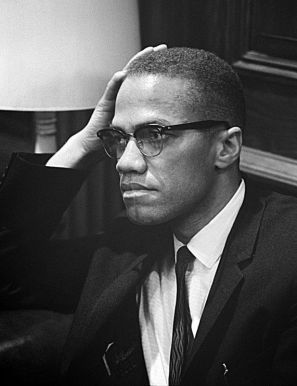
 

malcolm


Our people have made the mistake of confusing the methods with the objectives. As long as we agree on objectives, we should never fall out with each other just because we believe in different methods, or tactics, or strategy.

Malcolm X


Questions to consider

1. Is the Afrikan Emancipation Day Reparations March (‘The Reparations March’) nothing more than a group of attention seeking people with vague and conflicting messages and objectives on reparations parading through the streets of London begging and complaining?

2. Is the March achieving it’s aims?

3. Is the March succeeding in getting people politically mobilised to hold the British state accountable for its role in the Maangamizi?

4. What factors can increase success in implementation of the aims of the March?

5. What can we as stakeholders do to increase the numbers, diversity of constituencies of Afrikan heritage communities involved in planning, mobilising towards and participating in the March.

6. What work are you doing to help steer the energy galvanised by the March in the direction of political and policy change towards reparatory justice?

7. What role can and should allies play in mobilising for and between the Marches?

8. For those that still say that marching and petitioning, which actually cost us very little risk or harm in Britain today, achieve are a waste of time; what else is it you are prepared to do which you feel will bring about a more favourable response from the British state to our Afrikan Reparatory Justice demands?

9. What other initiatives or activities or protest actions are taking place that will be far more effective in holding the British state and other perpetrators of the Maangamizi to account?

10. What will make the International Social Movement for Afrikan Reparations actually move?

11. What are the methods that will effectively secure and win people of Afrikan heritage reparatory justice?

12. What have you been doing to promote the March or indeed what you may see as more effective alternatives to it?


Guidance on taking action previously put out

Call to Participate in the 2016 Afrikan Emancipation Day Reparations March 2016
https://www.youtube.com/watch?v=wR4ObeZ2QiE

Reparations March 2017: invitation to participate
https://www.youtube.com/watch?v=6U6qzMmtvO8

Reparations March 2017: call to action
https://www.youtube.com/watch?v=as8OjyFrh44

Reparations March 2017: call to mobilise
https://www.youtube.com/watch?v=pubRIzHplnk

SMWeCGEC Petition Update featuring video of AEDRMC Co-Chair Jendayi Serwah ‘Power is only going to respond to power’

https://www.change.org/p/stop-the-maangamizi-we-charge-genocide-ecocide/u/20457629

https://www.change.org/p/stop-the-maangamizi-we-charge-genocide-ecocide/u/21147298

https://stopthemaangamizi.com/2017/08/23/response-from-the-foreign-commonwealth-office-to-the-2017-smwecgec-petition/

Requoting from the 24th August SMWeCGEC Petition Update dated 24th August 2017

Increasingly it is becoming clearer that the British Government will only begin to listen to our Afrikan Reparatory Justice demands, including the demands of the SMWeCGEC when the advocacy, encouragement and support by our Afrikan Heritage Communities in Europe is given to the efforts of our Afrikan Communities of Resistance in Afrika, the Caribbean, other parts of Abya Yala, (the so-called Americas), as well as in Europe to shutting down extractive industries and other foreign corporate crime scenes of the Maangamizi. This is something we stated in the letter to the Prime Minister accompanying the 2017 hand-in of the ‘Stop the Maangamizi!’ Petition. It follows that the plunder of our community resources is still continuing to enrich white power in Britain and European domains of global apartheid across the world. We therefore need to seriously revisit some of the strategies and tactics with which our revered Ancestors fought successful liberation struggles; gaining some concessions that resulted in the official discontinuation of the British Empire, even from inside the brains and belly of the beast of the said Empire!

In fact, it is by pursuing strategies and tactics in Britain that advocated for, encouraged and supported actions of Afrikan people to make the British and other European Empires in Afrika, the Caribbean, Abya Yala as well as Asia ungovernable, which compelled changes in the British Empire, resulting in the proclamations of independence of our current nations states in Afrika and the Caribbean. A similar outcome and impact can be brought about again in our lifetime with the shutting down of Maangamizi crimes scenes in Afrika, the Caribbean, other parts of Abya Yala and Europe.

For those that still say they are not for petitioning or Marching, which actually cost us very little risk or harm in Britain today, what else is it you are prepared to do which you feel will bring about a more favourable response from the British state to our Afrikan Reparatory Justice demands?

The honestly critical discussion and reasoning that should flow from these perspectives of ours in the SMWeCGEC is something that we urge is carried out in Afrikan Heritage Communities not only in the UK, but throughout Europe, Afrika, Abya Yala and other parts of the world. We further urge that this is also done against the background of the historical legacies and the contemporary manifestations of the still ongoing Maangamizi as outlined in the ‘Stop the Maangamizi!’ Petition.


‘Take Action’ tab on the ‘Stop the Maangamizi!’ website
https://stopthemaangamizi.com/take-action/

After 4 years of marching what has been achieved?
https://stopthemaangamizi.com/2017/08/07/after-4-years-of-marching-what-has-been-achieved/

After the 2017 Reparations March: what next?
https://stopthemaangamizi.com/2017/08/05/after-the-reparations-march-what-next/


2017 POPSAR Topic

‘Black on Black Violence’: Why are we not doing enough to stop this manifestation of the Maangamizi?

Debating the motion: This gathering believes that we as Afrikan Heritage Communities are not doing what is necessary to stop this manifestation of the Maangamizi.

Please note: The topic was deliberately framed in this way to elicit strong responses to rebut this proposition.

Rationale for this topic

Micro-sites inter-personal violence between persons of Afrikan heritage communities, are not isolated manifestations. Instead, they are extensions of macro-state processes of violence. In other words, we must read inter-personal violence against men, women, children and young people of Afrikan heritage as part of the continuum of the state’s racialized, gendered, sexualized violence against Afrikan heritage communities. This is about showing the state’s complicity in ongoing intra-community violence which is in itself a ground for reparatory justice for those living today.


For further info about the 2018 Reparations March see here.
 

Posted in AEDRMC, AFRIKAN HELLACAUST, AFRIKAN RESISTANCE, EVENTS/TRAINING, INTERNATIONAL SOCIAL MOVEMENT FOR AFRIKAN REPARATIONS, ISMAR, REPARATIONS, SMWeCGEC, STOP THE MAANGAMIZI CAMPAIGN, STOP THE MAANGAMIZI PETITION, THE 2018 AFRIKAN EMANCIPATION DAY REPARATIONS MARCH, Uncategorized | Tagged Afrika, British Empire, Debate, Debating, Genocide, Geopolitics, Lobbying, People Power, POPSAR, Social Movement | Leave a comment

IS LABOUR NOW LISTENING TO AFRIKAN VOICES?

Posted on April 13, 2018 by STOP THE MAANGAMIZI

bernie grant collage 2


Greetings Supporters of the ‘Stop the Maangamizi: We Charge Genocide/Ecocide! Campaign (SMWeCGEC)

Following the 13th April 2018 news report on the front page of the Times Newspaper: ‘PM should apologise to ex-colonies says Labour’, it would appear as if the Labour Party is now taking steps towards listening to Afrikan voices for reparatory justice. It is only now since the passing of the late Bernie Grant MP that Labour is thinking of hearing Afrikan voices like his on our intergenerational struggle for reparatory justice.
Within 24 hours of the 11 April 2018 letter from Esther Stanford-Xosei being sent to Heidi Alexander MP and also made available to the office of the Rt Hon Jeremy Corbyn MP, leader of the Labour Party, the Shadow Foreign Secretary, Emily Thornberry, advocates in the House Magazine that Prime Minister Theresa May should use the forthcoming Commonwealth Heads of Government Meeting to apologise for the UK’s historic wrongs. Emily Thornberry also states that, if Labour form the next government in Britain, they will ensure that promoting and engaging with the Commonwealth is one of their top foreign policy priorities. In Esther Stanford-Xosei’s letter to Heidi Alexander she states:

“The fact that BREXIT is making it necessary for the UK Government to seek to strengthen its Commonwealth links in the aftermath of the BREXIT vote raises questions pertinent to Afrikan Reparatory Justice. Among such questions, for example, is the one about what type of relationship is Britain seeking to strengthen with Afrikan and Caribbean countries of the Commonwealth when the existing relationship is not only a product of the crimes of the past, but also fortifies present wrongs of the Maangamizi? So much is this the reality, that in the opinion of the constituencies of the ISMAR to which I belong, this relationship can only be transformed to ensure justice for all, by measures of reparations that will enable Afrikans and people of Afrikan heritage to equitably participate in re-ordering the war-begotten, unequal and unfair system of international relations that continues to be imposed, with manly Euro-American imperial might, upon the globe today.”

It would appear that Emily Thornberry is in her article also providing an answer to the above question that has been posed, in various arenas, by SMWeCGEC and some other formations of the International Social Movement for Afrikan Reparations (ISMAR) when she states:

“…we see our Commonwealth cousins [not] just as potential trading partners, but [because] we see them as full and equal partners in all of the challenges faced by the world and by each of our nations, from climate change and terrorism to the fight for gender equality.”

We in the SMWeCGEC are of the view that the above comment on behalf of the Labour Party demonstrates that they can be influenced to advance steps towards better listening to the case being made for holistic reparations by authentic Afrikan Heritage Community voices in and beyond the UK who are involved in building the ISMAR. However, this realisation should, under no circumstances. make campaigners for Afrikan reparations lower our guard about critically engaging with the Labour Party and the wider Labour Movement on what repairs ought to mean, so as to enable us make gains of true reparatory justice.

That is why we should be mindful and seek to ensure that the Labour Party is not made, by ‘BAME’ gate-keeping apparatchiks and other sections still clinging to its old ways of misusing the bureaucratic party machinery, to distort the legitimate measures of redress that oppressed communities influence it to address by revising them, sometimes even to the point of outright deformation; so that at the stages of policy-formulation and implementation, they become mere white-washing tokenistic gimmicks which tinker Afriphobically with vital concerns of particularly Afrikan Heritage Communities; thereby robbing us of the agency that is vitally necessary for us to do for ourselves the true reparatory justice we are seeking.

So let us keep knocking at the door of publicly elected officials as those seeking such offices will come knocking on our doors in the coming weeks soliciting our votes. We must ensure that we use our votes wisely to make candidates we may be inclined to vote for support our Afrikan Heritage Communities strategic interests and concerns; top-most on the agenda should be their support for Afrikan Reparatory Justice and their concrete action on the ‘Stop the Maangamizi!’ Postcard demands.


In Service

‘Stop the Maangamizi: We Charge Genocide/Ecocide!’ Campaign International Steering Committee Spearhead Team (ISC-SMWeCGEC)


Posted in AFRIKAN HELLACAUST, AFRIKAN RESISTANCE, ALL PARTY PARLIAMENTARY COMMISSION OF INQUIRY (APPCITARJ), INTERNATIONAL SOCIAL MOVEMENT FOR AFRIKAN REPARATIONS, ISMAR, MAANGAMIZI RESISTANCE, MAANGAMIZI RESISTORS, REPARATIONS, Reparatory Justice, SMWeCGEC, STOP THE MAANGAMIZI PETITION, THE 2018 AFRIKAN EMANCIPATION DAY REPARATIONS MARCH, Uncategorized | Tagged Afrika, Afrikan Heritage Communities, Afrikan Vote, Afriphobia, AHC-NSD, Apartheid, Apology of Substance, BAME, BAME Labour, Bernie Grant, BlackVotingCanonFodderNoMore!, British Colonialism, British Empire, British Government, CHOGM 2018, Commonwealth, Ecocide, Genocide, Geopolitics, Grassroots lobbying, Houses of Parliament, ISMAR, ISMAR-Building, Labour Movement, Labour Party, Lobbying, Nothing About Us Without Us!, People Power, PRIM, REPARATIONS, Social Movement, Tax Fraud | Leave a comment

OUR REPARATORY JUSTICE CHALLENGE TO LABOUR: TACKLE YOUR OWN MAANGAMIZI COMPLICITY!

Posted on April 13, 2018 by STOP THE MAANGAMIZI

“The future will have no pity for those men and women who possess the exceptional privilege to speak the words of truth, instead have taken refuge in an attitude of cold complicity and mute indifference.“

Revised quote from Frantz Fanon, ‘Toward the African Revolution: Political Essays’, 1994


Greetings Supporters of the ‘Stop the Maangamizi: We Charge Genocide/Ecocide!’ Campaign (SMWeCGEC)


The letter below is the latest in the ongoing correspondence between Esther Stanford-Xosei and MP, Heidi Alexander, on issues to do with the SMWeCGEC and the campaign’s work for reparatory justice:

ESTHER STANFORD-XOSEI LETTER TO HEIDI ALEXANDER MP RE RESPONSE FROM FCO MINISTER LORD AHMAD

The letter from Esther Stanford-Xosei deals with the response from Foreign & Commonwealth Minister of State for the Commonwealth and the UN, Lord Ahmad to the 2017 ‘Stop the Maangamizi!’ Petition and its accompanying correspondence.

The exchanges so far show that as much as sections of the Labour Movement are becoming more interested in communications with certain constituencies of the International Social Movement for Afrikan Reparations (ISMAR), there is a greater need to ensure that the Labour Party is challenged to develop a correct way of dealing with the issues raised in the correspondence and our Afrikan Heritage Communities in consonance with the ethics of reparatory justice. This must also be done in such a way that recognises Afrikan people’s human and people’s right to Substantive Afrikan Heritage Community Representation.

What this means is that Labour Party is being challenged by SMWeCGEC and other Afrikan Reparations campaigners to engage in ‘institutional self-repairs’ in the ways it deals with Afrikan Heritage Communities and our autonomous community organisations as well as the issues that concern us. Only by doing so, will it become a worthy stakeholder with locus standi in Afrikan Heritage Community reparatory justice engagements.

In livicated Service!

Stop the Maangamizi: We Charge Genocide/Ecocide! Campaign International Steering Committee Spearhead Team (ISC-SMWeCGEC)


Posted in AFRIKAN HELLACAUST, AFRIKAN RESISTANCE, ALL PARTY PARLIAMENTARY COMMISSION OF INQUIRY (APPCITARJ), INTERNATIONAL SOCIAL MOVEMENT FOR AFRIKAN REPARATIONS, ISMAR, MAANGAMIZI RESISTANCE, MAANGAMIZI RESISTORS, PREFIGURATIVE POLITICS, REPARATIONS, Reparatory Justice, STOP THE MAANGAMIZI CAMPAIGN, STOP THE MAANGAMIZI PETITION, THE 2018 AFRIKAN EMANCIPATION DAY REPARATIONS MARCH | Tagged Afrikan Heritage, Afrikan Heritage Communities, Afrikan Liberation, APPCITARJ, Battle of Ideas, Black Radical Imagination, BlackVotingCanonFodderNoMore!, British Colonialism, British Government, Cognitive Justice, Commission of Inquiry, Counterinsurgency, Ecocide, GAPP, Genocide, Global Afrikan People's Parliament, Global Apartheid, Grassroots Leadership, Grassroots lobbying, Hellacaust, Houses of Parliament, INOSAAR, International Social Movment for Afrikan Reparations, ISMAR-Building, Labour Movement, Labour Party, Lobbying, Maangamizi, Movement-Building, Neocolonialism, NothingAboutUsWithoutUs!, Pan-Afrikan Reparations for Global Justice, Pan-Afrikanism, People Power, Reparations March, Reparatory Justice, Self-Repairs, SMWeCGE Petition, Social Movement, Stop the Maangamizi, Substantive Afrikan Representation, Tax Fraud, We Charge Genocide/Ecocide! | Leave a comment

INOSAAR TEMPLATE LETTER TO MPs RE:THE ACADEMIC LEGITIMACY OF THE CASE FOR AFRIKAN REPARATIONS AND ITS IMPLICATIONS FOR BRITISH STATE POLICY-MAKING

Posted on April 11, 2018 by STOP THE MAANGAMIZI

INOSAAR PARLIAMENT


Greetings Supporters of the ‘Stop the Maangamizi: We Charge Genocide/Ecocide!’ Campaign (SMWeCGEC)

Last October we notified you about the launching of the International Network of Scholars & Activists for Afrikan Reparations (INOSAAR) in association with PARCOE, the Pan-Afrikan Reparations Coalition in Europe. We in the International Steering Committee Spearhead Team of the ‘Stop the Maangamizi: We Charge Genocide/Ecocide!’ Campaign (ISC-SMWeCGEC) recognise this initiative for making a significant and unprecedented contribution to developing the intellectual arsenals necessary for tackling Afriphobia and other manifestations of the genocide/ecocide; particularly its mentacide within and beyond educational institutions. We are also pleased that the SWWeCGEC is recognised in the INOSAAR Principles of Participation.

Since the launch event, the INOSAAR has had a conference in Birmingham and looks forward to two follow-up events in Senegal and a conference in Benin. One of the follow-up actions arising from the recent INOSAAR Birmingham Conference was for INOSAAR members and constituencies to support us in getting their MPs to support a meeting in the House of Parliament to discuss ‘The Academic Legitimacy of the Afrikan Case for Reparations and its Implications for British State Policy-Making’.

See this link for the template letter which you can amend accordingly and send to your own MPs if you are based in the UK. The text is also reproduced below.

Please let INOSAAR know of any progress you make with your MPs by emailing Dr Nicola Frith & Professor Joyce Hope Scott at inosaar.ed.ac.uk.


Dear [MP NAME]

I am writing as local constituent regarding a matter of concern to me as a person of Afrikan heritage/a concerned member of the public [DELETE AS APPROPRIATE].

I was horrified to recently discover that up until 2015, tax-payers in Britain, including myself as a descendant or relative of enslaved Afrikans [DELETE IF NOT APPLICABLE], were paying off a debt that was accrued as a result of the compensation awarded to British enslavers as legislated with the Slavery Abolition Act 1833 (see, for example, the article in the Bristol Post from 13 February 2018).

The opinion of experts working in the field, like Bristol-based historian David Olusoga, has strengthened my own conviction about the injustice glaringly showed in this matter (see, for example, the article published in The Guardian on 12 February 2018).

Such is the public outrage, that a petition has been started about this misuse of taxes. This increasing public interest is stimulating not only public debate, but also academic research and discourses relevant to policy-making regarding these and other pertinent issues of domestic and foreign policies.

The 17 March 2018 conference in Birmingham of the International Network of Scholars and Activists for Afrikan Reparations (INOSAAR) is an example of such activity, which is drawing together both scholars, activists and policy-campaigners to exchange perspectives on their thinking and actions about how best to address these kinds of injustices.

One recent political response has been the plan unveiled by the Labour Party for firms with links to the so-called Atlantic ‘slave trade’ to contribute to the setting up of a Slavery Educational Trust (see, for example, the article in The Standard on 23 March 2018).

In response to these developments, I am requesting your support to host a meeting in the Houses of Parliament to discuss ‘The Academic Legitimacy of the Afrikan Case for Reparations and its Implications for British State Policy-Making’.This proposed meeting in Parliament is important because, as hinted at in the ‘Refund Our Taxes’ petition, the refund of tax monies can assist the Afrikan Heritage Community to effect its own innovative ‘Pempamsie’-planning approaches to reparatory justice. In other words, Afrikan Heritage Communities will be able to design their own bespoke reparatory justice programme that will satisfy their own self-determined interests and purposes. Examples of such approaches include educational and other community self-repairs, which form a vital part of the reparative process and go far beyond paycheques to individuals and governments.

I look forward to hearing from you on this urgent matter in due course.

Yours Sincerely

[YOUR NAME & SIGNATURE]


Stop the Maangamizi: We Charge Genocide/Ecocide! Campaign International Steering Committee Spearhead Team (ISC-SMWeCGEC)


Posted in INTERNATIONAL SOCIAL MOVEMENT FOR AFRIKAN REPARATIONS, MAANGAMIZI RESISTANCE, PREFIGURATIVE POLITICS, REPARATIONS, Reparatory Justice, Uncategorized | Tagged Afrikan Heritage Community for National Self-Determination, Afrikan Reparations, AHC-NSD, British Government, GAPP, Genocide, Global Afrikan People's Parliament, Grassroots lobbying, Houses of Parliament, INOSAAR, International Network, Lobbying, Maatubuntujamaa, Nothing About Us Without Us!, PARCOE, Pempamsie Plan, People Power, REPARATIONS, Reparations Agenda, Scholars & Activists for Afrikan Reparations, Social Movement, Speaking Truth to Establishment Power, Tax Fraud, Template Letter to MPs | Leave a comment

Post navigation

Newer posts →

Recent Posts

  • SMWeCGEC MP Letter Template Guidance
  • MET brokers partnerships in Belize to advance reparations education & campaigning initiatives
  • Statement Issued by the Afrikan Emancipation Day Reparations March Committee & The Stop The Maangamizi: We Charge Genocide/Ecocide Campaign regarding Co-Organising the 1st Mosiah 2024
  • Theme for the PARRG 2023
  • SMWeCGEC & AEDRMC Key Achievements in ISMAR & PRIM-building

Recent Comments

Kitchen Kara's avatarKitchen Kara on METRO NEWSPAPER ADVERT 21, 25…
Enita Barrett's avatarEnita Barrett on MET brokers partnerships in Be…
Adé Olaiya, M.A.'s avatarAdé Olaiya, M.A. on Ourstory continues to be made:…
Morgan Moss, JR's avatarMorgan Moss, JR on Ourstory continues to be made:…
Morgan Moss, JR's avatarMorgan Moss, JR on Response to 2nd written questi…

Archives

  • March 2025
  • August 2024
  • June 2024
  • July 2023
  • June 2022
  • February 2022
  • December 2021
  • November 2021
  • October 2021
  • September 2021
  • June 2021
  • May 2021
  • March 2021
  • February 2021
  • January 2021
  • December 2020
  • November 2020
  • October 2020
  • September 2020
  • August 2020
  • July 2020
  • June 2020
  • December 2019
  • November 2019
  • August 2019
  • June 2019
  • May 2019
  • March 2019
  • February 2019
  • January 2019
  • December 2018
  • November 2018
  • October 2018
  • August 2018
  • July 2018
  • April 2018
  • March 2018
  • February 2018
  • December 2017
  • November 2017
  • October 2017
  • September 2017
  • August 2017
  • July 2017
  • June 2017
  • May 2017
  • March 2017
  • February 2017
  • December 2016
  • November 2016
  • September 2016
  • August 2016
  • July 2016
  • May 2016
  • April 2016
  • March 2016
  • January 2016
  • October 2015

Categories

  • 2019 AFRIKAN EMANCIPATION DAY REPARATIONS MARCH
  • AEDRMC
  • AFRIKAN HELLACAUST
  • AFRIKAN RESISTANCE
  • ALL PARTY PARLIAMENTARY COMMISSION OF INQUIRY (APPCITARJ)
  • APPGAR
  • Ecocide
  • EVENTS/TRAINING
  • Extinction Rebellion
  • I AM WITNESS
  • INTERNATIONAL SOCIAL MOVEMENT FOR AFRIKAN REPARATIONS
  • ISMAR
  • Jerry Amokwandoh
  • MAANGAMIZI RESISTANCE
  • MAANGAMIZI RESISTERS
  • MAANGAMIZI RESISTORS
  • PALM
  • Pan-Afrikan Liberation Movement
  • PARRG 2022
  • PARRG 2023
  • POPSAR
  • PREFIGURATIVE POLITICS
  • PRIM
  • REPARATIONS
  • Reparations Rebellion
  • REPARATIONS REBELLION 2020
  • REPARATIONS REBELLION GROUNDINGS
  • Reparatory Justice
  • SMWeCGEC
  • SMWeCGEC CAMPAIGNING TOOLS
  • STOP ECOCIDE
  • STOP THE MAANGAMIZI CAMPAIGN
  • STOP THE MAANGAMIZI PETITION
  • THE 2016 1ST AUGUST AFRIKAN EMANCIPATION DAY REPARATIONS MARCH
  • THE 2017 AFRIKAN EMANCIPATION DAY REPARATIONS MARCH
  • THE 2018 AFRIKAN EMANCIPATION DAY REPARATIONS MARCH
  • UBUNTUKGOTLA/PITGJ
  • Uncategorized
  • YOUNG PEOPLE/ GLOBAL MAJORITY V UK GOV

Meta

  • Create account
  • Log in
  • Entries feed
  • Comments feed
  • WordPress.com
Blog at WordPress.com.
  • Subscribe Subscribed
    • stopthemaangamizi.com
    • Join 49 other subscribers
    • Already have a WordPress.com account? Log in now.
    • stopthemaangamizi.com
    • Subscribe Subscribed
    • Sign up
    • Log in
    • Report this content
    • View site in Reader
    • Manage subscriptions
    • Collapse this bar
 

Loading Comments...