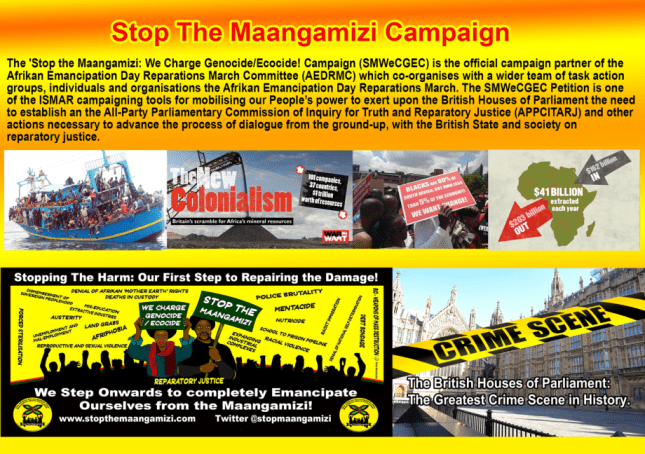
Greetings Supporter of the ‘Stop the Maangamizi: We Charge Genocide/Ecocide!’ Campaign (SMWeCGEC)
This is the response from Dr David Duncan, Chief Operating Officer and University Secretary to the SMWeCGEC open letter sent to the University of Glasgow History of Slavery Steering Committee.
Until next time!
‘Stop the Maangamizi: We Charge Genocide/Ecocide! Campaign International Steering Committee Spearhead Team (ISC-SMWeCGEC)
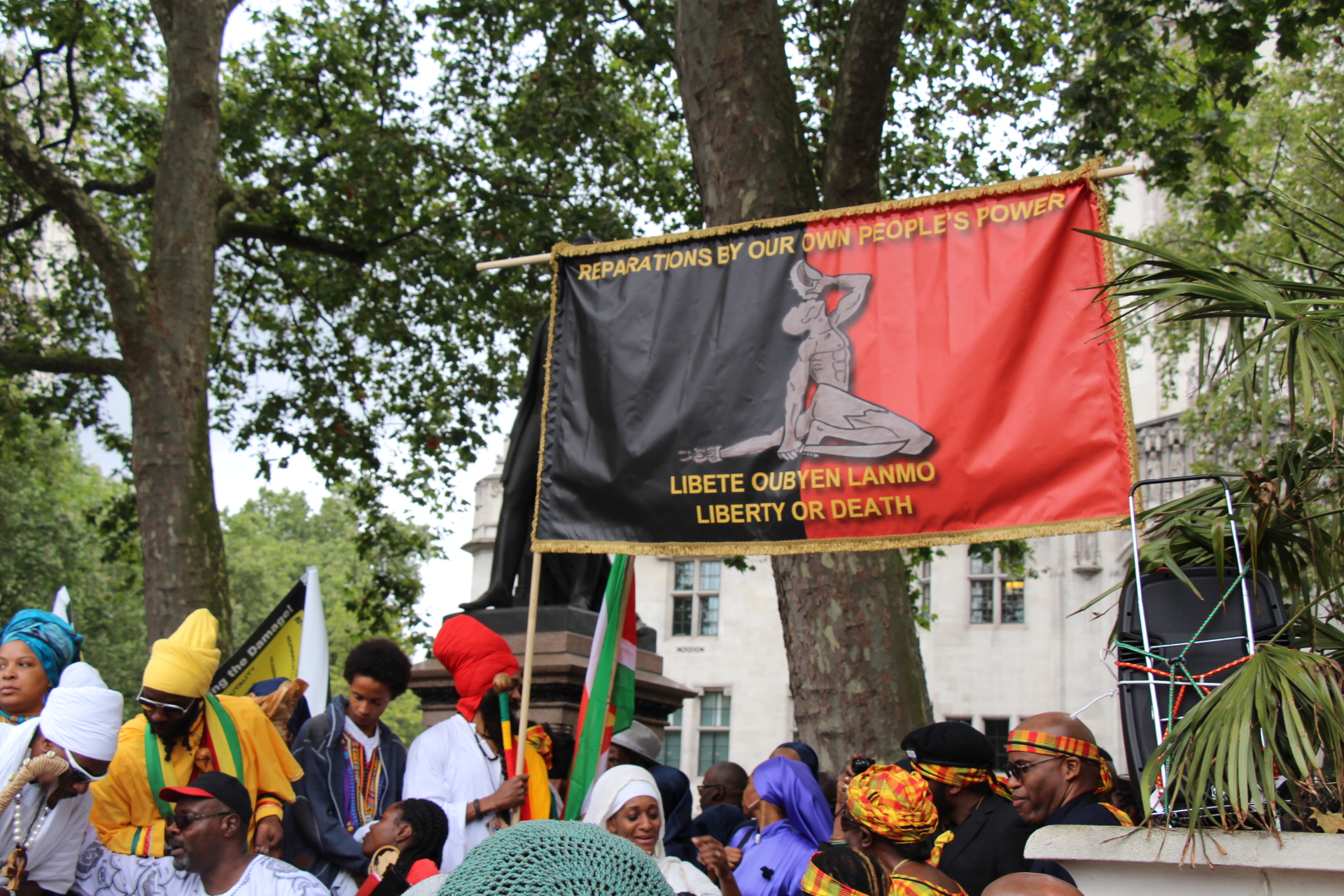
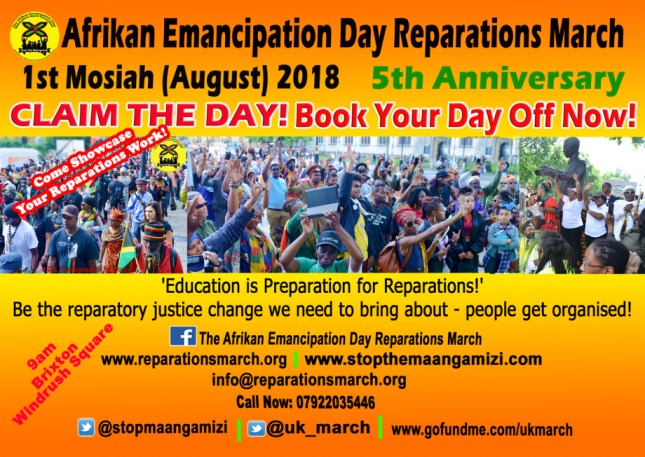
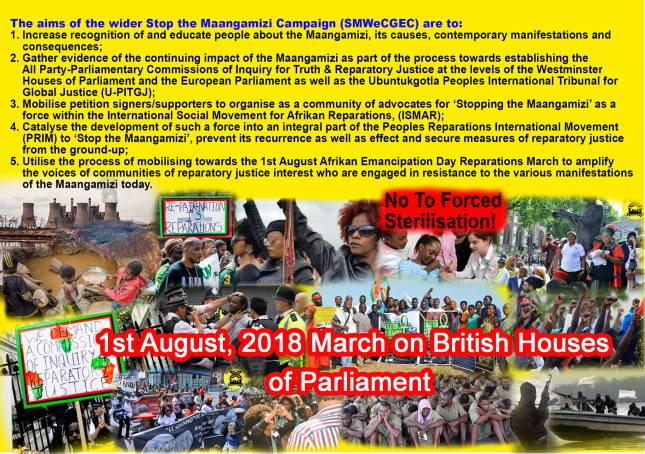
Selected images from the 2018 Afrikan Emancipation Day Reparations March
We see that our Afrikan Reparatory Justice efforts in general, and the work of the Afrikan Emancipation Day Reparations March Committee (AEDRMC) in particular, is now beginning to impact on British establishment political thinking; in terms of how to respond to our own community self-repair endeavours and the demands we are making, out of such endeavours, upon others. This is evidenced in the recently published Huffington Post article: ‘In the Wake of Windrush, Marking Emancipation Day is More Important Than Ever‘ by Dawn Butler MP, Shadow Minister for Women and Equalities and Labour MP for Brent Central.
It is encouraging to note that our criticism of the repugnant name of a Slavery Educational Trust which was made in AEDRMC promotional videos here and here has resulted in an attempt to rename such a proposed body to become the Emancipation Educational Trust. This still misses the whole point. Our preference for a name like the Afrikan Anti-Slavery Resistance Educational Trust (AASRET) still holds. It is mind-boggling that even some leading British Labour Party members, including MPs from our own Afrikan heritage communities, are still so engulfed by Afriphobia that they run away from including and explicitly identifying with anything Afrikan in the name of initiatives that are supposed to be about the Afrikan experience. This is even more shocking given that we are in the United Nations International Decade for People of African Descent which has the theme ‘People of African Descent: Recognition, Justice and Development.’ Indeed, there is nothing more unique to the global experience of Afrikan people other than the Maangamizi, (Afrikan Hellacaust) in relation to which this educational trust is being proposed.
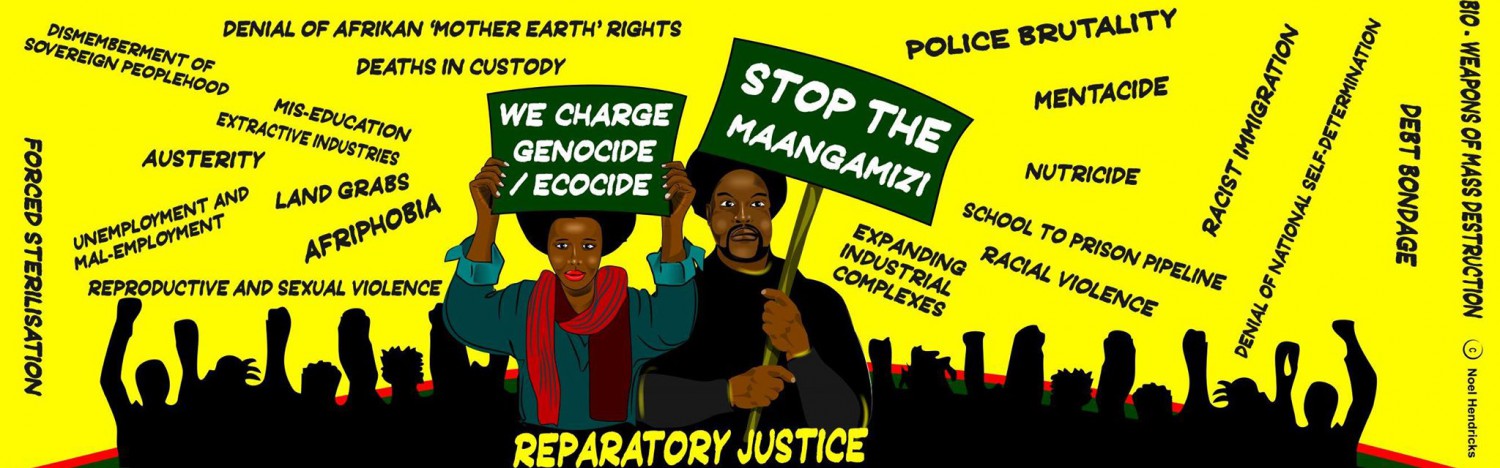
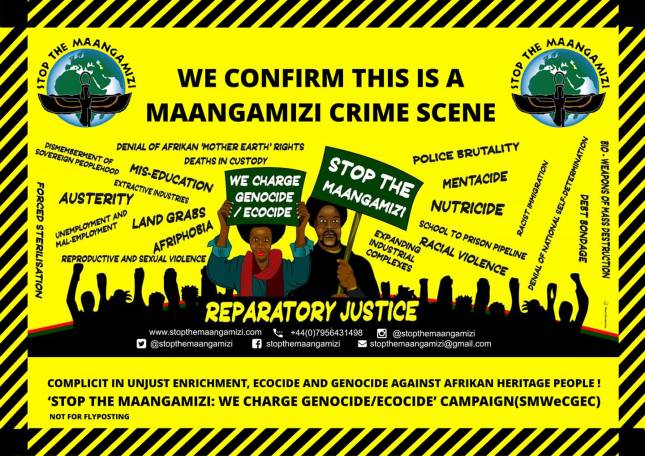
So pervasive is this Afriphobia, and so strongly does the British State hold unto it, that it is inherent in the processes of white supremacy racist brainwashing through which all those selected, even from our Afrikan heritage communities, to serve in various positions of the establishment are infected with it. Hence its prevalence amongst virtually all members of the British State legislature, executive, civil and public services, judiciary, armed forces, police, intelligence and other security agencies. It appears that not only submission to but an overt display of Afriphobia is a requirement for service in the institutions and agencies of the British State. No wonder it is those selected from our Afrikan heritage communities to serve in these institutions and agencies who appear to exhibit the worst traits of Afriphobic epistemic and structural violence upon Afrikan Heritage Community people. That is why the ‘Stop the Maangamizi: We Charge Genocide/Ecocide!’ Campaign (SMWeCGEC) regards all these institutions and agencies of the British State as ‘Maangamizi crime scenes’.
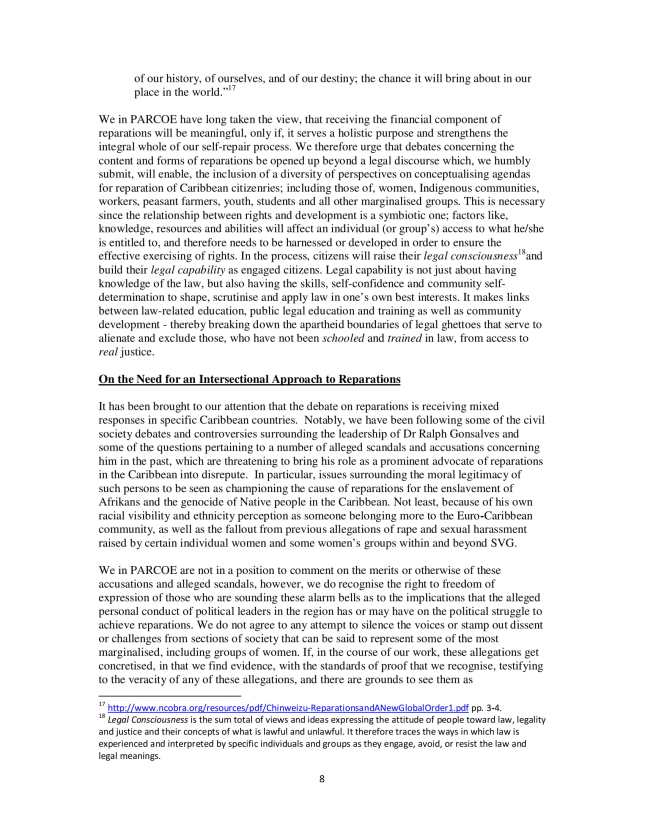
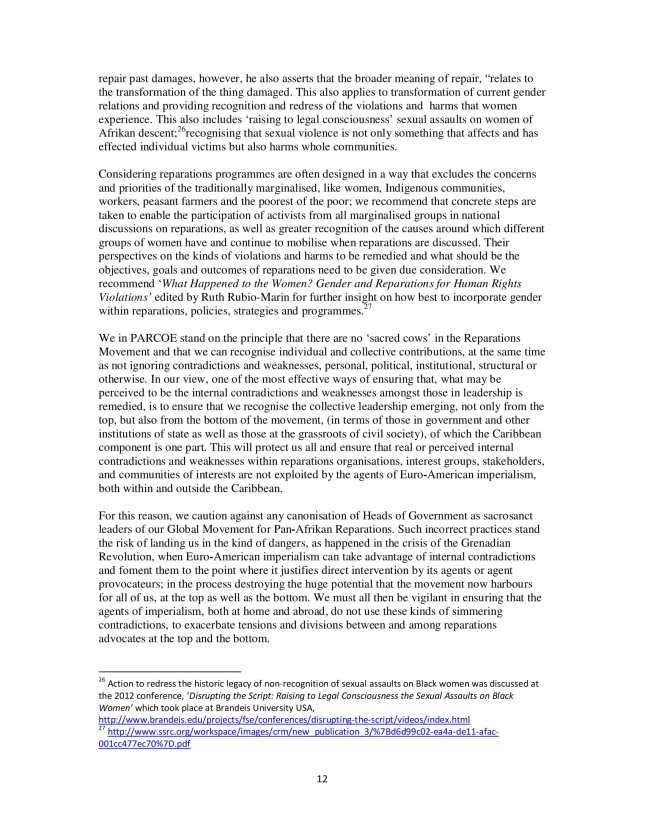
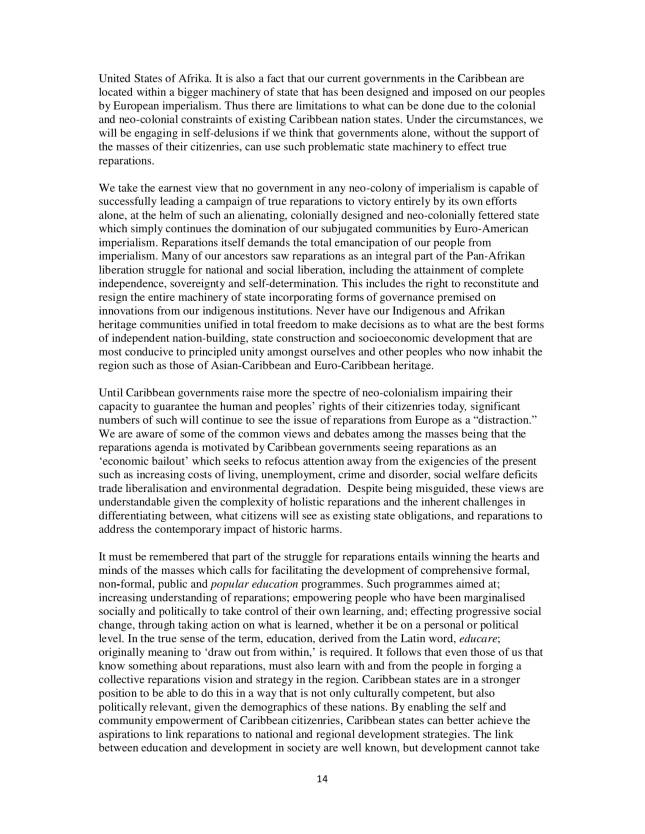
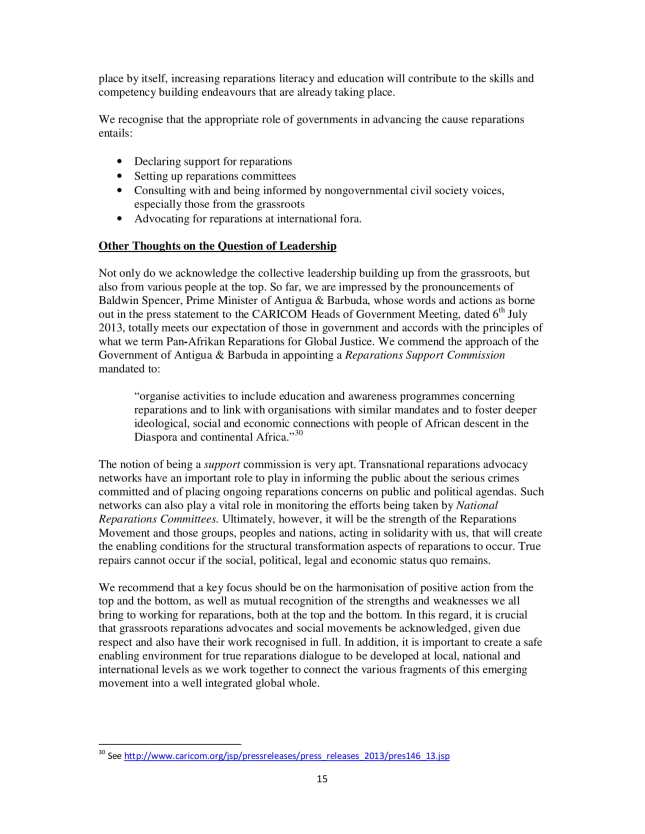
The proposed Emancipation Educational Trust will be nothing but another Maangamizi crime scene if it is established with the same intention of avoiding explicit Afrikan identification, whilst seeking to make it simply distortedly flirt with a commoditised form of Afrikan history and experiences. So, we urge Jeremy Corbyn, as leader of the Labour Party and the Party itself to study carefully, the themes and messages, which were promoted on the 1st August Afrikan Emancipation Day Reparations March: ‘Nothing About Us Without Us!: Actualizing the Reparatory Justice Change We Envisage’. It is about time the Labour Party stopped this nonsensical beating about the bush, openly confronts its deeply ingrained Afriphobic racism and seeks to honestly counteract it. This includes taking clear steps to initiate open dialogue with the legitimate grassroots representatives of our Afrikan heritage communities of reparations interest in the UK. Such representatives are clearly known through their visible work in organising endeavours such as the annual Afrikan Emancipation Day Reparations March and its related ‘Stop the Maangamizi!’ campaign activities.
The continuing attempts to evade substantive representation of our Afrikan heritage communities; by bringing members of the Labour Party far removed from such activities and also afflicted with white supremacy racist indoctrination to simply express, their ‘masters’ voices and prejudices in toying with vital matters concerning the survival of Afrikan people in the world today, such as reparatory justice, must be understood as no longer acceptable to us at all. We expect Jeremy Corbyn as leader of the Labour Party, to embrace this firm, non-negotiable standpoint of ours, against all Afriphobic expressions of the Maangamizi as part of the ‘new politics’ he promised Britain, the Commonwealth and the World.
We know Jeremy Corbyn can do better because in his laudable solidarity work for the Anti-Apartheid Movement he displayed some of his best efforts to date of internationalist solidarity with our Afrikan Liberation Struggle. We therefore hope that he will go back to such track-records of his own best practice and do the correct thing once again. The correct thing begins with him taking steps to initiate the dialogue we have been calling for by meeting, to start with, representatives from the Afrikan Emancipation Day Reparations March Committee (AEDRMC), the organisers of the annual 1st August Afrikan Emancipation Day Reparations March and their partners in the SMWeCGEC.
In Service
Esther Stanford-Xosei
Coordinator-General ‘Stop the Maangamizi: We Charge Genocide/Ecocide!’ Campaign
The 6-member delegation for the 2018 hand-in of the ‘Stop the Maangamizi!’ Petition were:
From Right to Left
1. Hon. Prophet Kweme Abubaka (Afrikan Emancipation Day Reparations March Committee, Ethiopia African Black International Congress)
2. Dr Barryl Biekman, (Europe-wide NGO Consultative Council for Afrikan Reparations, Netherlands)
3. Mama Lindiwe Tsele (Pan-African Congress of Azania)
4. Ms Kambanda Veii (Ovaherero Genocide Foundation, Namibia)
5. Cllr Joshua Brown-Smith, age 12 (Office of the Young Mayor, London Borough of Lewisham)
6. Professor Gus John (Gus John Associates, Member of the African Union Technical Union Technical Committee of Experts on the 6th Region).
The delegation which handed-in the 2018 ‘Stop the Maangamizi: We Charge Genocide!’ Petition represents a selection of the diversity within our Afrikan Heritage Community. The Young, The Elders, Born on the Continent, Born in the Diaspora, Male and Female, and as in previous members some members flew in from Afrika and Europe!
#ReparationsMarch2018
#Parliament is a Crime Scene!
#StopTheMaangamizi!
See the following letter which accompanied the hand-in of the ‘Stop the Maangamizi!’ Petition
Please note, the ‘Stop the Maangamizi!’ Petition has been handed-in since 2015, in 2016 no signatures were handed in just the petition and a cover letter. In 2016, 5811 signatures were handed in, in 2017, 9636 signatures were handed in.
It is important to note that the ‘Stop the Maangamizi!’ Petition is not the only tactic we are adopting, the petition signatures accompany a Maangamizi Crime Scene sticker operation and lobbying of MPs strategy via the ‘Stop the Maangamizi!’ Postcard involving support for developing Afrikan Heritage Community advocacy on the points contained in the petition.
It is also important to note that we in the International Steering Committee Spearhead Team of the ‘Stop the Maangamizi!’ Campaign (ISC-SMWeCGEC) know that reparations will not be achieved simply by submitting this petition, if one reads the petition it is clear that this is not our thinking. In numerous articles and documents we talk about the March and the petition being part of revolutionary strategy and tactics that we are engaged in, which also involve all forms and levels of liberation struggle waged by various contingents of the International Social Movement for Afrikans (ISMAR).
The Afrikan Emancipation Day Reparations March and the annual hand-in of the petition is about building a broad public support base for consolidating the ISMAR in order to strengthen the harnessing and building of Afrikan people’s power to advance reparations to definitive victory; whiincluding the establishment of MAATUBUNTUMAN Pan-Afrikan Union of Communities.
This video is of a workshop which took place on Friday 27th July, 2018 and provides some elaboration on the revolutionary thinking and work into for the long-term results that the March is meant to produce and to which it is already contributing.
This is a link to the initial response that was received from the Foreign & Commonwealth Office (FCO) in response to the 2017 ‘Stop of the Maangamizi!’ Petition and its covering letter, and also the further response from FCO Minister Lord Ahmad.
“Pan-Afrika, and not Eurafrica, should be our watchword, and the guide to our policies.”
– OSAGYEFO KWAME NKRUMAH, ‘Africa Must Unite’, 1963.
“It will be gross self-delusive wishful thinking to believe that those wielding the reins of White racist supremacy are going to pay any serious heed to the Afrikan demand for Reparations, unless their hold on the machinery of global power is effectively challenged by the well-organised, upsurgent and self-empowering masses of Afrikan people, and their allied progressive forces throughout the World.”
Kofi Mawuli Klu ‘Charting an Afrikan Self-Determined Path of Legal Struggle for Reparations’: A Draft Paper for Presentation to the 11th December 1993 Birmingham Working Conference of the African Reparations Movement, UK, 1993.
“At this juncture in our history, there is no way forward in addressing the problems that Afrikans and people of Afrikan descent and all other Black peoples face without seriously grasping the truth of the necessity for holistic reparatory justice. This includes restoring self-determination and sovereignty, implementing measures of cessation of contemporary violations, restitution.”
Esther Stanford-Xosei, 2016
This workshop will explore the meaning of the theme for the 5th annual Afrikan Emancipation Day Reparations March on 1st August 2018: ‘Nothing About Us Without Us: Actualizing the Reparatory Justice Change We Envisage.’ The main question we will discuss is: What kinds of tackling of problems and injustices that Afrikan people encounter can be deemed as the everyday repairs starting point of reparatory justice work? In this regard, we will highlight the outreach and other mobilizational work of the Afrikan Emancipation Day Reparations March Committee (AEDRMC), in association with the ‘Stop the Maangamizi: We Charge Genocide/Ecocide!’ Campaign (SMWeCGEC) with a view to making people see themselves as the actual ‘makers’ and ‘drivers’ of reparatory justice rather than being passive recipients of the benevolence of government and other state actors. This kind of thinking in views expressed by the likes of CARICOM Reparations Commission, Chairperson, Professor Sir Hilary Beckles when he reportedly stated in a recent interview published in the Barbados Advocate (12/07/18):“…reparations is ultimately a government to government conversation. It is about how governments talk to each other. How governments sit down and work out strategies to resolve issues of this nature.”.
In this connection, this workshop will also further explain the revolutionary substance of the rationale for the Reparations March given in the following video.
The difficulty of grasping reparations differently from what the white supremacist racist establishment defines it to be for us as Afrikan people, is largely as a result of miseducation and the coloniality of our mindsets in even how we are made to think about the cause, nature, consequences and solutions to the problems and injustices that we are encountering as a result of the Maangamizi (Afrikan Hellacaust). It is still largely the case that many who claim to be pro-reparations are inadvertently merely ‘supporters’ or reparations; waiting for the day when someone is going to say “here is your reparations,” or when they and/or Afrikan and Caribbean nation states receive some award of compensation from the British and other European Governments. The whole notion of exercising agency in conceptualising, effecting, securing and taking reparatory justice is completely absent for most of our people, across the world, who are sympathisers or adherents of the cause of reparatory justice.
Taking into account the criticism some establishment scholars make of Black reparations activism, in terms of not seeing its revolutionary tendencies, this workshop will therefore highlight those constituencies of the International Social Movement for Afrikan Reparations (ISMAR), like PARCOE and the Global Afrikan People’s Parliament (GAPP) that advance radical change-making perspectives. Examples of such perspectives are: the concept and methodology of Pan-Afrikan Reparations for Global Justice which embraces the world revolutionary transformational strategy of ‘Maatubuntusa’ (the art of Pan-Afrikan revolutionary freedom- fighting) for achieving MAATUBUNTUMAN. MAATUBUNTUMAN is the name being popularised for the envisaged future Pan-Afrikan Union of Communities, championed by PARCOE and GAPP and the Global Afrikan Family Reunion International Council (GAFRIC) in Ghana. Coined from the conjunction of “Maat” (the holistic Justice concept from Kemet, Ancient Egypt), with “Ubuntu” (the Bantu concept of the Communion of Humanity from Southern Afrika) and “Oman” (the Akan concept of egalitarian Polity from West Afrika). MAATUBUNTUMAN promotes the concept of a global Afrikan polity (“Oman”), which is an organic embodiment of “Maat” and therefore practices “Ubuntu” in relation to her own citizens and the entirety of Humanity, Mother Earth and the Universe.
PRESENTERS
Esther Stanford-Xosei is a jurisconsult, community advocate specialising in the critical legal praxis of ‘law as resistance’ and internationally acclaimed Reparationist. She is the official spokesperson for the Afrikan Emancipation Day Reparations March Committee (AEDRMC) which organises the annual 1st August Reparations March in London. In addition, Esther is the co-initiator of the ‘Stop the Maangamizi: We Charge Genocide/Ecocide!’ Petition and its wider campaign (SMWeCGEC). Esther also serves as the Co-Vice Chair of the Pan-Afrikan Reparations Coalition in Europe (PARCOE), co-founder of the Global Afrikan Peoples Parliament (GAPP), the Afrikan Reparations Transnational Community of Practice (ARTCoP) and the Europe-Wide NGO Consultative Council on Afrikan Reparations (ENGOCCAR). On behalf of PARCOE, Esther and other PARCOE members are involved as an activist partner in the building process of the International Network of Scholars & Activists for Afrikan Reparations (INOSAAR).
Oleye Gege is an emerging grassroots community scholar-activist, community radio broadcaster who promotes participatory approaches to effecting community self-repairs and addressing the intergenerational impacts of the psycho-social manifestations of the Maangamizi. He serves as the head of security and outreach facilitator on the Afrikan Emancipation Day Reparations March Committee and advocate of the ‘Stop the Maangamizi: We Charge Genocide Ecocide!’ Campaign (SMWeCGEC). He is also a member of Afrikan Reparations Transnational Community of Practice (ARTCoP) and the International Network of Scholars & Activists for Afrikan Reparations (INOSAAR).
Kofi Mawuli Klu is Chief Executive Commissioner of PANAFRIINDABA, a grassroots Pan-Afrikan Community Advocacy, Research and Think Tank based in London, UK and Accra, Ghana. He is also co-Vice Chair, Pan-Afrikan Reparation Coalition in Europe (PARCOE) in London and Joint Co-ordinator of the Global Justice Forum based in London and a founding member of the Global Afrikan People’s Parliament. Bro Kofi runs his own Law-Related Educational Services Agency, UEQUIPOISE. His scholarly activism has and continue to make a significant contribution within institutions of education in and outside of the UK [various courses, seminars, workshops, conferences and Groundings on Afrika and Pan-Afrikanism] and serves Afrikan students/communities as a conscientising tool for grassroots resistance and social change.
For further info about the Afrikan Emancipation Day Reparations March & the SMWeCGEC visit:
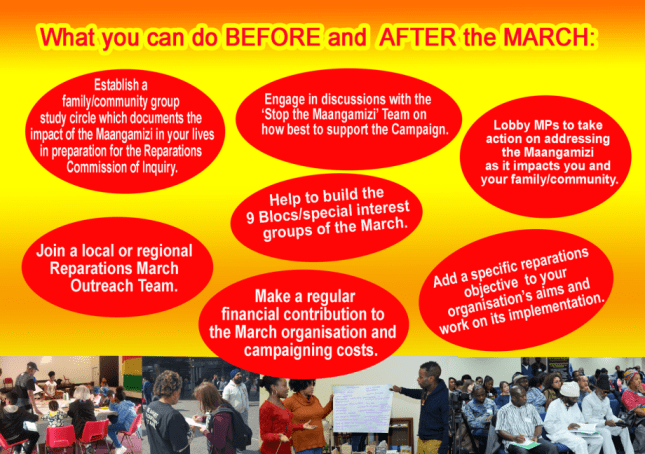
This is a special call-out for you to get more involved in the preparations for the 1st August Afrikan Emancipation Day Reparations March which partners with the ‘Stop the Maangamizi: We Charge Genocide/Ecocide!’ Campaign (SMWeCGEC).
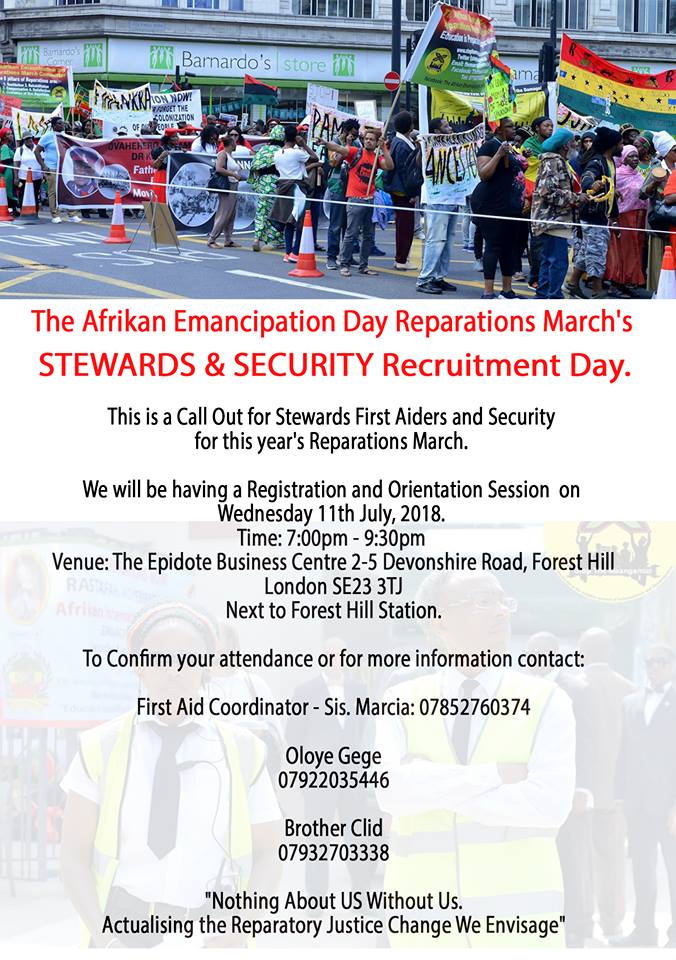
In particular, we draw your attention to the Stewards & Security Recruitment Day taking place on Wednesday 11th July 2018.
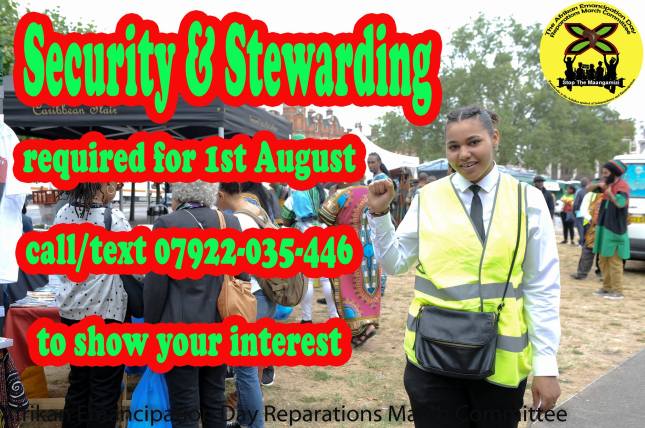
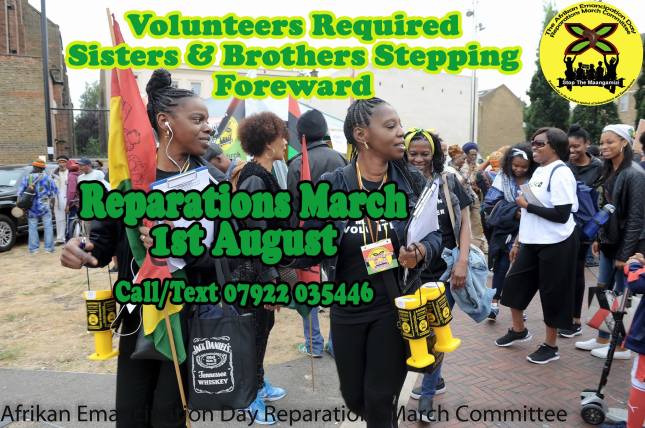
There are other ways you can get involved such as, first aiders, site-management support and petition promoters:
This is a video recording filmed by ‘joanjoan.london’ who attended the 2017 Afrikan Emancipation Day Reparations March on the 1st August. She recently released this edited version of the closing speech made at Parliament Square which is still relevant to the various aspects of the year-round mobilising and organising that the ‘Stop the Maangamizi: We Charge Genocide/Ecocide!’ Campaign (SMWeCGEC) engages in and advocates in association with the Afrikan Emancipation Day Reparations March Committee.
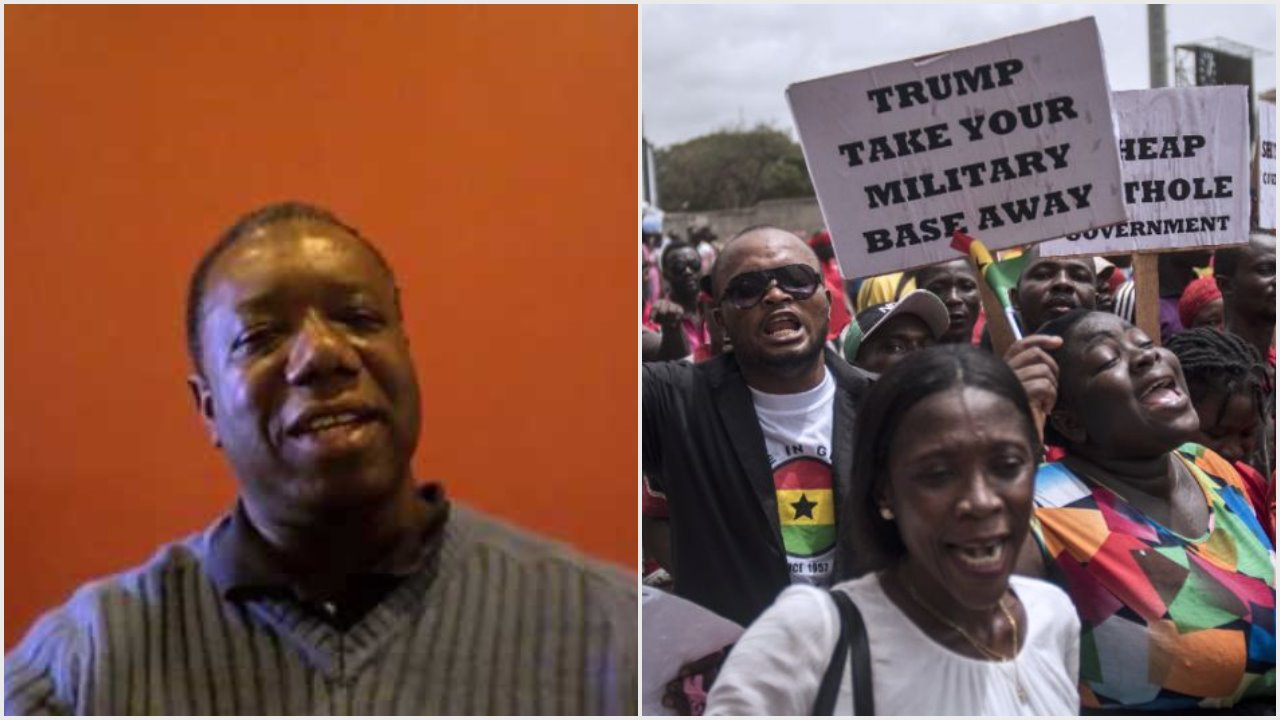
This is a recording from the Pan-Afrikan Society Community Forum (PASCF) workshop – USAFRICOM: GLOBALISING PAN-AFRIKAN RESISTANCE FROM GHANA TODAY” with Kofi Mawuli Klu, Co-Vice Chairperson of the ‘Stop the Maangamizi: We Charge Genocide/Ecocide!’ Campaign (SMWeCGEC) which took place on 13th April in London.
An outcome of this workshop was that a demonstration was organised by Ghana Action for Pan-Afrikan Resistance (GAPAR) to take place today, 21st April at the London School of Economics were President Nana Akufo-Addo of the Republic of Ghana is a keynote speaker at the 5th Annual ‘LSE Africa Summit’.
The synopsis for the workshop is as follows:
Osagyefo Kwame Nkrumah, Ghana’s first president, defined neocolonialism as “the last stage of imperialism” – understanding this as a violation of Afrikan sovereignty as Afrikan states are independent in name only and imperialism/white supremacy manipulates economic and political control, through globalization, capitalism and cultural expansionism. So, in effect foreign interests, are what dictate everything.
In ‘USAFRICOM: GLOBALISING PAN-AFRIKAN RESISTANCE FROM GHANA TODAY’ esteemed scholar-activist Kofi Mawuli Klu looks at the wider historical trajectory of neo-colonial relations between Ghana and the USA/white supremacy in view of their expanding and unrestricted access to a host of Ghanaian facilities, recently agreed by Ghana’s Cabinet.
The emphasis of Bro Kofi’s presentation is to facilitate public discussion on the 5th April 2018 joint statement issued by the Global Afrikan People’s Parliament (GAPP) and the Stop the Maangamizi: We Charge Genocide/Ecocide Campaign (SMWeCGEC) entitled “Opposing the USAFRICOM Base of Maangamizi in Ghana: Globalising Pan-Afrikan Resistance for Reparatory Justice is the Way to Victory”. Kofi explains the strategy and tactics being pursued by some of the Freedomfighting forces still upholding the teachings of Osagyefo Kwame Nkrumah in trying to steer the growing Resistance to the USA-Ghana Deal on Strengthening the Militarisation of Neocolonialism in West Afrika towards the goals of Pan-Afrikan Reparations for Global Justice.
He highlights the necessity of better meeting the challenge in and beyond Britain today of utilising Internationalist Solidarity mobilisation for such Resistance in Afrika for its best purpose of reclaiming authentic Pan-Afrikanism as an intellectually sharpening practical weapon for globally advancing emancipatory struggle towards what GAPP envisions as the Maatubuntuman achievement of the total liberation, unification and self-determined progress of Afrikan people all over the World.
PRESENTER: Bro Kofi Mawuli Klu is Chief Executive Commissioner of PANAFRIINDABA, a grassroots Pan-Afrikan Community Advocacy, Research and Think Tank based in London, UK and Accra, Ghana. He is also co-Vice Chair, Pan-Afrikan Reparation Coalition in Europe (PARCOE) in London and Joint Co-ordinator of the Global Justice Forum based in London as well as Co-Vice Chair of the ‘Stop the Maangamizi: We Charge Genocide/Ecocide’ Campaign (SMWeCGEC). Bro Kofi runs his own Law-Related Educational Services Agency, UEQUIPOISE. His scholarly activism has and continue to make a significant contribution within institutions of education in and outside of the United Kingdom [various courses, seminars, workshops, conferences and Groundings on Afrika and Pan-Afrikanism] and serves Afrikan students/communities as a conscientising tool for grassroots resistance and social change.
“The future will have no pity for those men and women who possess the exceptional privilege to speak the words of truth, instead have taken refuge in an attitude of cold complicity and mute indifference.“
Revised quote from Frantz Fanon, ‘Toward the African Revolution: Political Essays’, 1994
Greetings Supporters of the ‘Stop the Maangamizi: We Charge Genocide/Ecocide!’ Campaign (SMWeCGEC)
The letter below is the latest in the ongoing correspondence between Esther Stanford-Xosei and MP, Heidi Alexander, on issues to do with the SMWeCGEC and the campaign’s work for reparatory justice:
The letter from Esther Stanford-Xosei deals with the response from Foreign & Commonwealth Minister of State for the Commonwealth and the UN, Lord Ahmad to the 2017 ‘Stop the Maangamizi!’ Petition and its accompanying correspondence.
The exchanges so far show that as much as sections of the Labour Movement are becoming more interested in communications with certain constituencies of the International Social Movement for Afrikan Reparations (ISMAR), there is a greater need to ensure that the Labour Party is challenged to develop a correct way of dealing with the issues raised in the correspondence and our Afrikan Heritage Communities in consonance with the ethics of reparatory justice. This must also be done in such a way that recognises Afrikan people’s human and people’s right to Substantive Afrikan Heritage Community Representation.
What this means is that Labour Party is being challenged by SMWeCGEC and other Afrikan Reparations campaigners to engage in ‘institutional self-repairs’ in the ways it deals with Afrikan Heritage Communities and our autonomous community organisations as well as the issues that concern us. Only by doing so, will it become a worthy stakeholder with locus standi in Afrikan Heritage Community reparatory justice engagements.
In livicated Service!
Stop the Maangamizi: We Charge Genocide/Ecocide! Campaign International Steering Committee Spearhead Team (ISC-SMWeCGEC)














 stopthemaangamizi.com