How many times have you said or heard someone say:
“The system ain’t working for us!”
“Every day I pray for my children!”
“We need to come together and do something!”
These are the rallying calls of our communities, and they remind us that change starts with us. As we continue to build power through self-repair initiatives and community-building, engaging with our Members of Parliament (MPs) is one important step in our broader movement for reparatory justice.
But let’s be clear: the power to create change lies with us—our communities. MPs are public servants who are meant to represent our interests, and it’s their job to listen to us and act on our demands. By engaging with them, we’re using every available tool to advance reparations movement-building while keeping the focus on our leadership and our solutions.
We’ve prepared two template letters to help you approach your MP about supporting our community-led work:
A Concise Version (1 page) – short and to the point.
A Detailed Version (2 pages) – with more context and background.
These letters are tools to help you advocate for our communities while keeping the focus on our community leadership and the international frameworks that support our demands.
Engaging with Members of Parliament (MPs) is one tool in our broader movement for holistic reparatory justice. It’s important to remember that the power to create change lies with us—our communities. MPs are public servants who are meant to represent our interests, and it’s their job to listen to us and act on our demands.
By engaging with MPs, we:
Hold Them Accountable: MPs have access to resources, platforms, and decision-making spaces that can amplify our voices and support our work.
Build Awareness: Many MPs may not fully understand the issues our communities face. By reaching out, we educate them and push them to take a stand.
Create Pressure: When MPs hear from enough constituents, they are more likely to act. This is about using their position to support our community-led solutions, not waiting for them to lead.
This is not about looking to MPs as being all-powerful—it’s about using every available tool to advance our movement while keeping the focus on our leadership and our solutions.
Which Version of the Letter Should I Choose?
Concise Version (1 page)
Use when your MP is already familiar with reparations issues.
Best for follow-up communications or quick requests.
Great for MPs who prefer direct, brief messages.
Useful for initial contact that you can expand on later.
Detailed Version (2 pages)
Use for MPs who are new to reparations work.
Best for first contact or when you need to provide full context.
Helpful for creating a record of the issues and solutions.
Includes references to specific frameworks and examples.
Highlight the need for concrete steps to address historical and ongoing injustices.
Movement Building
Link letter-writing to other campaign activities.
Use this as an opportunity to educate and mobilise your community.
Build long-term pressure for change.
Coordination
Spread the word and pile on the pressure! Share responses and outcomes with:
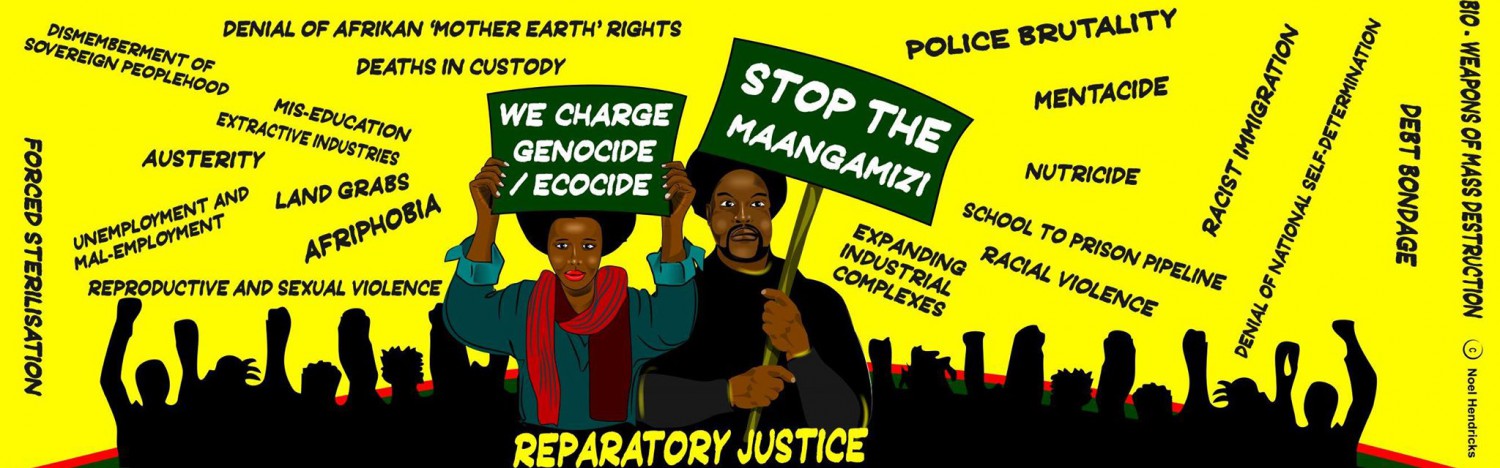
The Stop the Maangamizi Campaign
Local community organisations.
Relevant working groups.
Other community members engaging their MPs.
This helps build collective knowledge and coordinated action.
Support
For additional help or questions about using these templates, contact: Email:stopthemaangamizi@gmail.com Phone: 07482220013
Remember: These letters are one tool in our broader reparations movement-building strategy. Their effectiveness depends on connecting them to ongoing community building and organising work.
We are pleased to report that on the 1st of Mosiah, Stop The Maangamizi Campaign Coordinator-General, and Executive Director of the Maangamizi Educational Trust, Sista Esther Xosei was the international guest speaker for Afrikan Emancipation Day Commemorations organised by the UBAD Educational Foundation (UEF), chaired by Sista YaYa Marin Coleman. This trip was a vital component of glocalising and strengthening the building of the International Social Movement for Afrikan Reparations (ISMAR) in link with the Peoples Reparations International Movement (PRIM) in Belize and the wider Caribbean and Abya Yalan region.
The Maangamizi Educational Trust operates as the educational arm of the Stop The Maangamizi: We Charge Genocide/Ecocide Campaign (SMWeCGEC). We recognise that education is a critical aspect of the community preparations that are being undertaken in furtherance of effecting and securing holistic Afrikan Reparations. Furthermore, education can play a key role in preventing the Maangamizi by providing methods and strategies for addressing the impact of Maangamizi Crimes and violations while promoting the knowledge, skills, values, attitudes and cultural change that can contribute to preventing repetition of group-targeted atrocities and injustices.
MET is dedicated to building narrative and cultural power to move society toward a vision of holistic reparative justice as Planet Repairs, (the interconnection of cognitive justice, reparatory justice and environmental justice), required due to the continuum of the Maangamizi. Accordingly, MET seeks to build the public imagination and cultural will to counteract the Maangamizi and its pervasive impacts through advancing public education and narrative change which supports taking action to counteract the Maangamizi in the process of effecting and securing holistic reparations.
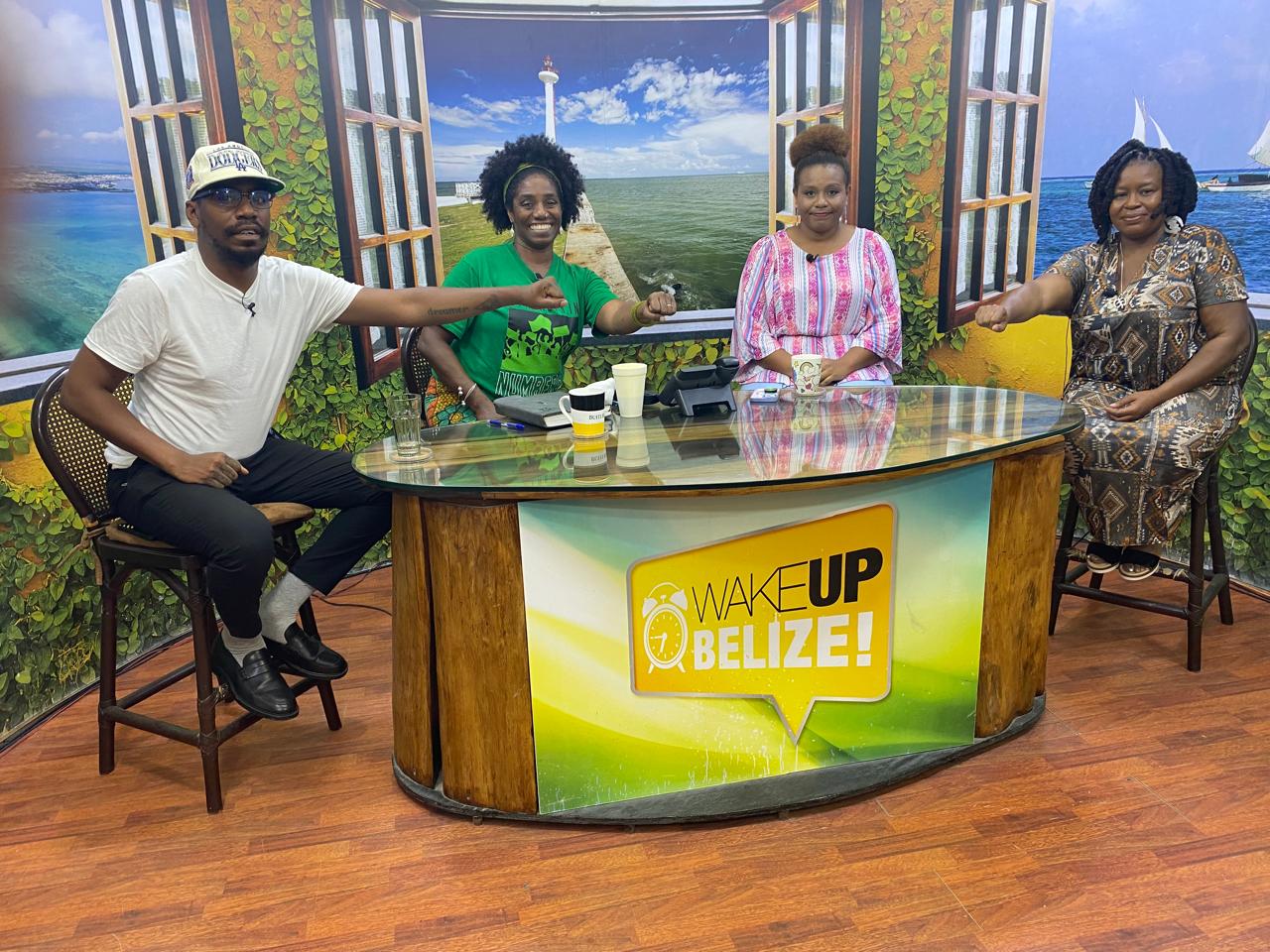
Wake Up Belize Show & Meet & Greet
On the morning of the 31st July, Sista YaYa, Sista Esther & Brother Menyelek appeared on Wake Up Belize (WUB) Mawning Vibes Talk Show the XTV Morning Talk Show.
Libation, Drumming & Petal Release Ceremony & Free Yuh Mind Community Reasoning
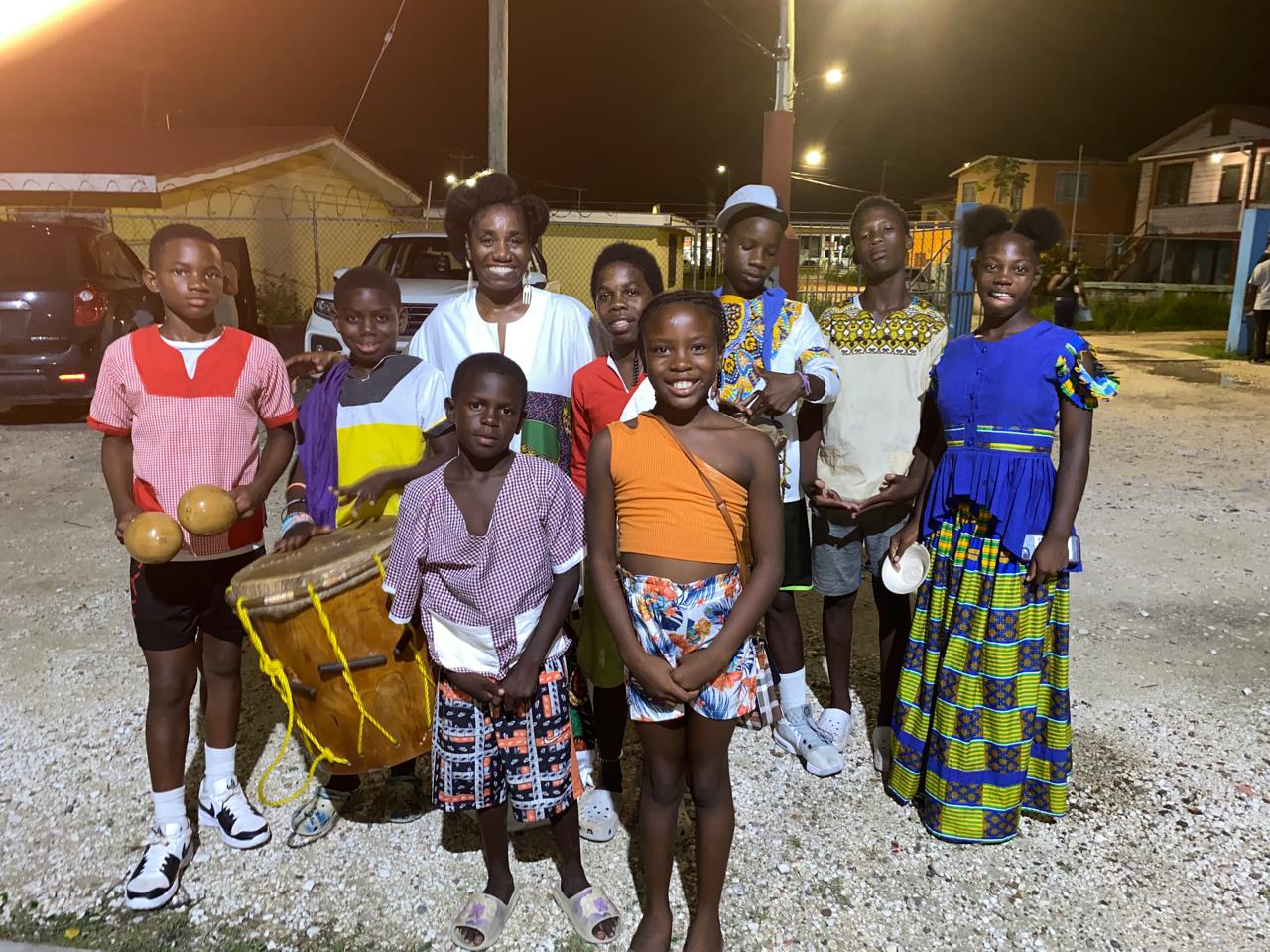
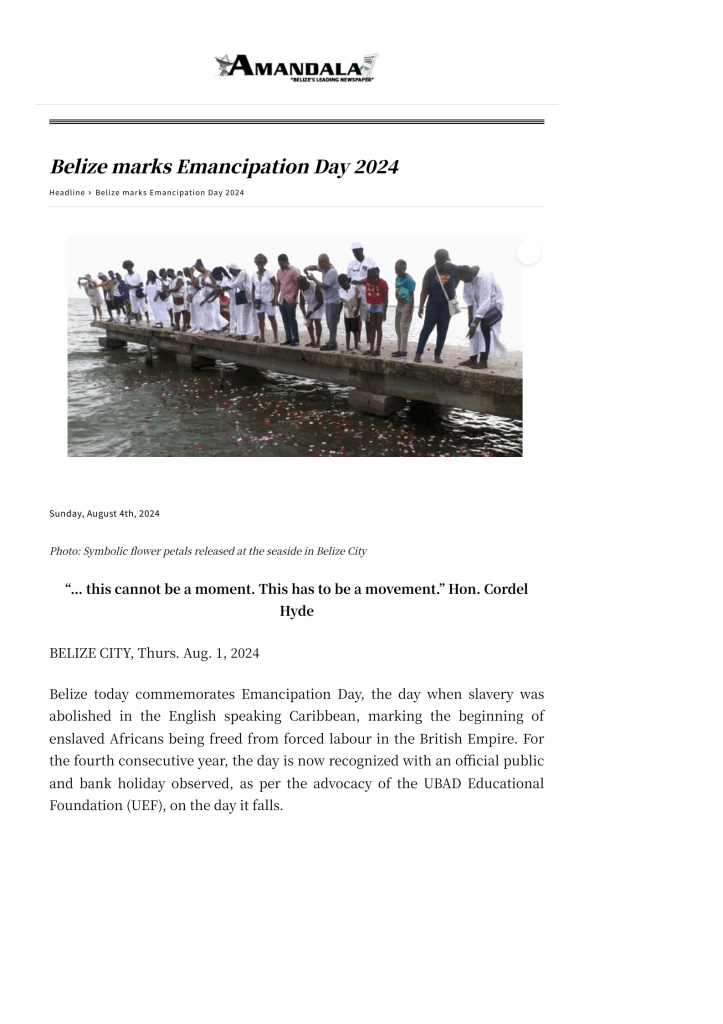
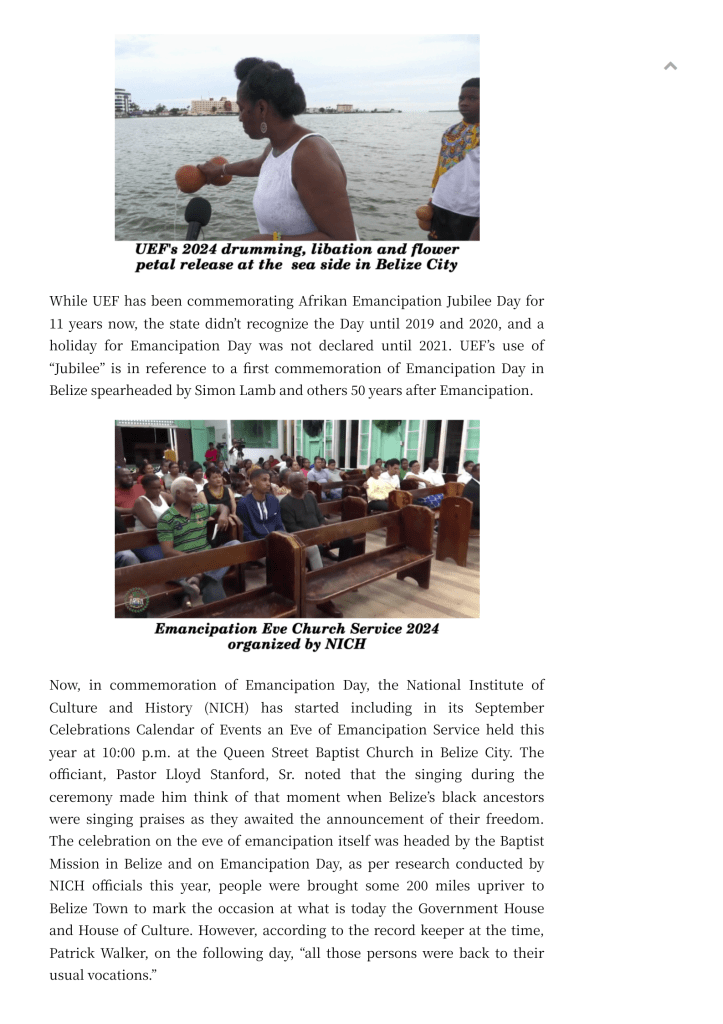
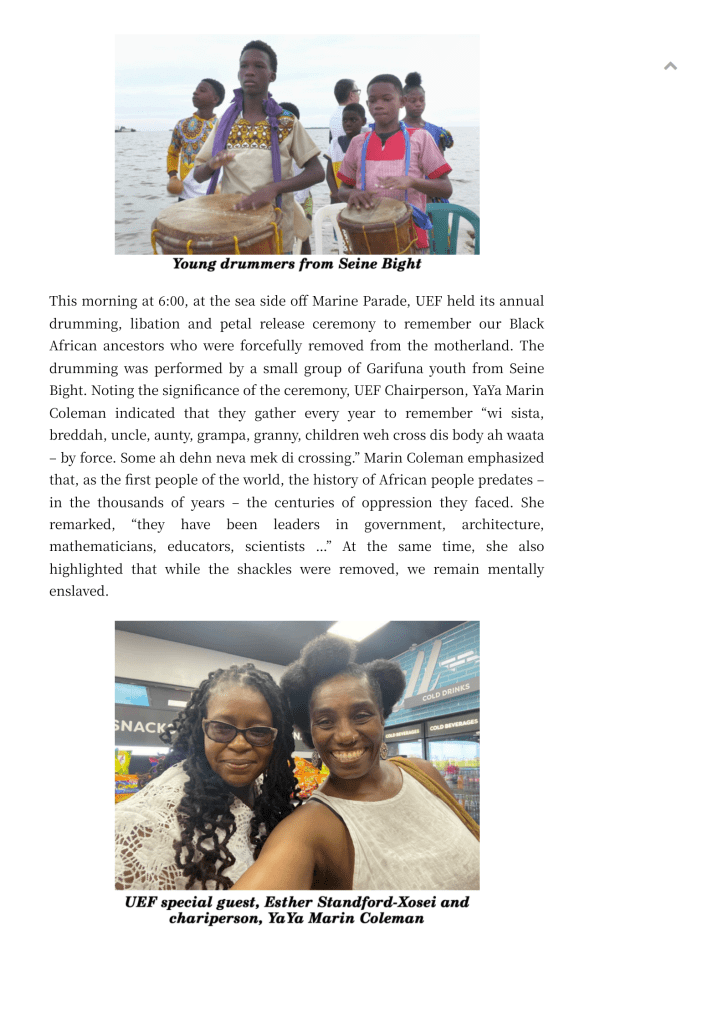
On the morning of the 1st of August, UEF hosted a Libation, Drumming, & Petal Release Ceremony in Belize City which featured Garifuna Youth Drummers from Seine Bight Village in the Stann Creek District of Southern Belize. The recording of the ceremony on XTV can be found here and below.
XTV & UEF Emancipation Day
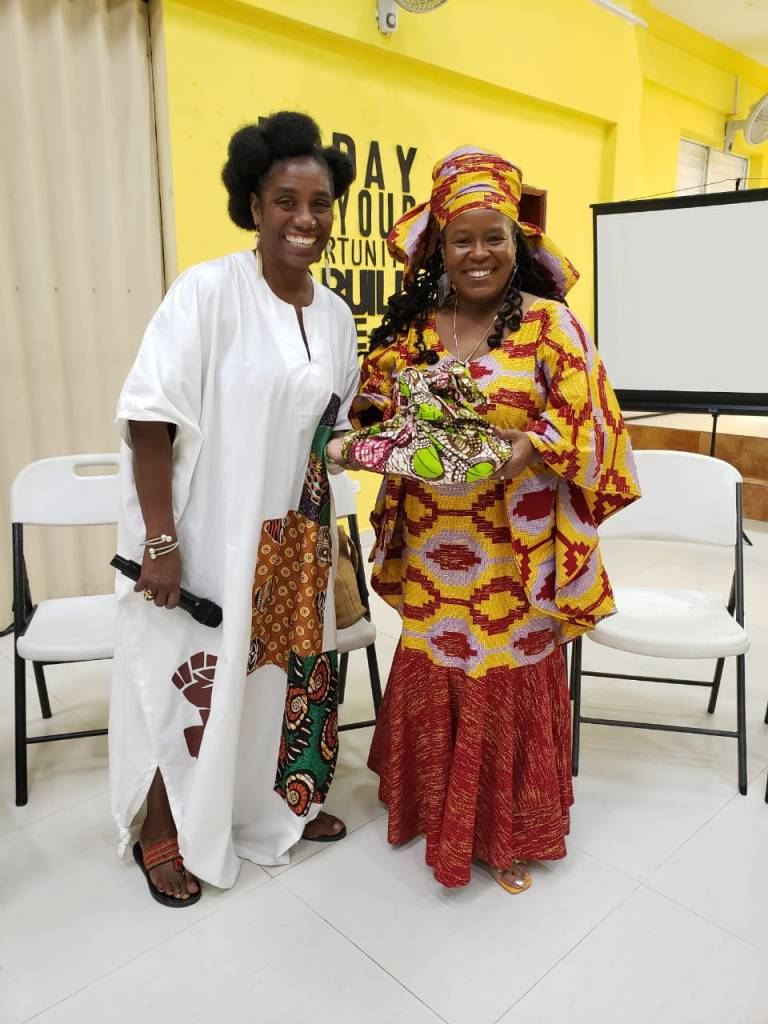
In the evening, Esther was the international guest speaker at the ‘Free Yuh Mind’ Community Reasoning where Sista Esther was given a special gift presentation by Sista YaYa Marin Coleman, UEF Chairperson. Sista Esther’s presentation was broadcasted by XTV and Krem Radio.
The following video is a snippet of some of the drumming done by the Garifuna Youth Drummers from Seine Bight Village where Sis YaYa is serenaded by one of them
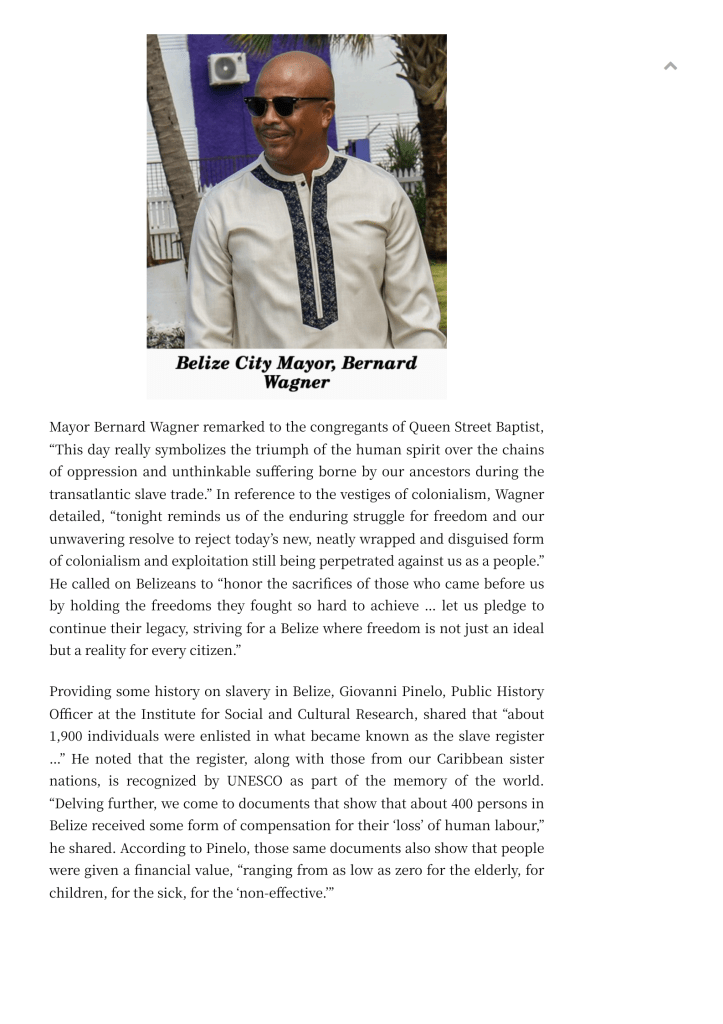
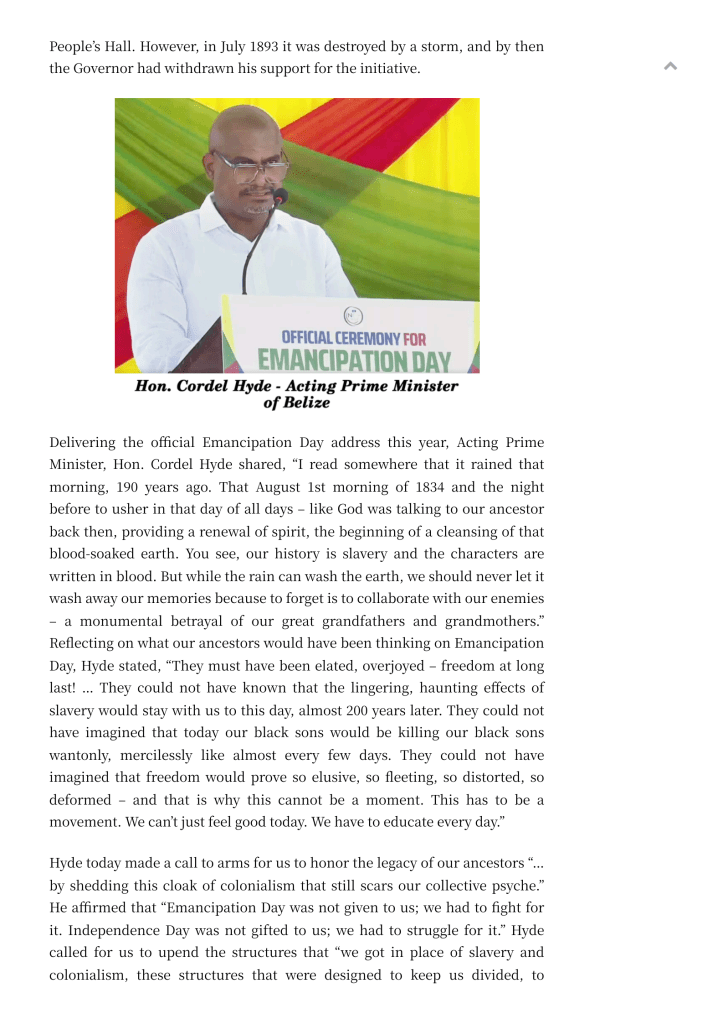
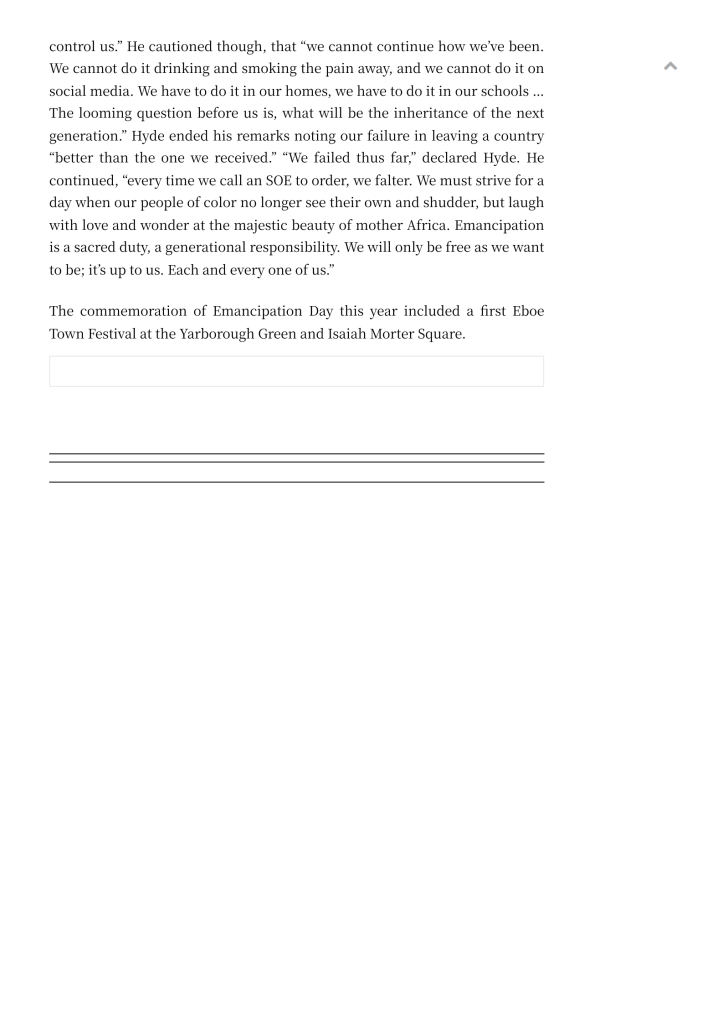
The following news report is what appeared in the Amandala Newspaper print copy 2nd August and online 4th August 2024.
Visits to Afrikan Heritage Communities
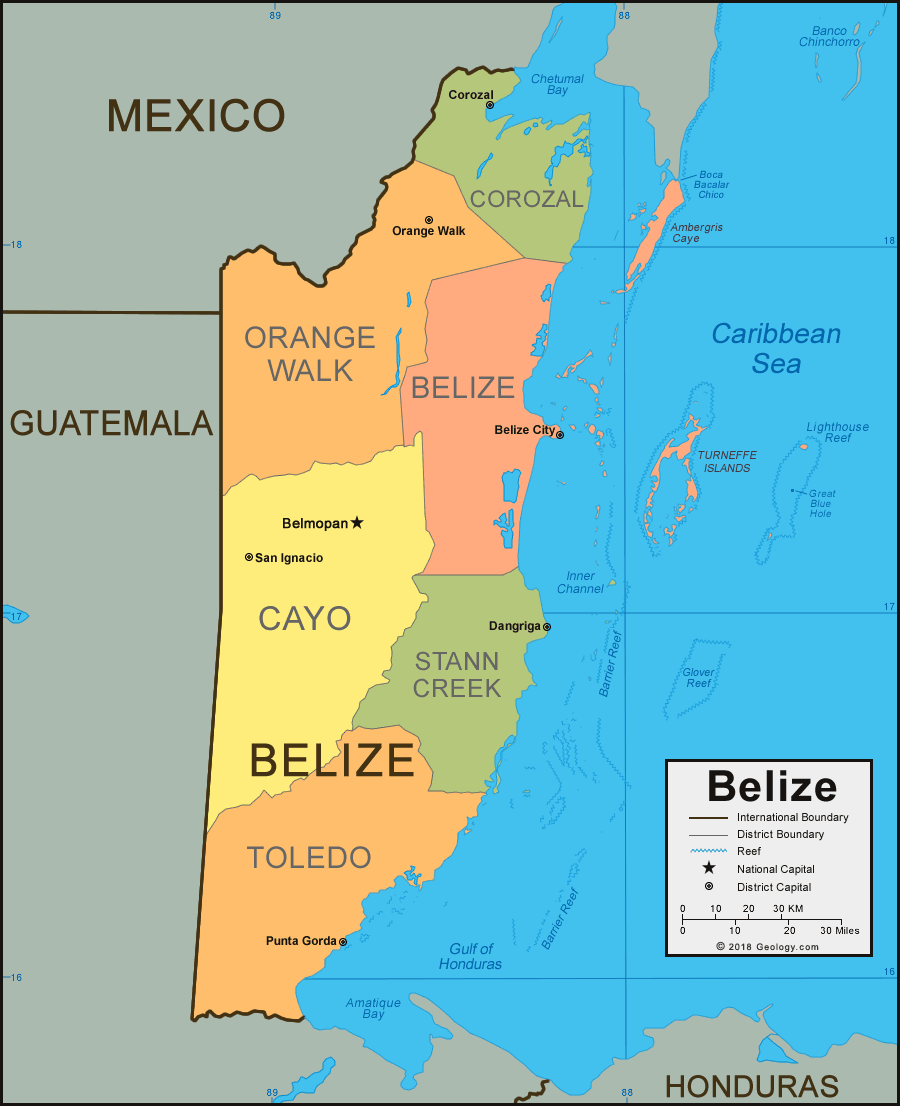
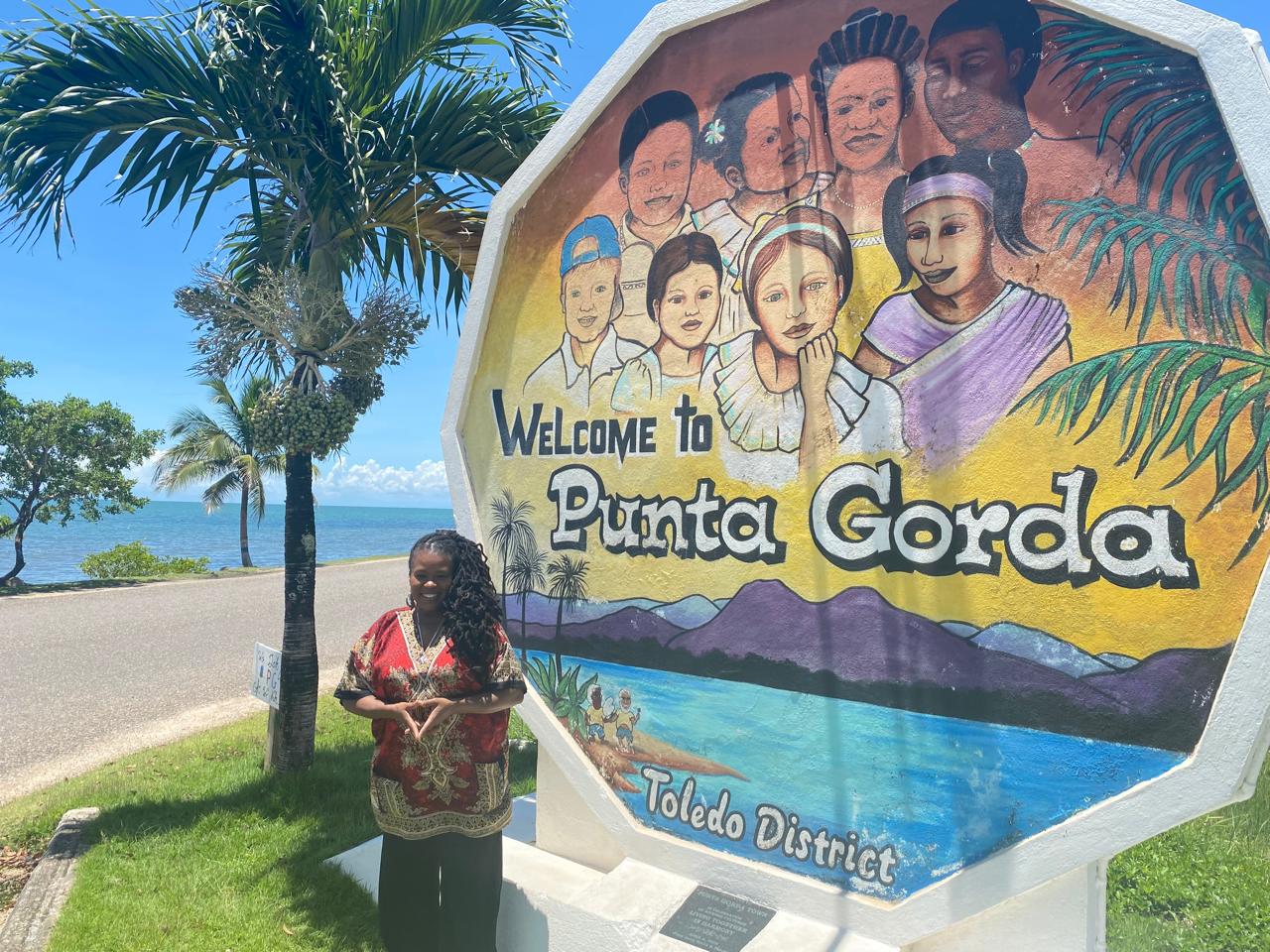
The trip to Belize also consisted of visits to historic Afrikan Heritage Communities such as Punta Gorda, Dangriga and Gales Point Manatee.
Punta Gorda is the southernmost town in Belize, and the administrative capital of the Toledo District. It was founded as Peini by the Garifuna people which is the accepted Garifuna name of PG. Peini means point in the Garifuna language. A Garifuna elder shared with Sista YaYa and Sista EstherPunta Gorda (PG) is between 2 points, when the Garifuna speaking people populated Punta Gorda 1832-1900, they were not English speakers.
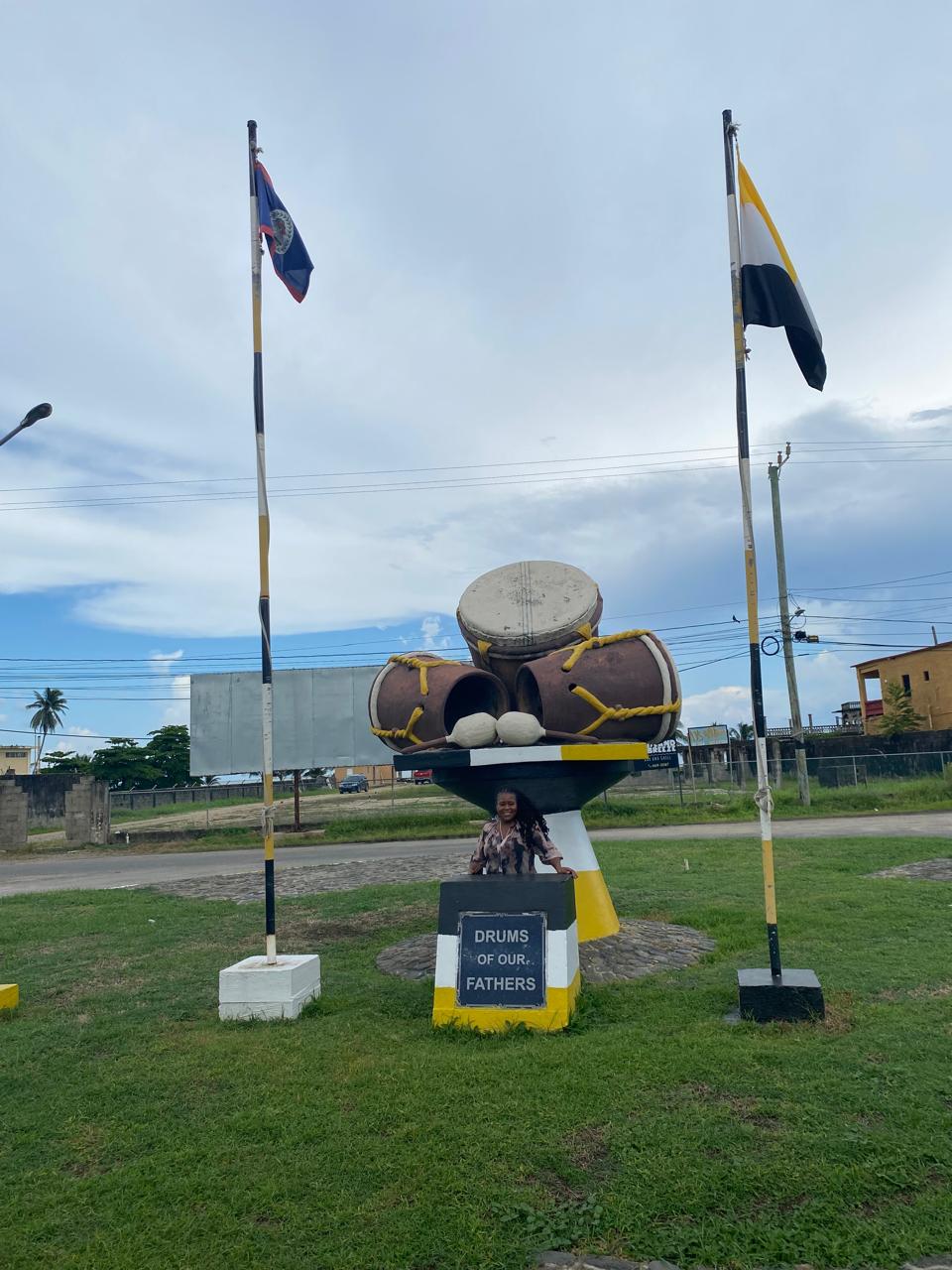
The Drums of Our Fathers Monument, located at the entrance of Dangriga, Stann Creek, Belize, is a monument designed by the Nigerian sculptor Stephen Okeke, honouring Garifuna history, culture and its beliefs
Finally, Esther visited Gales Point Manatee in Belize District which is home to a longstanding Afrikan Maroon Community where she heard from Breddah Liston Myers, community historian about the Afrikan Maroon history in Belize.
Meeting at the Institute of Social & Cultural Research
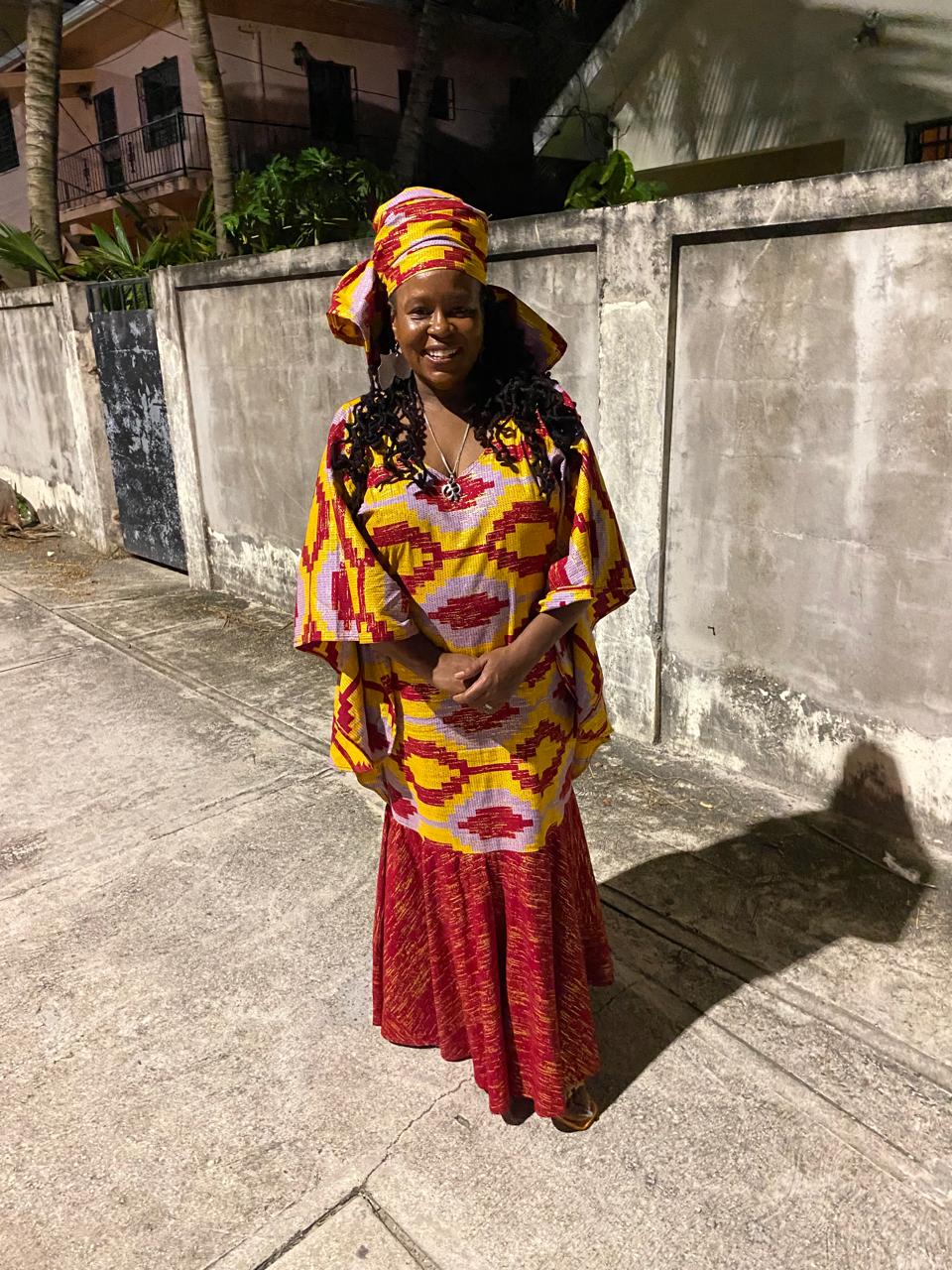
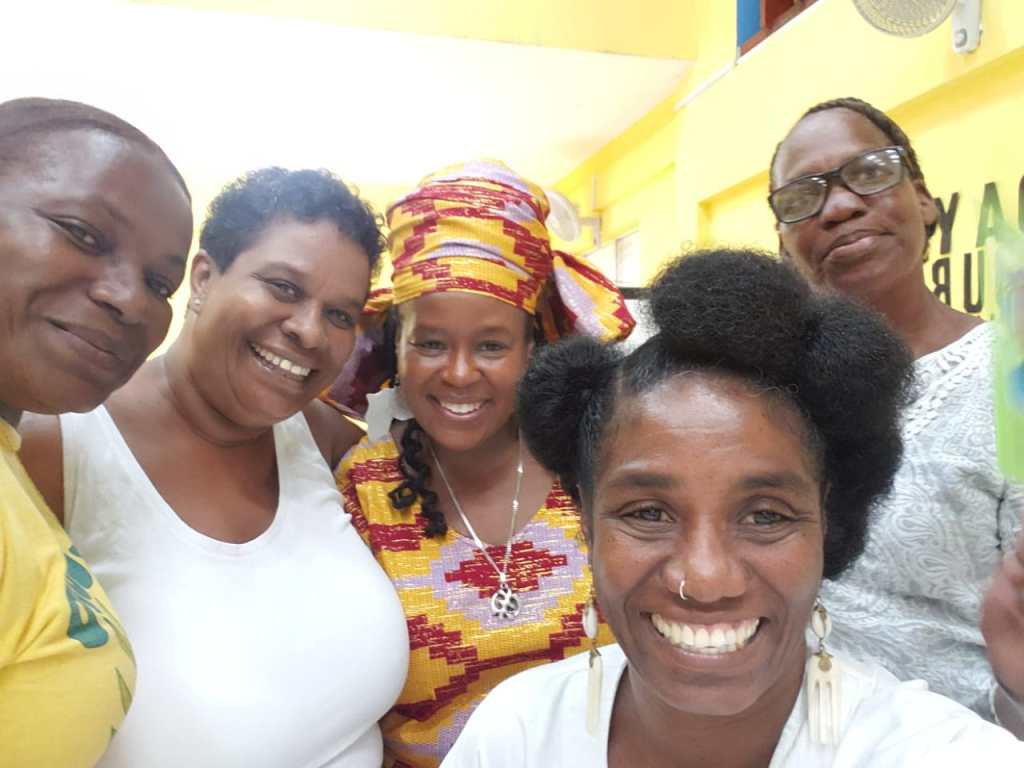
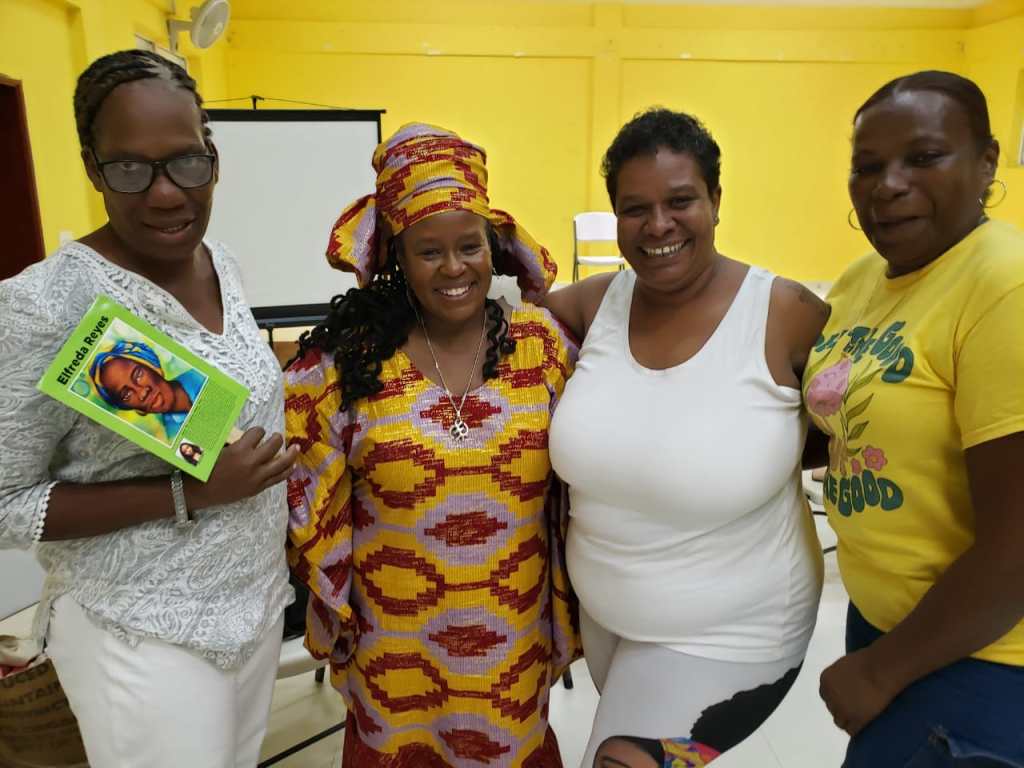
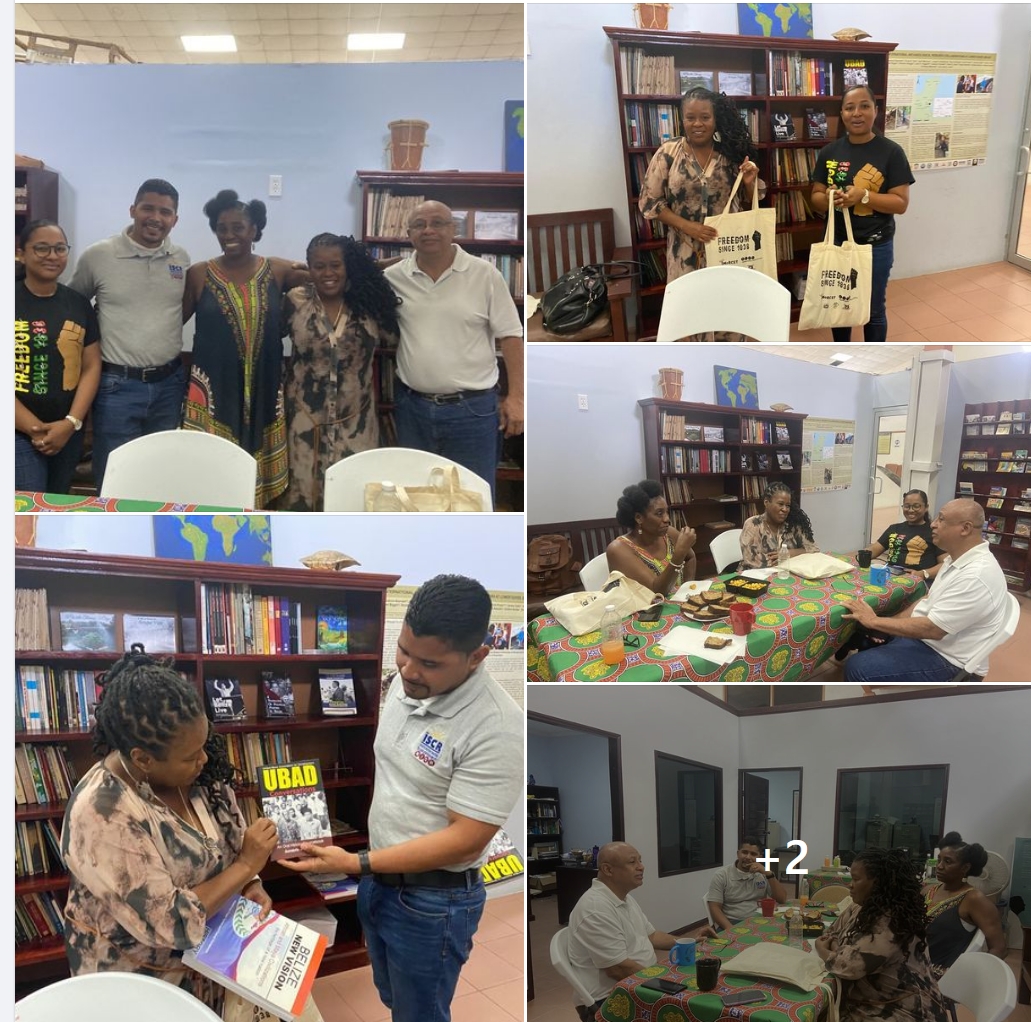
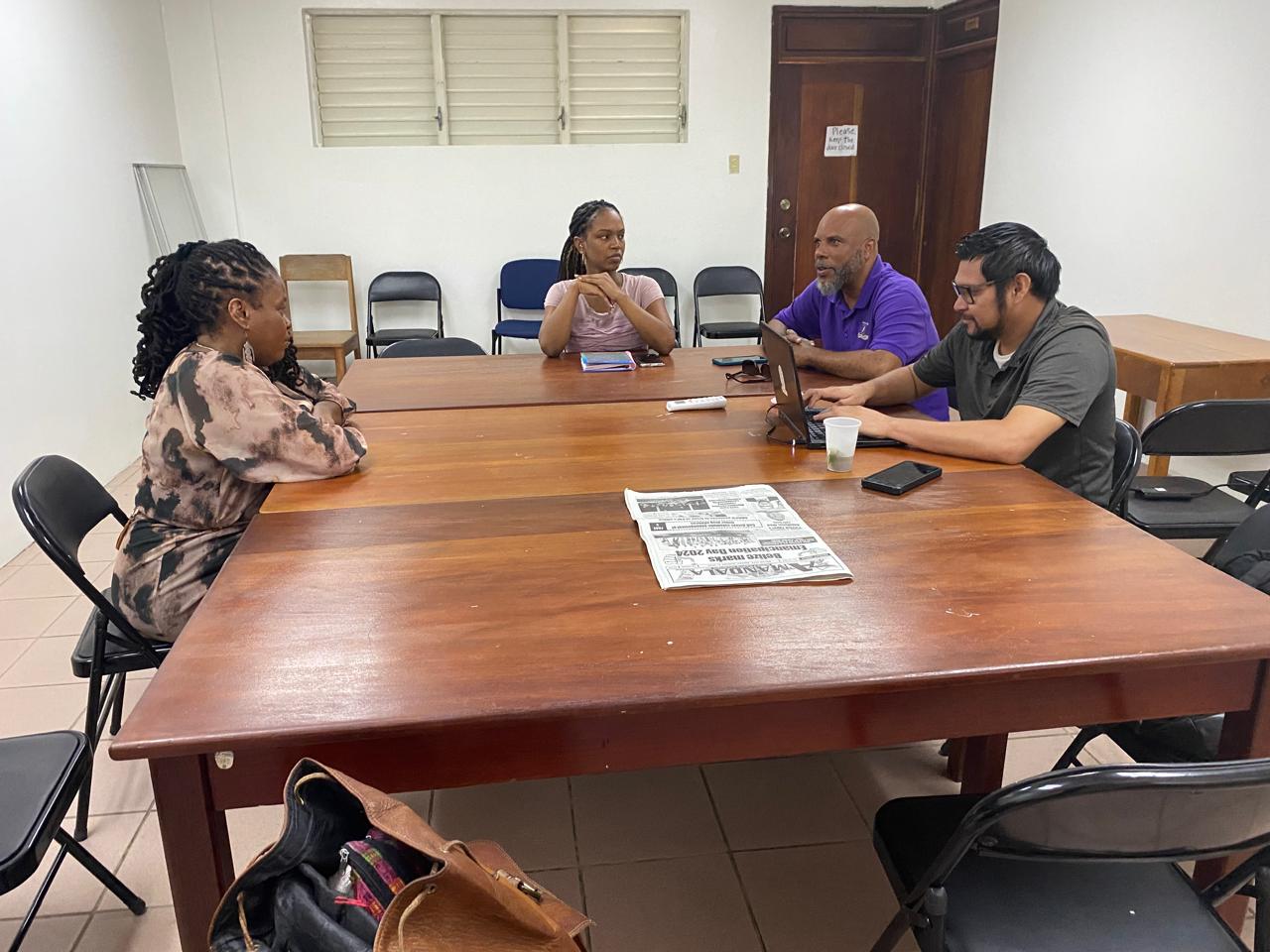
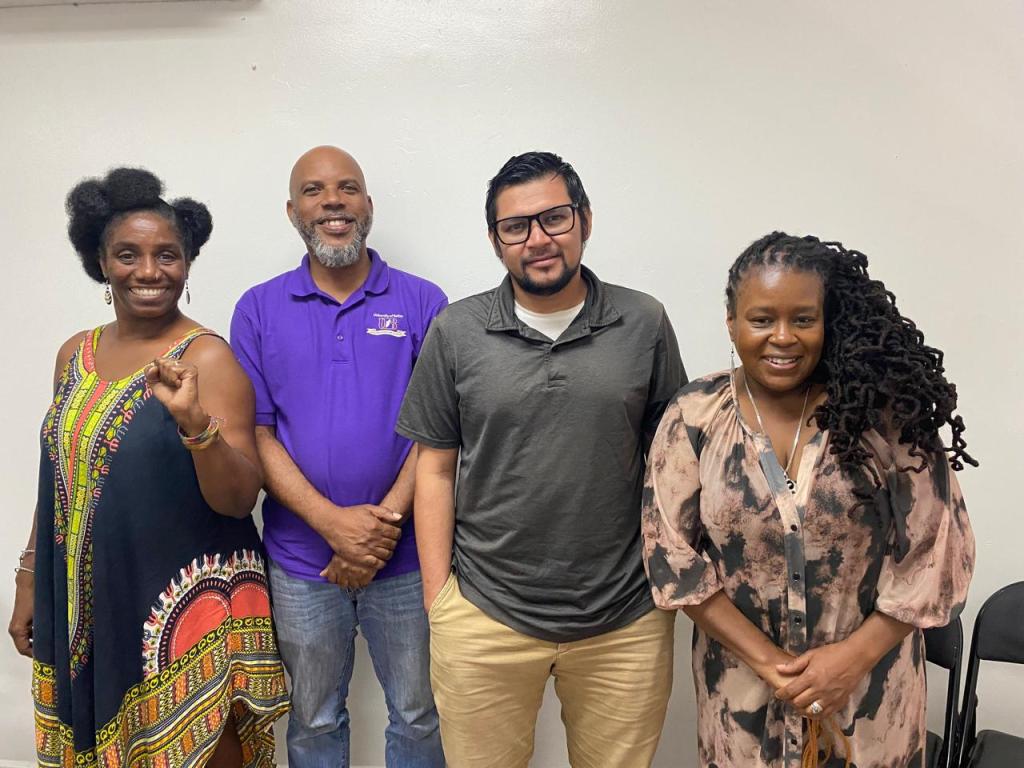
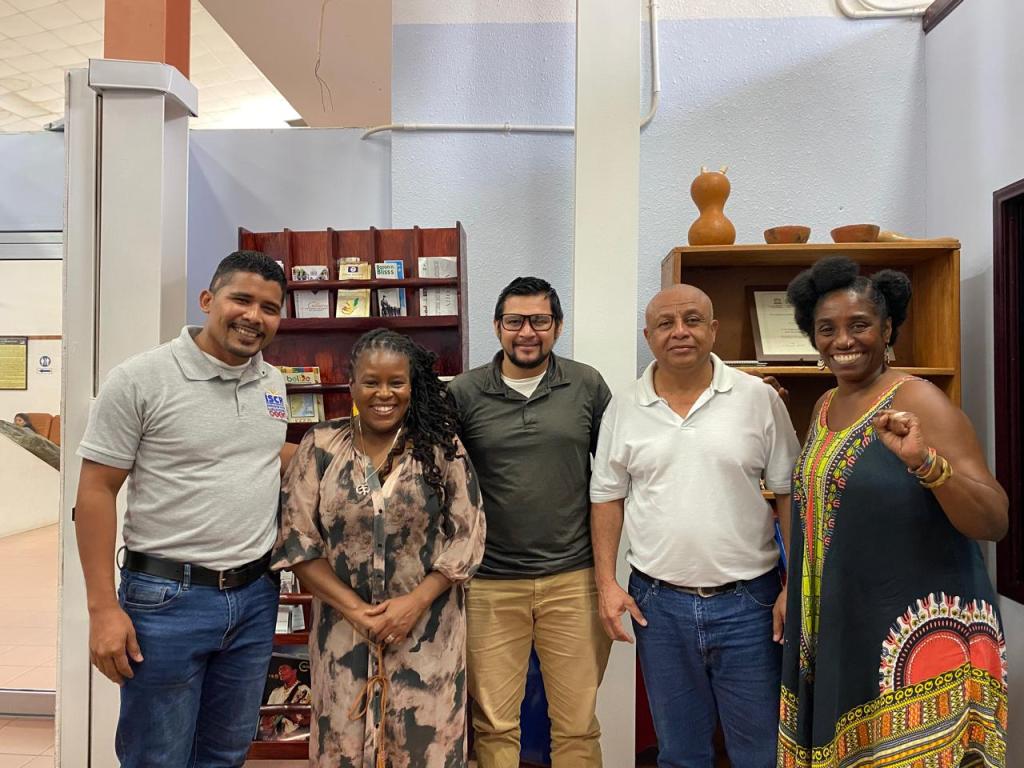
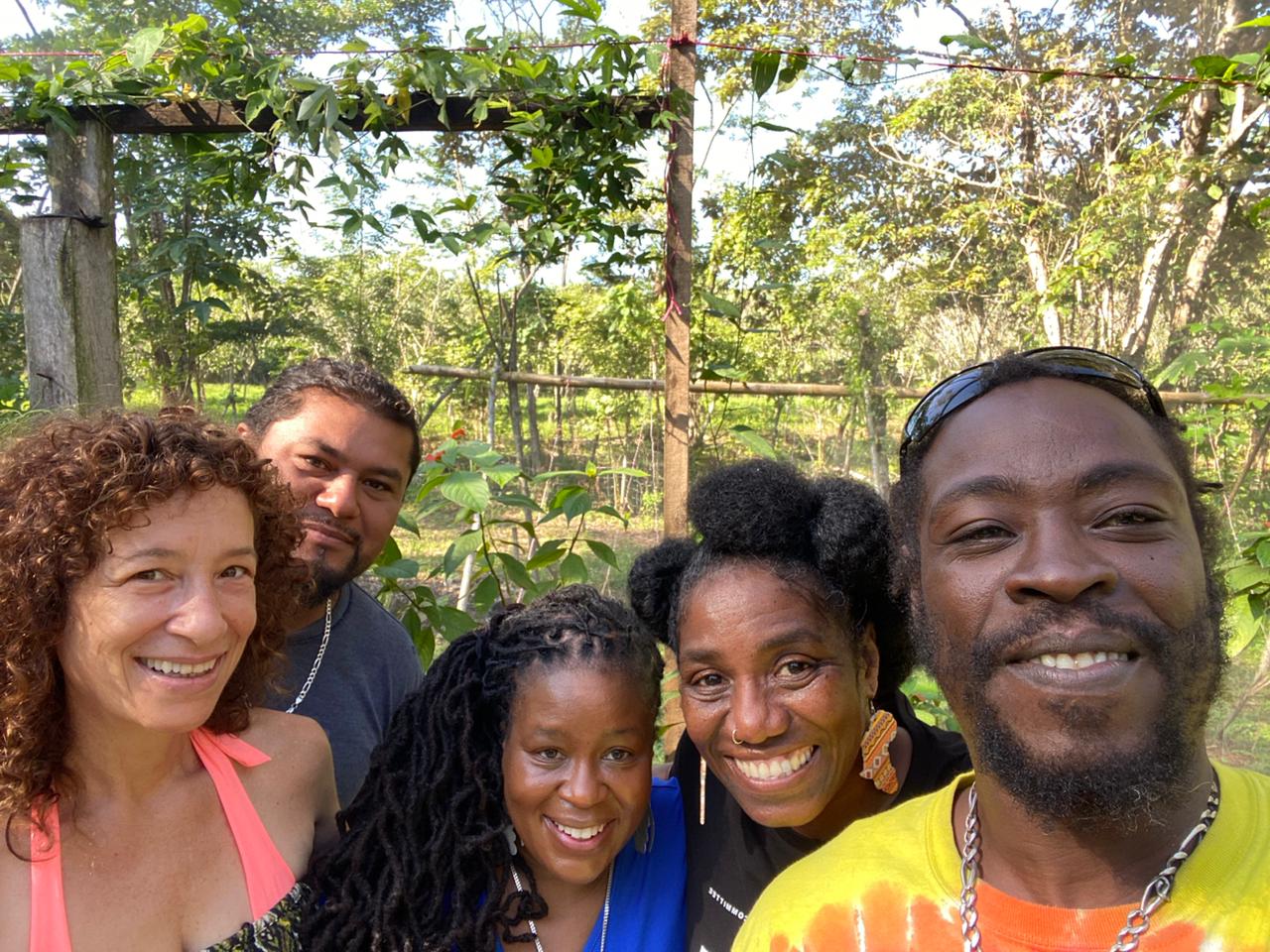
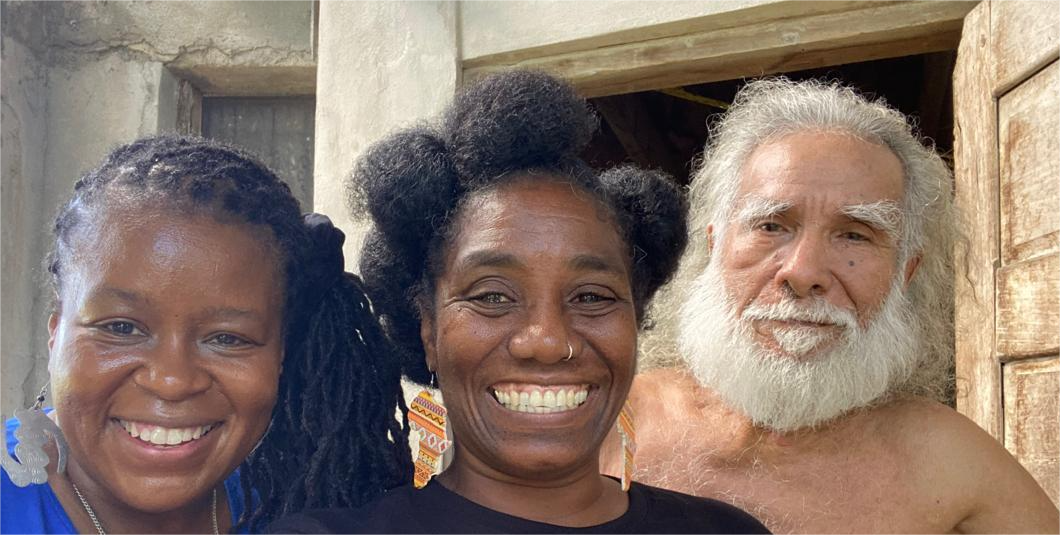
Below are some picture that were taken that documents the visit to Belize were two main meetings occurred.
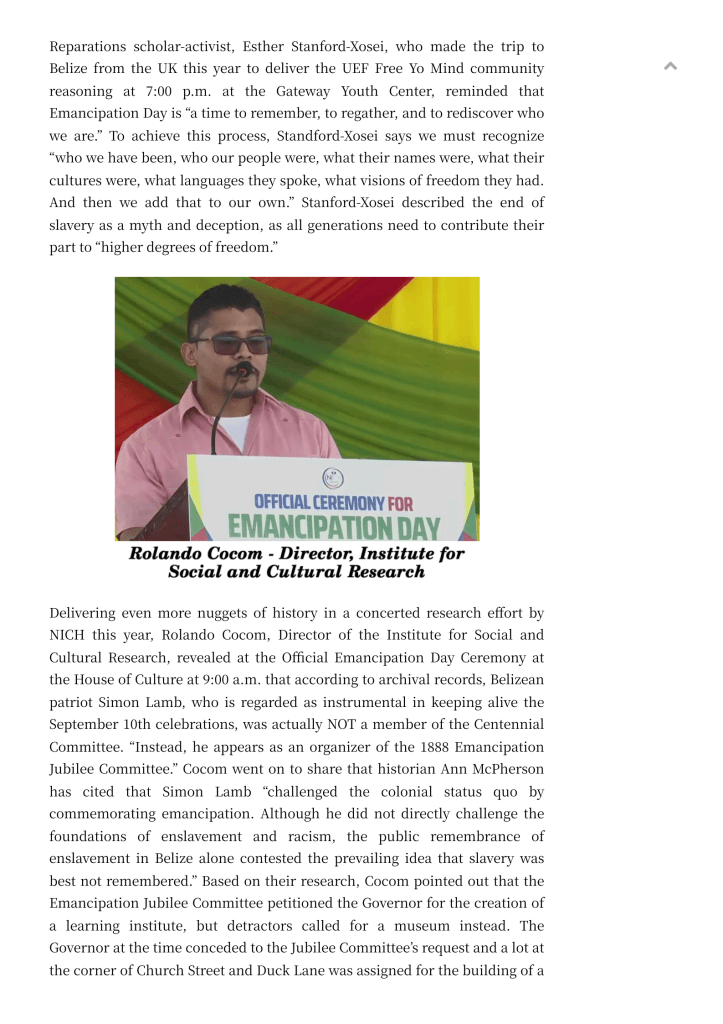
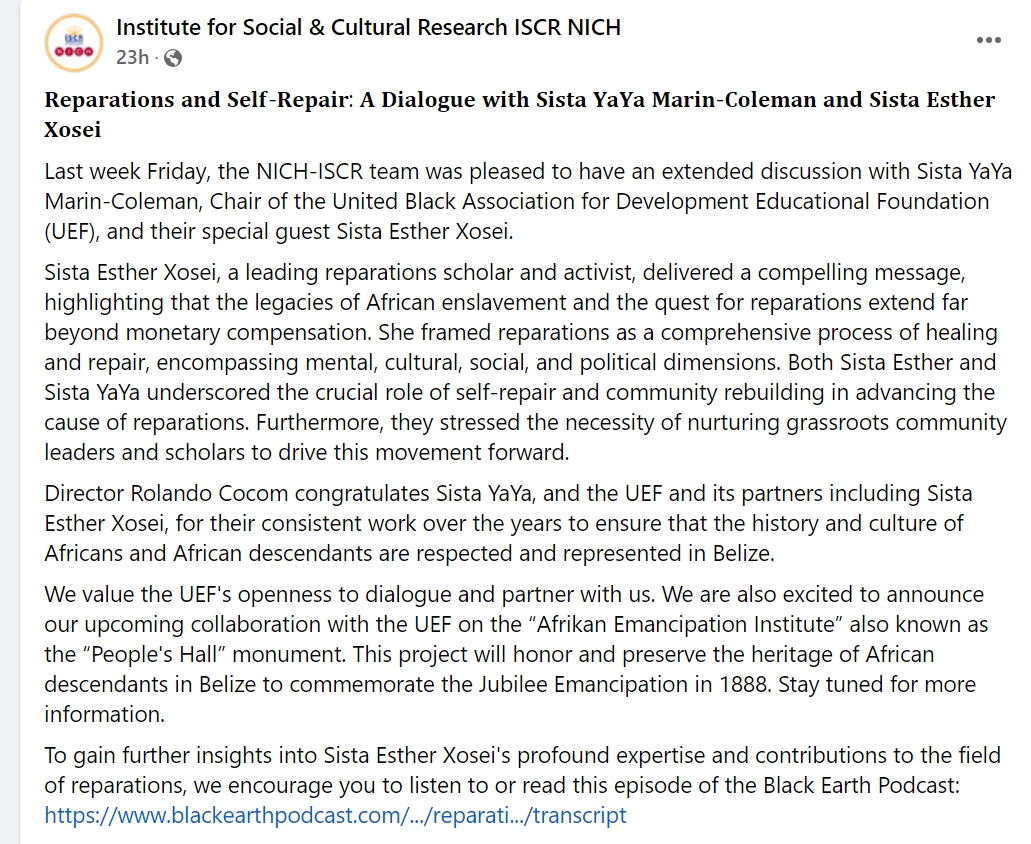
The first meeting was with Breddah Ronaldo Cocum, Director of the Institute of Social and Cultural Research (ISCR-NICH), Breddah Giovanni Pinelo, Senior Research and Education Officer at ISCR-NICH and other staff.
The Institute for Social & Cultural Research (ISCR-NICH) aims to advance research, safeguard Belize’s intangible cultural heritage, and deepen the appreciation of the country’s rich history and culture. It is a division ofthe National Institute of Culture and History(NICH), which is Belize’s premier cultural institution dedicated to the safeguarding, promotion, expression, conservation and sustainable development of culture in all its diversity in collaboration with the people of Belize.
The following is a report from ISCR NICH about our meeting:
Meeting at the Intercultural Language Institue – University of Belize
The second meeting was with Delmar Tzib, Director of the Intercultural Indigenous Language Institute, Egbert Irving, Director of Institutional Advancement and history lecturer, Jineen Roches, all at the University of Belize where talks were held about the necessity to develop reparations educational initiatives in association with UEF and the MET which compare, contrast and advance Afrikan and Mayan reparations struggles.
Visit to Hummingbird Farm in Toledo District
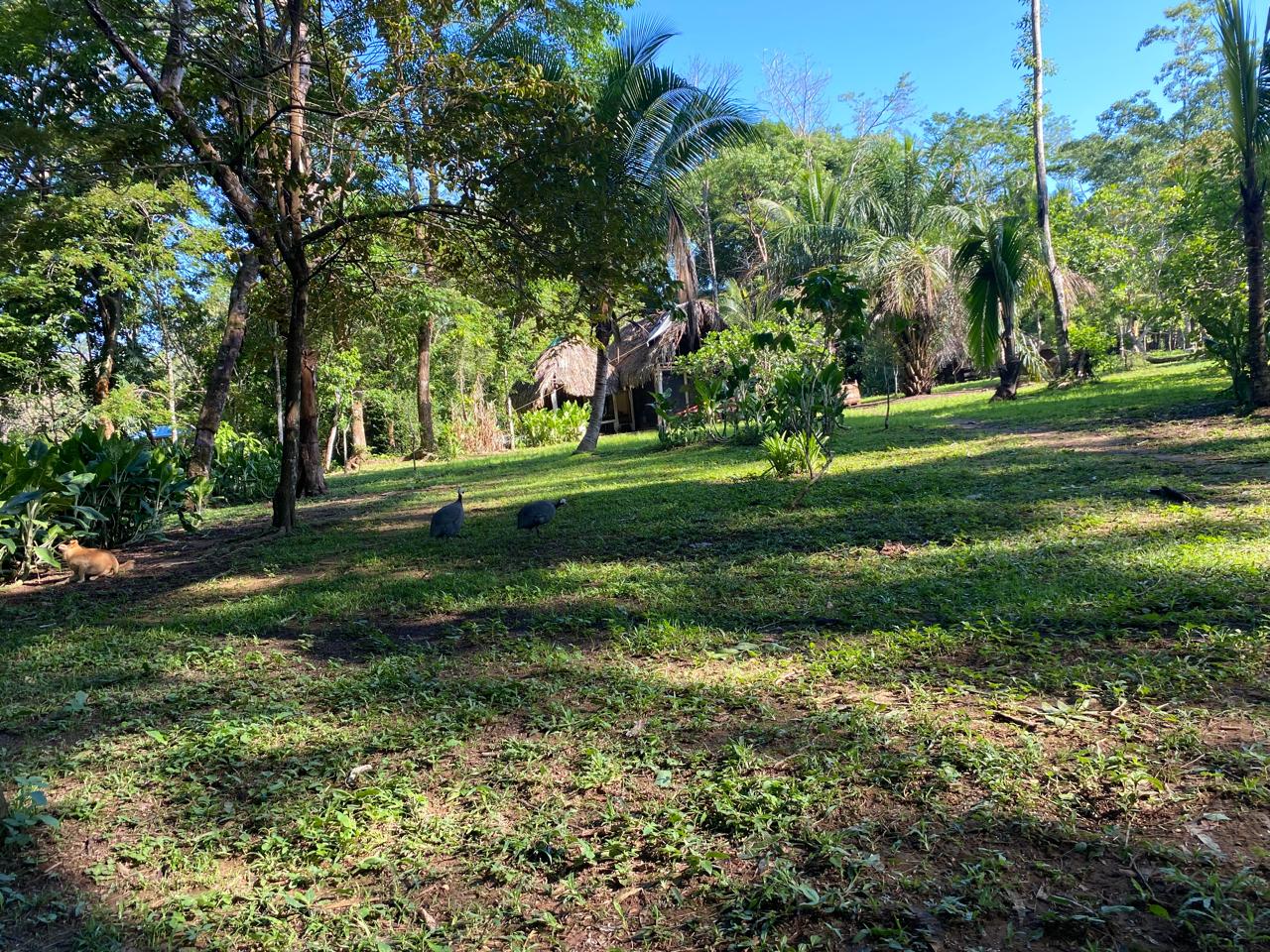
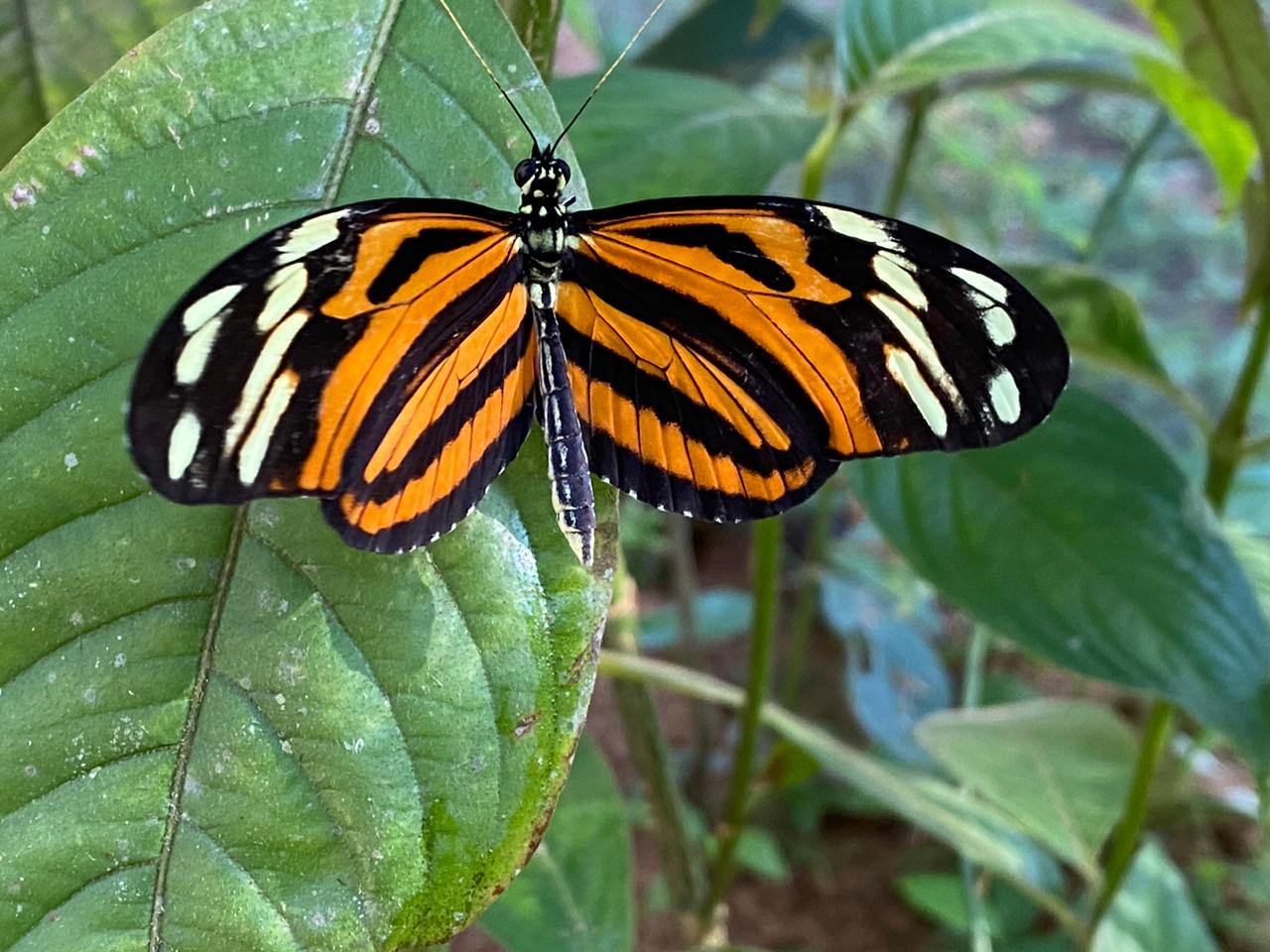
Sista Esther & Sista YaYa took a trip to the celebrated Hummingbird Farm in the Toledo District prior to Esther’s return. Hummingbird Farm is a 113 acre Hummingbird Farm committed to the principles of permaculture, conservation and family life. One of its key features is Rochochil PehPem (Butterfly House). Visiting the farm gave Esther an opportunity to see a land rematriation initiative in process.
Sista Esther could not leave the country without touching base with legendary land surveyor Elder Roque Marin (84), the father of Sista YaYa Marin Coleman.
Sista Esther extends her warm thanks and appreciation to Sista YaYa and the Marin Family for their hospitality during her stay in Belize.
Key Activities and Achievements of SMWeCGEC working in partnership with the Afrikan Emancipation Day Reparations March Committee (AEDRMC) in building the International Social Movement for Afrikan Reparations (ISMAR) & the Peoples Reparations International Movement (PRIM)
“To those caught up in only slogan-mongering about the Afrikan Revolution who self-derisively dismiss mass campaigns such as this one of Reparations, refusing to unfold their own blinds to its crucial significance in our Liberation Struggle; we address our paraphrasing of the remark of Amilcar Cabral that, by taking to the revolutionary path of self-determined Struggle for Afrikan Liberation, the masses of our people are not fighting for ideas in anyone’s head; they are fighting for a true National and Social Emancipation that will guarantee them such concrete benefits as will ensure their material and spiritual prosperity! That is why the AASU-E [All-Afrikan Student’s Union in Europe] sees Reparations, from the perspective of Afrikan youth, as the actual conscientization of the objectives of our whole people’s Liberation Struggle under the banner of revolutionary Pan-Afrikanism. Therefore the Reparations we the youth of Afrika are demanding must restore to all people of Afrikan origin throughout the World full sovereignty, the absolute ownership of the whole of our Homeland, including all its resources, and the Renaissance of Maat and other value of our classical civilisation, in order to give us the concrete basis for independently achieving our own material and spiritual prosperity.“
Antonieta Carla Santana, ‘Our Struggle for Reparations in Afrikan Youth Perspective’: A Draft Paper for Presentation to the 11th December 1993 Birmingham Working Conference of the African Reparations Movement (ARM-UK)
“Too often our standards for evaluating social movements pivot around whether or not they ‘succeeded’ in realizing their visions rather than on the merits or power of the visions themselves. By such a measure, virtually every radical movement failed because the basic power relations it sought to change remain pretty much intact. And yet it is precisely those alternative visions and dreams that inspire new generations to continue to struggle for change.”
— Robin D.G. Kelley —
The best way to keep abreast of the activities and achievements of the International Social Movement for Afrikan Reparations (ISMAR) is to be part of it!
We will not get a sense of the totality of the work just by turning up for one day and then lamenting the lack of numbers or vibes on the day. The UK has always had a Pan-Afrikan approach to this grassroots movement to effect and secure holistic reparations; which means fighting for our power base in Afrika and her Diaspora wherever we are. We cannot be concerned just with our people in the UK, a mere 3% of the UK population. Neither can we NOT connect our quest for reparatory, environmental and cognitive justice (referred to collectively as Planet Repairs) to our homeland and power base Afrika from which much or the resources that prop up the greedy inhumane global North, come from. So, it is necessary to have a glocal (local and global) approach which the Stop the Maangamizi: We Charge Genocide/Ecocide! Campaign (SMWeCGEC) and her affiliated structures has been operating with.
Securing Planet Repairs requires us to use all methods at our disposal including, social, legal, extra-legal, political, economic, parliamentary, and revolutionary means. It has meant taking our fight into hostile institutional spaces often led by people racialised as ‘White’, educational institutions, community spaces, social media spaces and taking up space on the streets. It has meant numerous instances of advocacy, public speaking and media appearances, attending conferences and public meetings, lobbying elected officials and making representations, providing reparations education and training to NGO’s, creating and disseminating our own messages and challenging power structures on their own turf.
You will not see all this work that goes on just by turning up on 1st Mosiah and cannot be achieved just by People of Afrikan Heritage talking amongst ourselves! There is a need to hold perpetrators to account (the external dimension of reparations) and challenge ourselves to be the reparatory justice change-makers we are seeking (the internal dimension often referred to as community self-repairs).
Since the first Reparations March in 2014 the SMWeCGEC, in partnership with the AEDRMC and other supporting organisations has:
• Stewarded the organising processes for the annual Afrikan Emancipation Day Reparations March with the formalisation of the Afrikan Emancipation Day Reparations March Committee (AEDRMC), consisting of a diverse array of Afrikan heritage groups, organisations, movements and individuals. Most of the committee members, both individual and organisational, have been involved with the March from its inception in 2014.
• Advanced reparations social movement-building of various constituencies within and outside our Afrikan Heritage Communities locally, nationally and internationally. The reparations movement led by Afrikan Heritage Communities is known as the International Social Movement for Afrikan Reparations (ISMAR) and the ISMAR is part of a wider internationalist movement of other peoples who have reparations struggles known as the PRIM (Peoples Reparations Internationalist Movement). In this regard, priority is given to mobilising our own individual and people’s collective ‘power to’ effect and secure reparatory justice through community organising, reparations social movement-building and institution-building. Social movement-building is the long-term, coordinated effort of individuals and organised groups of people to intentionally spark and sustain a (reparations) social movement. It entails: “the creation of movement infrastructures required for sustained organising and mobilisation, including social relationships, organisational networks and capacity, affective solidarity, as well as movement-related identities, frames, strategies, skills, and leadership.”
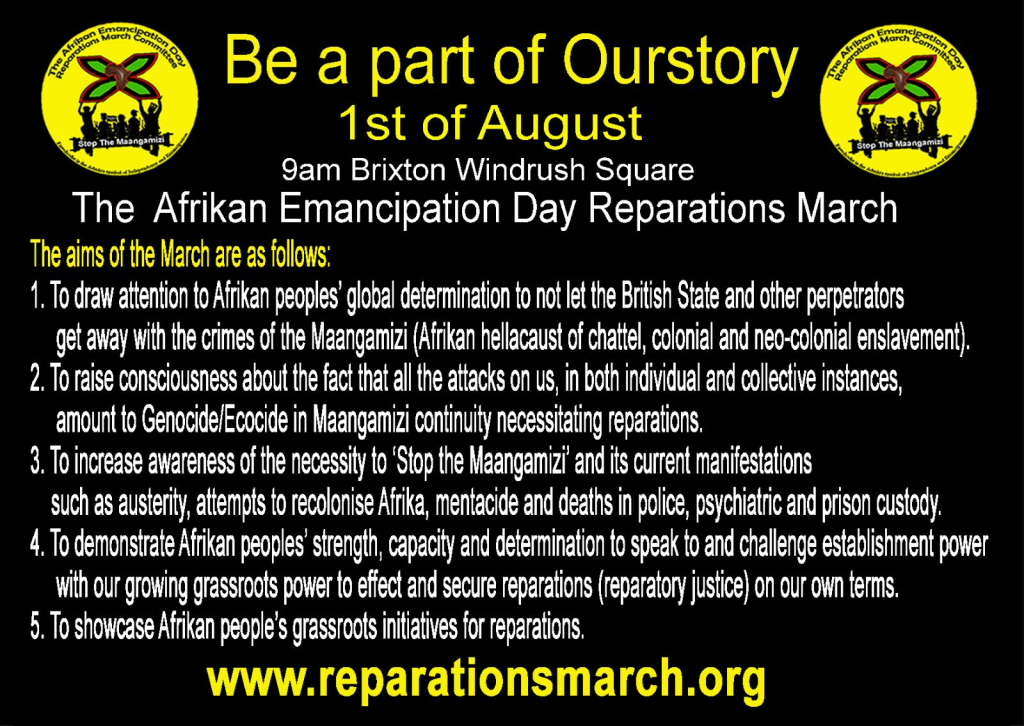
• Partnered with the Afrikan Emancipation Day Reparations March Committee (AEDRMC) to develop aims and objectives for the Afrikan Emancipation Day Reparations March on the 1st of Mosiah (August) which took place between 2015-2019. These aims (below) became necessary so that as co-organisers of the 1st Mosiah activities that we could provide a clear rationale for why we were marching.
• Strengthened the programme for the Afrikan Emancipation Day Reparations March itself by introducing to the programme of the day the People’s Open Parliamentary Session on Afrikan Reparations (POPSAR) which occurred in between 2016 and 2019. The POPSAR at Parliament Square was a mass consciousness-raising forum for public debate and discourse on manifestations of the Maangamizi necessitating Afrikan Reparations. It was a public forum where Afrikan people rehearsed our arguments in pursuit of the ‘Battle of Ideas’ on obstacles to the realisation of holistic reparatory justice. The purpose of the POPSAR was to engage audiences in action-learning on participatory democratic parliamentary debate and the ‘Battle of Ideas’ on critical issues such as how to stop various manifestations of the Maangamizi as part of the process of effecting and securing Afrikan Reparatory Justice.
• Helped to consolidate the emergence of an independent ground-up Pan-Afrikan inspired, and initiated, transnational process of facilitating grassroots leadership as well as mobilising and organising Afrikan people to advocate for reparations on their own terms, which goes beyond the statist CARICOM Reparatory Justice Programme and their Ten-Point Plan. Despite the fact that reparatory justice organising in the UK goes back centuries, there has been little recognition of this by Afrikan heritage social, political and economic elites within and beyond Britain who, for many decades, have chosen, (contrary to our indigenous Afrikan traditions of exercising people’s power), not to identify with the ground-up initiated and led ISMAR.
• Collected over 25,000 signatures for the Stop the Maangamizi petition which calls for the All-Party Parliamentary Commission of Inquiry for Truth and Reparatory Justice into the LEGACIES of Afrikan enslavement, colonisation and neocolonialism. Have you read and signed it? Click here to read and sign it.
• Established the Maangamizi Educational Trust (M.E.T) in 2018 as the educational, training and other activities conducive to fundraising arm of the SMWeCGEC.
• Through PARCOE, established an Afrikan Reparations research partnership working between grassroots scholar-activists and establishment scholars at the University of Boston and the University of Edinburgh – who came together to form the International Network of Scholars and Activists for Afrikan Reparations (INOSAAR) and its youth wing INOSAAR Rep-Afrika. We recommend you also download and read the INOSAAR Principles of Participation as a good model of how reparations activists should engage in co-production with power institutions.
• Co-initiated the Pan-Afrikan Reparations Rebellion Groundings with the AEDRMC in 2020. The main purpose of the Pan-Afrikan Reparations Rebellion Groundings is to showcase our Afrikan Heritage Communities self-repairs initiatives locally, nationally and internationally.
• Through the M.E.T, worked with Bell Ribeiro-Addy MP to establish the All-Party Parliamentary Group for Afrikan Reparations (APPGAR) as promoted in the SMWeCGEC postcard campaign. Since the establishment of the APPGAR, the M.E.T has shared the running of the secretariat with the African Foundation for Development (AFFORD) and the Glocal Afrika Reparations Forum of London (GARFOL). The APPGAR gained new members in 2023.
• In order to develop autonomous Afrikan Heritage Community participation in the work of the APPGAR, the SMWeCGEC, co-founded together with GARFOL, the APPGAR community link known as the APPGARL action-learning circles where Afrikan Heritage Communities learn to critically engage with state bodies and the UK Parliament as communities of resistance, e.g., the Education and Reparations Circle and the Mbuya Nehanda Afrikan Women & Reparations Circle.
• Raised awareness, popularised and increased public recognition of key concepts and knowledge produced by the ISMAR including: the Maangamizi, Maatubuntujamaas, Sankofahomes and Maatubuntudunia in Ubuntudunia.
• Been instrumental in the development of Maatubuntumitawo – Global Afrikan Family Reunion International Council (Maatubuntumitawo – GAFRIC) by promoting glocal relation-building in association with Vazoba Afrika & Friends Networking Open Forum and Maatubuntumitawo – GAFRIC with indigenous Afrikan communities of resistance on the continent of Afrika. In this way, contributing to the concretisation of Maatubuntujamaas in the UK and internationally in link with emerging Sankofahomes in West Afrika with a view to the eventual building of Maatubuntudunia in Ubuntudunia.
• Co-initiated the Glocal Afrikan Reparations Forum of London (GARFOL) to glocally promote Afrikan Heritage Community engagement with the British public and local and central government structures in London from the standpoint of enhancing efforts towards building Maatubuntujamaas in link with Sankofahomes as part of the building process of Maatubuntuman in Ubuntudunia.
• Developed the ISMAR Advocates Training Course and other reparations action-learning, education, learning & teaching initiatives and co-facilitated with the Afrikan Emancipation Day Reparations March Committee (AEDRMC), several reparations awareness and orientation workshops across the UK.
• Developed a version of the petition for lodging at the European Parliament and had it translated into Dutch, French and German through working as part of the Europe NGO Consultative Council for Afrikan Reparations (ENGOCCAR).
• Developed a critical analysis of the CARICOM Reparations Initiative, through the Pan-Afrikan Reparations Coalition of Europe (PARCOE)
• Contributed to developing a position on the CARICOM Reparations Initiative alternative approach to reparations in association with PARCOE and the Global Afrikan Peoples Parliament.
• Co-convened, in association with Esther Stanford-Xosei, a meeting with UK based reparations activists of International Social Movement for Afrikan Reparations (ISMAR) to interface with the CARICOM Reparations initiatives of the Jamaican National Council on Reparations regarding how best to jointly work together recognising differences in our respective reparations strategies and tactics.
• Supported the candidature of SMWeCGEC Co-Vice Chair, Kofi Mawuli Klu who championed programmatic aspects of the SMWeCGEC in his campaign as independent candidate in the 2019 European Parliamentary elections as part of the ‘CEE the Truth’ Campaign, (#CEEtheTruth). One of the 3 aims of #CEEtheTruth was to “develop National Citizens Assemblies on Climate & Ecological Justice to oversee policy making, including those of Planet Repairs embracing Reparations, and have a leading role in shaping a zero carbon Europe”.
• Established organisational links with the Ovaherero Genocide Foundation (Namibia), N’COBRA, the National Coalition of Blacks for Reparations in America (USA) and the UBAD Educational Foundation (Belize) through PARCOE. The SMWeCGEC Coordinator-General, Esther Stanford-Xosei was selected to become a board member of N’COBRA when she was appointed Co-Chair of the N’COBRA International Affairs Commission in 2022.
• Supported the formation of the Global Majority Vs Campaign and leant to their legal case knowledge and expertise in advocacy and critical legal praxis, particularly in developing the extra-legal dimension of the case from a law as resistance perspective.
• Co-initiated, the Extinction Rebellion Internationalist Solidarity Network (XRISN) and the Extinction Rebellion Being the Change Affinity Network (XR-BACN) as an organised way to work with non-Afrikan allies in championing Planet Repairs and PRIM-building. In addition, the XR-Ubuntunovisi (bridge network of Afrikan Heritage Community activists developing critical resistance engagement with Extinction Rebellion).
• Has been instrumental in co-founding and developing the Majority World Internationalist Solidarity Coordinating Council of Communities Of Resistance (MWISCCCOR) which currently embraces Afrikan and Abya Yalan Heritage (so-called Americas) community activist circles working within and around XR-Ubuntunovisi and XR-Aylhcan (Abya Yalan & Latinx Heritage Communities Affinity Network).
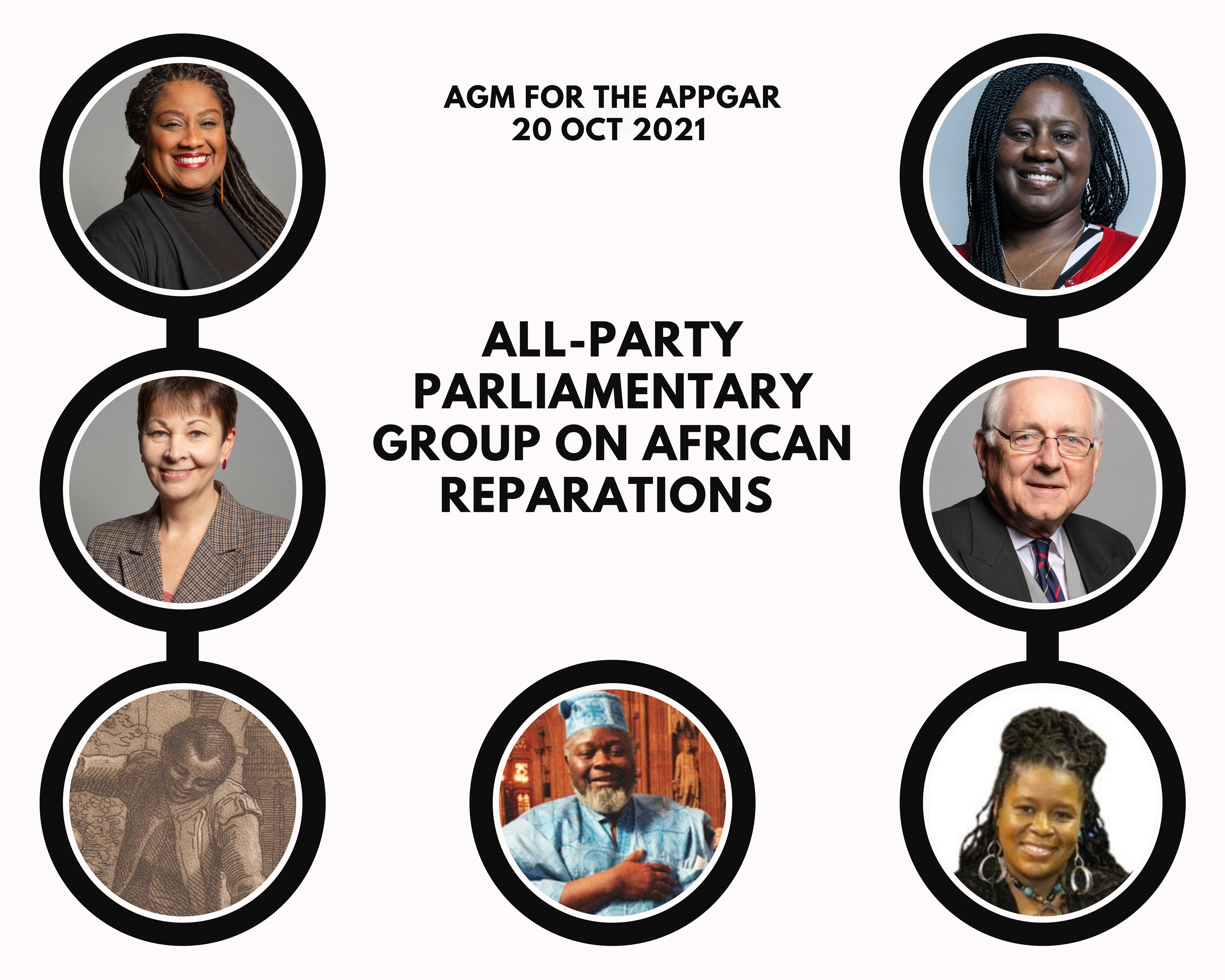
Left to Right: Bell Ribeiro-Addy MP, Marsha De Cordova MP, Caroline Lucas MP, Sir Peter Bottomley MP, Representation of Ottobah Cugoano, Bernie Grant MP, Esther Stanford-Xosei
Please note where you see different spellings of Afrikan this is because we in the SMWeCGEC use the spelling of Afrikan with a K but have preserved the spelling of African with a C when that is used by others.
Today we in the Stop The Maangamizi Campaign and our educational arm the Maangamizi Educational Trustwere participating stakeholders to the historic establishment of the All-Party Parliamentary Group on African Reparations (APPGAR) which was launched in the British Houses of Parliament (via an online AGM) at 10.30am this morning, Wednesday 20th October 2021. The APPGAR is chaired by Bell Ribeiro-AddyMP, the Vice Chairs are Marsha De Cordova MP and Caroline Lucus MP, the Assistant Secretary is Sir Peter Bottomley.
On behalf of the Stop the Maangamizi Campaign, the Maangamizi Educational Educational Trust will be sharing the running of the Secretariat for the APPGAR. Other organisations who will also be part of running the secretariat are the Glocal Afrikan Reparations Forum of London, (GARFOL) and The African Foundation for Development, (AFFORD).
The APPGAR will be officially launched on 27th October 2021.
Esther Stanford-Xosei, Chair of the Maangamizi Educational Trust and Coordinator General of the Stop The Maangamizi Campaign who was honoured to speak at the AGM made the following speech:
Good Morning
My name is Esther Stanford-Xosei and I speak as the Chair of the Maangamizi Educational Trust (MET) which is the educational arm of the Stop The Maangamizi: We Charge Genocide/Ecocide Campaign (SMWeCGEC). Because of the historic importance of the AGM of the All-Party Parliamentary Group on African Reparations (APPGAR) today, the MET/SMWeCGEC has agreed a written speech from which I shall read.
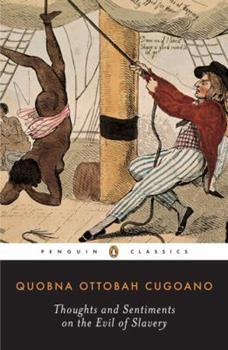
First of all, we would like to acknowledge countless generations of Afrikans in the International Social Movement for Afrikan Reparations (ISMAR) on whose shoulders, struggles and sacrifices we stand, whom since the mid-1700s in the UK specifically, have advocated for holistic reparations. In this regard, we particularly highlight the role of people like Ottobah Cugoano and other members of the Sons of Africa.
This idea for the APPGAR comes out of the campaigning efforts of the Stop The Maangamizi Campaign and our charitable educational arm, the Maangamizi Educational Trust. Maangamizi is the Kiswahili term for the continuum of chattel enslavement, colonialism and neocolonilaism.
We see the establishment of the APPGAR as a continuation of the work of the late Bernie Grant MPwho was the first member of the British Houses of Parliament to take up the issue of Afrikan Reparations following on from the ‘First Pan-African Conference on Reparations for Chattel Enslavement, Colonisation & Neocolonisation’ which took place in Abuja, Nigeria in 1993 and resulted in the establishment of the organisation known as the African Reparations Movement UK as well as the Abuja ProclamationEarly Day Motion 1987. It is in continuity of this work that we in the Maangamizi Educational Trust and the Stop the Maangamizi Campaign take our duties within the secretariat of the APPGAR very seriously. For this parliament has played a major role in legalizing, historical and contemporary injustices against Afrikan people worldwide including the passing of the Slave Compensation Act of 1837, which compensated our enslavers rather than Afrikan people. It has been very instrumental in legalizing our dehumanization, and continues with justifications being provided by this government for the discriminatory impacts of its extractivist policies in the Global South to supposedly avert the climate and ecological crises.
In terms of our MET/SMWeCGEC vision of the APPGAR, we see its purpose as: “bringing together parliamentarians, campaigners, communities and other stakeholders to examine issues of African Reparations; explore policy proposals on reparations and make recommendations to Parliament on how to redress the legacies of African enslavement, colonialism and neocolonialism today“. In this regard, a key objective of the APPGAR being to facilitate, work towards establishing the UKAll-Party Parliamentary Commission of Inquiry for Truth & Reparatory Justice (APPCITARJ) which is a key demand contained in the Stop The Maangamizi Petition and forms one of the main purposes of the ‘Atonement and Reparations for the United Kingdom’s Transatlantic Traffic in Enslaved Africans’ motions being passed by local and city councils.
People of Afrikan Heritage have been denied their right to be heard on what we mean by reparations, and what solutions we are already working on as part of Community Self-Repairs so that is what we are calling for a mechanism which can facilitate the dialogue between Afrikan Heritage Communities and the British State and society; which for us is the APPCITARJ. We therefore see this APPGAR as an important step in the process towards establishing such a mechanism of such vitally necessary dialogue. For it is only then that we can truly make appropriate policy and other programmatic types of redress by way of remedies to repair ourselves here in the UK and extending into the Afrikan Heritage Communities globally; and in the process also catalyze the repair of the entire British society and of course, of all peoples and societies, within and beyond in the UK.
It is necessary for the APPGAR to invite people to honest dialogue on this issue of Afrikan Reparations, because this struggle to effect and secure holistic reparatory justice, like all our struggles, begins with the need for, as advocated by Professor Karenga, a clear conception of what we want, how we define the issue and explain it to the world and what is to be done to achieve it. However, on this we should be guided by Afrikan Heritage Communities and the movements they have created to effect and secure holistic reparatory justice which have been operational over centuries.
We in the MET/SMWeCGEC want to emphasize that the grassroots of our Afrikan Heritage Communities across the world should be driving this work. It is up to this APPGAR to demonstrate that there is a leadership that will be of service to our communities at this time when there are big questions about what kind of leadership we have and even some of the state and non-state actors active on issues of reparations, being heavily scrutinised in terms of their credibility and commitment to our people in what some see as a tendency to want to make elitist deals under the guise of reparations which do not benefit the masses of the people. We should all be clear that Afrikan Heritage Communities have a right to participate in reparations programme and policy development and must be in the driving seat of such processes best summed up in the mantra: Nothing About Us Without Us for Anything About Us Without Us is Against Us. Furthermore, participation rights are individual and collective human rights under customary international law. They are enshrined in the International Covenant on Civil and Political Rights (ICCPR), and further established in states’ legal obligations as spelled out in the International Convention on the Elimination of Racial Discrimination(ICERD) and the UN Declaration on the Rights of Indigenous Peoples(UNDRIP).
That is why for us in the MET/SMWeCGEC, the emphasis should be on Afrikan Heritage Communities Self-Repairs as was recognised in the Bristol ‘Atonement and Reparations’ motion which states: reparative justice should be driven by Afrikan Heritage Communities experiences, voices and perspectives to ensure that advocacy messages not only reflect but also respond to the real needs of the community in order to recognise inequalities. Also, that Afrikan Heritage Communities in collaboration with wider stakeholders, should be supported to develop their own glocal ‘reparations plans‘ to tackle issues of community disrepair as a result of the Maangamizi, locally, nationally and internationally. These issues of disrepair rooted in conquest, dispossession, structural racism as well as intergenerational oppression and trauma include in the UK: gun and knife crime among young people, kidnapped and missing children, the discriminatory impacts of the criminal justice system, the education system and the issue of Afrikan heritage maternal death-rates and inequalities of primal health of people of Afrikan heritage and ancestry etc as a result of the continuing impacts of the Maangamizi.
Research of people like Professor Carlton Waterhouseshows that much of the reparations policy-making, scholarship and public discourse pays little attention to the quality of past reparations programmes implemented around the world and whilst the emphasis is placed on former and contemporary wrongdoers to make apology, recompense, or other types of restitution, very little attention is paid to results, the end result of any reparations process should be the restoration and recovery of those that have experienced enduring injustice and harm, as well as the critical role that communities and individuals suffering from past abuses should play in establishing those programmes in order to re-establish their personal well-being and societal standing. Similarly, a lot of attention gets placed on state initiated reparations programmes; but this is based on a false and outmoded notion of international law as just being about the law of nation-states or governments rather than peoples and/or affected communities.
As much as this APPGAR has been centuries in the making, we must also recognise the context within which this struggle to effect and secure holistic reparatory justice is unfolding as historian Professor John Henrik Clarke advocated, we must be conscious of what political and cultural time of day it is given our locations as Afrikan people on the map of human geography. At a time when the extent of the Maangamizi is now imperilling all life on Planet Earth and some of us are threatened with literal extinction; an approach to effecting and securing holistic reparatory justice is required which brings about Planet Repairs which means: when safeguarding the rights of past, present and future generations; the need to proceed from a standpoint of Pluriversality that highlights the nexus of reparatory, environmental and cognitive justice in articulating the impetus to repair holistically our relationship with, and inseparability from, the Earth, Environment and the Pluriverse. Such an approach recognises there is urgent need for us all to compel the stopping of the Maangamizi of Neocolonialism and its inbuilt manifestations of genocide and ecocide and for Afrikan Heritage Communities to engage in deep and transformative adaptation given the certainty of intensifying climate and ecological crisis which is already impacting all life support systems as we know it rapidly-changing Planet Earth; doing so in ways and means that repair and transform our existing failed institutions in all spheres of people activity, locally, nationally and internationally. Such repair and transformation being anchored in the ancient Afrikan ethical imperative of Serudj ta, i.e., healing, repairing and remaking the World, making it more beautiful and beneficial than we inherited it.
For these reasons, an essential part of our communities self-defence is transformative adaptation which is also about us beginning to make Pempamsiempangos, an Adinkra symbol, which encapsulates the necessity to knit and sew together in readiness for our community self-repairs; these are Glocal Afrikan Reparations Plan for Planet Repairs Alternative Progression being drawn up locally, nationally, internationally as well as globally. Alternative Progression plans become necessary given the contested nature of currently dominant processes of globalized development as highligted in Pluriverse: A Post Development Dictionary, given its structural roots in the Maangamizi, modernity, capitalism, state domination, and exclusively masculinist values which have often ended up being instead maldevelopment.
Finally, it is important to note that we who have been struggling to effect community self-repairs over centuries have built up an extensive knowledge base about the kind of system-change reparatory justice policy and programmatic measures are required. It follows that reparations education and conscientisation is part of the preparation for effecting and securing reparatory justice and this requires the APPGAR to also facilitate intense study about this issue as well as recognising that there is such a thing as reparations ethics. In this regard to acknowledge the INOSAAR Principles of Participationwhich promote equity between the knowledges produced by Afrikan Heritage Communities on Reparations and all other stakeholders.
We in the MET and the SMWeCGEC commit to disciplined, proactive work in the APPGAR secretariat and in fulfilment of this vision and we are keen to work equitably with partners who recognise the principles of Afrikan agency in determining what is best for our people.
We thank Bell Ribeiro-Addy for taking up this challenge by taking this historic step in initiating this APPGAR and agreeing to chair it and of course also to all of you who have agree to be the other executive officers.
We look forward to supporting and working with you all in the APPGAR.
The orginal proposal for the APPGAR as proposed by the MET can be found here.
“Accepting our responsibility and obligation to our Ancestors for ensuring that the African identity is proclaimed, maintained and developed; and that Africa is restored to its rightful place at the centre of world politics; call upon all people of African origin in the Caribbean, Africa, Europe, the Americas and elsewhere to support the movement for reparations and join forces with a view to forming a strong united front capable of exposing, confronting and overcoming the psychological, economic and cultural harm inflicted upon us by peoples of European origin.”
Birmingham Declaration, Africa Reparations Movement (UK), 01/01/94
“Reparations is a process of the repairing and remaking of a people who are in the process and practice of repairing, renewing and remaking the world”
Professor Maulana Karenga, Black Power Encyclopaedia: From “Black is Beautiful” to Urban Uprisings, 2018
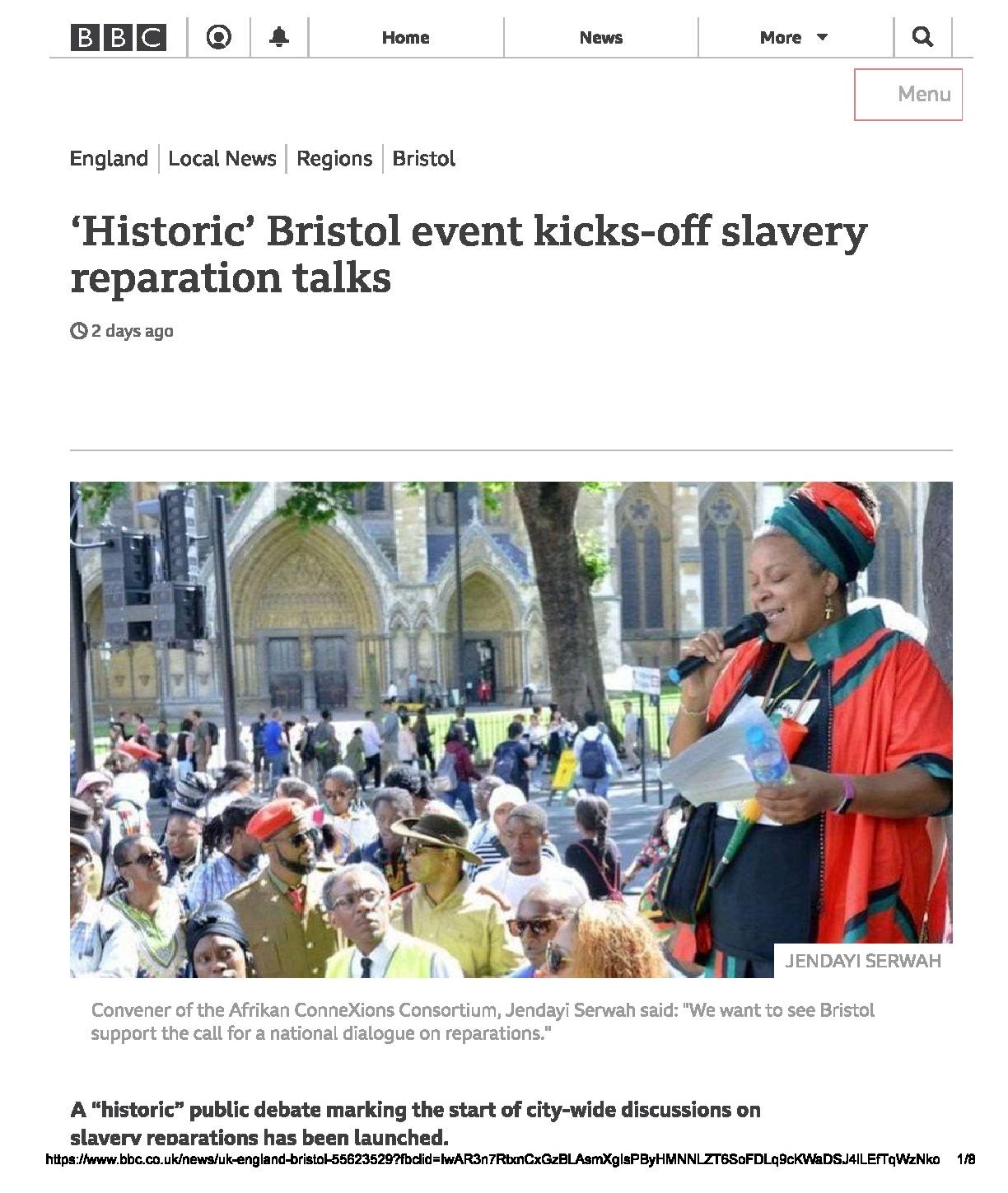
By now hopefully you have heard about the recent ‘Reparations and Atonement’ motionpassed by Bristol City Council on 2nd March 2021, the role of the Stop The Maangamizi: We Charge Genocide/Ecocide Campaign (SMWeCGEC) working with local partner, the Afrikan ConneXions Consortium as well as Afrikan Heritage publicly elected officials in this.
So now that we as the Stop The Maangamizi: We Charge Genocide/Ecocide Campaign (SMWeCGEC) are catalysing advancement of the ‘Afrikan Radical Imagination’ (i.e. the ability to envision and work toward bringing about better and repaired futures) in galvanising processes with a variety of Afrikan Heritage Community stakeholders as well as the support of allies; many of whom are publicly elected officials who we work with to ensure that variations of the ‘Atonement & Reparations for the Transatlantic Traffic of Enslaved Africans’ motions get passed by local and city councils in different parts of the country, the question on so many people’s minds is: where do we go from here?
It is necessary to recognise what the added significance of the Bristol motion, which includes resolutions committing Bristol City Council:
To call on councillors, the Mayor or other appropriate council agency to:
1. Write to the Speakers of both Houses of the UK Parliament, Chair of the Commons’ Women and Equalities Committee, and Chair of the Commons’ Home Affairs Committee to express Bristol City Council’s view that they should consider establishing, and seeking UK Government support for, an All-Party Parliamentary Commission of Inquiry. The purpose of this unprecedented commission would be to work on the scope of how reparations may be delivered and may also include for example raising concerns about how tax payers were until 2015 paying back compensation paid to enslavers.
2. Support Afrikan Heritage Community (AHC) organisations in Bristol to galvanise support for the emerging Bristol AHC led ‘Reparations Plan’ from, and in collaboration with, wider stakeholders including institutions, city strategic leaders, corporate leaders, key strategic programmes/initiatives and cross-party politicians.
4. Recognise that reparative justice should be driven by Afrikan Heritage Communities experiences, voices and perspectives to ensure that advocacy messages not only reflect but also respond to the real needs of the community in order to recognise inequalities.
The significance of sections two and four are critical to the success of section one regarding the establishment of the International Social Movement for Afrikan Reparations (ISMAR) demand for the All-Party Parliamentary Commission of Inquiry for Truth & Reparatory Justice (APPCITARJ), which as we in the Stop The Maangamizi Campaign have always advocated, must be led by our Afrikan Heritage Communities rather than others seeking to define for us what reparations mean and should look like.
The struggle for reparations for the Holocaust of Enslavement of African people is clearly oneof the most important struggles being waged in the world today. For it is about fundamental issues ofhuman freedom, human justice and the value we place on human life in the past as well as in the presentand future. It is a struggle which, of necessity, contributes to our regaining and refreshing our historicalmemory as a people remembering and raising up the rightful claims of our ancestors to lives of dignityand decency and to our reaffirming and securing the rights and capacity of their descendants to live free,full and meaningful lives in our times. But this struggle, like all our struggles, begins with the need for a clear conception of what we want, how we define the issue and explain it to the world and what is to be done to achieve it.
The key point to note about the PEMPAMSIEMPANGO glocal reparations action-planning process in Bristol is that it asserts the primacy of Afrikan Heritage Communities driving the process glocally through the development of a PEMPAMSIEMPANGO Glocal Reparations Action Plan for Planet Repairs Alternative Progression (PEMPAMSIEMPANGO-GRAPPRAP)
PEMPAMSIE is the Adinkra symbol for sewing together in readiness -preparatory actions for reparatory justice. building our future out of our principled operational unity despite our diversity. Indeed, part of the repair process is about Afrikan heritage communities developing our own community capacity and power-base as well as our own Afrikan Heritage Community Self-Repairs Plans. MPANGO is the swahili word for plan.
Afrikan Heritage Community Self-Repairs are the self-determined efforts that need to be made in building our own power, in such a way, that Afrikan heritage communities are able to identify and enhance ongoing work towards stopping the contemporary manifestations of the Maangamizi, which are putting the individuals, families and other social groups that make up our communities into a state of disrepair; as well as reasoning and consciously carrying out the alternative solutions for glocally rebuilding our power base as Afrikan Heritage Communities for National Self-Determination (AHC-NSDs), in such a way that that they are eventually transformed, in accordance with the principles and programmatic demands of Pan-Afrikan Reparations for Global Justice.
However, such Community Self-Repairs for Afrikan Heritage Communities cannot take place in isolation but must link with Afrikan People’s powerbase our Motherland Afrika irrespective of whether we live on the Continent or in the Diaspora. The process of Pempamsie planning should occur within the context of a glocal framework which is establishing repaired Afrikan Heritage Communities which we refer to as Afrikan Heritage Communities for National Self-Determination (AHCs-NSDs)/ Maatubuntujamaas in the UK and other parts of the Diaspora which organically builds links with such Communities of Resistance and Communities of Reparatory Justice Interest on the Continent of Afrika which are known as Sankofahomes. This simultaneous process of establishing Maatubuntujamaas in the Diaspora and Sankofahomes on the Continent of Afrika is what will help usher in a repaired Afrika known as MAATUBUNTUMAN that will take shape in a repaired multipolar world, i.e. UBUNTUDUNIA.
The planning process of developing such a PEMPAMSIEMPANGO, including the facilitation of glocal community hearings should itself be so participatory democratic that it sets the example for and leads into the establishment of the APPCITARJ from the ground-up.
The first step in the PEMPAMSIEMPANGO planning process is establishing working groups of PEMPAMSIESAFO Pan-Afrikan Reparatory Justice Special Task Action Research Forces (PEMPAMSIESAFO-PARJSTARF); the purpose of which is to work on addressing Afrikan Heritage Communities Community-Self Repairs Solutions to the various aspects of the Maangamizi that they and their families and communities are experiencing.
PEMPAMSIEASAFO – Afrikan Heritage Communities Self-Repairs forces that are ‘sewing in freedom-fighting readiness’ for Pan-Afrikan Reparatory Justice victory. Asafos are community militia formations to which everyone belongs for community self-defence in some indigenous communities in West Afrika.There are similar formations within Afrikan Communities throughout the Continent and the Diaspora of Afrika.
It goes without saying that our work continues in fulfilling the other SMWeCGEC aims and objectives as found here.
To call on Councillors, the Mayor or the Chief Executive as appropriate to:
1. Write to the Speakers of both Houses of the UK Parliament, Chair of the Commons’ Women and Equalities Committee, and Chair of the Commons’ Home Affairs Committee to express Bristol City Council’s view that they should consider establishing, and seeking UK Government support for, an All-Party Parliamentary Commission of Inquiry. The purpose of this unprecedented commission would be to work on the scope of how reparations may be delivered and may also include for example raising concerns about how tax payers were until 2015 paying back compensation paid to enslavers.
The ISMAR’s glocal Afrikan Reparatory Justice process driven by the SMWeCGEC is now advancing with our partners, foremost among them the MAATUBUNTUMITAWO-Global Afrikan Family Reunion International Council (MAATUBUNTUMITAWO-GAFRIC) on the Continent of Afrika as well as the Afrikan Emancipation Day Reparations March Committee (AEDRMC).
Bristol is the best demonstration, thus far, of the combined ground-up and top-down approach working together in equity. The Bristol process has included meetings with Afrikan Heritage Communities, Afrikan Heritage Community elected officials and Afrikan Heritage representatives of Bristol-based institutions, as well as allies. There were also 72 statements received from members of the public in support of the motion and nearly 200 statements received last year when the motion went before the Council as a silver motion.
The passing of this motion is indeed a cause for celebration as now more than ever we have collectively been able to demonstrate that a radical agenda for change, (in the sense of tackling Maangamizi injustices from the root), can win.
There are however two key additions in the motion which surpass the original motions in London passed so far, and that is the inclusion of the following sections:
2. Support Afrikan Heritage Community (AHC) organisations in Bristol to galvanise support for the emerging Bristol AHC led ‘Reparations Plan’ from, and in collaboration with, wider stakeholders including institutions, city strategic leaders, corporate leaders, key strategic programmes/initiatives and cross-party politicians.
4. Recognise that reparative justice should be driven by Afrikan Heritage Communities experiences, voices and perspectives to ensure that advocacy messages not only reflect but also respond to the real needs of the community in order to recognise inequalities.
Of note, is the motion referencing what we in the SMWeCGEC refer to as the PEMPAMSIEMPANGO Glocal Reparations Action Plan for Planet Repairs Alternative Progression (PEMPAMSIEMPANGO-GRAPPRAP), which is a ground-up reparations planning process where our Afrikan Heritage Communities are organised and spearheaded by Pempamsiesafo – Pan-Afrikan Reparatory Justice Special Task Action Research Forces (PARJSTARF) to carry out as a matter of study and applied knowledge-production on the complexities of Afrikan Reparations. Although the passing of this motion is a stepping stone in an emerging participatory reparatory justice Afrikan Heritage Communities-led process, it is a huge leap forward and a vindication of the position of some of us in the SMWeCGEC took to championing such an approach on behalf of our people and were derided by both state and civil society actors for it.
The above resolutions constructively address the concern some of us in the SMWeCGEC have expressed about the top-down CARICOM Reparatory Justice Initiative known as the Ten Point-Plan, where appointments and disappointments are made to national reparations committees/councils by neocolonial CARICOM state bureaucracies. See here and here for further info about ISMAR position papers on such CARICOM Reparations initiatives. We are glad that lessons from our insights and advocacy in support of the right of the masses of Our People to participate in and steer reparations processes, from the ground-up, have not only been learned but also applied in Bristol.
It is truly laudable that Mayor Marvin Rees and Deputy Mayor, Cllr Asher Craig have been in dialogue with campaigners from the ISMAR and acted in ways which have supported and enabled Afrikan Heritage Communities’ grassroots leadership of this glocal participatory reparations process, rather than seek to hijack leadership of the ISMAR. By so acting, they have contributed immensely to strengthening our prospects for the ultimate victory of our Afrikan People at Home and Abroad in ensuring that reparations results in our Planet Repairs winning of MAATUBUNTUMAN in UBUNTUDUNIA as the true guarantees of non-repetition out of which all other reparations gains can be effected and secured as a continuation of the liberation visions of our Ancestors, not only for present, but also future generations.
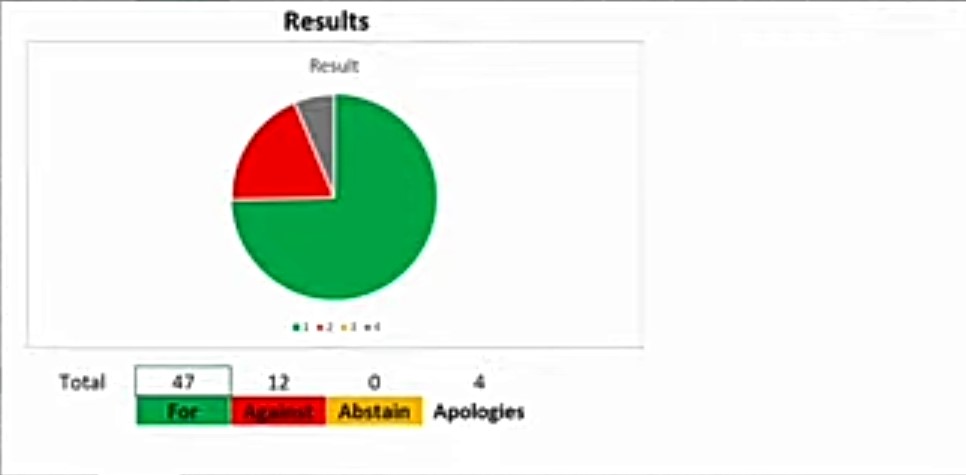
The full Bristol Motion can be found here. 47 Councillors voted for the motion, 12 voted against, there were 0 abstentions and 4 apologies. You can read the ACC statement of thanks and call to action following the passing of the Bristol Atonement and Reparations Motion here.
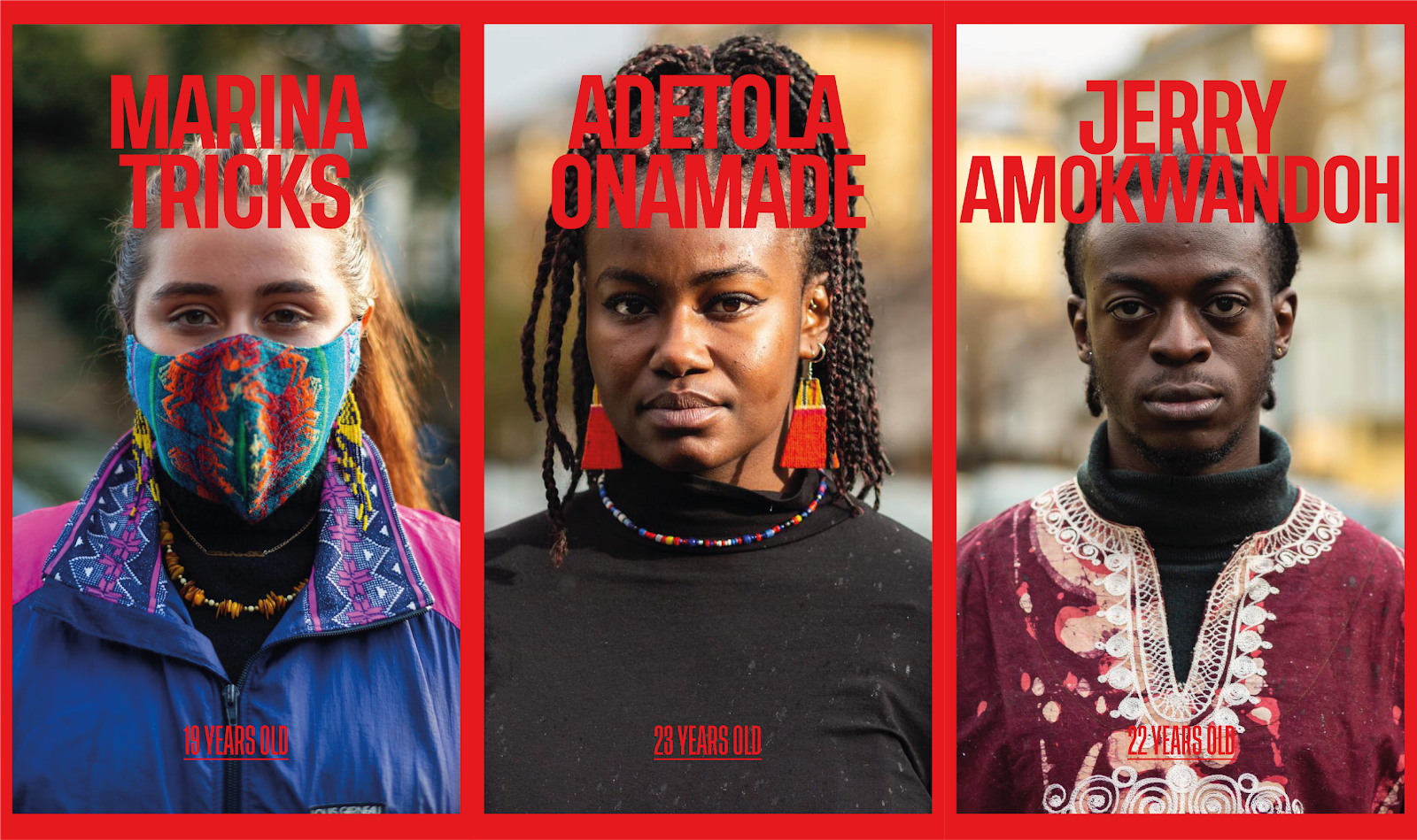
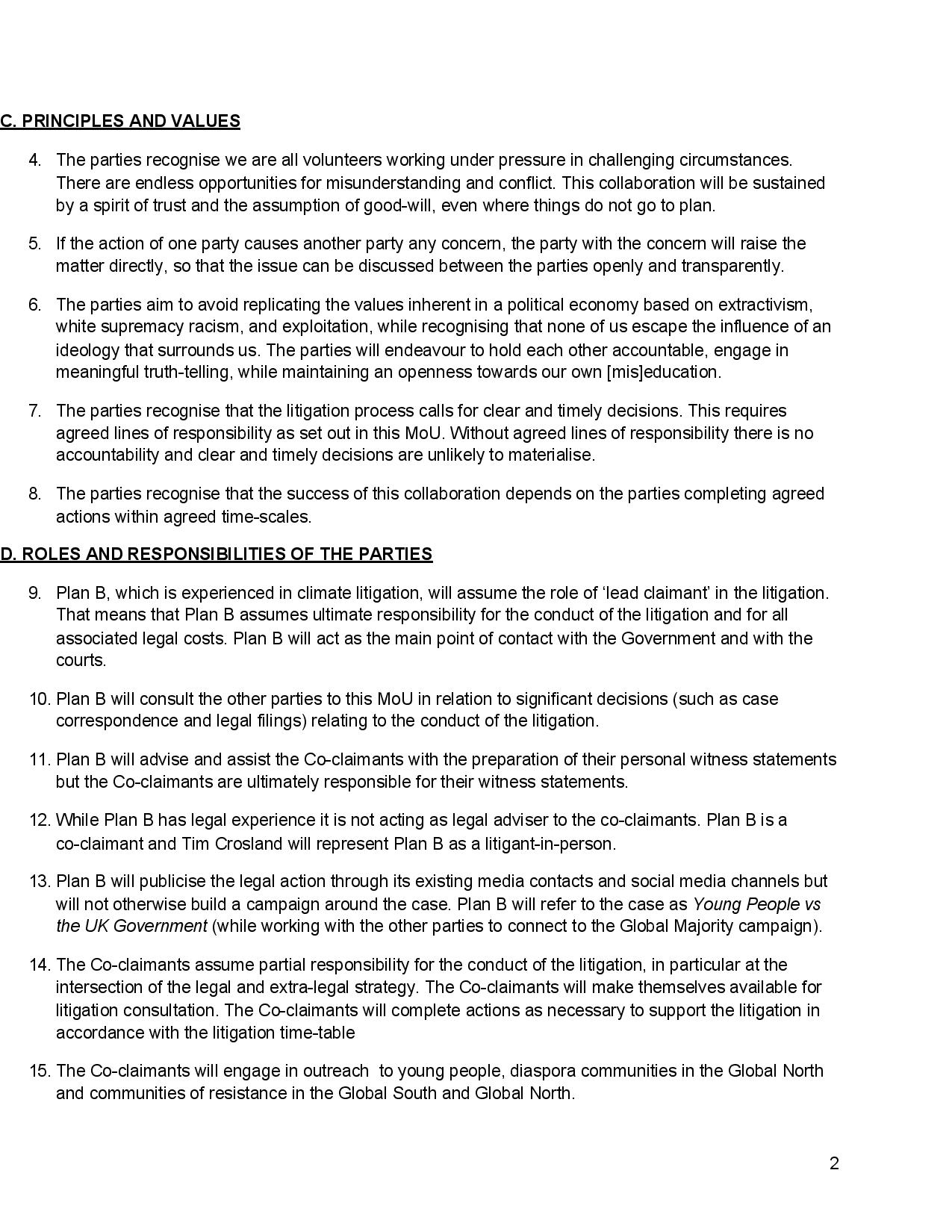
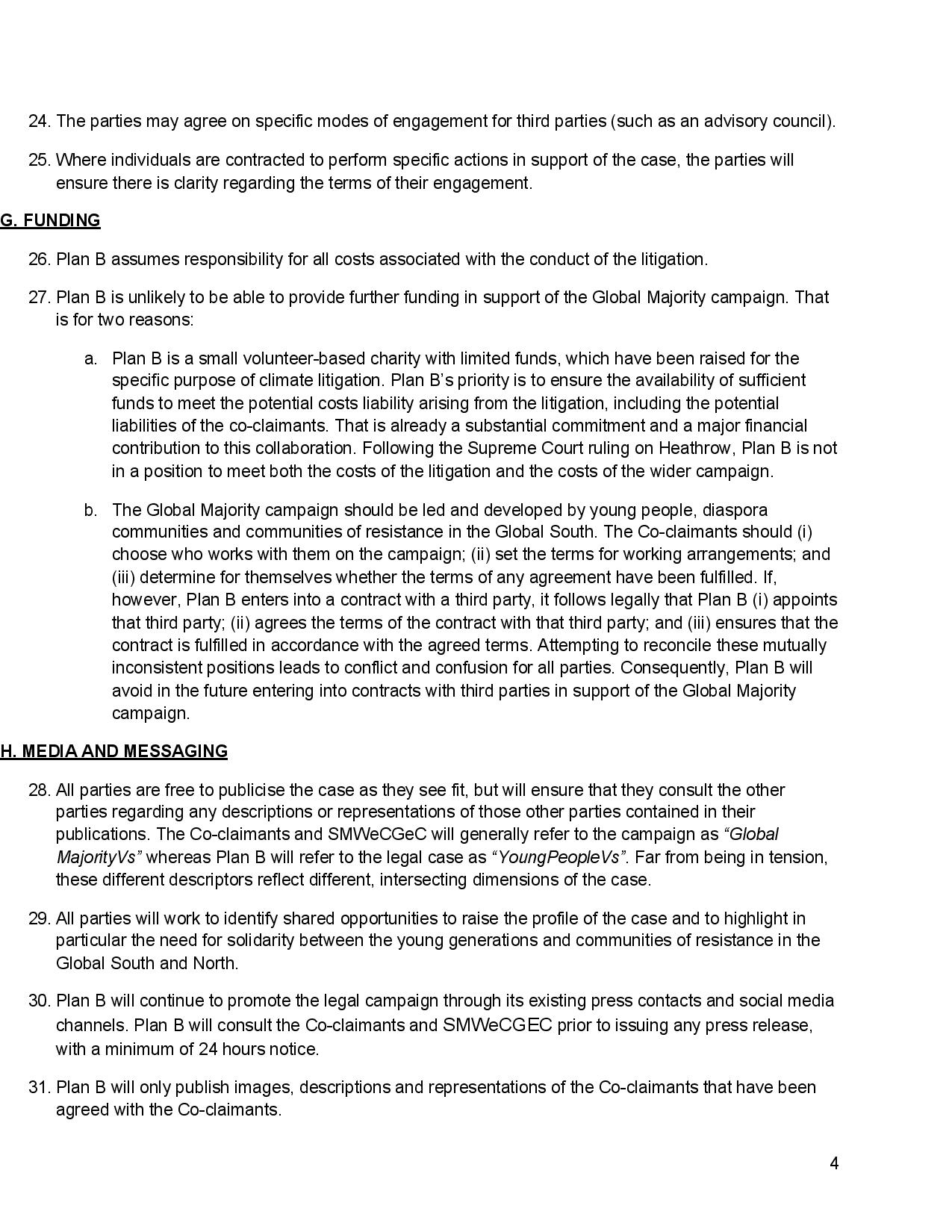
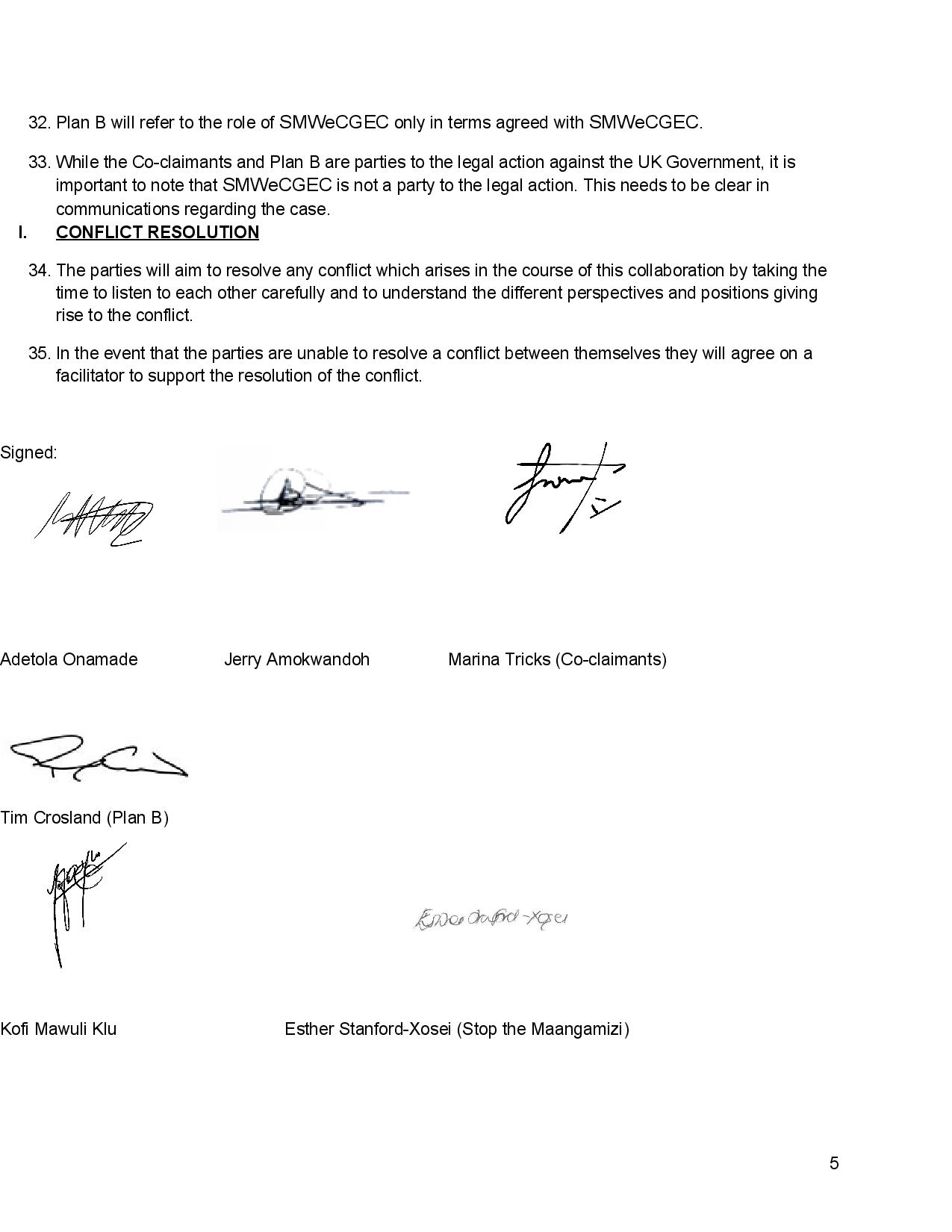
This Memorandum of Understanding (MoU) sets out the common understanding between the Co-Claimants: Marina Tricks, Adetola Onamade and Jerry Amokwandoh, Plan B and the Stop The Maangamizi: We Charge Genocide/Ecocide Campaign (SMWeCGEC) (“the parties”) concerning their collaboration, Young People / Global Majority vs UK Gov(a youth-led Global Majority campaign against the UK Government).
In this collaboration, the role of the Stop The Maangamizi: We Charge Genocide Campaign (SMWeCGEC) is to apply indigenous Afrikan knowledge, culture, concepts, symbols, methods and traditions of justice, in harmony with critical legal praxis, to the law as resistance development of the Global Majority V UK Government case. Our modus operandi entails ensuring that the case supports and is supported by the centuries of rebellion against genocide and ecocide by Afrikan and other Global South Communities of Resistance in link with Communities of Resistance throughout the Global North; and also in defence of Human, Peoples and Mother Earth rights.The SMWeCGEC will also ensure that such extra-legal efforts harmoniously complements the convention legal aspects of the case, in terms of work in the courts.
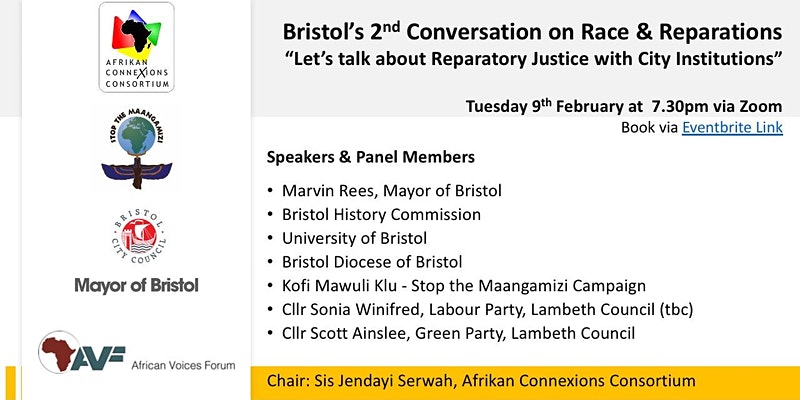
“Let’s talk about Reparatory Justice with City Institutions”?
About this Event
Many people are joining together to walk the path of racial justice and healing. Whilst it is important to do some deep introspection about how those of us from the Afrikan diaspora relate to each other and seek to heal from the racial wounds of the past and indeed the present. This healing cannot take place until we connect with others on the path towards reparatory justice.
“Lets talk about Reparatory Justice with City Institutions” is the 2nd in a series of 3 discussions on Bristol’s Conversation on Race & Reparations, following on from the 1st meeting held on the 14th January with and between Bristol’s Afrikan Heritage Communities, which started to explore the meaning of Reparations and the specific UK and international demand for An-All Party Parliamentary Commission of Inquiry for Truth and Reparatory Justice.
This 2nd meeting will hear from representatives from some of the city institutions who benefited from the Transatlantic Traffic of Enslaved AfriKans (TTEA). We have invited speakers from the Mayor of Bristol’s History Commission, University of Bristol, Diocese of Bristol and the Stop the Maangamizi Campaign. What reparative justice plans have they put in place and why? How do they intend to connect with the city’s Afrikan Heritage Communities ? “Nothing about us without us”
You will also hear from Lambeth Borough Council, the first council in the UK to pass a Reparations Motion. What happens after the motion is passed? Find out how Lambeth are supporting the reparations movement locally and nationally.
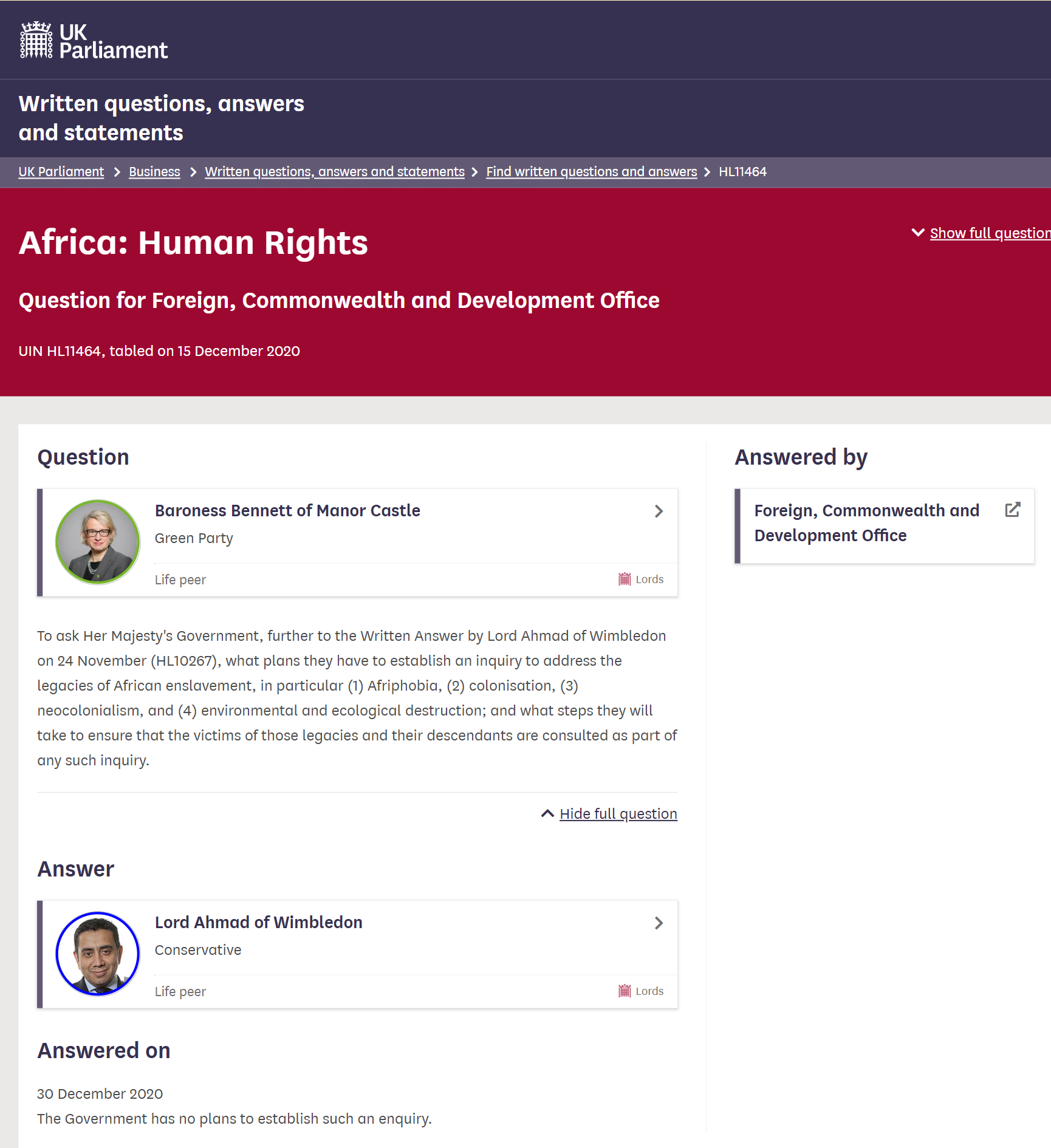
The above is the response by Lord Ahmad of Wimbledon on behalf of the UK Government to a second question asked by Baroness Bennett of Manor Castle, Green Party Life Peer regarding the UK Government’s intentions on establishing the All-Party Parliamentary Commission of Inquiry for Truth & Reparatory Justice (APPCITARJ).
As one can see, the result is no more favourable than the first response received from Lord Ahmad on behalf of the UK Government to the first question asked by Baroness Bennett contained in the following Stop the Maangamizi Campaign Briefing Note.
These type of responses are why the Stop the Maangamizi Campaign in association with the Afrikan Emancipation Day Reparations March Committee declared the Pan-Afrikan Reparations Rebellion in 2020; because our people are not being listened to or taken seriously regarding our reparations social-movement demands for the UK Government to establish the APPCITARJ.
If these demands for a community engaged participatory reparations process such as the APPCITARJ are not made, and concretely acted upon by the masses of our people and bringing pressure to bear on elected officials of local and central government, as well as state institutions, then of course we will continue to de disregarded, ignored and disrespected. At the level of popular mobilisation we in the Stop The Maangamizi Campaign continue to advocate the signing, sharing and reasoning through the content of the Stop the Maangamizi Petition as well as lobbying elected officials to support the work of self-repair which you are engaged. Such lobbying in can be done in a variety of ways. We also advocate the development of local, national and international community-owned reparations plans, which we refer to as Pempamsie Plans, such as the process unfolding in Bristol. Pempamsie is the Adinkra symbol for sewing together in readiness -preparatory actions for reparatory justice. building our future out of our principled operational unity despite our diversity. Indeed, part of the repair process is about Afrikan heritage communities developing our own community capacity and power-base as well as our own Afrikan Heritage Community Self-Repairs plans.
Afrikan Heritage Community Self-Repairs are the self-determined efforts that need to be made in building our own power, in such a way, that Afrikan heritage communities are able to identify and enhance ongoing work towards stopping the contemporary manifestations of the Maangamizi, which are putting the individuals, families and other social groups that make up our communities into a state of disrepair; as well as reasoning and consciously carrying out the alternative solutions for glocally rebuilding our power base as communities, in such a way that that they are eventually transformed, in accordance with the principles and programmatic demands of Pan-Afrikan Reparations for Global Justice.
The key thing is what more are you and the groupings that you are part of prepared to do to further Afrikan people’s sacred cause of effecting, securing and taking reparatory justice?
“Unless our struggle for Reparations leads to the Pan-Afrikanist revolutionary consientization, organization and mobilization of the broad masses of Afrikan people throughout the Continent and the Diaspora to achieve first and foremost, their definitive emancipation from the impeding vestiges of colonialism and the still enslaving bonds of present-day neocolonialism, to smash the yoke of White racist supremacy and utterly destroy the mental and physical stranglehold of Eurocentrism upon Afrikans at home and abroad, delinking Afrika completely from imperialism of any sort whatsoever, we shall have no POWER to back our claim for restitution and to give us the necessary force of coercion to make the perpetrators of the heinous crimes against us to honour the obligations of even the best fashioned letter and spirit of International Law.”
Kofi Mawuli Klu, ‘Charting An Afrikan Self-Determined Path of Legal Struggle for Reparations’: A Draft Paper for Presentation to the 11th December 1993 Birmingham Working Conference of the African Reparations Movement – UK Committee
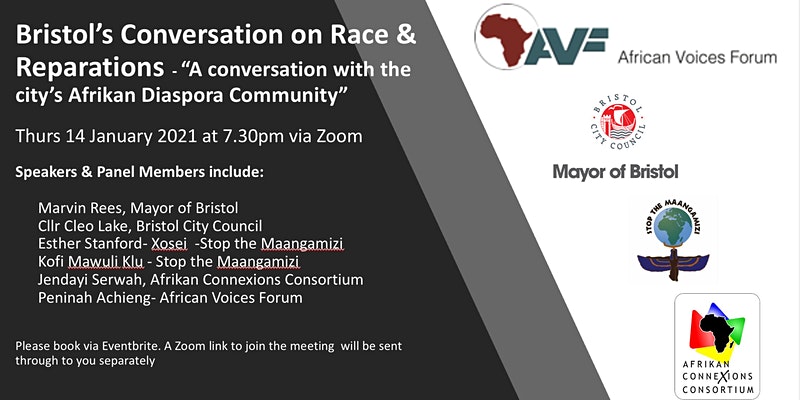
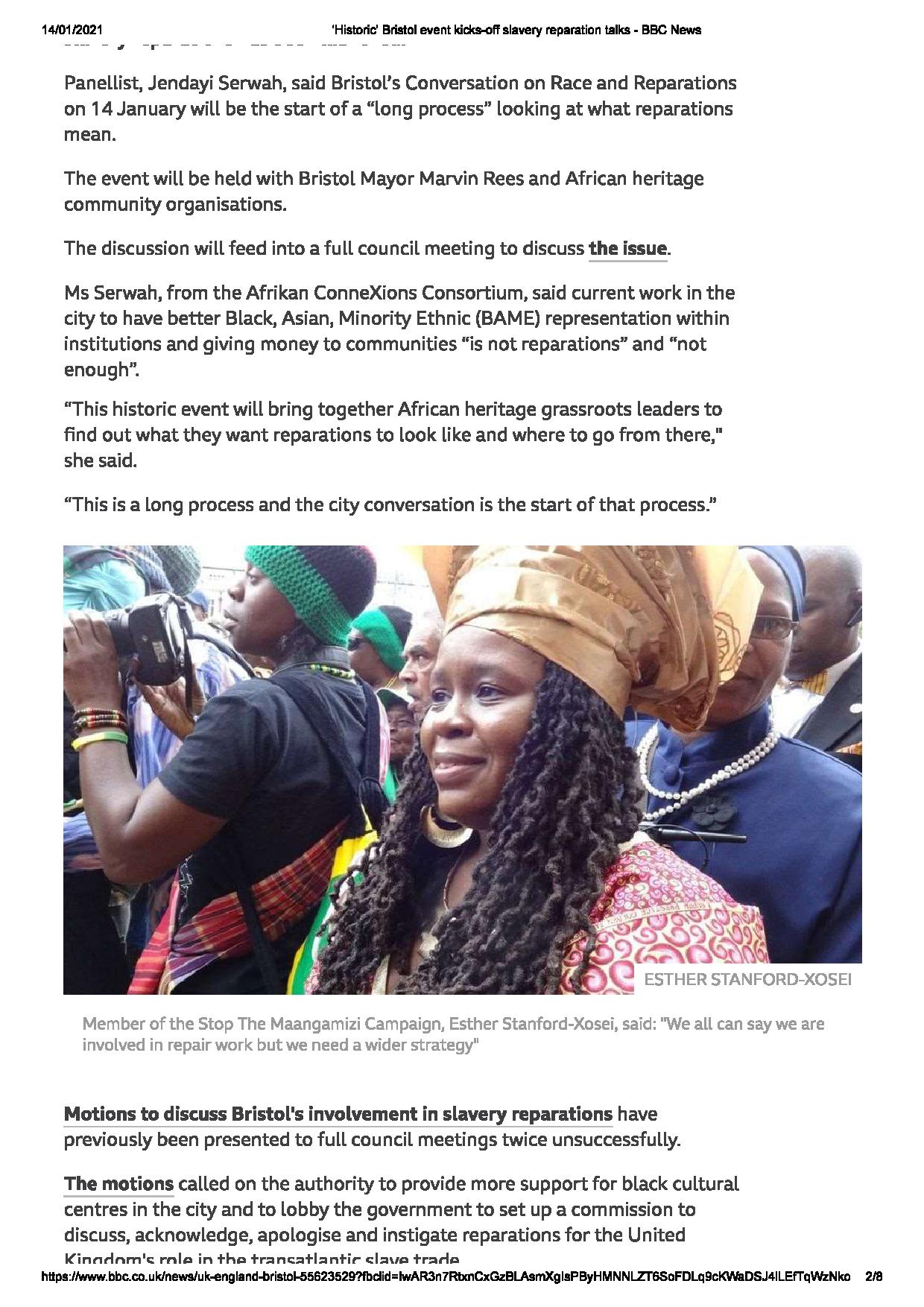
Colleagues in Bristol from Afrikan Heritage Communities are invited to an Afrikan Heritage Community-led conversation on Race and Reparations on Thursday 14th January from 7.30pm to 9.00pm. This community meeting has been called in partnership with the Mayor of Bristol, Bristol City Council, Afrikan ConneXions Consortium, African Voices Forum (AVF) and the Stop The Maangamizi Campaign.
All contributors to the dialogue are *Afrikan Heritage representatives from the bodies facilitating this event. You will hear from range of speakers about the context that has led to this point in the Reparations conversation, explore the meaning of Reparations and what that means for the city and globally, seek your support for the Stop The Maangamizi Campaign initiated call for an All-Party Parliamentary Commission of Inquiry for Truth and Reparatory Justice (APPCITARJ), as referenced in the Stop The Maangamizi Petition which will form the main proposals within the ‘Reparations and Atonement’ motion that Afrikan Heritage Communities are invited to comment upon before it is brought to a future Full Council meeting for discussion and approval.
It is really important that the debate is shaped by the whole community, both in terms of the concept itself, the work done to ready the city for a discussion and ensuring there is a shared understanding. This is the first of 2 conversations, the second conversation will be held with wider city stakeholders and the views of the city’s. Afrikan Heritage Communities (AHC) will be fed into this wider event to be held in early February 2021.
*Afrikan Heritage Communities are a diverse group who may also identify or describe themselves as:African, Caribbean, African-Caribbean, Nigerian, Jamaican, Ghanaian, Trinidadian, Black British, or of a dual heritage including African etc.
Please note that this initial meeting is open ONLY to the communities of interest as expressed above.









 stopthemaangamizi.com