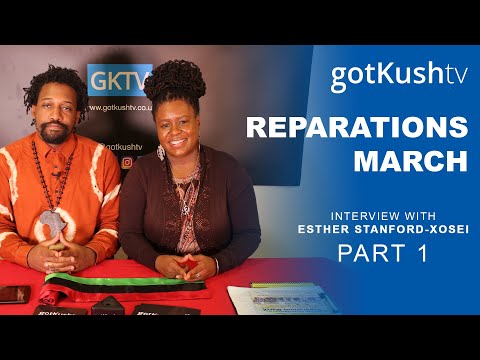
We in the ‘Stop The Maangamizi: We Charge Genocide/Ecocide!’ Campaign (SMWeCGEC) would like to extend our deep thanks and appreciation for the coverage Got Kush TV provided in preparation for the 2019 Afrikan Emancipation Day Reparations March and its all-year round campaigning work conducted through the SMWeCGEC as well as coverage of the March itself.
Although the 2019 Reparations March pre-March interviews below are relevant to the all-year round activism in advancement of the cause of reparations and strengthening the International Social Movement for Afrikan Reparations (ISMAR).
The following videos are coverage of the actual 2019 Afrikan Emancipation Day Reparations March including some of the speeches:
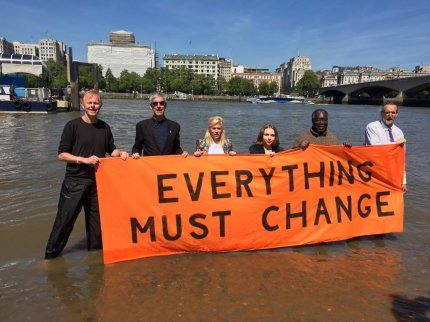
London UK 1st August 2019 (L to R) Cleo Alberta Lake, Lazarus Tamana , Hon. Kweme Abubaka and Dr Barryl Biekman present the ‘Stop The Maangamizi!’ Petition calling for the establishment of the All-Party Parliamentary Commission of Inquiry for Truth & Reparatory Justice for the Afrikan Hellacaust at 10 Downing Street as part of the Afrikan Emancipation Day Reparations March on Emancipation Day, . Emancipation Day marks the anniversary of the 1833 Slavery Abolition Act.
Please note, only copies of the additional 2,828 signatures collected between last year (14,590) and this year (17,418) were handed in with a copy of the ‘Stop the Maangamizi!’ Petition. Every year we tend to copy the same petitions and re-submit them with additional signatures collected. For environmental reasons, it was determined that we would only hand in the additional signatures collected this year until we reach 100,000 signatures that will be handed in all together when that figure is reached. Or in the alternative that the lobbying efforts of MPs and other elected officials via the ‘Stop The Maangamizi!’ Postcard yield the desired results. However, the SMWeCGEC is not relying on securing 100,000 to secure the campaign objectives, as ultimately reparatory justice will be effected, secured and taken by our own People’s Power, supported by other People’s of Conscience as well as our non-Afrikan Allies as part of PRIM-building.
In total 17,418 people have now signed the petition, this includes those who sign the online petition and the paper version.
Although 6 Petitioners were present as identified in the covering letter to the UK pRIME Minister which accompanied the petition, only 4 of the 6-member delegation were able to hand in the petition this year due to 2 members of the delegation unfortunately forgetting their ID.
This is a link to info about the petition hand-ins in the three preceding years:
We in the ‘Stop The Maangamizi: We Charge Genocide/Ecocide!’ Campaign (SMWeCGEC) would like to extend our deep thanks and appreciation for the coverage Got Kush TV provided in preparation for the 2019 Afrikan Emancipation Day Reparations March and its all-year round campaigning work conducted through the SMWeCGEC.
Although the 2019 Reparations March has now taken place, the interviews below are relevant to the all-year round activism in advancement of the cause of reparations and strengthening the International Social Movement for Afrikan Reparations (ISMAR).
Co-Vice Chair, Pan-Afrikan Reparations Coalition in Europe (PARCOE
Coordinator-General, ‘Stop The Maangamizi: We Charge Genocide/Ecocide!’ Campaign (SMWeCGEC)
Spokesperson, Afrikan Emancipation Day Reparations March Committee (AEDRMC)
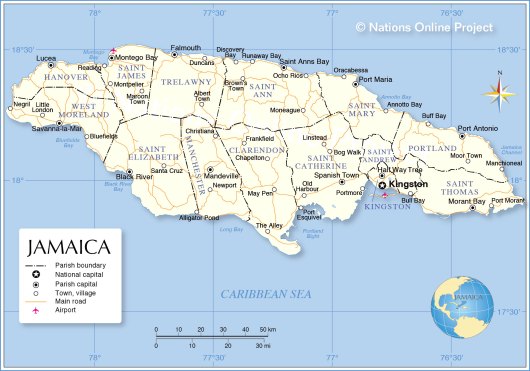
Since last year, when Brother Steven Golding spoke at the 5th annual Afrikan Emancipation Day Reparations March, we stayed in contact. He got in touch earlier this year about the possibility of me visiting Jamaica to do a lecture in recognition of the 2015 – 2024 United Nations International Decade for People of African Descent. Such a trip was finally organised to take place at the end of May 2019.
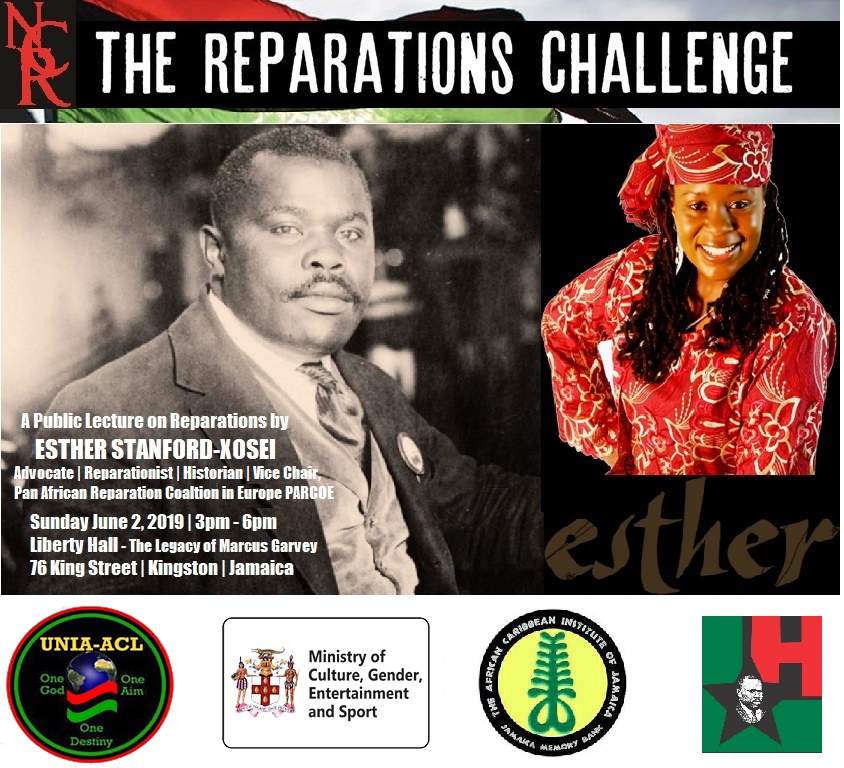
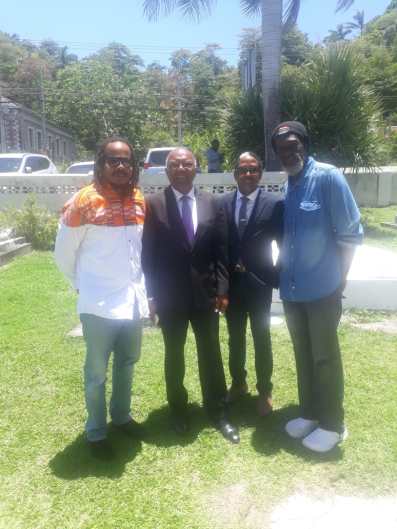
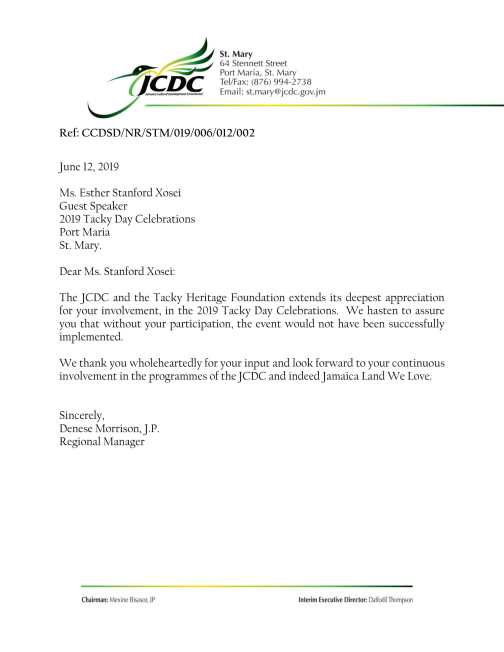
From the 29th May to 5th June 2019, I was invited by Brother Steven to deliver a couple of public lectures on Reparations. This included doing a public lecture on the ‘The Reparations Challenge‘ at the UNIA Jamaica Mass Meeting, which took place at Liberty Hall, as well as being the first international speaker to deliver the annual Tacky Day Lecture in the Parish of St. Mary themed ‘Chief Tacky 1760 – 2060: The Struggle Then, The Struggle Now‘.
When I arrived in Jamaica, I was pleasantly surprised to be met at the airport by Sister Marva Pringle-Ximinnies from the Ministry of Culture, Gender, Entertainment & Sports, Brother Steven as well as Brother Derrick Robinson aka ‘Black X’. I did not know at the time but Black X had actually walked 57+ miles from Port Maria in the parish of St. Mary to Norman Manley International Airport in Kingston to officially welcome me to Jamaica as the international speaker for the Tacky Day Lecture.
This is a message that Black X had sent out to various networks before my arrival:
Dear friends, Today Tuesday May 28 at 3pm, I will be embarking on a 24 and a half hours walk from the Tacky Monument in Port Maria St Mary Jamaica to the Norman Manley Airport in Kingston, to be a part of the team that will be welcoming our Guest Speaker for Tacky Day to Jamaica! she is due to arrive in Jamaica from England (UK) at 3.30pm. Her Name is Esther Stanford-Xosei a Pan-African Speaker, a leading voice in the global Struggle in the call for Reparations to be paid for the atrocious and the beyond repair damage that was done to our African fore Fathers and Mothers. So it is with great conviction of duty in honourable memory of the Great Chief Tacky that in our Ancestors Name, I will challenge this 24 and a half hours walk to the Norman Manley Airport in Kingston from Port Maria St Mary. Thank you for your support.
Derrick Black X Robinson, Chairman Tacky Foundation, Tacky Heritage – Pan-African Garden Of Assembly 1760
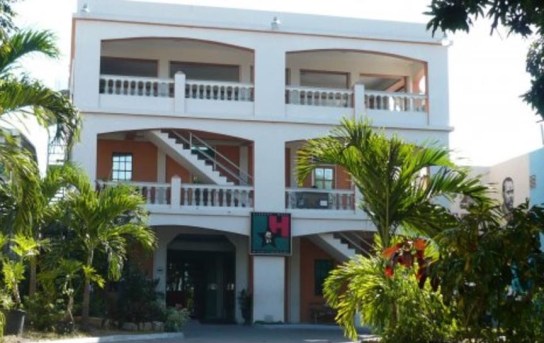
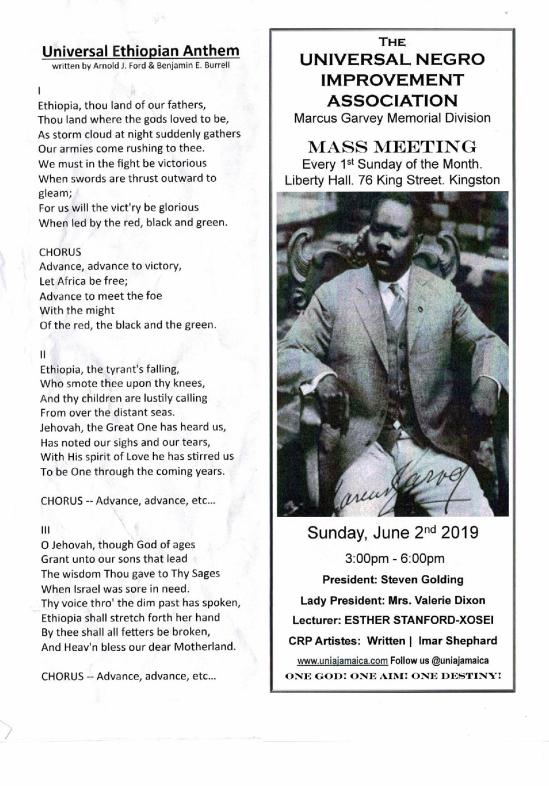
The first public lecture I did was on Sunday 2nd June, 2019 at the famous Liberty Hall at 76 King Street, Kingston which was (at one point) the Hon. Marcus Garvey’s headquarters and that of the UNIA-ACL. The U.N.I.A’s constitution required each UNIA to have a Liberty Hall, which was its headquarters. Jamaica’s Liberty Hall was the centre of activities for the Kingston division of The UNIA. The two-storey building was the first meeting hall in Jamaica that was fully owned and operated by people of Afrikan heritage. First opened in 1923, the site has been restored to serve as a museum of the life and work of Marcus Garvey, who was the first man to be declared an official National Hero of Jamaica.
Programme for the Mass Meeting
This is a link to an Instagram post of Emprezz @emprezzgolding with a video clip from my lecture at the UNIA Mass Meeting.
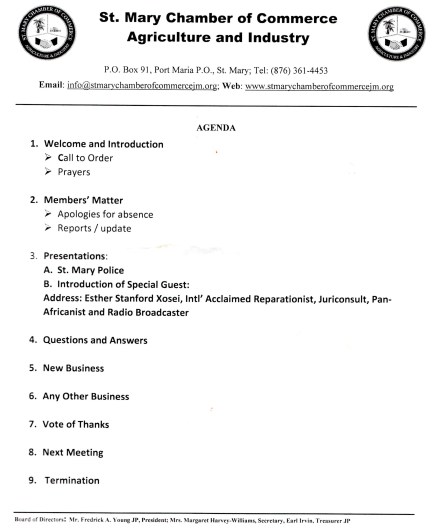
On Monday 3rd June 2019, I was hosted at a reception organised by the St Mary Chamber of Commerce, Agriculture & Industry. I spoke at their meeting about the relevance of reparations to addressing local community development issues and challenges spoken about at the meeting.
I was a guest at the St. Mary Chamber of Commerce Meeting & Reception
Tacky Day Commemorations
Before I come unto the commemoration, it is important for me to say a little bit about Chief Tacky. Tacky’s War or the Easter Rebellion of Port Maria, one of the bloodiest revolts that took place in Jamaica, was an uprising of enslaved Afrikans from the central region of Ghana then referred to as Koromantse which started on Easter Sunday 1760 and went on until July 1760. The Rebellion broke out in St. Mary and spread throughout most of the country. The leader of the rebellion, Tacky (Akan spelling: Takyi), was originally from the Fante ethnic group in West Afrika and had been a Paramount Chief in Fante land (in the Central region of present-day Ghana) before being captured and sold into slavery after the Koromantse Wars. Tacky was subsequently enslaved on the Frontier Estate, in Jamaica where he was subsequently made foreman. However, he used this position to plan and influence some fellow enslaved Afrikans on his estate and neighbouring Trinity Estate to revolt. He, along with the Asante Queen Nanny or Nana, both, with the support of fellow rebels, planned to defeat the British and all enslavers and make Jamaica a separate and independent Black country. They began by seizing control of Frontier and the neighbouring Trinity plantation, killing the masters or estate managers and freeing the enslaved before heading to the nearby town of Port Maria.
One of the most-well known people seeking to gain greater recognition of Tacky is Black X, Chairman of the Tacky Heritage Group, who is truly a legend in Jamaica and is doing excellent work to help conscientise the Jamaican public about the importance of Chief Tacky. A waterfall close to the cave where Takyi and his fellow rebels planned the revolt was named Tacky Falls and is currently open to visitors. A school has also been named after Chief Tacky.
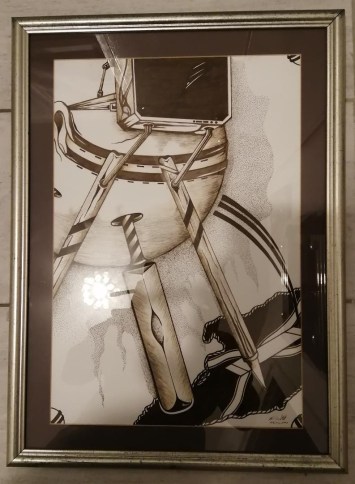
At the end of the lecture, I was presented with a picture by Chelsea Chin, administrator for Dr Morais Guy, J.P., Member of Parliament for Central St. Mary.
These are some of the pictures from the Tacky Day Commemorations, it was truly a beautiful day. Local MPs, the Mayor, business leaders, community members as well as children from 8 local schools in St. Mary attended the lecture!
Pics courtesy of Steven Golding.
This slideshow requires JavaScript.
Left to Right: Steven Golding, Dr Morais Guy, J.P., MP, Central St. Mary, Dr Norman Dunn, BH, J.P., MP South East, St. Mary, Derrick Robinson aka ‘Black X’
This is a link to Minister Olivia Grange’s speech that was read out by Dr Norman Dunn, BH, (M), J.P. Member of Parliament, South East, St. Mary:
Esther Stanford-Xosei with Derrick Robinson aka ‘Black X’ at Tacky Day Lecture
Make Chief Tacky A National Hero Resolution
Since my return to the UK, I have been forwarded the following text of resolution to be put forward at the local Parish Council in St. Mary on Thursday 11th July 2019:
MAKE CHIEF TACKY A NATIONAL HERO OF JAMAICA
On Easter Sunday, in the year 1760 in Jamaica in the Parish of Saint Mary, the great rebel leader called Chief Tacky led our ancestors in a rebellion against the establishment of chattel slavery in the country. They raided the English garrison at Fort Haldane and attacked the estates at Frontier, Trinity, Ballard’s Valley, Esher, among others. Tacky’s revolt/war spread to several parishes across the country and lasted for over 18 months even when they thought it had ended. The brave Chief Tacky lost his own life but his vision and actions had struck a blow for freedom that helped to hasten the end of the act of inhumanity and the bondage of chattel slavery. Ultimately, history has proven that freedom was irreversible from that point on.
As a result of this trip, PARCOE decided to update our banner/flyer to include Chief Tacky and to also lobby for his inclusion as one of the revered Ancestors commemorated as part of the Ancestors Bloc of the Afrikan Emancipation Day Reparations March.
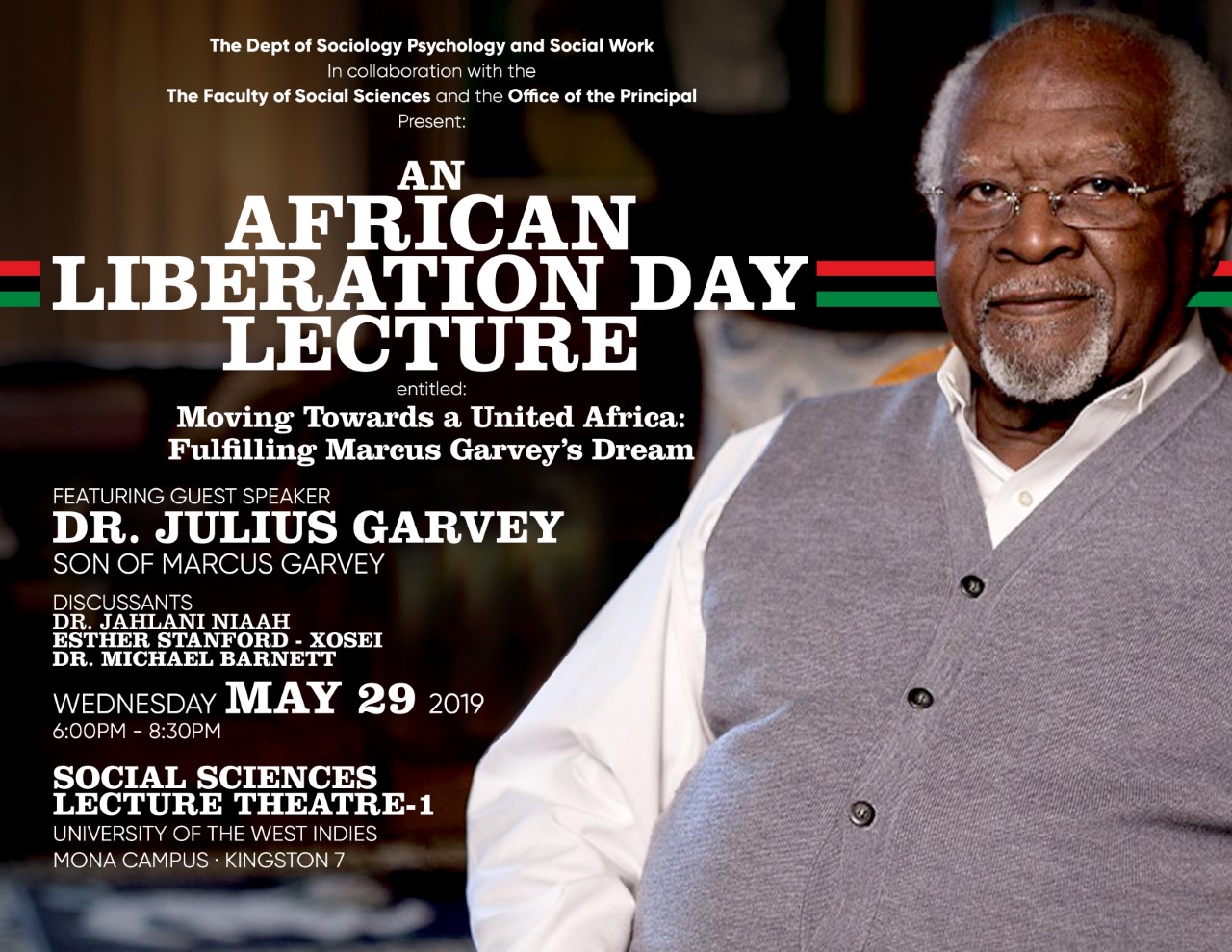
In addition, Esther was a panellist for the UWI ‘African Liberation Day Lecture’ on 29th May 2019 featuring keynote speaker Dr Julius Garvey who spoke to the theme ‘Moving Towards A United Africa: Fulfilling Marcus Garvey’s Dream‘.
Meeting with Minister Olivia Grange & Representatives of the NCR
Another important aspect of the trip was the meeting I got to have with representatives of the Ministry of Culture, Gender, Entertainment & Sport, including the Hon. Olivia (Babsy) Grange, MP, CD, Minister of Culture, Gender, Entertainment & Sport and Barbara Blake-Hannah; in addition to meeting with several members of the National Council on Reparations (NCR), in particular, NCR Co-Chair Mrs Laleta Davis-Mattis (who attended the Reparations Challenge Lecture), Mr Frank Phipps, Q.C., Lord Anthony Gifford, Q.C., Attorney Bert Samuels, Dr Jahlani Niaah, Dr Michael Barnett and Ras Ho-Shing. Barbara Blake-Hannah was also in attendance at the meeting with members of the NCR and Minister Grange.
I did not get to meet or speak with NCR Co-Chair Professor Verene Shepherd on my trip.
Pics courtesy of Steven Golding.
This slideshow requires JavaScript.
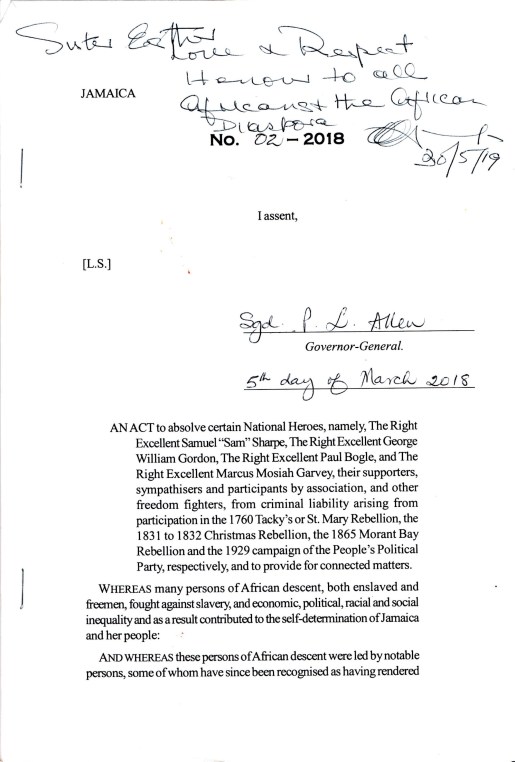
During the meeting, Minister Grange updated me on some of the developments taking place pertaining to reparations, including the work being championed under the auspices of the Ministry of Culture in relation to the absolution of the resistance efforts of National Heroes. Minister Grange made a special presentation to me of a copy of The National Heroes and Other Freedom Fighters (Absolution from Criminal Liability in Respect of Specified Events) Acts, 2018 No.2
The following is a copy of the front and back page of the act of the act. A link to the act can be found below:
In the meeting I also shared information about what reparations activism was taking place by the UK contingent of the International Social Movement for Afrikan Reparations (ISMAR). The main updates I shared pertained to:
The alliances being forged by elevating a reparatory justice approach to tackling the climate and ecological crisis which will disproportionately impact on our communities in Afrika and the Caribbean; highlighting developments made in this regard by the ‘Stop the Maangamizi!’ Campaign developing an affinity with Extinction Rebellion (XR). As a result of the advocacy and involvement of reparationists in the ‘Stop the Maangamizi!’ Campaign, this has resulted in the subsequent development of the CEE the Truth Campaign by some members of XR and the emerging Climate & Ecological Independents championing Planet Repairs and reparations, as one of their core demands of their political manifesto in the 2019 European Parliamentary Elections.
The importance of state and non-state actors, recognising their distinct but possibly complementary roles and working together on the common cause of effecting and securing reparatory justice by seeking to join up actions and initiatives where possible. An example being the Afrikan Emancipation Day Reparations March which takes place on 1st August.
In seeking accountability from European nation states, the importance of factoring engagement strategies with country diasporas living in the UK/Europe as well as the wider Afrikan Diaspora communities in Europe. This being necessary to ensure that there was harmonisation between distinct reparations strategies and tactics by state and non-state actors.
Likewise, the necessity of also seeking to influence European and other civil society populations in Europe and win support from them in standing in solidarity with the cause of reparatory justice. In this regard, it was pointed out that the notion of Britain and Europe coming to help “clean up the monumental mess of Empire” they left in the Caribbean is not being taken seriously or endearing support from wider constituencies in the UK. This is largely because it is clear, even to many white people, that the British Parliamentary System is in crisis, with Brexit and the emergence of Extinction Rebellion which is challenging the inadequacies of governance and failure of moral leadership of British parliamentarians who have failed to act to avert the climate & ecological crisis etc. The popular overstanding being how can Britain be asked to clean up the mess in the Caribbean when it cannot clean up the mess in its own back-yard?
Meeting with Minister Mike Henry
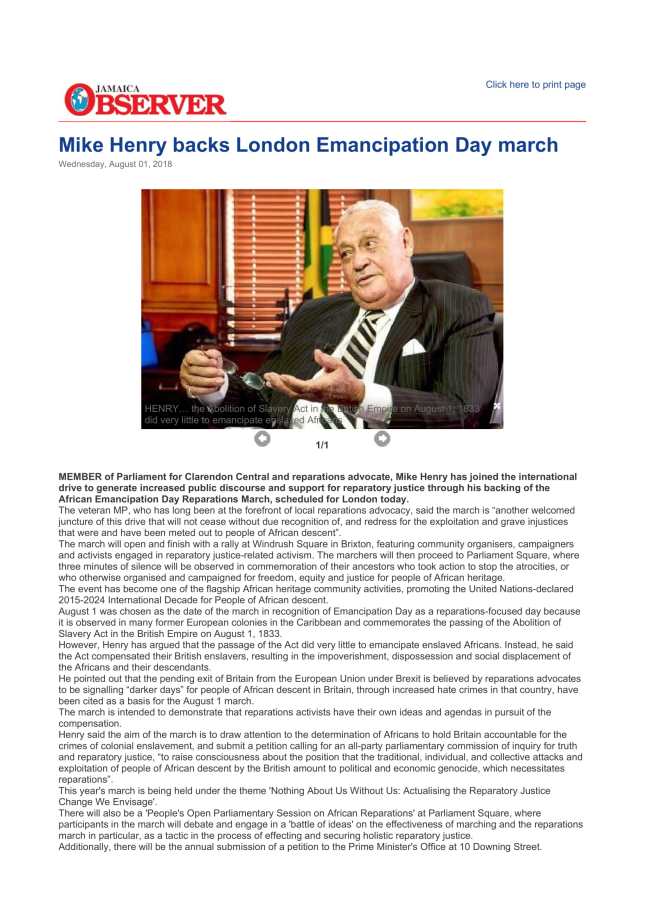
I also met with the Hon. Minister Mike Henry, MP, CD, Minister without Portfolio in the Office of the Prime Minister of Jamaica who spoke to me about the legal action he was pursuing against Queen Elizabeth II, as part of a reparations strategy, which is further explained in the newspaper articles section below.
I raised similar points made in the meeting with Minister Grange and members of the NCR, in particular, regarding:
The importance of those in the Caribbean linking with country diasporas and the wider Afrikan Diaspora in UK/Europe as well as paying greater attention to winning over those of European ancestry to be in solidarity with our cause of reparatory justice.
Us as state and non-state actors recognising differing strategy and tactics even when making legal and political challenges to the British State and seeking to have dialogue with each other and share information other about these different approaches so what we do does not conflict.
On behalf of the Afrikan Emancipation Day Reparations March Committee, I thanked Minister Henry for the solidarity message he gave for the 2018 Afrikan Emancipation Day Reparations March.
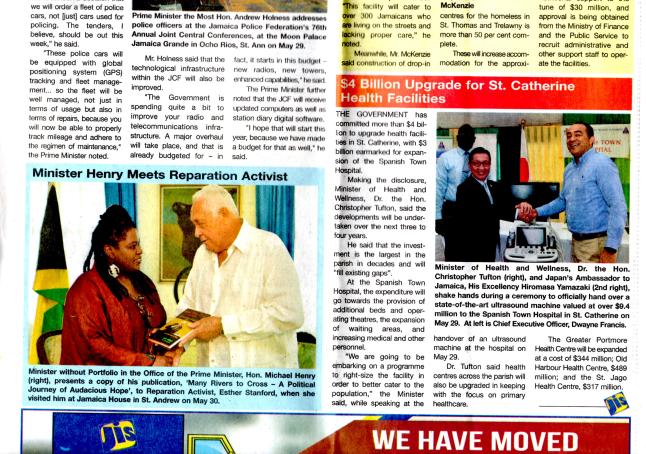
Minister Mike Henry made a special presentation to me of a copy of his book ‘Many Rivers To Cross: A Political Journey of Audacious Hope‘ (2013).
Pics courtesy of Steven Golding & Ras Ho-Shing.
This slideshow requires JavaScript.
Newspaper Articles
The following are the newspaper articles about my visit:
This article clipping is taken from section C10 of the Gleaner on Monday 3, June, 2019
Anonlineversion of the Jamaica Information Service appeared in the Jamaica Observer on Thursday 30 May, 2019
Meeting with Lord Anthony Gifford
Due to the fact that Anthony Gifford could not attend the meeting with Minister Grange and members of the NCR, he invited me to visit with him. I was accompanied by Steven Golding and I discussed the work being done here in the UK, particularly with reference to some of the new developments on the work being done by representatives of the UK ISMAR to broaden constituents of engagement and influence in relation to reparatory justice through working with Extinction Rebellion Internationalist Solidarity Network (XRISN) and The CEE The Truth CampaignClimate & Ecological Emergency Independents.
I explained that The CEE Independents have adopted reparations as part of the core demands and there was much scope for those in the Caribbean also doing more to link the struggle for reparatory justice to the growing consciousness of the necessity of reparations for climate and ecological breakdown. I reiterated the messages given at public lectures on the importance of those in the national councils and committees for reparations in the Caribbean recognising the importance of the country and wider Afrikan Diasporas living in Europe and secondly the importance of messaging which can also win hearts and minds of allies of European and other non-Afrikan ancestries in Europe. This is a Gleaner newspaper article which Lord Gifford wrote aspects of which he has subsequently notified me were influenced by some of our discussions.
Since returning to the UK, I shared info regarding a recent interview with music artist and write Gaika given by Leader of the UK Opposition, Jeremy Corbyn where he speaks about his support for reparations to former colonies to combat climate change with Steven Golding and Lord Gifford which in my view affirms the approach that we in PARCOE and the ‘Stop The Maangamizi!’ Campaign have long been championing in relation to ‘Planet Repairs’ and the importance of including reparations for climate and ecological destruction (ecocide) as part of the advocacy strategies coming out of Afrika and the Caribbean.
Visit to Pre-View Windush Murals
I visited Studio 174, a Kingston based Art Academy in downtown Kingston, to preview a series of murals being finalised as a mobile exhibit featuring a series of murals to honour the Windrush Generation; people from Jamaica and the Caribbean who left the region, beginning in 1948, on The Empire Windrush. This exhibit is part of the Paint Up Ya Creative Space Initiative of the Ministry of Culture, Gender, Entertainment & Sports in partnership with the British Council. Some of the discussions myself and Steven Golding had with the artistic director and artists was the possibility of such an exhibit of murals to come to the UK and possibly feature as part of the events leading up to the annual Afrikan Emancipation Day Reparations March.
Pics courtesy of Steven Golding
Media Interviews
I did the following interviews:
‘Rootsology’ show on Roots 96.1 FM,
‘Beyond the Headlines’ show on RJR 94 FM,
‘Talk Up Radio’ show on Nation-wide 90 FM
‘Sunrise’ show on CVM TV.
Unfortunately, although I contacted Pan-Afrikanist Activist-Journalist and host of the ‘Running African’ show on IRIE FM, Ka’Bu Ma’at Kheru ahead of the trip, with a view to meeting up during her visit, unfortunately I did not get to connect or speak with Ka’Bu on my trip. Ka’Bu was also the initiator of the ‘UofG Consult With Grass – Root Reparation Movements NOT Colonial Institutions!’ Petition on change.org (and also supported by the SMWeCGEC).
On the tentative schedule I received before my trip, it was planned that I was to do an interview on Thursday 30th May 2019 at 3pm on IRIE FM ‘Stepping Razor’ show with Mutabaruka and on Sunday 2nd June on IRIE FM at 7am on the ‘Running Africa Forum’ Radio with Ka’bu Ma’at Kheru. However, this changed with the updated schedule I received when I arrived in Jamaica. I was notified that Ka’bu had to travel urgently so had cancelled her show on 30th May.
Pics courtesy of Steven Golding.
Linking with Empress Esther of the EABIC ‘Bobo Shanti’
Through a link provided by Afrikan Emancipation Day Reparations March Committee, Co- Vice Chair, Prophet Jah B, I made contact with Empress Esther from the Ethiopia Africa Black International Congress (EABIC) on my visit. Although we did not get to meet in person, we did have discussions about the need for further outreach and connections with Rastafari community members and other Afrikan heritage communities in the Montego Bay Area who often do not get to go to Pan-Afrikan and Reparations focused events and activities in Kingston.
Courtesy Call on Permanent Secretary, Mr Denzil Thorpe
The last stop I made before leaving Jamaica, en route to the airport, was to return to the Ministry of Culture, Gender, Entertainment & Sport for a curtesy call on Mr Denzil Thorpe, Permanent Secretary for the Ministry. I was accompanied by my Steven Golding and Black X. Permanent Secretary Denzil Thorpe also made a special presentation to me of NCR memorabilia and we spoke about my visit to Jamaica.
Pics courtesy of Steven Golding & Marva Pringle-Ximminies
Greetings Supporters of the ‘Stop the Maangamizi: We Charge Genocide/Ecocide!’ Campaign (SMWeCGEC)
We in the SMWeCGEC wish to notify you of some exciting developments in our ability to build influence for achieving our cause as highlighted in the aims of the campaign.
SMWeCGEC co-initiator, Kofi Mawuli Klu has decided to champion programmatic aspects of the SMWeCGEC as part of standing as an independent candidate in the forthcoming European Parliamentary elections starting on 23rd May 2019. Kofi is one of nine climate and ecological emergency independent candidates who are collectively standing as part of the ‘CEE the Truth’ Campaign, (#CEEtheTruth).
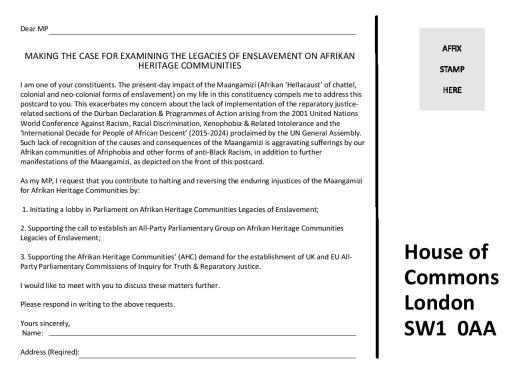
Although we in the SMWeCGEC have advocated multi-layered tactics in achieving our goals, which include lobbying of MPs via the ‘Stop The Maangamizi!’ Postcard Campaign, we cannot wait for people who are in mainstream political parties to act in support of our cause. They are too slow in doing so! Whereas the official British Government position is “we do not believe reparations are the answer”; the opposition Labour Party support reparations, but have their own agenda as to how they feel they can address the matter. Their agenda, which has been highlighted here disregards Afrikan Heritage Community agency in shaping what reparations programmes are in our own self-determined best interests and therefore it is questionable in whose interests such plans really are. In reality, it flies in the face of our often repeated principle, which has been highlighted during the Afrikan Emancipation Day Reparations Marches: ‘Nothing About Us Without Us!’. So just like the Ruling Party in the British Government, the official opposition and their representatives, are also refusing to have a dialogue with us in terms of taking to address the goals on the ‘Stop the Maangamizi!’ Postcard, hearing the voices of those of us who every year sign the ‘Stop The Maangamizi!’ Petition and mobilise as part of the wider SMWeCGEC, as well as those who participate in the annual Afrikan Emancipation Day Reparations March.
Rather, we in the SMWeCGEC take the view that we cannot rely on others to plead our cause; we must do that for ourselves! In this regard, the SMWeCGEC and the Global Afrikan People’s Parliament has taken steps to further adavance its policy position on electoral politics via the candidacy of Kofi Mawuli Klu as an Independent Climate & Ecological Emergency/Planet Repairs Candidate.
See here for more info about Kofi and other #CEEindependents.
The three core demands of the climate and ecological independents are:
1. The Council of Ministers and the European Parliament must tell the truth and take action to declare a Climate and Ecological Emergency.
2. The Declaration on a Climate and Ecological Emergency must demand a zero carbon Europe by a date no later than 2030.
3. National Citizens Assemblies on Climate & Ecological Justice must be instituted to oversee policy making, including those of Planet Repairs embracing Reparations, and have a leading role in shaping a zero carbon Europe.
Kofi takes into this #CEEtheTruth Campaign, all that represents the perspectives of the SMWeCGEC with emphasis upon Pan-Afrikan Reparations for Global Justice as advocated by the Pan-Afrikan Reparations Coalition in Europe (PARCOE), in its Planet Repairs meaningfulness. For us this is such an exciting campaign because it links the struggle for effecting and securing Pan-Afrikan Reparations for Global Justice with the struggle to end ecocide, hold accountable those responsible for perpetrating environmental crimes and harms and honour human, peoples and Mother Earth Rights by instituting Planet Repairs. This cosmic and holistic approach to reparatory justice (repairs) as highlighted by the Professor Chinweizu conceptual framework on reparations in addition to those ancient Afrikan approaches to repairing, renewing and transforming our World making it much more beautiful than what we found it, such as the Kemetan (ancient Egyptian) verb seruja ta
“Let me begin by noting that reparation is not just about money: it is not even mostly about money; in fact, money is not even one percent of what reparation is about. Reparation is mostly about making repairs. self-made repairs, on ourselves: mental repairs, psychological repairs, cultural repairs, organisational repairs, social repairs, institutional repairs, technological repairs, economic repairs, political repairs, educational repairs, repairs of every type that we need in order to recreate sustainable Black societies….More important than any monies to be received; more fundamental than any lands to be recovered, is the opportunity the reparations campaign offers us for the rehabilitation of Black people, by Black people, for Black people; opportunities for the rehabilitation of our minds, our material condition, our collective reputation, our cultures, our memories, our self-respect, our religious, our political traditions and our family institutions; but first and foremost for the rehabilitation of our minds”
Professor Chinweizi
It is the view of this campaign that in terms of cessation of the current manifestations of the Maangamizi including violations of genocide and ecocide as well as ensuring guarantees of non-repetition. Not only do we have to end genocide against us but we also have to work with other progressive non-Afrikan forces to stop ecocide and also draw them into taking responsibility for repairing Mother Earth, their nations and communities, in order to safeguard the rights of future generations. If not, any gains we make will not be sustainable as they will be undone by disrepaired members of the human family, including those among of us who have been so dehumanised by the Maangamizi that they are incapable of being the reparatory justice change we need to see.
Reparations are the totality of repairs that individuals and groups of people have to do for themselves and for the rest of their communities as well as humanity in order to make amends for the harm that has been done to them by historical and contemporary wrongs; which have so structurally affected them as to devalue their humanity. In this understanding, reparations are something that individuals and groups of people have to do for themselves, internally and externally and ensure that the wrongs done will not be repeated to themselves, the communities they belong to and the rest of humanity Kofi Mawuli Klu
Aims three and four of the SMWeCGEC are to:
• Mobilise petition signers/supporters to organise as a community of advocates for ‘Stopping the Maangamizi’ as a force within the International Social Movement for Afrikan Reparations, (ISMAR);
• Catalyse the development of such a force into an integral part of the Peoples Reparations International Movement (PRIM) to ‘Stop the Maangamizi’, build MAATUBUNTUMAN and establish UBUNTUDUNIA* as the most effective way to prevent its recurrence as well as effect and secure measures of reparatory justice from the ground-up;
Similarly, two of the seven political goals of a Pan-Afrikan reparations strategy that the SMWeCGEC adheres to include measures which:
• Restore Afrikan Sovereignty by redressing with MAATUBUNTUMANDLA (Pan-Afrikan Government of People’s Power) the disrepair in our Power and usher in a fundamental change of the existing world order that would definitively bring about new geopolitical realities such as MAATUBUNTUMAN; the anti-imperialist sovereign Pan-Afrikan Union of Communities/polity of Afrikan People’s Power.
• Institutionalise Maat and ubuntu in People to People internationalist solidarity relationship-building that will advance humanity to a Rendezvous of Victory where UBUNTUDUNIA emerges as a Global Justice ‘World of Many Worlds’ i.e. an equitable multipolar World of Pluriversality.
It is only through effecting and securing Pan-Afrikan Reparations for Global Justice that we will be able to ensure that the Maangamizi will not only be stopped but also not repeated.
This a message from Kofi:
Kofi’s political strategy is to help build the new alliance of progressive forces whose politics are rooted in Environmental Justice and all other related issues which marginalised communities, including his own minoritised Afrikan Heritage Communities in and beyond Europe, deem of importance to themselves; and about which no effective remedies have so far been implemented to their satisfaction.
This is a campaign which our Afrikan Heritage Communities and all other marginalised sections of the population in Europe, including migrants, denied their right to be legally present in this part of the world, where the wealth of their nations have been looted and continue to be plundered to enrich privileged groups, ought to see this as their opportunity to build a unifying power that can be flexed to give themselves Substantive Representation; and thereby enable them to effect their own solutions to the problems they are encountering. That is why Kofi’s campaigning is not about elevating himself as being the one who will provide the solutions, instead, he seeks to amplify the voices and actions of those already making efforts to find effective solutions to the problems they are encountering.
Some of our people talk about not engaging because the ‘reds’ (Labour) and ‘blues’ (Conservatives) are two wings of the same bird. Now, particularly for those living in London, there are alternatives. We now have a candidate standing as part of a collective who is pushing a reparations agenda, as per aim three of the core demands of the climate and ecological Independents. The point here is about amplifying voices and getting Afrikan Heritage Communities issues elevated in these spaces. This has not happened before with a genuine pan-Afrikan orientated candidacy not subservient to existing political party lines. We have several MPs and Councillors that look like us but it’s highly questionable as to their efforts to bat for us. Why? They did not stand on any kind of Black, Afrikan or Pan-Afrikan platform and they are not accountable to our Afrikan Heritage Communities. Some think because we looked alike that they represented US. Not so! And they never said they were standing for US. They are firstly accountable to their party and their constituency. Kofi Mawuli Klu has no such constraints. So, if you are in London check out what he is saying and the refreshing approach to electoral politics he is taking.
Until such time please familiarise yourself with the Global Afrikan People’s Parliament Policy Positions and learn more about the principles Kofi is standing for. It’s a start, not the sum total of our political strategies and quests for National Self-Determination. Seeds are being sown. In other places shoots are being watered. This is a process. Be patient and take action.
If you would like to contact Kofi on 07956431498 or email kofi.planetrepairs@gmail.com
The theme of the meeting was ‘Legacies of Enslavement and Resistance For Rebellion Today‘. It was co-chaired by Robin Boardman from XR Bristol and Jendayi Serwah, Co-Vice Chair, SMWeCGEC who introduced the meeting and the interconnections between XR Bristol, SMWeCGEC and ACC. Kofi Mawuli Klu, a Pan-Afrikanist political activist and SMWeCGEC Co-Vice Chair spoke on ‘Lessons from Abolitionist Resistance for Stopping the Maangamizi Today By the Necessary Reparatory Justice Means of Extinction Rebellion’.
In his message, Kofi explored the legacies of the history of Afrikan & Abolitionist resistance to the Maangamizi (Afrikan Hellacaust) which can be drawn on in building solidarities with the Extinction Rebellion Movement today in tackling common goals of stopping ecocide, genocide and repairing the World.
There were participatory workshop discussions which followed the presentation.
The following was a video taken by Extinction Rebellion Bristol of the introductory messages from Robin, Jendayi as well as Kofi’s speech.
Pictures from the event, courtesy of Extinction Rebellion Bristol & Afrikan Connexions Consortium
Greetings Signatories of the ‘Stop the Maangamizi!’ Petition and other Supporters of the ‘Stop the Maangamizi!: We Charge Genocide/Ecocide Campaign (SMWeCGEC)
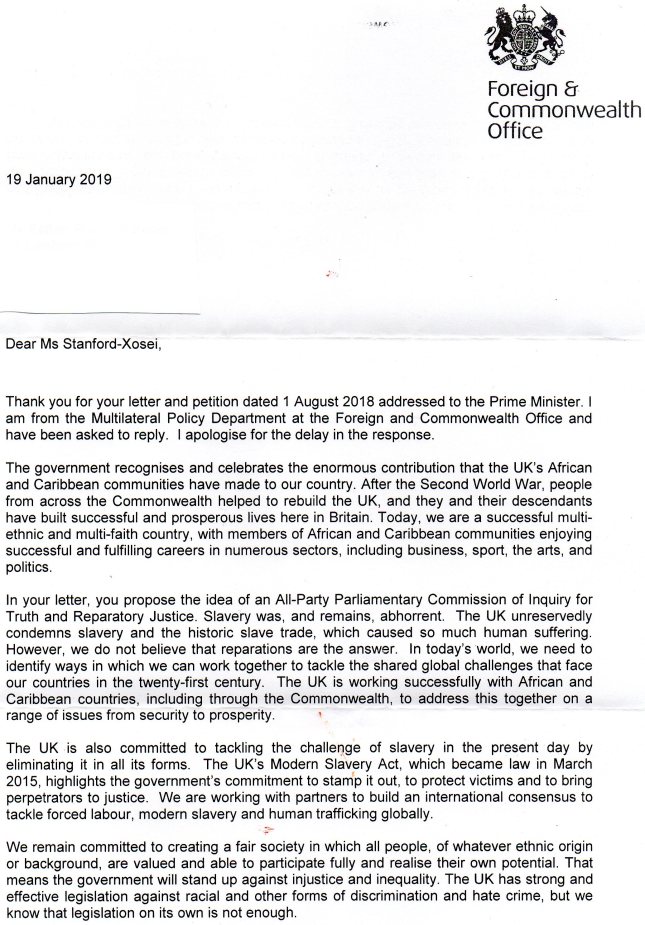
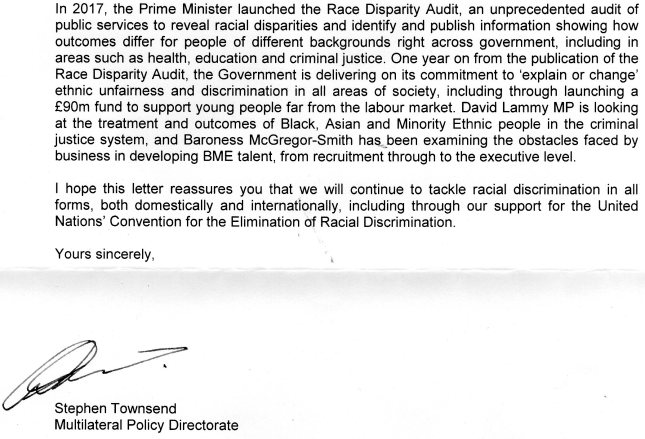
After sending two letters to the UK Prime Minister Theresa May, requesting a response to the 2018 ‘Stop the Maangamizi!’ Petition and its accompanying letter (which was handed in to the Office of the Prime Minister at 10 Downing Street on 1st August 2018), the letter below is a scanned copy of the response that we received.
The letter from Stephen Townsend in the Multilateral Policy Directorate of the Foreign & Commonwealth Office, dated 19th January 2019, was received by post today. You can find a scanned copy below.
Clearly, more needs to be done on our part, as community members, campaign supporters and advocates as well as other interested parties to ‘up the ante’, so that we do not keep getting such unsatisfactory cut and paste responses. We are reminded by the late Frederick Douglass that: “the limits of tyrants are prescribed by the endurance of those whom they oppress.”
Your constructive suggestions as to what can be done are welcome. Please contact us by emailing stopthemaangamizi@gmail.com or call/message us on 07956431498.
Until next time!
‘Stop the Maangamizi: We Charge Genocide/Ecocide! Campaign International Steering Committee Spearhead Team (ISC-SMWeCGEC)
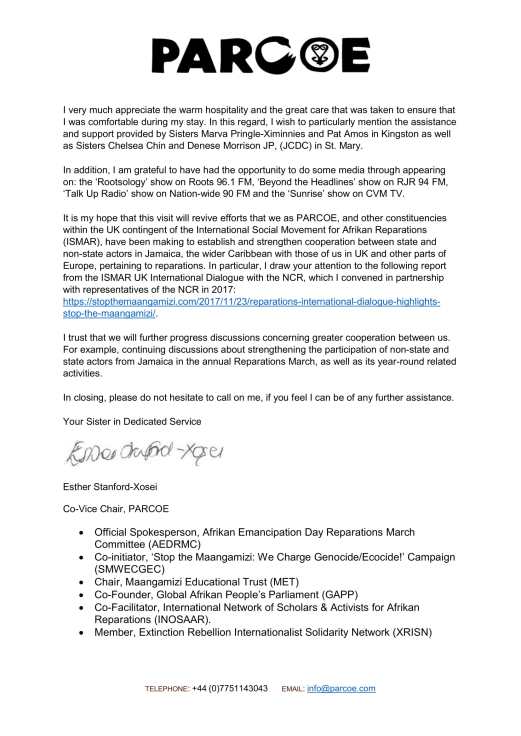
Please note, Esther Stanford-Xosei’s address has been redacted
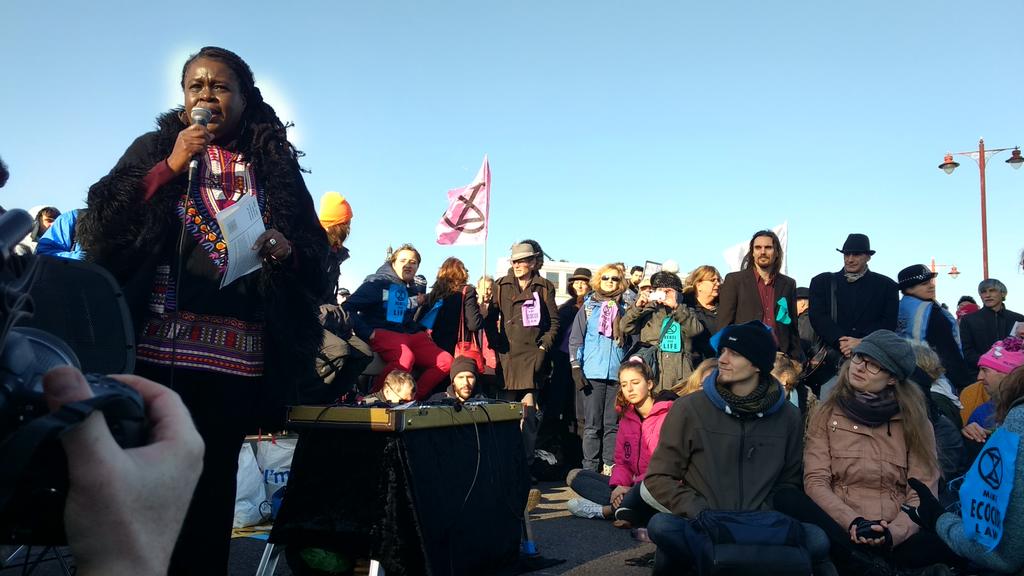
I spoke as an activist in the International Social Movement for Afrikan Reparations, in general and a representative of the ‘Stop the Maangamizi: We Charge Genocide/Ecocide!’ Campaign (SMWeCGEC) which takes a special interest in the connections between the Maangamizi (the Afrikan Hellacaust), the global Afrikan reparations claim arising from it, and a host of contemporary injustices that not only we as Afrikans, but also the rest of humanity faces and which endanger our very existence. That is the possibility of human and other species extinction.
Extinction is an expression of structural violence against Indigenous peoples and their relations, and colonial violence in particular; involving systemic forms of harm, exclusion and discrimination, each of which is ecologically devastating. So how does extinction apply to us as Afrikan Heritage Communities?; well, for over 500 years, the entre Maangamizi, in all its phases, rooted in the Transatlantic Traffic in Enslaved Afrikans (TTEA), enslavement and colonialism, has been and still is geared towards the extinction of Afrikan people. These forms of colonial and structural violence not only involved mass killing, but also the invasion, occupation, settlement and despoliation of our Motherland, Afrika; uprooting and disordering Afrikan communities, trafficking millions of Afrikans into Abya Yala (the so-called Americas) which had genocidal and ecocidal outcomes; destroyed millions of lives over generations and changed the socio-economic fabric of existing societies in Afrika, Abya Yala and the Caribbean. For those that remained, this led to enduring injustice with intergenerational and epigenetic effects. For instance, undermining our own Afrikan modes of governance and kinship systems and in the process systematically destroying relationships between life forms in addition to epistemicide/s or the erasure of knowledges. Such forms of violence weakened the co-constitutive relationships between Afrikan Heritage communities, other life forms and ecosystems that have enabled our collective survival in harmony with nature for millennia.
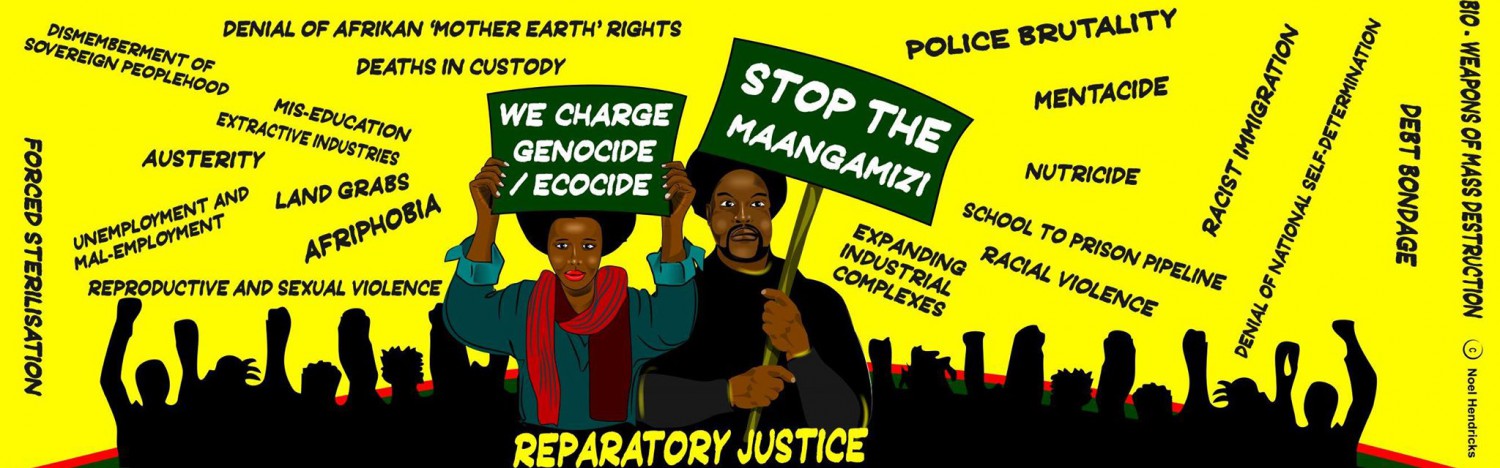
An aspect of genocide is “Deliberately inflicting on the group conditions of life calculated to bring about its physical destruction in whole or in part.” Various aspects of these harms are epitomised in the twelve manifestations of ecocide and genocide highlighted in the ‘Stop the Maangamizi!’ Petition, a grassroots tool of the SMWeCGEC, working towards genocide and ecocide prevention by mobilising people as part of the People’s Reparations International Movement (PRIM) and the ISMAR to stop various manifestations of the Maangamizi. The third manifestation of the Maangamizi contained in the petition is: denial of Black and Afrikan ‘Mother Earth’ (Nana Asase Yaa), human and peoples’ rights to national self-determination as an oppressed People. In the petition, various other ‘power disparities’ and inhumane public policies and practices are identified which have genocidal outcomes and continue to cause devastation to Afrikan Heritage Communities within and beyond the UK. Such policies and practices have resulted in the decimation of generation after generation of people of Afrikan heritage due to ecocidally induced physical and cultural genocide, the destruction of ecological and social life-systems as well as natural flora and fauna. Not to mention the perpetration of a myriad of other environmental crimes such as wildlife crimes, illegal logging, illegal fishing, illegal waste disposal and pollution, illegal traffic of ozone-depleting substances and illegal mining.
Some of the genocidal outcomes for Afrikan Heritage Communities include:
• Physical, biological, economic, cultural genocide
• Social and civil death of Afrikan People.
• Ecocide of our environment.
However, the life-destroying pollution of our planet, anti-Black racism, its specific form of Afriphobia and the impoverishment of whom Frantz Fanon referred to as the ‘Wretched of the Earth’, all arguably have their causes in the current unjust world system. Many scholar-activists have helped us to understand that the current world system is rooted in and has been established through the Transatlantic enslavement of Afrikans. We as an Afrikan-led Reparatory Justice campaign are therefore working as an affinity group and campaign which is building solidarities with the Extinction Rebellion Movement on the basis of the commonality of interest we share in rebelling against ecocide and ensuring accountability for environmental crimes. In addition to the fact that our campaign itself is a form of ‘rebellion against extinction.’ – In that it is safeguarding Afrikan people’s role as custodians of humanity’s futures; which focuses on the racialised and other intersectional destruction/s of genocide and ecocide as deliberately inflicted forms of colonial, imperialist violence against Afrikans, indigenous peoples and Mother Earth, in furtherance of advancing holistic reparatory justice. This is something which PARCOE, the reparations coalition I am part, of refers to as Pan-Afrikan Reparations for Global Justice. In this regard, the SMWeCGEC has been heavily influenced by PARCOE’s approach or (‘overstanding’) of the problem of climate change from a Pan-Afrikan internationalist perspective; therefore seeing the climate emergency as the result of the criminal imposition – by the ruling classes of Europe – of a rapacious system expropriating the resources of the globe, not only at the expense of the majority of Humanity, but also to the detriment of our Mother Earth.
Our strapline in the ‘Stop the Maangamizi!’ Campaign is ‘stopping the harm – the first step to repairing the damage’. By repairing the damage we are referring to reparations or as we prefer to say, Reparatory Justice. We see this as the beginning of the solution to reversing centuries of super-exploitation and extractivism and ending the ‘climate emergency’ and its corollary ‘human and peoples rights emergency’. Enforced access to much of the world’s natural capital – oil, gas, timber, minerals which lies on or beneath lands occupied by Afrikan, indigenous and Aboriginal peoples often entails land evictions, displacements, forced relocations, arrests, abuses and killings and other violations. For us as people of Afrikan heritage, reparations cannot simply be limited to financial compensation alone due to the nature of the damage and existential threat that we are facing. Comprehensive and adequate reparations require the removal of structures built on centuries of war crimes, crimes against humanity, genocide and crimes of aggression, in the forms of enslavement, colonialism and neo-colonialism or what we refer to as the Maangamizi.
Reparations must entail the cessation of current violations, such as environmental crimes in particular, and guarantees of non-repetition including true decolonisation and the restitution of sovereignty for Afrikan, Aboriginal and other indigenous peoples globally. For sovereignty, as conceptualised by Afrikan and indigenous peoples, is indispensable to halting the destruction of Nana Asase Yaa (Mother Earth) as our home; which has been caused by the structurally violent European initiated cultural, political, socio-economic system known as capitalism that is rooted in the genocide of indigenous and Afrikan peoples, chattel enslavement and the dispossession of ancestral lands, territories and natural resources.
Afrikans, Aboriginal and indigenous peoples have always known that the processes of genocide and ecocide are inseparable, for what has happened to our people and the lands on which we live are interconnected. In the Pan-Afrikan perspective of the ‘Stop the Maangamizi!’ Campaign this warrants an ‘overstanding’ that in stopping the harms of ecocide and genocide, we not only have to emancipate and save ourselves, but this process of stopping the harm and repairing the damage must also result in the repair of humanity and the cosmos. Since we as Afrikan people, who in the words of Audre Lorde, “were never meant to survive,” see that we have unique insights into what it means to be in stewardship of this World, Planet and Cosmos.
Accordingly, one of the seven goals of Pan-Afrikan Reparations for Global Justice is to “Enforce environmental elements of global justice full respect for Mother Earth/ Nana Asase Yaa rights.” However, we know that we cannot accomplish even our own self-determined goals for Reparatory Justice fully without working with others who are seeking to achieve similar goals of revolutionary social change and transformation. As the Afrikan freedom fighter Samora Machel said: “International solidarity is not an act of charity: it is an act of unity between allies fighting on different terrains toward the same objectives. The foremost of these objectives is to assist in the development of humanity to the highest level possible.”
Samora Machel
But how do we repair the loss of a future?
We have to destroy the peace of those who are too comfortable to change in order to rebuild!
By all means, we must escalate the rebellion by building alternative futures.
I close with some words of wisdom from the Calypsonian Baron’s ‘Mother Earth is Dying’.
Today the things we nurture could determine the future And pray what would the picture be See grandson and granddaughter fighting, chaos and disaster As Mother Earth protest violently Wake up, wake up people and be part of the struggle! The planet earth in serious trouble We got to end this melancholy refrain We cannot afford to lose Paradise again That’s why I’m pleading.
Mother Earth is crying, she say to stop the polluting… Mother Earth is Dying, we got to stop the polluting… Whole attitude got to change, and priorities rearrange We got to become more competent The way we protect the environment And fight, fight for all that it’s worth Fight to save Mother Earth… Mother Earth crying… In case you don’t know, the planet Earth dying slow What a sad way to go.
Thank you!
Esther Stanford-Xosei, Coordinator-General, ‘Stop the Maangamizi: We Charge Genocide/Ecocide!’ Campaign (SMWeCGEC)



























 stopthemaangamizi.com
