Do you want to take action to get redress for the Maangamizi (Afrikan ‘Hellacaust’ of chattel, colonial and neo-colonial forms of enslavement) as it affects you, your family and community?
Here is an example of how you can do so; see the revised ‘Stop the Maangamizi!’ postcard template, which we urge you to send to your MP, you can find out details about your MP here.
The postcard is one tool aimed at enabling you to better lobby and engage with establishment decision-makers about including Maangamizi impact issues as they affect you, your family and community in the constituency representational work and local, national and international policy-making they prioritise.
Please keep us updated about any progress you make as we are beginning to map which MPs are responding positively to the campaign aims.
Stop the Maangamizi: We Charge Genocide/Ecocide! Campaign (SMWeCGEC) Spearhead Team
Since originally posting these comments under the video on 14th December 2016, when the youtube link was checked yesterday 15th December 2016, the comments mysteriously became unavailable despite them being viewable for some hours when the comments were initially posted. The original comments are now available again for viewing under the you tube video. This video has been shared on many social media platforms. Since the video is publicly accessible and has been widely circulated, so must this public response be made available too.
Having watched this video, it would have been better if the recording of the whole discussion on the 1st August Afrikan Emancipation Day Reparations March was posted to get a full sense of what the discussion was that proceeded the interventions from Glenroy Watson in the Q & A session (from 20 mins of the recording) in relation to the Afrikan Emancipation Day Reparations March specifically. These comments I am making are therefore in response to the discussion in the above video pertaining to the 1st Mosiah (August) Afrikan Emancipation Day Reparations March. This video recording is available for the public to view and has been circulated across many social media platforms.
It is important for viewers to know that the organising of the Reparations March is part of a broader strategy that has legal, extra-legal, parliamentary, extra-parliamentary as well as community organising and mobilisation dimensions. Whilst critical discussion, dialogue and debate about the efficacy of specific strategy and tactics is part of the battle of ideas in arriving at the best way forward, I am somewhat concerned by the inadvertent impression that the conversation pertaining to the March by the speakers in the above recording cultivates. Viewers could be left with the limiting and incorrect impression that grassroots activists and leading organisers involved in developing and implementing reparations strategy and tactics pertaining to the March and its related activities, are not thinkers or strategists; lack the intelligence and cognitive wherewithal to be strategic, develop critical conceptual tools on the best methodologies for effecting and securing reparatory justice social change or fashion imaginative policies regarding implementation of what they are organising to achieve; or indeed that they are not engaged in their own creative processes of activist learning, knowledge co-production, research, critical debate and discussion or even aware of the strengths and limitations of the tactics they embark upon at particular points in our reparations-movement-building processes. Furthermore viewers are denied proper analysis of the context of ordinary people’s leadership and for a significant number, their involvement in the March organising and mobilising processes being interpreted as forms of ‘direct action from below’ that stem from the active resistance and opposition of ordinary people to the continuing impact of the Maangamiziin their lives.
A further impression may also be created that the best way forward is for some elite group of ‘professionalised’ civil society experts or lobbyists who are unaccountable to Afrikan Heritage Communities, our specific Communities of Reparatory Justice Interest and our autonomous community organisations and institutions, are the ones who should be speaking, representing and negotiating for everyone else in terms of lobbying and other similar tactics etc. Furthermore, that what is required and more likely to be ‘successful’ is a more watered down, ‘liberal’ set of visions, demands and declarations Indeed, such assumptions, perspectives and views reveals some of the often obfuscated national and class politics, interests and struggles within the International Social Movement for Afrikan Reparations (ISMAR). In addition, such assumptions, perspectives and views are in danger of reinforcing the notion that ordinary people are powerless, lack agency should just be spectators in the contemporary process of emancipation from the modern-day Maangamizi, which is part of the means by which power to Afrikan people will be restored making it more likely that reparatory justice can be effected and secured.
The Afrikan Emancipation Day Reparations March is not just a March, it is organised as an action-learning participatory March where Afrikan Heritage Communities led from the ground-up, collectively learn how to better fight injustice and unjust systems of power as well as build on the powerful insights they gain about structures and systems of power oppression and exploitation and how to build counter-power to help advance reparations social movement-building with various constituencies within the Afrikan Heritage Communities in general and specific Communities of Reparatory Justice Interest. For many, it is in the processes of marching and engaging in allied programmes and activities of the March, including through its partnership with the ‘Stop the Maangamizi: We Charge Genocide/Ecocide’ Campaign (SMWeCGE), that participants co-facilitators and organisers enhance their ability to think, act, theorize and imagine “outside of the box”. Priority is given to mobilising Afrikans people’s individual and collective agency and ‘power to’ effect and secure reparatory justice through community organising, reparations social movement-building and alternative institution-building. Social movement-building is the long-term, coordinated effort of individuals and organised groups of people to intentionally spark and sustain a (reparations) social movement from the ground-up. Part of which is by sustaining the March and other organizing processes that build collective power by organizing constituencies of Afrikan Heritage Communities and our Communities of Reparatory Justice Interest, to build a change agenda and engage in joint actions to access and implementour human, peoples and Mother Earth rights, entitlements and responsibilities, challenge and change ideologies of injustice and social inequity and seek to transform social power relations in our people’s favour. It entails: “the creation of movement infrastructures required for sustained organising and mobilisation, including social relationships, organisational networks and capacity, affective solidarity, as well as movement-related identities, frames, strategies, skills, and leadership.”
It is publicly known, and well known to Glenroy Watson, that the March has never been just about marching for a day. In the first year (2014) the Reparations March was also a vehicle for delivery of a reparations petition and in the second (2015) and third years (2016) of the annual March the ‘Stop the Maangamizi’ Petition got handed in to number 10 Downing Street, Office of the UK Prime Minister as part of the programme of activities of the March.
The Afrikan Emancipation Day Reparations March Committee (AEDRMC,) which Glenroy Watson knows facilitates the organising and mobilizational processes towards the annual Reparations March, are well aware that Parliament is closed on the 1st August. The 1st of August was originally chosen in the first year of the March as the day of the March because it is the officially commemorated “Emancipation Day”, marking the passing of the Slavery Abolition Act in the British Empire, on 1st August 1833. Furthermore, the significance of 1st August 1833 is that it is the date that after all the years of resistance by chattelised Afrikans, torn away from the Motherland, Britain and its fellow European enslaver-nations of Afrikan people were compelled to recognise that they could no longer continue to enslave us without severe consequences. It therefore represents a symbolic day highlighting Afrikan people’s refusal to accept enslavement, in every manner, including its present-day manifestations.
In addition, it was determined that we as Afrikans and people of Afrikan heritage should March in protest at the fact that it was in the passing of the above piece of legislation; one of the most unjust passed in the recent history of Afrikan people’s resistance to the Maangamizi. Please note the full title of the act: ‘Act for the Abolition of Slavery throughout the British Colonies; for promoting the Industry of the manumitted Slaves; and for compensating the Persons hitherto entitled to the Services of such Slaves commencing on 1st August 1834’.In this act, the British Parliament legislated that enslaved Afrikans in the Caribbean would be forced to pay more than 50% of the cost of their own so-called emancipation. In 1833 the British Parliament determined that the 800,000 enslaved Afrikans in the Caribbean were deemed to be chattel and to have a market value of £47 million. This same Parliament provided the sum of £20 million in grants to our people’s enslavers which was deemed to be fair compensation to them for the loss of their so-called human chattel. This same British Parliament determined that the remaining £27 million would be paid by the enslaved people to their enslavers, by means of a 4-6 year period of unjustly extorted free labour known as ‘Apprenticeship’. It was expected that all people over six years would work for 60 hours per week as apprentices to their so-called former enslavers, 45 hours of which were extorted by their enslavers.
This recording quite graciously includes the flyer with the aims of the Reparations March and any basic comprehension of the March aims makes it clear that the aims are not expected to be realised by simply marching for one day. The aims also include recognition and a profiling of Afrikan people’s varied demands, programmes and initiatives for securing reparatory justice in recognition of the diversity of strategy and tactics being deployed by various constituencies within the ISMAR. This is why the Afrikan Emancipation Day Reparations March Committee adopted 9 blocs (i.e. Ancestors, Global Afrikan Family, Community, Repatriation, Interfaith, Artists, Trade Unionists, Students, Non-Afrikan Allies) as part of the mobilising process towards the annual Reparations March and to carry on the process of contributing to and strengthening reparations social movement-building, community, mobilising and organising after and between Marches.
See here for more info about the organising blocs of the March:
Since the 2016 1st August March the Afrikan Emancipation Day Reparations March Committee has held two public evaluation meetings which have provided information on the strategy that the Afrikan Emancipation Day Reparations March Committee are working to. For your information, the Co-Chairperson of GACuk, Abu Akil was in attendance at the last public evaluation meeting on 20th November 2016, where a hard copy of the following progress report was handed-out to all present:
In addition, a copy of the following form on how people could get involved with and contribute to the various mobilisation and organising processes of the March, (which is available on the Afrikan Emancipation Day Reparations March websitewww.reparationsmarch.org ), was also handed out at the same public evaluation meeting:
It would not be unreasonable to expect that Glenroy Watson, (GACuk Secretary) would have also been aware of this information at the time this video was filmed on 28th November 2016 as he does mention not being at the “last evaluation meeting” (at 20 mins 30 of the recording).
To clarify, the aims of the March are as follows:
To draw attention to Afrikan peoples’ global determination to not let the British State and other perpetrators get away with the crimes of the Maangamizi (Afrikan hellacaust and continuum of chattel, colonial and neo-colonial enslavement);
To hand in the Stop the Maangamizi: We Charge Genocide/Ecocide petition calling for an All-Party Commission of Inquiry for Truth & Reparatory Justice in order to raise consciousness about the fact that all the attacks on us, in both individual and collective instances, amount to Genocide/Ecocide in Maangamizi continuity, necessitating reparations;
To increase awareness of the necessity to ‘Stop the Maangamizi’ and its current manifestations such as austerity, attempts to recolonise Afrika, mentacide and deaths in police, psychiatric and prison custody;
To demonstrate Afrikan peoples’ strength, capacity and determination to speak truth to, and challenge establishment power, with our growing grassroots power to effect and secure reparatory justice on our own terms;
To highlight Afrikan people’s grassroots demands and initiatives for effecting and securing reparations.
Please note for historical accuracy, one of the very public priorities of the March that the Afrikan Emancipation Day Reparations March Committee is working to is utilising theMarch to hand-in the’ Stop the Maangamizi: We Charge Genocide/Ecocide’ (SMWeCGE) Petition in partnership with the ‘Stop the Maangamizi’ Campaign. The SMWeCGE Petition is one of the campaigning tools of the International Social Movement for Afrikan Reparations (ISMAR) for mobilising Afrikan people’s power to exert upon the British Houses of Parliament and the European Parliament towards establishing All-Party Commissions of Inquiry for Truth & Reparatory Justice (APPCITARJs) and other actions necessary to advance the process of dialogue from the ground-upwards, with the British and other European states and society on the ‘how’ of securing Reparatory Justice. Accordingly, the annual Reparations March accompanies strategic lobbying to establish APPCITARJs at the levels of the UK and European Parliaments with various other endeavours taking place in between in different European countries. Such a goal is part of a demand being made on the British and European states to honour the need and right of the descendants of the Afrikan enslaved to speak in a public forum, provide testimony and evidence of how the legacies of enslavement are resulting in continued human and peoples’ rights violations, impaired quality of life and the ensuing destruction of the essential foundations of life for Afrikan people today.
By way of emphasis, please note the SMWeCGE Petition is delivered as part of the multiple programme of activities of the March which takes place all-year round. Such information was omitted from the commentary posted on the Reparations March, if indeed it was mentioned at all by anyone who contributed to the discussion in the above video.
The 2016 Afrikan Emancipation Day Reparations March saw the introduction of the POPSAR (People’s Open Parliamentary Session on Afrikan Reparations) which took place at Parliament Square, (opposite the British Houses of Parliament), developed in association with the SMWeCGE Campaign:
The POPSAR is a mass conscientisational forum for public debate and discourse on Afrikan Reparations as a matter of critical social importance. The purpose of the POPSAR is to engage participants and public audiences in action-learning on participatory democratic parliamentary debate on critical issues such as Afrikan Reparatory Justice. Each year a different reparations related motion will be debated and people are encouraged to engage in practical rehearsals in preparation for the annual POPSAR on 1st August which takes place as part of the programme for the Afrikan Emancipation Day Reparations March. So yes, the British Houses of Parliament are closed, but our people hold our own ‘People’s Open Parliamentary Session’ on this date as part of our demonstration of “Afrikan peoples’ strength, capacity and determination to speak truth to, and challenge establishment power, with our growing grassroots power to effect and secure reparatory justice on our own terms!“
Please read the following to find out a progress report on the activities of the March in association with the SMWeCGE Campaign and other partnerships.
‘Our collective reparations work is about much more than marching for one day!!!’ (Published in November 2016)
Please also see the lobbying tool of the SMWeCGE Campaign which is supported by the Afrikan Emancipation Day Reparations March Committee and is handed out publicly as part of the outreach being led by the Grassroots Reparations Education & Outreach Teams (GREOTs) in London and Bristol which do public mobilisation and organising work all year-round.
Teams being action-learning exemplars of the dictum ‘Education is Preparation for Reparations’ by becoming advocates for the cause of ‘Stopping the Maangamizi’ as part of the process effecting and securing Reparatory Justice;
Teams promoting the role of the Afrikan Emancipation Day Reparations March as part of the ‘street column’ of the International Social Movement for Afrikan Reparations (ISMAR).
Teams being the first point of contact in the education and mobilisation of Afrikan people and the general public in relation to the March – it’s aims and intended outcomes.
Teams providing the general public with information about the ‘Stop the Maangamizi Campaign (SMWeCGE), its petition, the SMWeCGE Postcard’ and the annual March, (in addition to its associated events), which takes place on 1st Mosiah (August), which is also known as Maangamizi Awareness Month. Part of the purpose of the GREOTs include: 1. Teams being action-learning exemplars of the dictum ‘Education is Preparation for Reparations’ by becoming advocates for the cause of ‘Stopping the Maangamizi’ as part of the process effecting and securing Reparatory Justice.
A thorough reading, digestion and overstanding of the information contained in the above documentation will demonstrate that the March is more than a one day event and most certainly does not stand alone!!!
To get a fuller perspective of the contributions being made by the March, its related activities and those of the SMWeCGE Campaign, to reparations social movement-building, it would be useful to compare and contrast these initiatives of the UK contingent of the ISMAR with other reparations related actions taking place within the UK and other countries with Afrikan Diaspora populations.
It is unfortunate that no one from the Afrikan Emancipation Day Reparations March Committee, or its campaigning partner, the SMWeCGE Campaign, were invited to provide information or clarification or even answer to the critiques of the March. Such a biased discussion, being publicly circulated pertaining to the Reparations March could reasonably lead to the conclusion that there is an attempt to deny the Black/ Afrikan ‘Radical Imagination’, rationale, collective thought-processes and praxis of those engaging in tangible reparatory justice activism as part of ISMAR-building in the UK from the ground-up. People who say they are for reparations should also practice Reparatory Justice Ethics (RJE). The conversation started by Professor Maulana Karenga on reparations ethics is something we should all pay serious attention to and help develop in order to know how best to deal with each and with the issues involved in ISMAR-building.
Please see Karenga’s article on the ‘Ethics of Reparations: Engaging the Holocaust of Enslavement’ here:
The PARCOE article: ‘On Matters of Integrity, Ethics and Representation Within the International Social Movement for Afrikan Reparations’ is also relevant –
We must all endeavour to be seen to be doing true justice to our sacred cause of Afrikan reparatory justice.
In Service & Struggle
Esther Stanford-Xosei
Official Spokesperson, Afrikan Emancipation Day Reparations March Committee (AEDRMC)
Coordinator-General, ‘Stop the Maangamizi: We Charge Genocide/Ecocide!’ Campaign (SMWeCGE)
16/12/16
“Progressive social movements do not simply produce statistics and narratives of oppression; rather, the best ones do what great poetry always does: transport us to another place, compel us to relive horrors and, more importantly, enable us to imagine a new society. We must remember that the conditions and the very existence of social movements enable participants to imagine something different, to realize that things need not always be this way. It is that imagination, that effort to see the future in the present, that I shall call “poetry” or “poetic knowledge.” I take my lead from Aimé Césaire’s great essay “Poetry and Knowledge,” first published in 1945. Opening with the simple but provocative proposition that “Poetic knowledge is born in the great silence ofscientific knowledge,” he then demonstrates why poetry is the only way to achieve the kind of knowledge we need to move beyond the world’s crises. “What presides over the poem,” he writes, is not the most lucid intelligence, the sharpest sensibility or the subtlest feelings, but experience as a whole.” This means everything, every history, every future, every dream, every life formfrom plant to animal, every creative impulse—plumbed from the depths of the unconscious. Poetry, therefore, is not what we simply recognize as the formal “poem,” but a revolt: a scream in the night, an emancipation of language and old ways of thinking…”
Robin D.G. Kelly, ‘Freedom’s Dreams: The Black Radical Imagination’, (Boston: Beacon Press, 2002), pp.9-10)
“What are today’s young activists dreaming about? We know what they are fighting against, but what are they fighting for?… the most powerful, visionary dreams of a new society don’t come from little think tanks of smart people or out of the atomized, individualistic world of consumer capitalism where raging against the status quo is simply the hip thing to do. Revolutionary dreams erupt out of political engagement.”
Robin D.G. Kelly, ‘Freedom’s Dreams: The Black Radical Imagination’, p8
“Unfortunately, too often our standards for evaluating social movements pivot around whether or not they “succeeded” in realizing their visions rather than on the merits or power of the visions themselves. By such a measure, virtually every radical movement failed because the basic power relations they sought to change remain pretty much intact. And yet it is precisely these alternative visions and dreams that inspire new generations to continue to struggle for change.”
Robin D.G. Kelly, ‘Freedom’s Dreams: The Black Radical Imagination’, Preface
This is the covering letter delivered to the Office of the UK Prime Minister, Rt Hon Theresa May, MP on 1st August 2016 as part of implementation of the aims of the Afrikan Emancipation Day Reparations March:
This is the initial response received from the Correspondence Office at No 10 Downing Street dated 2nd August 2016.
Please note that the text concealed on the top left hand corner of the letter of acknowledgement is the home address of SMWeCGE Coordinator-General, Esther Stanford-Xosei. When one submits an application to hand in a petition via the Downing Street Liaison Office, one is required to also include a return address for receipt of acknowledgement, as per the requirements of Form 2103- Petition to Downing Street.
The 2016 Afrikan Emancipation Day Reparations March saw the introduction of the POPSAR (People’s Open Parliamentary Session on Afrikan Reparations) in association with the Stop the Maangamizi: We Charge Genocide/Ecocide (SMWeCGE) Campaign.
The POPSAR is a mass conscientisational forum for public debate and discourse on Afrikan Reparations as a matter of critical social importance.
The purpose of the POPSAR is to engage speakers and audiences in action-learning on participatory democratic parliamentary debate on critical issues such as Afrikan Reparatory Justice.
Each year a different but reparations related motion will be debated and people are encouraged to engage in practical rehearsals in preparation for the annual POPSAR on 1st August which takes place as part of the programme for the Afrikan Emancipation Day Reparations March.
In between Marches, members of the public are invited to rehearse arguments for reparations and to also find ways of countering the opposing arguments. The theme for the 2017 POPSAR will be announced by October 2016.
See the following videos for some snippets of the speeches made at the POPSAR.
Please note such productions were produced independent of the Afrikan Emancipation Day Reparations March Committee (AEDRMC).
The Afrikan Emancipation Day Reparations March, as the street column of the International Social Movement for Afrikan Reparations (ISMAR) is a vehicle for mass mobilisation and education as part of our self-repair and people’s power-building process. It is also a conduit as part of an on-going parliamentary and extra-parliamentary strategy, hence the delivery of the ‘Stop the Maangamizi: We Charge Genocide/Ecocide‘ (SMWeCGE) Petition charging the British State with the crimes of Genocide and Ecocide and demanding an end to their role in the continuing Maangamizi. The Afrikan Emancipation Day Reparations March Committee (AEDRMC), in association with the SMWeCGE Campaign, will continue the year long process of march planning, mobilisation and organisation alongside its ‘Education is Part of the Preparation for Reparations‘ programmes in preparedness for the establishment of All-Party Parliamentary (People’s) Commissions of Inquiry for Truth and Reparatory Justice (APPCITARJs), also contained within the SMWeCGE Petition.
You are encouraged to continue to mobilising and self-organising. The March is NOT the entire Reparations Movement so YOU need to develop complimentary reparatory justice strategies in your own groups, organisations and networks. If you would like to get more information about and/or be more involved in the ISMAR, please read on…
Given that the AEDRMC as facilitators of the annual 1st August Afrikan Emancipation Day Reparations March organising process want and are in pursuit of comprehensive holistic land-based reparations. This means our reparations as Afrikans in the Diaspora is umbilically connected to the liberation of our Motherland Afrika, restoration of her sovereignty and the self-determination of Afrikan people worldwide including the establishment of forms of non-territorial forms of autonomy in the Diaspora. We are working for the achievement of the kind of reparations that we can ALL be truly proud of. This is necessary to ensure that all of our people, (not just a few) get ‘satisfaction’ out of the results (that also includes our predecessors, our contemporaries and our posterity, i.e. those yet to be born).
For these reasons, our means of achieving and securing this kind of reparations is by revolution starting with enhancing and developing our independent people’s power, from the ground-up, so as to ‘effect’ this kind of reparations by our own power. There is no shortcut to the freedom true reparations shall deliver to us. We want the majority of our people in the Diaspora and on the Continent of Afrika involved, as this will ensure that we collectively and cooperatively harness our people’s power to effect and secure reparatory justice in our own self-determined best interests. This is why the following are are all steps in the revolutionary achievement of true holistic reparatory justice:
1st August Afrikan Emancipation Day Reparations March;
Implementation of the aims & objectives of the March and its sister Campaign ‘Stop the Maangamizi‘, which continue to be relevant all year-round;
Development of a nuclei of Afrikan communities of reparatory justice interest into interconnected Afrikan Heritage Communities for National Self-Determination(AHC-NSD’s) all over the Diaspora. The AHC-NSD is focused on the holistic regeneration of Afrikan communities; mindful of the fact that, at present, such Afrikan communities exist within and beyond the UK as a multiplicity of different and even conflicting nation-state, ethnic, racial, class, gender, age and other socio-cultural configurations brought from all over the world. The AHC-NSD seeks to strengthen links with similar communities of resistance in contested and liberated zones (as explained by Osagyefo Kwame Nkrumah) on the Continent of Afrika. Doing this is also in line with the imperatives for us as Afrikan people coming out of the BREXIT crisis in Europe, necessitating a Pan-Afrikan reparatory justice response by way of a PAFREXIT.
By PAFREXIT we mean, the Pan-Afrikan exit out of the global system of Euro-Amerikkkan imperialism! The more people in Europe find it difficult to endure the systemic malaise of their own European Union, as much as increasing numbers of people in North Abya Yala, (the so-called USA), are crying about the ‘American dream’ becoming more of an ‘American nightmare’, the more it becomes untenable for Afrikan people to work for their salvation as an integral part of the Euro-American Empire.So, PAFREXIT becomes necessary for Afrikan people getting out of the Babylon of Euro-America and stepping towards our Maatubuntuman: Pan-Afrikan Union of Communities throughout the Continent and Diaspora of Afrika expressing Maatubuntu dignity integrated into a holistic global superpowerful polity of Maat which practices Ubuntu in relation to her people, all of humanity and the cosmos.
Whilst everyone is free to choose their own path, those who want and are committed to achieving this holistic and transformative kind of reparatory justicefor our people (and not just for us as individuals and parochial groups committed to the status quo), in the quickest possible time, are called upon to work their hardest in educating, organising and mobilising around these tasks of everyday resistance and transformative people’s power-building. This can be initiated as part of the various Street Outreach Teams and Task Action Groups operating under the auspices of the AEDRMC and in support of the Afrikan Emancipation Day Reparations March in addition to the SMWeCGE Campaign as an integral part of the ISMAR.
The International Social Movement for Afrikan Reparations is not a spectator movement that we watch others build, sacrifice for, and be repressed whilst we sit back and wait for the benefits. It demands active participation by all those who have a stake in the outcome, not only to walk its talk, but also to become, be and live the self-repairs change we desire. There are many things that you can do to get more involved and strengthen the ISMAR, through mobilising and organising as part of the various constituencies within the Afrikan Emancipation Day Reparations community of interest. The following are some suggestions:
1.Keep in touch with the AEDRMC and listen out for announcements about the Public Meeting in September 2016 (date to be confirmed), when we would like to here from you your feed-forward (reflections on and community evaluation of) the Afrikan Emancipation Day Reparations March. We would also like to hear more about the work you are doing towards effecting and securing reparatory justice, remember it is not either or, but both and much more!
2. Continue to do as much as possible to educate yourself and your families about reparations, the history of the Movement, the diversity of the Movement, the goals, tactics and strategies of the Movement, even the internal contradictions of the Movement. One of the best ways apart from increasing your theoretical knowledge base is to engage in praxis (a cycle of theory, action and reflection that helps us analyze our efforts in order to improve our ideas) and action-learning (learning through doing). Theory without action and testing out that which we have theoretically learned produces armchair critics and/or revolutionaries. However, action without reflection produces ineffective or counter-productive activism. That’s why we advocate praxis. To assist in this process, we encourage you to look at some of the suggestions made under the ‘Take Action’ tab on the ‘Stop the Maangamizi’ (SMWeCGE) website.
3. Continue to sign, discuss and disseminate the SMWeCGE Petition which calls for the establishment of a UK All-Party Parliamentary Commission of Inquiry for Truth and Reparatory Justice (APPCITARJ). This petition is being used as a political tool and tactic to accompany reparations conscientisation, mobilisation and organisation.
4. Between the annual 1st August Afrikan Emancipation Day Reparations Marches, contribute to building and sustaining the organisation of the following blocs:
Mwakale/nkonso – Revered Ancestors
Pamoja – Community
Ujamaa – Global Afrikan Family
Fiankra – Repatriation
Imani – Interfaith
Sankofasuafo – Students
Ujima – Trade Unionists
Kuumba – Artists
Ubuntu – Non-Afrikan Allies.
These blocs will continue to operate, mobilise and organise throughout the year as part of reparations social movement-building, at the core of which is the intergenerational Afrikan Liberation Movement. If this bloc-building work is sustained between the Marches, the annual Afrikan Emancipation Day Reparations March then becomes the culmination point of our year round reparations campaigning and other forms of activism, in addition to being a vehicle for publicly showcasing the strength of our organising, networks and capacity-building to advance the ISMAR.
As part of the bloc-building, please remember that the costs of emancipating ourselves from the modern-day Maangamizi are not free. Social-movement building needs resourcing, and this is a movement that is self-funded. Fundraising to build and sustain this aspect of the ISMAR must also go on all year round. See below for how you can support the work towards facilitating the March and its related campaigning aspects by donating to the ASR fund (Afrikan Self-Repairs) of the Afrikan Emancipation Day Reparations March Committee (AEDRMC): https://www.gofundme.com/ukmarch
For further info about the blocs and how you can get involved contact the AEDRMC Tel: 07922035446/ 07597592889
Email: getinvolved@reparationsmarch.org FB page: TheMarch August
5. Prepare yourself for the APPCITARJs by beginning to do family and community research on how we and our immediate families each have suffered, continue to suffer and have also challenged the various crimes of the Maangamizi. In this regard, see the aims of the SMWeCGE Campaign: https://stopthemaangamizi.com/
Afrikans in the UK and Europe organising towards establishing commissions of inquiry for truth and reparatory justice and local, national and international people’s tribunals to hold the governments of Britain, and other European countries to account. If you are able to gather such evidence you can assist us to arrive at a comprehensive assessment and a full picture of what our journeys and experiences of the Maangamizi have been across the Diaspora, as well as on the Continent of Afrika. Each person and representative of families and their communities have to become our own advocates and experts on your own situation and then we can bring all these experiences together as part of us becoming ‘reparations enforcers’ who are building the power and capacity to hold to account all those who are continuing to profit from the ill-gotten gains of the Maangamizi and are also complicit in its perpetuation today.
See the video below from the documentary ‘Freedom Summer’ for some AAPCITARJ lessons from our Shero Fannie Lou Hamer.
Hamer’s testimony had such a huge impact upon the government and public in and outside the USA, and was so powerful, that President Lyndon B. Johnson called an impromptu press conference to get her off the air. This is a recording of the full testimony and also a transcript of that testimony. Her testimony provides an example of what we envisage could be the impact similar ISMAR-coordinated grassroots testimonies by our Afrikan Survivors, Resistors and Challengers of the Maangamizi, from all over the World to the APPCITARJs in the UK Parliament of Westminster and the European Parliament. We surmise that the ‘holding to account’ referred to above can best be done in a collective way by supporting the establishment of the Ubuntukgotla, court of peoples humanity interconnectedness, otherwise known as the Peoples International Tribunal for Global Justice (U-PITGJ), which we encourage you to support the development of. This can be done through hosting sittings of the tribunal, locally, nationally and internationally. If you would like to know more about the APPCITARJ/U-PITGJ contact PARCOE on info@parcoe.com or 07751143043.
As part of the rationale for this approach, it is important to have a better sense of the historical antecedents of the SMWeCGE Campaign in the UK, see this video for some further insight:
6. Set up a MAATZOEZADUARAs (i.e. Maat action-learning circles or ‘Maat Training Practice Rings’) which is a reparatory justice circle of Maat practitioners who learn to be the self-repairs change at the levels of their person, home, family, neighbourhood, workplace, school, places of leisure and worship, etc. These Maat Training Practice Rings encompass a number of families and lineages, across geographical boundaries and generations. For example, a home or family based Maat Training Practice Ring will entail getting a selected number of people in your family interested in unravelling family histories and using this knowledge to recognise and gather evidence of the harm that has been done to you as a family. the Practice Rings will also explore how such harms have been passed down throughout the generations, resulting in increasing levels of disrepair. We are looking for case studies of some of these family stories documenting family member’s lived experiences of the Maangamizi and resistance to it. This unraveling of these stories is part of the process of repairing the harm and continuing damage being done within our own families.
7. Creatively utilise SMWeCGE Petition Soulsquestathons (SMWeCGE-PS), which is literally a collection of souls, for sparkrippling MAATZOEZADUARAs. The aim is to link chains of MAATZOEZADUARAs together encompassing a number of families, across geographical boundaries and generations, all over the place, as Grassroots Afrikan Reparatory Justice Action Learning Praxis Exercising Rings (GARJALPERs) of the U-PITGJ. This means that they will share their stories and practice not only testifying with these stories but also putting their cases through trial rehearsals. The key point about the Soulsquestathons is that the various participants connect to, compare and contrast their self-repairs reparatory justice work as families within these MAATZOEZADUARAs. Basically, these are intergenerational connections, not only of family members of the present, but also the past. It therefore becomes necessary for us to keep records about and bring the lives and work of our revered Ancestors into our everyday lives of the present.
It is important to see ourselves as belonging to an intergenerational continuum of Survivors, Resistors and Challengers of the Maangamizi that unless it (the Maangamizi) is stopped, will stretch indefinitely into the future. We are reminded that our society today is not merely an association of contemporaries, it extends forward and backwards in time and encompasses our family members and people of the past who sought to provide us with a just inheritance, as well as those entities who unjustly conspired to deny them their rights to pass on the fruits of their labour and sacrifices, thereby denying future generations their rightful inheritance. As Afrikan liberation leader Amilcar Cabral reminded us, “As Afrikans we firmly believe that the dead continue to walk beside us. We are a society of both the living and the dead.” Our society also consists of people of the future who will inherit what we have achieved, good and bad as well as what we have failed to redress and repair. In our justice-seeking endeavours we remain duty-bound to our revered Ancestors on whose behalf we act today, as the temporary caretakers of lineages and prosperity.
The work we can do within our own families, the SMWeCGE-PS sparkrippling and proliferation of MAATZOEZADUARAs, are the first strides of ‘Global Afrikan Reparations How Steps of Positive Action’ (GARHSOPA), which can be taken by Afrikans and all people of Afrikan heritage everywhere. This speaks to positive action steps as part of a process or methodology for moving beyond making a demand for holistic reparations to seeking to enforce such demands. This is done by us building the power and collective capacity to effect and secure reparatory justice, starting with personal and interpersonal change collectivized until it contributes to social change. Positive action therefore refers to the adoption of all legitimate democratic means by which we can cripple the pro-White supremacy forces of European imperialism and similar powers, from within and outside our communities, obstructing the free exercise of our right to effect and secure reparatory justice, by any means necessary, for ourselves.
The methods of positive action include: (1) legitimate political agitation;
(2) media and educational campaigns; and (3) the democratic exercise of our rights to protest, to organise agitational rehearsals of our people’s reparatory justice case through the MAATZOEZADUARAs as part of the process of establishing the U-PITGJ and pressurising the establishment at UK and European levels, resorting to various actions of non-cooperation and civil disobedience, such as the application of strikes, boycotts, occupations, declarations of expropriation of the expropriated etc. based on the principle of non-violence and organising constitutionally towards participatory democratic ‘upstandings’.
There must be clearer overstanding of the signing of the SMWeCGE Petition in a “Soulsquestathon” as meaningful only when a signatory proceeds not only to promote the diligent comprehensive study of its contents to encourage participatory mass education, but also the use of the contents for the glocal practical training and rehearsal of court proceedings in his/her home, workplace, spaces of worship, leisure sites, etc., of our Global Afrikan Family Case for Holistic Reparatory Justice, as it ought to be heard by the future U-PITGJ.
Likewise, the MAATZOEZADUARAs should also be utilised to very well prepare, by way of rehearsals and other training and educational practices, e.g. ‘SoulTruth Barings’, (where we bear our soul truthfully), and other kinds of presentations to parliamentary commissions of inquiry at local, national and international levels by Afrikan Heritage Community groups and individuals, as well as interested others from diverse communities, who desire the truthful public telling of their own germane personal, family and community stories relating to the Maangamizi. The creative popular democratic utilisation of the SMWeCGE-PS, in propelling the mass educational wide-spreading of the MAATZOEZADUARAs, ought therefore to be the kickstarting point for conscientisational agitation in stepping forward towards various self-empowering measures of self-determination to effect and secure holistic reparatory justice, by our own sovereign Afrikan people’s power throughout the continent and Diaspora of Afrika.
The MAATZOEZADUARAs are extremely important in ensuring that we proceed in our pursuit of reparations mindful of the fact that the claims and case of Afrikan reparations are based on the principle of intergenerational justice and therefore have transgenerational, transnational and intercultural dimensions. The point about any struggle including the struggle for reparations is that it comes with its own heritage, knowledge foundations and social justice traditions. So those of us in this generation who seek to be integrated into the ISMAR should not pretend as though we are coming with new ideas which have not been forged at the heart of our Afrikan and Diaspora communities of resistance seeking to reclaim our true sovereignty, wealth, livelihoods and custodianship of and the ‘right to belong’ to our Motherland and benefit from the resources generated from such land. As the descendants and heirs of Afrikans, some of whom were martyrs, that were enslaved in previous phases of the Maangamizi, we are mindful of our ancestral responsibility to ensure that when we speak in their names we do not allow our enslaver’s visions of justice to prevail in advocating what are considered to be adequate reparatory justice. The discourse on reparations therefore has to move beyond merely calling on the name of our ancestors as justification for the genesis of our entitlements to redress today, to truly recognising the personhood, worldviews and visions of justice of our Afrikan predecessors that were kidnapped, trafficked and enslaved in Abya Yala (the so-called Americas, including the Caribbean).
We have to remember that they were sentient and rational human beings who lived under conditions in which that humanity as well as their Afrikan personalities, legal and political heritages were denied. It is no longer tenable to assume that the practice of law was alien to Afrikan peoples prior to chattel enslavement and colonisation and they operated on the basis of cultural, legal and political logics of their own. To give primacy to their enslaved status and legal and justice frameworks of their enslavers and their descendants continues their deracination, invisibilisation and dehumanisation.
According to Jurisconsult, Kofi Mawuli Klu, the use of law is one of the most important instruments of our Afrikan struggle for reparations. For Klu, the need to locate our claim to restitution for the damages caused by gross violations of Afrikan sovereignty raise for us the essential questions of whose framework, whose law and whose justice? Such an approach of social justice/community/movement lawyering includes recognising how Afrikans have and continue to exercise legal agency, define law, assert alternative conceptualisations of law and legality in addition to how resistance to unjust laws contributes to the everyday legal meaning-making and justice restoring practices that we engage in. Albeit that there are different legal models as to how to use law to create the desired reparations outcomes that we seek to achieve, the idea that reparations will ultimately be something that will be ‘won’ in a European court of law by ‘hot shot’ lawyers needs to be re-evaluated in the face of what reparations social movement history reveals.
“Progressive social movements do not simply produce statistics and narratives of oppression; rather, the best ones do what great poetry always does: transport us to another place, compel us to relive horrors and, more importantly, enable us to imagine a new society. We must remember that the conditions and the very existence of social movements enable participants to imagine something different, to realize that things need not always be this way.”
Robin D.G. Kelley, Freedoms Dreams: The Black Radical Imagination, 2002, p.23
In our view, justice for Afrikan people, our ancestors and the required legal transformation to ensure it can only really happen with the political education and mobilisation of large numbers of people to challenge the systemic and structural legacies of Afrikan enslavement, colonialism and neo-colonialism. Such collective action must ultimately disrupt the Eurocentric norm of lawyers being seen as saviours or gatekeepers and seek to exceed the limits of existing law by forcing progressive change through direct action. This requires utilising legal advocacy to build and mobilise the power and leadership of grassroots communities. It does not come from the top-from legal, political or academic elites assuming that it is their ‘brain power’ that will result in a negotiated settlement or simply receiving pay-outs through legislation or courts. In fact, there are multiple tactics that social justice lawyers genuinely working to advance the cause of reparations can engage in to support the goals of the ISMAR.
Accordingly, we take the view that by charting and combining an Afrikan self-determined path of ‘legal’ recourse and struggle for reparations and community organising, it is possible to effect and secure reparations holistically defined as part of a broader social change strategy generally referred to as ‘social justice’ ‘community lawyering’ or ‘movement lawyering’. Community lawyering encourages lawyers to critically and creatively examine non-traditional forms of advocacy such as community organising and other grassroots actions as a way of addressing the unmet legal and non-legal needs of clients and stakeholders of strategic litigation. This entails engaging lawyers and other law and justice practioners who are willing to de-emphasise litigation as the primary tool for advancing reparations goals and outcomes at the systemic, group and systemic level. The role of a “community lawyer” also includes working in partnership with community ‘clients’ and utilising multiple forms of advocacy, including community organising, litigation, media events, community education workshops and public demonstrations to address their individual, group as well as systemic outcomes. Movement lawyering is a type of community lawyering whereby lawyers work in partnership with social movement organisations trying to bring about reparatory justice social change. Such lawyers work with organisations within a Movement to build their ‘agency‘, rights awareness and take back their power in the process of building a sustainable reparations movement.
It follows that in building our family cases as part of our Global Afrikan Case for Reparatory Justice, we have a responsibility to future generations to ensure that the decisions we make today do not negatively impact the interests or well being of the unborn and each generation to come. All of these factors should be prime considerations in establishing MAATZOEZADUARAs.
If you would like support or further guidance on setting up a MAATZOEZADUARA or initiate any other action, you think appropriate at your own individual or group effort towards reparatory justice positive action, then you can seek assistance from the OSORJALs (Open Surgeries of Reparatory Justice Action Learning) of PARCOE https://www.facebook.com/parcoeinfo, email info@parcoe.com or call: 07751143043.
8. Help us gather evidence of and document the Maangamizi (hellacaust of chattel, colonial, and neocolonial forms of enslavement) as well as resistance to it, as it is genocidally and ecocidally impacting on our various Afrikan heritage communities today. In this regard, please share such knowledge and experiences with the SMWeCGE Campaign. Gathering such data is essential because we are building a dossier of Maangamizi crimes and resistance them in the modern era. We aim to produce a version of the original 1951 We Charge Genocide Petition edited by Afrikan American communist lawyer William L. Patterson which documents the various manifestations of genocide against Afrikan Americans in the 1940s and 1950s. This document will provide undeniable evidence of the Global Afrikan Family Case for Holistic Reparatory Justice citing the various contemporary manifestations of genocide and the ecocide that we and our lands and environment are being subjected too.
9. Organise a group of family members, friends or colleagues to attend the 2017 1st August Emancipation Day Reparations March from Windrush Square (Brixton, London) to the Houses of Parliament. Simultaneous marches take place in Afrika, the Caribbean and so-called North America. For more info about the march or if you would like to organise a solidarity march/action in other parts of the world please contact Tel: 07922035446/ 07597592889, Email: info@reparationsmarch.org, FB page: TheMarch August.
This slideshow requires JavaScript.
See here for more pictures from the 2016 Afrikan Emancipation Day Reparations March.
10. Organise local, regional and international Grassroots Reparations Education and Outreach Teams (GREOTs) between the Afrikan Emancipation Day Reparations Marches to continue the street education and mobilisation work for reparatory justice for more info about how to go about this and the GREOT inductions and ‘Education is Preparation for Reparations’ teach-ins and workshops please contact: education@reparationsmarch.org or call 07922035446/ 07597592889 .
11.Start rehearsing arguments in support of reparatory justice for the People’s Open Parliamentary Session on Afrikan Reparations (POPSAR), which was introduced as a feature of the 2016 March. The POPSAR is a mass concientisational forum for public debate and discourse on Afrikan Reparations as a matter of critical social importance. The purpose of the POPSAR is to engage audiences in action-learning on participatory democratic parliamentary debate on critical issues such as Afrikan Reparatory Justice. Each year a different reparations related motion will be debated and people are encouraged to engage in practical rehearsals in preparation for the annual POPSAR on 1st August which takes place as part of the programme for the Afrikan Emanipation Day Reparations March.
13. Agree to host an ‘Education is Preparations for Reparations’ workshop organised by the AEDRMC. Other advanced courses available are the ‘Introduction to the Social Movement for Afrikan Reparations’ course, the ‘Stop the Maangamizi Advocates Course’ or the ‘Reparations Advocacy Training for Allies’ courses delivered by PARCOE, in association with the SMWeCGE Campaign, Momentum Black ConneXions and the Afrikan Reparations Transnational Commuity of Practice (ARTCoP) See this early promo video here as well as this interview with Akala which references the aforementioned training course. For more info about the AEDRMC ‘Education is Peparation for Reparations’ workshops contact the AEDRMC. For more info about the other courses contact: info@parcoe.com.
14. Vote in accordance with pro-reparations choices of candidates for elected public offices, lobby elected public officials to support reparations and the establishment of the UK APPCITARJ as contained in the SMWeCGE Petition. For support in taking this kind of action visit https://globalafrikanpeoplesparliament.org/policy-positions/.
15. Join the ARTCoP which promotes the development of grassroots scholar activists on reparations and harnesses the co-production of activist and other forms of knowledge between advocates, activists and academics on reparations. To contact ARTCoP email: artcop.edu@gmail.com.
16. Among the opportunities that the ARTCoP can open for interested participants in its activities, is training to become a volunteer researcher or advocate for the APPCITARJ and/or the U-PITGJ. This will be particularly beneficial to participants of the Sankofasuafo – Students Bloc of the Afrikan Emancipation Day Reparations March who would like to keep themselves engaged with grassroots scholar-activist work and activities relevant to their normal academic studies in between the annual 1st August Afrikan Emancipation Day Reparations Marches.
18. Organise a church service for ‘Reparations Sunday’ on the second Sunday, or the Sunday closest to 12th October, the European Union (EU) Day for Reparations Related to Colonisation. If you are part of another faith community then you can organise a similar activity on your preferred day of worship closest to 12th October. This action is particularly relevant for people who are interested in building the Imani-Interfath Bloc of the Afrikan Emancipation Day Reparations March.
19. For more info about the reparations activist research, (PhD in history at the University of Chichester), that is being undertaken on the history of the ISMAR in the UK and other matter relevant to reparations learning, advocacy and scholarship please visit: https://reparationsscholaractivist.wordpress.com/about/.
20.For those from other communities (non-Afrikan) who wish to show solidarity with the cause of Afrikan reparations, you can get involved with the relevant programmes and activities of the Global Justice Forum, (GJF).
If you are interested in mobilising as part of the Peoples Reparations International Movement (PRIM), i.e. the reparations movement that consists of all other people’s reparations causes. It is also recommended that you get involved with the Intercommunity Forum.
First Nation Brother from Australia, Ghillar Michael Anderson, Convenor of the Sovereign Union of Aboriginal Nations and Peoples in Australia and Head of State of the Euahlayi Peoples Republic
If you are from other Black Majority World communities, that do not necessarily define as Afrikan but would like to work in solidarity with the March as non-Afrikan allies, please connect with Momentum Black ConneXions (MBC).
If you would like to get more involved with the Afrikan Emancipation Day Reparations March please contact
Tel: 07922035446/ 07597592889
Email: getinvolved@reparationsmarch.org Twitter: @uk_march.
Coordinator-General of the International Steering Committee of the Stop the Maangamizi: We Charge Genocide/Ecocide (SMWeCGE) Campaign
Esther Stanford-Xosei is also the Official Spokesperson for the Afrikan Emancipation Day Reparations March Committee (AEDRMC)
“It will be gross self-delusive wishful thinking to believe that those wielding the reins of White racist supremacy are going to pay and serious heed to the Afrikan demand for Reparations unless their hold on the machinery of global power is effectively challenged by the well-organised, upsurgent and self-empowering masses of Afrikan people and their allied progressive forces throughout the world.”
Kofi Mawuli Klu ‘Charting an Afrikan Self-Determined Path of Legal Struggle for Reparations’, a draft paper for presentation to the 11th December 1993 Birmingham Working Conference of the African Reparations Movement, UK, 1993.
“The use of law as one of the most important instruments of our Afrikan struggle for reparations, indeed the need to locate our claim to restitution for the damages caused by gross violations of Afrikan sovereignty must raise immediately for us the essential questions of whose Framework, whose Law and whose Justice“
Kofi Mawuli Klu ‘Charting an Afrikan self-Determined Path of Legal Struggle for Reparations’, A draft paper for presentation to the 11th December 1993 Birmingham Working Conference of the Africa Reparations Movement, UK, 1993
In the above paper, presented at the African Reparations Movement conference launch in the early 1990’s as a contribution to reparations-movement-building and movement-lawyering, jurisconsult Kofi Mawuli Klu advocates the need for Afrikan people to chart our own self-determined path of legal struggle to enforce and secure reparations. However, this requires decolonisation and repair of the law, legal system and processes. Ahead of his time, Klu asserted the self-rehabilitation and healing in a Fanonian sense that comes about through Afrikans exercising agency in the shaping, making and implementation of international law. This model has subsequently been referred to as international law from below by various legal scholars. Klu affirms seven principles which should be followed in charting an Afrikan self-determined path of legal struggle for reparations. These include:
Demystification of the law.
Developing legal creativity and creativity in applying what has been referred to as the ‘legal imagination‘.
Afrikan popular democratic involvement in the law-making process.
Recognition of the criminal injustice of enslavement, colonisation and neo-colonisation from the perspective of the legal consciousness of Afrikan people.*
Judging the crimes and wrongs of enslavement in accordance with Afrikan law.
Promoting mass adjudication of the Afrikan and other indigenous peoples cases for reparations through grassroots benches of an International Peoples Tribunal on Crimes Against Humanity.
Developing international legal strategies on the formulation and prosecution of the Afrikan case for reparations.
*Legal Consciousness is the sum of views and ideas expressing the attitude of a group or people toward law, legality, and justice and their concept of what is lawful and unlawful. Legal Consciousness therefore traces the ways in which law is experienced and interpreted by specific individuals and groups as they engage, avoid, or resist the law and legal meanings. Legal consciousness also entails the process by which a group or people concretize their political goals and demands and the means by which they try to give them universal force in the form of laws and policy. It follows that legal consciousness is a form of social consciousness and closely related to political consciousness.
Building on this unrivaled foresight, the ‘Stop the Maangamizi: We Charge Genocide/Ecocide‘ Petition concludes by stating that it “will also galvanise grassroots work towards establishing glocal sittings of the Ubuntukgotla -Peoples International Tribunal for Global Justice (Ubuntukgotla-PITGJ) as part of a series of actions which will put a full stop, by way of holistic and transformative reparations, to all acts of Genocide/Ecocide against Afrikan people.”
What is an International Peoples’ Tribunal?
An international peoples tribunal is a process initiated by communities and/or civil society groupings which seeks to establish whether a state, international organisation, corporation, or less frequently specified individuals have committed breaches of international law or of another body of law or norms, (such as national law, Afrikan law, indigenous law of peoples’ law); which involves the presentation of evidence and arguments to a body of people deemed competent to adjudicate on relevant issues in the best interests of the communities themselves, nations or humanity as whole. In light of documentary and other forms of evidence presented to tribunal members in formal proceedings, it presents a reasoned set of findings based on an evaluation of such evidence and they can also pass judgements. There is however considerable variation in in the emphasis and practice of such tribunals which are also described in various terms such as a people’s tribunal, people’s hearing, or tribunal of conscience.
Seizing back Afrikan people’s power to define, make, shape and advocate for legal strategies and processes in our own best interests and in accordance with Afrikan forms of law and jurisprudence, the term Ubuntukgotla has been chosen to give culturally competent expression to the increasingly popular notion of an international people’s tribunal.
The Ubuntukgotla–PITGJ is a court of peoples humanity interconnectedness. The term is comprised of the Afrikan terms ubuntu and kgotla. A Kgotla is a Tswana traditional institution of participatory democracy, i.e. peoples assembly or court in Botswana which has a number of functions including:
(1) enabling public debate and consultation on policy and legislation;
(2) being a judicial institution in which cases are heard providing access to justice;
(3) soliciting views from the community on government actions and decisions or those of any other interest group; and
(4) facilitating the means to come to an agreement or key issues pertaining to the health and well-being of the community.
The term ubuntu which translates as: “I am because of who we are” is a concept from the Southern Afrikan region which means literally “human-ness”, and is often understood to mean”humanity towards others”. It is also considered, in a more philosophical sense, to mean “the belief in a universal bond of sharing that connects all humanity. In Southern Afrika, ubuntu has come to be used as a term for a kind of humanist philosophy, ethic or ideology, also known as Ubuntuism or Hunhuism propagated in the re-Afrikanisation process of these countries during the 1980s and 1990s.
The Ubuntukgotla–PITGJ is being developed as a site of an activist ‘doing of law’ which also includes knowledge-production and praxis on making, enforcing and implementing just law. Although like other peoples tribunals, it may be perceived as a deviant or even illegitimate ‘institution’ within the institutional landscape of dominant forms of law.
Civil society (peoples’) tribunals initiated by citizens of conscience and oppressed groups have emerged to fill the normative vacuum created by the gap between the ideals, of justice and access to justice. In this regard, people’s tribunals are seen as more effectively responding to the failures, exclusions and mendacity of existing domestic and international state and state sponsored institutions apparatuses to provide effective redress for human, peoples and Mother Earth right violations and atrocities committed, despite having formal power and jurisdiction to do so. They do so by: asserting the rights of peoples (and people) to articulate law that is not dependent on endorsements by states for its legitimacy; as well as utilising, interpreting and developing international and other forms of law.
People’s tribunals can critique the content of existing international law where such law perpetuates oppressive power relations. Oftentimes, peoples’ tribunals have resulted in a greater democratisation of international law-making from belowand provided additional accountability mechanisms for the exercise of and abuses/misuse of power by states and international organisations. They have been used by many different peoples and special interest groups.
For example, in 1993 the indigenous people of Hawaii developed the Ka Ho‘okolokolonui Kānaka Maoli-Peoples’ International Tribunal Hawai‘i in which the United States and the state of Hawai‘i were put on trial for crimes against the original people of Hawai‘i, the Kānaka Maoli. A video has been made of this tribunal which we recommend you view. It can be found here.
The Ka Ho‘okolokolonui Kānaka Maoli Tribunal features a panel of international judges that was convened to hear the charges, which included genocide, ethnocide, the taking of their sovereign government and the destruction of their environment. The Tribunal judges and prosecutor/advocates came from Japan, Aotearoa (New Zealand), Jordan, Korea, Afrika, the U.S., Puerto Rico and the Cree, Cherokee, Shawnee and Creek nations. It traveled to five islands to see and hear firsthand the words and personal experiences of witnesses, many of whom faced arrest and eviction from native lands. At the end of ten days, the Tribunal called upon the United States and the world to recognise the fact that Hawaian sovereignty has never been extinguished. It also called for the restoration and return of all lands to which Kānaka Maoli have a claim.
Peoples’ tribunals are formed to take up a variety of cases that may fall under the following, sometimes overlapping, categories:
Violations by the state of the rights of citizens or residents of that state, including violations of the rights of peoples within that state;
Claims of the denial of the right to self-determination;
The treatment by regions or groups of states of particular groups of people;
Historical injustices such as conquest, enslavement, colonisation and other thematic issues;
The role of international organisations, especially international financial institutions, in the regulation of the international and national economic and social systems;
The interaction between state law and the violations of the rights of persons by ‘private’ individuals (including corporations) and the responsibility of business, especially transnational corporations, in the violations of human rights.
In most cases, peoples’ tribunals arraign individual states, international organisations, corporations or combination of these. In some cases peoples’ tribunals ‘put on trial’ named individuals.
As a people’s tribunal, the Ubuntukgotla-PITGJ derives its power from the voices of Afrikan heritage community victims and survivors, and also those of national and international civil societies with relevant knowledge and expertise to establishing and providing evidence on the concrete manifestations of the Maangamizi including the genocide of Afrikan heritage communities. The Ubuntukgotla-PITGJ will have the format of a formal human rights court,however, it is not a criminal court in the sense that individual persons are indicted. In the first instance, the prosecutors will indict the state and institutions of the UK, based on the proofs presented of responsibility for the widespread and systematic crimes against humanity committed in the current phase of the Maangamizi. It is expected that, as support for and the influence of the U-PITGJ grows, it will be also be able to build the capacity to address other instances of genocidal crimes that have been perpetrated on other peoples who have experienced European settler colonialism, conquest and invasion. This is why it is important to recognise the interconnections between the International Social Movement for Afrikan Reparations (ISMAR) and the Peoples Reparations International Movement (PRIM).
The proof presented will consist of documents, audiovisual materials, statements of witnesses and other recognised legal means. The power of the Ubuntukgotla-PITGJ will be to examine the evidence, develop an accurate historical and scientific record and apply principles of international law to the facts as found. It is expected that the chosen judges will produce a verdict based on the material presented and call upon the Government of the UK to realise that so far they have failed to take legal and moral responsibility for the victims. This verdict can also be used as a basis for an United Nations resolution and other actions on these crimes.
How can the Ubuntukgotla-PITGJ contribute to Afrikan people’s empowerment and healing?
By taking as its primary source the voices, experiences, aspirations, demands and visions for reparatory social change of the peoples’ and communities of the violated themselves, from which all other specialist support groups – lawyers, the media, politicians, institutionalised academics, economists, and others – may build upon by utilising their specialist languages for resistance in diverse sites of public judgement.
Through establishing informal but public and ‘judicial’ processes to deal with atrocities committed by States resulting in the moral power and authority of informal quasi judicial processes.
Through giving effect to Afrikan peoples’ voices of judgement, developing and disseminating the often silenced articulations of Afrikan people’s legality as part of a legal strategy of resistance whose contribution is to advance, through the specific language of law, the broader struggles against the violence of the Maangamizi today.
Volunteer researchers required to contribute to a people’s history-making process of securing reparatory justice!
If you are a law or politics student or have other relevant skills and experience and you are interested in using your knowledge and skills to support Afrikan people’s struggle for holistic redress and secure Afrikan Reparatory Justice, you can become a volunteer researcher. We are looking for volunteer researchers who would like to join the SMWeCGEC research team in preparations for establishing the APPCITARJ and the Ubuntukgotla-PITGJ.
If you are a social justice advocate, legal practitioner or cause lawyer and would like to offer pro-bono advice or support to this community-led initiative; are willing to build equitable relationships with people and organisations challenging historical and contemporary injustice; and are prepared to respect the approach of social justice/community lawyering,*please also get in touch as above.
*Community lawyering has many variants: collaborative lawyering, community, lay lawyering, cause lawyering, social justice lawyering, political lawyering, critical lawyering, rebellious lawyering, movement-lawyering etc. The common thread among them is that the clients, not the lawyers, play a central role in resolving the issues that have an impact on their opportunities to succeed. It is: lawyering that is community-located, community-collaborative, community-directed and based on the collaboration of lawyers, clients and communities in which they live; and transforming law and lawyering to address the inequalities experienced by subordinated and underserved groups. The legal system in the UK and other Westernised countries is very individualistic. It tends to atomise and depoliticise disputes, which work against a community organising model. Furthermore, the facilitation of individual rights has not benefited the long-term needs of communities, especially impoverished communities, especially where such impoverishment is as a result of intergenerational injustice. The Sargent Shriver National Centre on Poverty Law (USA) defines “community lawyering” as a “process through which advocates contribute their legal knowledge and skills to support initiatives that are identified by the community and enhance the community’s power.”
Similar to the different schools of thought in community organising, community lawyering has many different strains. However, what sets lawyers who adopt community lawyering apart from each other boils down to their answers to the following three questions: Who do you work with? What do you do for them? And how do you work together? Similar to community organising, the answers to these questions vary depending on the political orientation of the lawyer and the theory of social change they ascribe to. By combining legal recourse and community organising, it is possible to utilise “community lawyering” as a social change strategy.” This approach engages lawyers who are prepared to de-emphasise litigation as the primary tool for advancing social justice. Instead, community lawyering encourages such lawyers, in collaboration with communities, their groups, activists and organisers, to critically and creatively examine non-traditional forms of advocacy such as facilitative leadership, institution-building, community organising, collective action and other grassroots actions including strategic litigation, media events, community education workshops and public demonstrations. This is done as a way of addressing the legal and non-legal problems of their clients.
Community lawyering can also be described as a more participatory process that fosters collaboration between lawyers and their community (group) clients, rather than fostering—if not perpetuating—the dependency that most clients have on their lawyers to solve their legal problems in a conventional lawyer-client relationship. The role of a “community lawyer” entails working in partnership with one’s community clients and utilises multiple forms of advocacy, to address their individual as well as systemic problems. Community lawyering practitioners recognise that their clients are partners—not just in name—but in leadership, control and decision-making. Through collaboration, lawyers can support Afrikan Heritage Community groups in building their own resources and community capacities to advance their own interests in effecting and securing reparatory justice in a self-determined and self-directed manner.
Another critical component of community lawyering is creating race-conscious cultural competence—a set of beliefs, values, and skills built into a structure that enables one to negotiate cross-cultural situations in a manner that does not force one to assimilate to the other. The goal of race-conscious community lawyering is to support lasting structural and systemic changes that will bring about holistic reparatory justice for racialised groups.
Movement-lawyering is a specific form of community lawyering but the lawyers work in collaboration with grassroots movements. This lawyering recognises that community members and organisers have expertise that should be valued. In fact, movement lawyers should also be engaged in a process of political study and growth collectively with movement-organisers that are aligned with particular community struggles. Here are some tips for lawyers that are aligned with movements and are particularly relevant to how lawyers can best support communities, their activists and organisers who are engaged in reparatory justice struggles as part of the ISMAR.
You can do your bit to compel accountability for genocide against Afrikans and people of Afrikan heritage by sending a signed copy of the wording on this postcard to your MP.#StopTheMaangamizi
Petitions are not necessarily an end in themselves but often form part of wider protest actions including, other forms of direct action.The most significant thing about petitions is that a group of people break through fear, intimidation and intellectual terrorism to declare that they are strongly opposed to something, stand for something and this helps more people to come forward to support the cause highlighted in the petition. The more people who do so, the more people are willing to stand up for the said cause.
In fact, petitions are not just about what gets handed in to the Prime Minister or the British Parliament. By speaking to and grounding with our people, we are stimulating conscious-ness raising and getting them to sign up to and agree to something whereby they append their name to a significant international reparations campaign in history. They are the ones who are recorded as openly standing up in history to say that we must ‘Stop the Maangamizi!’
In essence, by signing the historic ‘Stop the Maangamizi/ We Charge Genocide/Ecocide!’Campaign (SMWeCGEC) Petition that are signing an agreement with history and destiny. Essentially, the action of marching and handing in the SMWeCGEC Petition is about Afrikan people taking people, extra-parliamentary action/activity and engaging in extra-parliamentary struggle, gathering our forces to impress upon the British state and its parliament that reparatory justice is the biggest issue for our people.
When we are outside of our homeland and without access to land and the full benefits of the resources that our people have generated, reparatory justice cannot be just about self-repairs as essential as this is, but must also tackle external repairs. This is because we are estopped from effectively repairing ourselves in so many ways, including, truly building community and establishing own autonomous self-determined institutions. We must remember that we are here because they were there in our homeland and we have never recovered from the harmful intergenerational effects of the Maangamizi. As Malcolm X brilliantly stated: “If you stick a knife nine inches into my back and pull it out three inches, that is not progress. Even if you pull it all the way out, that is not progress. Progress is healing the wound, and America hasn’t even begun to pull out the knife.” This quote does not just relate to those that are unjustly ruling America but also those who exercise and wield the coloniality of white supremacist power* in the UK and other parts of Europe.
We have to also find ways of tackling the system and confronting, as well as, challenging oppressive power structures with our own people based power, if we are to bring about systemic change and we truly want to stop the genocide/ecocide. We also recognise that people’s and political pressure must be mounted at every level, politically, culturally and legally. By promoting, discussing and reasoning through the contents of the petition, we are helping to raise popular legal consciousness,* building peoples power and knowledge for effecting and securing reparatory justice.
Petitions are equally as likely to play more of a role building a sense of community among campaigners in addition to sometimes influencing parliament or Whitehall. So, they still play an important role in mobilising support for other more revolutionary and other more advances types of reparatory action. Therefore, it is important to note that the SMWeCGE petition is a tactic, it is not a strategy! The strategy for effecting and securing reparatory justice, both internal and external, cannot be a singular one because the movement, and those who comprise it, have many different and sometimes contradictory goals. Hence the annual 1st August Afrikan Emancipation Day Reparations March is just one column or pillar in a wider International Social Movement for Afrikan Reparations (ISMAR) and is also a tool for mobilising people around the goal of acquiring the consciousness for effecting/taking and securing (internal and external reparations). The other columns of the ISMAR include:
Street Column (those who take forms of street action e.g the Afrikan Emancipation Day Reparations March)
Parliamentary & Extra Parliamentary Column
Legal & Extra-legal Column
(Political) Economy Column
Faith Column
Labour (workers) Column
Women’s Column
Youth & Students Column
Veterans Column (Elders)
Edutainment Column.
Sports & Recreation Column
Academic Column (including reparations scholar-activists e.g. ARTCoP, INOSAAR etc).
The aims of the March were formalised in 2015 as follows:
1. To draw attention to Afrikan peoples’ global determination to not let the British State and other perpetrators get away with the crimes of the Maangamizi (Afrikan hellacaust and continuum of chattel, colonial and neo-colonial enslavement);
3. To increase awareness of the necessity to ‘Stop the Maangamizi’ and its current manifestations such as austerity, attempts to recolonise Afrika, mentacide and deaths in police, psychiatric and prison custody;
4. To demonstrate Afrikan peoples’ strength, capacity and determination to speak truth to, and challenge establishment power, with our growing grassroots power to effect and secure reparatory justice on our own terms;
5. To highlight Afrikan people’s grassroots demands and initiatives for effecting and securing reparations.
*Coloniality of poweris a theory of interrelation of the practices and legacies of European colonialism in social systems and forms of knowledge. The theory describes the living legacy of colonialism in contemporary societies in the form of social discrimination that outlived formal colonialism and became integrated in succeeding social orders. The concept identifies the racial, political and social hierarchical orders imposed by European colonialism that prescribes value to certain peoples/societies while disenfranchising others.
*Legal Consciousnessis the sum total of views and ideas expressing the attitude of people toward law, legality and justice and their concepts of what is lawful and unlawful. The SMWeCGEC petition is part of a social justice lawyering approach to utilising law to effect and secure forms of reparatory justice.
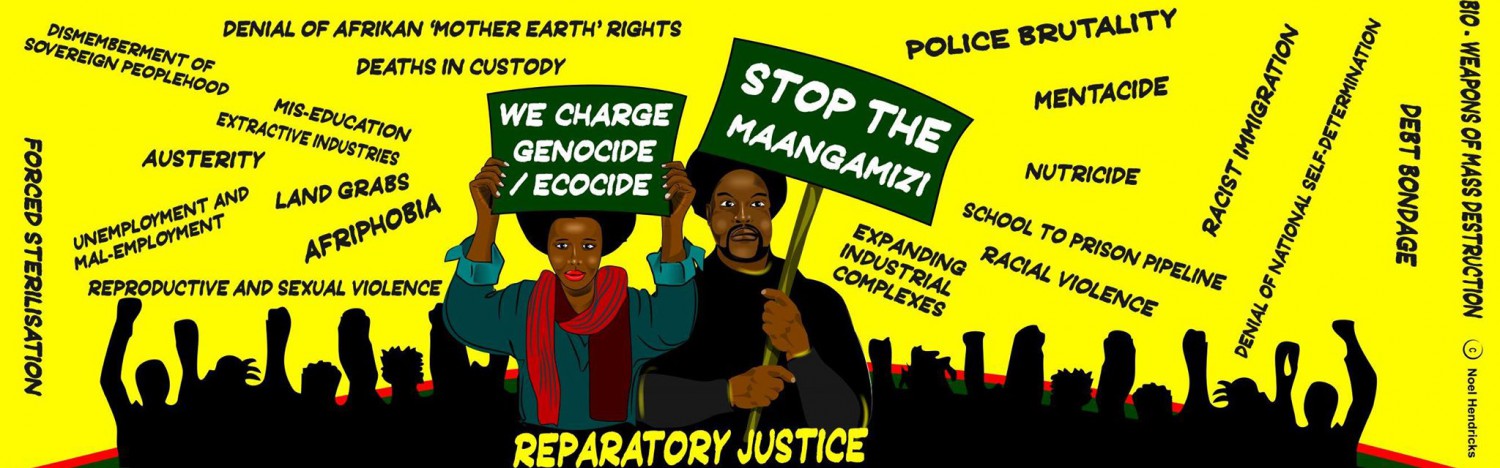
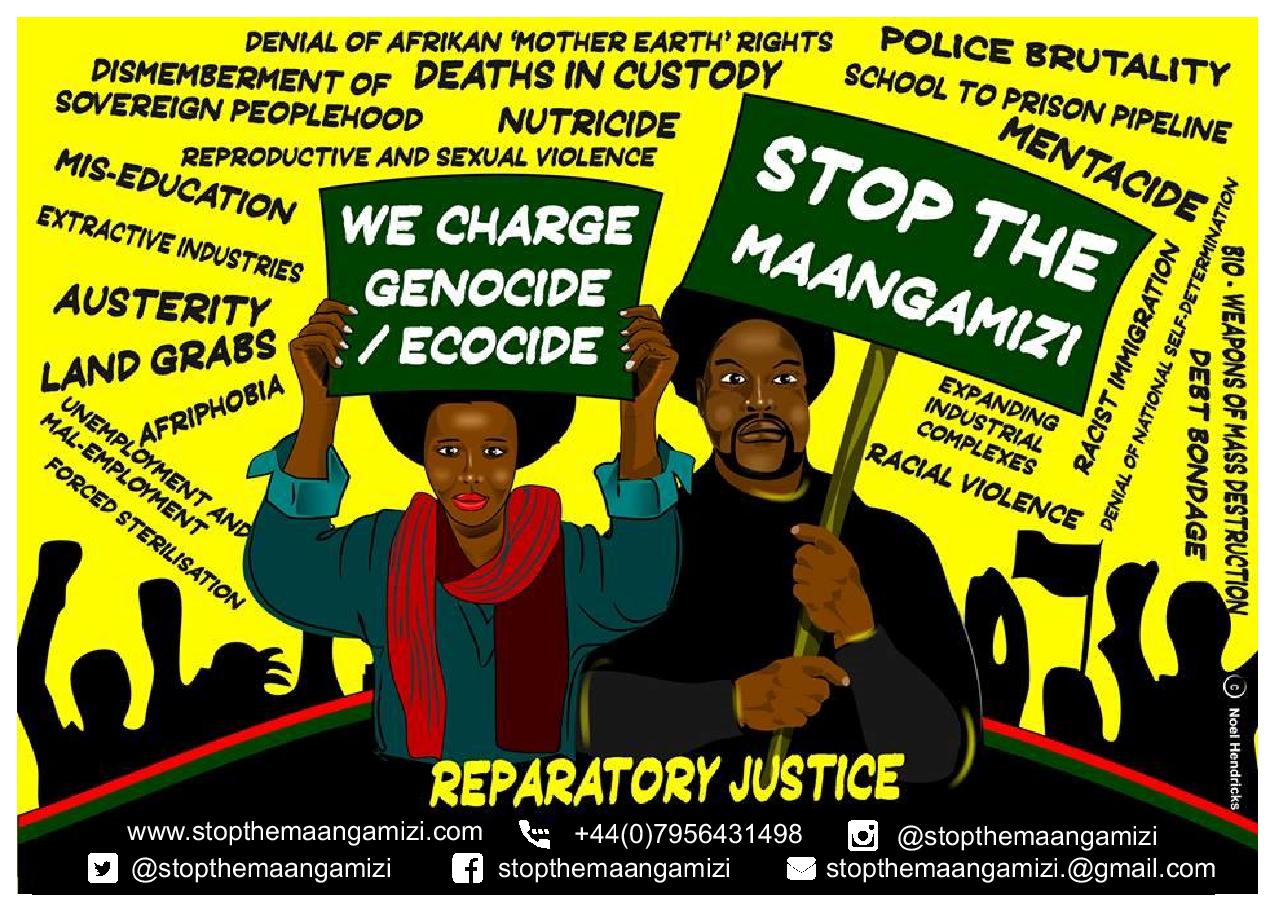


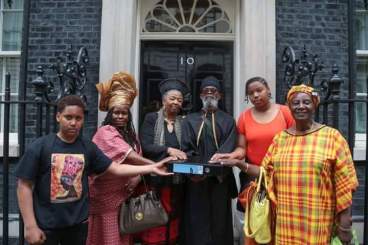
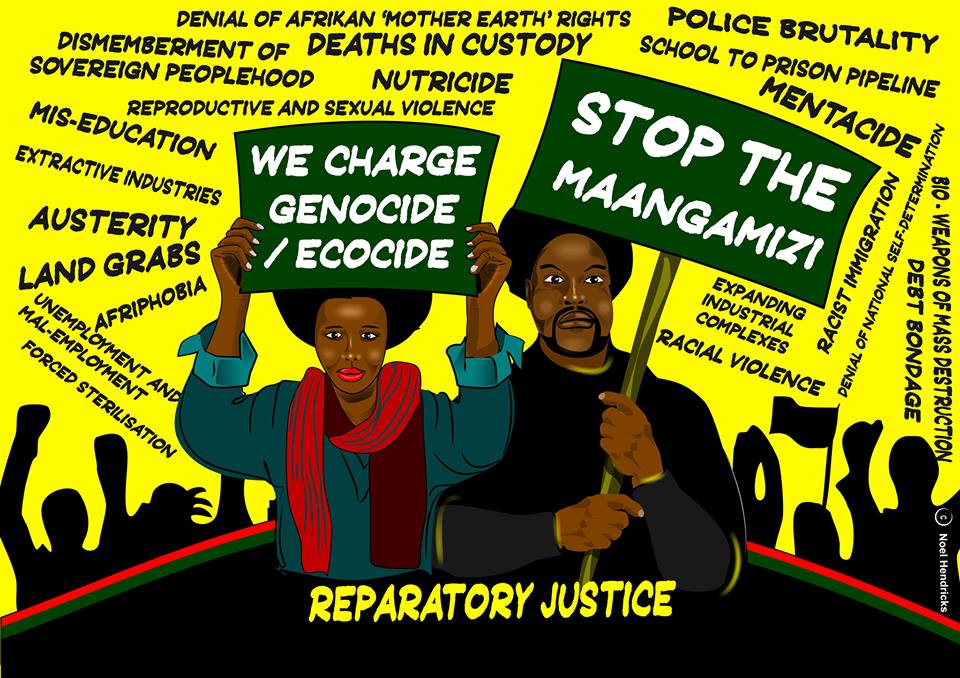


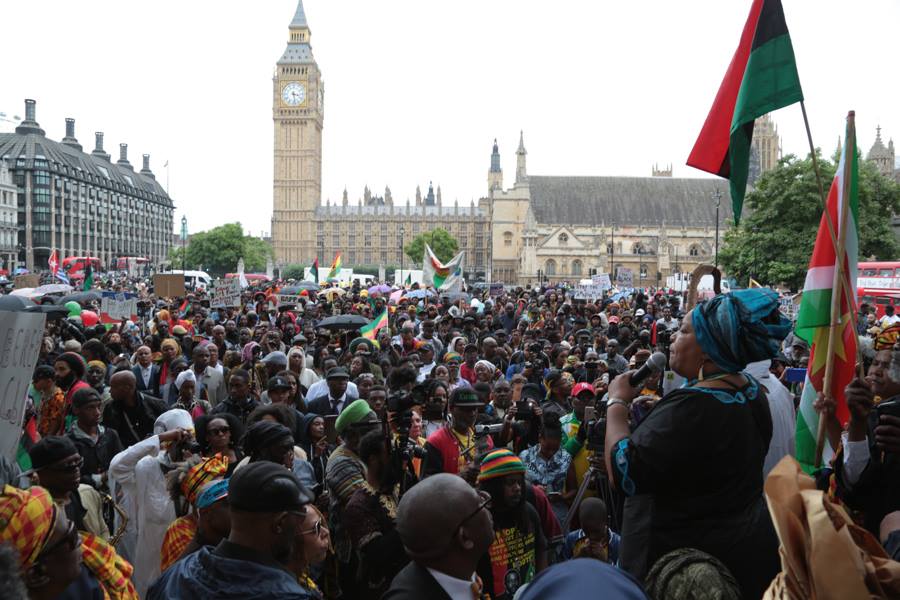
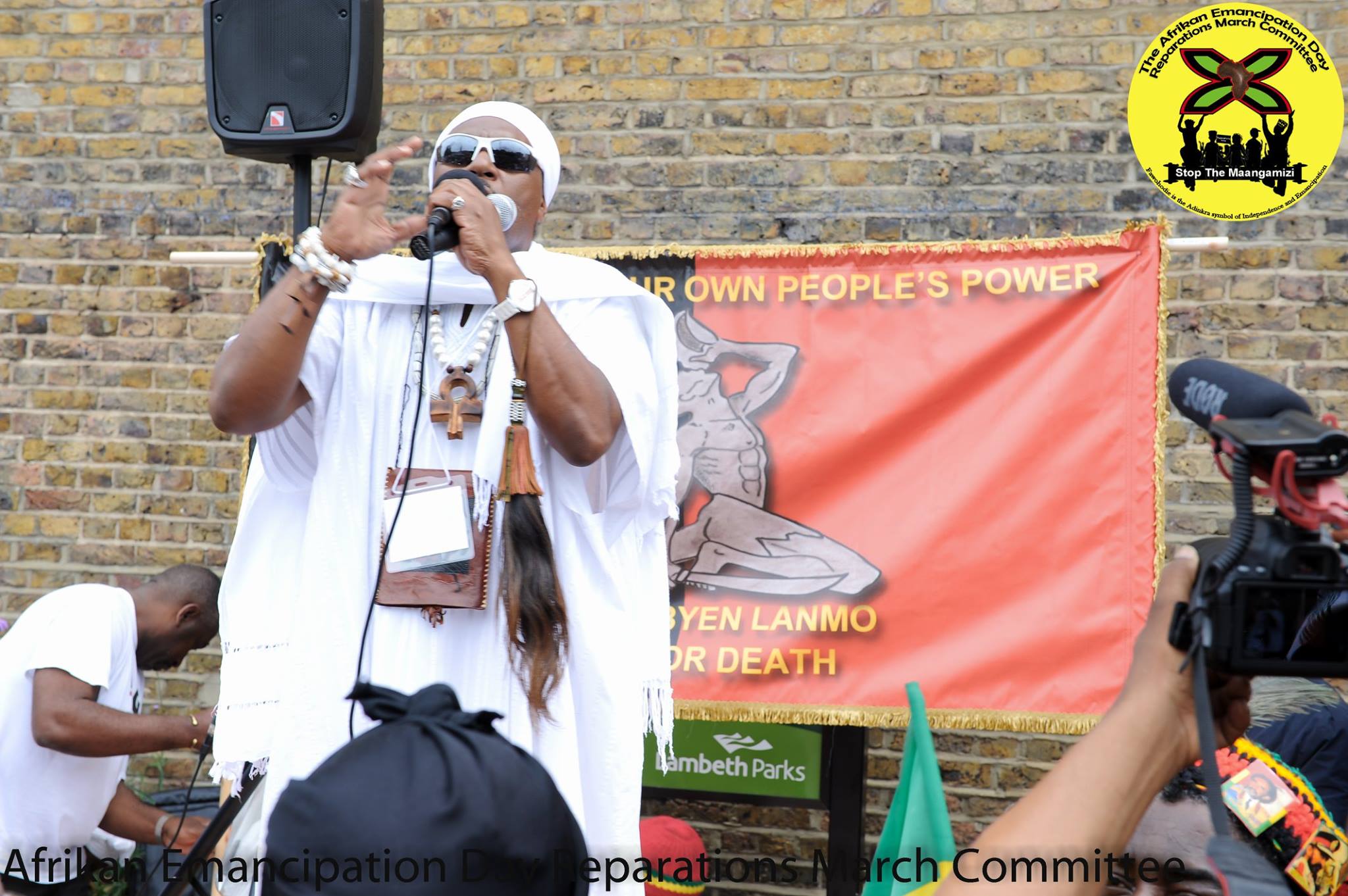
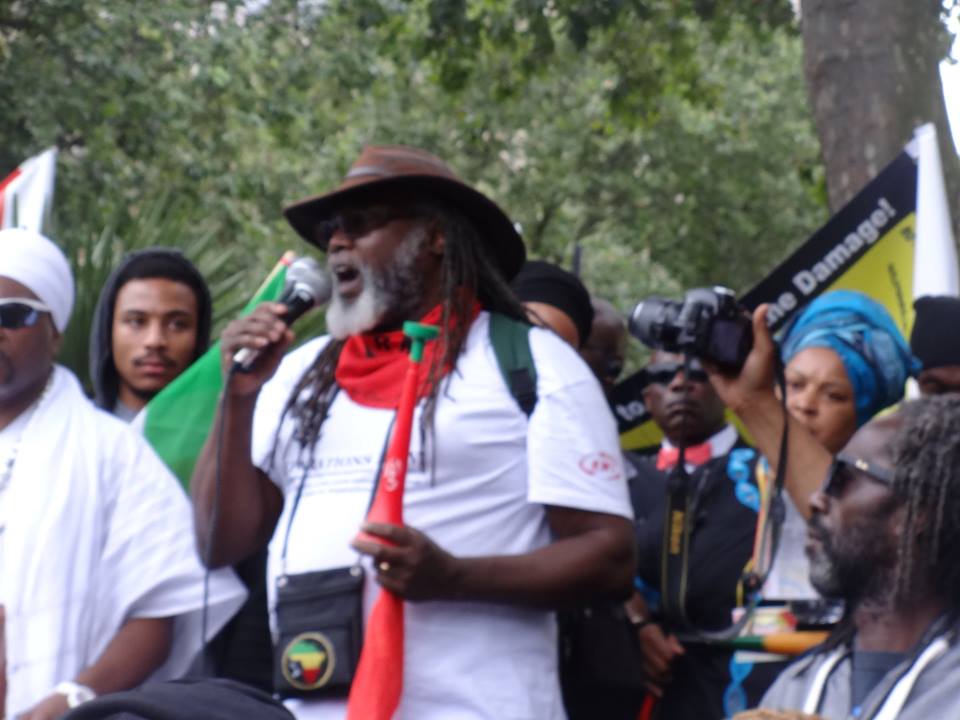
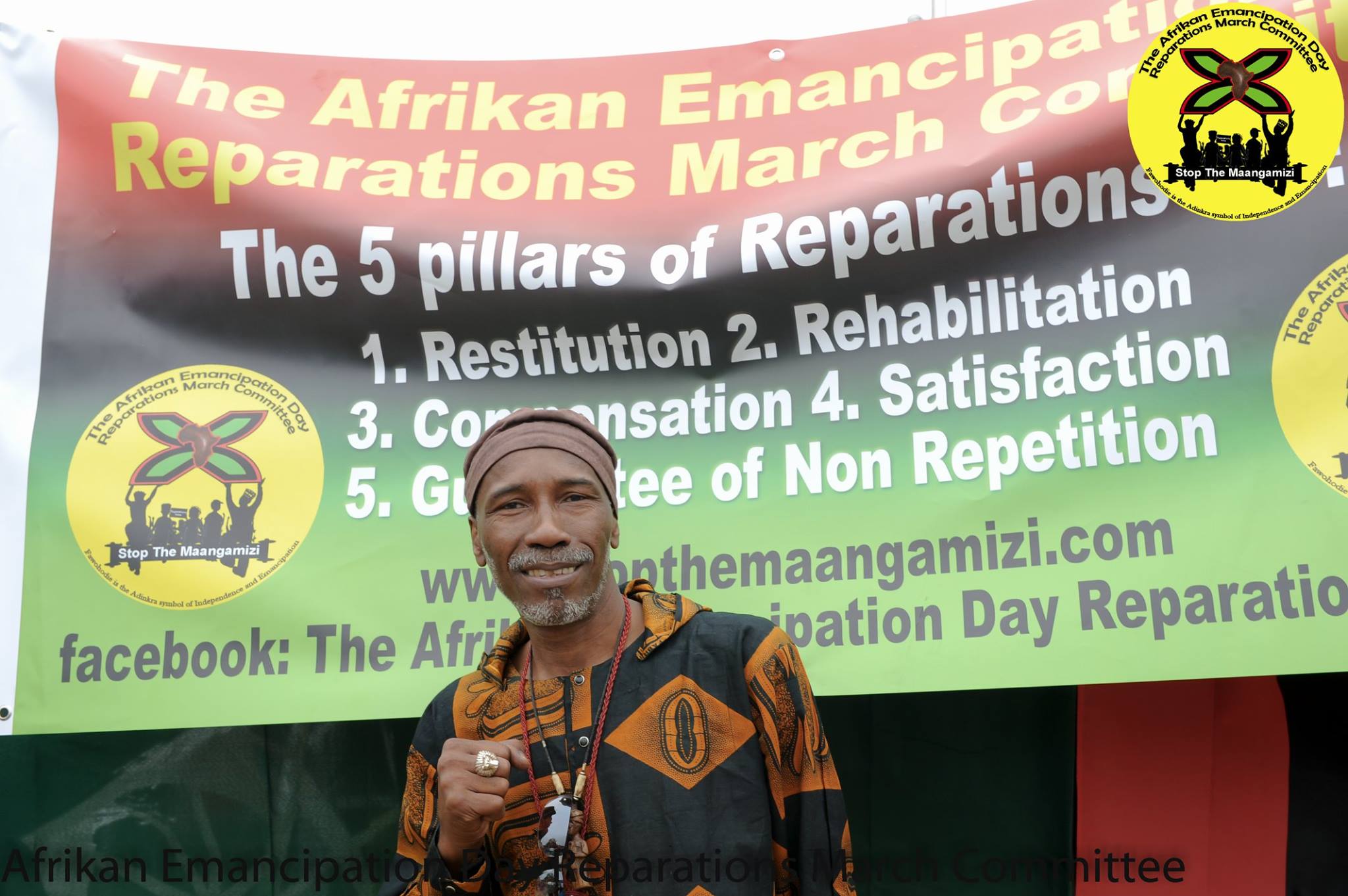


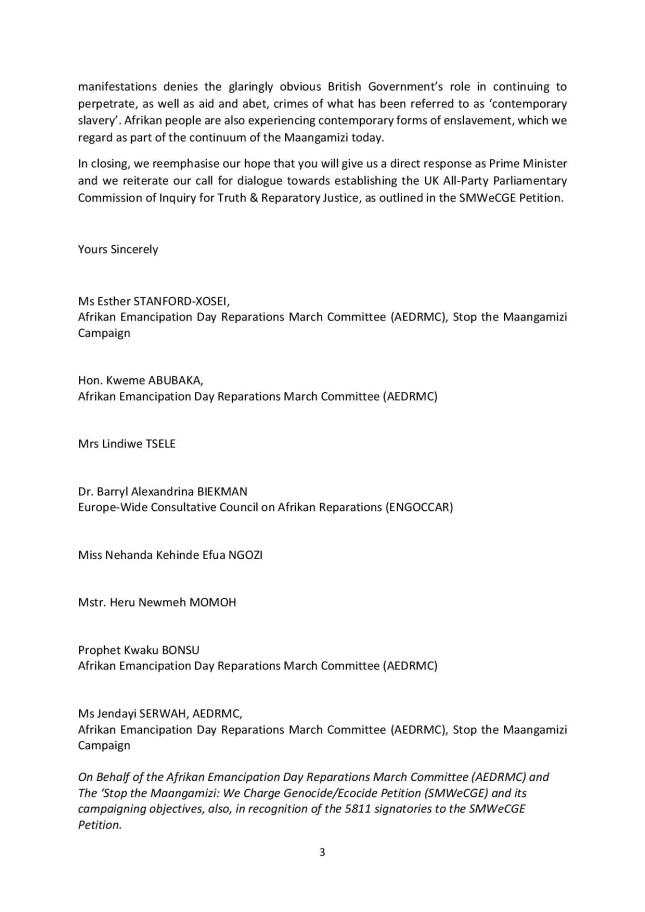
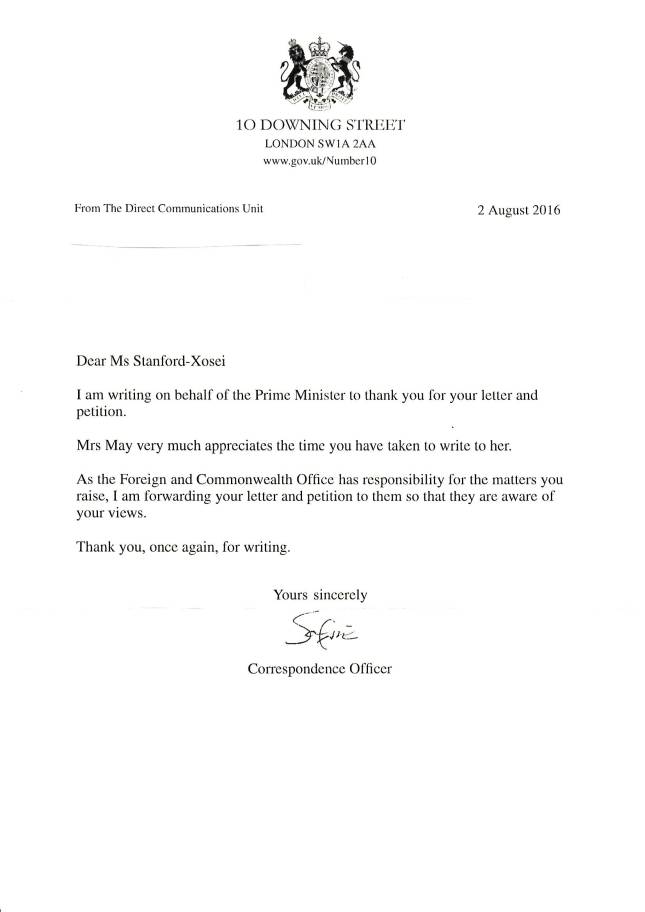
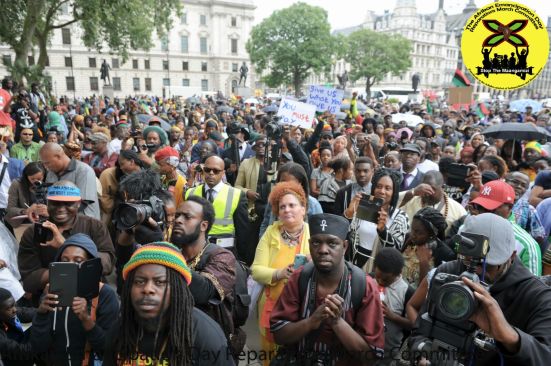
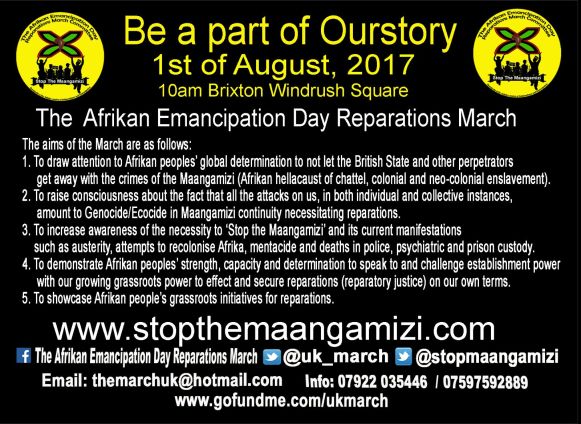
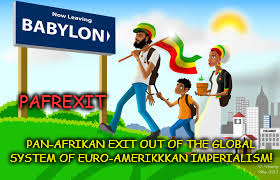
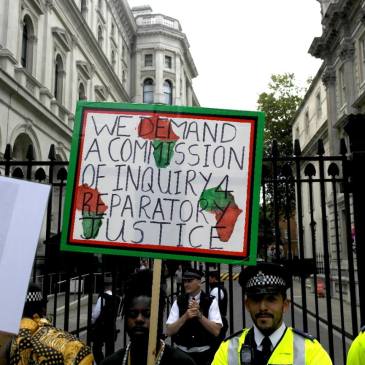
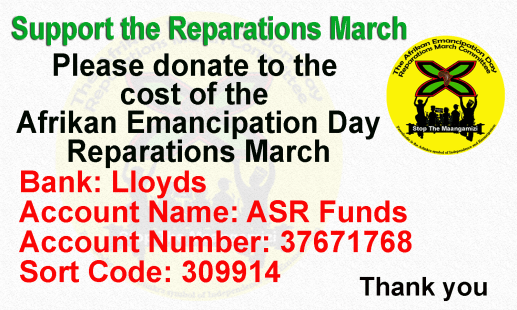

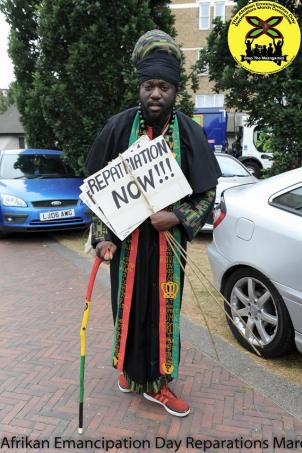

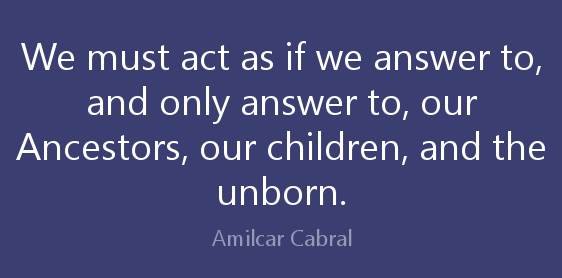
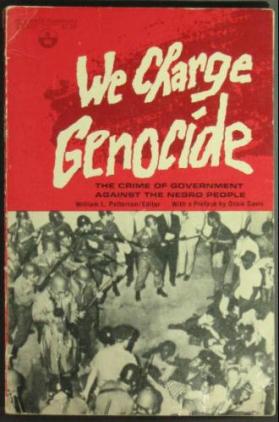
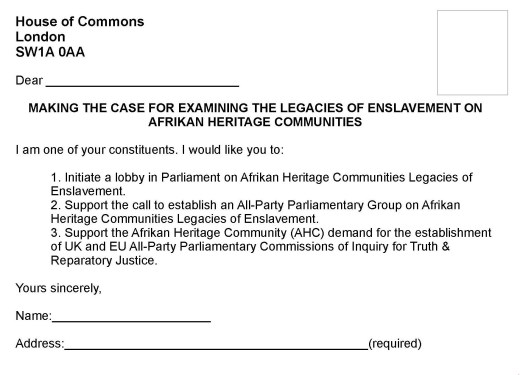
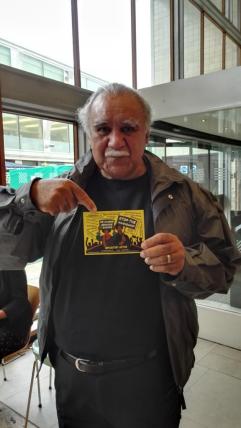
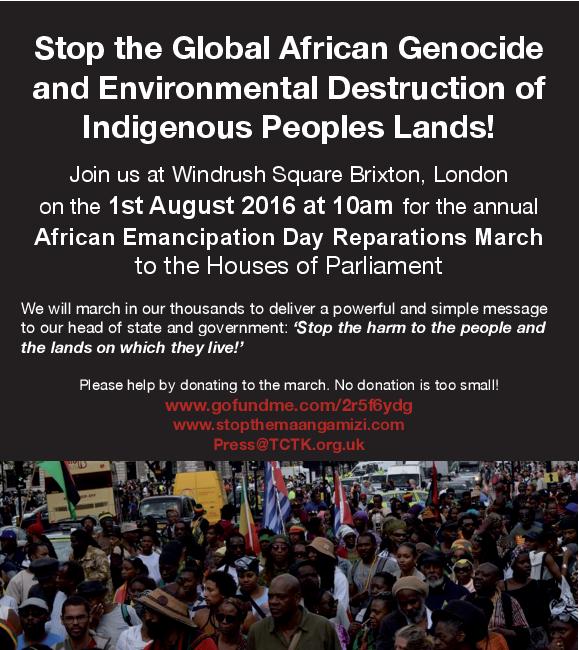




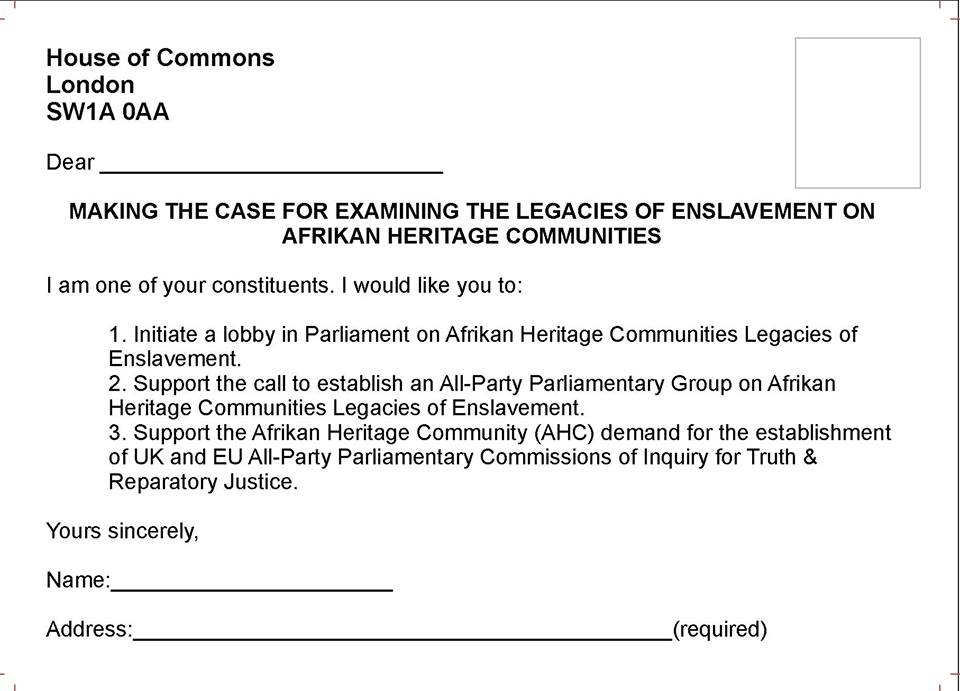
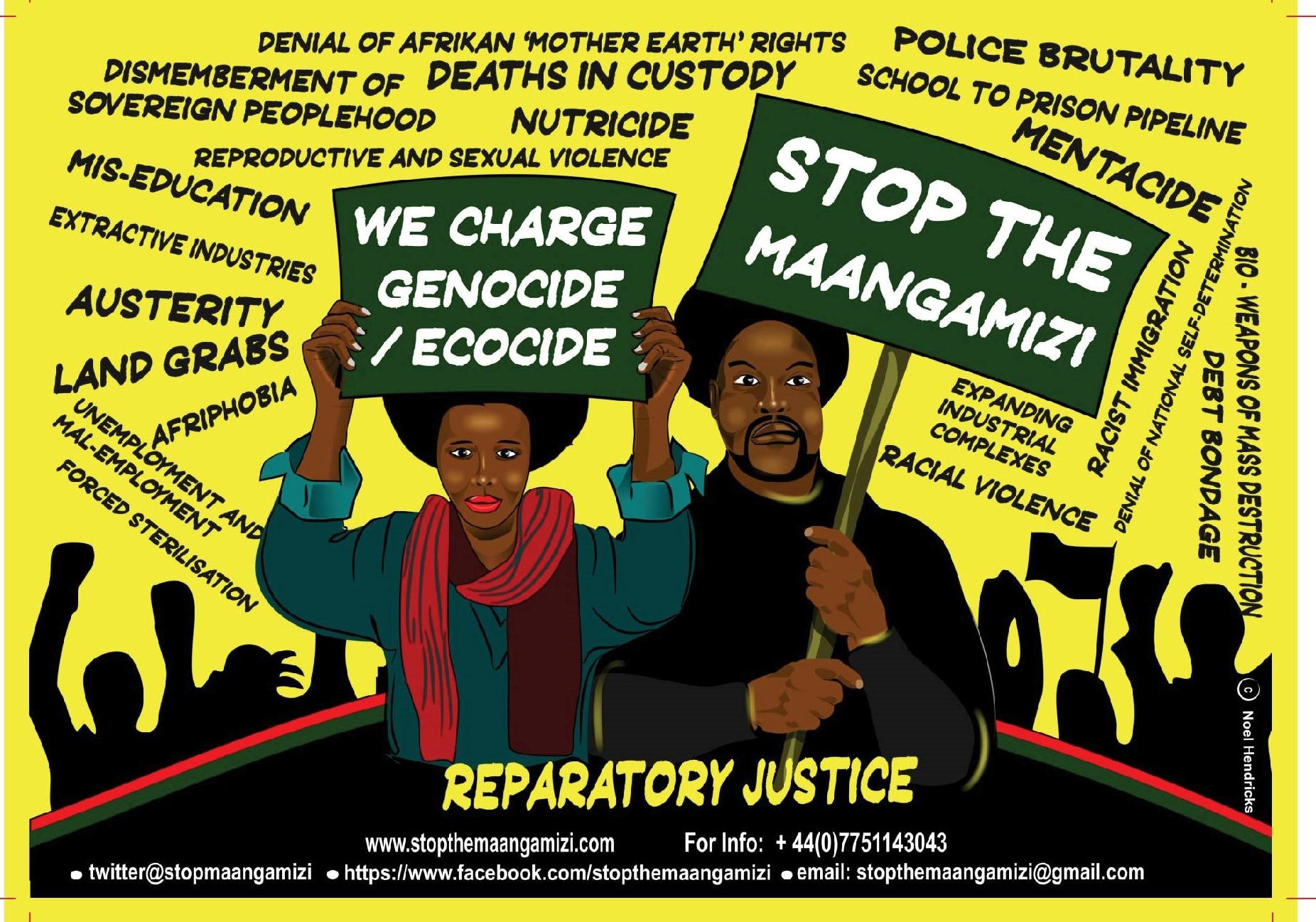

 stopthemaangamizi.com