How many times have you said or heard someone say:
“The system ain’t working for us!”
“Every day I pray for my children!”
“We need to come together and do something!”
These are the rallying calls of our communities, and they remind us that change starts with us. As we continue to build power through self-repair initiatives and community-building, engaging with our Members of Parliament (MPs) is one important step in our broader movement for reparatory justice.
But let’s be clear: the power to create change lies with us—our communities. MPs are public servants who are meant to represent our interests, and it’s their job to listen to us and act on our demands. By engaging with them, we’re using every available tool to advance reparations movement-building while keeping the focus on our leadership and our solutions.
We’ve prepared two template letters to help you approach your MP about supporting our community-led work:
A Concise Version (1 page) – short and to the point.
A Detailed Version (2 pages) – with more context and background.
These letters are tools to help you advocate for our communities while keeping the focus on our community leadership and the international frameworks that support our demands.
Engaging with Members of Parliament (MPs) is one tool in our broader movement for holistic reparatory justice. It’s important to remember that the power to create change lies with us—our communities. MPs are public servants who are meant to represent our interests, and it’s their job to listen to us and act on our demands.
By engaging with MPs, we:
Hold Them Accountable: MPs have access to resources, platforms, and decision-making spaces that can amplify our voices and support our work.
Build Awareness: Many MPs may not fully understand the issues our communities face. By reaching out, we educate them and push them to take a stand.
Create Pressure: When MPs hear from enough constituents, they are more likely to act. This is about using their position to support our community-led solutions, not waiting for them to lead.
This is not about looking to MPs as being all-powerful—it’s about using every available tool to advance our movement while keeping the focus on our leadership and our solutions.
Which Version of the Letter Should I Choose?
Concise Version (1 page)
Use when your MP is already familiar with reparations issues.
Best for follow-up communications or quick requests.
Great for MPs who prefer direct, brief messages.
Useful for initial contact that you can expand on later.
Detailed Version (2 pages)
Use for MPs who are new to reparations work.
Best for first contact or when you need to provide full context.
Helpful for creating a record of the issues and solutions.
Includes references to specific frameworks and examples.
Highlight the need for concrete steps to address historical and ongoing injustices.
Movement Building
Link letter-writing to other campaign activities.
Use this as an opportunity to educate and mobilise your community.
Build long-term pressure for change.
Coordination
Spread the word and pile on the pressure! Share responses and outcomes with:
The Stop the Maangamizi Campaign
Local community organisations.
Relevant working groups.
Other community members engaging their MPs.
This helps build collective knowledge and coordinated action.
Support
For additional help or questions about using these templates, contact: Email:stopthemaangamizi@gmail.com Phone: 07482220013
Remember: These letters are one tool in our broader reparations movement-building strategy. Their effectiveness depends on connecting them to ongoing community building and organising work.
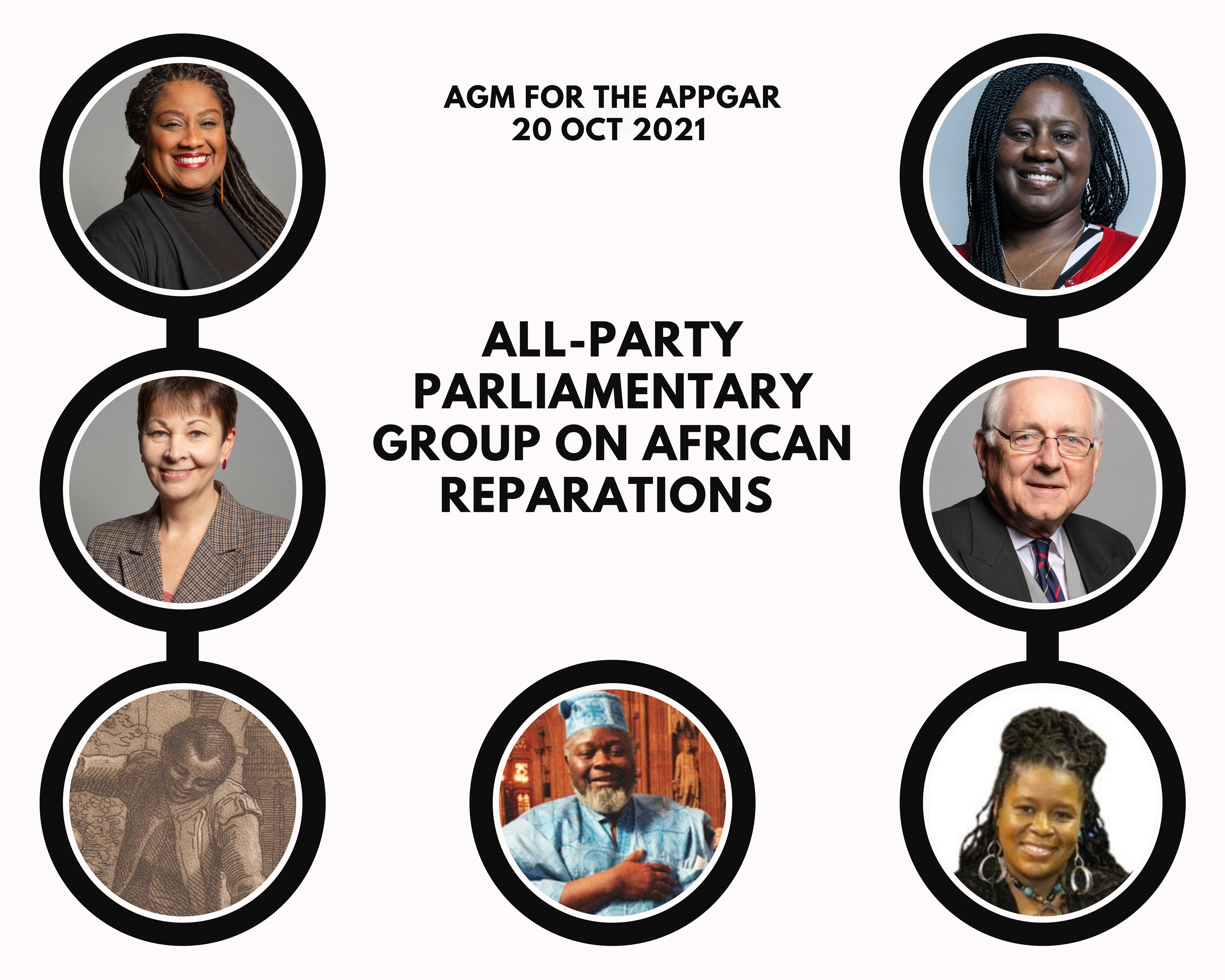
Left to Right: Bell Ribeiro-Addy MP, Marsha De Cordova MP, Caroline Lucas MP, Sir Peter Bottomley MP, Representation of Ottobah Cugoano, Bernie Grant MP, Esther Stanford-Xosei
Please note where you see different spellings of Afrikan this is because we in the SMWeCGEC use the spelling of Afrikan with a K but have preserved the spelling of African with a C when that is used by others.
Today we in the Stop The Maangamizi Campaign and our educational arm the Maangamizi Educational Trustwere participating stakeholders to the historic establishment of the All-Party Parliamentary Group on African Reparations (APPGAR) which was launched in the British Houses of Parliament (via an online AGM) at 10.30am this morning, Wednesday 20th October 2021. The APPGAR is chaired by Bell Ribeiro-AddyMP, the Vice Chairs are Marsha De Cordova MP and Caroline Lucus MP, the Assistant Secretary is Sir Peter Bottomley.
On behalf of the Stop the Maangamizi Campaign, the Maangamizi Educational Educational Trust will be sharing the running of the Secretariat for the APPGAR. Other organisations who will also be part of running the secretariat are the Glocal Afrikan Reparations Forum of London, (GARFOL) and The African Foundation for Development, (AFFORD).
The APPGAR will be officially launched on 27th October 2021.
Esther Stanford-Xosei, Chair of the Maangamizi Educational Trust and Coordinator General of the Stop The Maangamizi Campaign who was honoured to speak at the AGM made the following speech:
Good Morning
My name is Esther Stanford-Xosei and I speak as the Chair of the Maangamizi Educational Trust (MET) which is the educational arm of the Stop The Maangamizi: We Charge Genocide/Ecocide Campaign (SMWeCGEC). Because of the historic importance of the AGM of the All-Party Parliamentary Group on African Reparations (APPGAR) today, the MET/SMWeCGEC has agreed a written speech from which I shall read.
First of all, we would like to acknowledge countless generations of Afrikans in the International Social Movement for Afrikan Reparations (ISMAR) on whose shoulders, struggles and sacrifices we stand, whom since the mid-1700s in the UK specifically, have advocated for holistic reparations. In this regard, we particularly highlight the role of people like Ottobah Cugoano and other members of the Sons of Africa.
This idea for the APPGAR comes out of the campaigning efforts of the Stop The Maangamizi Campaign and our charitable educational arm, the Maangamizi Educational Trust. Maangamizi is the Kiswahili term for the continuum of chattel enslavement, colonialism and neocolonilaism.
We see the establishment of the APPGAR as a continuation of the work of the late Bernie Grant MPwho was the first member of the British Houses of Parliament to take up the issue of Afrikan Reparations following on from the ‘First Pan-African Conference on Reparations for Chattel Enslavement, Colonisation & Neocolonisation’ which took place in Abuja, Nigeria in 1993 and resulted in the establishment of the organisation known as the African Reparations Movement UK as well as the Abuja ProclamationEarly Day Motion 1987. It is in continuity of this work that we in the Maangamizi Educational Trust and the Stop the Maangamizi Campaign take our duties within the secretariat of the APPGAR very seriously. For this parliament has played a major role in legalizing, historical and contemporary injustices against Afrikan people worldwide including the passing of the Slave Compensation Act of 1837, which compensated our enslavers rather than Afrikan people. It has been very instrumental in legalizing our dehumanization, and continues with justifications being provided by this government for the discriminatory impacts of its extractivist policies in the Global South to supposedly avert the climate and ecological crises.
In terms of our MET/SMWeCGEC vision of the APPGAR, we see its purpose as: “bringing together parliamentarians, campaigners, communities and other stakeholders to examine issues of African Reparations; explore policy proposals on reparations and make recommendations to Parliament on how to redress the legacies of African enslavement, colonialism and neocolonialism today“. In this regard, a key objective of the APPGAR being to facilitate, work towards establishing the UKAll-Party Parliamentary Commission of Inquiry for Truth & Reparatory Justice (APPCITARJ) which is a key demand contained in the Stop The Maangamizi Petition and forms one of the main purposes of the ‘Atonement and Reparations for the United Kingdom’s Transatlantic Traffic in Enslaved Africans’ motions being passed by local and city councils.
People of Afrikan Heritage have been denied their right to be heard on what we mean by reparations, and what solutions we are already working on as part of Community Self-Repairs so that is what we are calling for a mechanism which can facilitate the dialogue between Afrikan Heritage Communities and the British State and society; which for us is the APPCITARJ. We therefore see this APPGAR as an important step in the process towards establishing such a mechanism of such vitally necessary dialogue. For it is only then that we can truly make appropriate policy and other programmatic types of redress by way of remedies to repair ourselves here in the UK and extending into the Afrikan Heritage Communities globally; and in the process also catalyze the repair of the entire British society and of course, of all peoples and societies, within and beyond in the UK.
It is necessary for the APPGAR to invite people to honest dialogue on this issue of Afrikan Reparations, because this struggle to effect and secure holistic reparatory justice, like all our struggles, begins with the need for, as advocated by Professor Karenga, a clear conception of what we want, how we define the issue and explain it to the world and what is to be done to achieve it. However, on this we should be guided by Afrikan Heritage Communities and the movements they have created to effect and secure holistic reparatory justice which have been operational over centuries.
We in the MET/SMWeCGEC want to emphasize that the grassroots of our Afrikan Heritage Communities across the world should be driving this work. It is up to this APPGAR to demonstrate that there is a leadership that will be of service to our communities at this time when there are big questions about what kind of leadership we have and even some of the state and non-state actors active on issues of reparations, being heavily scrutinised in terms of their credibility and commitment to our people in what some see as a tendency to want to make elitist deals under the guise of reparations which do not benefit the masses of the people. We should all be clear that Afrikan Heritage Communities have a right to participate in reparations programme and policy development and must be in the driving seat of such processes best summed up in the mantra: Nothing About Us Without Us for Anything About Us Without Us is Against Us. Furthermore, participation rights are individual and collective human rights under customary international law. They are enshrined in the International Covenant on Civil and Political Rights (ICCPR), and further established in states’ legal obligations as spelled out in the International Convention on the Elimination of Racial Discrimination(ICERD) and the UN Declaration on the Rights of Indigenous Peoples(UNDRIP).
That is why for us in the MET/SMWeCGEC, the emphasis should be on Afrikan Heritage Communities Self-Repairs as was recognised in the Bristol ‘Atonement and Reparations’ motion which states: reparative justice should be driven by Afrikan Heritage Communities experiences, voices and perspectives to ensure that advocacy messages not only reflect but also respond to the real needs of the community in order to recognise inequalities. Also, that Afrikan Heritage Communities in collaboration with wider stakeholders, should be supported to develop their own glocal ‘reparations plans‘ to tackle issues of community disrepair as a result of the Maangamizi, locally, nationally and internationally. These issues of disrepair rooted in conquest, dispossession, structural racism as well as intergenerational oppression and trauma include in the UK: gun and knife crime among young people, kidnapped and missing children, the discriminatory impacts of the criminal justice system, the education system and the issue of Afrikan heritage maternal death-rates and inequalities of primal health of people of Afrikan heritage and ancestry etc as a result of the continuing impacts of the Maangamizi.
Research of people like Professor Carlton Waterhouseshows that much of the reparations policy-making, scholarship and public discourse pays little attention to the quality of past reparations programmes implemented around the world and whilst the emphasis is placed on former and contemporary wrongdoers to make apology, recompense, or other types of restitution, very little attention is paid to results, the end result of any reparations process should be the restoration and recovery of those that have experienced enduring injustice and harm, as well as the critical role that communities and individuals suffering from past abuses should play in establishing those programmes in order to re-establish their personal well-being and societal standing. Similarly, a lot of attention gets placed on state initiated reparations programmes; but this is based on a false and outmoded notion of international law as just being about the law of nation-states or governments rather than peoples and/or affected communities.
As much as this APPGAR has been centuries in the making, we must also recognise the context within which this struggle to effect and secure holistic reparatory justice is unfolding as historian Professor John Henrik Clarke advocated, we must be conscious of what political and cultural time of day it is given our locations as Afrikan people on the map of human geography. At a time when the extent of the Maangamizi is now imperilling all life on Planet Earth and some of us are threatened with literal extinction; an approach to effecting and securing holistic reparatory justice is required which brings about Planet Repairs which means: when safeguarding the rights of past, present and future generations; the need to proceed from a standpoint of Pluriversality that highlights the nexus of reparatory, environmental and cognitive justice in articulating the impetus to repair holistically our relationship with, and inseparability from, the Earth, Environment and the Pluriverse. Such an approach recognises there is urgent need for us all to compel the stopping of the Maangamizi of Neocolonialism and its inbuilt manifestations of genocide and ecocide and for Afrikan Heritage Communities to engage in deep and transformative adaptation given the certainty of intensifying climate and ecological crisis which is already impacting all life support systems as we know it rapidly-changing Planet Earth; doing so in ways and means that repair and transform our existing failed institutions in all spheres of people activity, locally, nationally and internationally. Such repair and transformation being anchored in the ancient Afrikan ethical imperative of Serudj ta, i.e., healing, repairing and remaking the World, making it more beautiful and beneficial than we inherited it.
For these reasons, an essential part of our communities self-defence is transformative adaptation which is also about us beginning to make Pempamsiempangos, an Adinkra symbol, which encapsulates the necessity to knit and sew together in readiness for our community self-repairs; these are Glocal Afrikan Reparations Plan for Planet Repairs Alternative Progression being drawn up locally, nationally, internationally as well as globally. Alternative Progression plans become necessary given the contested nature of currently dominant processes of globalized development as highligted in Pluriverse: A Post Development Dictionary, given its structural roots in the Maangamizi, modernity, capitalism, state domination, and exclusively masculinist values which have often ended up being instead maldevelopment.
Finally, it is important to note that we who have been struggling to effect community self-repairs over centuries have built up an extensive knowledge base about the kind of system-change reparatory justice policy and programmatic measures are required. It follows that reparations education and conscientisation is part of the preparation for effecting and securing reparatory justice and this requires the APPGAR to also facilitate intense study about this issue as well as recognising that there is such a thing as reparations ethics. In this regard to acknowledge the INOSAAR Principles of Participationwhich promote equity between the knowledges produced by Afrikan Heritage Communities on Reparations and all other stakeholders.
We in the MET and the SMWeCGEC commit to disciplined, proactive work in the APPGAR secretariat and in fulfilment of this vision and we are keen to work equitably with partners who recognise the principles of Afrikan agency in determining what is best for our people.
We thank Bell Ribeiro-Addy for taking up this challenge by taking this historic step in initiating this APPGAR and agreeing to chair it and of course also to all of you who have agree to be the other executive officers.
We look forward to supporting and working with you all in the APPGAR.
The orginal proposal for the APPGAR as proposed by the MET can be found here.
“Accepting our responsibility and obligation to our Ancestors for ensuring that the African identity is proclaimed, maintained and developed; and that Africa is restored to its rightful place at the centre of world politics; call upon all people of African origin in the Caribbean, Africa, Europe, the Americas and elsewhere to support the movement for reparations and join forces with a view to forming a strong united front capable of exposing, confronting and overcoming the psychological, economic and cultural harm inflicted upon us by peoples of European origin.”
Birmingham Declaration, Africa Reparations Movement (UK), 01/01/94
“Reparations is a process of the repairing and remaking of a people who are in the process and practice of repairing, renewing and remaking the world”
Professor Maulana Karenga, Black Power Encyclopaedia: From “Black is Beautiful” to Urban Uprisings, 2018
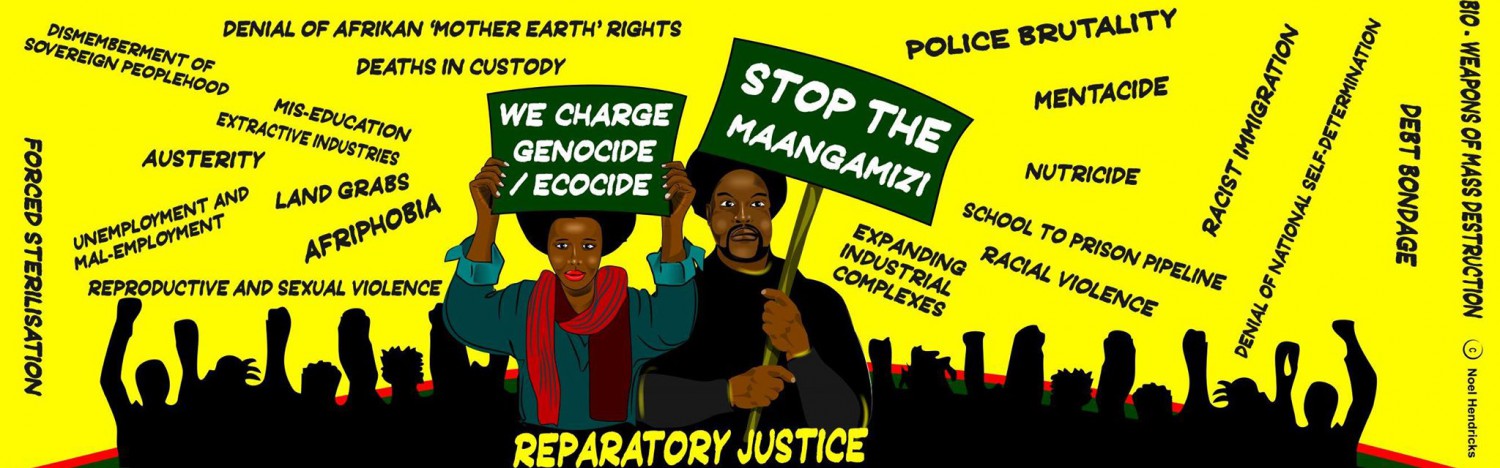
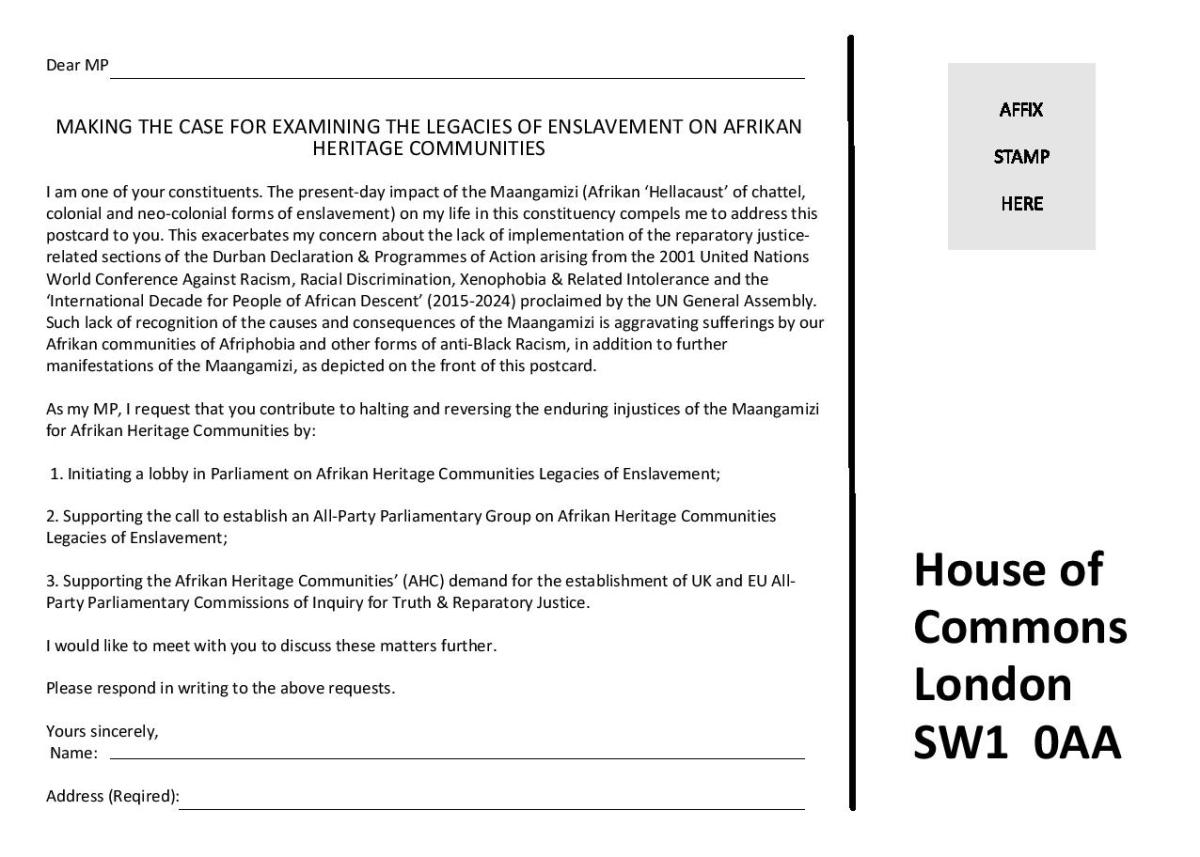
The Stop The Maangamizi: We Charge Genocide/Ecocide Campaign (SMWeCGEC) has, since its inception, been campaigning for the setting up of an All-Party Parliamentary Group (APPG) to address the legacies of Afrikan Enslavement as highlighted in the Stop The Maangamizi Postcard (below). The Maangamizi is the Kiswahili term for the African Holocaust of chattel, colonial and neocolonial forms of enslavement. The call to set up an APPG on Afrikan Heritage Communities Legacies of Enslavement has now developed into a concrete proposal driven by the Maangamizi Educational Trustfor the estabishment of the All-Party Parliamentary Group on African Reparations (APPGAR).
We in the SMWeCGEC have had promising discussions with various members of the British Houses of Parliament, including MPs and peers, who have agreed to set up and be part of the APPGAR. Discussions and negotiations are still taking place on a number of key issues concerninG the scope, remit and timeframe for establishing the APPGAR; nevertheless, we felt it was important to share the proposals that we have made for such an APPGAR. These proposals also include aspects of the text within the the Lambeth, Islington and Bristol ‘Atonement and Reparations‘ motions as well as text contributed by the International Network of Scholars & Activists for Afrikan Reparations(INOSAAR).
Please note in this proposal African is spelled with a C. We in the Stop The Maangamizi Campaign recognise that the consciousness raising journey of self-defining as Afrikan with a K has not begun for all people of Afrikan ancestry and heritage. Hence this starting point with a view to seeking to raise conciousness of the need for People of Afrikan heritage and ancestry to self-define as Afrikans.
DRAFT TERMS OF REFERENCE FOR THE ALL-PARTY PARLIAMENTARY GROUP ON AFRICAN REPARATIONS (APPGAR)
All-Party Parliamentary Groups (APPGs) are informal, cross-party, interest groups of MPs and Peers which meet to discuss, campaign on and promote a certain issue. Many APPGs choose to involve individuals, campaign groups, charities, and other non-governmental organisations from outside Parliament, but who are active in the field of interest, to become involved in their administration and activities. They have no official status within Parliament but can, however, be very influential in bringing matters to the attention of Parliament and ministers as well as also encouraging action by other bodies.
The All-Party Parliamentary Group on African Reparations (hereafter referred to as ‘APPGAR’) is to be established in [October] 2021 by a cross-party group of parliamentarians.
The APPGAR is to be chaired by (MP’s name withheld until agreements reached).
SHORT DESCRIPTION
The All-Party Parliamentary Group on African Reparations (APPGAR) brings together parliamentarians, campaigners, communities and other stakeholders to examine issues of African Reparations; explore policy proposals on reparations and make recommendations to Parliament on how to redress the legacies of African enslavement, colonialism and neocolonialism today.
OBJECTIVES
1. The APPGAR exists to:
(a) raise parliamentary awareness and public understanding about the meaning of, rationale, and proposals for African Reparations to address the legacies of African enslavement, colonisation and neocolonialism within and beyond the UK.
(b) study, review research and share knowledge about the effects of African enslavement, colonisation and neocolonialism within the British Empire from 1662 to the present.
(c) provide a springboard for parliamentary action on African Reparations such as debates, questions for oral and written answers and legislative reform.
(e) seek evidence on what measures and reforms are needed to address African Reparations at the level of policy.
(f) advise and make recommendations to the UK Government on African Reparations.
(g) stimulate cross-community dialogue on African Reparations and explore interconnections with reparations campaigns and movements of other Majority World Peoples.
To further the above aims the APPGAR and its members and its members will:
· Maintain an important forum for discussion of issues relevant to African Reparations, including measures to implement proposals for African Reparations such as:
(a) the establishment of the APPCITARJ;
(b) debt cancellation and repudiation;
(c) restitution of African cultural property and human remains;
(d) public disclosure about which financial institutions were involved in the enslaver compensation loan taken out by the UK Government in 1835, and restitution of the value of taxes paid by African Heritage taxpayers in Britain until 2015 to service this loan;
· Produce high quality reports, publications and calls for action;
· Facilitate events that further the objectives of the APPGAR;
· Attend other events, meetings where influence can be brought to bear.
BACKGROUND
2. The roots of this APPGAR lie in the longstanding socio-political struggle of the International Social Movement for African Reparations (ISMAR) to have their voices heard. For centuries, African people and their descendants who were colonised and enslaved have been calling for reparatory justice to address the long-standing and harmful legacies of enslavement, colonial oppression, genocide and ecocide.
The United Kingdom establishment played a major role in the Transoceanic Traffic in Enslaved Africans (TTEA) which saw at least 15 million Africans forcibly trafficked to the Western Hemisphere with many thousands losing their lives during the crossing from Africa to the Americas on British Ships. A great deal of the wealth of the UK was founded on this vile Crime Against Humanity(CAH), and the legacies of chattel, colonial and neocolonial forms of enslavement are still prevalent in society today.
One of the most visible and enduring legacies of African enslavement, colonisation and neocolonialism is systematic Anti-Black and other forms of Afriphobic racism that exists within Western societies. The systematic racism that is ingrained in our society manifests itself in inequality in education, housing, health, employment and the criminal justice system. The legacy of African enslavement is responsible for ingraining racial inequality within Western society, that manifests itself both in overt acts of violent racism, deaths in police, prison, psychiatric custody and immigration detention in the UK, or in institutional failings to provide sufficient support and care for African Heritage Communities, such as the disproportionate impact of Covid-19 on people of African descent in the UK.
For too long, the UK Government has ignored the repercussions of Britain’s involvement in the enslavement and colonisation of African People, preferring to emphasise its role in the abolition of slavery, which led to the 1833 Slavery Abolition Act. While it is true that certain sectors and individuals within British society actively participated in, and helped to bring about, abolition of slavery in 1833, it did so only after 200 years of profiting from it. The prevalence of this historical narrative overlooks the fact that many within the British political establishment actively resisted the abolition of slavery, not least of which was Britain’s former Prime Minister William Gladstone. It was men like Gladstone who argued for the need for the enslavers to be financially compensated, resulting in the passing of the Slave Compensation Act in1837. This allowed the enslavers (rather than the enslaved) to receive a total of £20 million in compensation, amounting to 40% of the Treasury’s annual income at the time.[1]
That debt was not fully repaid by British taxpayers until 2015, allowing the bulk of the wealth of the European-led TTEA to remain in the hands of powerful elites and their institutions in both the former colonies and in the UK.
The APPGAR will also seek to build on the work done by campaigners in the UK to advance the cause of reparations.
In 2003 the Lambeth based Black Quest for Justice Campaign (BQJC) supported by the Pan-Afrikan Reparations Coalition in Europe(PARCOE) initiated a class action for Pan-African Reparations for Global Justice against Queen Elizabeth II and agents of the Crown as Head of State and Head of the British Commonwealth; calling for the establishment of a Reparations Commission of Inquiry. This action was denied on the grounds that the Crown could not be prosecuted, and these crimes could not be enforced prior to the enactment of the International Criminal Courts Act in 2001.
In 2004 the Rastafarian Movement were denied their appeal for reparation because the UK government felt it could not be held responsible for events of past centuries.
In 2013 Caribbean Heads of Governments established the CARICOM Reparations Commission (CRC) with a mandate to prepare the case for reparatory justice for the region’s indigenous and African descendant communities who are the victims of Crimes against Humanityin the forms of genocide, slavery, slave trading, and racial apartheid.
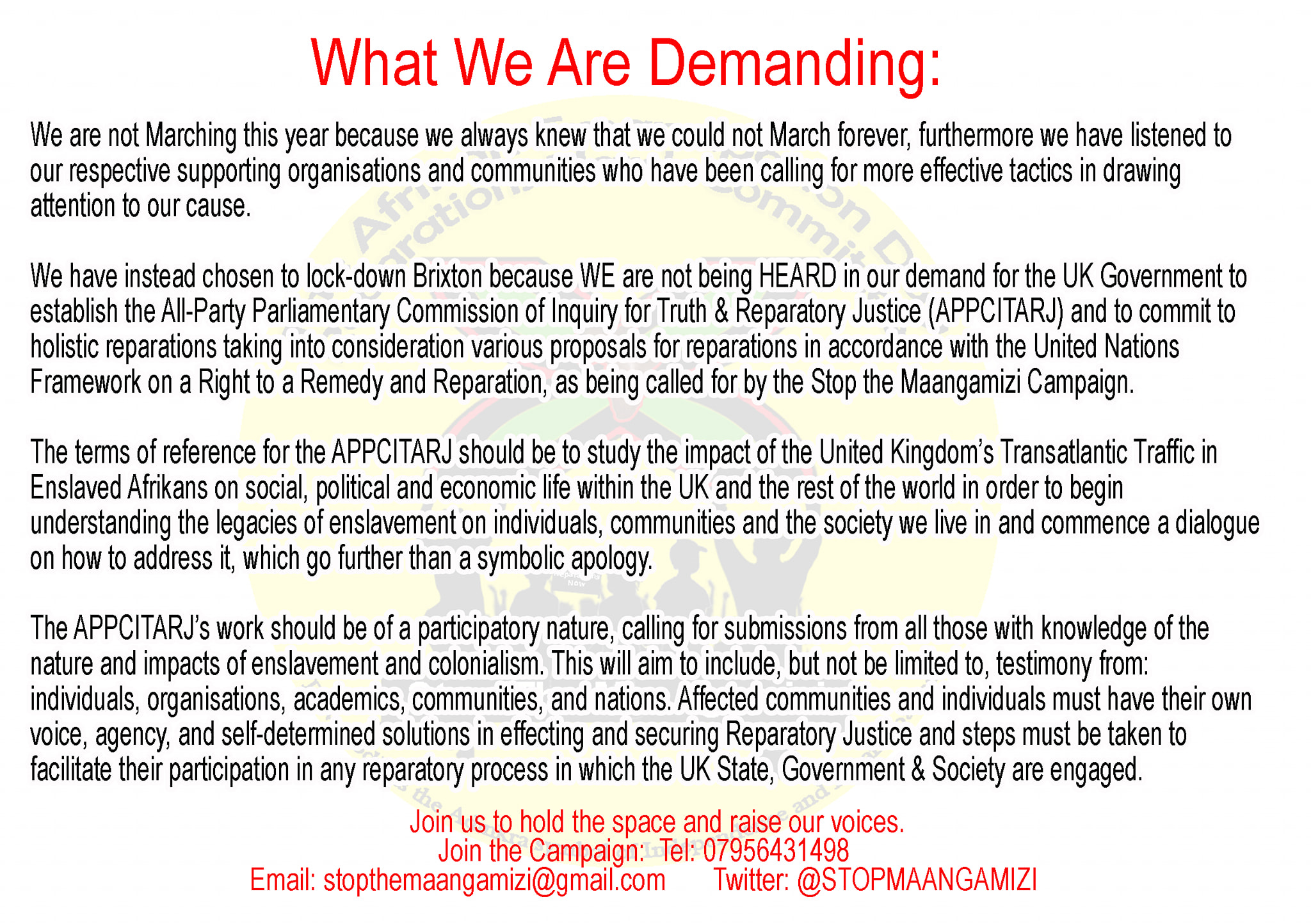
From 2015 to 2019, the Stop the Maangamizi Campaign in association with the Afrikan Emancipation Day Reparations March Committee co-organised the annual Afrikan Emancipation Day Reparations March on the 1st of August, commemorated as Emancipation Day. In 2020 the Stop The Maangamizi Campaign and the Afrikan Emancipation Day Reparations March Committee evolved the tactic of marching to co-organising the Pan-Afrikan Reparations Rebellion Groundings (PARRG) annually on the 1st of August. The Stop The Maangamizi Campaign presents the Stop the Maangamizi Petition to the Office of the UK Prime Minister annually calling for the establishment of the UK All-Party Parliamentary Commission of Inquiry for Truth and Reparatory Justice (APPCITARJ).
In July 2020 Lambeth Council, home to the largest African Caribbean population in the UK, became the first local authority in the UK to pass a successful Atonement and Reparations for the Transoceanic Trafficking of Enslaved Africansmotion followed byBristol City Council in March 2021 calling for the establishment of the APPCITARJ to address the impact of African enslavement, colonisation and neocolonialism on present generations of People of African descent and their environments.
The APPCITARJ is a campaigning initiative founded by the Pan-Afrikan Reparations Coalition in Europe (PARCOE) and now driven by theStop the Maangamizi Campaign. The need for this Commission has long been supported by the work and activism of other members of the International Social Movement for Afrikan Reparations (ISMAR), including those of the Pan-Afrikan Liberation Movement and theINOSAAR. The campaign aims to urge the UK Government to commit to a holistic process of atonement and reparations in accordance with the United Nations Framework on a Right to A Remedy and Reparations. A key part of the process includes recognizing and addressing the longstanding legacies of African enslavement, colonialism and neo-colonialism, such as Afriphobic Racism and the racial discrimination of People of African descent and other Majority World Peoples, socio-economic inequality and environmental injustice.
The APPCITARJ’s main purpose is to inform the public of the nature of African enslavement and colonialism, as well as its long-term consequences, including present-day impacts of neocolonialism upon both individuals and communities. It will kick start a political process where the space to fully bring people together and listen to the voices of those who are normally excluded would be given the opportunity to be heard. It is intended to be participatory in nature, meaning that it will call for submissions from all those with knowledge of the nature and impacts of enslavement and colonialism to provide testimony. These include, but are not limited to: individuals, organisations, academics, communities and nations.
At a practical level, it is the process of conducting this Commission that is of the utmost importance. In order to be able to hear all voices on this matter, we need a mechanism similar to but building on the ‘Commission to Study and Develop Reparation Proposals Act for African-Americans Act’, (also known as HR40) that will act as a conduit for that conversation.[2]
This process cannot be bypassed because there are so many different constituencies and Communities of African Reparations Interest that need to be heard. The APPCITARJ will provide the basis for affected communities and individuals to voice their own self-determined solutions in effecting reparatory justice, and will identify the steps needed to facilitate their participation in any reparatory process in which the UK is engaged going forwards.
The MET works in servicing the SMWeCGEC and its partners with highly qualitative community-based research, mindful of UNESCO guidelines, as well as with action learning, public conscientization, mainly through cross-community dialogue, and other lifelong learning ways and means of mural and extra-mural education; doing so in order to ensure Cognitive Justicebecomes the key driving impetus in the promotion of broad societal awareness about the full meaning, creative application and practical realisation of African Reparations as a matter of total Pan-African Liberation and the ‘Maatubuntu’ emancipation of all Humanity, in furtherance of holistically transformative African Heritage Community Self-Repairs as an integral part of Planet Repairs in Global Justice meaningfulness.
The MET guides the SMWeCGEC in its public intellectual work for the organic development of unifying Peoples’ Power to support not only grassroots Community Activist campaigners engaged in Pan-African Reparatory Justice Advocacy Action Learning, but also all interested public officials, including members of Parliament, local and central government officials, teachers and students and youths at all levels, including complimentary and supplementary education in their variations. The MET seeks, by so doing, to encourage, guide and provide all other forms of support, to enable such entities to organically learn to grasp the full meaning and practical know how in all ramifications of effecting holistic African Reparations in such ways of ‘Maatubuntu’ creativity as to embrace Planet Repairs in Global Justice meaningfulness.
In this regard, the MET works in guiding the SMWeCGEC and its partners with public intellectual support for its efforts towards establishing the APPCITARJ.
In this regard, the MET provides technical and administrative support to the APPGAR, upholds the rules of APPGs, and acts as a key contact/coordinator for meetings and members.
The role of the Secretariat is to act as a designated secondary enquiry point alongside the Chair, who is the main registered contact. The Secretariat supports the Chair to ensure records are maintained according to APPG rules. The Secretariat maintains a list of active members – both parliamentary and external; dates of meeting – both past and future; minutes of past formal meetings (which will record both attendance and decisions); any reports or other publications issued; and income and expenditure statements as required. The Secretariat also acts as the conduit for contact with sponsors, supporters, any external advisory functions and individual experts who may interact with the APPGAR.
The interaction between the Secretariat and outside bodies is determined and subject to approval by the elected APPGAR officers.
Where bespoke and original research is to be carried out to uncover new insights and support the APPGAR’s decision-making, the MET will lead on carrying out this work. The MET will also manage any sponsorship monies, events and expenses, keeping full accounts records and making any necessary declarations of interest within the rules of the APPGAR.
The APPGAR has a Memorandum of Understanding with the MET which covers the role of the secretariat and gives responsibility for maintaining personal data as the Data Processor for the APPGAR in accordance with the principles and legal obligations of the UK General Data Protection Regulation (UK GDPR) and related legislation.
The APPGAR’s Privacy Statement can be downloaded here….[to be added]
Further support provided to the APPGAR secretariat will be declared when confirmed.
The Secretariat will be supported by a Parliamentary Coordinator on administrative matters, such as registration, parliamentary event organisation, meeting scheduling, minute taking, communications, but with a particular focus on supporting the Chair.
5. MPs and members of the House of Lords from all parties are invited to join the APPGAR – if you are interested in exploring issues concerning African Reparations and other forms of transitional justice, we very much encourage you to join.
Officers of the group include: [Names withheld]
Other members of the group include: [Names witheld]
Members of the general public are encouraged to contact their local MP to encourage them to show interest in joining the APPGAR – either as a permanent member or for specific discussions – to play an active part in furthering African Reparatory Justice in the UK.
ADVISORY PANEL
6. External organisations and individuals are permitted to offer advice and contribute to the strategy of the APPGAR if the relationship is properly defined and declared and a register of interests is maintained by the group Secretariat.
An Advisory Panel will consist of independent specialists with specific expertise including policy or research expertise in all areas related to African Reparations who work in association with INOSAAR and adhere to its ‘Principles of Participation’ as a benchmark for good practice. The Advisory Panel will provide expert knowledge and guidance to the APPGAR.
The Advisory Panel of the APPGAR cannot have a formal relationship with the APPGAR – it is merely an informal function that can offer support on matters undertaken to further the objectives of the APPGAR. The officers of the APPGAR have the final say over all workstreams and strategic decisions taken by the group.
SUPPORTING ORGANISATIONS
7. Alongside its parliamentary members, the APPGAR invites Supporting Organisations with a campaigning track record or who undertake research and advocacy on African Reparations to contribute valuable opinions and expertise to work of the APPGAR.
Being a Supporting Organisation of the APPGAR does not necessarily signify support for or opposition to any particular reparations focused policy or initiative, but rather a desire to facilitate and informed, evidence-based dialogue and debate on African Reparations.
The APPGAR does not grant voting rights to Supporting Organisations. A full list of Supporting Organisations will be published in due course on the APPGAR page on the APPGAR Website.
PROGRAMME OF WORK
8. The APPGAR members will work together to build its annual programme of work. As part of its programme, the APPGAR will:
(a) hold an inquiry into the Legacies of African Enslavement on African Heritage Communities and;
(b) regularly review:
· new and emerging research on Reparations, working closely with civil society, academic as well as local, regional, national and international policy;
· Local, regional and international innovation, comparisons and best practice and the APPGAR may look to produce reports/documents following its own inquiries into specific areas. It will also signpost to and reference any external reports and information that it feels are appropriate to the topic and work of the APPGAR.
The APPGAR will ensure involvement of a broad diversity of African Heritage Communities within and beyond the UK, including people of African descent from all backgrounds in the work of the APPGAR, paying particular attention to the involvement of women and young people.
PURPOSE AND STRUCTURE OF THE INQUIRY
9. The purpose of this inquiry is, on a global level, to:
Redress global inequalities caused by the Transoceanic Trafficking of Enslaved Africans (TTEA). These include, but are not limited to, social, economic and ecological harms;
Acknowledge the fundamental injustice, cruelty, brutality, and inhumanity of the imposition of the Maangamizi, i.e. African chattel, colonial and neocolonial enslavement within and beyond the British Empire;
Examine the health, social, environmental and climate impacts of neocolonialism as it impacts on African Heritage Communities;
Examine Afriphobia and subsequent de jure and de facto racial and socio-economic discrimination against Africans and people of African descent, including their gendered impacts and consequences;
Examine how African enslavement, colonialism and neocolonialism have directly benefited societal institutions, both public and private, including higher education and other public sector organisations, corporations, as well as religious organisations;
Make recommendations to Parliament and similar bodies at local, national and international levels, including the European Parliament, and;
Determine appropriate methods of dissemination of findings to the public within and beyond Britain for consultation about proposals for supporting initiatives of African Heritage Community Self-Repairs, Planet Repairs and designing other forms of redress and repairs.
Written evidence
The APPGAR is calling for evidence from organisations and individuals to be submitted to inform its recommendations to the UK Government on African Reparations proposals. All evidence received will be reviewed and submissions of particular interest may be followed up with an invitation to submit oral evidence.
This call for evidence is to get a better understanding of what reparations focused proposals and solutions are already taking place, and what needs to happen to address the legacies of African enslavement, colonisation and neocolonialism within and beyond the UK.
The inquiry would particularly welcome written evidence on the following key questions:
(a) What evidence is there to help understand the impact that enslavement, colonialism and neocolonialism have had on people of African descent and African Heritage Communities?
(b) What challenges/barriers are faced by people of African descent and African Heritage Communities in overcoming the legacies of enslavement, colonialism and neocolonialism?
(c) Are there examples of best practice in implementing reparations proposals and what lessons can be learned from other Majority World Communities experiences of implementing reparations proposals?
(d) What are the most effective measures the UK Government and other bodies could take to ensure that the crimes and violations of enslavement, colonialism and neocolonialism are repaired and redressed?
All written evidence should be emailed to:…., Coordinator of APPGAR. Any queries to that email: or telephone ….
The APPGAR will use responses to the call for evidence phase of the inquiry to inform and legislative proposals on African Reparations.
Oral evidence
The APPGAR is planning to hold a number of oral evidence sessions in February 2022 with a variety of people being invited to give their testimonies. Hearing African Heritage Communities’ stories and acknowledging the truth about their experiences is essential for healing and justice for people of African descent.
Report
A report, based on the written and oral evidence, will be produced which will make clear recommendations for the government and public policy decision makers.
MEETINGS AND EVENTS
10. The APPGAR will hold a minimum of two meetings per year, in the accordance with the rules on APPGs. Details of these meetings will be announced in due course. The APPGAR may also host a number of events throughout the year.
FINANCIALS
11. The APPGAR receives no taxpayer funding. However, funding is required to run a professional and effective group. There are costs associated with administration, event management, running a webpage and more. The APPGAR is currently seeking funding to support both its secretarial work for members, and for specific projects. External organisations and individuals are invited to sponsor the APPGAR to help pay for secretariat services to manage trips, events, research, the websites and reports produced by the APPGAR.
For example, if a report or other publication has been compiled or funded by any external organisation or individual, this will be made clear on the front cover of the report using the wording provided by the APPG Registrar’s office. The APPGAR is also required to identify sources of external funding on its headed paper. If the APPGAR receives over £12,500 from outside Parliament, in money or in kind, in its reporting year, it will undertake the reporting and declarations set out in the official rule book. All funds received (no matter how great or small the amount) are declared; and all monies go directly to funding salaries and reasonable expenses of the APPGAR Secretariat; nothing goes, or will ever go, to any officer or Parliamentarian.
A List of Supporters is maintained by the Secretariat and published externally along with the names of sponsors. Supporters are invited to attend all public meetings and may be invited to give evidence as or when appropriate.
Any monies received relating to the APPGAR will be declared on the UK Parliament website within 28 days of receipt. All funds received (no matter how great or small the amount) are declared in the Register of All-Party Groups, which is compiled and published by the Office of the Parliamentary Commissioner for Standards.
Sponsors have no say over the running of the APPGAR, and sponsorship confers no special access or privileges.
It is the role of the Officers of the APPGAR to ensure transparency and independence within the group.
Full year accounts will be prepared by the MET and made available upon request
Please reach out to ……..if you would like to discuss options for providing funding, large or small.
GUIDELINES FOR COMMUNICATION
12. Sponsors and partners can communicate their association with the APPGAR. Once the reporting rules for declaring a financial or professional contribution are complied with, sponsors and partners are free to communicate their association with the group and the APPGAR can do the same. That includes sponsors and partners being able to take pictures and promote their involvement with the APPGAR on social media.
The following provides high-level principles for sponsors, supporting organisations and partners to follow when communicating their involvement externally:
• Press releases or statements announcing sponsorship/partnership should be signed off by the APPGAR Secretariat.
• Sponsors can acknowledge their affiliation with the APPGAR as a sponsor, but cannot use the APPGAR logo for their own PR and marketing purposes.
The APPGAR logo is only for use on the APPGAR’s letterhead, reports, website, and social media accounts such as Facebook, Twitter and Instagram.
• Tweets and other social media posts confirming an organisation is a sponsor, supporting organisation or partner and proud to support the aims of the group are appropriate but committing the APPGAR to policy positions outside the scope of the group’s aims and objectives are not appropriate unless the Secretariat has approved it
• Announcing support or funding for publications or events should be approved by the APPGAR Secretariat.
• APPGAR policy positions are agreed by the officers and Parliamentarians of the group. Sponsors, supporting organisations and partners should consider posting social media comments that complement the work and views of the APPGAR.
• APPGAR Advisory Panel meetings are internal meetings so discretion is needed on what constitutes appropriate promotion by sponsors and partners and should be approved by the APPGAR Secretariat.
[2] ‘H.R. 3745 Commission to Study Reparation Proposal for African Americans Act,’ 101st Congress (1989–1990), 20 November 1989, https://www.congress.gov/bill/101st-congress/house-bill/3745. Having been submitted by congressman John Conyers Jr every year since 1989, the House Judiciary Committee held a hearing to consider reparations for the descendants of African Americans who had been enslaved on 19 June 2019.
First of all, the Afrikan Emancipation Day Reparations Rebellion Groundings were not organised by Black Lives Matter. They were organised by the Stop the Maangamizi: We Charge Genocide/Ecocide Campaign in partnership with the Afrikan Emancipation Day Reparations March Committee who from 2015 have been co-organising the Afrikan Emancipation Day Reparations March on the 1st August.
This year however, we decided to organise the Afrikan Emancipation Day Reparations Groundings as a form of peaceful non-violent direct action because we are not being heard in our demand contained in the Stop the Maangamizi: We Charge Genocide/Ecocide Petition that the UK Government establish the All-Party Parliamentary Commission of Inquiry for Truth & Reparatory Justice and commit to holistic reparations. according to the Basic Principles and Guidelines on the Right to a Remedy and Reparation for Victims of Gross Violations of International Human Rights Law and Serious Violations of International Humanitarian Law.
Our peacefully organised non-violent direct action which took the form of these Reparations Rebellion Groundings, was assisted through the Extinction Rebellion Internationalist Solidarity Network and all other sections of Extinction Rebellion for which we made a prior agreement as to how best they could play the roles assigned to them.
The procession of Forever Family and some of the other supporting organisations, which marched from Clapham to Brixton Windrush Square to join the Afrikan Emancipation Day Reparations Rebellion Groundings was a significant contribution to our overall very successful event.
This is an edited version of the statement provided to, Beth Ani, a journalist with the Morning Star Newspaper, in response to a request made on Sunday 2nd August 2020
I am a journalist at the Morning Star newspaper – i’m wondering if you could send a comment on yesterday’s march and also respond to Nigel Farage’s comments in which he described scenes at the protest as “terrifying” and accused BLM of “diving society.” Let me know if you’re able to comment, many thanks, Beth.
This is the Morning Star article were some of the above comments were included.
Terrifying scenes in Brixton today.
A paramilitary-style force marching in the streets.
This is what the BLM movement wanted from the start and it will divide our society like never before.https://t.co/7bfaSIelCM
As to Nigel Farage’s completely unjustified comments: “Terrifying scenes in Brixton today. A paramilitary-style force marching in the streets. This is what the BLM movement wanted from the start and it will divide our society like never before”, they should be taken for the racist nonsense and deceitful propaganda that they are. Farage’s comments were an abysmal attempt to frighten away allies from supporting these Reparations Rebellion Groundings of our Afrikan Heritage Communities; and connecting their own actions of rebellion to ours. Far from dividing society, this year’s Afrikan Emancipation Day Reparations Rebellion Groundings became a cross-community unifying celebration of the internationalist solidarity, and its best traditions, that have always brought together peoples from diverse communities of resistance, within and outside of the UK, to strengthen their cooperation in fighting to eradicate the divisive weapon of racism.
We deliberately organised this year’s Afrikan Emancipation Day activities in ways to counter the use of racism, by the elitist establishment of Global Apartheid racism, to keep all communities of resistance apart from each other, and therefore make it difficult for us to collectively achieve the desired victory of total emancipation for all Humanity to reclaim the Planet and build a multipolar World of Global Justice for All. The deceptive fear mongering of the white supremacy racist ilk of Nigel Farage is not going to stop us progressing this work of rebuilding principled unity in continuation of similar efforts in the past.
Learning from our predecessors, (whose efforts in this same direction were given recognition in the British champions of internationalist solidarity section of our Sankofasafarinta Exhibition at Max Roach Park), as part of the Reparations Rebellion Groundings, we are better prepared now to defend this work of forging principled unity as a necessity for advancing all of us towards the Rendezvous of Victory that our own Pan-Afrikan freedom-fighters like Aimé Césairelong ago envisioned for us. This is what we mean by our slogan ‘Stop the Maangamizi: Build Maatubuntuman in Ubuntudunia!’
Esther Stanford-Xosei, Coordinator General, Stop the Maangamizi: We Charge Genocide/Ecocide Campaign
The 1 August Afrikan Emancipation Day Reparations Rebellion Groundings were organised by the Stop the Maangamizi: We Charge Genocide/Ecocide Campaign in partnership with the Afrikan Emancipation Day Reparations March Committee. Both formations have, since 2015, been co-organising the Afrikan Emancipation Day Reparations March on the 1st August. This year however, we decided to organise the Afrikan Emancipation Day Reparations Rebellion Groundings as a form of peaceful non-violent direct action.
The reason being that we are not being heard in our demand contained in the Stop the Maangamizi: We Charge Genocide/Ecocide Petition that the UK Government establish an All-Party Parliamentary Commission of Inquiry for Truth & Reparatory Justice and commit to holistic reparations according to the UN Framework on the Right to a Remedy and Reparation for Victims of Gross Violations of International Human Rights Law and Serious Violations of International Humanitarian Law. The theme for the Groundings was ‘Uniting to Stop the Maangamizi: For Our Very Survival – Planet Repairs Now’.
Although our plan could not be fully executed because of unfair UK Government and police impositions, our overall assessment is that of success in the fact that most of what we had planned was carried out.
We did occupy Brixton Road intermittently.
We did disrupt the normal ecocide business as usual that occurs in Brixton.
We did contribute to less air pollution by traffic.
We did challenge environmental racism and other manifestations of Maangamizi crimes of genocide and ecocide in Britain.
We did facilitate the co-organisation of a powerfully unifying commemorative and inspiring protest event, in tribute to our illustrious Revered Ancestors on whose shoulders we stand resolute in our sacred quest to effect and secure holistic Planet Repairs, for all our generations who have resisted the Maangamizi, including guarantees of non-repetition for future generations of ‘Beautyful Ones Not Yet Born’.
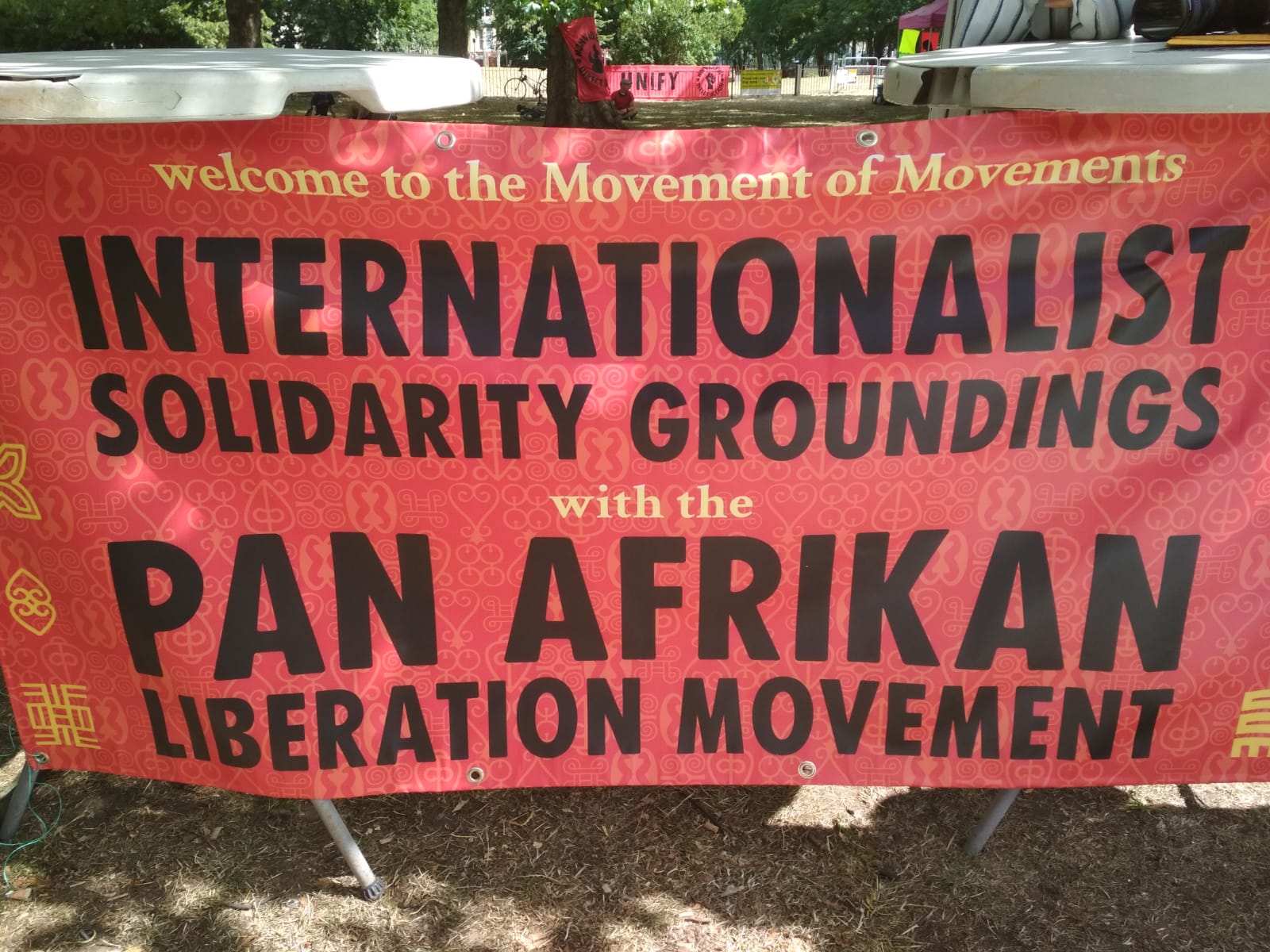
We did have a powerful array of Pan-Afrikanist and internationalist contributors to our event, who participated in the Movement of Movements Internationalist Solidarity Groundings with the Pan-Afrikan Liberation Movement, which took place at Max Roach Park, that reflected Pan-Afrikan dimensions of the struggle to effect and secure holistic Reparatory Justice.
We did compel public attention to be paid to our cause of asserting our legitimate intergenerational demand that the UK Government commit to holistic reparations, with the first serious step being that of establishing the UK All-Party Parliamentary Commission of Inquiry For Truth & Reparatory Justice.
Support Received
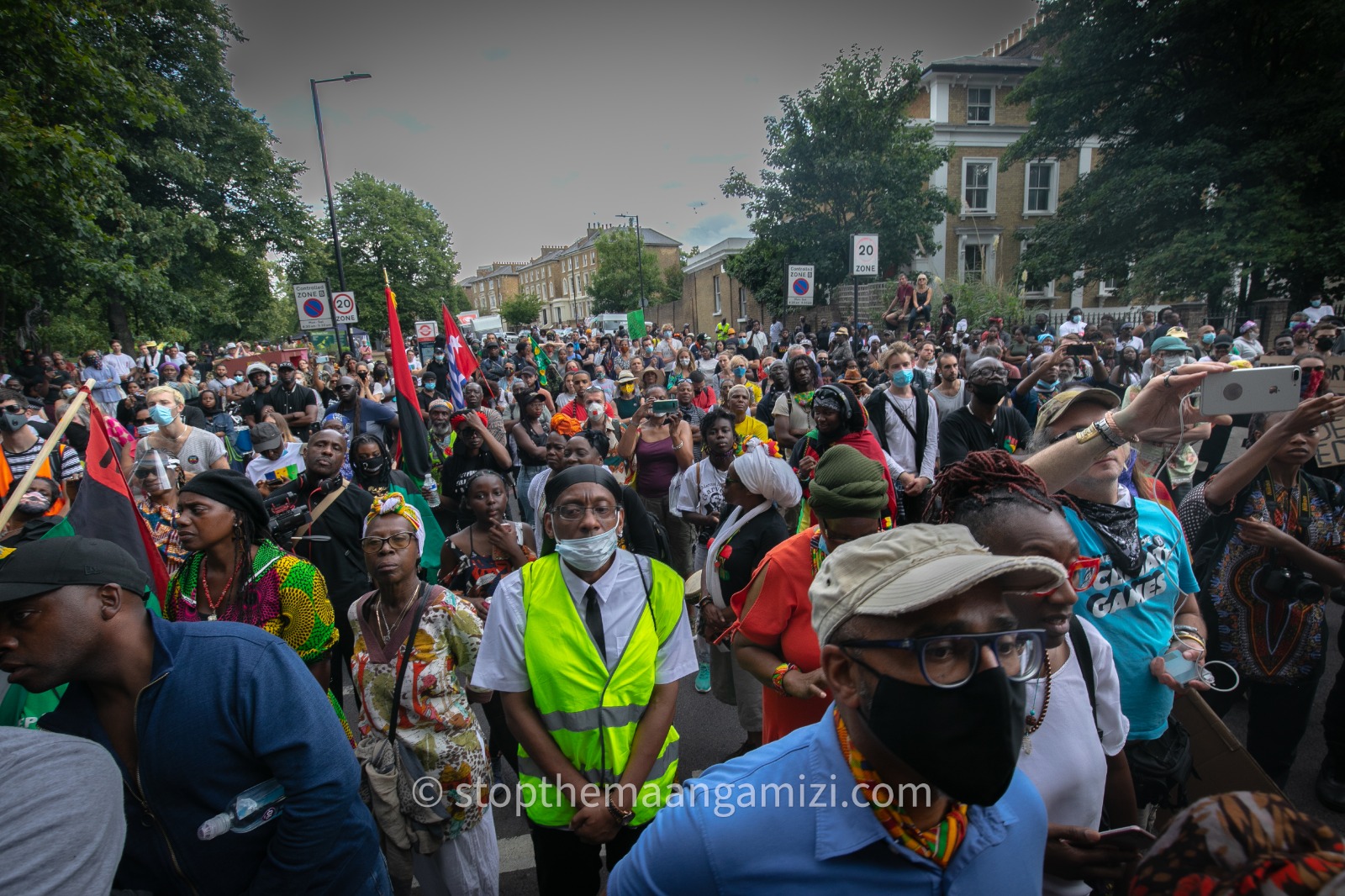
We received extensive support from diverse sections of our Afrikan Heritage Communities, including many supporting and contributing community based organisations, who came out in their thousands, (not hundreds as many of the media reports are mis-reporting). We take pride in the fact that despite fearmongering and threats from the police and the entire British State machinery, our people still came out defiantly in support of our call to unity for Reparatory Justice action.
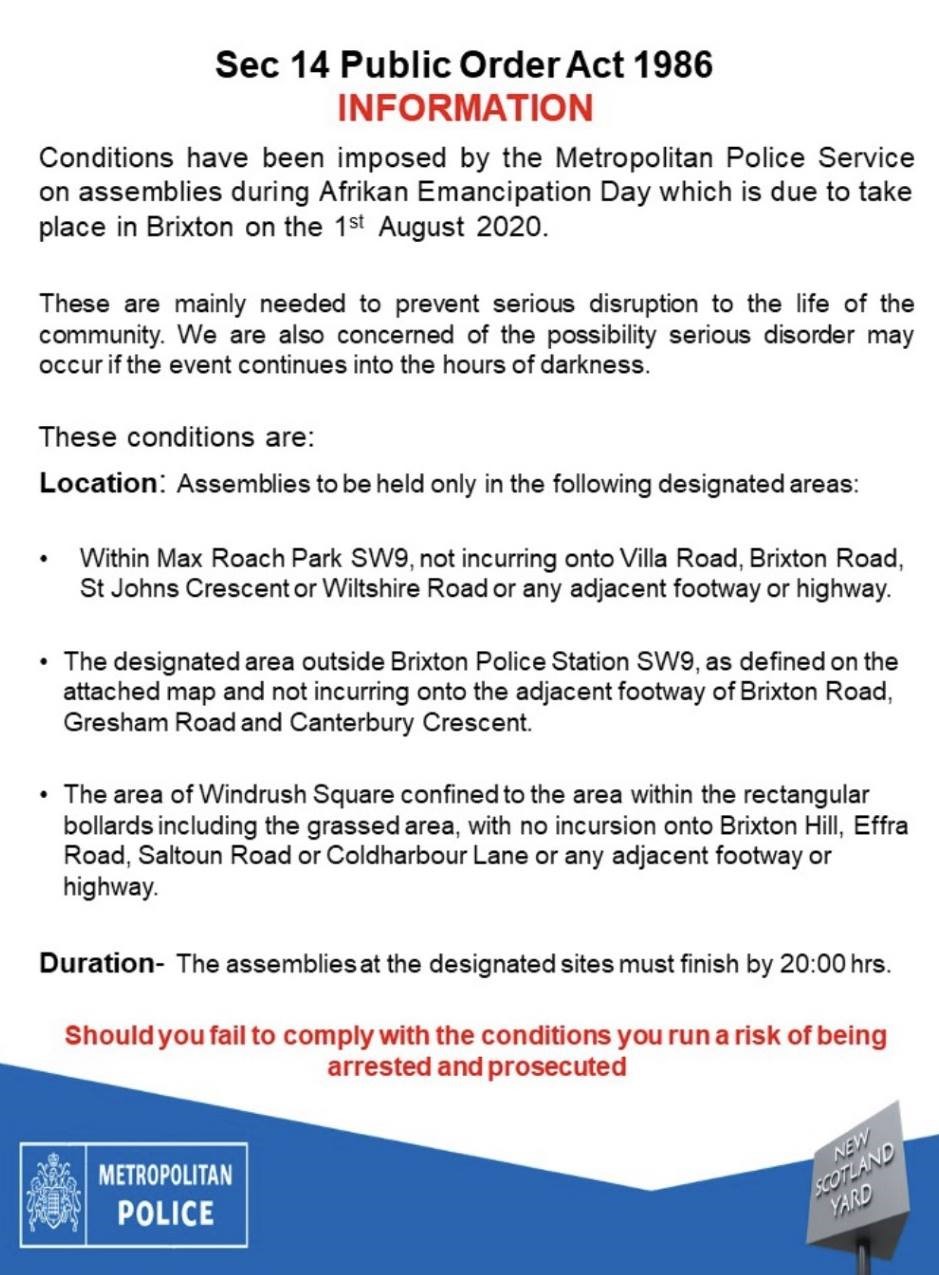
We acknowledge the fact that, because of the government and state anti-terrorism policing impositions imposed within less than 24 hours of our Reparations Rebellion Groundings, a few shortcomings made what we had planned as co-organisers not to be fully realised. Such short-comings, some of which were due to interferences and obstructions from central government were taken advantage of, by the British state machinery, to falsify and create situations of make-believe conflict that resulted in 3 arrests and threatened to provoke our Black communities in attendance, into what could have degenerated into rioting.
We have good cause to say so because on the morning of the 1st of August, a member of the public who was driving in his car in the vicinity of where the Reparations Rebellion Groundings were meant to be taking place, observed police officers piling bricks into a police van. The member of the public described the bricks as being “proper house bricks” so Leo Muhammad, a longstanding member of the Nation of Islam, but who was not working in an official capacity, but rather participated in the Reparations Rebellion Groundings as a longstanding member of the Afrikan Emancipation Day Reparations March Committee, reported this incident to Superintendent Ian Howell (Lambeth Borough), Police Liaison Officer Sergeant Simon Hearn and Community Liaison Officer, Lance Edmondson, based at Brixton Police Station. Leo Muhammad was accompanied by the eye-witness and a security officer supporting our security and stewarding operations for the Reparations Rebellion Groundings, who was wearing a body camera and therefore such reporting of this incident was recorded.
As co-organisers, we in the Stop the Maangamizi Campaign and Afrikan Emancipation Day Reparations March Committee up till now have not received a satisfactory answer to the request to know why police officers were seen piling bricks into a police van. The explanation provided was that the local authorities, Lambeth Council had been doing some “cleaning up”. Notwithstanding the aforementioned, as co-organisers, we would like to express our appreciation to Extinction Rebellion Police Liaison, Paul Stephens who brilliantly helped us in working reasonably well with the police in general but also particularly with Police Liaison Officer Sergeant Simon Hearn and Community Liaison Officer, Lance Edmondson who genuinely tried to help and facilitate us to ensure that the Reparations Rebellion Groundings ran peacefully according to our purpose.
Through the increasing level of awareness and collective discipline that we are cultivating in our Afrikan Heritage Communities and in the building of cross-community alliances and ‘movement of movements’ cooperative relationships, such provocations, were pre-empted and resisted from our peaceful standpoint of non-violent direct action. We are grateful to our own Afrikan Heritage Communities and all who came in solidarity for enabling us to defeat the shenanigans and machinations of the British state machinery and other white supremacy racist agent provocateurs so that our activities on the day were held successfully in accordance with our ancestral Afrikan visions, values and principles of Ma’at and Ubuntu to ensure a peaceful success in tune with our Reparatory Justice demands for Planet Repairs.
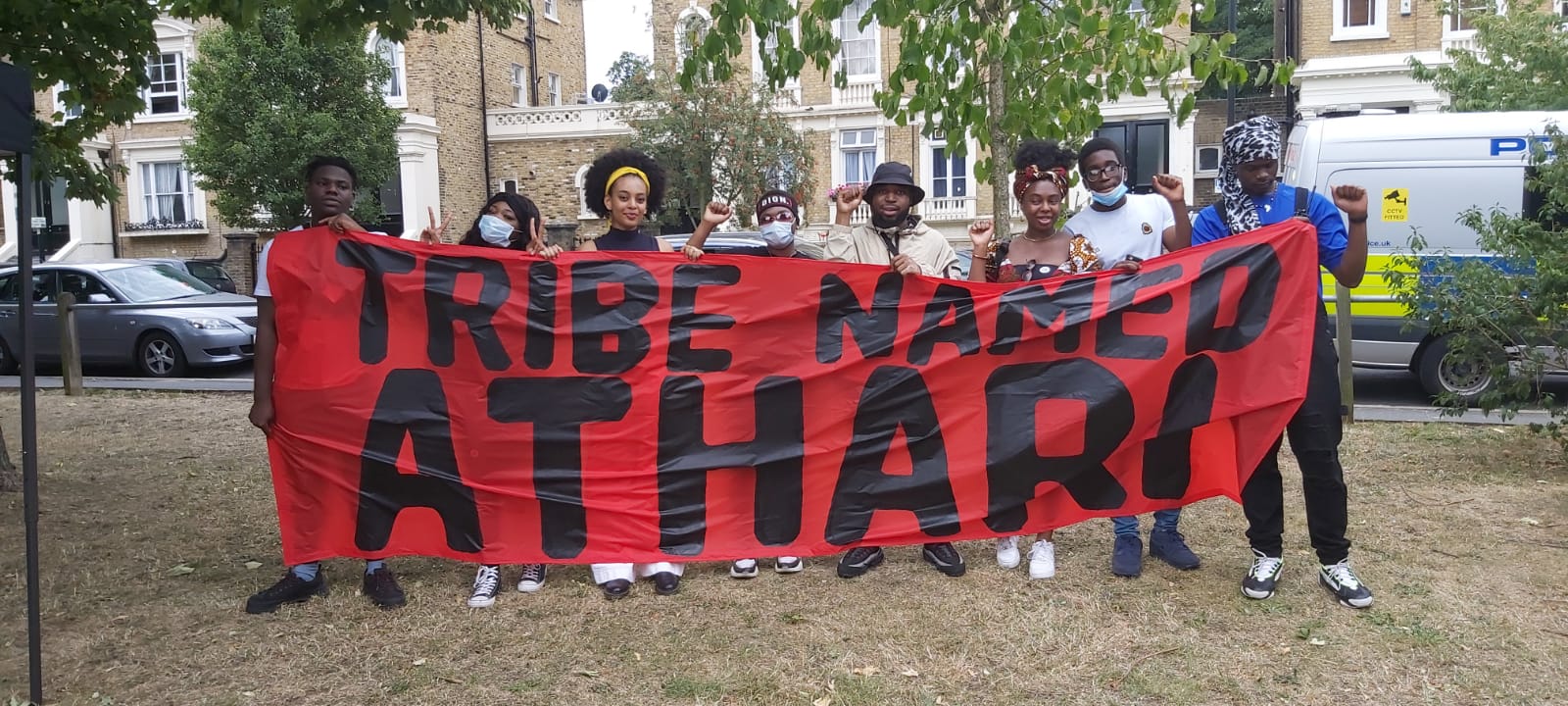
We are appreciative of our youth and student contingents from the Tribe Named Athari (TNA) and Rhodes Must Fall Oxford (RMFO) who contributed immensely to ensuring that the participation of the younger generation manifested the ethos of our Afrikan Emancipation Day commemorations as those of Reparations Rebellion Groundings in their real community educational meaning promoted by Dr Walter Rodney. We express our highest regards to various allies particularly those from Extinction Rebellion (XR) who demonstrated some of the best traditions of internationalist solidarity long displayed by progressive forces in Britain by acting in strict accordance with roles we had agreed that they would play, in contributing to the success of our activities on the day, through the facilitation of the Extinction Rebellion Internationalist Solidarity Network (XRISN).
We also express our gratitude to Councillors like Cllr. Scott Ainslie, and Cllr. Cleo Lake, who have been leading our engagement with the Green Party in getting ‘Atonement and Reparations’ motions passed by Lambeth Council on 15th July 2020 and Islington Council on the 9th July 2020. We particularly commend those in Lambeth Council whose version of the motion passed highlighted our need for the UK Government to establish the All-Party Parliamentary Commission of Inquiry for Truth & Reparatory Justice (APPCITARJ). The APPCITARJ is what we, as co-organisers from the International Social Movement for Afrikan Reparations see as the essential starting point for British state action in facilitating the masses of our Afrikan Heritage Communities across the World to access just hearings; which is in itself a reparative measure in accordance with the UN Framework on a Right to a Remedy and Reparations.
We are encouraged by the growing support from our Afrikan Heritage and other Black Communities, as well as wider sections of society in Britain, including diverse communities of the Global South Diasporas. We are glad that many in these communities are increasingly recognising the need for all of us to build the kind of principled unity that will enable the prolonging resistance efforts of our communities in the Global South to merge into the Global Rebellion that will deliver victory to all of us in ways that will not only make us win our specific community Reparations goals but also ensure the achievement of all the necessary Planet Repairs. For it is such holistic repairs to Peoples and Planet that will guarantee a cessation of violations and non-repetition of what we refer to as the Maangamizi (Afrikan Hellacaust), so that we shall have a New World of enduring Global Justice for all.
The Way Forward
We shall continue to work in advancing the momentum reinvigorated by the 1st Mosiah (August ) Afrikan and support the likes of A Tribe Named Athari (TNA) and allies who are working to earn for themselves places of honour in the front-ranks of the International Social Movement Afrikan Reparations (ISMAR) and the Peoples Reparations International Movement (PRIM) respectively.
We encourage community members, supporters and allies to do any of the following 4 things:
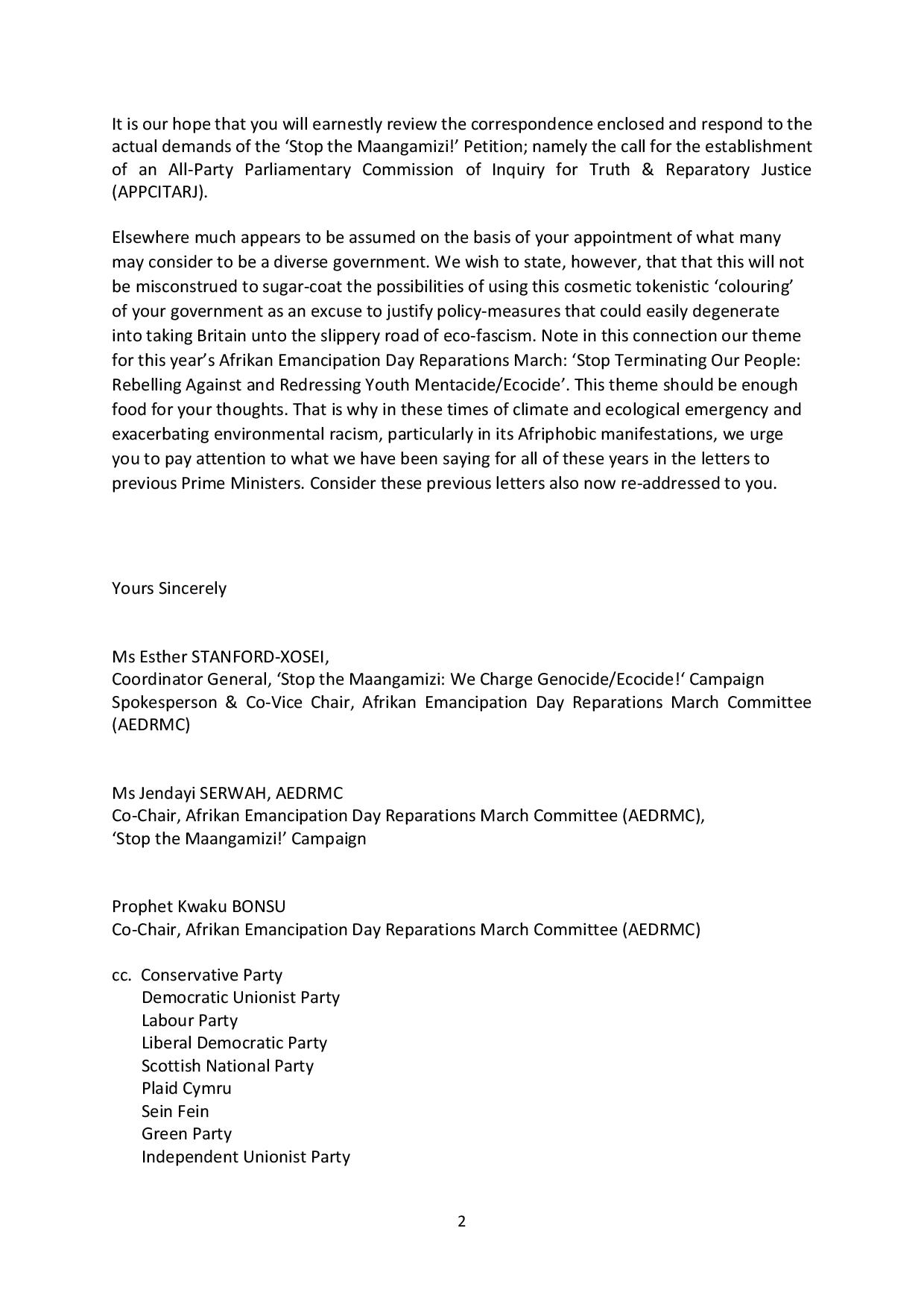
Write to elected officials to request their support for the Stop the Maangamizi Campaign demand for the establishment of the All-Party Parliamentary Commission of Inquiry for Truth & Reparatory Justice at the level of the UK Parliament.This is a link to an article we have on our website, with a template Stop The Maangamizi Postcard and template letter which can be amended from the perspective of allies supporting this demand.
In accordance with the Afrikan visionary ethical framework of MA’AT, we are supporting XR, through XRISN, to work towards the successful holding of its next phase of rebellion ‘We want to live – The Rebellion returns to Parliament on 1 September amidst warnings of a 4°C world‘; doing so in ways that will take shared learning from our 1st August Afrikan Emancipation Day Reparations Rebellion Groundings into their own manifestations of non-violent direct action – ‘From Brixton Lockdown to Parliament Lockout’. We are planning to organise an interfaith human chain to surround the British Houses of Parliament with ceremonies to exorcise the criminal demons of genocide and ecocide out of such a Maangamizi crime scene to prepare this institution to host the APPCITARJ. Such spiritual cleansing ceremonies will be conducted by Indigenous spiritual practitioners of liberation theology from Afrika and other regions of the Global South assisted by interested people of all faiths in the Global North. By so doing, we shall be strengthening People-to-Peoples Internationalist Solidarity in order to move all progressive forces of Humanity harmoniously towards our common objective of ‘Planet Repairs!’ as expressed in our Reparatory Justice slogan of ‘Stop The Maangamizi – We have Ubuntudunia to Win’.
We are inviting all from our Afrikan Heritage Communities and allies to join us in responding to the internationalist solidarity gesture of the New Tribe and their supporters from the communities of resistance of the South Abya Yalan (so-called Americas) Diaspora, who participated in the edutainment activities of our Reparations Rebellion Groundings in Brixton to support their own forthcoming commemoration of 12th October, as the International Day of Indigenous Resistance. Together, in such actions of true internationalist solidarity, we all shall win.
For us in the Stop the Maangamizi Campaign and others in our ‘coalition of the willing’, preparation for 1st August 2021 Afrikan Emancipation Day Reparations Rebellion Groundings start from today, 3rd August 2020. Such Groundings will take place in the same area we were meant to lock-down in Brixton from Windrush Square to Max Roach Park including Brixton Road.
Esther Stanford-Xosei
Coordinator General, Stop The Maangamizi: We Charge Genocide/Ecocide Campaign (SMWeCGEC)
Esther is also the official spokesperson for the Afrikan Emancipation Day Reparations March Committee (AEDRMC) and Co-founder of Extinction Rebellion Internationalist Solidarity Network (XRISN)
See our response to Nigel Farage’s disparaging remarks here.
We in the ‘Stop The Maangamizi: We Charge Genocide/Ecocide!’ Campaign (SMWeCGEC) would like to extend our deep thanks and appreciation for the coverage Got Kush TV provided in preparation for the 2019 Afrikan Emancipation Day Reparations March and its all-year round campaigning work conducted through the SMWeCGEC as well as coverage of the March itself.
Although the 2019 Reparations March pre-March interviews below are relevant to the all-year round activism in advancement of the cause of reparations and strengthening the International Social Movement for Afrikan Reparations (ISMAR).
The following videos are coverage of the actual 2019 Afrikan Emancipation Day Reparations March including some of the speeches:
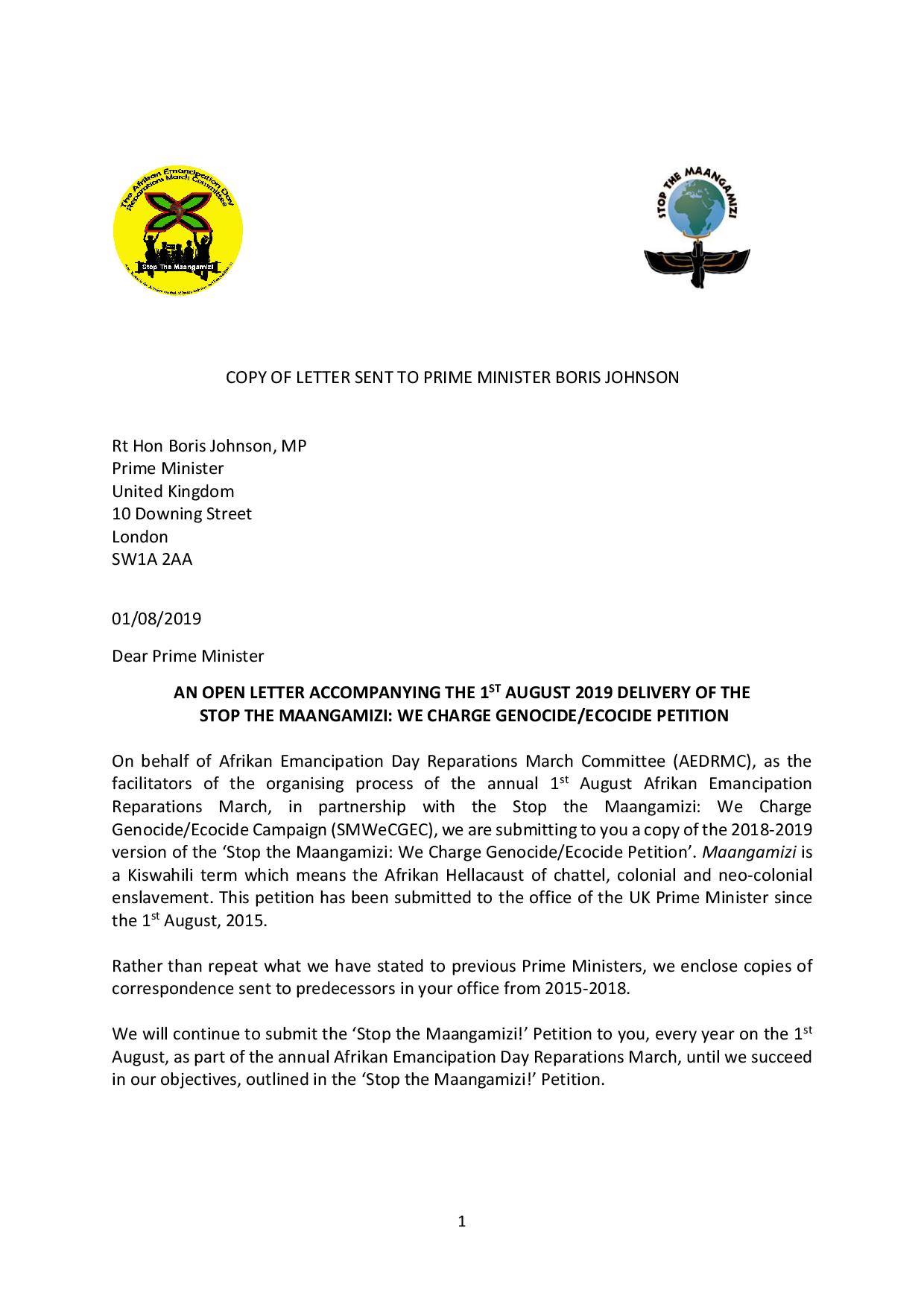
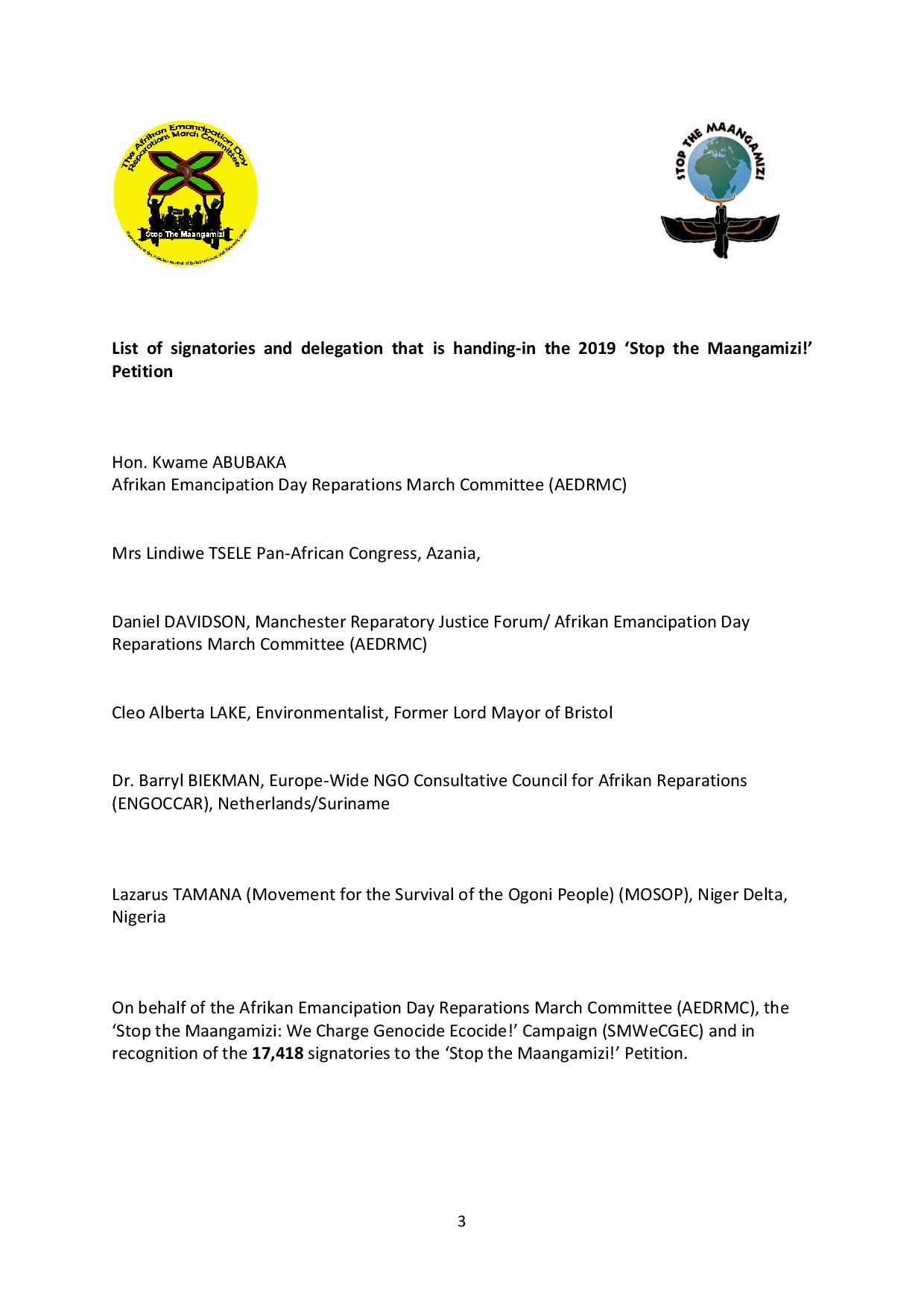
London UK 1st August 2019 (L to R) Cleo Alberta Lake, Lazarus Tamana , Hon. Kweme Abubaka and Dr Barryl Biekman present the ‘Stop The Maangamizi!’ Petition calling for the establishment of the All-Party Parliamentary Commission of Inquiry for Truth & Reparatory Justice for the Afrikan Hellacaust at 10 Downing Street as part of the Afrikan Emancipation Day Reparations March on Emancipation Day, . Emancipation Day marks the anniversary of the 1833 Slavery Abolition Act.
Please note, only copies of the additional 2,828 signatures collected between last year (14,590) and this year (17,418) were handed in with a copy of the ‘Stop the Maangamizi!’ Petition. Every year we tend to copy the same petitions and re-submit them with additional signatures collected. For environmental reasons, it was determined that we would only hand in the additional signatures collected this year until we reach 100,000 signatures that will be handed in all together when that figure is reached. Or in the alternative that the lobbying efforts of MPs and other elected officials via the ‘Stop The Maangamizi!’ Postcard yield the desired results. However, the SMWeCGEC is not relying on securing 100,000 to secure the campaign objectives, as ultimately reparatory justice will be effected, secured and taken by our own People’s Power, supported by other People’s of Conscience as well as our non-Afrikan Allies as part of PRIM-building.
In total 17,418 people have now signed the petition, this includes those who sign the online petition and the paper version.
Although 6 Petitioners were present as identified in the covering letter to the UK pRIME Minister which accompanied the petition, only 4 of the 6-member delegation were able to hand in the petition this year due to 2 members of the delegation unfortunately forgetting their ID.
This is a link to info about the petition hand-ins in the three preceding years:
We in the ‘Stop The Maangamizi: We Charge Genocide/Ecocide!’ Campaign (SMWeCGEC) would like to extend our deep thanks and appreciation for the coverage Got Kush TV provided in preparation for the 2019 Afrikan Emancipation Day Reparations March and its all-year round campaigning work conducted through the SMWeCGEC.
Although the 2019 Reparations March has now taken place, the interviews below are relevant to the all-year round activism in advancement of the cause of reparations and strengthening the International Social Movement for Afrikan Reparations (ISMAR).
Greetings Signatories of the ‘Stop the Maangamizi!’ Petition and other Supporters of the ‘Stop the Maangamizi!: We Charge Genocide/Ecocide Campaign (SMWeCGEC).
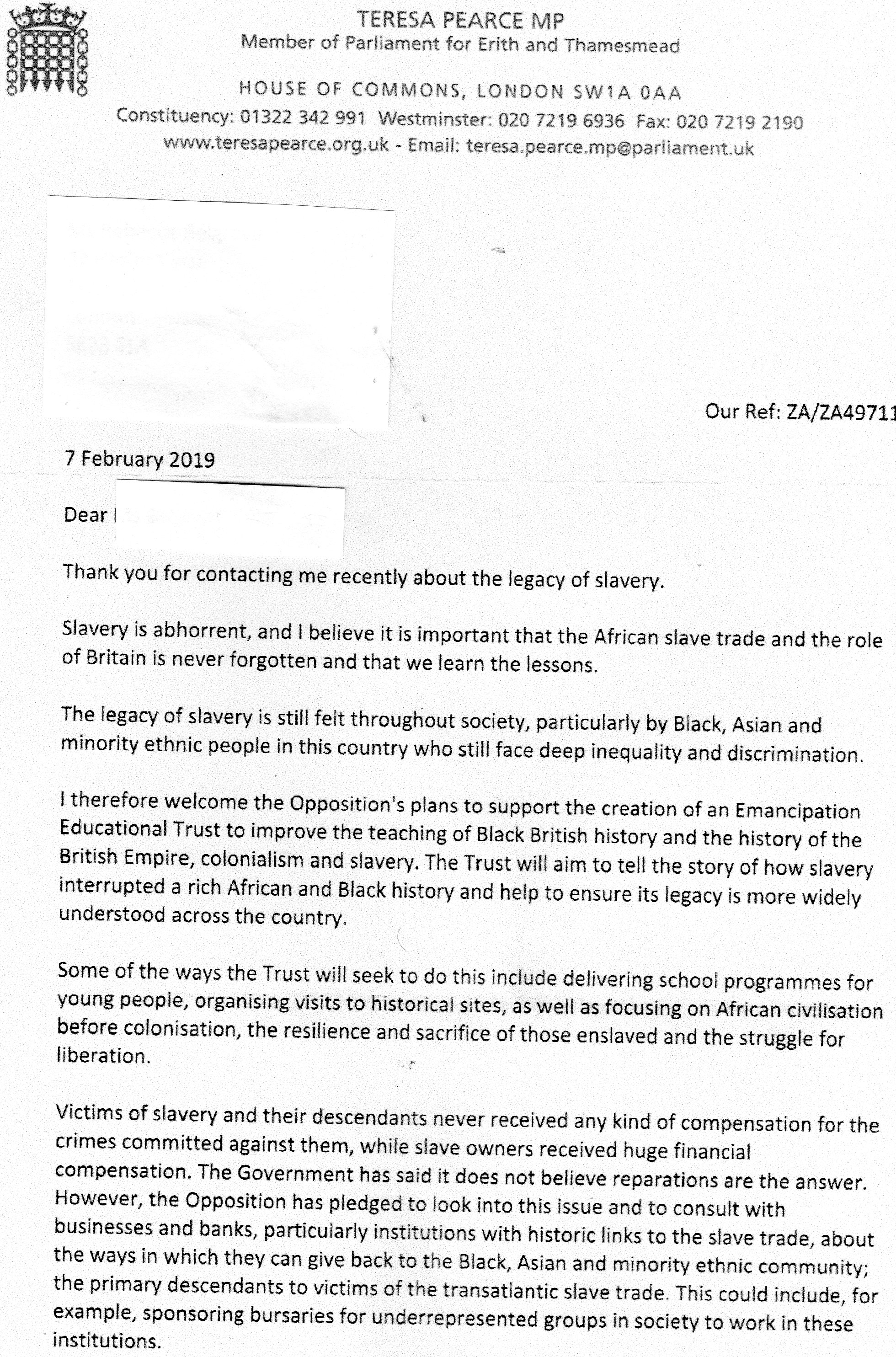
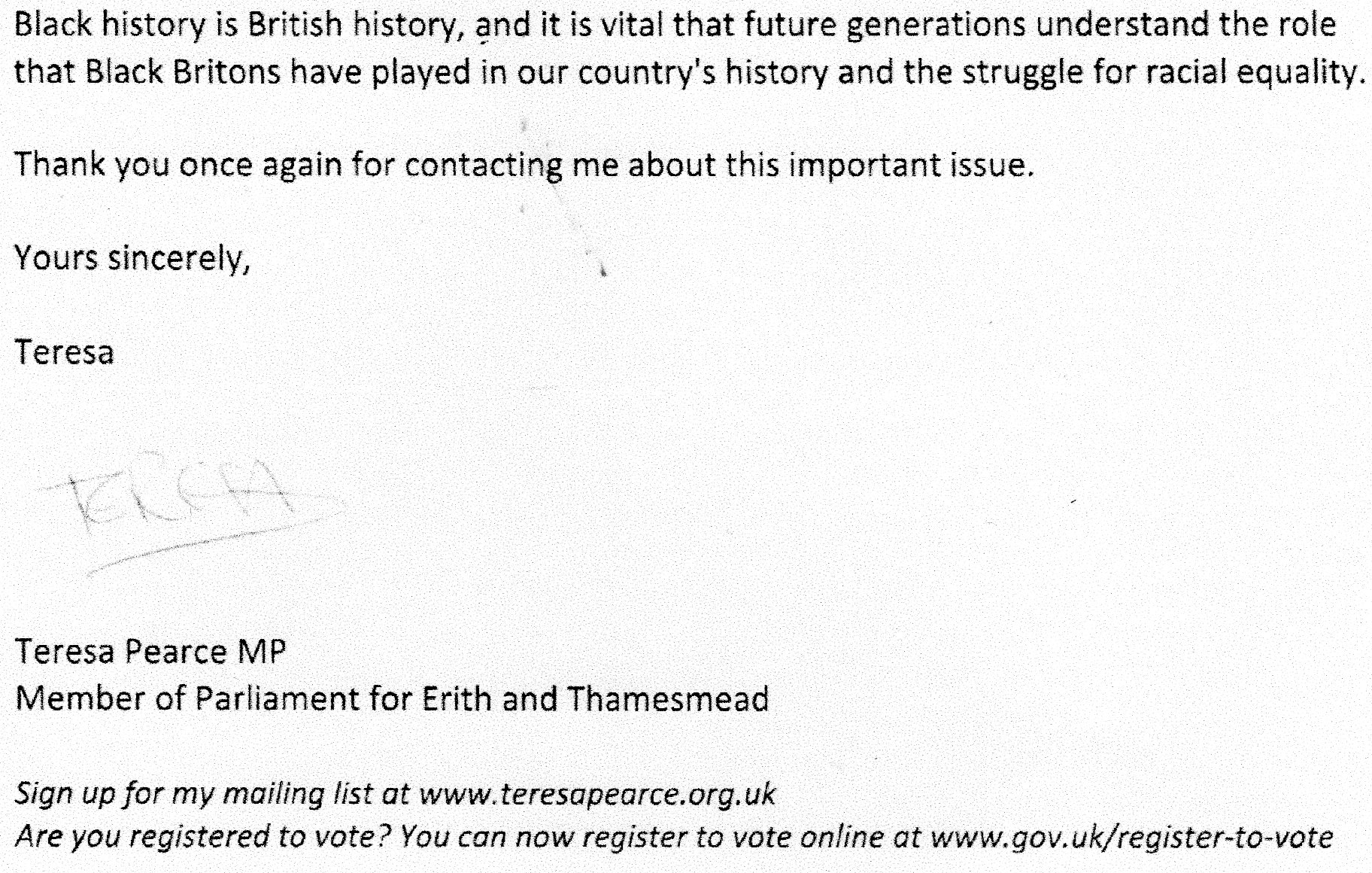
This is a case study of the advocacy of ‘Stop the Maangamizi!’ campaigner, Sis Dan, an Actioneer with the Afrikan Emancipation Day Reparations March Outreach Team, with her MP, Teresa Pearce, Member of Parliament for Erith and Thamesmead.
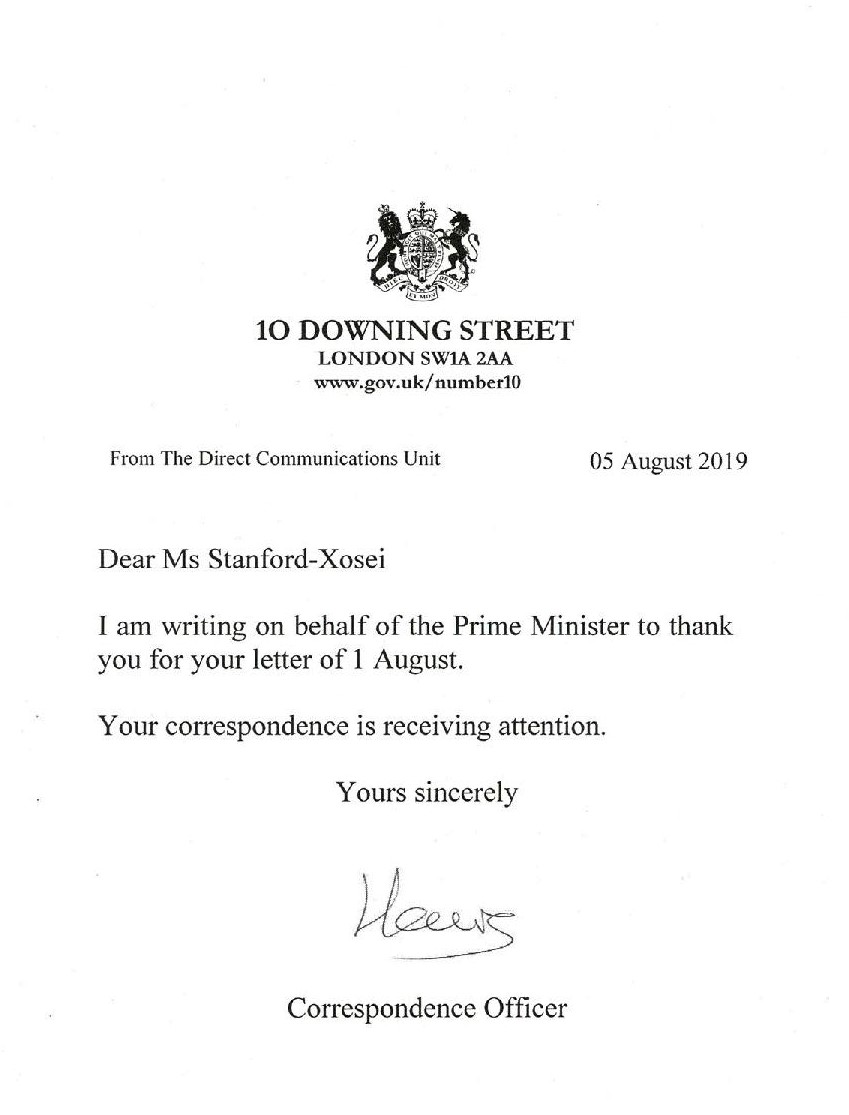
The response below, dated 7 February 2019, was received by Sis Dan, who sent a copy of the ‘Stop the Maangamizi! template letter to her MP Teresa Peace. The letter requests that MPs as elected officials “contribute to halting and reversing the enduring injustices of the Maangamizi for Afrikan Heritage Communities by:
1. Initiating a lobby in Parliament on Afrikan Heritage Communities Legacies of Enslavement;
2. Supporting the call to establish an All-Party Parliamentary Group on Afrikan Heritage Communities Legacies of Enslavement;
3. Supporting the Afrikan Heritage Communities’ (AHC) demand for the establishment of UK and EU All-Party Parliamentary Commissions of Inquiry for Truth & Reparatory Justice.”
The personal details of Sis Dan have been redacted at her request
Page 2 of the letter
You can read SMWeCGEC commentary about the above response in the posting here.
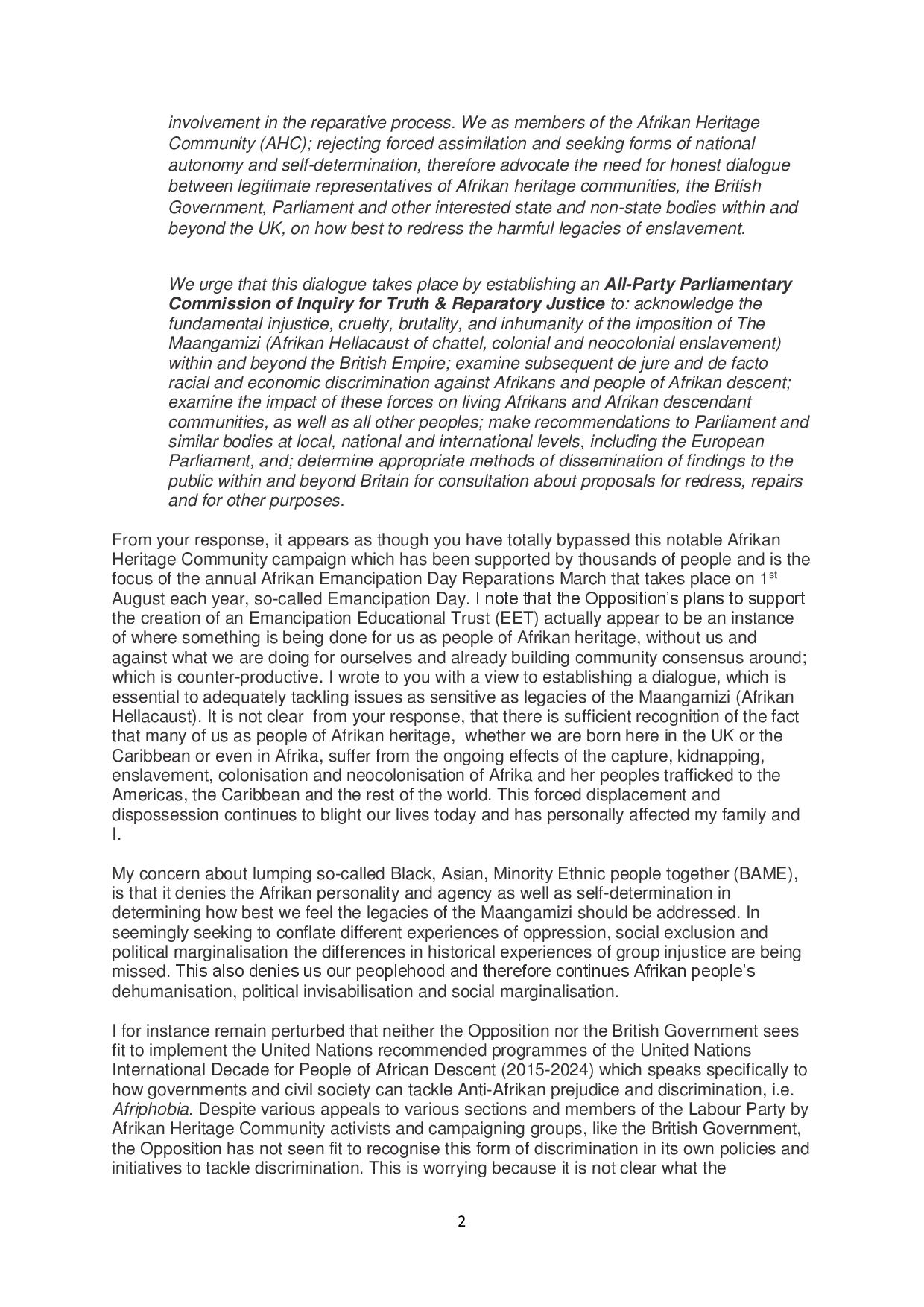
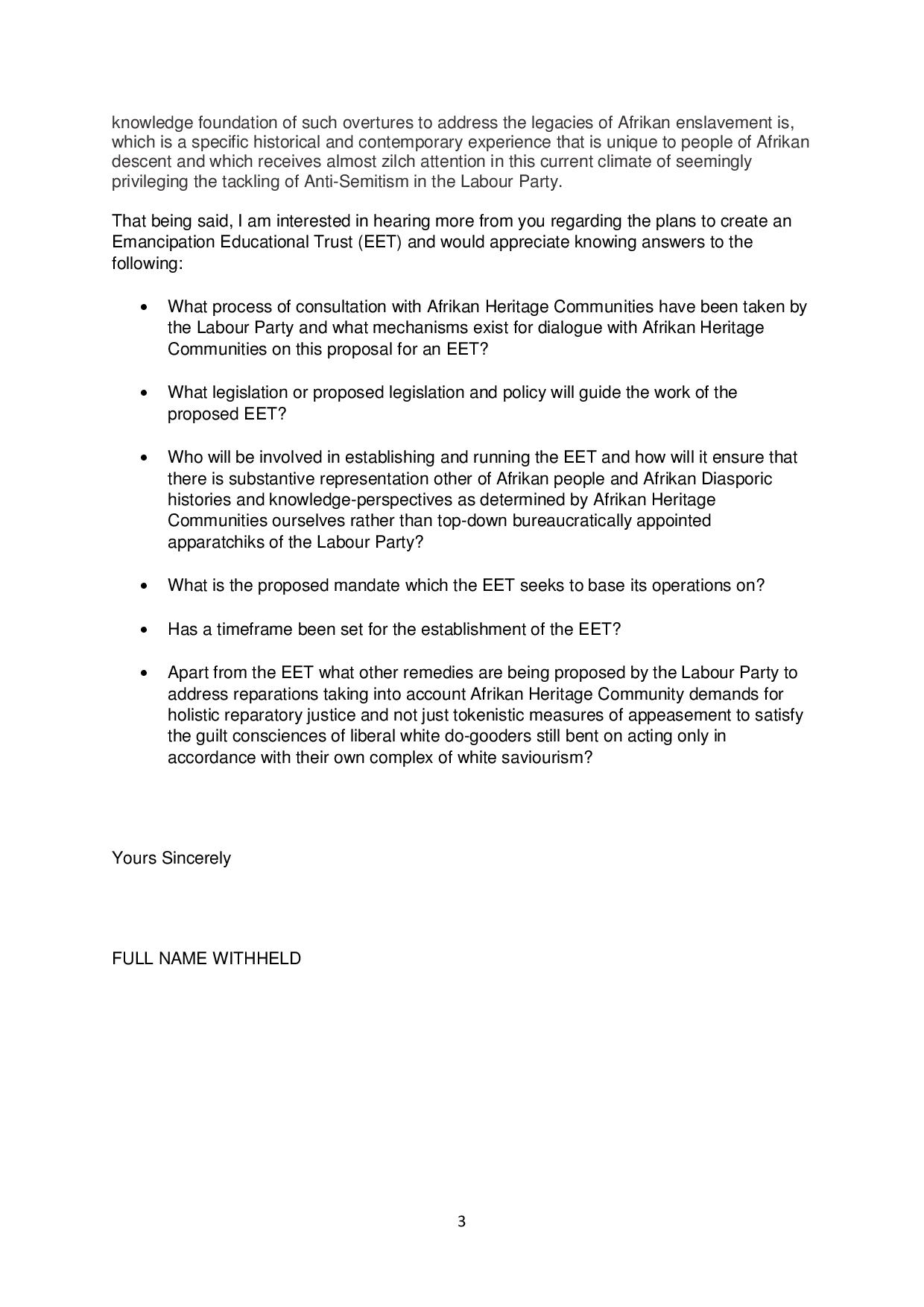
Sis Dan sent the following response to Teresa Pearce which was also copied to the SMWeCGEC. She has given permission for her response to be shared but we have also removed Sis Dan’s address and other personal details.
It is important to note that Sis Dan was able to formulate this response in consultation and after much discussion with her children and other family members as per the approach which the SMWeCGEC has advocated in the establishment of Maatzoezaduara’s (i.e. Maat action-learning circles or ‘Maat Training Practice Rings’) which is a reparatory justice circle of Maat practitioners who learn to be the self-repairs change at the levels of their person, home, family, neighbourhood, workplace, school, college, university, places of leisure and worship, etc.
These Maat Training Practice Rings encompass a number of families and lineages, across geographical boundaries and generations. For example, a home or family based Maat Training Practice Ring will entail getting a selected number of people in your family interested in unravelling family histories and using this knowledge to recognise and gather evidence of the harm that has been done to you as a family. The Practice Rings will also explore how such harms have been passed down throughout the generations, resulting in increasing levels of disrepair.
Until next time!
SMWeCGEC International Steering Committee Spearhead Team





 This is a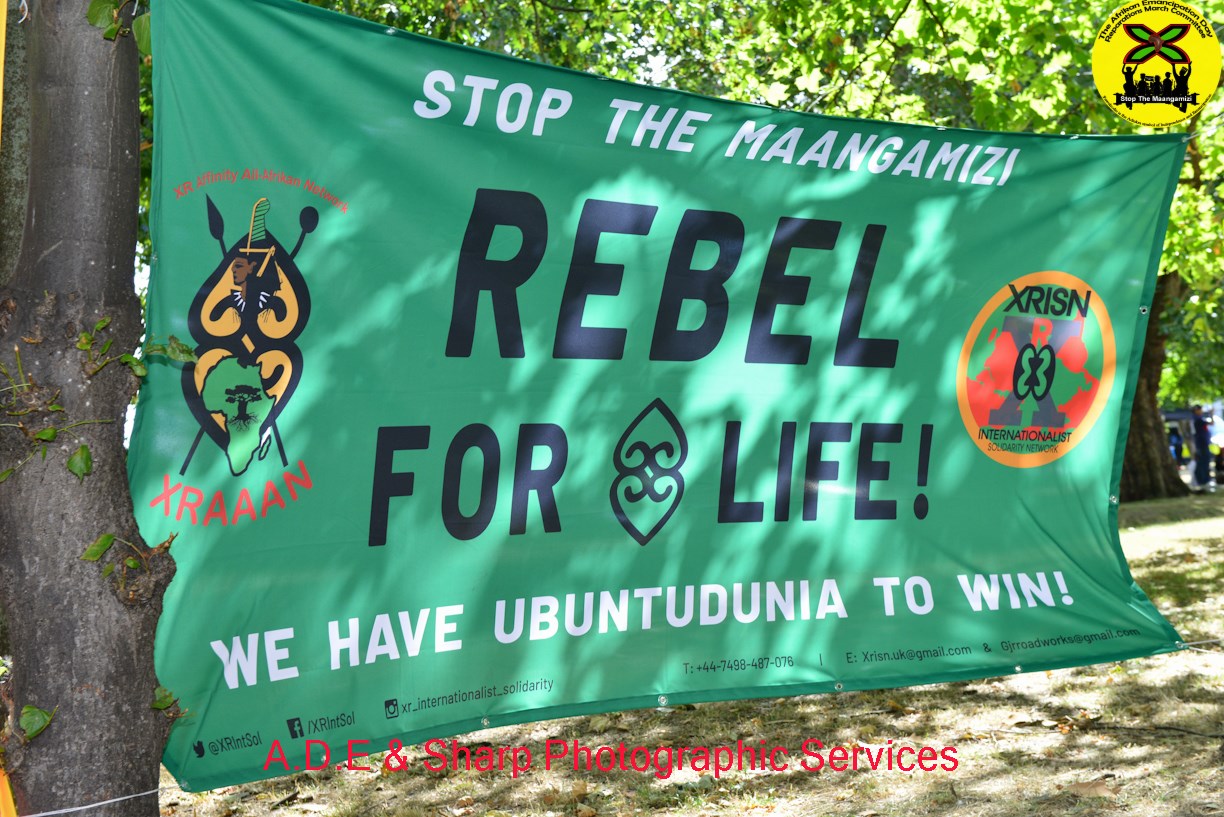





 stopthemaangamizi.com