stopthemaangamizi.com

Stop the harm as the first step to repairing the damage!

Menu

Skip to content
  • Home
  • CONTACTS
  • GLOBAL MAJORITY VS
  • I AM WITNESS
  • MAANGAMIZI DESECRATORS & DENIERS
  • MAANGAMIZI EDUCATIONAL TRUST (M.E.T)
  • SMWeCGEC PETITION
  • TAKE ACTION
  • PAN-AFRIKAN REPARATIONS REBELLION GROUNDINGS

Category Archives: STOP THE MAANGAMIZI CAMPAIGN

A CALL FOR REPARATORY JUSTICE ETHICS

Posted on November 27, 2017 by STOP THE MAANGAMIZI


LETTER TO ‘THE VOICE’ NEWSPAPER

Dated 24th November 2017


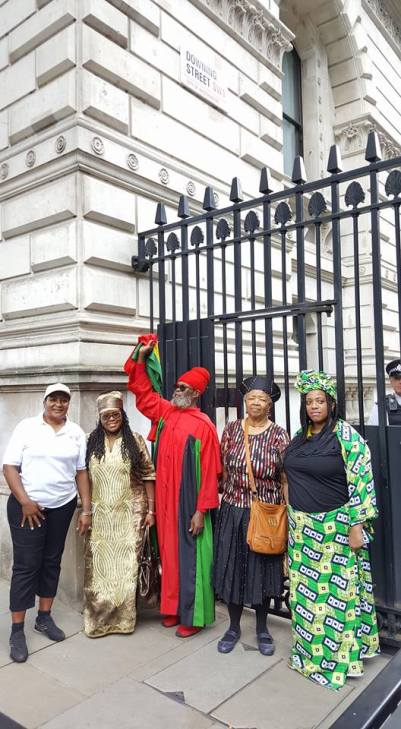
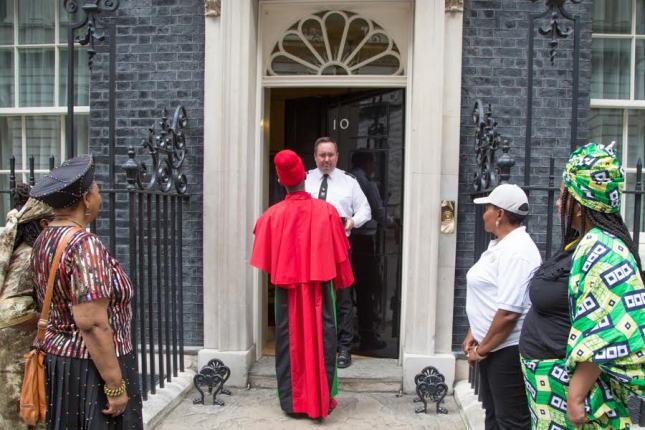
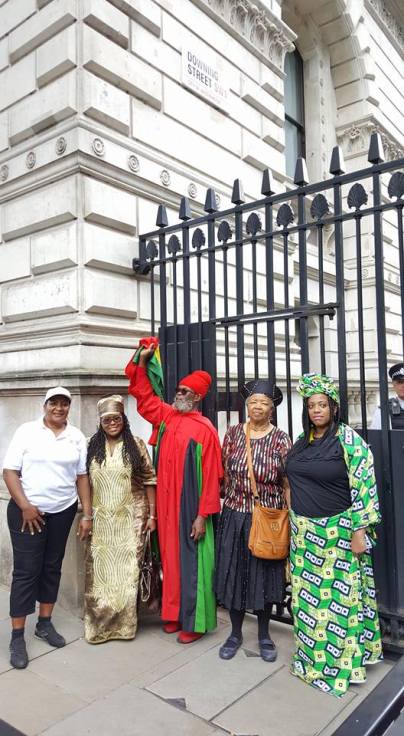
London: A delegation hands in 'Stop The Maangamizi' Petition at Prime Minister's Office, 10 Downing Street on 1st August to counter Afrikan Holocaust (Maangamizi) denial and demand holistic reparatory justice for the Afrikan Holocaust.
London: A delegation hands in ‘Stop The Maangamizi’ Petition at Prime Minister’s Office, 10 Downing Street on 1st August to counter Afrikan Holocaust (Maangamizi) denial and demand holistic reparatory justice for the Afrikan Holocaust.

Dear George Ruddock, Editor & Leah Sinclair, Online Editor of The Voice Newspaper

I was interested to read ‘The Voice’ online article published on 19th November 2017: ‘Parliament urged to examine reparations’ and the report back on the Global Afrikan Congress UK lobby written by Vic Motune.

It would be good if your journalists researched to verify the sources of ideas and initiatives that they report on. You ought to have known that the concepts and its practical translation into campaigning for the All-Party Parliamentary Commission of Inquiry for Truth & Reparatory Justice (APPCITARJ) originated from, and have been publicly pursued by, the ‘Stop the Maangamizi!’ Campaign.

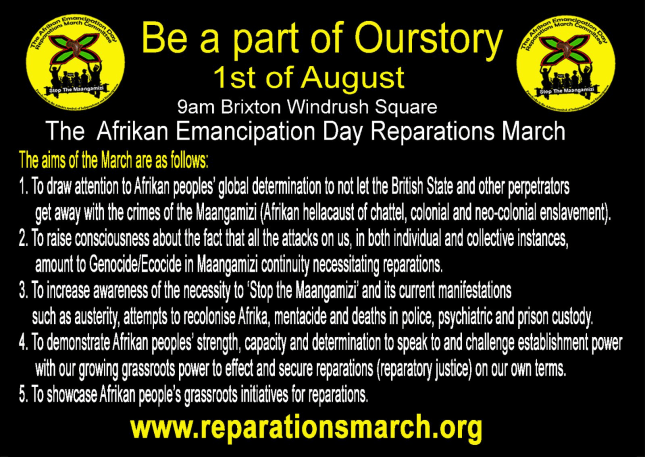
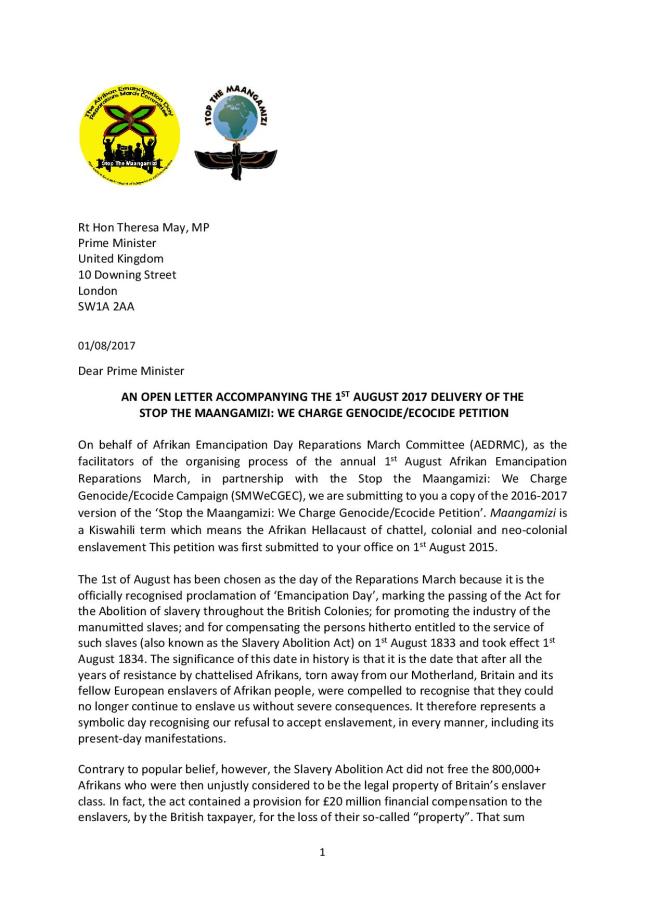
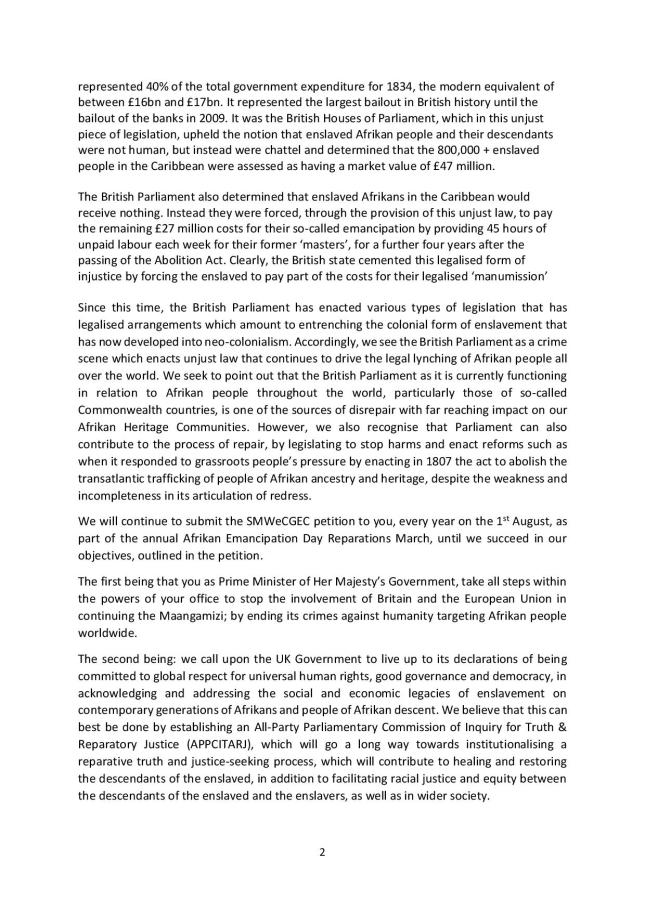
The ‘Stop the Maangamizi’ Campaign is the official campaign partner to the Afrikan Emancipation Day Reparation March Committee (AEDRMC) which organises the annual Afrikan Emancipation Day Reparations March on the 1st August each year. This is one of the main demands we have recurrently been putting before the entire British state in our annual 1st August reparations marches. Even a cursory reader of the letters that accompany the ‘Stop the Maangamizi’ Petition, which is presented each year to the UK Prime Minister at No 10 Downing Street as one of the activities of the reparations march, would know this.

GACuk, which has always participated in these marches over the years, is therefore being dishonest in not acknowledging the originators of the APPCITARJ as is the ethical requirement for borrowing other people’s ideas.

We hope your diligent research and professional media following of the activities of the International Social Movement for Afrikans (ISMAR) in the UK, which include the co-organsers and supporters of the annual reparations march and its demands, which include embracing the APPCITARJ, will be more accurately reported on in your future coverage of these matters.

We recommend that you study and possibly do a write up on the report of the recent international dialogue with UK reparations activists and representatives from the National Council on Reparation in Jamaica which took place on 14th November 2017.

It would be good if one of your journalists wrote about some of the recent updates in the ISMAR in the UK, or I could help by writing one; even doing so jointly with one of your journalists.

We in the ‘Stop the Maangamizi!’ Campaign are very much interested in the ‘Voice’ maintaining its reputation as a credible media institution and ‘Britain’s top Black Newspaper’ and would like to contribute to making it remain so.

Sincerely

Esther Stanford-Xosei

Coordinator-General, ‘Stop the Maangamizi: We Charge Genocide/Ecocide!’ Campaign

Spokesperson, Afrikan Emancipation Day Reparations March Committee (AEDRMC)

Posted in AEDRMC, AFRIKAN HELLACAUST, AFRIKAN RESISTANCE, ALL PARTY PARLIAMENTARY COMMISSION OF INQUIRY (APPCITARJ), INTERNATIONAL SOCIAL MOVEMENT FOR AFRIKAN REPARATIONS, ISMAR, MAANGAMIZI RESISTANCE, REPARATIONS, Reparatory Justice, SMWeCGEC, STOP THE MAANGAMIZI CAMPAIGN, STOP THE MAANGAMIZI PETITION, THE 2017 AFRIKAN EMANCIPATION DAY REPARATIONS MARCH, UBUNTUKGOTLA/PITGJ, Uncategorized | Tagged 1st August, Afrikan Liberation, British Government, Commission of Inquiry, Emancipation Day, Genocide, Holocaust, Marching, Movement-Building, Pan-Afrikanism, People Power, REPARATIONS, Reparations Ethics, Reparations March, Reparatory Justice, Reparatory Justice Ethics, Self-Repairs, Social Movement | Leave a comment

REPARATIONS INTERNATIONAL DIALOGUE HIGHLIGHTS ‘STOP THE MAANGAMIZI!’

Posted on November 23, 2017 by STOP THE MAANGAMIZI

AN ISMAR UK DIALOGUE IN LONDON WITH CARICOM – NATIONAL COUNCIL ON REPARATION IN JAMAICA (JNCR): AN INITIAL REPORT-BACK

DIALOGUE DATE : 14 NOVEMBER 2017


*ISMAR stands for International Social Movement for Afrikan Reparations


Including:

1. Professor Verene Shepherd: Scholar-Activist Co-Chair of the Jamaica National Council on Reparation (JNCR), Director of the UWI – Centre for Reparation Research, Independent Expert at the UN Committee on the Elimination of Racial Discrimination.

2. Bert Samuels: Pan-Afrikanist Attorney-at-Law, Head of JNCR Legal Working Group.

3. Lord Anthony Gifford QC: Attorney-At-Law, Member of Queen’s Commission, Member of JNCR, Citizen of Jamaica since 1990’s, involved with reparations since days of mentor Bernie Grant, MP.

“Dialogue is a form of struggle. It is not a chit chat. Create a dialogue that focuses not just on the vulnerability of all groups, but on those larger issues of justice, democracy and the crisis within our own communities then try to hammer out some everyday problems that relate to the everyday lives of those groups”

Professor Cornel West


Purpose of the Meeting

The meeting started with introductions and a reminder of the purpose of the deliberations:

1: The status of the reparatory justice movement in the UK and Jamaica (update on both sides);

2: What strategies have worked and why? What strategies have not worked and why?;

3. The way forward.

It was reiterated that this meeting is a dialogue and, notwithstanding the limits of time, participants should adhere to and help reinforce the principles of dialogue. Communication agreements were highlighted: it was emphasized that people should speak from their own reality, speak in their name, from their own point of view and also realise that we are here to share as well as listen to others; and that in doing, so we do not all have to agree with each other.


From the JNCR

Professor Shepherd made some preliminary comments. She recognised that there were some misgivings and acknowledged that some of the participants had previously sent in their issues of concern in advance of the meeting. She stated that they would not be able address all the points and issues that had been sent in advance from some parties in the dialogue but emphasized that this is not the only trip the delegation will make. She informed the gathering that she is head of the JNCR Diaspora and International Engagement Working Group. There is another JNCR working group which is the Internal Reparations and Internal Engagement Working Group for Postcolonial Wrongs committed by post-colonial regimes like Coral Gardens. So, the JNCR is working externally and internally.

Professor Shepherd acknowledged that there were lots of questions about the CARICOM Reparations Commission (CRC). The Chair of the CRC, she explained that Professor Sir Hilary Beckles, wanted to join on this trip and was not able to but has committed to a separate trip here next year on behalf of the CRC. She reiterated that this engagement is part of the JNCR terms of reference point 6, which is “to engage the international community in Afrika, the Americas and Europe in discussion on reparations and build a global coalition of reparations activists”. It was pointed out that the experience in the UK can guide in what they are doing in Jamaica. After all, many in the United Kingdom are part of Jamaica and have been calling for closer collaboration. She acknowledged that reparations conversations in Jamaica and other parts of the Caribbean cannot continue to exclude us in UK.

Professor Shepherd explained that the JNCR was first established in 2009, but this version of the JNCR is the 3rd version of it. She explained that the JNCR is preparing a report on its activities of the last few years, in order to advise on the way forward, including what forms reparations should take. It is currently consulting on this with a view to better comprehending what reparations would be like internally and externally.

First reason being the need to ally itself with civil society, including Rastafari organisations, as governments should not stand aside from the movement. Secondly, was their own conviction that the Maangamizi (Afrikan holocaust/hellacaust) is a Crime against humanity and that Western European nations have failed to repair damage done by the Afrikan holocaust.

Professor Shepherd commented on the recent visit to Jamaica by Lord Tariq Ahmad, the current UK Government Minister responsible for the Caribbean, Commonwealth and the United Nations Affairs. During his visit, Lord Ahmad insensitively stated that it was better for Jamaica to look ahead and maximise its potential rather than to peer into history at a time when everyone was peering into history at Remembrance Day. She pointed out that similar comments were made by Lord Ahmad’s predecessor, Mark Simmonds, as well as former UK Prime Ministers, David Cameron and Tony Blair. She mentioned the letter of Barbados PM Fruendel Stuart, QC. to Lord Tariq Ahmad proposing a meeting to discuss the evidential basis of Caribbean Reparations Initiative to which there was a response that the British Government “does not believe that reparations are the answer”.

Professor Shepherd referenced the reparations context from a state perspective, within which the movement is growing and why the Jamaican government felt it should establish the JNCR. It was highlighted that Gordon K. Lewis reminded us in ‘The Growth of the Modern West Indies’ that Britain “sought withdrawal from the Caribbean area without providing the sort of economic aid to which, on any showing, the colonies were entitled.” In addition, Sir Ellis Clarke, who was the Trinidadian Government’s United Nations representative to a sub-committee of the Committee on Colonialism in 1964, had made this point in his statement: “An administering power… is not entitled to extract for centuries all that can be got out of a colony and when that has been done to relieve itself of its obligations…. Justice requires that reparation be made to the country that has suffered the ravages of colonialism before that country is expected to face up to the problems and difficulties that will inevitably beset it upon independence.”

Professor Shepherd spoke about challenges that the JNCR has had in implementing its workplan in relation to receiving submissions, undertaking public consultations, conducting hearings and receiving testimonies to guide a national response on reparations and consulting various constituencies. Nevertheless, they have tried to reach people by conducting a media blitz, utilising the ‘Running African’ show of Ka’bu Ma’at Kheru on IRIE FM and big public events where reparations are promoted and discussed such as:

• Establishment of a memorial for the ‘Zong Massacre’ in Black River to commemorate the lives of the 133 enslaved Afrikans who were thrown overboard by the crew of the ‘slave ship’ Zong in 1781 for insurance purposes);

• Play on the ‘Trial of Governor Eyre’ written by Bert Samuels, directed by Michael Holgate; the play addresses what would happen if Edward John Eyre, governor of Jamaica during the Morant Bay Rebellion of 1865, was tried for murder, including the deaths of National Heroes Paul Bogle and George William Gordon;

•  It was acknowledged that the Jamaican Government must follow through on obligations to pay compensation to Coral Gardens victims and deal with responsibilities to family members where victims have died;

• Committing to youth engagement as youth are not significantly engaged;

• Highlighted the regional ‘run for reparations’ baton relay, which is going around the country, to end on 27th December in St. James, where war of 1831-2 started. So, the focus is on the youth using media and events;

• Professor Shepherd informed the gathering that she had helped to revise history on the syllabus in schools; over much objection, reparations is now on the syllabus; having to take applied history perspectives i.e. using history to address a modern concern.

She concluded her comments by sharing other challenges that they are working with in the JNCR including:

• 49% in a 2011 poll by the Jamaica Gleaner suggested most Jamaicans believe the country would be better off today if it had remained a British colony;

•”Reparations are another begging bowl”;

• “Governments cannot be trusted and only a grassroots movement will succeed”;

• People don’t trust academics, elite Rastas and lawyers and worse CARICOM;

• People do not agree on forms of reparations and only individual reparations with a personal benefit will appeal to them;

• People are not too happy how £350 million distributed in the region, not part of reparations.

Professor Shepherd closed her comments by asking “So how do we overcome the challenges, how do we go forward, what has worked for you and what lessons can be learned?”


Lord Anthony Gifford QC

Lord Gifford commenced by stating that he sees the delegation and their colleagues in the JNCR as being “independent thinkers” with connections and skills who have been asked to advise the Jamaican government. In this regard, firstly, it must be continually emphasized that reparations is a legally sound just cause for crimes against humanity, and reparations have never been addressed. This case was made in Abuja in 1993 and in Durban at the 2001 World Conference Against Racism (WCAR). He highlighted that there has been at least a verbal acceptance by CARICOM governments that this case is made out. He pointed out that lots of strides have thus far been made in the Caribbean by mobilising people in support of reparations.

Secondly, it is important to work out what reparations mean and if possible agree upon what forms reparations will take. He explained that this point of unity among pro-reparations forces has not as yet been arrived at. Hence why it is important to consult people and friends in other countries as well as consult with the wider Diaspora.

One of most important things on which to give honest and correct advice to the JA government is the necessity to consult the people. Gifford explained that we cannot just have a scheme that just looks good on paper; adding: “you can’t even just have a scheme that is good on paper because government can be destabilised by all kinds of forces, and there are many working against reparations in a vicious way. He pointed out that it is no coincidence that Lord Ahmad was visiting the Caribbean at the same time while their JNCR delegation is in the UK; and also surmised that part of Chief Abiola’s downfall in Nigeria was because he spoke out on reparations on behalf of Afrika and her Diaspora.

Lord Gifford concluded by highlighting that it seems that in the UK we are in a potentially life changing situation, with a possibility of a Corbyn led- government; stating that he was, interested to know how the gathering, in attendance, thought a change in UK government will assist the cause of reparatory justice.


Attorney Bert Samuels

Bert Samuels raised the case of Somerset v Stewart highlighting contradictions within the British legal system, (as well as between Britain and Jamaica), concerning the whole idea of slavery being a crime against humanity. He sees internal reparations as very important, and is proud to be lead adviser to the Coral Gardens group, helping to win $10 million Jamaica Dollars for the Rastafari community. He believes we must “tidy our own houses” before we can approach others to say they should help tidy ours. He also spoke of what happened at the 1865 Morant Bay Rebellion, where 400+ persons were killed by militia and that historical-legal research was being done to include various dimensions to the Jamaican reparations case.

Samuels concluded by highlighting the role of legal actions in ‘demystifying the law’ and also creating avenues for public education and mass mobilisation which are part of the power-building to institute alternative legal and extra-legal measures.


To demystify law is to make people lose their awe before the law as it being something ‘sacrosanct’ by simplifying and summarizing legal principles, concepts and decisions/judgements for those not critically schooled or untrained in the disciplines of law ultimately leading to a democratisation of law-making and legal practice.


UK ISMAR Report Back

It was stressed that we need to recognise the fact that the International Social Movement for Afrikan Reparations (ISMAR) is the way it is here in the UK because of the radical ground-up anti-imperialist approach, led from the grassroots, by non-state actors that we have inherited in terms of the global legacies of the Pan-Afrikan Congresses, the Garveyite Movement, the Black Power and Rastafari Movements as they have developed in the UK. We endeavour to maintain fidelity to such legacies that have been shaped by the roles of Afrikans from both the continent and diaspora of Afrika such as Attobah Kwodjo Enu (aka Ottobah Cuguano), Olaudah Equiano, Henry Sylvester-Williams, Marcus Garvey, W.E.B. DuBois, John Archer, Paul Robeson, C.L.R. James, Osagyefo Kwame Nkrumah, Peter Abrahams, George Padmore, Amy Ashwood Garvey, Ras Makonnen and Jomo Kenyatta in advancing together from Britain the Pan-Afrikan Movement to enhance the global harmonisation within the Pan-Afrikan Congresses of the reparatory justice demands that Afrikan people have been making for centuries from their own homeland and extending throughout the World.

It was further emphasized that it is with their precious blood, sweat and tears from exertions not only of brawn but also of brain power, wherever our Afrikan people were compelled to endure the dispossessions, degradations and dehumanization of various forms of enslavement, that they have bequeathed to us a most treasurable arsenal of intellectual and organisational weapons that we continue to utilise in updating our ISMAR-building and its strategy and tactics here in the UK, with input from all those contingents of the ISMAR and its interconnected Peoples’ Reparations International Movement (PRIM) throughout the World, particularly Afrikan Communities of Reparations Interest and their allies, with which we keep networking. Therefore, most of the leading Afrikan Heritage Community activists who identify with the ISMAR and are conscious of its history and true legacies see ourselves as custodians of a Reparations Movement which is informed by a global and glocal, rather than country national, or even regional perspectives. Most of such leading activists see reparations as inextricably connected to global Afrikan Liberation, recognising that it is through such total liberation in Pan-Afrikan revolutionary perspective that we can glocally effect truly meaningful reparatory justice by our own Black People’s Power.

However, it was also recognised that there was a need for this history to be more accessible and widely known by ordinary members of the public who are largely miseducated about this history due to state schooling; more so since ordinary members of the public are recipients of a state-miseducation system which continues to perpetuate the disconnection of generations of Afrikan Heritage Communities from their history and the neglected social history that Afrikan people have made in the UK, particularly since the so-called World War I and II. In addition to the failure of the education system to equip Afrikan people to see the connections between their current reality, in relation to deaths in custody, school exclusions and colonialism and neocolonialism, i.e. the failure to see the domestic colonised/neocolonised status of people of Afrikan heritage in the UK. In this regard, it was recommended and strongly advocated that we cannot approach Afrikan reparatory justice from the perspective of sentimentality but that there was a need for serious scholarly work to be done which was put in service of building a people-centred mass movement for reparatory justice.

At the same time there was also a need for scholars/intellectuals whether they are establishment scholars or grassroots scholars to become or stay community engaged and accountable. In this regard, the International Network of Scholars and Activists for Afrikan Reparations (INOSAAR) was highlighted as an approach to non-extractivist research and scholarship which is accountable to the ISMAR. Just as is being done by some constituencies of the PRIM in various countries of Abya Yala (the so-called Americas), including Bolivia, Ecuador, Brazil, the USA and Canada, the INOSAAR is supporting the ISMAR-promoted development of endeavours towards building a more egalitarian, equitable and pluriversal Global Academy Commons by giving recognition to scholars not only in Establishment Academia but also those of Grassroots Academia, including those engaged in scholarship utilising Afrikan Indigenous Knowledge Systems that indigenous communities of Afrika are revitalising on the continent as well as other systems of knowledge production developed by Afrikan Heritage Communities of the Diaspora.

It was further recommended that the JNCR as well as the UWI-based Centre for Reparations Research (CRR) should link into the work and replicate some of the approaches of the INOSAAR.

ISMAR activists in the meeting articulated their defence of advocating for activists in the UK to work from the non-negotiable standpoint of critical support for some reparations state actors, while maintaining that it is non-state actors of civil society that remain the foremost driving force of the ISMAR. Hence taking the uncompromising standpoint that it is the grassroots of Afrikan Civil Society that leads the ISMAR, with its own independent programme of action arising from its anti-establishment strategy and tactics of total Pan-Afrikan liberation as the process through which we can best take, effect and secure holistic reparatory justice, by our own people’s power, in pursuit of this strategy and tactics.

• It was pointed out that the 1993 Abuja first Pan-Afrikan conference on Reparations for chattel enslavement, colonialism and neocolonialism was appealing to many of us who identify as being part of the ISMAR in the UK, because of its interconnection of the past with present systemic injustices of the Maangamizi, unlike the CARICOM position which emphasizes reparations for the past of chattel enslavement and native genocide only. Accordingly, very good note must be taken of the popularisation of the 1993 Abuja Declaration, and its related documents such as the very enlightening paper of Professor Chinweizu, by the likes of the late Bernie Grant MP in his parliamentary and extra-parliamentary work. Noteworthily, Bernie Grant drew together both state and non-state actors within and beyond the UK, to buttress the African Reparations Movement (ARM) with the active involvement and support of some of the participants in the 14th November 2017 Dialogue in London. The remarks about this made in the meeting by Lord Anthony Gifford are therefore of very important significance. These legacies from before and beyond the Abuja Declaration are what have left deep imprints upon the landscape of reparations movement-building in the UK, which most of us committed to advancing the ISMAR to its definitive victory continue to energetically promote.

It was explained that, notwithstanding this fact, there are some in the movement here in Britain that still do not appear to be taking reparations for neo-colonialism seriously and it was pointed out that some of the pro-reparations forces were reluctant to countenance any critical appraisal of the CARICOM Reparatory Justice Initiative including its 10-Point Plan for this reason. Some groups and individuals appear therefore to be taking neocolonialism off their reparations agenda. It follows that some of the standpoints of uncritical support for the CARICOM position on Reparations were devoid of objectively critical people-centred appraisal of CARICOM because they do not see reparations for neocolonialism and the role of CARICOM states in the still ongoing perpetuation of neocolonialism. Therefore, it was reasoned that such elements do not want to interrogate neocolonialism because of what others see as ‘complicity’ in aiding and abetting it in the desire to be what is perceived to be ‘economically successful’ within the Global Apartheid status quo of the ongoing Maangamizi against Afrikan and all other oppressed “Wretched of the Earth“.

“The neo-colonialism of today represents imperialism in its final and perhaps its most dangerous stage. In the past it was possible to convert a country upon which a neo-colonial regime had been imposed — Egypt in the nineteenth century is an example — into a colonial territory. Today this process is no longer feasible. Old-fashioned colonialism is by no means entirely abolished. It still constitutes an African problem, but it is everywhere on the retreat. Once a territory has become nominally independent it is no longer possible, as it was in the last century, to reverse the process. Existing colonies may linger on, but no new colonies will be created. In place of colonialism as the main instrument of imperialism we have today neo-colonialism. The essence of neo-colonialism is that the State which is subject to it is, in theory, independent and has all the outward trappings of international sovereignty. In reality its economic system and thus its political policy is directed from outside.”

Osagyefo Dr Kwame Nkrumah, ‘Neocolonialism: The Last Stage of Imperialism’


• Disapproval of ‘Caribbean citizenship by investment programmes’ was expressed. The creation of such Citizenship by Investment (CBI) programmes have mainly driven by the Caribbean governments desire to find new ways to raise revenue and are currently operating in St Kitts and Nevis, Grenada, Dominica, Antigua and Barbuda, and St Lucia. In particular, concern was raised by what is currently happening in Barbuda where politicians and investors are taking advantage of the island’s devastation after Hurricanes Irma and Maria to grab land from people displaced by the recent series of hurricanes. It is feared that the government will overturn Barbuda’s communal land system by introducing land privatisation. Prime Minister Gaston Browne recently proposed changing the law to privatise the land by selling it for a dollar a plot to leaseholders. But, local people, activist groups and even some politicians are saying that it is really commercial leaseholders of large plots such as those for hotels, who will benefit from the move. This is even more worrying given that no land has been bought or sold on Barbuda since the abolition of slavery more than 180 years ago, so in this era it was stated that Antigua & Barbuda were going back to the days of English ‘slave trader’ and plantation developer Christopher Codrington! It was asserted that this and other failures to interrogate the operation of neocolonialism leaves doubts about where heads of government are finding the ‘collective consciousness’ through which to authentically champion true reparatory justice on behalf of their Afrikan Caribbean citizenries.

• Concerns were raised about the impact of neocolonialism on Afrikan Heritage Communities in Europe which has the purpose of seeking to assimilate and co-opt Afrikan and other Black peoples into the system of white supremacy within and outside the imperialist metropolis. It was pointed out that this is occurring through the whitening of Black spaces through the spatial racism and Afriphobia of gentrification such as is occurring in Brixton. Initiatives such as those of Brixtonics@Brixton, which are seeking to counter the erasure of Brixton’s association with the legacies of CLR James, Olive Morris and their associated militant traditions of Revolutionary Pan-Afrikanism and Black Power resistance, were highlighted, including the work now happening to bring together Black traders and their allies who are seeking to develop a glocal economic base. It was pointed out that the success building of such a glocal economic base in the Diaspora to impact effectively on reparatory justice transformations on the continent of Afrika will require the development of a global Pan-Afrikan Government in waiting hosted by the Afrikan Diaspora. It is this kind of governance body that some refer to as the MAATUBUNTUMANDLA – Pan-Afrikan Government of People’s Power Abroad.

• Challenging questions were asked about the outcomes of existing CARICOM legal and diplomatic strategies and a discussion ensued about conventional legal strategies and their effectiveness in securing reparatory justice gains to our people. It was highlighted that a key feature of the ISMAR in the UK is that there is not a prioritization of conventional Eurocentric legal strategies, hence the strong critique of Leigh Day & Co which came from many activists in the UK. There was a recognition that the settlement in Mutua & Others V FCO (Mau Mau case) was a not a precedent that could or should be replicated in the global Afrikan reparations case. In this regard, there was a discussion about Lord Gifford’s legal opinion on the Leigh Day advice and some of the ‘legal insurmountables’ that his advice indicated. There was an exploration of the limitations as well some benefits of the uses of conventional legal strategies in terms of public conscientisation and mobilisation. The approach of ‘Law as Resistance’ was highlighted, from the standpoint of which grassroots legal and extra-legal initiatives in Britain, such as the 2003 Black Quest for Justice Campaign case for the Queen Elizabeth II to answer was advocated. From this precedent was identified the need to enhance the international popularisation of ‘Law as Resistance’ and also to support the proposal for partnership with the INOSAAR in training younger legal practitioners and activists to utilise community-engaging forms of lawyering as well as alternative mechanisms to the International Court of Justice such as the Ubuntukgotla-Peoples’ International Tribunal for Global Justice (U-PITGJ), as advocated by the ‘Stop the Maangamizi: We Charge Genocide/Ecocide!’ Campaign (SMWeCGEC).

• The question of London-centrism was raised and the need for outreach to and participation of activists, communities and other stakeholders outside of London. It was agreed that greater attention should be paid to broadening engagement within the ISMAR by doing outreach, community education and mobilisation etc. It was also highlighted that due recognition of the reparations movement-building work that is being spearheaded from London, which is also informed by activists from outside London; and also to recognise the rich intellectual sophistication and greater audacity of perspectives and praxis emanating from activists who have taken advantage of the global positioning of London and its Black demographics in order to shape London-based and glocally rippling Pan-Afrikan liberatory activism, rooted in militant intellectual and organisational traditions cultivated from the Global Apartheid anti-racism of anti-imperialist dimensions. It was pointed out that such historically conscious advancements were possible because of the presence and central role in contemporary ISMAR-building of London-based and London influencing activists with specially privileged elevation from gains of ‘Struggle’ made by those from previous generations that provide considerably advantageous ramparts more than is currently possible to have in other places within Britain and even throughout Europe.

It was agreed that there should be regular report-back sessions which included the various regions where people were organising for reparations and jointly collaborating and publicising each other’s initiatives and programmes for reparations. It was highlighted that there needed to be greater information sharing and planning among and between reparations organisations and stakeholder groups in the UK especially when it came to matters such as initiatives being taken at the United Nations, the African Union, and especially in relation to meetings regarding the United Nations International Decade for People of African Descent (IDPAD) and the Committee for the Convention of the Elimination of Racial Discrimination (CERD). GACuk highlighted some of the work they have been doing in relation to the CERD.

• There was a reiteration of the importance of voluntary Repatriation, which some of us prefer to call Rematriation, given the fact that conceptually, we refer to Afrika as our Motherland rather than Fatherland. Rematriation/Repatriation should be central to all we do, in addition to recognition of the need to include renewal of Afrikan material cultural as well as integration and restoration of independent Afrikan community and nationhood. This must be pursued being sensitive to and cognisant of the perspectives of formations like the Global Afrikan Family Reunion International Council: the developing network of Chiefs, other traditional leaders and activists in Ghana/West Afrika who are demanding, in accord with the legitimate reparatory justice interests of indigenous Afrikan Communities on the continent of Afrika, particularly those arising from their still ongoing freedom-fighting against neocolonialism and its related vestiges of colonialism and the devastating impact of chattel enslavement, as manifestations of the continuing Maangamizi; such as land rights and the divisive borders of the 1884-1885 Berlin Conference, among all other concerns of their inalienable human, peoples‘ and Mother Earth rights.

• The question of the inadequacy of existing internal reparations initiatives, including compensation for the Tivoli Gardens Massacre was reiterated. In addition, concerns were expressed about the role of lawyers in what was stated to be the “cover up” process of the ensuing 2016 West Kingston Commission of Enquiry was expressed as a cause of concern.

• There needed to be greater recognition of the importance and role of sites of community organising and activity where masses of our people are engaged to focus on in seeking to advance the cause and build the movement for reparations. Such sites of organising including, trade unions, faith groupings, youth and student groupings as well as women-focused and other sites of social justice activism.

• A point was made about the representativeness of the meeting and other groups that ought to have been represented in the deliberations. Explanations offered highlighted the request of Professor Verene Shepherd and others who had asked for the meeting to be convened to restrict this initial meeting to a selected group of about 10-12 activists capable of engaging in mutually respectful discussions on the agenda proposed by the National Council on Reparations in Jamaica (JNRC) initially; in accordance with which request the Convenor diligently acted as best as she could with the necessary serious consideration in the careful choice of the participants in this meeting. Attendees to the dialogue with reparesentatives of the JNCR were identified on the basis of those who were considered, with appropriate consultations, as not only representative of our Afrikan Heritage Communities and groups of reparations interest in and around London, in addition to having an organisational/ track-record on reparations organising as groups and associated individuals; but also who are most capable at this initial stage of engaging meaningfully with due respect for the required best practice and rules of meaningful dialogue.

This was added to by emphasizing the wider terrain of representation and the need for Afrikan Heritage Community representation outside of narrow activist circles which were not representative of wider Afrikan, Afrikan Caribbean and other Afrikan Diaspora communities, including Afrikan and Caribbean country Diaspora representative groups and organisations who are doing work relevant to reparatory justice. It was emphasised that we all had to do more to broaden our outreach work to much wider embrace our Afrikan Heritage Communities (AHCs) in their rich diversity from all over the World that make up the Diaspora and our mother-continent of Afrika. In doing so, we must always remember that it was on our mother-continent of Afrika that the ISMAR began; when the first captured Afrikans immediately started raising their Reparatory Justice demands, with insistence upon recovering their inalienable freedom and other human, peoples’ and Mother Earth rights according to their own values and worldviewpoints. They did so in full cognisance of their Cognitive Justice right to their own self-determination of whom they regarded themselves and their own communities and systems of being, knowledge and societal organisation and progress to be; with what they regarded as their own civilizational systems of morality, law and Justice, for which reason they, there and then, started their freedomfighting against the Maangamizi crimes of denial of their humanity, enslavement and colonisation in various forms.

• It was advocated that there needed to be a ‘truth’ process among various representatives and groupings of the ISMAR in the UK; because, in spite of our lofty declarations and the grandstanding of some amongst us, there were not only commendable strengths but also some despicable weaknesses among us, including negative tendencies such as unscrupulous pandering to Establishment power no matter how unjust it is, sycophancy, sectarian competitiveness, male-chauvinistic and other egoistic posturings that are at variance with the ethics of the very reparatory justice we claim to be standing up for and demanding of others to honour! It was also pointed out that recognition should be given to initiators of initiatives like what has now developed to become the Afrikan Emancipation Day Reparations March which takes place annually on the 1st August, now has specific aims and objectives and is organised in such a way as to promote and strengthen ISMAR-building. Equally it was stressed that is necessary and truthful to recognise when there are developments and improvements on such initiatives especially when they are abandoned by initiating groups. It was pointed out that history was relevant here, as often the consequences of actions taken historically often have unforeseen consequences which must also be acknowledged and reflected upon when surveying and assessing the current state of the ISMAR in the UK. It was emphasized that in all our endeavours, we must listen to the wishes of our communities to guide our organising actions and that there should be transparency and accountability to the constituencies we represent.


Way forward

• We as the Civil Society grassroots from diverse Afrikan Heritage Communities of Reparations interest in the UK, shall work with all non-state actors in and beyond Britain on our terms; as such, we shall also work in critical engagement with those state actors that are prepared to engage in honest dialogue with us. We will proactively engage such state actors, with whom, we will identify in such dialogue; and maintain our right to be critical of those positions taken and/or advocated which we find detrimental to the interests of the majority of Afrikan people all over the World and therefore not conducive to the kind of victory for holistic reparatory justice that we are pursuing.

• We ask those who represent or are accountable to CARICOM states (e.g. national commissions and councils for Reparations) to make it clear that, as state actors or organising as state-appointed and accountable actors, they do not control or speak for civil society in and beyond their respective countries. It should be recognised that Afrikan Heritage Community civil society, via their own autonomous organisations, is freely pursuing and should be encouraged and where possible facilitated to carry out its own programmes, strategies and tactics in doing what it has to do independently locally, nationally and internationally, with due respect for human, peoples’ and Mother Earth rights. Further that they, as state actors, should seek to increase overstanding for, and in certain circumstances, even critical support for, what the non-state actors of civil society can do, mindful of the strengths and weaknesses on both sides, and with particular attention in all honesty to the realities of neocolonialism and therefore the limitations it imposes upon all those located within the state machinery, even with the best of their intentions to advance the goals of reparatory justice.

• We will recognise points of convergences and differences between state and non-state actors. Accordingly, we will be mindful of each other’s strengths, weaknesses and resources, as state and non-state actors as well as within and between various groups of non-state actors.

• Our independence is non-negotiable as non-state actors of the ISMAR, located at the grassroots of Afrikan Heritage Civil Society in the UK, and therefore, in thinking globally and acting locally in fidelity to the legacies bequeathed to us by some of the very best of the sons and daughters of Mother Afrika, committed in firm principledness to working glocally for holistic Reparatory Justice from the fundamental global Pan-Afrikan liberatory perspective of our “Wretched of the Earth”.

• There is a need to recognise the importance of such dialogue that we entered into and institutionalise such dialogue between state and non-state actors, as for example with the establishment of the kind of forum mentioned below.

• It is important to promote diligent reparations study and application of knowledge through praxis by way of action-learning conducive to cognitive justice for Afrikan people at home and abroad as integral to true reparatory justice.

• It is necessary to pay greater attention to how we harmonise strategy and tactics; and therefore, recognize that such a process of harmonisation should be in the form of knowing what state actors can do most effectively and equally what non-state actors can do most effectively. For example, non-state actors are best able to build people’s power from the ground upwards through initiatives like the SMWeCGEC in association with mass mobilisation and community unifying processes like the street column of the ISMAR which is being strengthened through organisation and mobilisations towards the annual Afrikan Emancipation Day Reparation March as spearheaded by the Afrikan Emancipation Day Reparations March Committee (AEDRMC). It was therefore important to recognise, support and implement the SMWeCGEC campaigning operations such as advocating and defending human, peoples’ and Mother Earth rights to the point of working towards shutting down Maangamizi crime scenes on the continent and Diaspora of Afrika. It was proposed that this should be done also being cognisant that state actors will feel unable to openly advocate such operations.

• It was advocated that this issue of shutting down Maangamizi crime scenes is key in relation to stopping the ongoing pillage of Afrikan resources and despoliation of lands and destabilisation of Afrikan communities as can be seen to be the manifestations of the ongoing Genocide/Ecocide of the present-day phase of escalating neocolonial enslavement against Afrikan people throughout the World. This point was further elaborated on in the ‘Britain’s New Colonialism’ report by War on Want. If we can stop the Maangamizi, resources can be used for Afrikan people’s self-empowerment, self-emancipation and self-development in Afrika and throughout the Diaspora all over the World. The importance of abandoning dehumanising enslaver-mentality terminology like ‘slave’ and ‘slave trade’ was emphasized. It was proposed that there should be a greater usage of terminology such as Maangamizi and the awareness-raising popularisation of its contemporary manifestations as well as the imperative to stop this phase of the Maangamizi in order to effect genuine reparatory justice, hence the clarion call to ‘Stop the Maangamizi!’

• It was further asserted that unless we have an ‘or else’ dimension to our advocacy and relations when dealing with European powers, they will not respond seriously to our respective campaigning demands; there is ample global historical evidence that the forces of white supremacy never seriously respond to merely gentlemanly and diplomatic approaches because there is no threat factor in that and powerless groups do not subject themselves to less powerful groups. This would also impact on our ability to capture the imaginations of and attract the youth, who often see our people as powerless in relation to other peoples who are able to flex their power on the international stage. ‘Separation’ was advocated in terms of carrying this reparatory justice struggle to its logical conclusion, which entailed separating our Black/Afrikan selves from the stranglehold of white supremacy racism instead of appealing to the absent morality of the European Establishment and pursuing a course of reparations which is palatable to and on the terms of our historical and contemporary oppressors. The self-repair process of reclaiming, recreating and reinforcing our Afrikan Personality and ‘Black selves’, was key to realising the intergenerational goals of the re-establishment of the sovereignty of Afrikan people; given that the question of Afrikan reparatory justice, even for people of Afrikan origin in the Caribbean, is premised upon a global Afrikan solution to the Afrikan National Question at home and abroad.

• Common areas of possible joint work between state and non-state actors identified include education, mass Mobilisation and international community diplomacy. In this regard, it was proposed that a joint Memorandum of Understanding should be developed to include joint working protocols in furtherance of principled operational unity, including adherence to principles of reparaBerlntions ethics.

• Whilst our approach to International Community Diplomacy as non-state actors is “Grassroots People-to-Peoples’ Internationalist Solidarity and Ground-up Diplomacy Action Learning” through the ISMAR as a vital column of (PRIM); that of state and state-aligned actors is working through governmental organisations and other state institutions at local, national and international levels. A relevant action point in this connection is targeting, with our soft as well as hard power, the forthcoming Commonwealth Heads of Government Meeting (CHOGM) to be held in London and Windsor in April 2018.

• A Forum of State and Non-State Actors for Reparatory Justice (FOSANSARJ) will be established as a UK-wide formation, with local branches as deemed necessary, to keep the dialogue going towards concrete aims and objectives flowing from the above matters as well as other relevant issues to be determined in a ‘summit of solutions’. In light of the concerns about what diplomatic missions of the CARICOM member countries, in London, are failing to do with regard to desirable public engagement with its Reparatory Justice Framework, it is envisaged that such a forum (the FOSANSARJ) shall include duly mandated representatives of high commissions and other embassy officials from member-countries of the CARICOM, the African Union (AU) and other such bodies in the UK representing countries with significant Afrikan Heritage Communities.

• Practical steps can be taken to counter anti-reparations propaganda by reading Caribbean/UK/European newspapers to get a sense of the extent of such anti-reparations propaganda and that activists and other stakeholders should also counter such negative propaganda by writing rebuttals and giving alternative perspectives by way of a corrective to counter media disinformation. One such example that was highlighted was Professor Shepherd’s response to statements made by the UK Minister of state with responsibility for the Caribbean, the Commonwealth and the United Nations, Lord Tariq Ahmad, on his recent trip to the Caribbean, where he denounced the call for reparations.

• In guiding our reparations activism as activists, scholar-activists, civil society groups/organisations and members of communities of reparatory justice interest, we must be mindful of the need to ‘ground’ with the masses as advocated by the late Dr Walter Rodney who explained the relevance of the term “grounding” to the Black Power Movement and his manner of activism in Jamaica. This included the need for the Black/Afrikan intellectual to “attach himself/herself to the activity of the masses”, by facilitating public and open critical dialogue at the level of the society and engaging in free, popular education sessions beyond Establishment Academia with workers, the dispossessed and ostracized groups, where the classroom takes on any form as a site for organising cells of popular resistance in his ‘Groundings with my Brothers’: “I was prepared to go anywhere that any group of Black people were prepared to sit down to talk and listen.  Because, that is Black Power, that is one of the elements, a sitting down together to reason, to ‘ground’ as the Brothers say…We have to ground together [Groundings, pg.78]” As well as adhere to the admonition best articulated by Amilcar Cabral that: “we should always bear in mind that the people are not fighting for ideas [about reparatory justice], for the things in anyone’s head. They are fighting to win material benefits, to live better and in peace, to see their lives go forward, to guarantee the future of their children.” In this regard, what should unite us is our focus and prioritisation of efforts to create a better world; and, in doing so, to be conscious of the varying and various strengths that we have; strengths to which we should work, whilst at the same time struggling together, individually, collectively and organisationally, against our own weaknesses.

“We must begin by asking ourselves: What weaknesses on our side made the holocaust possible? Weaknesses of organization? Weakness of solidarity? Weaknesses of identity? Weaknesses of mentality? Weaknesses of behaviour? If we do not correct such weaknesses, even if we got billions of billions of dollars in reparations money, even if we got back all our expropriated land, we would fritter it all away yet again, and recycle it all back into alien hands. We must therefore find out what deficiencies in our sense of identity what quirks in our mentality, what faults in our feelings solidarity made it possible for some of us to sell some of us into bondage; still make it possible for us to succumb to the divide and conquer tactics of our exploiters; make it possible for all too many of us to be afflicted with Negro necrophobia- our counterpart of the self-hating disease of the anti-Semitic Semite. Twenty years ago, when I was writing The West and the Rest of Us , I gave it a subtitle: ‘White Predators, Black Slavers and the African Elite.’ That was to serve notice that we cannot overlook our complicity, as Black Slavers and as the African Elite, in what happened, and is still happening to us. We must, therefore, change ourselves in order to end our criminal complicity in perpetuating our lamentable condition.”

‘Reparations and A New Global Order: A Comparative Overview’ by Professor Chinweizu 


Sis Esther Stanford-Xosei
Convenor of the Dialogue

23 November 2017


Meeting Venue: May Day Rooms @Fleet Street


Attendees

1. Abu Akil, Global Afrikan Congress, uk (GACuk)

2. Judy Richards, GACuk

3. Sorena Francis, GACuk

4. Jendayi Serwah, Afrikan Emancipation Day Reparations March Committee (AEDRMC)

5. Dulani Masibuwa Dumisai, (AEDRMC)

6. Chief Gege, Stop the Maangamizi’: We Charge Genocide/Ecocide Campaign (SMWeCGEC)

7. Kwame Adofo Sampong, Pan-Afrikan Fora International Support Coordinating Council (PAFISCC)

8. Leo Muhammad, Nation of Islam, London Study Group (NOI)

9. Althea Gordon Davidson, Pan-Afrikan Community Educational Service (PACES)

10. Daniel Solomon, Brixtonics@Brixton

11. Simeon Stanford, Global Afrikan People’s Parliament (GAPP)

12. Ras Shango Baku (Contributed in absentia), Nyabinghi National Council (NNC), IDPAD UK

13. Sugar Dredd, Rastafari Movement UK (RMUK)

14. Prophet Kweme Abubaka, Ethiopian Afrika Black International Congress (EABIC)

15. Cecil Gutzmore, Pan-Afrikan Society Community Forum, (PASCF)

16. Professor Gus John, Gus John Associates, Member of the African Union Technical Union Technical Committee of Experts on the 6th Region

17. Esther Stanford-Xosei, Pan-Afrikan Reparations Coalition in Europe (PARCOE)

18. Kofi Mawuli Klu, (PARCOE)

19. Rosemarie Davidson-Gotobed, Founding-Member of Sam Sharpe Project, Jamaica Baptist Union, Founder and Direct of Sam Sharpe Lectures


This slideshow requires JavaScript.


Posted in EVENTS/TRAINING, INTERNATIONAL SOCIAL MOVEMENT FOR AFRIKAN REPARATIONS, ISMAR, PRIM, REPARATIONS, STOP THE MAANGAMIZI CAMPAIGN, UBUNTUKGOTLA/PITGJ, Uncategorized | Tagged 1st August, Afrikan Heritage, Afrikan Liberation, Afrikan National Question, Afrikan Sovereignty, Afriphobia, Berlin Conference, Black Radical Imagination, British Colonialism, British Government, Caribbean Citizenship by Investment, CARICOM, CARICOM Ten-Point Plan, CHOGM, Cognitive Justice, Critical Dialogue, DPAD, Ecocide, Emancipation Day, Genocide, Global Apartheid, Grassroots Leadership, Groundings, IDPAD, International Social Movment for Afrikan Reparations, ISMAR, ISMAR-Building, Land Grab, Maangamizi, MAATUBUNTUMANDLA, Marching, Movement-Building, Neocolonialism, Pan-Afrikan Revolution, Pan-Afrikanism, People Power, Peoples Tribunal, PRIM, Rematriation, REPARATIONS, Reparations debate, Reparations March, Reparatory Justice, Repatriation, Self-Repairs, Social Movement, Stop the Maangamizi, U-PITGJ, UK Reparations Activism, We Charge Genocide/Ecocide! | Leave a comment

BLACK RAGE: FUEL OF OUR BLACK POWER FOR SHUTTING DOWN MAANGAMIZI CRIME SCENES!

Posted on September 13, 2017 by STOP THE MAANGAMIZI

A SMWeCGEC Comment on the Documentary Film ‘FUCK WHITE TEARS!’

by Annelie Boros (Germany 2016)


“Fuck White Tears!” is an eye-opening  film all must watch! It is a must watch because, among many other reasons for doing so, it very clearly shows Black Rage as the abundant fuel of the Black Power with which the masses of our Black people throughout the continent and diaspora of Afrika can shut down the many crime scenes of the Genocide/Ecocide that the continuum of the Maangamizi from the past into the present is perpetrating against us all over the World! That is why it is a must watch, particularly for all those who doubt our SMWeCGEC viewpoint that the principled unity of the masses of our most exploited, impoverished and underprivileged Black people throughout the continent and diaspora of Afrika, interconnected glocally in the coordinated Positive Action carrying out of their own independent self-organisation, self-conscientization and self-emancipation with their own unifying Black Power, is the most potent force for self-determinedly effecting holistic Pan-Afrikan Reparations to definitively win Global Justice.

This is a must watch film for officials of the British Government and other apparatchiks of Euro-Amerikkkan Imperialism and their corruptly depraved puppet quislings of the Black-Skin-White-Masked Elite who retort to our correspondence in our ongoing dialogue with the United Kingdom State with remarks about their deliberately fabricated Mandela-Zuma-Ramaphosa-type of fake ‘African’ successful role models we are supposed to be sheepishly happy in gullibly looking up to. Such is the contemptuous White Supremacist racism of the Afriphobia with which they still look down upon, underestimate and grossly disrespect us! The rejection of such questionable role models of “Blacks as eternal kaffirs” by not only the incorruptible old stalwarts but also the new generations of our Black Power Freedomfighters in and beyond Azania/South Africa must sound the Abeng of the new phase of our rekindling Pan-Afrikan Liberation Struggle that is now better focused upon achieving holistic Reparatory Justice in accordance with the updated agenda of the reinvigorating International Social Movement for Afrikan Reparations (ISMAR); that is, the ISMAR which is glocally rebuilding itself as an autonomous bastion of the Peoples’ Reparations International Movement (PRIM). For you can fool all the people some of the time; and fool some of the people all the time; but you cannot fool all the people all the time! So the ‘Big Lie of the sophisticatedly deceptive White Power fabricated “Mandela Project” of Global Apartheid Racism has now collapsed in the eyes of the rebellious Youthguards of the New Breed of Black Power Freedomfighters of the Pan-Afrikan Revolution even inside Azania/South Africa! So shall fail the Big Hoax of Black Lives Matter, similarly fabricated, ‘fucked up’ and funded by the ilk of George Soros, Bill & Melinda Gates Foundation, Ford Foundation etc. as a COINTELPRO-type of Counterinsurgency Subterfuge to be spread around the World in order, as happened in the so-called Arab Spring, to sow confusion, distortion and subversion under the false flags of Counterfeit Radicalism and Counter-Revolution within our resurgent Black Power forces; they will fail as their carefully trained, camouflaged and surreptitiously infiltrated agents get effectively exposed, confronted and expunged from our Communities of Resistance by uncompromisingly vigilant Black Power Activists of our Pan-Afrikan Revolution for Global Justice who are very highly conscientised with all the necessary rigorous Guerrilla Intellectual clarity, skilfulness and integrity about their authentically Afrikan Reparatory Justice politico-ideological bearings of Positive Action throughout the continent and diaspora of Afrika!

Above all, “Fuck White Tears” reinforces our faith in our own uncompromisingly militant revolutionary Black Power as our most potent force for our own Afrikan self-emancipation throughout the World! It shows the source of the fuel for generating such Black Power: the justified Black Rage of the masses of our Afrikan ‘Wretched of the Earth’! Fortunately, Black Rage is abundant and growing more and more self-conscious, self-organised and self-empowering throughout the continent and diaspora of Afrika. We of the SMWeCGEC and its supporting organisations, networks and campaigns in and beyond the UK are amplifying from Europe the Black Rage in the voices of Black Power Resistance for Pan-Afrikan Reparatory Justice such as those of our ISMAR/PRIM Combatants in the various contingents of the Old Guards and New Guards of Freedomfighters in Azania/South Africa; such as those of Kémi Séba, President of ‘Urgences Panafricanistes’ and the Anti-CFA movement rocking so-called Francophone Afrika; the Ablodeduko Flag-bearers of the Gbetowo in their Ewe-Fon-Adza Communities of Resistance against the 1884-1885 Berlin Conference border divisions of the European colonial partition in and beyond West Afrika; those voicing their disgust at the deceptive promises and other Big Lies of the Politricks of Pseudo-Democracy with which the Eurocentric hype of the West is being obscurantly used by buffoonish quislings, under the guise of promoting multi-party democratic “good governance”, to impose the neoliberal capitalist Neocolonialism of Euro-Amerikkkan Imperialism upon Ghana, Nigeria, Libya, Tanzania, Mozambique, Botswana, Rwanda and other parts of the continent and diaspora of Afrika; as well as those of the Maroon Community strongholds of Cockpit Country in Jamaica, Haiti and Suriname, of the Quilombos in Brazil, of the Palenques in Colombia, etc; in addition to those of our Black Liberation Army and other Black Power political prisoners and escaped combatants in and outside the White Supremacy racist military-industrial-prison complexes of Euro-Amerikkkan Imperialism in and outside the USA! With all of these and more of such Black Rage voices of Black Power Resistance growing louder throughout the World, an overstanding of the real message in the “Fuck White Tears” film should reinforce confidence in our unifying Pan-Afrikan revolutionary self-determining capacity to very well answer the arrogance of White Power nonsensical responses to our Reparatory Justice dialogue overtures to the British Government and other state apparatchiks of Euro-Amerikkkan Imperialism with the successful glocally coordinated shutting down of the Global Apartheid racist Genocide/Ecocide crime scenes of the continuing Maangamizi throughout the continent and diaspora of Afrika!


Amandla Ngawethu!

Izwe lethu I Afrika!

Ubuntuhurushindi!


SMWeCGEC-ISC Spearhead Team

Stop the Maangamizi: We Charge Genocide/Ecocide Campaign International Steering Committee


A higher resolution version of ‘Fuck White Tears!’ can be found here.

Posted in AFRIKAN HELLACAUST, AFRIKAN RESISTANCE, INTERNATIONAL SOCIAL MOVEMENT FOR AFRIKAN REPARATIONS, ISMAR, MAANGAMIZI RESISTANCE, MAANGAMIZI RESISTORS, PRIM, REPARATIONS, Reparatory Justice, SMWeCGEC, STOP THE MAANGAMIZI CAMPAIGN, Uncategorized | Tagged Afrikan Liberation, Afrikan Sovereignty, British Colonialism, Ecocide, French Imperialism, Grassroots Leadership, Hellacaust, Movement-Building, Pan-Afrikanism, Social Movement | Leave a comment

PRESIDENT MACKY SALL: STOP THE MAANGAMIZI CRIME OF DETAINING KEMI SEBA!

Posted on August 27, 2017 by STOP THE MAANGAMIZI

STM LOGO - RGB-blk-02


OPEN LETTER TO HIS EXCELLENCY MACKY SALL, PRESIDENT OF THE REPUBLIC OF SENEGAL


His Excellency Macky Sall
President of The Republic of Sénégal
Dakar
Senegal

27/08/17


Your Excellency,

We in the International Steering Committee (ISC) of the ‘Stop the Maangamizi: We Charge Genocide/Ecocide!’ Campaign (SMWeCGEC) write to you as head of state of the Republic of Sénégal. We unequivocally condemn and demand the immediate, remorseful and unconditional release of Brother Kémi Séba, President of ‘Urgences Panafricanistes’ (SOS Pan-Afrika) who was arrested and detained on 25th August 2017.

One of the aims of the SMWeCGEC is “to amplify the voices of communities of reparatory justice interest who are engaged in resistance to the various manifestations of the Maangamizi today“. Accordingly, we recognise Brother Kémi Séba as being one of those most notably involved in activism towards stopping the Maangamizi of the present.

It is our overstanding that Kémi Séba was arrested by officers from the Division of Criminal Investigations (DIC), the Sénégalésé equivalent of the FBI, and detained at the Rebeuss prison in Dakar for burning a 5,000 Francs CFA (West African CFA Franc and the Central African CFA Franc) banknote during a rally against the “Françafrique” organised by Urgences Panafricanistes which took place on 19th August 2017. Kémi Séba has described this gesture of protesting to this monetary form of bondage as “symbolic”. For the CFA mainly serves the interests of European groups – in particular the French – operating in Francophone Afrikan countries monetary zones in addition to their rentier elites.

Irrespective of whether or not such a symbolic action contravenes Article 411 of the Sénégalésé Criminal Code provides which states that “anyone who wilfully burns or destroys in any way registers, minutes or Public authorities, securities, notes, bills of exchange, commercial or bank papers … If the destroyed documents are acts of public authority or bills of commerce or banking, the penalty shall be imprisonment of five years to ten years”; we regard this application of the criminal code as being an example of unjust law which is designed to preserve the relics of colonialism in Sénégal and penalise those who seek to lawfully protest against this form of French monetary imperialism and conquest.

We see the Sénégalésé state response to his laudable protest action as the perpetration, on your part, of another crime of the Maangamizi for which Afrikan people are organising to effect and secure Pan-Afrikan Reparatory Justice.

We hold the person of Brother Kémi Séba in very high esteem and regard his courageous work on this anti-CFA Franc social movement as a valuable Pan-Afrikan Reparatory Justice contribution to stopping the continuing Maangamizi crimes of Genocide/Ecocide against Afrikan people today not only in Afrika but throughout the World. That is why we honour him with our distinguished title of a “Sankofakakatitsokale” (Sankofa-Torchbearing-Brave) of our International Social Movement for Afrikan Reparations (ISMAR) in link with the Peoples’ Reparations International Movement (PRIM).

Your holding Kémi Séba in prison is of no avail in silencing him because his is one of the powerful voices from the still valiantly Freedomfighting Black Power heartdepths of our Communities of Resistance throughout the continent and Diaspora of Afrika that we of the SMWeCGEC are already amplifying; and will keep resounding from Europe, to reach all the nooks and crevices of our entire Mother Earth, for all to hear.

We see this arrest as an act of repression against this courageous Pan-Afrikan activist. Kémi Séba’s arrest and continued detention is also a most graphic example of the Maangamizi crime of state terrorism in the service of white supremacist racism. In this regard, we support the view of activist Ndéyé Nogayé Babél Sow, coordinator of the Anti-Franc CFA Front in Sénégal, who in her recent interview with SeneNews TV on 26/08/17, accuses France of being behind the complaint of La Banque Centrale des États de l’Afrique de l’Ouest (Central Bank of West African States, BCEAO), which led to the arrest of Kémi Séba. Nothing short of the unconditional release of our Brother Kémi Séba will suffice in assisting to salvage the already damaged reputation of yourself and your government in Sénégal before the high courts of opinion of the masses of our Afrikan people and the progressive forces of the true International Community.

So long as Kémi Séba continues to be detained and put before this kangaroo court process of Maangamizi injustice, we continue to regard him as a political prisoner being persecuted by the state of Sénégal on behalf of the French Gendarmerie of Euro-American imperialism. We therefore demand that his human and people’s rights under international law are respected as such; and that international human rights standards regarding the treatment of prisoners are also adhered to.

Freedom now for Brother Kémi Séba! Amandla Ngawethu! Our Pan-Afrikan Reparatory Justice Victory is certain!

Esther Stanford-Xosei

Coordinator General on behalf of the International Steering Committee of the ‘Stop the Maangamizi: We Charge Genocide/Ecocide!’ Campaign (ISC-SMWeCGEC)


#StopTheMaangamizi!

#LiberezKemiSeba


liberez 2


cc.

Urgences Panafricaines (SOS Africa)
Embassy of the Republic of Senegal, UK
African Commission on Human & People’s Rights (ACHPR)
Pan-African Parliament (PAP)
Amnesty International
Human Rights Watch (HRW)
Haldane Society of Socialist Lawyers
International Democratic Association of Lawyers (IADL)
Human Rights League (France)
Mouvement Contre le Racisme et Pour l’amitié Entre les Peoples (MRAP)
The Association of European Democratic Lawyers (AED-EDL)
European Association of Lawyers for Democracy & World Human Rights (ELDH)
National Conference of Black Lawyers (NCBL)
Mouvement Social Panafricaine Pour le Development Integral (MSPDI)
Youth for Human Rights Africa
Global Afrikan People’s Parliament (GAPP)
Europe-Wide NGO Consultative Council on Afrikan Reparations (ENGOCCAR)
Pan-Afrikan Fora International Support Coordinating Council (PAFISCC)


KEMI BURN 2


“The Franc CFA is a colonial economic-political scandal that kills our people. In the name of our ancestors, I cannot be silent when I see our people being robbed (both by the French oligarchy and by our Afrikan elites who betray their mission). If, in order to place this fight against Franc CFA in the center of the debates (as we were able to do in a historical way this year), I must be deprived of my family whom I love madly, my brothers and sisters of ‘Urgences Panafricanistes’ or the many brothers and sisters who love us, I will do so without hesitation. For sovereignty is the struggle of our generation…”

 English translation of Kémi Séba Facebook post on 24/08/17


hery

“We are part of this generation of activists who are committed, who do not commit themselves lightly. When Kémi Séba poses this act, he is aware of the risks, but I want to say that we do not make omelettes without breaking eggs… A revolution is always part of an act of transgression. When you consider that a law or a system is iniquitous, it is the responsibility of every citizen to take responsibility, to take courage in both hands and to protest against a law that can violate freedoms and the inalienable right of each one. The CFA Franc is the symbol of an easement, the CFA Franc does not allow the Afrikan countries to develop. The CFA Franc maintains Afrikan countries in a form of dependence on France. It is the duty of every citizen who aspires to the freedom to pose any act likely to enable him to free himself. In this sense burning a ticket of 5000 FCFA is certainly losing 5000 FCFA but it is mainly burning what incarnates a system of submission and servitude . It is above all an act that allows us to free ourselves and to escape from a system. I take the example of Mandela who had burned his pass under apartheid, it is part of these historical acts of transgression. If you consider that a law does not have to be, it is the duty of every citizen to put down the acts of the end of servitude. That is how it should be read.”

  English translation of comments made by Héry Djéhuty, Coordinator of Urgences Panafricanistes in an interview with La Nouvelle Tribune (27/08/17)


Posted in AFRIKAN HELLACAUST, ALL PARTY PARLIAMENTARY COMMISSION OF INQUIRY (APPCITARJ), INTERNATIONAL SOCIAL MOVEMENT FOR AFRIKAN REPARATIONS, ISMAR, MAANGAMIZI RESISTORS, PRIM, REPARATIONS, STOP THE MAANGAMIZI CAMPAIGN, STOP THE MAANGAMIZI PETITION, UBUNTUKGOTLA/PITGJ, Uncategorized | Tagged Afrikan Liberation, French Colonialism, French Imperialism, Modern-day Maangamizi, Movement-Building, Reparatory Justice | Leave a comment

THE MAANGAMIZI CRIME SCENE OF THE CURRENT MAP OF AFRIKA & ITS CONSEQUENCES IN AFRIKAN REPARATORY JUSTICE PERSPECTIVE

Posted on August 25, 2017 by STOP THE MAANGAMIZI

This video ‘The New Scramble for Africa – Explo Nani Kofi Jeremy Corbyn MP’ filmed at the – International Anti-War Conference of the Stop the War Coalition is a must-watch for those who have been doubting our viewpoint in the ‘Stop the Maangamizi: We Charge Genocide/Ecocide!’ Campaign (SMWeCGEC) that one of the manifestations of the Maangamizi crimes of Genocide and Ecocide, for which we demand Pan-Afrikan Reparatory Justice is the current mapping of the so-called nation-states of Afrika resulting from the 1884-5 Berlin Conference of the powers of European imperialism in addition to the USA.


There is a lot to learn about this global Afrikan reparatory justice case of ours from listening to what Explo Nani-Kofi of Kilombo based in Peki, in the Volta region of Ghana, has to say in this video. The seriousness and huge global justice importance of our International Social Movement for Afrikan Reparations (ISMAR), in link with the People’s Reparations International Movement (PRIM), is also highlighted in this video by Jeremy Corbyn MP, the leader of the British Labour Party with increasing prospects of becoming the next Prime Minister of the UK. Jeremy Corbyn says a lot that is significant but we would like to emphasize the importance he gives to the ISMAR, which needs to be taken seriously according to the assessment of one of the most towering figures on the world stage of politics at this time.

Posted in AFRIKAN HELLACAUST, INTERNATIONAL SOCIAL MOVEMENT FOR AFRIKAN REPARATIONS, ISMAR, PRIM, REPARATIONS, STOP THE MAANGAMIZI CAMPAIGN, STOP THE MAANGAMIZI PETITION, Uncategorized | Tagged Afrikan Liberation, Afrikan Sovereignty, Black Radical Imagination, British Government, Cognitive Justice, Ecocide, Genocide, Grassroots Leadership, Holocaust, ISMAR, Pan-Afrikan Revolution, Pan-Afrikanism, REPARATIONS, Reparatory Justice, Self-Repairs, Social Movement, Stop the Maangamizi | Leave a comment

RESPONSE FROM THE FOREIGN & COMMONWEALTH OFFICE TO THE 2017 SMWeCGEC PETITION

Posted on August 23, 2017 by STOP THE MAANGAMIZI


Greetings Signatories of the ‘Stop the Maangamizi!’ Petition and Supporters of the ‘Stop the Maangamizi!: We Charge Genocide/Ecocide Campaign (SMWeCGEC).

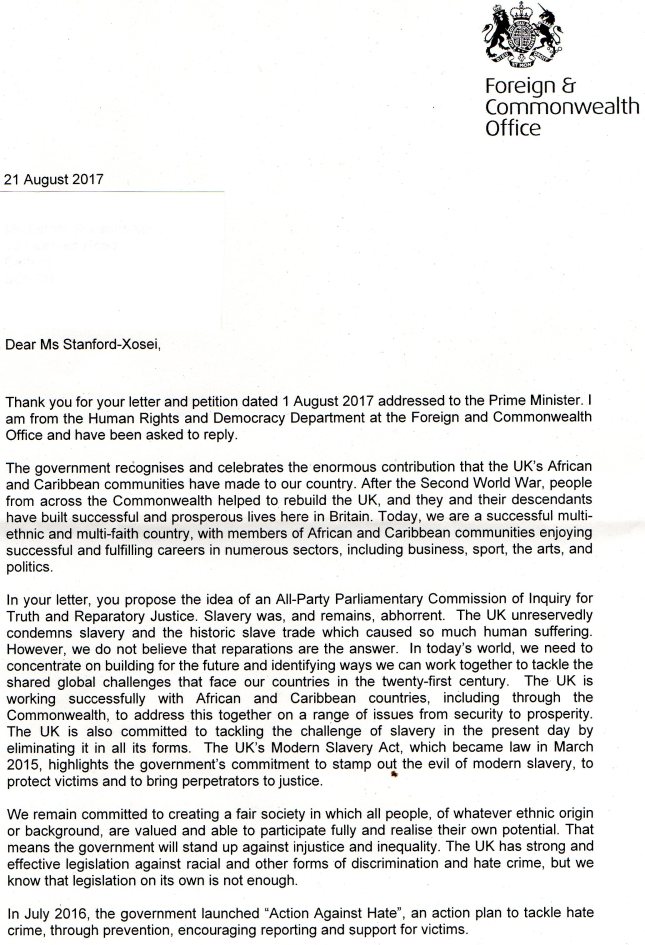
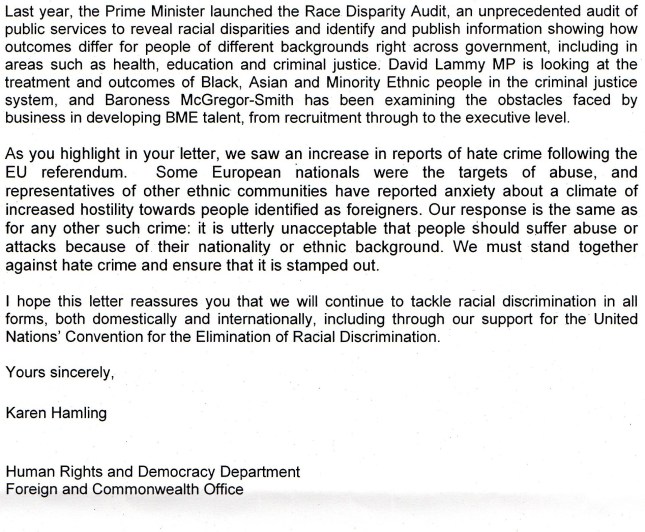
Please see the attached response from the Foreign & Commonwealth Office (FCO) of Her Majesty, Queen Elizabeth II’s Government dated 21st August 2017 and received today 23rd August 2017. No doubt the British Government would have been aware that today is the 226th anniversary of the insurrection of Afrikans in the north of the then French colony of Santo Domingo (present-day Haiti) which occurred during the night of August 22–23, 1791. However, to be true to the historical record, the Haitian Revolution (1791-1804) actually commenced on 14th August 1791 with a Vodun ceeremony in Bwa Kayiman, in the northern part of present-day Haiti. The Haitian Revolution was one of the most important events in modern history. It was the first successful anti-slavery revolution. Not only did enslaved Afrikans in Haiti liberate themselves, they also inflicted crushing defeats on three empires – the Spanish, French, and British. There were numerous fatalities among the colonialists, each suffered catastrophic losses trying, and failing, to take back the island from its heroic defenders. 161 sugarcane refineries and 1,200 coffee plantations got torched, with damage estimated at 600 million pounds. In recognition of the fact that it was Afrikans that liberated themselves in Haiti, the 23rd August is also commemorated as the United Nations ‘International Day for the Remembrance of the Slave Trade and its Abolition’.

You can then read our initial thoughts on this response below the letter from the FCO.

Please note the address of Esther Stanford-Xosei has been concealed which explains the gap between the date and opening line of the letter.


img014img015A


Our initial thoughts in reaction to this sort of Maangamizi denial response are:

Firstly, further insult has been added to injury in that contrary to the Prime Minister Theresa May’s initial response to the ‘Stop the Maangamizi!’ Petition and its accompanying letter  dated 8th August 2017 stated that she had requested her correspondence officer to arrange for a Minister in the FCO to respond to us directly;  instead we have received a response from Karen Hamling, Human Rights & Democracy Department. Karen Hamling’s position within the department is not clearly identified in the correspondence. For your information, a list of FCO ministers can be found here:

So, is Theresa May confirming her notoriety popularised in song as a “Liar Liar” or has the Foreign & Commonwealth Office chosen to disobey her requests seeing her as a weak leader on her way out?

Secondly, the response from Karen Hamling on behalf of the FCO shows how the Government in its response to us is seeking to counter our assertions by highlighting those from our communities who are collaborating with the genocide and ecocide crimes of white power and priding themselves on being successful within this genocidal imperialist white supremacy racist capitalist system, without highlighting anything being fundamentally wrong with it. This emboldens the FCO to display this type of dismissive attitude to the cries of the majority of our Afrikan people across the world about the continuing genocide and ecocide of the Maangamizi that they are suffering. In addition, such a response starkly reveals that if our case for reparatory justice is to be taken seriously by the British state and its white power accomplices in Europe, then we have to re-examine the situation of the minority who are made to look successful from among us. Arguably, their so-called success in this genocidal imperialist, white supremacy racist capitalist system is largely possible due to the ‘selling out’ of our people through the actions, inactions and omissions of those deemed to be successful i.e. those collaborators in perpetration of the Maangamizi crimes of genocide and ecocide against Afrikans and Mother Earth.

Yes, we often hear praise-singing alongside finger-pointing to some in our Afrikan Heritage Communities who are deemed to be successful, the question is:

at what genocidal price for the majority of our people does the so-called success of a tiny minority come?

This type of untruthful and insulting response from FCO comes out of such notions of success that some ignorantly or opportunistically tout and pride themselves on in our Afrikan Heritage Communities.

It is mind-boggling that in spite of reports by British NGOs such as the ‘Honest Accounts 2017 – How the world profits from Africa’s wealth’ and ‘The New Colonialism: Britain’s scramble for Africa’s energy and mineral resources’, the British Government is still in denial that it is aiding and abetting British corporate criminals in the perpetration of the Maangamizi crimes of ecocide and genocide against Afrika and people of Afrikan heritage all over the world today.

Increasingly it is becoming clearer that the British Government will only begin to listen to our Afrikan Reparatory Justice demands, including the demands of the SMWeCGEC when the advocacy, encouragement and support by our Afrikan Heritage Communities in Europe is given to the efforts of our Afrikan Communities of Resistance in Afrika, the Caribbean, other parts of Abya Yala, (the so-called Americas), as well as in Europe to shutting down extractive industries and other foreign corporate crime scenes of the Maangamizi. This is something we stated in the letter to the Prime Minister accompanying the 2017 hand-in of the ‘Stop the Maangamizi!’ Petition. It follows that the plunder of our community resources is still continuing to enrich white power in Britain and European domains of global apartheid across the world. We therefore need to seriously revisit some of the strategies and tactics with which our revered Ancestors fought successful liberation struggles; gaining some concessions that resulted in the official discontinuation of the British Empire, even from inside the brains and belly of the beast of the said Empire!

In fact, it is by pursuing strategies and tactics in Britain that advocated for, encouraged and supported actions of Afrikan people to make the British and other European Empires in Afrika, the Caribbean, Abya Yala as well as Asia ungovernable, which compelled changes in the British Empire, resulting in the proclamations of independence of our current nations states in Afrika and the Caribbean. A similar outcome and impact can be brought about again in our lifetime with the shutting down of Maangamizi crimes scenes in Afrika, the Caribbean, other parts of Abya Yala and Europe.

For those that still say they are not for petitioning or Marching, which actually cost us very little risk or harm in Britain today, what else is it you are prepared to do which you feel will bring about a more favourable response from the British state to our Afrikan Reparatory Justice demands?

The honestly critical discussion and reasoning that should flow from these perspectives of ours in the SMWeCGEC is something that we urge is carried out in Afrikan Heritage Communities not only in the UK, but throughout Europe, Afrika, Abya Yala and other parts of the world. We further urge that this is also done against the background of the historical legacies and the contemporary manifestations of the still ongoing Maangamizi as outlined in the ‘Stop the Maangamizi!’ Petition.

So we in the SMWeCGEC invite you to share your own thoughts on the contents of this response from the FCO. Please email your thoughts and suggestions to: stopthemaangamizi@gmail.com by Friday 22nd September 2017.

We aim to utilise your ideas to inform a more detailed response to the FCO on our part as the SMWeCGEC.


In Service & Struggle


International Steering Committee ‘Stop the Maangamizi: We Charge Genocide/Ecocide!’ Campaign

(ISC-SMWeCGEC)


bell hooks

“[We] have had only a slave’s idea of freedom, and to the slave the master’s way of life represents the ideal free lifestyle...”

bell hooks, ‘Ain’t I a Woman’


Kwame_nkrumah


“It is my deep conviction that all peoples wish to be free, and that the desire for freedom is rooted in the soul of every one of us. A people long subjected to foreign domination, however, does not always find it easy to translate that wish into action. Under arbitrary rule, people are apt to become lethargic; their senses are dulled. Fear becomes the dominant force in their lives; fear of breaking the law, fear of the punitive measures which might result from an unsuccessful attempt to break loose from their shackles. Those who lead the struggle for freedom must break through this apathy and fear. They must give active expression to the universal longing to be free. They must strengthen the peoples’ faith in themselves, and encourage them to take part in the freedom struggle. Above all, they must declare their aims openly and unmistakably, and organize the people towards the achievement of their goal of self-government.”

Osagyefo Kwame Nkrumah, ‘Africa Must Unite’


queen_moore_mother

“Those who seek temporary security rather than basic liberty deserve neither!”

Queen Mother Audley Moore

Posted in AFRIKAN HELLACAUST, ALL PARTY PARLIAMENTARY COMMISSION OF INQUIRY (APPCITARJ), INTERNATIONAL SOCIAL MOVEMENT FOR AFRIKAN REPARATIONS, ISMAR, REPARATIONS, Reparatory Justice, STOP THE MAANGAMIZI CAMPAIGN, STOP THE MAANGAMIZI PETITION, THE 2017 AFRIKAN EMANCIPATION DAY REPARATIONS MARCH | Tagged 1st August, Afrikan Heritage, APPCITARJ, British Colonialism, British Government, Commission of Inquiry, Ecocide, Emancipation Day, Hellacaust, International Social Movment for Afrikan Reparations, ISMAR, Maangamizi, People Power, Reparations March, Reparatory Justice, Stop the Maangamizi | 4 Comments

MEDIA PROMOTION & REPORTING OF THE 2017 MARCH & SMWeCGEC

Video | Posted on August 12, 2017 by STOP THE MAANGAMIZI


MEDIA


This year the Afrikan Emancipation Day Reparations March in partnership with the ‘Stop the Maangamizi: We Charge Genocide/Ecocide’ Campaign (SMWeCGEC) was promoted and/or reported on the following mediums:

The documentary ‘Education is Preparation for Reparations’ produced by ECOM Media and broadcast on Made in Bristol TV, Sunday 23rd, Tuesday 25th and Thursday 27th July 2017.
vintage-calligraphic-elements-1nyoWZ-clipart
Interview with George Galloway on ‘Sputnik-Orbiting the World’, show 186, broadcast on Russia Today, Saturday 29th July 2017.

vintage-calligraphic-elements-1nyoWZ-clipart
‘Your Politics Daily’ feature on the Reparations March ‘Day 8. Slavery Reparations March’ 2nd August 2017.vintage-calligraphic-elements-1nyoWZ-clipart
Article on Ligali Organisation website ‘Being Woke: Annual Reparations March brings Parliament to silent standstill’, Tuesday 1st August 2017.

vintage-calligraphic-elements-1nyoWZ-clipart
Article on the Voice Online website ‘Hundreds to March for Emancipation Day’, 1st August 2017.

vintage-calligraphic-elements-1nyoWZ-clipart
Article in the Barbados Nation Newspaper, ‘Reparations Petition delivered to PM May’, Friday 11th August 2017, pages 8-9, see below.
vintage-calligraphic-elements-1nyoWZ-clipart
A less than complimentary report was also published on the Spiked website ‘Emancipation Day should be about freedom, not victimhood’, 1st August 2017.

vintage-calligraphic-elements-1nyoWZ-clipart


Inclusion of the above media items does not mean that the items are endorsed by the Afrikan Emancipation Day Reparations March Committee or the SMWeCGEC. We do recognise that we need to develop our own media platforms but until such time we also acknowledge the media outputs of others and their contributions to publicising the March.

To keep updated with the Afrikan Emancipation Day Reparations March media promotions, you can subscribe to the Reparations March UK You Tube channel


Please note, the Afrikan Emancipation Day Reparations March & the SMWeCGEC were also promoted across community radio platforms such as Galaxy Radio, TheRock926.com, Majestic Radio, Ujima Radio (Bristol), Peace FM (Manchester) and many others.

Barbados Nation Article
The following 1.5 page spread was published in the Barbados Nation Newspaper UK Edition article by Tyrone Roach © Barbados Nation

This slideshow requires JavaScript.
 

The article reads:

“The streets of South London were greeted on August 1 by the sounds of drums and chants as hundreds of people made their way from Windrush Square, Brixton to Parliament Square on the Afrikan Emancipation Day Reparations March.

On arrival, a delegation of six then made their way to Downing Street to deliver the Stop the Maangamizi Petition with 9,636 signatures and a letter to Prime Minister Theresa May.

The Marchers, assembled around the Nelson Mandela statute, were addressed by several members of the organising committee, including Esther Utijua Muinjangue from Namibia. In her address Esther Stanford-Xosei, who is of Barbadian descent, the spokesperson and co-vice chair of the March Committee, noted that the British Parliament legislated that the slave-owners should be compensated, hence the immediate goals are the establishment of an All-Party Parliamentary Commission of Inquiry for Truth & Reparatory Justice. Her view is that the strategy is even more important given the fact that people of African heritage who are part of the African Diaspora in Europe, are not represented, and have not been consulted or included in the CARICOM ten-point plan on reparations.

The annual March, which started three years ago, has an international focus and has in the past attracted delegations from other areas such as North America, Suriname, St Vincent and Ethiopia. In 2016 there were delegations from Nigeria, and South Africa and this year from Manchester, Bristol, Wolverhampton, Reading and other parts of the UK.

Despite this, there has been a decrease in numbers which can be attributed to many factors. Unlike in the Caribbean Emancipation Day is not a public holiday in the UK and the march occurred on a Tuesday when many people were at work. Simultaneous marches held in St Lucia and Barbados and being highlighted in the Prime Minister of Trinidad & Tobago’s Emancipation Day Speech demonstrated the impact the campaign has made.

Speaking of the London March, Esther Stanford-Xosei said ”regardless of numbers, the focused and sterling organisation of the march is attracting recognition and attention worldwide. People also do not recognise that the March costs £8000 plus to organise and this is paid for by ordinary people, often the most marginalised in society. No state resources or even resources from Black professional classes and elites come from anywhere.”

Included in the petition delegation were:
Kweme Abubaka, Ethiopia, Afrikan Black International Congress (EABIC), Afrikan Emancipation Day Reparations March Committee (AEDRMC)
Mama Lindiwe TSELE, Veteran Anti-Apartheid & Pan-Afrikan Activist-Organiser
Anouska RAYMOND, Co-Facilitator, Afrikan Emancipation Day Reparations Outreach Team
Esther Utijua MUINJANGUE, Chairperson, Ovaherero Genocide Foundation (OJF)
Esther Stanford-Xosei,
Coordinator General, ‘Stop the Maangamizi: We Charge Genocide/Ecocide ‘Campaign
Spokesperson, & Co-Vice Chair, Afrikan Emancipation Day Reparations March Committee (AEDRMC).”


Posted in AEDRMC, AFRIKAN HELLACAUST, INTERNATIONAL SOCIAL MOVEMENT FOR AFRIKAN REPARATIONS, ISMAR, REPARATIONS, STOP THE MAANGAMIZI CAMPAIGN, STOP THE MAANGAMIZI PETITION, THE 2017 AFRIKAN EMANCIPATION DAY REPARATIONS MARCH, Uncategorized | Tagged 1st August, Afrikan Heritage, British Colonialism, British Government, CARICOM, Genocide, Grassroots Leadership, Maangamizi, Pan-Afrikanism, People Power, REPARATIONS, Reparatory Justice | Leave a comment

AFTER 4 YEARS OF MARCHING: WHAT HAS BEEN ACHIEVED?

Posted on August 7, 2017 by STOP THE MAANGAMIZI


This slideshow requires JavaScript.
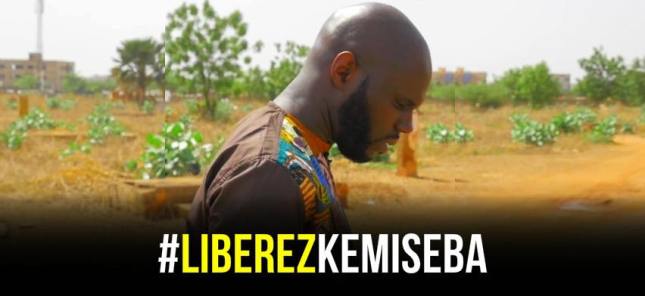
Afrikan Emancipation Day Reparations March 2017

vintage-calligraphic-elements-1nyoWZ-clipart

“To those caught up in only slogan-mongering about the Afrikan Revolution who self-derisively dismiss mass campaigns such as this one of Reparations, refusing to unfold their own blinds to its crucial significance in our Liberation Struggle; we address our paraphrasing of the remark of Amilcar Cabral that, by taking to the revolutionary path of self-determined Struggle for Afrikan Liberation, the masses of our people are not fighting for ideas in anyone’s head; they are fighting  for a true National and Social Emancipation that will guarantee them such concrete benefits as will ensure their material and spiritual prosperity! That is why the AASU-E [All-Afrikan Student’s Union in Europe] sees Reparations from the perspective of Afrikan youth as the actual conscientization of the objectives of our whole people’s Liberation Struggle under the banner of revolutionary Pan-Afrikanism. Therefore the Reparations we the youth of Afrika are demanding must restore to all people of Afrikan origin throughout the World full sovereignty, the absolute ownership of the whole of our Homeland, including all its resources, and the Renaissance of Maat and other value of our classical civilisation, in order to give us the concrete basis for independently achieving our own material and spiritual prosperity.“

Antonieta Carla Santana, ‘Our Struggle for Reparations in Afrikan Youth Perspective’: A Draft Paper for Presentation to the 11th December 1993 Birmingham Working Conference of the African Reparations Movement (ARM-UK)

vintage-calligraphic-elements-1nyoWZ-clipart

“Too often our standards for evaluating social movements pivot around whether or not they ‘succeeded’ in realizing their visions rather than on the merits or power of the visions themselves. By such a measure, virtually every radical movement failed because the basic power relations it sought to change remain pretty much intact. And yet it is precisely those alternative visions and dreams that inspire new generations to continue to struggle for change.”
— Robin D.G. Kelley —

vintage-calligraphic-elements-1nyoWZ-clipart

The March as the street column of the International Social Movement for Afrikan Reparations (ISMAR) is going through a period of change; which involves reflecting on what has been done so far, what have been the gains so far and what more is to be done? including how best to ‘repair’ the movement itself to make it better fit for purpose. So unlike in the past, when the perception of many adherents of reparations was just let’s all go and demand compensation for the wrongs that were done to our Ancestors, it is dawning on the leading activists and increasing members of the Afrikan Heritage Community, that it will take far more programmatic work to win hearts and minds and achieve the true purpose of holistic Afrikan Reparatory Justice, which is much more than money! The messaging of the March, via the chants, images and text displayed on banners and other ephemera has grown to include the context of ‘Stopping the Maangamizi’ in terms of a cessation of violations which is an essential prequisite of effecting and securing reparatory justice as a result of the continuum of enslavement from chattel enslavement through to colonialism and now into this neocolonial phase. So now it is not as easy to dismiss the public and grassroots advocacy of Marchers as being stuck in the past with very little recognition of the continuation of the systems, structures and manifestations of oppression and injustice today. Furthermore, taking into account, that we live in a Britain of state and non-state orchestrated terrorism; care is being taken as to how the form and content of the March should be. So, the March is at a crossroads and this has also impacted the amount of people who came out to support it this year.

However, success of the March should not just be judged in terms of how many people attend each year which seems to be many people’s perception of what constitutes success.  But who decides what constitutes success? Success can only be determined by those people in struggle; those who are fighting or organizing for something. If we compare year one of the March with year four you will see that the March has better organisation, clear- consensus-building and decision-making structures, such as the 9 organising Blocs to recognise the diverse constituencies who are pulling together to help strengthen and build the movement as well as several task-action groups which deal with operational tasks throughout the year.


SM AIMS MARCH


The March also has clear aims and objectives and clear goals which was not the case for the first March of 2014, as significant as it was. The programme for the March itself has also improved with the introduction in 2016 of the People’s Open Parliamentary Session on Afrikan Reparations (POPSAR). The POPSAR at Parliament Square is a mass consciousness-raising forum for public debate and discourse on manifestations of the Maangamizi necessitating Afrikan Reparations. It is a public forum where Afrikan people rehearse our arguments in pursuit of the ‘battle of Ideas’ on obstacles to the realisation of holistic reparatory justice. The purpose of the POPSAR is to engage audiences in action-learning on participatory democratic parliamentary debate and the ‘Battle of Ideas’ on critical issues such as how to stop various manifestations of the Maangamizi as part of the process of effecting and securing Afrikan Reparatory Justice.


The Battle of Ideas is an important ideological tool. Within a space where a number of ideological positions struggle for supremacy – reflective of national, ethnic, class and gendered  tensions within society – the ISMAR as a revolutionary international social movement cannot neglect the importance of winning hearts and minds and mobilising society around a common reparatory justice vision that presents a credible political, social and economic narrative that is in itself an alternative to that of the dominant white supremacy racist, capitalist class. This is the Battle of Ideas.


The theme for the 2017-2018 March year, which we encourage our Afrikan Heritage Communities to continue to discuss and take action on between the 2017 and 2018 Marches is:

‘Black on Black Violence’: Why are we not doing enough to stop this manifestation of the Maangamizi? Debating the motion: This gathering believes that we as Afrikan Heritage Communities are not doing what is necessary to stop this manifestation of the Maangamizi0001In addition, the Afrikan Emancipation Day Reparations March Committee (AEDRMC) and its campaign partner, the ‘Stop the Maangamizi: We Charge Genocide/Ecocide!’ Campaign (SMWeCGEC) now have websites which regularly put out reparations focused information and educational content as part of public reparations education which are not being put out elsewhere. Whether people want to recognise it or not, the March has now become a recognised institution and is the most visible and largest activity of the UK contingent of the ISMAR in the yearly calendar of Afrikan organising activities to further the cause of Afrikan reparatory justice.


“The March visually displays a freedom-fighting unity of Afrikan people from all over the world, on the streets of London, rallying together as one defiant family, inside the belly of the beast; that is no longer happening in Afrikan protests, in any other parts of the world, including those on the Continent of Afrika. I am an Afrikan born and bred in Ghana  and I know what the power of this image meaningfully conveys to Afrikans at home and all other peoples across the world“.  

Kofi Mawuli Klu, Co-Vice Chairperson SMWeCGEC


power


It also needs to be recognised that, unlike in CARICOM countries, Emancipation Day is not a public holiday in the UK and the 2017 March occurred on a Tuesday, when many people are normally at work. We have also had many reports that people were denied the day off who wanted to take it off and in an economic climate of austerity people want to hold unto their jobs. Regardless of numbers, the focused and sterling organisation of the March is attracting recognition and attention worldwide. It may not also be widely known that the March costs £8000 plus to organise and this is paid for by ordinary people, often the most marginalised in society. So, the fact that the March has been able to establish itself and become institutionalised as a key feature of the street column of the ISMAR is in itself an achievement. It is important to note that the March is a totally Afrikan and totally independent, grassroots funded march; no state resources, no funding or resourcing from Black professional classes and elites enables this March to happen! This is important so that the agenda of making a direct challenge to the British state, which the March represents, does not become co-opted or diluted.

vintage-calligraphic-elements-1nyoWZ-clipart

MARCH 2017 PETITION

Delegation which handed in the 2017 SMWeCGEC Petition

vintage-calligraphic-elements-1nyoWZ-clipart

Anyhow, what is clear is that each year there is  a constituency that support the SMWeCGEC. According to the count on 31st July 2017, 9636 people have been courageous enough to sign the petition and advocate its perspectives so far and that figures continues to rise each day. This is no mean feat given the fact that so many who have a lot to say about what should be done, are not prepared to sign it, and often come up with quite porous reasons as to why they will not attach their name and contact details to the petition.

You can read the letter that accompanied the petition hand-in on 1st August 2017 here. This 9636 + people are a clear constituency and shows progress from the 5811 who signed the petition last year!  You can also see the response to the petition here. This article provides some responses to those who say “what is the point of petitioning?”


 On ISMAR strategy & tactics…

quote-strategy-without-tactics-is-the-slowest-route-to-victory-tactics-without-strategy-is-the-noise-sun-tzu-334777

Tactics are forms of collective action publicly deployed, whether in-person or via audio, visual, or written media, in service of a sustained campaign of claims making.


What is the strategy?

We are not just marching for the sake of marching, the 1st August Afrikan Emancipation Day Reparations March is just one of a number of tactics, in an overall multi-layered strategy to ‘Stop the Maangamizi!’ (Afrikan Hellacaust of chattel, colonial and neocolonial enslavement), in order to bring about systemic change and revolutionary social transformation of our condition as Afrikan people, as part of building our people’s power to effect, secure and take reparatory justice on our own terms.

The Maangamizi will only be stopped by the collective power and might of our people on the continent and the Diaspora of Afrika, by way of completing the Pan-Afrikan Revolution, (with complete steps, too numerous and unnecessary to fully spell out here), which include the realisation of social change reparatory justice goals of the ISMAR and the People’s Reparations International Movement (PRIM).

Clearly the March, cannot be reduced to be an event that occurs on one day; rather it is organised in such a way as to help advance reparations social movement-building of various constituencies within our Afrikan Heritage Communities locally, nationally and internationally. In this regard, priority is given to mobilising our own individual and people’s collective ‘power to’ effect and secure reparatory justice through community organising, reparations social movement-building and institution-building. Social movement-building is the long-term, coordinated effort of individuals and organised groups of people to intentionally spark and sustain a (reparations) social movement. It entails: “the creation of movement infrastructures required for sustained organising and mobilisation, including social relationships, organisational networks and capacity, affective solidarity, as well as movement-related identities, frames, strategies, skills, and leadership.”

No one organisation or institution can supplant the power of a vibrant ISMAR. Successful social change efforts have been led not by individual organisations, but by movements. See here for the difference between organisations and movements.

The Afrikan Emancipation Day Reparations March, as the street column of the ISMAR is therefore a vehicle for mass mobilisation and education as part of our self-repair and people’s power-building process. It is also a conduit as part of an on-going parliamentary and extra-parliamentary strategy, hence the delivery of the SMWeCGEC Petition charging the British State with the crimes of Genocide and Ecocide and demanding an end to their role in the continuing Maangamizi. So we can say that despite much activity and mobilisation occurring in the UK towards reparatory justice, there has in recent times, been very little focus on the British State. We can now say that since the 1990s there has not been an Afrikan Heritage Community dialogue with the British state on our global justice case for total Pan-Afrikan liberation, including issues of Pan-Afrikan Reparations for Global Justice. This is now occurring as a result the SMWeCGEC and the promotion of its campaign goals by the March. We know that the radical content of this dialogue, pertaining to Afrikan genocide, the need to ‘Stop the Maangamizi! of the present, as well as shut down Maangamizi crimes scenes as a form of civil disobedience, is not being raised before the British Government and any other state body in Europe by any other reparations process, campaign, organisation or even any Afrikan or Caribbean state entity.

The AEDRMC, in partnership with the SMWeCGEC, will continue the year long process of march planning, mobilisation and organisation alongside its ‘Education is Part of the Preparation for Reparations’. Similarly, to compliment these initiatives, the SMWeCGEC is carrying out ISMAR Advocacy Training programmes and the promotion of reparatory justice action-learning programmes and initiatives in preparedness for educating people about how to effect and secure reparatory justice including the methodology for effectively establishing the All-Party Parliamentary (People’s) Commissions of Inquiry for Truth and Reparatory Justice (APPCITARJs) and local benches of the Ubuntukgotla People’s International Tribunal For Global Justice (U-PITGJ), also contained within the SMWeCGEC Petition.


vintage-calligraphic-elements-1nyoWZ-clipart

“The issue at stake is whether we want to formulate reparations as a reformist, and even potentially reactionary demand, or as a radical demand for social transformation. A variety of platforms have been developed under the rubric of reparations, and many of these demands can actually serve to strengthen the demands of white supremacy.”
Andrea Smith, ‘Conquest’, p53

vintage-calligraphic-elements-1nyoWZ-clipart


The AEDRMC, as facilitators of the annual 1st August Afrikan Emancipation Day Reparations March organising process in partnership with the SMWeCGEC are in pursuit of comprehensive holistic land-based reparations. This means our reparations as Afrikans in the Diaspora is umbilically connected to the liberation of our Motherland, Afrika; including restoration of her sovereignty and the self-determination of Afrikan people worldwide and the establishment of structures of non-territorial autonomy in the Diaspora. Hence support for the notion of us being an Afrikan Heritage Community for National Self-Determination. As representatives of a diverse array of campaigns, organisations and interests groups, we are collectively working for the achievement of the kind of reparations that we can ALL be truly proud of and benefit from. This is necessary to ensure that all of our people, (not just a few) get ‘satisfaction’ out of the results (that also includes our predecessors, our contemporaries and our posterity, i.e. those yet to be born).

However, YOU are encouraged to continue to mobilising and self-organising. The March is NOT the entire Reparations Movement so YOU need to develop complimentary reparatory justice strategies in your own groups, organisations and networks.


what if final


There is much dichotomous thinking and many misconceptions among the general public about what tactics movement’s should utilise to best meet their objectives. Movements often select from a repertoire of possibilities available to them at any given time and place. Nevertheless, it is often assumed that adopting one tactic, at a particular point, in time precludes a movement from adopting other tactics at a different time or even simultaneously. Multiple tactics must be undertaken by movements in order to reach and build support among their intended audiences, the multiple publics they are seeking to influence as well as achieve their desired objectives. Nevertheless, there are different tactics that self-reflective movements will use depending on the campaign objectives and goals that different forces within such a movement set out to achieve.

Despite its growing visibility, it is important to emphasize that the March is not the whole ISMAR, it is simply an aspect of it, otherwise known as a column within it, i.e. the street column. However, it is also the case that many movements have characteristically relied on demonstrative or even ‘confrontational’ tactics to advance their cause, and this is still the method of choice for street protest actions. Although movement activists expend a great deal of energy, time, and resources choosing tactics, all tactics are not designed to have the same outcomes or impact, for the tactical choices of a movement often embody the movement’s key demands.

There is a difference for example, between political persuasion (lobbying, voting, petitioning), demonstrative (marches, rallies, vigils, acts of civil disobedience) and economic (boycotts and selective buying) tactics. Boycotts, selective buying, buying-Black, setting up ‘Black’ businesses, group economics, or even cooperative group economics, (which do not take into consideration the reparatory justice political economy of glocal Pan-Afrikan community regeneration and development) alone, will not be sufficient to stop the various manifestations of the Maangamizi that people of Afrikan heritage are being subjected to today. In fact, in some instances our people can get inadvertently caught up in the pursuit of ‘big’ anti-people private business models that promote mal-development, genocidal, ecocidal and slavery-like working practices which contribute to prolonging the Maangamizi. Neither is it the case that ‘political persuasion’ or demonstrative tactics such as lobbying, marching and petitioning alone are enough to stop the various manifestation of the Maangamizi. However, each of the aforementioned combination of tactics can contribute to this overall objective of the ISMAR in different ways and all together unify the diversity of forces necessary for ultimate victory!!!

We are approaching what is often referred to as a ‘revolutionary situation’, the crisis of the European Global Order is worsening more than ever before, their state machineries, political parties and other institutions are crumbling from within, their societies are broken, in some cases beyond repair, and the social forces they command are in disarray. This situation presents us as Afrikan people with great opportunity. There is however, a missing link which is the organised, disciplined political might of the Afrikan masses in concert with the masses of Global Black Humanity, which includes the linking up with and sharing of strategy and tactics among Afrikan Heritage communities of reparatory justice interest and resistance in Europe, Abya Yala, (the so-called Americas), Melanasia, Australasia, Oceania and those on the continent of Afrika.

Accordingly, the AEDRMC in partnership with the SMWeCGEC are engaging in mass mobilisational and popular educational work, action-learning, knowledge-building, mobilisation and organising towards that purpose.

Whilst the March first took place in 2014 under the leadership of the Rastafari Movement UK (RMUK) with a number of supporting organisations, since the introduction of specific March aims and march being facilitated by the AEDRMC, this is a further summary of what has been achieved thus far:

• There is now (since 2015), a consolidated stewardship and facilitation of the organising processes for the annual Afrikan Emancipation Day (People’s) Reparations March with the formalisation of the AEDRMC, consisting of a diverse array of Afrikan heritage groups, organisatons, movements and individuals. Most of the committee members, both individual and organisational, have been involved with the March from its inception.

vintage-calligraphic-elements-1nyoWZ-clipart

• The AEDRMC and its subsequent partnership with the SMWeCGEC has helped to consolidate the emergence of an independent ground-up Pan-Afrikan inspired, and initiated, transnational process of leading, mobilising and organising Afrikan people other than the anti-Pan-Afrikan Liberation statist CARICOM Reparatory Justice Programme and their Ten-Point Plan. Despite the fact that reparatory justice organising goes back centuries, there has been little recognition of this by Afrikan heritage social, political and economic elites who, for many decades, have chosen, contrary to our indigenous Afrikan traditions of exercising people’s power, not to identify with the ground-up initiated and led ISMAR. For instance, in 2003 the UK based Black Quest for Justice Campaign supported by PARCOE (Pan-Afrikan Reparations Coalition in Europe), the then Black United Front (UK), the then Global Afrikan Congress (UK) and the then International Front for Afrikan Reparations (IFAR) developed a Ten-Point Plan (below), as part of a legal and extra-legal strategy to effect and secure Pan-Afrikan Reparations, which continues to be championed by PARCOE. Despite this being one of several reparations focused initiatives emanating from Afrikans in the UK ISMAR, the mass media and some newer reparations focused organisations and activists have tended to  defer to the CARICOM Ten-Point Plan, or initiatives taking place in so-called North America, as though there has been no history-making on the part of the prior-existing ISMAR in the UK.


Afrikans in the UK developed a ten-point plan in 2003!

This slideshow requires JavaScript.
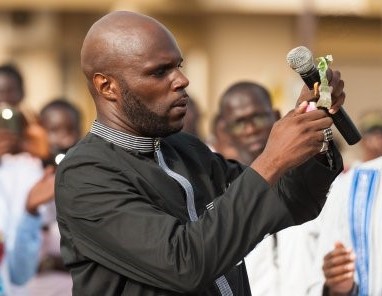
 

According to Professors Adjoa Aiyetoro and Adrienne Davis in their 2010 article ‘Historic and Modern Movements for Reparations: The National Coalition of Blacks for Reparations in America ...”part of the largely untold history of reparations is the struggle not only for reparations itself, but also the struggle between distinct Black classes over strategies for citizenship and the right to envision the racial future”. The ISMAR, just like any other social movement has its contestations, national, classed, gendered and other internal struggles.


Representative Sample of ISMAR Collective Leadership, Past & Present

PARCOE OLD

PARCOE NEW


• There is increased engagement with and implementation of the March aims. We are not just marching aimlessly but with a strategy which is in operation at various levels. This means that March facilitators, in partnership with the SMWeCGEC, support the mobilisation and organisation of a core section of the Afrikan Heritage Community of Reparatory Justice Interest who seek to engage in strategic reparations activism and direct their energies to the attainment of specific reparations social-movement-building goals, which are measurable and through which progress can be evaluated. In the process of mobilising and organising together all year-round, the March organising process significantly contributes to transforming activism from being an individualistic approach to a Ujima (collective work and responsibility) approach. Our revolutionary Afrikan ideology will ensure that we can consciously construct the society that we want to build. Although the March aims were in place and operation for the 2015 March, there was not as much take up with implementing the aims as is occurring now.

• Since 2015, a partnership, operational unity and working relationship between the AEDRMC and the SMWeCGEC has been established. In recognition of the fact that the March is not the whole Reparations Movement, the AEDRMC has also embraced the complimentary SMWCGEC goals contained in the SMWeCGEC Petition, both the 2014, 2015, 2016 and 2017 versions. So, whilst the AEDRMC, the March Aims and the SMWeCGEC campaigning aims and goals remain distinct, the fulfilment of both the aims of the March and the SMWeCGEC campaigning aims and goals are mutually constitutive.

The complimentary aims of the SMWeCGEC as a positive action step of reparatory justice campaigning are to:


SM campaign aims


The above aims and objectives are implemented and worked on all year-round by various organisational members and individuals involved in the AEDRMC and the SMWeCGEC, the Local and Regional March Outreach Teams, Task Actions Groups, in addition to the various Blocs of the March. The key point to highlight here is that the aims of the March and the SMWeCGEC promote social movement-building, which is part of a people power-building process to be able to effect our people’s reparatory justice will.

Social movements are a type of group action. They are large, sometimes informal, groupings of individuals, organisations and other relevant interest groups which focus on specific political or social issues; and who are organised and organising to promote, carry out, resist or undo social, cultural or political change.

Social movement-building is the long-term, coordinated effort of individuals and organized groups of people to intentionally spark and sustain a social movement.

Social movement forces constantly engage with multiple publics, core constituencies in addition to allies and seek to harness people’s collective power to address systemic problems, redress enduring injustice and promote alternative visions or solutions. It follows that reparations which will meaningfully work for ALL of US as Afrikan People, will only be effected and secured as a result of a MASS MOVEMENT that we continue to build. Our people’s process of history-making thus far teaches us that this is the only way that sustainable and transformative change occurs, despite the reversion to Messianic approaches to reparatory justice change which are being promoted by some sections of the Afrikan Heritage Community; which assume that all we need to do is follow a particular leader who is divinely anointed to lead us to the promised land of reparatory justice, and none can truly get to this post-Afrikan Reparations World Order but through following such a divinely sent leader!

Whilst it is recognised that movements always use a mixture of tactics, generally have multiple leaders, groups and agendas, ultimately, such reparatory justice will only be effected and secured when we have built and harnessed the POWER to effect our National will and strategic geopolitical interests as people of Afrikan ancestry and heritage.

vintage-calligraphic-elements-1nyoWZ-clipart

Kofi Mawuli Klu 2222 (2)

“It will be gross self-delusive wishful thinking to believe that those wielding the reins of White racist supremacy are going to pay any serious heed to the Afrikan demand for Reparations, unless their hold on the machinery of global power is effectively challenged by the well-organised, upsurgent and self-empowering masses of Afrikan people, and their allied progressive forces throughout the World.”

 Kofi Mawuli Klu ‘Charting an Afrikan Self-Determined Path of Legal Struggle for Reparations’: A Draft Paper for Presentation to the 11th December 1993 Birmingham Working Conference of the African Reparations Movement, UK, 1993.

 vintage-calligraphic-elements-1nyoWZ-clipart

  • Since the 2015 March, the AEDRMC has introduced 9 organising blocs relating to specific constituencies as part of the process of reparations social movement-building and maintaining organising processes toward effecting and securing reparatory justice including various processes, programmes and initiatives of self-repair all year round.
    vintage-calligraphic-elements-1nyoWZ-clipart
  • The AEDRMC in association with the SMWCGEC has developed a ‘Education is Part of the Preparation for Reparations‘ curriculum and programme which has consisted of the roll out of educational workshops across London and in other cities to raise reparations related legal and political consciousness. Similarly, the SMWeCGEC has developed the ISMAR Advocates Training Course and other reparations action-learning, education, learning & teaching initiatives.


vintage-calligraphic-elements-1nyoWZ-clipart

  • dsc_0315

@ ISMAR Advocates Training Course 13/11/16

vintage-calligraphic-elements-1nyoWZ-clipart

  • There is increased popular reparations consciousness-raising, education and participatory learning processes through action-learning which facilitate popular sensitisation and communication strategies on getting information out to the the general public about the rationale behind taking particular forms of action and how people can participate in and shape the the various reparations processes unfolding from the ground-up. Community organisers, activists, organisations and radio stations such as Galaxy Radio, Majestic Radio, Conscious Radio, Lightening Radio, the Rock, and Citylock have been instrumental to mass dissemination of information and programming pertaining to the March. It is greatly acknowledged that Galaxy Radio have been consistently broadcasting programmes, reparations content and debate promoting the March and the SMWeCGEC. Whilst it is also acknowledged that there were many community videographers who have popularised reporting on the various Marches, a special mention goes out to the following who worked with the AEDRMC and the SMWeCGEC  to promote relevant reparations social movement-building media content in furtherance of the aims of the March and the SMWeCGEC: GotKush TV (GKTV) for their numerous March and SMWCGEC focused exclusive video programming in 2015-2016;  Mwangole TV for offcial 2015 March video; and Rayy of Ibuka TV for the 2016 & 2017 March ‘Call to action’ and ‘Invitation to Participate’ promotional videos.
    vintage-calligraphic-elements-1nyoWZ-clipartjendayi                                                    Filming in Bristol 20/10/16vintage-calligraphic-elements-1nyoWZ-clipart
  • In 2016 -2017 the documentary: ‘Education is Preparation for Reparations’ promoting the reparations activism of AEDRMC Co-Chair, Jendayi Serwah and the March was produced by ECOM Media and premiered on Made in Bristol TV in July 2017.
    vintage-calligraphic-elements-1nyoWZ-clipart
  • 2016 saw the development of the London Outreach Team which engage in regular outreach on high streets and at community events to promote the March, the SMWeCGEC and obtain signatures for the SMWeCGEC Petition.

vintage-calligraphic-elements-1nyoWZ-clipart

  • Working in conjunction with the AEDRMC, the SMWeCGEC and the Europe-Wide Consultative Council for Afrikan Reparations (ENGOCCAR), has increased the visibility of the March among Afrikan Heritage Communities and allies in other European countries. This has been significantly enhanced by the translation of the SMWeCGEC Petition, the ‘Take Action’ article on the SMWeCGEC website and the aims and objectives of the campaign into other European languages e.g. French, German and Dutch. This essential work in translating and making reparations campaigning documents accessible to those whose first language is not English has been done by Co-Deputy Secretary of the SMWeCGEC, Marissa Dawuwalla and other members of the SMWeCGEC Team – Europe.vintage-calligraphic-elements-1nyoWZ-clipart
  • The March in London has also inspired, engendered, galvanised related marches, campaigning efforts and other pertinent activities, in various parts of the world including Ghana, Jamaica, St Lucia and St Vincent & the Grenadines via its Ujaama-Global Afrikan Family Bloc. For example, the fraternal SANKOFAAPAE (Pan-Afrikan Reparatory Justice International Libation Ceremony) which takes place in Accra, Ghana was initiated in 2016 and also took place on the 1st August 2017.The SANKOFAAPAE Pan-Afrikan Reparatory Justice International Libation Ceremony (SANKOFAAPAE-PARJILC) is a strictly non-party political activity of various grassroots progressive forces of Pan-Afrikan civil society which are independently mobilizing for the ground-up popular education, reparatory justice civic conscientization and its relevant human, peoples’ and Mother Earth rights awareness raising among ordinary masses of peoples throughout the World to achieve our vision of Pan-Afrikan Reparations for Global Justice. We in the SMWeCGEC and the Ujaama Global Afrikan Family Bloc recognise this SANKOFAAPAE as a unity promotional endeavour, of global dimensions, for connecting into the global Pan-Afrikan reparatory justice struggle, the efforts being made by various in Afrikan communities to assert their rights to self-determination and reconstruction of nationhood including  overcoming the divisions imposed by the artificially created European borders and other manifestations of the Maangamizi that continue into the present to the detriment of their Afrikan personality, humanity and sovereignty. You can watch the presentation that was made at the 2017 SANKOFAAPAE by Dr Ọbádélé Kambon here:vintage-calligraphic-elements-1nyoWZ-clipart
    yao 1
    ya0 2
    MARCH 2017 Nyoefe Yawa Dake Xolanyo Yawa Gbafa holding the banner
    ED GHANA 2

vintage-calligraphic-elements-1nyoWZ-clipart

  • The significance of this annual SANKOFAAPAE includes the replay of the process whereby the ripples of the 1945 5th Pan-African Congress in Manchester, Britain took Osagyefo Kwame Nkrumah and its other co-organisers including George Padmore, Ras Makonnen, Amy Ashwood Garvey and WEB Du Bois to galvanise the Independence Struggle in Ghana. This resulted in Ghana becoming one of the early nation-states to break open the pathway to reclaiming Afrikan Sovereignty and sounding the clarion for reparations towards securing the total emancipation and unification of Afrikan people on the Continent and in the Diaspora of Afrika as the basis for effecting and securing holistic Pan-Afrikan Reparations for Global Justice. In this regard, The AEDRMC via the Global Afrikan Family Bloc of the March and its related activities such as the SANKOFAAPAE has inspired its co-organisers to now take up the work of lobbying Afrikan Chiefs and other community leaders. An outcome of this lobbying has been to establish the Pan-Afrikan Reparatory Justice Law of Holistic Rematriation/Repatriation Advocacy Network (PARJLOHRRAN). Holistic rematriation and repatriation are highlighted in the SMWeCGEC Petition.

vintage-calligraphic-elements-1nyoWZ-clipart

HERERO 2
EFF DALI
ED DULANI HOLLAND
biaffra 222
ED HOLLAND 4
OLYMPUS DIGITAL CAMERA
benny
HEREO JS OJF
no 2

vintage-calligraphic-elements-1nyoWZ-clipart

  • In between the 2015 and 2017 Marches, there has been a concerted effort to reach out to, learn from and incorporate the demands and aspirations of communities of reparatory justice interest in Afrika who are still quite marginalised within the programmes and actions of regional contingents of the ISMAR and the PRIM.

vintage-calligraphic-elements-1nyoWZ-clipart

  • For example, in the 2015 March there was participation of Dali Mpofu from the Economic Freedom Fighters of Azania, (so-called South Africa), engagement with those leading the struggle for the restoration of Biafra and Biafran nationhood, as well as continuing links previously established with representatives of the Movement for the Survival of the Ogoni Peoples (MOSOP) and the Mau Mau Community of Reparatory Justice Interest. This is part of the Pan-Afrikanist tradition of organising in the UK in general and builds on previous organising efforts such as those of Pan-Afrikanists within the UK and the African Reparations Movement.

vintage-calligraphic-elements-1nyoWZ-clipart

  • On the 2015, 2016 and 2017 Marches there were also activists from Cote D’Ivoire who came along to highlight the need for raising as a matter of reparatory justice concern fighting to release Afrikan Liberation political prisoners such as Laurent Gbagbo and Omah Simone Gbagbo.

vintage-calligraphic-elements-1nyoWZ-clipart

  • Similarly, on the 2015 and 2016 Marches, Freedom-Fighter and West Papua Independence Leader Benny Wenda and the Free West Papua campaign were also on the March representing West Papuans and other Black Communities of Reparatory Justice Interest in Melanasia, Australasia, and Oceania. The SMWCGEC continues to work with such diverse Communities of Afrikan Reparatory Justice Interest from the Continent and Diaspora of Afrika who are represented in Britain to amplify their voices and  increase the visibility of the reparatory justice struggles they are waging on the March.

vintage-calligraphic-elements-1nyoWZ-clipart

  • On the 2016 March, there was representation also from the National Coalition of Blacks for Reparations in America (N’COBRA), USA and the Europe-Wide Consultative Council for Afrikan Reparations (ENGOCCAR) delegation from Suriname but residing in the Netherlands.vintage-calligraphic-elements-1nyoWZ-clipart
  • In 2017, the March was headlined by Esther Utjiua Muinjangue, Chairperson of the Ovaherero Genocide Foundation (OGF). At the same time the OJF held a solidarity event that took place in Namibia on 1st August 2017

vintage-calligraphic-elements-1nyoWZ-clipart

  • Our emphasis has been on relating to reparations, not just as a legal case or claim and political struggle, but also as an international social movement. This speaks to the issue of mobilising and building our individual and collective people based power, knowledge and influence through community organising and social movement-building to bring about the reparations objectives we desire by resisting, challenging, and transforming the power against us that denies us reparatory justice. In terms of what can be considered success from the perspective of those of us who see ourselves as part of the ISMAR, this is not only being measured against the aims of the March and those of the SMWeCGEC, but also in relation to the fact that more and more people are identifying as being part of the ISMAR and are organising and mobilising accordingly. By this we mean, being social movement adherents who are developing ground-up leadership, learning by participation in reparations social-movement-building actions and engaging in all year-round activism. In effect, more and more people are: taking leadership; becoming activists as well as rank-and-file participants in the ISMAR; identify as being part of this ‘movement’; and relate their own activist and organising endeavours to movement-building.

vintage-calligraphic-elements-1nyoWZ-clipart

  • Greater amounts of people are taking action on the SMWeCGEC Petition and its campaign aims and goals including lobbying MP’s and other elected officials to support the demands contained on the ‘Stop the Maangamizi!’ Postcard and adhering to the SMWeCGEC Guidance on Proposals for Parliamentary Action.


SM CARD SIDE 2-page-001


Afrikan Reparationists are playing a leading role in building the Academic column of the ISMAR through which the March and the SMWeCGEC are being critically studied

  • The March organising process, accompanied by the SMWeCGEC is now being studied and analysed in terms of their contribution to activist led knowledge-production and co-production on reparatory justice as part of action-research that is led by Afrikan heritage community based scholar-activists, primarily organising under the banner of the Afrikan Reparations Transnational Community of Practice (ARTCoP), but who have also engaged with establishment academia and contributed to the 2015 ‘Repairing the Past, Imagining the Future: Reparations and Beyond‘ International Interdisciplinary Event at the University of Edinburgh in collaboration with Wheelock College (Boston US). In addition, members of the SMWCGEC and the AEDRMC contributed to shaping the 2016 ‘From the Transatlantic Slave Trade to Engaging the Maangamizi ‘conference which took place at Queen’s University, Belfast, Northern Ireland.

SM BELFAST Programme-1-page-001SM BELFAST Programme-1-page-002

The SMWeCGEC in partnership with the March are also being promoted within the emerging International Network of Scholars & Activists on Afrikan Reparations (INOSAAR) which will be launched in London on 21st October 2017 in association with academic researchers at the University of Edinburgh and Wheelock College (Boston, USA). The INOSAAR will bring together activists and scholars  to explore the development of academic spaces for institutionalising work on Afrikan reparations. This launch of the INOSAAR in London will be the first of four events being organised by the INOSAAR; the first series of events continues from London through Birmingham, Paris and Porto Novo (Benin). The London launch is being coordinated in collaboration with PARCOE, through which engagement is being developed with the ARTCoP, as a special grassroots academic interest network of the ISMAR.


How the SMWCGEC enhances the purposefulness of the March

The March is a mass mobilisational and organisational vehicle for delivery of the SMWeCGEC Petition. Some have likened the petition and its campaign goals of establishing All-Party Parliamentary Commissions of Inquiry for Truth & Reparatory Justice (APPCITARJs) at the levels of the Westminster and European Parliaments, to ‘begging’ those most responsible for causing our Maangamizi, to repair us or that it is futile because the British Establishment will never meet this demand. This is simply not the case. In the SMWeCGEC Petition, we say :“We affirm” that WE, as members of the Afrikan Heritage Community are charging the British state with acts of Genocide/Ecocide against people of Afrikan heritage, within and beyond the UK. In reality we are affirming this rather than begging the State.

It is our firm view that the demand for such a APPCITARJ is very possible to be realised if we mount people’s political pressure at every level. The process of establishing such an APPCITARJ will itself raise awareness on the part of Afrikan people, of our right to holistic reparations and is part of a legal, extra-legal, parliamentary  and extra-parliamentary strategy, which enables and supports the development of mass popular legal consciousness-raising about the legitimacy of our reparations case and the necessity to stop current manifestations of the Maangamizi harms that we continue to suffer. Given that the established legal disorder of unjust law , which has violated Afrikan people’s legal rights for 500+ years, has worked hard to deny the legitimacy of our people’s reparations claims, under the guise that slavery was legalised by Europeans, the assertion by Afrikan people of our right to reparations is fundamental to reparatory justice social change-making. Such social change being necessary to transform the old global order, which denies responsibility for the Maangamizi, as well as the legitimacy of our people’s global case for reparatory justice, and the Post-Reparations World Order, where such Maangamizi denial is criminalised and the consequences of the Maangamizi are redressed and holistically repaired.

This is an aspect of charting an Afrikan self-determined path of legal struggle for reparations (i.e. struggle by use of the law as a form of resistance) which is advocated by Kofi Mawuli Klu, co-founder member of the ‘Stop the Maangamizi’ campaign in his 1993 Paper ‘Charting an Afrikan Self-Determined Path of Legal Struggle for Reparations’. The key components to such a self-determined legal path of struggle include:

  1. Demystification of the law.
  2. Legal creativity.
  3. Afrikan popular democratic involvement in the law-making process.
  4. Recognition of the criminal injustice of enslavement, colonisation and neo-colonisation from the perspective of the legal consciousness of Afrikan people.
  5. Judging the crimes and wrongs of enslavement in accordance with Afrikan law
  6. Promoting mass adjudication of the Afrikan and other indigenous Peoples cases for reparations through grassroots benches of the Ubuntukgotla Peoples International Tribunal for Global Justice.
  7. International legal strategies on the formulation and prosecution of the Afrikan case for reparations.

In light of the history of Afrikan people’s experience of violence from systems of hegemony imposed by European elites, for the purposes of defending an imperialistic White supremacy racist system of wealth, privilege and power, we are not advocating the unnecessary spilling of our blood and loss of life of our people by taking actions which we are not yet adequately prepared for, as a group within the UK and Europe, i.e. politically, organisationally, militarily or otherwise. Rather, we see the SMWeCGEC  advocating a process of non-violent direct action, in the first instance, which calls upon the UK Government and the European Parliament to:

“…live up to its declarations of commitment to global respect for universal human rights, good governance and democracy in acknowledging and addressing the social and economic legacies of enslavement on contemporary generations of Afrikans and people of Afrikan heritage. We believe that establishing the All-Party Parliamentary Commission of Inquiry for Truth & Reparatory Justice will go a long way towards institutionalising a reparative truth-seeking process that will contribute to healing and restoring the descendants of the enslaved and facilitating racial justice and equity between the descendants of the enslaved and the enslavers as well as in the wider society. However, such “repair” of the relationship between people of Afrikan heritage and the rest of society cannot take place without public acknowledgement of the crimes against Afrikan people and their descendants over five centuries and counting, and without UK governmental action to enable redress and reparation for the brutal injustices committed in the past which still continues into the present. We call upon the British state to honour the need and right of the descendants of the enslaved to speak in a public forum, provide testimony and evidence of how the legacies of enslavement are resulting in continued human and peoples’ rights violations, impaired quality of life and the ensuing destruction of the essential foundations of life for Afrikan people today.”

The SMWeCGEC is also galvanising grassroots work towards establishing glocal sittings of the Ubuntukgotla Peoples International Tribunal for Global Justice (U-PITGJ) as part of a series of actions which will put a full stop, by way of holistic and transformative reparations, to all acts of Genocide/Ecocide against Afrikan people.

It is important to note that the APPCITARJs, combined with the establishment of glocal sittings of the U-PITGJ are essential to legitimize other forms of direct action, which are increasingly being resorted to by communities of Afrikan Reparatory Justice Interest especially in Afrika, more so given the fact that the demands contained within the  SMWeCGEC are not as yet being met by non-violent means. The SMWeCGEC therefore acts as an important catalyser to continue the process of Afrikan People’s self-liberation to victory and in the process to effect and take reparations by our own efforts.


SM FIJI (2)
SM GHILLAR

First Nation Brother & Sister from Australia and Fiji – Ghillar Michael Anderson, Convenor of the Sovereign Union of Aboriginal Nations and Peoples in Australia and Head of State of Euahlayi Peoples Republic & Fijian Lawyer, Oni Kirwin representing the Fiji Native Government in Exile, domiciled in Australia


Notably, the SMWeCGEC has been helping to consolidate the PRIM of which the ISMAR is part, through participating and helping to shape the Spearhead Pacific Alliance and BOOMERANGCIRCUIT Preparatory Conference for the 2017 Pacific Alliance Gathering of Colonised Peoples & Sovereign Peoples Union for Global Justice through Decolonisation and Reparations (11-14/10/16). This prep conference produced the ‘London Statement of Common Purpose’ arising from this momentous event, which continues in the best Black radical traditions in our Peoples making of world history. The International Consultative Preparatory Forum (ICPF) was initiated by, members of the SMWeCGEC and the AEDRMC working through the Popular Educational Complex of Black Empowerment Action Learning (PECOBEAL) and the Global Afrikan People’s Parliament (GAPP) in partnership with the First Nations ‘Spearhead Pacific Alliance’ on Decolonisation and Reparations in alliance of Tribal Chiefs, Rulers, Lawmen and Law women and includes the Sovereign Union of First Nations and Peoples of Australia ; the Union of British Columbian Chiefs who are non-Treaty Nations; and colonized Pacific Nations, including the Fiji Native Government-in-Exile.


lond-Esther-Stanford-Xosei


Reparations by our own people’s power

SM ed-dulani-11111

Adapted version of Jean-Jacques Dessalines Original Haitian Flag

Our history shows us that the greatest examples of us effecting and securing reparatory justice is by our own people’s efforts, such as in the case of the Haitian Revolution.

Drawing from and reformulating the notion of reparations enforcement, the SMWeCGEC also advocates a form of reparations enforcement. Reparations enforcement is the 21st century reparations activism paradigm. Armed with the various programmes and declarations that have sought to address our people’s condition, wedded to our definition of reparations, we have moved from the position of simply advocating for reparations to that of enforcing our human, people’s and Mother Earth rights to be repaired.

A reparations enforcer is a person, organisation, or state who has an understanding, and acts upon that understanding, that reparations for people of Afrikan heritage is a vital matter of asserting human, peoples and Mother Earth rights.

The reparations enforcer effectively identifies and uses their internal resources to move the injuring parties – governments, corporations, institutions, or individuals – to stop manifestations of the Maangamizi, first and foremost; contribute to building healthy alternatives to the harmful manifestations of the Maangamizi, including such alternatives that will ensure the healing, repair, restoration, nation-building and sovereignty of Afrikan heritage communities.


ED POPSAR 10

“Reparations is like freedom, nobody gives you reparations, reparations is something you have to take”

Prophet Kwaku 2014, Co-Chair, Afrikan Emancipation Day Reparations March Committee


vintage-calligraphic-elements-1nyoWZ-clipart

“I believe that there are now two reasons why people have not embraced this cause as their own. One is skepticism, and the other is racism, one doubts whether we can succeed, the other hopes that we do not. I do not have much to say to the racist, the one who wishes to deny us our rights only because of our colour. But I do have a few words for the [person] who though [he/she] wished us well, believes that we have taken on more than we can accomplish. I remind him that Samuel Johnson said that ‘nothing will be attempted if all possible objections must first be overcome.’ And finally, I refer him to James Baldwin, who said, I know that what I am asking is impossible. But in our time, as in every time, the impossible is the least that one can demand. And one is after all emboldened by the spectacle of human history in general, and [Afrikan Diaspora] history in particular, for it testifies to nothing less than the perpetual achievement of the impossible“

(bracketed text changes to reflect contemporary usage of terms).

Bashorun M.K.O Abiola, extracts from an address on ‘Reparation: Progress Report and Future Prospects’ – delivered in London on 3 May, 1992


mko-abiola

Please note, this update has been written by the SMWeCGEC Team although some of the members of the Afrikan Emancipation Day Reparations March Committee are also members of this team. That being said, the SMWeCGEC Team takes full responsibility for the views and information presented expressed above.

07/08/2017

Posted in AEDRMC, AFRIKAN HELLACAUST, ALL PARTY PARLIAMENTARY COMMISSION OF INQUIRY (APPCITARJ), EVENTS/TRAINING, INTERNATIONAL SOCIAL MOVEMENT FOR AFRIKAN REPARATIONS, ISMAR, PREFIGURATIVE POLITICS, REPARATIONS, Reparatory Justice, STOP THE MAANGAMIZI CAMPAIGN, STOP THE MAANGAMIZI PETITION, THE 2016 1ST AUGUST AFRIKAN EMANCIPATION DAY REPARATIONS MARCH, THE 2017 AFRIKAN EMANCIPATION DAY REPARATIONS MARCH, UBUNTUKGOTLA/PITGJ | Tagged 1st August, Afrikan Heritage, Afrikan Liberation, Afrikan Sovereignty, Buy-Black, CARICOM, CARICOM Ten-Point Plan, Commission of Inquiry, Emancipation Day, Group Economics, Hellacaust, Holocaust, ISMAR, Maangamizi, Marching, Movement-Building, Pan-Afrikan Revolution, Pan-Afrikanism, People Power, Peoples Tribunal, REPARATIONS, Reparations March, Reparatory Justice, Repatriation, Social Movement, Stop the Maangamizi | Leave a comment

HOW DO YOU REPAIR WHAT IS STILL ACTIVELY IN THE PROCESS OF BEING DESTROYED?

Posted on August 5, 2017 by STOP THE MAANGAMIZI

SECTIONS OF THE AFRIKA CONTINGENT OF THE ISMAR ARE SPEAKING:

ARE WE LISTENING?

This slideshow requires JavaScript.

We in the ‘Stop the Maangamizi: We Charge Genocide/Ecocide Campaign’ (SMWeCGEC) give special acknowledgement to those Brethren & Sistren who are part of the continental Afrikan contingent of the International Social Movement for Afrikan Reparations (ISMAR) who organised solidarity events with SMWeCGEC in partnership with the 1st August Afrikan Emancipation Day Reparations March. We recognise the difficulties you have faced from state and non-state agents in co-organising in fraternal league with us as the Afrikan Diaspora in Europe.

We particularly highlight the Ovaherero Genocide Foundation (OJF) event that took place in Namibia on 1st August 2017:

In addition, we give thanks for the SANKOFAAPAE Pan-Afrikan Reparatory Justice Libation Ceremony which took place at Osikan, Jamestown, Accra, Ghana organised by Vazoba featuring Dr. Ọbádélé Kambon of Abibitumikasa http://www.abibitumikasa.com

Please see the video presentation of Dr. Ọbádélé Kambon – REPARATIONS? RETRIBUTION! OR HOW DO YOU REPAIR WHAT IS STILL ACTIVELY IN THE PROCESS OF BEING DESTROYED? which was delivered on 1st August 2017 annual SANKOFAAPAE Pan-Afrikan Reparatory Justice Libation Ceremony at Osikan, Jamestown, Accra, Ghana organised by Vazoba.


The SANKOFAAPAE Pan-Afrikan Reparatory Justice International Libation Ceremony (SANKOFAAPAE-PARJILC) is a strictly non-party political activity of various grassroots progressive forces of Pan-Afrikan civil society which are independently mobilizing for the ground-up popular education, reparatory justice civic conscientization and its relevant human, peoples’ and Mother Earth rights awareness raising among ordinary masses of peoples throughout the World to achieve our vision of Pan-Afrikan Reparations for Global Justice.

We recognise this SANKOFAAPAE as a unity promotional endeavour, of global dimensions, for connecting into the global Pan-Afrikan reparatory justice struggle, the efforts being made by various in Afrikan communities to assert their rights to self-determination and reconstruction of nationhood including overcoming the divisions imposed by the artificially created European borders and other manifestations of the Maangamizi that continue into the present to the detriment of their Afrikan personality, humanity and sovereignty.

The SANKOFAAPAE is also relevant to providing global visibility for such self-determination battles and the communities waging them in order to facilitate Pan-Afrikan internationalist solidarity for them, including enabling them to participate in efforts of rematriation*/voluntary repatriation as part of Pan-Afrikan reparatory justice. In so doing, Afrikans from the Diaspora can reintegrate into such communities and make their contributions to ensuring recognition, justice and sustainable development in accordance with the ‘Right to Afrika’ which we are promoting as the most vital aspect of the UN ‘International Decade for People of African Descent’.

*The Indigenous concept of ‘Rematriation’ refers to restoring a living material culture to its rightful place on Mother Earth; restoring a people to a spiritual way of life, in sacred relationship with their ancestral lands; and reclaiming ancestral remains, spirituality, culture, knowledge and resources.

If you would like to know more about how to get involved with the year-round Vazoba solidarity initiatives in association with the SMWeCGEC in association with the Afrikan Emancipation Day Reparations March please contact: Bro Mawuse Yao on + (233) 203 790 105 or email sankofaapae.ghana@gmail.com.

See here for the aims of the SMWeCGEC :


Posted in AFRIKAN HELLACAUST, INTERNATIONAL SOCIAL MOVEMENT FOR AFRIKAN REPARATIONS, ISMAR, REPARATIONS, Reparatory Justice, STOP THE MAANGAMIZI CAMPAIGN, THE 2017 AFRIKAN EMANCIPATION DAY REPARATIONS MARCH, Uncategorized | Tagged Afrikan Liberation, British Colonialism, Emancipation Day, Genocide, Grassroots Leadership, Hellacaust, Holocaust, Maangamizi, Movement-Building, Pan-Afrikanism, People Power, REPARATIONS, Repatriation, Self-Repairs, Social Movement, Stop the Maangamizi | Leave a comment

LETTER TO PM MAY & HAND-IN OF THE 2017 STOP THE MAANGAMIZI PETITION

Posted on August 3, 2017 by STOP THE MAANGAMIZI

MARCH 2017 THABO

From the series Reparation March. A delegation hands the annual ‘Stop the Maangamizi: We Charge Genocide/Ecocide’ Petition to 10 Downing Street. Photo © Thabo Jaiyesimi/Photos

http://www.thabojaiyesimi.co.uk/REPARATIONS-MARCH

Thabo Jaiyesimi, Photojournalist +44(0)7413096856


The delegation consisted of:
Hon. Kweme ABUBAKA, Ethiopia, Afrikan Black International Congress (EABIC), Afrikan Emancipation Day Reparations March Committee (AEDRMC)
Mama Lindiwe TSELE, Veteran Anti-Apartheid & Pan-Afrikan Activist-Organiser
Anouska RAYMOND, Co-Facilitator, Afrikan Emancipation Day Reparations Outreach Team
Esther Utijua MUINJANGUE, Chairperson, Ovaherero Genocide Foundation (OJF)
Esther STANFORD-XOSEI,
Coordinator General, ‘Stop the Maangamizi: We Charge Genocide/Ecocide ‘Campaign
Spokesperson, & Co-Vice Chair, Afrikan Emancipation Day Reparations March Committee (AEDRMC).


MARCH 2017 PETITION


The following is the letter that was delivered to the office of the UK Prime Minister with the 9636 signatures that accompanied the 2017 Stop the Maangamizi:We Charge Genocie/Ecocide Petition (SMWeCGEC).

LETTER TO THERESA MAY 2017-page-001LETTER TO THERESA MAY 2017-page-002LETTER TO THERESA MAY 2017-page-003LETTER TO THERESA MAY 2017-page-004LETTER TO THERESA MAY 2017-page-005

Posted in AEDRMC, AFRIKAN HELLACAUST, ALL PARTY PARLIAMENTARY COMMISSION OF INQUIRY (APPCITARJ), INTERNATIONAL SOCIAL MOVEMENT FOR AFRIKAN REPARATIONS, ISMAR, PREFIGURATIVE POLITICS, REPARATIONS, Reparatory Justice, STOP THE MAANGAMIZI CAMPAIGN, STOP THE MAANGAMIZI PETITION, THE 2017 AFRIKAN EMANCIPATION DAY REPARATIONS MARCH, UBUNTUKGOTLA/PITGJ, Uncategorized | Tagged 1st August, Afrikan Liberation, British Government, Cognitive Justice, Commission of Inquiry, Ecocide, Emancipation Day, Genocide, Grassroots Leadership, Hellacaust, ISMAR, Maangamizi, Pan-Afrikanism, People Power, Social Movement | Leave a comment

Post navigation

← Older posts
Newer posts →

Recent Posts

  • SMWeCGEC MP Letter Template Guidance
  • MET brokers partnerships in Belize to advance reparations education & campaigning initiatives
  • Statement Issued by the Afrikan Emancipation Day Reparations March Committee & The Stop The Maangamizi: We Charge Genocide/Ecocide Campaign regarding Co-Organising the 1st Mosiah 2024
  • Theme for the PARRG 2023
  • SMWeCGEC & AEDRMC Key Achievements in ISMAR & PRIM-building

Recent Comments

Kitchen Kara's avatarKitchen Kara on METRO NEWSPAPER ADVERT 21, 25…
Enita Barrett's avatarEnita Barrett on MET brokers partnerships in Be…
Adé Olaiya, M.A.'s avatarAdé Olaiya, M.A. on Ourstory continues to be made:…
Morgan Moss, JR's avatarMorgan Moss, JR on Ourstory continues to be made:…
Morgan Moss, JR's avatarMorgan Moss, JR on Response to 2nd written questi…

Archives

  • March 2025
  • August 2024
  • June 2024
  • July 2023
  • June 2022
  • February 2022
  • December 2021
  • November 2021
  • October 2021
  • September 2021
  • June 2021
  • May 2021
  • March 2021
  • February 2021
  • January 2021
  • December 2020
  • November 2020
  • October 2020
  • September 2020
  • August 2020
  • July 2020
  • June 2020
  • December 2019
  • November 2019
  • August 2019
  • June 2019
  • May 2019
  • March 2019
  • February 2019
  • January 2019
  • December 2018
  • November 2018
  • October 2018
  • August 2018
  • July 2018
  • April 2018
  • March 2018
  • February 2018
  • December 2017
  • November 2017
  • October 2017
  • September 2017
  • August 2017
  • July 2017
  • June 2017
  • May 2017
  • March 2017
  • February 2017
  • December 2016
  • November 2016
  • September 2016
  • August 2016
  • July 2016
  • May 2016
  • April 2016
  • March 2016
  • January 2016
  • October 2015

Categories

  • 2019 AFRIKAN EMANCIPATION DAY REPARATIONS MARCH
  • AEDRMC
  • AFRIKAN HELLACAUST
  • AFRIKAN RESISTANCE
  • ALL PARTY PARLIAMENTARY COMMISSION OF INQUIRY (APPCITARJ)
  • APPGAR
  • Ecocide
  • EVENTS/TRAINING
  • Extinction Rebellion
  • I AM WITNESS
  • INTERNATIONAL SOCIAL MOVEMENT FOR AFRIKAN REPARATIONS
  • ISMAR
  • Jerry Amokwandoh
  • MAANGAMIZI RESISTANCE
  • MAANGAMIZI RESISTERS
  • MAANGAMIZI RESISTORS
  • PALM
  • Pan-Afrikan Liberation Movement
  • PARRG 2022
  • PARRG 2023
  • POPSAR
  • PREFIGURATIVE POLITICS
  • PRIM
  • REPARATIONS
  • Reparations Rebellion
  • REPARATIONS REBELLION 2020
  • REPARATIONS REBELLION GROUNDINGS
  • Reparatory Justice
  • SMWeCGEC
  • SMWeCGEC CAMPAIGNING TOOLS
  • STOP ECOCIDE
  • STOP THE MAANGAMIZI CAMPAIGN
  • STOP THE MAANGAMIZI PETITION
  • THE 2016 1ST AUGUST AFRIKAN EMANCIPATION DAY REPARATIONS MARCH
  • THE 2017 AFRIKAN EMANCIPATION DAY REPARATIONS MARCH
  • THE 2018 AFRIKAN EMANCIPATION DAY REPARATIONS MARCH
  • UBUNTUKGOTLA/PITGJ
  • Uncategorized
  • YOUNG PEOPLE/ GLOBAL MAJORITY V UK GOV

Meta

  • Create account
  • Log in
  • Entries feed
  • Comments feed
  • WordPress.com
Blog at WordPress.com.
stopthemaangamizi.com
Blog at WordPress.com.
  • Subscribe Subscribed
    • stopthemaangamizi.com
    • Join 49 other subscribers
    • Already have a WordPress.com account? Log in now.
    • stopthemaangamizi.com
    • Subscribe Subscribed
    • Sign up
    • Log in
    • Report this content
    • View site in Reader
    • Manage subscriptions
    • Collapse this bar
 

Loading Comments...