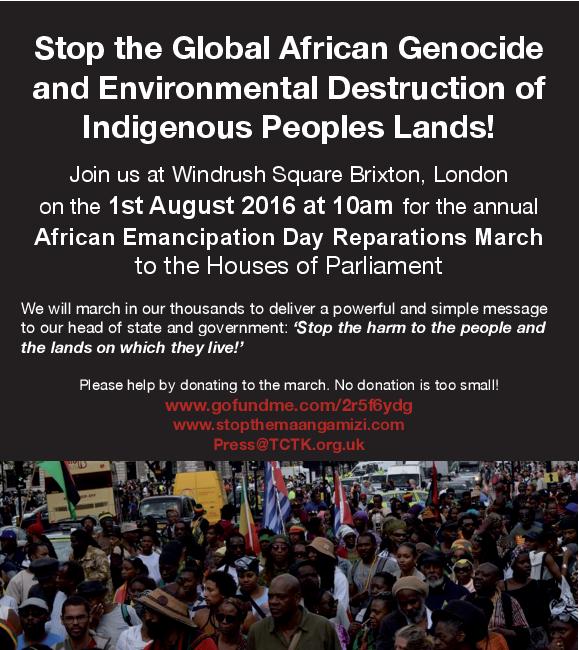
Versions of this advert also appeared in the Voice and Gleaner Newspapers.
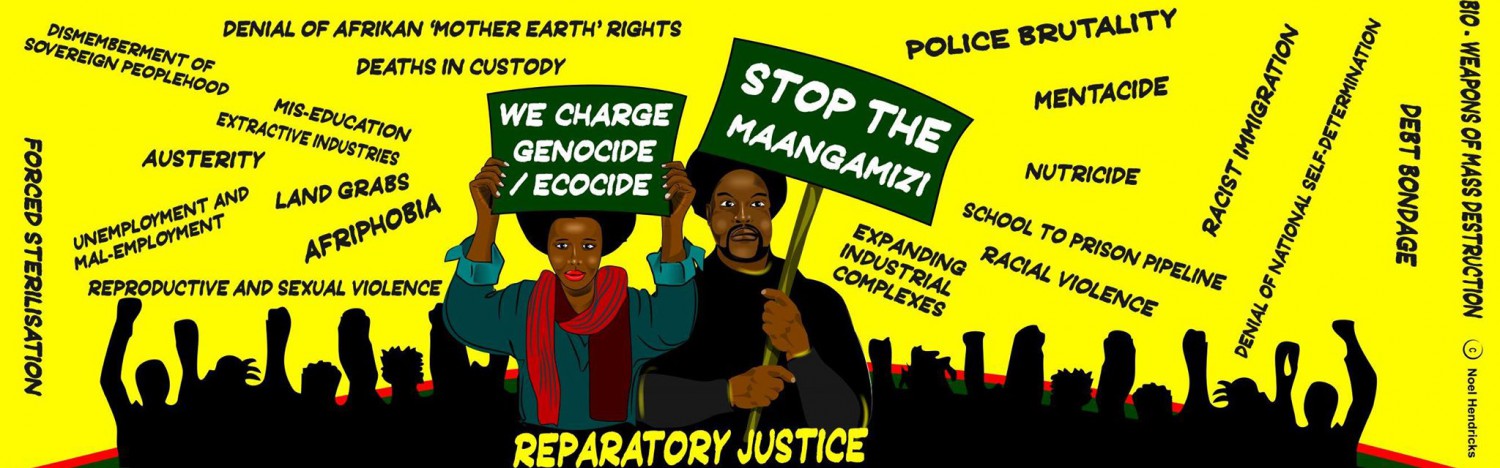
Versions of this advert also appeared in the Voice and Gleaner Newspapers.
Calling all Community Radio Stations!
If you are on Radio and would like to support the 1st August Afrikan Emancipation Day Reparations March, please get your radio station to play some of these promotional jingles click this link.


Afrikan Emancipation Day Reparations March 2015
“To those caught up in only slogan-mongering about the Afrikan Revolution who self-derisively dismiss mass campaigns such as this one of Reparations, refusing to unfold their own blinds to its crucial significance in our Liberation Struggle; we address our paraphrasing of the remark of Amilcar Cabral that, by taking to the revolutionary path of self-determined Struggle for Afrikan Liberation, the masses of our people are not fighting for ideas in anyone’s head; they are fighting for a true National and Social Emancipation that will guarantee them such concrete benefits as will ensure their material and spiritual prosperity! That is why the AASU-E [All-Afrikan Student’s Union in Europe] sees Reparations from the perspective of Afrikan youth as the actual conscientization of the objectives of our whole people’s Liberation Struggle under the banner of revolutionary Pan-Afrikanism. Therefore the Reparations we the youth of Afrika are demanding must restore to all people of Afrikan origin throughout the World full sovereignty, the absolute ownership of the whole of our Homeland, including all its resources, and the Renaissance of Maat and other value of our classical civilisation, in order to give us the concrete basis for independently achieving our own material and spiritual prosperity.“
Antonieta Carla Santana, ‘Our Struggle for Reparations in Afrikan Youth Perspective’: A Draft Paper for Presentation to the 11th December 1993 Birmingham Working Conference of the African Reparations Movement (ARM-UK)
First and Foremost on Strategy & Tactics…
Tactics are forms of collective action publicly deployed, whether in-person or via audio, visual, or written media, in service of a sustained campaign of claims making.
We are not just marching for the sake of marching, the 1st August Afrikan Emancipation Day Reparations March is just one of a number of tactics, in an overall multi-layered strategy to ‘Stop the Maangamizi’ (Afrikan Hellacaust of chattel, colonial and neocolonial enslavement), in order to bring about systemic change and revolutionary social transformation of our condition as Afrikan people, as part of building our people’s power to effect and secure reparatory justice on our own terms.
The Maangamizi will only be stopped by the collective power and might of our people on the continent and the Diaspora of Afrika, by way of completing the Pan-Afrikan Revolution, (with complete steps, too numerous and unnecessary to fully spell out here), which include the social change reparatory justice goals of the International Social Movement for Afrikan Reparations (ISMAR) and the People’s Reparations International Movement (PRIM).
There is much dichotomous thinking and many misconceptions among the general public about what tactics Movement’s should utilise to best meet their objectives. Movements often select from a repertoire of possibilities available to them at any given time and place. Nevertheless, it is often assumed that adopting one tactic, at a particular point, in time precludes a Movement from adopting other tactics at a different time or even simultaneously. Multiple tactics must be undertaken by Movements in order to reach and build support among their intended audiences, the multiple publics they are seeking to influence as well as achieve their desired objectives. Nevertheless, there are different tactics that self-reflective Movements will use depending on the campaign objectives and goals that different forces within such a Movement set out to achieve.
It is important to emphasize that the March is not the whole ISMAR, it is simply an aspect of it, otherwise known as a column within it, i.e. the street column. However, it is also the case that many Movements have characteristically relied on demonstrative or even ‘confrontational’ tactics to advance their cause, and this is still the method of choice for street protest actions. Although Movement activists expend a great deal of energy, time, and resources choosing tactics, all tactics are not designed to have the same outcomes or impact, for the tactical choices of a Movement often embody the Movement’s key demands.
There is a difference for example, between political persuasion (lobbying, voting, petitioning), demonstrative (marches, rallies, vigils, acts of civil disobedience) and economic (boycotts and selective buying) tactics. Boycotts, selective buying, buying-Black, setting up ‘Black’ businesses, group economics, or even cooperative group economics, (which do not take into consideration the reparatory justice political economy of glocal Pan-Afrikan community regeneration and development) alone, will not be sufficient to stop the various manifestations of the Maangamizi that people of Afrikan heritage are being subjected to today. In fact, in some instances our people can get inadvertently caught up in the pursuit of ‘big’ anti-people private business models that promote maldevelopment, genocidal, ecocidal and slavery-like working practices which contribute to prolonging the Maangamizi. Neither is it the case that ‘political persuasion’ or demonstrative tactics such as lobbying, marching and petitioning alone are enough to stop the various manifestation of the Maangamizi. However, each of the aforementioned combination of tactics can contribute to this overall objective of the ISMAR in different ways and all together unify the diversity of forces necessary for ultimate victory!!!
We are approaching what is often referred to as a ‘revolutionary situation’, the crisis of the European Global Order is worsening more than ever before, their state machineries, political parties and other institutions are crumbling from within, their societies are broken, in some cases beyond repair, and the social forces they command are in disarray. This situation presents us as Afrikan people with great opportunity.There is however, a missing link which is the organised, disciplined political might of the Afrikan masses in concert with the masses of Global Black Humanity, which includes the linking up with and sharing of strategy and tactics among Afrikan Heritage communities of reparatory justice interest and resistance in Europe, Abya Yala, (the so-called Americas), Melanasia, Australasia, Oceania and those on the continent of Afrika.
Accordingly, the 1st August Afrikan Emancipation Day Reparations March in partnership with the ‘Stop the Maangamizi: We Charge Genocide/Ecocide (SMWeCGE) campaign is engaging in mass work, mass popular education, action, mobilisation and organisation towards that purpose.


First Nation Brother & Sister from Australia and Fiji – Ghillar Michael Anderson, Convenor of the Sovereign Union of Aboriginal Nations and Peoples in Australia and Head of State of Euahlayi Peoples Republic & Fijian Lawyer, Oni Kirwin representing the Fiji Native Government in Exile, domiciled in Australia
Since the inception of the March in 2014, particularly since the introduction of specific March aims in 2015, this is a summary of what has been achieved:
Afrikans in the UK Developed a Ten-Point Plan in 2003!


According to Professors Adjoa Aiyetoro and Adrienne Davis in their 2010 article ‘Historic and Modern Movements for Reparations: The National Coalition of Blacks for Reparations in America ...”part of the largely untold history of reparations is the struggle not only for reparations itself, but also the struggle between distinct Black classes over strategies for citizenship and the right to envision the racial future”. The ISMAR, just like any other social movement has its contestations, classed, gendered and other internal struggles.
Representative Sample of ISMAR Collective Leadership, Past & Present


To reiterate, the aims of the 1st August Afrikan Emancipation Day Reparations March are:
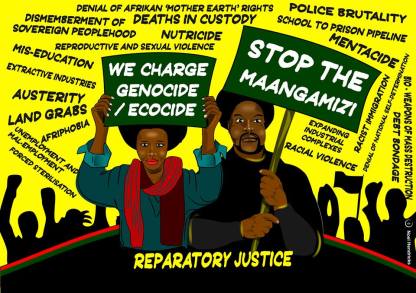
The complimentary aims of the ‘Stop the Maangamizi’ campaign as a positive action step of reparatory justice campaigning are to:
The key point to highlight here is that the aims of the 1st August Afrikan Emancipation Day Peoples Reparations March and the SMWCGE campaign promote social movement-building, which is part of a people power-building process to be able to effect our people’s reparatory justice will.
Social movements are a type of group action. They are large, sometimes informal, groupings of individuals, organisations and other relevant interest groups which focus on specific political or social issues; and who are organised and organising to promote, carry out, resist or undo social, cultural or political change.
Social movement-building is the long-term, coordinated effort of individuals and organized groups of people to intentionally spark and sustain a social movement, it entails:
“the creation of movement infrastructures required for sustained organising and mobilisation, including social relationships, organisational networks and capacity, affective solidarity, as well as movement-related identities, frames, strategies, skills, and leadership.”
Social Movement forces constantly engage with multiple publics, core constituencies in addition to allies and seek to harness people’s collective power to address systemic problems, redress enduring injustice and promote alternative visions or solutions. It follows that reparations which will meaningfully work for ALL of US as Afrikan People, will only be effected and secured as a result of a MASS MOVEMENT that we continue to build. Whilst it is recognised that Movements always use a mixture of tactics, generally have multiple leaders, groups and agendas, ultimately, such reparatory justice will only be effected and secured when we have built and harnessed the POWER to effect our National will and strategic geopolitical interests as people of Afrikan ancestry and heritage.
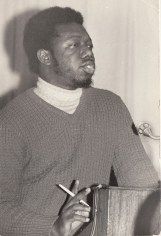
“It will be gross self-delusive wishful thinking to believe that those wielding the reins of White racist supremacy are going to pay any serious heed to the Afrikan demand for Reparations, unless their hold on the machinery of global power is effectively challenged by the well-organised, upsurgent and self-empowering masses of Afrikan people, and their allied progressive forces throughout the World.”
Kofi Mawuli Klu ‘Charting an Afrikan Self-Determined Path of Legal Struggle for Reparations’: A Draft Paper for Presentation to the 11th December 1993 Birmingham Working Conference of the African Reparations Movement, UK, 1993.
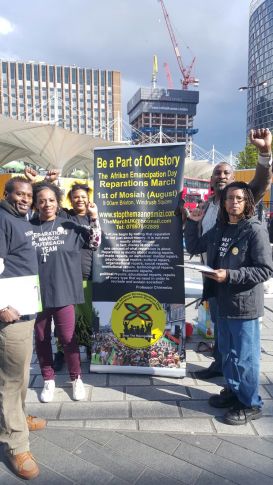


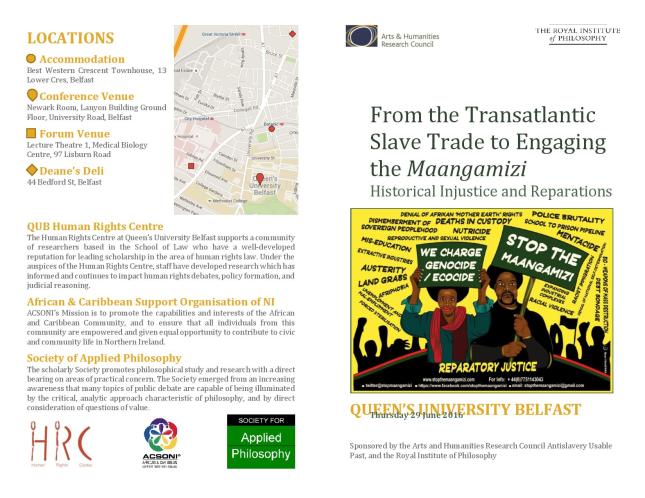
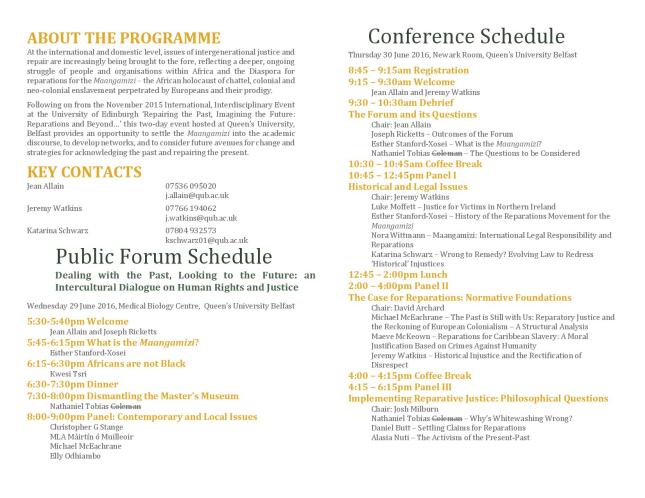
How does the SMWCGE Campaign Enhances the Purposefulness of the March?
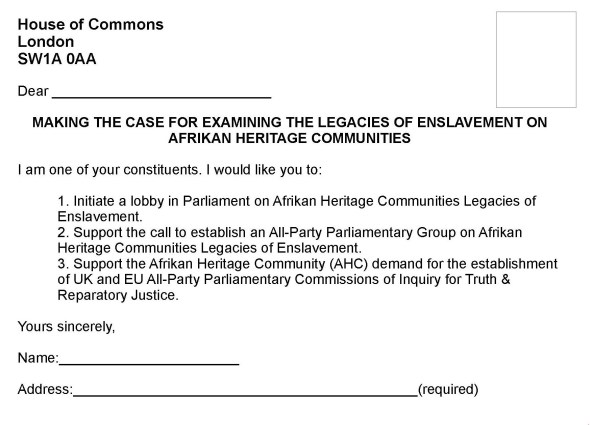
The March is a mass mobilisational and organisational vehicle for delivery of the SMWeCGE petition. Some have likened the petition and its campaign goals of establishing All-Party Parliamentary Commissions of Inquiry for Truth & Reparatory Justice (APPCITRJs) at the levels of the Westminster and European Parliaments, to ‘begging’ those most responsible for causing our Maangamizi, to repair us or that it is futile because the British Establishment will never meet this demand. This is simply not the case. In the SMWeCGE petition, we say :“We affirm” that WE, as members of the Afrikan Heritage Community are charging the British state with acts of Genocide/Ecocide against people of Afrikan heritage, within and beyond the UK. In reality we are affirming this rather than begging the State.
It is our firm view that the demand for such a APPCITRJ is very possible to be realised if we mount our people’s and political pressure at every level. The process of establishing such an APPCITRJ will itself raise awareness on the part of Afrikan people, of our right to holistic reparations and is part of a legal, extra-legal, parliamentary and extra-parliamentary strategy, which enables and supports the development of mass popular legal consciousness-raising about the legitimacy of our Reparations case and the necessity to stop current manifestations of the Maangamizi harms that we continue to suffer. Given that the established legal disorder of unjust law , which has violated Afrikan people’s legal rights for over 500 years, has worked hard to deny the legitimacy of our people’s reparations claims, under the guise that slavery was legalised by Europeans, the assertion by Afrikan people of our right to reparations is fundamental to reparatory justice social change-making. Such social change being necessary to transform the old global order, which denies responsibility for the Maangamizi, as well as the legitimacy of our people’s global case for reparatory justice, and the Post-Reparations World Order, where such Maangamizi denial is criminalised and the consequences of the Maangamizi are redressed and holistically repaired.
This is an aspect of charting an Afrikan self-determined path of legal struggle for reparations (i.e. struggle by use of the law as a form of resistance) which is advocated by Kofi Mawuli Klu, co-founder member of the ‘Stop the Maangamizi’ campaign in his 1993 Paper ‘Charting an Afrikan Self-Determined Path of Legal Struggle for Reparations’. The key components to such a self-determined legal path of struggle include:
In light of the history of Afrikan people’s experience of violence from systems of hegemony imposed by European elites, for the purposes of defending an imperialistic White supremacy racist system of wealth, privilege and power, we are not advocating the unnecessary spilling of our blood and loss of life of our people by taking actions which we are not yet adequately prepared for, as a group within the UK and Europe, i.e. politically, organisationally, militarily or otherwise. Rather, we see the SMWeCGE campaign advocating a process of non-violent direct action, in the first instance, which calls upon the UK Government and the European Parliament to:
“…live up to its declarations of commitment to global respect for universal human rights, good governance and democracy in acknowledging and addressing the social and economic legacies of enslavement on contemporary generations of Afrikans and people of Afrikan heritage. We believe that establishing the All-Party Parliamentary Commission of Inquiry for Truth & Reparatory Justice will go a long way towards institutionalising a reparative truth-seeking process that will contribute to healing and restoring the descendants of the enslaved and facilitating racial justice and equity between the descendants of the enslaved and the enslavers as well as in the wider society. However, such “repair” of the relationship between people of Afrikan heritage and the rest of society cannot take place without public acknowledgement of the crimes against Afrikan people and their descendants over five centuries and counting, and without UK governmental action to enable redress and reparation for the brutal injustices committed in the past which still continues into the present. We call upon the British state to honour the need and right of the descendants of the enslaved to speak in a public forum, provide testimony and evidence of how the legacies of enslavement are resulting in continued human and peoples’ rights violations, impaired quality of life and the ensuing destruction of the essential foundations of life for Afrikan people today.”
The petition will also galvanise grassroots work towards establishing glocal sittings of the Ubunukgotla Peoples International Tribunal for Global Justice (PITGJ) as part of a series of actions which will put a full stop, by way of holistic and transformative reparations, to all acts of Genocide/Ecocide against Afrikan people.
It is important to note that the APPCITRJs, combined with the establishment of glocal sittings of the PITGJ are essential to legitimize other forms of direct action, which will need to be resorted to, if the demands contained within the SMWeCGE campaign are not met by non-violent means.The SMWeCGE campaign therefore acts as an important catalyser to continue the process of Afrikan People’s self-liberation to victory and in the process to take Reparations by our own efforts.
Reparations By Our Own People’s Power
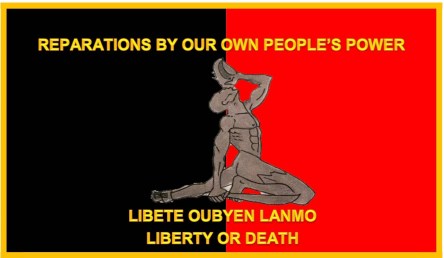
Adapted version of Jean-Jacques Dessalines Original Haitian Flag
Our history shows us that the greatest examples of us effecting and securing reparatory justice is by our own people’s efforts, such as in the case of the Haitian Revolution.
Drawing from and reformulating the notion of reparations enforcement, the SMWeCGE campaign also advocates a form of reparations enforcement. Reparations enforcement is the 21st century reparations activism paradigm. Armed with the various programmes and declarations that have sought to address our people’s condition, wedded to our definition of reparations, we have moved from the position of simply advocating for reparations to that of enforcing our human, people’s and Mother Earth rights to be repaired.
A reparations enforcer is a person, organisation, or state who has an understanding, and acts upon that understanding, that reparations for people of Afrikan heritage is a vital matter of asserting human, peoples and Mother Earth rights.
The reparations enforcer effectively identifies and uses their internal resources to move the injuring parties – governments, corporations, institutions, or individuals – to stop manifestations of the Maangamizi, first and foremost; contribute to building healthy alternatives to the harmful manifestations of the Maangamizi, including such alternatives that will ensure the healing, repair, restoration, nation-building and sovereignty of Afrikan heritage communities.


“Reparations is like freedom, nobody gives you reparations, reparations is something you have to take”
Prophet Kwaku 2014, Co-Chair, Afrikan Emancipation Day Reparations March Committee
With
Sister Jendayi Serwah, Co-Chair of the Afrikan Emancipation Day Reparations March Committee & Co-Vice Chair of the Stop the Maangamizi Campaign Team
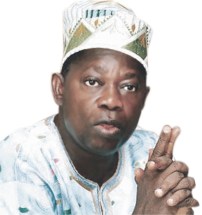
“I believe that there are now two reasons why people have not embraced this cause as their own. One is skepticism, and the other is racism, one doubts whether we can succeed, the other hopes that we do not. I do not have much to say to the racist, the one who wishes to deny us our rights only because of our colour. But I do have a few words for the [person] who though [he/she] wished us well, believes that we have taken on more than we can accomplish. I remind him that Samuel Johnson said that ‘nothing will be attempted if all possible objections must first be overcome.’ And finally, I refer him to James Baldwin, who said, I know that what I am asking is impossible. But in our time, as in every time, the impossible is the least that one can demand. And one is after all emboldened by the spectacle of human history in general, and [Afrikan Diaspora] history in particular, for it testifies to nothing less than the perpetual achievement of the impossible“
(bracketed text changes to reflect contemporary usage of terms).
Bashorun M.K.O Abiola, Extracts from an address on ‘Reparation: Progress Report and Future Prospects’ – delivered in London on 3 May, 1992
Please note, this update has been written by the SMWeCGE Campaign Team although some of the members of the Afrikan Emancipation Day Reparations March Committee are also members of the SMWeCGE Campaign Team. That being said, the SMWeCGE Campaign Team takes full responsibility for the views and information presented expressed above.
12/07/2016
 stopthemaangamizi.com